INTRODUCTION
 The term Mollusca was coined by Aristotle
 The term Mollusca was defined by Cuvier
 Soft bodied animals.
 Second largest phylum
 Malacology- Study of Molluscs
 Conchology- Study of Shells.
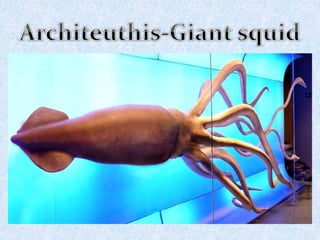
 Architeuthis-largest invertebrate-commonly called as giant squid
 Inhabited all habitats except Air
 Molluscans came into existence in the early cambrian period and
flourished.
GENERAL CHARACTERS:-
 Terrestrial or aquatic( fresh water or Marine water)
 Triploblastic , bilaterally symmetrical, schizocoelomic,
protostomic, unsegmented animals
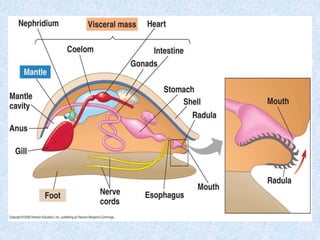
 Body divisible into head, mantle, foot, and visceral mass.
 Shell when present , usually either external or internal or
absent.
 Coelom is reduced and is represented by pericardial cavity,
gonadal cavity, and around kidney.
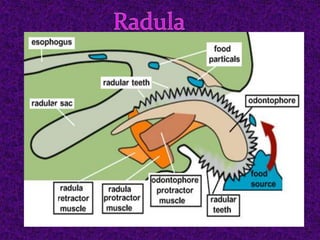
 Digestive system is complete with digestive gland or
liver(hepatopancreas) Radula – a rasping organ ,
usually present.
 Circulatory system is mainly of closed type, heart is
whith two auricles and one ventricle , blood is with
amoebocytes and haemocyanin
 Respiration is direct or by gills or by lungs or both.
 Excretion is by Paired Metanephridia(Kidneys).
Molluscans General characters continued:
Nervous system is of paired ganglia, connectives abd
nerves. Ganglia usually form a circum centric ring.
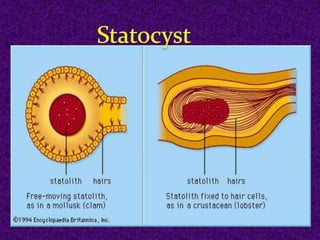
Sense organs include eyes , statocysts(Balancing
organs) and chemo receptors for touch , smell and taste.
Diecious/ Monoecius: One or two gonads with
gonoducts, opening into renal ducts or to exterior.
Fertilisation either external or internal: development
direct or through free larval forms
Mollusca general characters

Mollusca general characters

  • 2.
    INTRODUCTION  The termMollusca was coined by Aristotle  The term Mollusca was defined by Cuvier  Soft bodied animals.  Second largest phylum  Malacology- Study of Molluscs  Conchology- Study of Shells.  Architeuthis-largest invertebrate-commonly called as giant squid  Inhabited all habitats except Air  Molluscans came into existence in the early cambrian period and flourished.
  • 5.
    GENERAL CHARACTERS:-  Terrestrialor aquatic( fresh water or Marine water)  Triploblastic , bilaterally symmetrical, schizocoelomic, protostomic, unsegmented animals  Body divisible into head, mantle, foot, and visceral mass.  Shell when present , usually either external or internal or absent.  Coelom is reduced and is represented by pericardial cavity, gonadal cavity, and around kidney.
  • 6.
     Digestive systemis complete with digestive gland or liver(hepatopancreas) Radula – a rasping organ , usually present.  Circulatory system is mainly of closed type, heart is whith two auricles and one ventricle , blood is with amoebocytes and haemocyanin  Respiration is direct or by gills or by lungs or both.  Excretion is by Paired Metanephridia(Kidneys).
  • 9.
    Molluscans General characterscontinued: Nervous system is of paired ganglia, connectives abd nerves. Ganglia usually form a circum centric ring. Sense organs include eyes , statocysts(Balancing organs) and chemo receptors for touch , smell and taste. Diecious/ Monoecius: One or two gonads with gonoducts, opening into renal ducts or to exterior. Fertilisation either external or internal: development direct or through free larval forms