Kingdom
Animalia
Introduction
 1.2 billion animal species, with great diversity.
 Diversified in habitat, level of organisation, body plan,
symmetry, body cavity, germ layers, mode of
locomotion, physiological processes (respiration,
reproduction, circulation, excretion).
 Number of germ layers
 Animal body pattern
 Body symmetry
 Body cavity
 Body segmentation (metamerism)
 Body support
Criteria for classification
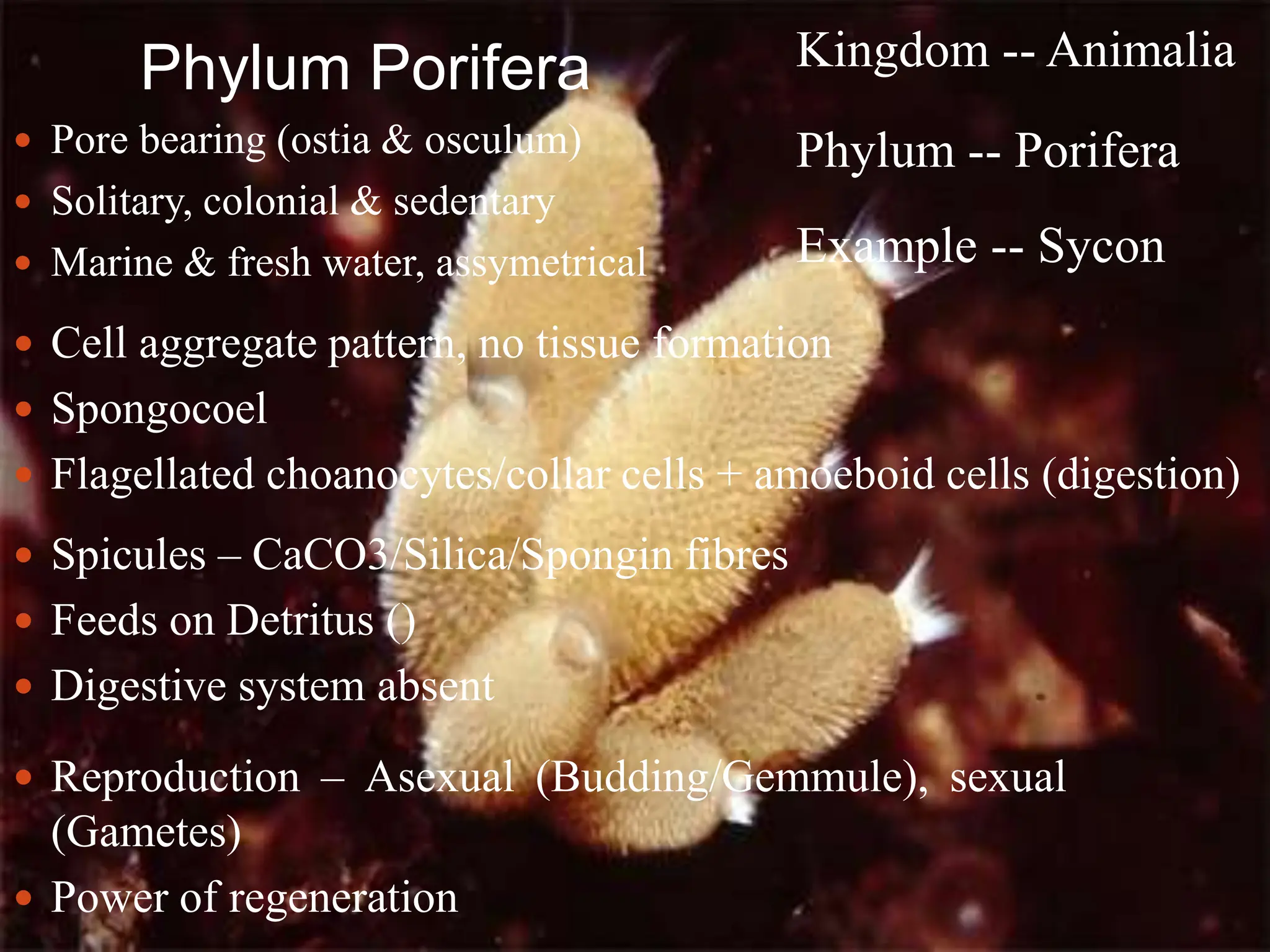
Phylum Porifera
 Pore bearing (ostia & osculum)
 Solitary, colonial & sedentary
 Marine & fresh water, assymetrical
 Cell aggregate pattern, no tissue formation
 Spongocoel
 Flagellated choanocytes/collar cells + amoeboid cells (digestion)
 Spicules – CaCO3/Silica/Spongin fibres
 Feeds on Detritus ()
 Digestive system absent
 Reproduction – Asexual (Budding/Gemmule), sexual
(Gametes)
 Power of regeneration
Kingdom -- Animalia
Phylum -- Porifera
Example -- Sycon
Phylum Coelenterata/Cnidaria
 Solitary/colonial & sedentary
 Marine & fresh water, radial symmetry
 Blind sac pattern , Tissue level organisation
 Coelenteron/gastrovascular cavity, Acoelomates.
 Cnidocytes in tentacles (nematocysts) – offence & defence
 Reproduction – Asexual
(Budding/Gemmule), sexual (Gametes)
 Power of regeneration Kingdom -- Animalia
Phylum -- Cnidaria
Example -- Hydra
• Two forms Polyp (sedentary, cylindrical) & medusa (free
swimming, umbrella shaped)
Kingdom -- Animalia
Phylum -- Platyhelminthes
Example – Liverfluke
Phylum Platyhelminthes
 Flat worms, Body – leaf like/ribbon shaped, ,unsegmented
 Free living/endoparasitic, bilaterally symmetrical
 Dorsoventrally flattenned,cuticularized, hooks &suckers present.
 Blind sac pattern, acoelomate
 Digestive system absent.
 Excretory system – Flame cells/Protonephridia
 Nervous system – nerve ring & nerve cords.
 Reproductive system is well developed (hermaphrodite).
 Locomotory organs, sense organs are absent.
 High power of Regeneration
Phylum Aschelminthes
 Round worms,
 Endoparasitic, cylindrical, bilaterally symmetrical
 Tube within tube pattern, pseudocoelomate.
 Dorsoventrally flattenned,cuticularized, hooks &suckers present.
 Digestive system complete.
 Excretory system – Canals/Protonephridia
 Nervous system – nerve ring & nerves
 Sexual dimorphism – male short narrow – post end shows penial
setae (copulation)
 Female – longer & broader straight posterior end.
Kingdom -- Animalia
Phylum -- Annelida
Example -- Earthworm
Phylum Annelida
 Ring worms,
 Free living /Endoparasitic, cylindrical, bilaterally symmetrical
 Tube within tube pattern, true coelomate.
 Elongated, cylindrical, metameric segmentation.
 Digestive system complete
 Locomotion – setae, parapodia/suckers
 Respiration – body surface, Respiratory pigment – heamoglobin
 Excretion – nephridia,
 Circulatory system closed type
 Nervous system – nerve ring & ganglionated
 Hermaphrodite, few unisexual.
 Ectoparasites (leech) – sanguivorous (blood sucking)
 Anticoagulant – hirudin.
Kingdom -- Animalia
Phylum -- Arthropoda
Example -- Prawn
Phylum Arthropoda
 Solitary, colonial (Barnacles are sedentary), Omnipresent.
 Free living /Endoparasitic -- sanguivorous, cylindrical, bilaterally
symmetrical.
 Chitinous exoskeleton (ecdysis/moulting)
 Body divisible into head, thorax
& abdomen. (in some cephalothorax)
 Tube within tube pattern, true coelomate.
 Metameric segmentation
 Feeds on detritus, flesh
 Digestive system is complete, mouth
parts – sucking/biting/chewing.
 Legs for crawling, creeping, walking,
wings for flying
 Circulatory system -- open type (blood flows
through open sinuses & bathes the organs)
 Respiratoy organs – gills/trachea/book lungs/book
gills
 Excretion -- green glands/malphighian tubules.
 Nervous system – nerve ring, double ventral
ganglionated nerve cord
 Sense organs – antennae, compound eyes, taste
receptors
 Sexual dimorphism, oviparous (except
scorpion), fertilization internal, honey bees
(parthenogenesis)
 Few are economically important
(honey bees, silk worm, lobster, prawn)
 Few are harmful eg. mosquito/centipede
/crab/spider/cockroach act as vectors.
 Soft bodied animals
 Free living/sedentary, marine (benthoic, pelagic), marshy places.
 Tube within tube pattern,
 Bilateral symmetry, assymetrical (torsion i.e. twisting)
 Body divisible – head, foot & visceral mass – enclosed by mantle
(muscular fold).
Phylum Mollusca
 Mantle secretes shell – external/internal or absent.
 Feed on plants & animals
 Locomotion – arms/foot (creeping, burrowing & swimming)
 Digestive system well developed, due to torsion intestine bends
takes “U” shaped curve.
 Mouth & Anus lie close, buccal cavity shows radula provided
with transverse rows of teeth.
 Respiration -- Aquatic forms -- gills called ctenidia. Terrestrial –
lungs
 Circulatory system -- open (except sepia), blood contains
haemocyanin (blue coloured with Cu).
 Excretion – Kidney (organ of bojanus).
 Nervous system – 3 pairs of ganglia (head, pedal & visceral)
,connected by commissures & connectives.
 Sense organs – eyes, tentacles, osphradia (purity of water).
 Sexes are separate, oviparous, development is direct/indirect.
Kingdom -- Animalia
Phylum -- Mollusca
Example -- Snail
Kingdom -- Animalia
Phylum -- Echinodermata
Example -- Starfish
 Spiny skinned animals
 Solitary, Free living/sedentary, exclusively marine (gregarious,
benthoic),.
 Tube within tube pattern,
 Radial symmetry pentamerous
 Body – spherical/elongated, without well defined head.
 Exoskeleton – spiny, calcareous plates or ossicles.
 Characteristic feature -- Water vascular system (madreporite)
used for locomotion.
 Feeding – carnivorous,
Phylum Echinodermata
 locomotion – arms & tubefeet
 Respiration – peristomial gills, papillae.
 Circulatory system – reduced, open type , heart absent.
 Nervous system – ring around mouth & radial nerves in
arms.
 Sexes are separate(sometimes bisexual)
 Fertilisation – External, development is indirect
 High power of regeneration.
Kingdom -- Animalia
Phylum -- Echinodermata
Example -- Starfish
 Acorn worms
 Free living, few sedentary, Exclusively marine(bottom of sea in
burrows)
 Body is soft, fragile, vermiform, unsegmented & divided into probocis,
collar & trunk.
 Buccal cavity – diverticulum – rod shaped
 Feed on microbes by ciliary action.
 Alimentary canal is complete, straight/’U’ shaped.
 Respiration – paired gills arranged in longitudinal rows in trunk.
 Gills open by gill slits.
 Circulatory system – simple & closed, blood is colourless.
 Nervous tissue is embedded in dorsal & ventral sides.
 Sexes are separate (few bisexual) fertilisation – external, development
– indirect (free swimming larva).
 Connecting link – non-chordates & chordates
Phylum Hemichordata
Phylum -- Chordata
Subphylum --Invertebrate
Chordate
Subphylum -
-
Vertebrata
Cephalochordat
a
Urochordata
Division Gnathostomata
Class
-
Super Class -
Pisces
Tetrapoda
Class -
Chondrichthyes
Osteichthye
s
Class
Mammalia
Aves
Reptili
Agnatha
Cyclostomat
a
Amphibia
 Cartilagenous notochord (at least in the embryonic stage)
 Gill slits – neck region
 Hollow dorsal nerve cord.
 Invertebrate Chordates - link between invertebrates & chordates
 Invertebrate chordate -- Urochordata, Cephalochordata.
 Chordata includes Urochordata, Cephalochordata &
Vertebrata.
Salient Features of Chordata
 Eg Botryllus, Herdmania, Dololium
 Exclusively marine, pharynx – gill slits
 Also called as TUNICATES
 Body is soft covered by test (tunicine).
 Notochord – only in larval tail, lost during metamorphosis
Salient Features of Urochordata
 Eg Amphioxus
 Fish like animals rarely exceed 5 cms
 Also called as LANCEOLATES
 Partly buried in soft marine sediments
 Notochord – throughout the length & life.
 Show chordate characters – pharyngeal gill slits, tail & dorsal
nerve cord.
Salient Features of Cephalochordata
Phylum -- Chordata
Subphylum --Invertebrate
Chordate
Subphylum -
-
Vertebrata
Cephalochordat
a
Urochordata
Division Gnathostomata
Class
-
Super Class -
Pisces
Tetrapoda
Class -
Chondrichthyes
Osteichthye
s
Class
Mammalia
Aves
Reptili
Agnatha
Cyclostomat
a
Amphibia
SUB PHYLUM
VERTEBRATA
Super Class
Pisces
Aquatic, poikilothermic.
Locomotion – muscles & fins, Caudal fins -- steering
Exoskeleton – dermal scales, endoskeleton –
cartilagenous/bony
Body – streamlined & boat shaped
Mouth – terminal/ventral, Respiration -- gills
Circulation – single & closed, blood is red (RBC’s)
Heart – 2 chambered, ventral
Brain – well developed, large olfactory lobes
Sexes are separate, mostly oviparous, few
viviparous
Class
Chondrichthyes
Cartilagenous endoskeleton – placoid scales
Exclusively marine
2dorsal fins, claspers are present
Mouth – ventral
Tail fin unequal heterocercal
5 to 7 pairs of gill slits,not covered by operculum
Fertilisation – internal, viviparous.
Class
Osteichthyes
Bony endoskeleton – cycloid/ctenoid scales
Aquatic – fresh & marine
Single dorsal fin, claspers absent
Mouth – terminal
Tail fin has equal lobes -- homocercal
4pairs of gill slits covered by operculum
Fertilisation – external, oviparous.
Class Amphibia
Lives on land & water(fresh)
Carnivorous, poikilothermic, differentiated into head,
trunk & tail, neck is absent. (in some adults tail is absent.)
Webs are digited (swim), Skin - moist, glandular
(mucous)
Two pairs of limbs from girdles (pelvic & pectoral)
Intestine & digestive glands – well developed
Prominent ear drums/tympanic membranes -- lateral
Circulatory system – closed, heart – 3 chambered &
ventral, RBC’s are biconvex, nucleated
Respiration – skin/lungs & bucco-pharynx
Nervous system – well developed
Sexual dimorphism, oviparous, fertilisation is
external, &metamorphosis
Class Reptilia
First true terrestrial vertebrates
Aquatic, semiaquatic, marshy areas, carnivorous
Locomotion – pentadactyle digits & clawslimbs
Skin is dry, non glandular covered by
scales/scutes/plates
Snakes – limbless, crawl on belly, poikilothermic
Ear drums depressed
Circulatory system – closed, heart – ventral, 2
complete auricles & ventricles incompletely
partitioned
Respiration – lungs, olfactory lobes & cerebellum
better developed.
Sexes are separate, fertilisation – internal,
oviparous,lay shelled eggs & show parental care
Class Aves
Aerial mode of life, forelimbs are modified into wings
Hind limbs – walking & running
Body is differentiated into head, neck, trunk & tail.
Exoskeleton – feathers, scales are on hind limbs.
Body is streamlined, homeotherms
Skin is dry, non glandular, bones are hollow
pneumatic
Jaws are modified into beak, teeth absent, crop &
gizzard are present.
Blood is red, RBC’s – biconvex & nucleated, heart is
ventral, perfectly four chambered, double
circulation.
Respiration – lungs, air sacs – increase buoyancy
Brain – well developed cerebellum --- equilibrium
Class Aves
Sexes are separate, sexual dimorphism --
prominent
Oviparous, shelled eggs with yolk & albumin
Fertilisation -- internal
Urinary bladder -- absent
Parental care, seasonal migration is common
Only left ovary & oviduct, reduces body weight.
Class Mammalia
Mammary glands – characteristic feature
Terrestrial, aquatic, arboreal, aerial, mostly
herbivorous, few are carnivores, some are
omnivores
Body differentiated into head, neck, trunk & tail
Locomotion -- Limbs
Exoskeleton – hair, fur, nails, hooves
Skin – glandular, sweat & sebaceous (oil)
Body cavity – diaphragm thorax & abdomen
Presence of external ear/Pinnae
Heterodont teeth, double circulation, RBC’s
biconcave & anucleated, blood is red, ventral heart,
four chambered
Class Mammalia
Respiration – Lungs, brain well developed,
cerebrum -- corpus callosum.
Optic lobes better developed than olfactory lobes
Few are oviparous, some have pouches for
development of young ones (marsupials).
Majority are placental & viviparous.

Chapter_4_Kingdom_Animalia.pptx

  • 1.
  • 2.
    Introduction  1.2 billionanimal species, with great diversity.  Diversified in habitat, level of organisation, body plan, symmetry, body cavity, germ layers, mode of locomotion, physiological processes (respiration, reproduction, circulation, excretion).  Number of germ layers  Animal body pattern  Body symmetry  Body cavity  Body segmentation (metamerism)  Body support Criteria for classification
  • 3.
    Phylum Porifera  Porebearing (ostia & osculum)  Solitary, colonial & sedentary  Marine & fresh water, assymetrical  Cell aggregate pattern, no tissue formation  Spongocoel  Flagellated choanocytes/collar cells + amoeboid cells (digestion)  Spicules – CaCO3/Silica/Spongin fibres  Feeds on Detritus ()  Digestive system absent  Reproduction – Asexual (Budding/Gemmule), sexual (Gametes)  Power of regeneration Kingdom -- Animalia Phylum -- Porifera Example -- Sycon
  • 4.
    Phylum Coelenterata/Cnidaria  Solitary/colonial& sedentary  Marine & fresh water, radial symmetry  Blind sac pattern , Tissue level organisation  Coelenteron/gastrovascular cavity, Acoelomates.  Cnidocytes in tentacles (nematocysts) – offence & defence  Reproduction – Asexual (Budding/Gemmule), sexual (Gametes)  Power of regeneration Kingdom -- Animalia Phylum -- Cnidaria Example -- Hydra • Two forms Polyp (sedentary, cylindrical) & medusa (free swimming, umbrella shaped)
  • 5.
    Kingdom -- Animalia Phylum-- Platyhelminthes Example – Liverfluke Phylum Platyhelminthes  Flat worms, Body – leaf like/ribbon shaped, ,unsegmented  Free living/endoparasitic, bilaterally symmetrical  Dorsoventrally flattenned,cuticularized, hooks &suckers present.  Blind sac pattern, acoelomate  Digestive system absent.  Excretory system – Flame cells/Protonephridia  Nervous system – nerve ring & nerve cords.  Reproductive system is well developed (hermaphrodite).  Locomotory organs, sense organs are absent.  High power of Regeneration
  • 6.
    Phylum Aschelminthes  Roundworms,  Endoparasitic, cylindrical, bilaterally symmetrical  Tube within tube pattern, pseudocoelomate.  Dorsoventrally flattenned,cuticularized, hooks &suckers present.  Digestive system complete.  Excretory system – Canals/Protonephridia  Nervous system – nerve ring & nerves  Sexual dimorphism – male short narrow – post end shows penial setae (copulation)  Female – longer & broader straight posterior end.
  • 7.
    Kingdom -- Animalia Phylum-- Annelida Example -- Earthworm Phylum Annelida  Ring worms,  Free living /Endoparasitic, cylindrical, bilaterally symmetrical  Tube within tube pattern, true coelomate.  Elongated, cylindrical, metameric segmentation.  Digestive system complete  Locomotion – setae, parapodia/suckers  Respiration – body surface, Respiratory pigment – heamoglobin  Excretion – nephridia,  Circulatory system closed type  Nervous system – nerve ring & ganglionated  Hermaphrodite, few unisexual.  Ectoparasites (leech) – sanguivorous (blood sucking)  Anticoagulant – hirudin.
  • 8.
    Kingdom -- Animalia Phylum-- Arthropoda Example -- Prawn Phylum Arthropoda  Solitary, colonial (Barnacles are sedentary), Omnipresent.  Free living /Endoparasitic -- sanguivorous, cylindrical, bilaterally symmetrical.  Chitinous exoskeleton (ecdysis/moulting)  Body divisible into head, thorax & abdomen. (in some cephalothorax)  Tube within tube pattern, true coelomate.  Metameric segmentation  Feeds on detritus, flesh  Digestive system is complete, mouth parts – sucking/biting/chewing.  Legs for crawling, creeping, walking, wings for flying
  • 9.
     Circulatory system-- open type (blood flows through open sinuses & bathes the organs)  Respiratoy organs – gills/trachea/book lungs/book gills  Excretion -- green glands/malphighian tubules.  Nervous system – nerve ring, double ventral ganglionated nerve cord  Sense organs – antennae, compound eyes, taste receptors  Sexual dimorphism, oviparous (except scorpion), fertilization internal, honey bees (parthenogenesis)  Few are economically important (honey bees, silk worm, lobster, prawn)  Few are harmful eg. mosquito/centipede /crab/spider/cockroach act as vectors.
  • 10.
     Soft bodiedanimals  Free living/sedentary, marine (benthoic, pelagic), marshy places.  Tube within tube pattern,  Bilateral symmetry, assymetrical (torsion i.e. twisting)  Body divisible – head, foot & visceral mass – enclosed by mantle (muscular fold). Phylum Mollusca  Mantle secretes shell – external/internal or absent.  Feed on plants & animals  Locomotion – arms/foot (creeping, burrowing & swimming)  Digestive system well developed, due to torsion intestine bends takes “U” shaped curve.  Mouth & Anus lie close, buccal cavity shows radula provided with transverse rows of teeth.
  • 11.
     Respiration --Aquatic forms -- gills called ctenidia. Terrestrial – lungs  Circulatory system -- open (except sepia), blood contains haemocyanin (blue coloured with Cu).  Excretion – Kidney (organ of bojanus).  Nervous system – 3 pairs of ganglia (head, pedal & visceral) ,connected by commissures & connectives.  Sense organs – eyes, tentacles, osphradia (purity of water).  Sexes are separate, oviparous, development is direct/indirect. Kingdom -- Animalia Phylum -- Mollusca Example -- Snail
  • 12.
    Kingdom -- Animalia Phylum-- Echinodermata Example -- Starfish  Spiny skinned animals  Solitary, Free living/sedentary, exclusively marine (gregarious, benthoic),.  Tube within tube pattern,  Radial symmetry pentamerous  Body – spherical/elongated, without well defined head.  Exoskeleton – spiny, calcareous plates or ossicles.  Characteristic feature -- Water vascular system (madreporite) used for locomotion.  Feeding – carnivorous, Phylum Echinodermata
  • 13.
     locomotion –arms & tubefeet  Respiration – peristomial gills, papillae.  Circulatory system – reduced, open type , heart absent.  Nervous system – ring around mouth & radial nerves in arms.  Sexes are separate(sometimes bisexual)  Fertilisation – External, development is indirect  High power of regeneration. Kingdom -- Animalia Phylum -- Echinodermata Example -- Starfish
  • 14.
     Acorn worms Free living, few sedentary, Exclusively marine(bottom of sea in burrows)  Body is soft, fragile, vermiform, unsegmented & divided into probocis, collar & trunk.  Buccal cavity – diverticulum – rod shaped  Feed on microbes by ciliary action.  Alimentary canal is complete, straight/’U’ shaped.  Respiration – paired gills arranged in longitudinal rows in trunk.  Gills open by gill slits.  Circulatory system – simple & closed, blood is colourless.  Nervous tissue is embedded in dorsal & ventral sides.  Sexes are separate (few bisexual) fertilisation – external, development – indirect (free swimming larva).  Connecting link – non-chordates & chordates Phylum Hemichordata
  • 15.
    Phylum -- Chordata Subphylum--Invertebrate Chordate Subphylum - - Vertebrata Cephalochordat a Urochordata Division Gnathostomata Class - Super Class - Pisces Tetrapoda Class - Chondrichthyes Osteichthye s Class Mammalia Aves Reptili Agnatha Cyclostomat a Amphibia
  • 16.
     Cartilagenous notochord(at least in the embryonic stage)  Gill slits – neck region  Hollow dorsal nerve cord.  Invertebrate Chordates - link between invertebrates & chordates  Invertebrate chordate -- Urochordata, Cephalochordata.  Chordata includes Urochordata, Cephalochordata & Vertebrata. Salient Features of Chordata
  • 17.
     Eg Botryllus,Herdmania, Dololium  Exclusively marine, pharynx – gill slits  Also called as TUNICATES  Body is soft covered by test (tunicine).  Notochord – only in larval tail, lost during metamorphosis Salient Features of Urochordata
  • 18.
     Eg Amphioxus Fish like animals rarely exceed 5 cms  Also called as LANCEOLATES  Partly buried in soft marine sediments  Notochord – throughout the length & life.  Show chordate characters – pharyngeal gill slits, tail & dorsal nerve cord. Salient Features of Cephalochordata
  • 19.
    Phylum -- Chordata Subphylum--Invertebrate Chordate Subphylum - - Vertebrata Cephalochordat a Urochordata Division Gnathostomata Class - Super Class - Pisces Tetrapoda Class - Chondrichthyes Osteichthye s Class Mammalia Aves Reptili Agnatha Cyclostomat a Amphibia
  • 20.
  • 21.
    Super Class Pisces Aquatic, poikilothermic. Locomotion– muscles & fins, Caudal fins -- steering Exoskeleton – dermal scales, endoskeleton – cartilagenous/bony Body – streamlined & boat shaped Mouth – terminal/ventral, Respiration -- gills Circulation – single & closed, blood is red (RBC’s) Heart – 2 chambered, ventral Brain – well developed, large olfactory lobes Sexes are separate, mostly oviparous, few viviparous
  • 22.
    Class Chondrichthyes Cartilagenous endoskeleton –placoid scales Exclusively marine 2dorsal fins, claspers are present Mouth – ventral Tail fin unequal heterocercal 5 to 7 pairs of gill slits,not covered by operculum Fertilisation – internal, viviparous.
  • 23.
    Class Osteichthyes Bony endoskeleton –cycloid/ctenoid scales Aquatic – fresh & marine Single dorsal fin, claspers absent Mouth – terminal Tail fin has equal lobes -- homocercal 4pairs of gill slits covered by operculum Fertilisation – external, oviparous.
  • 24.
    Class Amphibia Lives onland & water(fresh) Carnivorous, poikilothermic, differentiated into head, trunk & tail, neck is absent. (in some adults tail is absent.) Webs are digited (swim), Skin - moist, glandular (mucous) Two pairs of limbs from girdles (pelvic & pectoral) Intestine & digestive glands – well developed Prominent ear drums/tympanic membranes -- lateral Circulatory system – closed, heart – 3 chambered & ventral, RBC’s are biconvex, nucleated Respiration – skin/lungs & bucco-pharynx Nervous system – well developed Sexual dimorphism, oviparous, fertilisation is external, &metamorphosis
  • 25.
    Class Reptilia First trueterrestrial vertebrates Aquatic, semiaquatic, marshy areas, carnivorous Locomotion – pentadactyle digits & clawslimbs Skin is dry, non glandular covered by scales/scutes/plates Snakes – limbless, crawl on belly, poikilothermic Ear drums depressed Circulatory system – closed, heart – ventral, 2 complete auricles & ventricles incompletely partitioned Respiration – lungs, olfactory lobes & cerebellum better developed. Sexes are separate, fertilisation – internal, oviparous,lay shelled eggs & show parental care
  • 26.
    Class Aves Aerial modeof life, forelimbs are modified into wings Hind limbs – walking & running Body is differentiated into head, neck, trunk & tail. Exoskeleton – feathers, scales are on hind limbs. Body is streamlined, homeotherms Skin is dry, non glandular, bones are hollow pneumatic Jaws are modified into beak, teeth absent, crop & gizzard are present. Blood is red, RBC’s – biconvex & nucleated, heart is ventral, perfectly four chambered, double circulation. Respiration – lungs, air sacs – increase buoyancy Brain – well developed cerebellum --- equilibrium
  • 27.
    Class Aves Sexes areseparate, sexual dimorphism -- prominent Oviparous, shelled eggs with yolk & albumin Fertilisation -- internal Urinary bladder -- absent Parental care, seasonal migration is common Only left ovary & oviduct, reduces body weight.
  • 28.
    Class Mammalia Mammary glands– characteristic feature Terrestrial, aquatic, arboreal, aerial, mostly herbivorous, few are carnivores, some are omnivores Body differentiated into head, neck, trunk & tail Locomotion -- Limbs Exoskeleton – hair, fur, nails, hooves Skin – glandular, sweat & sebaceous (oil) Body cavity – diaphragm thorax & abdomen Presence of external ear/Pinnae Heterodont teeth, double circulation, RBC’s biconcave & anucleated, blood is red, ventral heart, four chambered
  • 29.
    Class Mammalia Respiration –Lungs, brain well developed, cerebrum -- corpus callosum. Optic lobes better developed than olfactory lobes Few are oviparous, some have pouches for development of young ones (marsupials). Majority are placental & viviparous.