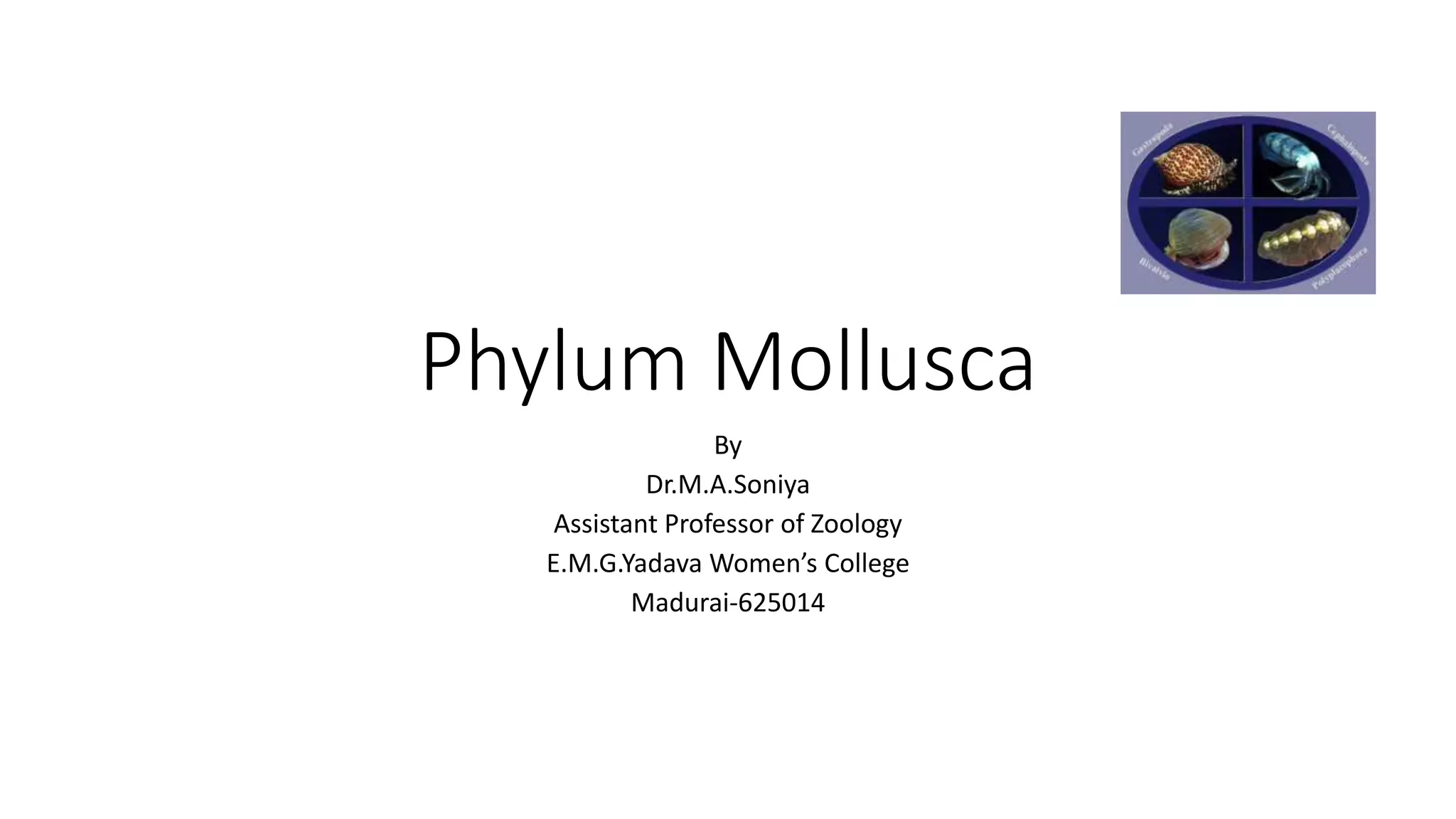
Phylum Mollusca
By
Dr.M.A.Soniya
Assistant Professor of Zoology
E.M.G.Yadava Women’s College
Madurai-625014
 The animals belonging to the phylum Mollusca have soft-bodies, triploblastic and bilaterally symmetrical and
coelomate.
 The study of Mollusca is called Malacology. They are sluggish invertebrates, with a thin fleshy envelope or mantle
covering the visceral organs.
 The term Mollusca was derived from the term given by Aristotle to cuttlefish. Mollusc means soft.
 These organisms are found in the terrestrial as well as in deep seas. Their size ranges from microscopic organisms
to organisms 20 metres long.
 They play a very important role in the lives of humans. They are a source of jewellery as well as food. Natural pearls
are formed within these molluscs.
 The bivalve molluscs are used as bioindicators in the marine and freshwater environments. But few of them such as
snails and slugs are pests.
A few examples of the animals belonging to phylum Mollusca:
Pila (Apple snail) Limax (Slug) Unio (Freshwater mussel) Turbinella (Shankha) Helix (Garden snail)
Octopus (Devilfish) Loligo (Squid)
Characteristics of Phylum Mollusca
They exhibit organ system level of organization.
Their body has a cavity.
The body is divided into head, visceral mass, muscular foot and
mantle.
The head comprises of tentacles and compound eyes.
The body is covered by a calcareous shell.
The muscular foot helps in locomotion.
They are mostly found in marine and freshwater. Very few are
terrestrial and found in moist soil.
• They have a well-developed digestive system, the radula is the rasping organ for feeding.
• Respiration in Mollusca occurs through the general body surface, gills or pulmonary sac.
• The blood circulates through the open circulatory system.
• They have a pair of metanephridia that helps in excretion.
• The nervous system in Mollusca consists of number of paired ganglia and nerves.
• The tentacles, eyes, osphradium, and statocysts act as the sensory organs.
• The sexes are separate in most of the molluscs but some species are
hermaphrodites. Fertilization may be external or internal.
• They are generally oviparous with indirect development.
Classification of Mollusca
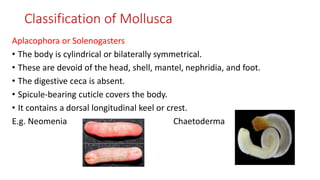
Aplacophora or Solenogasters
• The body is cylindrical or bilaterally symmetrical.
• These are devoid of the head, shell, mantel, nephridia, and foot.
• The digestive ceca is absent.
• Spicule-bearing cuticle covers the body.
• It contains a dorsal longitudinal keel or crest.
E.g. Neomenia Chaetoderma
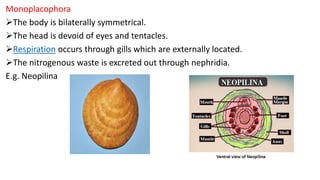
Monoplacophora
The body is bilaterally symmetrical.
The head is devoid of eyes and tentacles.
Respiration occurs through gills which are externally located.
The nitrogenous waste is excreted out through nephridia.
E.g. Neopilina
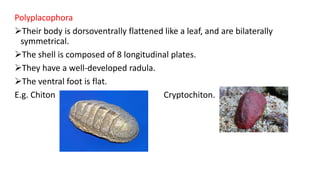
Polyplacophora
Their body is dorsoventrally flattened like a leaf, and are bilaterally
symmetrical.
The shell is composed of 8 longitudinal plates.
They have a well-developed radula.
The ventral foot is flat.
E.g. Chiton Cryptochiton.
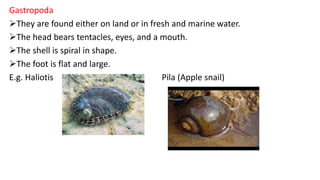
Gastropoda
They are found either on land or in fresh and marine water.
The head bears tentacles, eyes, and a mouth.
The shell is spiral in shape.
The foot is flat and large.
E.g. Haliotis Pila (Apple snail)
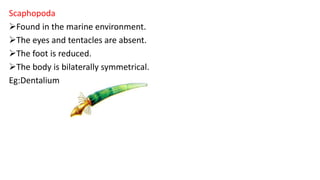
Scaphopoda
Found in the marine environment.
The eyes and tentacles are absent.
The foot is reduced.
The body is bilaterally symmetrical.
Eg:Dentalium
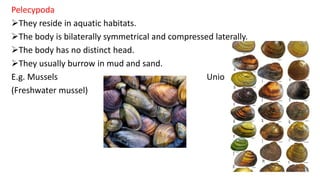
Pelecypoda
They reside in aquatic habitats.
The body is bilaterally symmetrical and compressed laterally.
The body has no distinct head.
They usually burrow in mud and sand.
E.g. Mussels Unio
(Freshwater mussel)
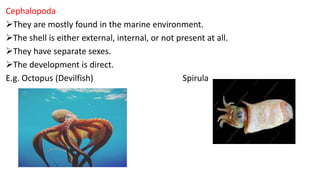
Cephalopoda
They are mostly found in the marine environment.
The shell is either external, internal, or not present at all.
They have separate sexes.
The development is direct.
E.g. Octopus (Devilfish) Spirula

Mollusca.pptx

  • 1.
    Phylum Mollusca By Dr.M.A.Soniya Assistant Professorof Zoology E.M.G.Yadava Women’s College Madurai-625014
  • 2.
     The animalsbelonging to the phylum Mollusca have soft-bodies, triploblastic and bilaterally symmetrical and coelomate.  The study of Mollusca is called Malacology. They are sluggish invertebrates, with a thin fleshy envelope or mantle covering the visceral organs.  The term Mollusca was derived from the term given by Aristotle to cuttlefish. Mollusc means soft.  These organisms are found in the terrestrial as well as in deep seas. Their size ranges from microscopic organisms to organisms 20 metres long.  They play a very important role in the lives of humans. They are a source of jewellery as well as food. Natural pearls are formed within these molluscs.  The bivalve molluscs are used as bioindicators in the marine and freshwater environments. But few of them such as snails and slugs are pests. A few examples of the animals belonging to phylum Mollusca: Pila (Apple snail) Limax (Slug) Unio (Freshwater mussel) Turbinella (Shankha) Helix (Garden snail) Octopus (Devilfish) Loligo (Squid)
  • 3.
    Characteristics of PhylumMollusca They exhibit organ system level of organization. Their body has a cavity. The body is divided into head, visceral mass, muscular foot and mantle. The head comprises of tentacles and compound eyes. The body is covered by a calcareous shell. The muscular foot helps in locomotion. They are mostly found in marine and freshwater. Very few are terrestrial and found in moist soil.
  • 4.
    • They havea well-developed digestive system, the radula is the rasping organ for feeding. • Respiration in Mollusca occurs through the general body surface, gills or pulmonary sac. • The blood circulates through the open circulatory system. • They have a pair of metanephridia that helps in excretion. • The nervous system in Mollusca consists of number of paired ganglia and nerves. • The tentacles, eyes, osphradium, and statocysts act as the sensory organs. • The sexes are separate in most of the molluscs but some species are hermaphrodites. Fertilization may be external or internal. • They are generally oviparous with indirect development.
  • 5.
    Classification of Mollusca Aplacophoraor Solenogasters • The body is cylindrical or bilaterally symmetrical. • These are devoid of the head, shell, mantel, nephridia, and foot. • The digestive ceca is absent. • Spicule-bearing cuticle covers the body. • It contains a dorsal longitudinal keel or crest. E.g. Neomenia Chaetoderma
  • 6.
    Monoplacophora The body isbilaterally symmetrical. The head is devoid of eyes and tentacles. Respiration occurs through gills which are externally located. The nitrogenous waste is excreted out through nephridia. E.g. Neopilina
  • 7.
    Polyplacophora Their body isdorsoventrally flattened like a leaf, and are bilaterally symmetrical. The shell is composed of 8 longitudinal plates. They have a well-developed radula. The ventral foot is flat. E.g. Chiton Cryptochiton.
  • 8.
    Gastropoda They are foundeither on land or in fresh and marine water. The head bears tentacles, eyes, and a mouth. The shell is spiral in shape. The foot is flat and large. E.g. Haliotis Pila (Apple snail)
  • 9.
    Scaphopoda Found in themarine environment. The eyes and tentacles are absent. The foot is reduced. The body is bilaterally symmetrical. Eg:Dentalium
  • 10.
    Pelecypoda They reside inaquatic habitats. The body is bilaterally symmetrical and compressed laterally. The body has no distinct head. They usually burrow in mud and sand. E.g. Mussels Unio (Freshwater mussel)
  • 11.
    Cephalopoda They are mostlyfound in the marine environment. The shell is either external, internal, or not present at all. They have separate sexes. The development is direct. E.g. Octopus (Devilfish) Spirula