Stella Maris Polytechnic University
Mother Patern College Of Health Science
Group One Members:
1. Chrisphine M. Mendimasa 11350
2. Elvis K. Goodridge 11269
3. B.k Adjaenehn Nyenpan 11306
4. Amosrine Young 11182
5. Yamah Paypay
11183
6. CourageGbolo
11253
7. Elaine P. Boakai
11258
8. Abraham S. Saysay 11064
General Zoology I (Zoo 201)
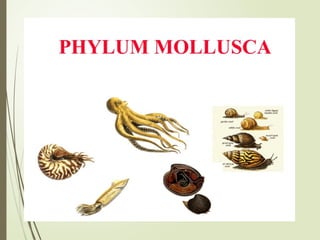
Presented to: Paul Zawolo Seamehn Phylum Mollusca
Phylum Nemertea
Objectives
By the end of this lecture session, students will be able to know:
• The phyla Nemertea and Mollusca
•Their Characteristics
•Classification
•Their distinguishing features
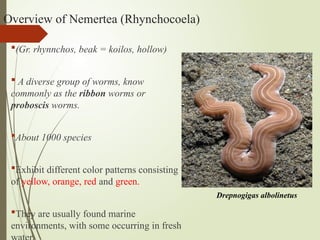
Overview of Nemertea (Rhynchocoela)
(Gr. rhynnchos, beak = koilos, hollow)
 A diverse group of worms, know
commonly as the ribbon worms or
proboscis worms.
About 1000 species
Exhibit different color patterns consisting
of yellow, orange, red and green.
They are usually found marine
environments, with some occurring in fresh
Drepnogigas albolinetus
General Characteristics
Triploblastic
Acoelomate
Bilateral symmetrical
 Unsegmented
Closed circulatory system
No Repiratory system
An eversible Proboscis, which in the
cavity above the alimentary canal.
Complete Digestive system
Most free living, burrowing in
sediments.
Distinguishing Features:
• Proboscis
• Rhynchocoel.
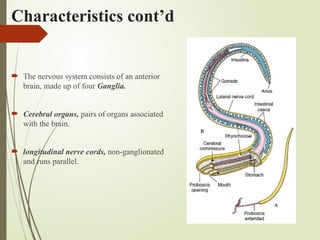
Characteristics cont’d
 The nervous system consists of an anterior
brain, made up of four Ganglia.
 Cerebral organs, pairs of organs associated
with the brain.
 longitudinal nerve cords, non-ganglionated
and runs parallel.
Cont’d
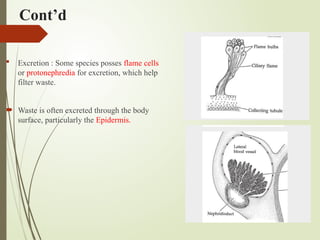
 Excretion : Some species posses flame cells
or protonephredia for excretion, which help
filter waste.
 Waste is often excreted through the body
surface, particularly the Epidermis.
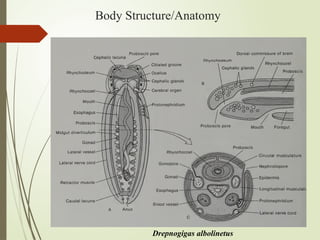
Body Structure/Anatomy
Drepnogigas albolinetus
Cont’d
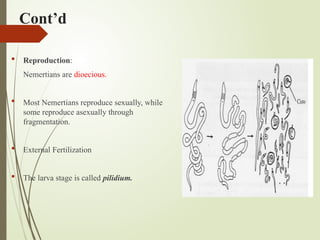
 Reproduction:
Nemertians are dioecious.
 Most Nemertians reproduce sexually, while
some reproduce asexually through
fragmentation.
 External Fertilization
 The larva stage is called pilidium.
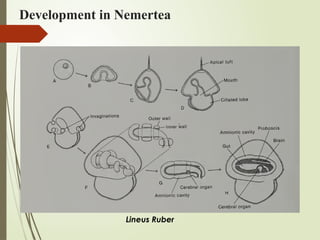
Development in Nemertea
Lineus Ruber
Classification
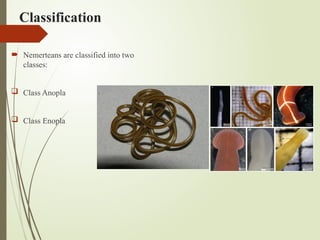
 Nemerteans are classified into two
classes:
 Class Anopla
 Class Enopla
Classification cont’d
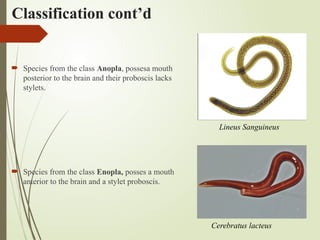
 Species from the class Anopla, possesa mouth
posterior to the brain and their proboscis lacks
stylets.
 Species from the class Enopla, posses a mouth
anterior to the brain and a stylet proboscis.
Lineus Sanguineus
Cerebratus lacteus
Overview of Mollusca
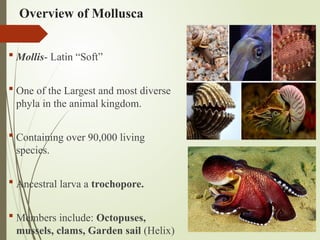
 Mollis- Latin “Soft”
 One of the Largest and most diverse
phyla in the animal kingdom.
 Containing over 90,000 living
species.
 Ancestral larva a trochopore.
 Members include: Octopuses,
mussels, clams, Garden sail (Helix)
General Characteristics
 Triploblastic
 Usually Bilateral symmetrical
 Soft and unsegmented
 Mantle and shell
 Organ Grade Organization
Primary locomotory organ is the foot.
 22
Coelemate
Mollusks are mostly free living
species.
 Cephalization
Aquatic & Terrestrial organisms
They are distinguished from other
organisms by the presence of a
Mantle and Radula
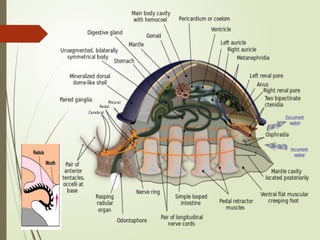
Body Plan /Anatomy

Head~ Foot Region

Contains the sensory organs and motor organs.

Mantle: a layer of overlapping skin, that protects the visceral
organs and secrets the shell in some species.

Visceral mass: Digestive organs, reproductive organs,
respiratory organs and excretory organs.

Radula: a tongue like structure that is essential for their feeding.
General Characteristics Cont’d
Mode of Reproduction
Most are Dieoecious; although some
are hermaphroditic.
Mode of Excretion
They consist of a pair of kidneys
(Metanephridia)
Anus
Mode of respiration
 Aquatic: Gills (ctenidia)
 Terrestrial: Lungs or Cutaneous
Nervous system
The nervous system structure
varies with classes.
Consists of pairs of Ganglia
Nerve cord
A chemo-receptive sense organ,
regulates the water currents in the
mantle cavity called Osphradium.
Ocelli- photo receptive sense
organ.
Conchifera
• Bivalvia
• Gastropoda
• Cephalopoda
• Scaphopoda
Classification
Aculifera
• Monoplacophora
• Aplacophora
• Polyplacophora
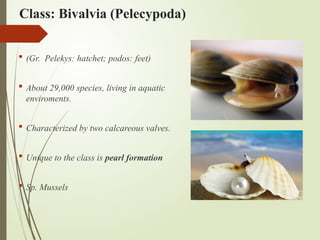
Class: Bivalvia (Pelecypoda)
 (Gr. Pelekys: hatchet; podos: feet)
 About 29,000 species, living in aquatic
enviroments.
 Characterized by two calcareous valves.
 Unique to the class is pearl formation
 Sp. Mussels
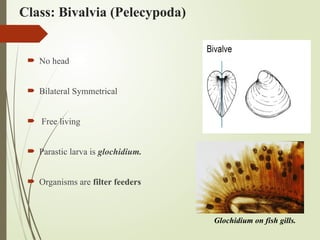
Class: Bivalvia (Pelecypoda)
 No head
 Bilateral Symmetrical
 Free living
 Parastic larva is glochidium.
 Organisms are filter feeders
Glochidium on fish gills.
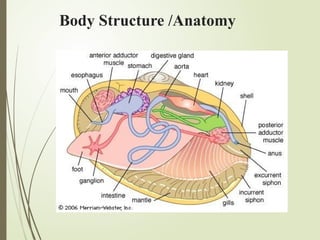
Body Structure /Anatomy
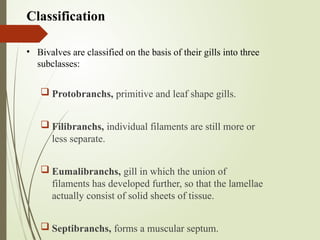
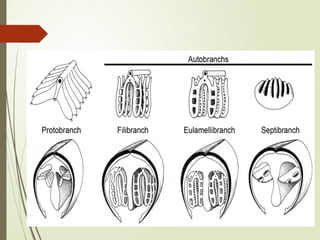
 Protobranchs, primitive and leaf shape gills.
 Filibranchs, individual filaments are still more or
less separate.
 Eumalibranchs, gill in which the union of
filaments has developed further, so that the lamellae
actually consist of solid sheets of tissue.
 Septibranchs, forms a muscular septum.
Classification
• Bivalves are classified on the basis of their gills into three
subclasses:
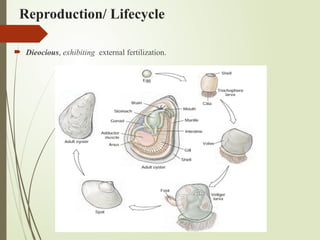
Reproduction/ Lifecycle
 Dieocious, exhibiting external fertilization.
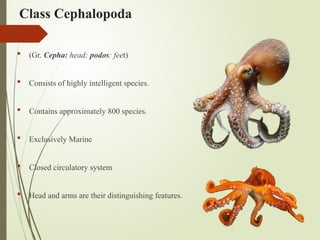
Class Cephalopoda
 (Gr. Cepha: head; podos: feet)
 Consists of highly intelligent species.
 Contains approximately 800 species.
 Exclusively Marine
 Closed circulatory system
 Head and arms are their distinguishing features.
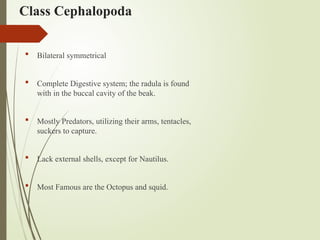
Class Cephalopoda
 Bilateral symmetrical
 Complete Digestive system; the radula is found
with in the buccal cavity of the beak.
 Mostly Predators, utilizing their arms, tentacles,
suckers to capture.
 Lack external shells, except for Nautilus.
 Most Famous are the Octopus and squid.
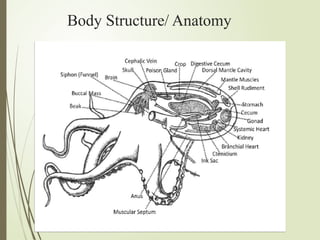
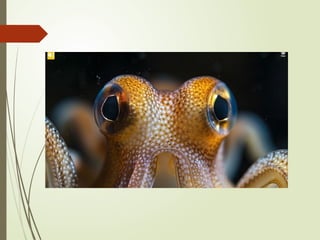
Body Structure/ Anatomy
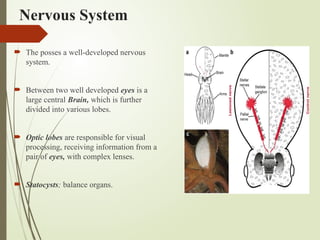
Nervous System
 The posses a well-developed nervous
system.
 Between two well developed eyes is a
large central Brain, which is further
divided into various lobes.
 Optic lobes are responsible for visual
processing, receiving information from a
pair of eyes, with complex lenses.
 Statocysts; balance organs.
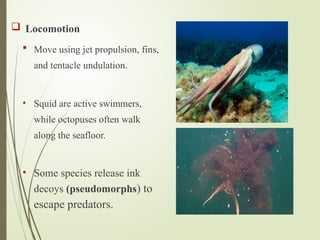
 Locomotion
 Move using jet propulsion, fins,
and tentacle undulation.
• Squid are active swimmers,
while octopuses often walk
along the seafloor.
• Some species release ink
decoys (pseudomorphs) to
escape predators.
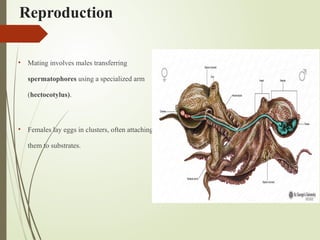
Reproduction
• Mating involves males transferring
spermatophores using a specialized arm
(hectocotylus).
• Females lay eggs in clusters, often attaching
them to substrates.
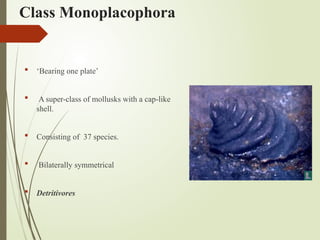
Class Monoplacophora
 ‘Bearing one plate’
 A super-class of mollusks with a cap-like
shell.
 Consisting of 37 species.
 Bilaterally symmetrical
 Detritivores
Reproduction/Lifecycle
 Dioecious, with external fertilization.
 - Spawning influenced by environmental
factors.
 - Long lifespan compensates for slow
growth.
 Image plz
Ecological and Economical
importance
 Part of Deep-Sea Ecosystems
 Indicator Species
 Evolutionary Research
 Biotechnological Potential
Contrasting Monoplacophora and Alpacophorans
 Shell
 Habitat
 Foot
 Body plan
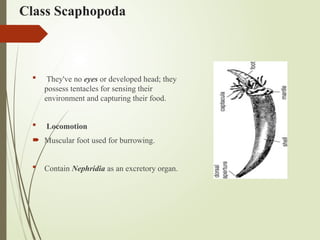
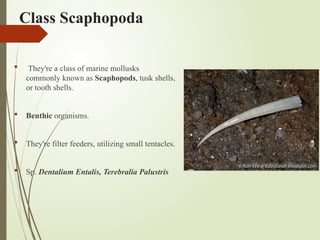
Class Scaphopoda
 They're a class of marine mollusks
commonly known as Scaphopods, tusk shells,
or tooth shells.
 Benthic organisms.
 They're filter feeders, utilizing small tentacles.
 Sp. Dentalium Entalis, Terebralia Palustris
Class Scaphopoda
 They've no eyes or developed head; they
possess tentacles for sensing their
environment and capturing their food.
 Locomotion
 Muscular foot used for burrowing.
 Contain Nephridia as an excretory organ.
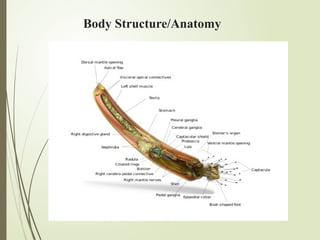
Body Structure/Anatomy
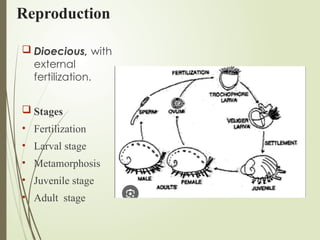
Reproduction
 Dioecious, with
external
fertilization.
 Stages
• Fertilization
• Larval stage
• Metamorphosis
• Juvenile stage
• Adult stage
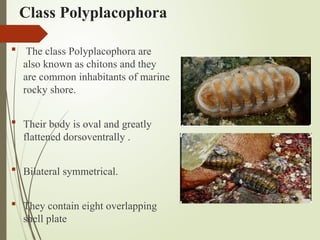
Class Polyplacophora
 The class Polyplacophora are
also known as chitons and they
are common inhabitants of marine
rocky shore.
 Their body is oval and greatly
flattened dorsoventrally .
 Bilateral symmetrical.
 They contain eight overlapping
shell plate
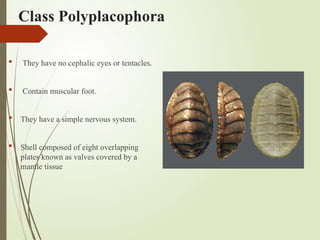
Class Polyplacophora
 They have no cephalic eyes or tentacles.
 Contain muscular foot.
 They have a simple nervous system.
 Shell composed of eight overlapping
plates known as valves covered by a
mantle tissue
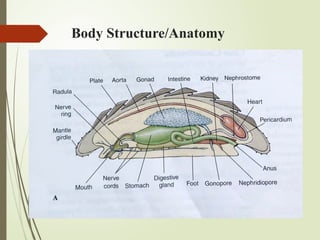
Body Structure/Anatomy
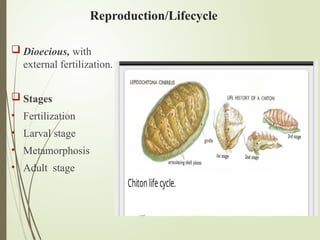
Reproduction/Lifecycle
 Dioecious, with
external fertilization.
 Stages
• Fertilization
• Larval stage
• Metamorphosis
• Adult stage
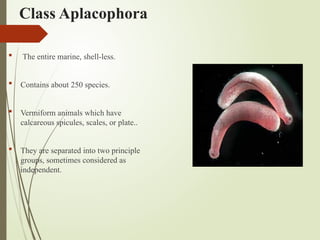
Class Aplacophora
 The entire marine, shell-less.
 Contains about 250 species.
 Vermiform animals which have
calcareous spicules, scales, or plate..
 They are separated into two principle
groups, sometimes considered as
independent.
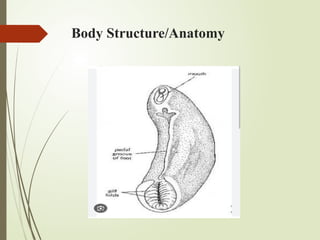
Body Structure/Anatomy
Classification
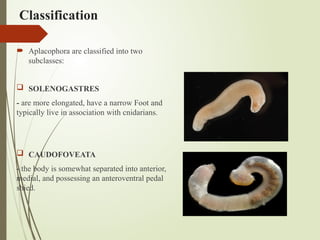
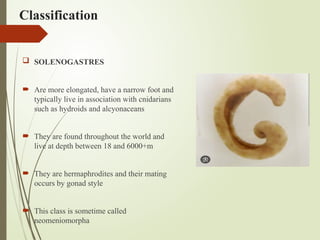
 Aplacophora are classified into two
subclasses:
 SOLENOGASTRES
- are more elongated, have a narrow Foot and
typically live in association with cnidarians.
 CAUDOFOVEATA
- the body is somewhat separated into anterior,
medial, and possessing an anteroventral pedal
shied.
Classification
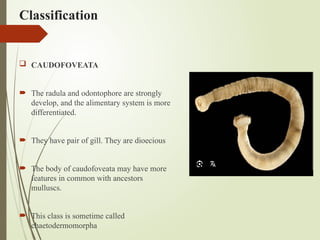
 SOLENOGASTRES
 Are more elongated, have a narrow foot and
typically live in association with cnidarians
such as hydroids and alcyonaceans
 They are found throughout the world and
live at depth between 18 and 6000+m
 They are hermaphrodites and their mating
occurs by gonad style
 This class is sometime called
neomeniomorpha
Classification
 CAUDOFOVEATA
 The radula and odontophore are strongly
develop, and the alimentary system is more
differentiated.
 They have pair of gill. They are dioecious
 The body of caudofoveata may have more
features in common with ancestors
mulluscs.
 This class is sometime called
chaetodermomorpha
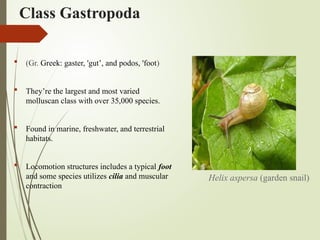
Class Gastropoda
 (Gr. Greek: gaster, 'gut’, and podos, 'foot)
 They’re the largest and most varied
molluscan class with over 35,000 species.
 Found in marine, freshwater, and terrestrial
habitats.
 Locomotion structures includes a typical foot
and some species utilizes cilia and muscular
contraction
Helix aspersa (garden snail)
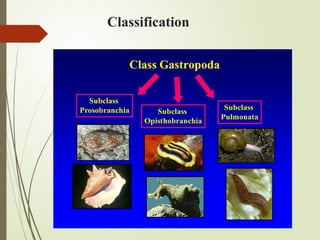
Classification
Class Gastropoda
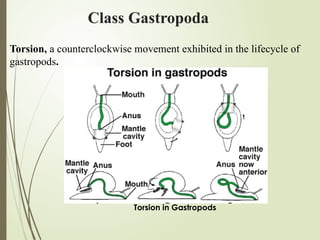
Torsion, a counterclockwise movement exhibited in the lifecycle of
gastropods.
Torsion in Gastropods
Reproduction
 Dioecious, with external fertilization.
 Monoecious, with internal
fertilization.
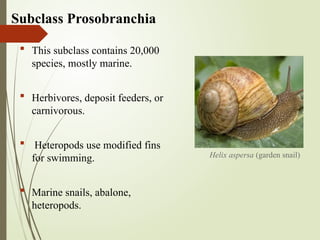
Subclass Prosobranchia
 This subclass contains 20,000
species, mostly marine.
 Herbivores, deposit feeders, or
carnivorous.
 Heteropods use modified fins
for swimming.
 Marine snails, abalone,
heteropods.
Helix aspersa (garden snail)
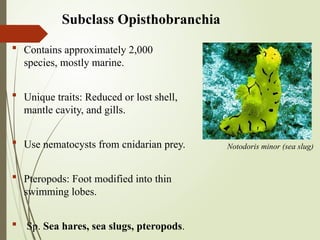
Subclass Opisthobranchia
 Contains approximately 2,000
species, mostly marine.
 Unique traits: Reduced or lost shell,
mantle cavity, and gills.
 Use nematocysts from cnidarian prey.
 Pteropods: Foot modified into thin
swimming lobes.
 Sp. Sea hares, sea slugs, pteropods.
Notodoris minor (sea slug)
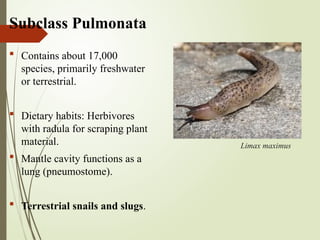
Subclass Pulmonata
 Contains about 17,000
species, primarily freshwater
or terrestrial.
 Dietary habits: Herbivores
with radula for scraping plant
material.
 Mantle cavity functions as a
lung (pneumostome).
 Terrestrial snails and slugs.
Limax maximus
Quote of the Day
References
Abbott, R. T., and P. A. Morris. 2001. R. T. Peterson (ed.). A fi eld guide to shells:
Atlantic coasts and the West Indies, ed. 5. Boston, Houghton Miffl in Company. An
excellent revision of a popular handbook.
Barinaga, M. 1990. Science digests the secrets of voracious killer snails. Science 249:
250–251. Describes current research on the toxins produced by cone snails.
Bergström, J. 1989. The origin of animal phyla and the new phylum Procoelomata.
Lethaia 22: 259–269. Argues that Caudofoveata are the only surviving members of
Procoelomata, putative ancestral sclerite bearing early Cambrian metazoan.
Fleischman, J. 1997. Mass extinctions come to Ohio. Discover 18 (5):84–90. Of the 300
species of freshwater bivalves in the Mississippi River basin, 161 are extinct or
endangered.
Images: Google

The Phylum Nemertea and Phylum Mollusca characters

  • 1.
    Stella Maris PolytechnicUniversity Mother Patern College Of Health Science Group One Members: 1. Chrisphine M. Mendimasa 11350 2. Elvis K. Goodridge 11269 3. B.k Adjaenehn Nyenpan 11306 4. Amosrine Young 11182 5. Yamah Paypay 11183 6. CourageGbolo 11253 7. Elaine P. Boakai 11258 8. Abraham S. Saysay 11064 General Zoology I (Zoo 201) Presented to: Paul Zawolo Seamehn Phylum Mollusca Phylum Nemertea
  • 2.
    Objectives By the endof this lecture session, students will be able to know: • The phyla Nemertea and Mollusca •Their Characteristics •Classification •Their distinguishing features
  • 3.
    Overview of Nemertea(Rhynchocoela) (Gr. rhynnchos, beak = koilos, hollow)  A diverse group of worms, know commonly as the ribbon worms or proboscis worms. About 1000 species Exhibit different color patterns consisting of yellow, orange, red and green. They are usually found marine environments, with some occurring in fresh Drepnogigas albolinetus
  • 4.
    General Characteristics Triploblastic Acoelomate Bilateral symmetrical Unsegmented Closed circulatory system No Repiratory system An eversible Proboscis, which in the cavity above the alimentary canal. Complete Digestive system Most free living, burrowing in sediments. Distinguishing Features: • Proboscis • Rhynchocoel.
  • 5.
    Characteristics cont’d  Thenervous system consists of an anterior brain, made up of four Ganglia.  Cerebral organs, pairs of organs associated with the brain.  longitudinal nerve cords, non-ganglionated and runs parallel.
  • 6.
    Cont’d  Excretion :Some species posses flame cells or protonephredia for excretion, which help filter waste.  Waste is often excreted through the body surface, particularly the Epidermis.
  • 7.
  • 8.
    Cont’d  Reproduction: Nemertians aredioecious.  Most Nemertians reproduce sexually, while some reproduce asexually through fragmentation.  External Fertilization  The larva stage is called pilidium.
  • 9.
  • 10.
    Classification  Nemerteans areclassified into two classes:  Class Anopla  Class Enopla
  • 11.
    Classification cont’d  Speciesfrom the class Anopla, possesa mouth posterior to the brain and their proboscis lacks stylets.  Species from the class Enopla, posses a mouth anterior to the brain and a stylet proboscis. Lineus Sanguineus Cerebratus lacteus
  • 13.
    Overview of Mollusca Mollis- Latin “Soft”  One of the Largest and most diverse phyla in the animal kingdom.  Containing over 90,000 living species.  Ancestral larva a trochopore.  Members include: Octopuses, mussels, clams, Garden sail (Helix)
  • 14.
    General Characteristics  Triploblastic Usually Bilateral symmetrical  Soft and unsegmented  Mantle and shell  Organ Grade Organization Primary locomotory organ is the foot.  22 Coelemate Mollusks are mostly free living species.  Cephalization Aquatic & Terrestrial organisms They are distinguished from other organisms by the presence of a Mantle and Radula
  • 15.
    Body Plan /Anatomy  Head~Foot Region  Contains the sensory organs and motor organs.  Mantle: a layer of overlapping skin, that protects the visceral organs and secrets the shell in some species.  Visceral mass: Digestive organs, reproductive organs, respiratory organs and excretory organs.  Radula: a tongue like structure that is essential for their feeding.
  • 17.
    General Characteristics Cont’d Modeof Reproduction Most are Dieoecious; although some are hermaphroditic. Mode of Excretion They consist of a pair of kidneys (Metanephridia) Anus Mode of respiration  Aquatic: Gills (ctenidia)  Terrestrial: Lungs or Cutaneous
  • 18.
    Nervous system The nervoussystem structure varies with classes. Consists of pairs of Ganglia Nerve cord A chemo-receptive sense organ, regulates the water currents in the mantle cavity called Osphradium. Ocelli- photo receptive sense organ.
  • 19.
    Conchifera • Bivalvia • Gastropoda •Cephalopoda • Scaphopoda Classification Aculifera • Monoplacophora • Aplacophora • Polyplacophora
  • 20.
    Class: Bivalvia (Pelecypoda) (Gr. Pelekys: hatchet; podos: feet)  About 29,000 species, living in aquatic enviroments.  Characterized by two calcareous valves.  Unique to the class is pearl formation  Sp. Mussels
  • 21.
    Class: Bivalvia (Pelecypoda) No head  Bilateral Symmetrical  Free living  Parastic larva is glochidium.  Organisms are filter feeders Glochidium on fish gills.
  • 22.
  • 23.
     Protobranchs, primitiveand leaf shape gills.  Filibranchs, individual filaments are still more or less separate.  Eumalibranchs, gill in which the union of filaments has developed further, so that the lamellae actually consist of solid sheets of tissue.  Septibranchs, forms a muscular septum. Classification • Bivalves are classified on the basis of their gills into three subclasses:
  • 25.
    Reproduction/ Lifecycle  Dieocious,exhibiting external fertilization.
  • 26.
    Class Cephalopoda  (Gr.Cepha: head; podos: feet)  Consists of highly intelligent species.  Contains approximately 800 species.  Exclusively Marine  Closed circulatory system  Head and arms are their distinguishing features.
  • 27.
    Class Cephalopoda  Bilateralsymmetrical  Complete Digestive system; the radula is found with in the buccal cavity of the beak.  Mostly Predators, utilizing their arms, tentacles, suckers to capture.  Lack external shells, except for Nautilus.  Most Famous are the Octopus and squid.
  • 28.
  • 29.
    Nervous System  Theposses a well-developed nervous system.  Between two well developed eyes is a large central Brain, which is further divided into various lobes.  Optic lobes are responsible for visual processing, receiving information from a pair of eyes, with complex lenses.  Statocysts; balance organs.
  • 31.
     Locomotion  Moveusing jet propulsion, fins, and tentacle undulation. • Squid are active swimmers, while octopuses often walk along the seafloor. • Some species release ink decoys (pseudomorphs) to escape predators.
  • 32.
    Reproduction • Mating involvesmales transferring spermatophores using a specialized arm (hectocotylus). • Females lay eggs in clusters, often attaching them to substrates.
  • 34.
    Class Monoplacophora  ‘Bearingone plate’  A super-class of mollusks with a cap-like shell.  Consisting of 37 species.  Bilaterally symmetrical  Detritivores
  • 35.
    Reproduction/Lifecycle  Dioecious, withexternal fertilization.  - Spawning influenced by environmental factors.  - Long lifespan compensates for slow growth.  Image plz
  • 36.
    Ecological and Economical importance Part of Deep-Sea Ecosystems  Indicator Species  Evolutionary Research  Biotechnological Potential
  • 37.
    Contrasting Monoplacophora andAlpacophorans  Shell  Habitat  Foot  Body plan
  • 38.
    Class Scaphopoda  They'rea class of marine mollusks commonly known as Scaphopods, tusk shells, or tooth shells.  Benthic organisms.  They're filter feeders, utilizing small tentacles.  Sp. Dentalium Entalis, Terebralia Palustris
  • 39.
    Class Scaphopoda  They'veno eyes or developed head; they possess tentacles for sensing their environment and capturing their food.  Locomotion  Muscular foot used for burrowing.  Contain Nephridia as an excretory organ.
  • 40.
  • 41.
    Reproduction  Dioecious, with external fertilization. Stages • Fertilization • Larval stage • Metamorphosis • Juvenile stage • Adult stage
  • 42.
    Class Polyplacophora  Theclass Polyplacophora are also known as chitons and they are common inhabitants of marine rocky shore.  Their body is oval and greatly flattened dorsoventrally .  Bilateral symmetrical.  They contain eight overlapping shell plate
  • 43.
    Class Polyplacophora  Theyhave no cephalic eyes or tentacles.  Contain muscular foot.  They have a simple nervous system.  Shell composed of eight overlapping plates known as valves covered by a mantle tissue
  • 44.
  • 45.
    Reproduction/Lifecycle  Dioecious, with externalfertilization.  Stages • Fertilization • Larval stage • Metamorphosis • Adult stage
  • 46.
    Class Aplacophora  Theentire marine, shell-less.  Contains about 250 species.  Vermiform animals which have calcareous spicules, scales, or plate..  They are separated into two principle groups, sometimes considered as independent.
  • 47.
  • 48.
    Classification  Aplacophora areclassified into two subclasses:  SOLENOGASTRES - are more elongated, have a narrow Foot and typically live in association with cnidarians.  CAUDOFOVEATA - the body is somewhat separated into anterior, medial, and possessing an anteroventral pedal shied.
  • 49.
    Classification  SOLENOGASTRES  Aremore elongated, have a narrow foot and typically live in association with cnidarians such as hydroids and alcyonaceans  They are found throughout the world and live at depth between 18 and 6000+m  They are hermaphrodites and their mating occurs by gonad style  This class is sometime called neomeniomorpha
  • 50.
    Classification  CAUDOFOVEATA  Theradula and odontophore are strongly develop, and the alimentary system is more differentiated.  They have pair of gill. They are dioecious  The body of caudofoveata may have more features in common with ancestors mulluscs.  This class is sometime called chaetodermomorpha
  • 51.
    Class Gastropoda  (Gr.Greek: gaster, 'gut’, and podos, 'foot)  They’re the largest and most varied molluscan class with over 35,000 species.  Found in marine, freshwater, and terrestrial habitats.  Locomotion structures includes a typical foot and some species utilizes cilia and muscular contraction Helix aspersa (garden snail)
  • 52.
  • 53.
    Class Gastropoda Torsion, acounterclockwise movement exhibited in the lifecycle of gastropods. Torsion in Gastropods
  • 54.
    Reproduction  Dioecious, withexternal fertilization.  Monoecious, with internal fertilization.
  • 55.
    Subclass Prosobranchia  Thissubclass contains 20,000 species, mostly marine.  Herbivores, deposit feeders, or carnivorous.  Heteropods use modified fins for swimming.  Marine snails, abalone, heteropods. Helix aspersa (garden snail)
  • 56.
    Subclass Opisthobranchia  Containsapproximately 2,000 species, mostly marine.  Unique traits: Reduced or lost shell, mantle cavity, and gills.  Use nematocysts from cnidarian prey.  Pteropods: Foot modified into thin swimming lobes.  Sp. Sea hares, sea slugs, pteropods. Notodoris minor (sea slug)
  • 57.
    Subclass Pulmonata  Containsabout 17,000 species, primarily freshwater or terrestrial.  Dietary habits: Herbivores with radula for scraping plant material.  Mantle cavity functions as a lung (pneumostome).  Terrestrial snails and slugs. Limax maximus
  • 58.
  • 59.
    References Abbott, R. T.,and P. A. Morris. 2001. R. T. Peterson (ed.). A fi eld guide to shells: Atlantic coasts and the West Indies, ed. 5. Boston, Houghton Miffl in Company. An excellent revision of a popular handbook. Barinaga, M. 1990. Science digests the secrets of voracious killer snails. Science 249: 250–251. Describes current research on the toxins produced by cone snails. Bergström, J. 1989. The origin of animal phyla and the new phylum Procoelomata. Lethaia 22: 259–269. Argues that Caudofoveata are the only surviving members of Procoelomata, putative ancestral sclerite bearing early Cambrian metazoan. Fleischman, J. 1997. Mass extinctions come to Ohio. Discover 18 (5):84–90. Of the 300 species of freshwater bivalves in the Mississippi River basin, 161 are extinct or endangered. Images: Google