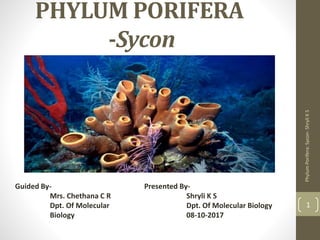
PHYLUM PORIFERA
-Sycon
Phylum
Porifera:
Sycon-
Shryli
K
S
1
Presented By-
Shryli K S
Dpt. Of Molecular Biology
08-10-2017
Guided By-
Mrs. Chethana C R
Dpt. Of Molecular
Biology
CONTENTS
• Introduction
• Sycon
• Habitat
• Structure
- Spicules
- Canal system
• Nutrition
• Reproduction
• Conclusion
• References
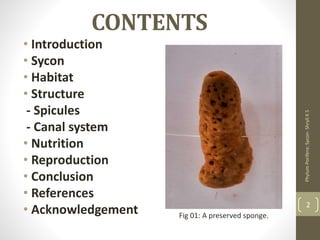
• Acknowledgement Fig 01: A preserved sponge.
Phylum
Porifera:
Sycon-
Shryli
K
S
2
INTRODUCTION
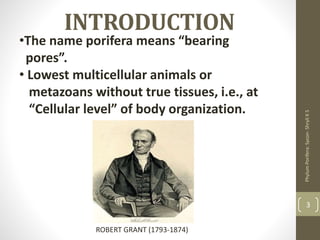
•The name porifera means “bearing
pores”.
• Lowest multicellular animals or
metazoans without true tissues, i.e., at
“Cellular level” of body organization.
Phylum
Porifera:
Sycon-
Shryli
K
S
3
ROBERT GRANT (1793-1874)
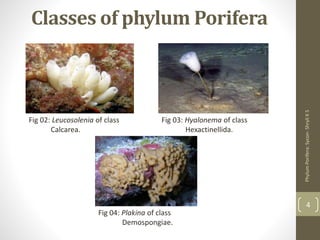
Classes of phylum Porifera
Fig 02: Leucosolenia of class
Calcarea.
Fig 03: Hyalonema of class
Hexactinellida.
Fig 04: Plakina of class
Demospongiae.
Phylum
Porifera:
Sycon-
Shryli
K
S
4
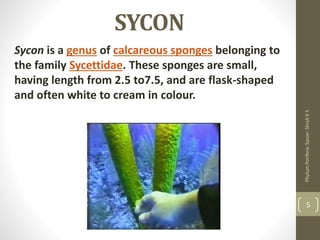
SYCON
Sycon is a genus of calcareous sponges belonging to
the family Sycettidae. These sponges are small,
having length from 2.5 to7.5, and are flask-shaped
and often white to cream in colour.
Phylum
Porifera:
Sycon-
Shryli
K
S
5
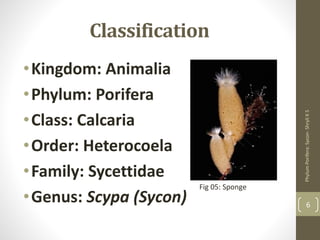
Classification
•Kingdom: Animalia
•Phylum: Porifera
•Class: Calcaria
•Order: Heterocoela
•Family: Sycettidae
•Genus: Scypa (Sycon)
Fig 05: Sponge
Phylum
Porifera:
Sycon-
Shryli
K
S
6
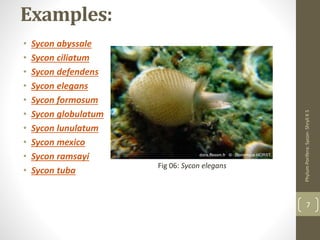
Examples:
• Sycon abyssale
• Sycon ciliatum
• Sycon defendens
• Sycon elegans
• Sycon formosum
• Sycon globulatum
• Sycon lunulatum
• Sycon mexico
• Sycon ramsayi
• Sycon tuba
Fig 06: Sycon elegans
Phylum
Porifera:
Sycon-
Shryli
K
S
7
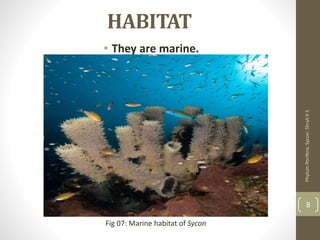
HABITAT
• They are marine.
Fig 07: Marine habitat of Sycon
Phylum
Porifera:
Sycon-
Shryli
K
S
8
STRUCTURE
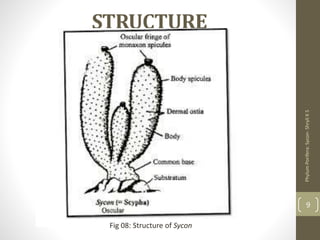
Fig 08: Structure of Sycon
Phylum
Porifera:
Sycon-
Shryli
K
S
9
SPICULES
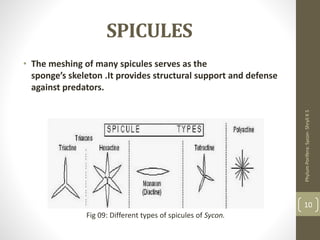
• The meshing of many spicules serves as the
sponge’s skeleton .It provides structural support and defense
against predators.
Fig 09: Different types of spicules of Sycon.
Phylum
Porifera:
Sycon-
Shryli
K
S
10
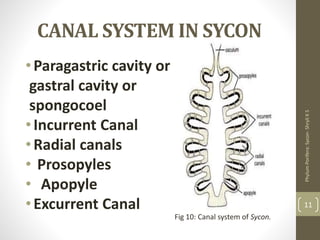
CANAL SYSTEM IN SYCON
•Paragastric cavity or
gastral cavity or
spongocoel
•Incurrent Canal
•Radial canals
• Prosopyles
• Apopyle
•Excurrent Canal
Fig 10: Canal system of Sycon.
Phylum
Porifera:
Sycon-
Shryli
K
S
11
NUTRITION
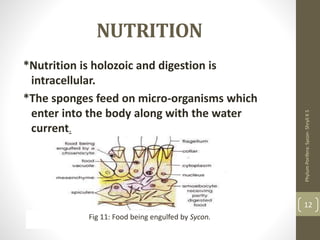
*Nutrition is holozoic and digestion is
intracellular.
*The sponges feed on micro-organisms which
enter into the body along with the water
current.
Fig 11: Food being engulfed by Sycon.
Phylum
Porifera:
Sycon-
Shryli
K
S
12
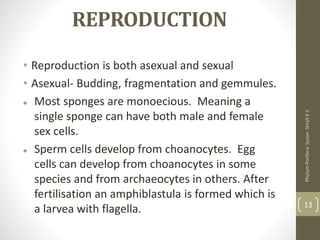
REPRODUCTION
• Reproduction is both asexual and sexual
• Asexual- Budding, fragmentation and gemmules.
 Most sponges are monoecious. Meaning a
single sponge can have both male and female
sex cells.
 Sperm cells develop from choanocytes. Egg
cells can develop from choanocytes in some
species and from archaeocytes in others. After
fertilisation an amphiblastula is formed which is
a larvea with flagella.
Phylum
Porifera:
Sycon-
Shryli
K
S
13
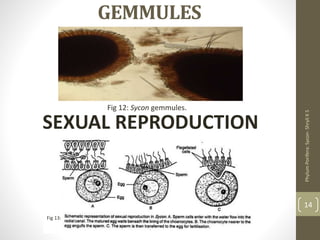
GEMMULES
SEXUAL REPRODUCTION
Phylum
Porifera:
Sycon-
Shryli
K
S
14
Fig 12: Sycon gemmules.
Fig 13:
CONCLUSION
Phylum
Porifera:
Sycon-
Shryli
K
S
15
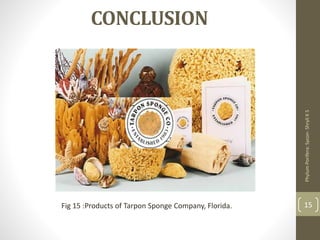
Fig 15 :Products of Tarpon Sponge Company, Florida.
REFERENCES
• Sponges (Porifera), Volume 37, Werner E. G. Müller, 2003,
258 pg.
• Gray’s Anatomy, Peter Gray, general Zoology, Oxford and IHB
Publishing Co. Newdelhi, 1970, 564pg.
• https://www.thoughtco.com/sponges-profile-2291833
• http://www.biozoomer.com/2014/04/sycon-sponge-
spicules.html
• https://en.wikipedia.org/wiki/Sycon
• http://www.biologydiscussion.com/invertebrate-
zoology/phylum-porifera/an-example-of-phylum-porifera-
sycon/32600
• http://species-
identification.org/species.php?species_group=sponges&id=43
5
Phylum
Porifera:
Sycon-
Shryli
K
S
16
ACKNOWLEDGEMENT
I would like to thank the Department of
Molecular Biology, for providing me this
opportunity to present my seminar, I would
also like to thank my guide Chethana Ma’am,
for her valuable guidance and support through
out the preparation of my seminar. Thank you
all.
Phylum
Porifera:
Sycon-
Shryli
K
S
17
Phylum
Porifera:
Sycon-
Shryli
K
S
18

Phylum Porifera - Sycon

  • 1.
    PHYLUM PORIFERA -Sycon Phylum Porifera: Sycon- Shryli K S 1 Presented By- ShryliK S Dpt. Of Molecular Biology 08-10-2017 Guided By- Mrs. Chethana C R Dpt. Of Molecular Biology
  • 2.
    CONTENTS • Introduction • Sycon •Habitat • Structure - Spicules - Canal system • Nutrition • Reproduction • Conclusion • References • Acknowledgement Fig 01: A preserved sponge. Phylum Porifera: Sycon- Shryli K S 2
  • 3.
    INTRODUCTION •The name poriferameans “bearing pores”. • Lowest multicellular animals or metazoans without true tissues, i.e., at “Cellular level” of body organization. Phylum Porifera: Sycon- Shryli K S 3 ROBERT GRANT (1793-1874)
  • 4.
    Classes of phylumPorifera Fig 02: Leucosolenia of class Calcarea. Fig 03: Hyalonema of class Hexactinellida. Fig 04: Plakina of class Demospongiae. Phylum Porifera: Sycon- Shryli K S 4
  • 5.
    SYCON Sycon is agenus of calcareous sponges belonging to the family Sycettidae. These sponges are small, having length from 2.5 to7.5, and are flask-shaped and often white to cream in colour. Phylum Porifera: Sycon- Shryli K S 5
  • 6.
    Classification •Kingdom: Animalia •Phylum: Porifera •Class:Calcaria •Order: Heterocoela •Family: Sycettidae •Genus: Scypa (Sycon) Fig 05: Sponge Phylum Porifera: Sycon- Shryli K S 6
  • 7.
    Examples: • Sycon abyssale •Sycon ciliatum • Sycon defendens • Sycon elegans • Sycon formosum • Sycon globulatum • Sycon lunulatum • Sycon mexico • Sycon ramsayi • Sycon tuba Fig 06: Sycon elegans Phylum Porifera: Sycon- Shryli K S 7
  • 8.
    HABITAT • They aremarine. Fig 07: Marine habitat of Sycon Phylum Porifera: Sycon- Shryli K S 8
  • 9.
    STRUCTURE Fig 08: Structureof Sycon Phylum Porifera: Sycon- Shryli K S 9
  • 10.
    SPICULES • The meshingof many spicules serves as the sponge’s skeleton .It provides structural support and defense against predators. Fig 09: Different types of spicules of Sycon. Phylum Porifera: Sycon- Shryli K S 10
  • 11.
    CANAL SYSTEM INSYCON •Paragastric cavity or gastral cavity or spongocoel •Incurrent Canal •Radial canals • Prosopyles • Apopyle •Excurrent Canal Fig 10: Canal system of Sycon. Phylum Porifera: Sycon- Shryli K S 11
  • 12.
    NUTRITION *Nutrition is holozoicand digestion is intracellular. *The sponges feed on micro-organisms which enter into the body along with the water current. Fig 11: Food being engulfed by Sycon. Phylum Porifera: Sycon- Shryli K S 12
  • 13.
    REPRODUCTION • Reproduction isboth asexual and sexual • Asexual- Budding, fragmentation and gemmules.  Most sponges are monoecious. Meaning a single sponge can have both male and female sex cells.  Sperm cells develop from choanocytes. Egg cells can develop from choanocytes in some species and from archaeocytes in others. After fertilisation an amphiblastula is formed which is a larvea with flagella. Phylum Porifera: Sycon- Shryli K S 13
  • 14.
  • 15.
  • 16.
    REFERENCES • Sponges (Porifera),Volume 37, Werner E. G. Müller, 2003, 258 pg. • Gray’s Anatomy, Peter Gray, general Zoology, Oxford and IHB Publishing Co. Newdelhi, 1970, 564pg. • https://www.thoughtco.com/sponges-profile-2291833 • http://www.biozoomer.com/2014/04/sycon-sponge- spicules.html • https://en.wikipedia.org/wiki/Sycon • http://www.biologydiscussion.com/invertebrate- zoology/phylum-porifera/an-example-of-phylum-porifera- sycon/32600 • http://species- identification.org/species.php?species_group=sponges&id=43 5 Phylum Porifera: Sycon- Shryli K S 16
  • 17.
    ACKNOWLEDGEMENT I would liketo thank the Department of Molecular Biology, for providing me this opportunity to present my seminar, I would also like to thank my guide Chethana Ma’am, for her valuable guidance and support through out the preparation of my seminar. Thank you all. Phylum Porifera: Sycon- Shryli K S 17
  • 18.