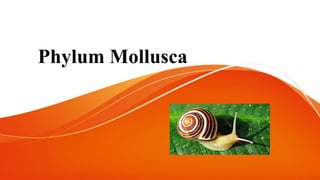

Phylum Mollusca
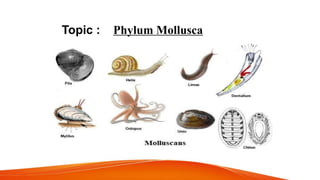
Topic : Phylum Mollusca
 Introduction
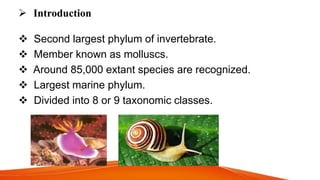
 Second largest phylum of invertebrate.
 Member known as molluscs.
 Around 85,000 extant species are recognized.
 Largest marine phylum.
 Divided into 8 or 9 taxonomic classes.
 Defination
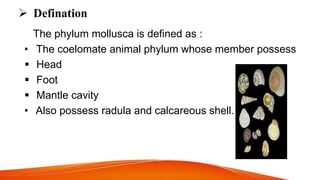
The phylum mollusca is defined as :
• The coelomate animal phylum whose member possess
 Head
 Foot
 Mantle cavity
• Also possess radula and calcareous shell.
 General Characteristics
 Body characters:
• Soft
• Unsegmented
• Triploblastic
• No jointed appendages
 Symmetry:
• Bilaterally symmetrical.
 Shell:
• Externally mantle secretes hard, brittle, calcareous shell.
• Protects the soft body.
Cont.....
 Division of body:
• Head: Carries mouth, eyes, tentacles.
• Foot: Ventral, thick and muscular . Modified for
creeping.
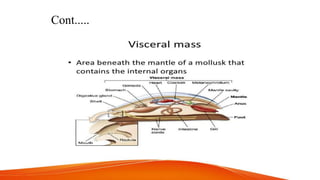
• Mantle: Thick muscular fold of body wall.
• Visceral mass: Contains all internal organs.
 Digestive organs:
• Alimentary canal is well developed and coiled.
 Respiration:
• Respiration by gills enclosed in mantle cavity.
Cont.....
 Circulatory system:
• Open circulatory system in all except in one class
Cephalopods.
 Excretory organs:
• Ome or two pairs of kidney.
 Nervous system:
• Comprises of paired cerebrals, plural, pedal and
visceral ganglia.
 Reproduction:
• Dioecious or monoecious, gonads with one or two
ducts.
Cont.....
 Classification
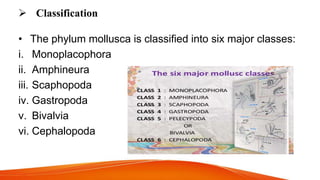
• The phylum mollusca is classified into six major classes:
i. Monoplacophora
ii. Amphineura
iii. Scaphopoda
iv. Gastropoda
v. Bivalvia
vi. Cephalopoda
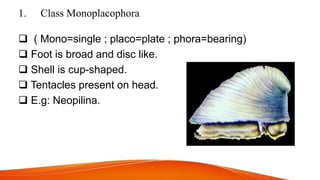
1. Class Monoplacophora
 ( Mono=single ; placo=plate ; phora=bearing)
 Foot is broad and disc like.
 Shell is cup-shaped.
 Tentacles present on head.
 E.g: Neopilina.
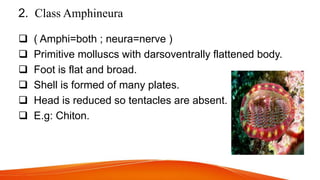
2. Class Amphineura
 ( Amphi=both ; neura=nerve )
 Primitive molluscs with darsoventrally flattened body.
 Foot is flat and broad.
 Shell is formed of many plates.
 Head is reduced so tentacles are absent.
 E.g: Chiton.
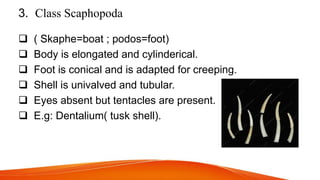
3. Class Scaphopoda
 ( Skaphe=boat ; podos=foot)
 Body is elongated and cylinderical.
 Foot is conical and is adapted for creeping.
 Shell is univalved and tubular.
 Eyes absent but tentacles are present.
 E.g: Dentalium( tusk shell).
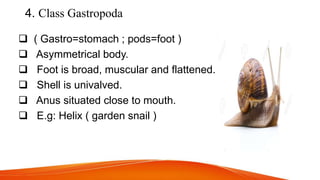
4. Class Gastropoda
 ( Gastro=stomach ; pods=foot )
 Asymmetrical body.
 Foot is broad, muscular and flattened.
 Shell is univalved.
 Anus situated close to mouth.
 E.g: Helix ( garden snail )
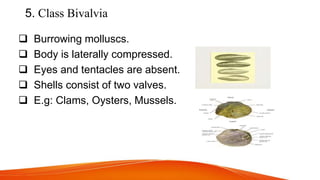
5. Class Bivalvia
 Burrowing molluscs.
 Body is laterally compressed.
 Eyes and tentacles are absent.
 Shells consist of two valves.
 E.g: Clams, Oysters, Mussels.
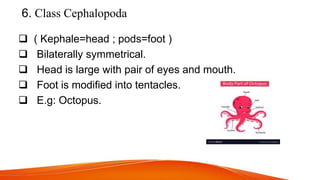
6. Class Cephalopoda
 ( Kephale=head ; pods=foot )
 Bilaterally symmetrical.
 Head is large with pair of eyes and mouth.
 Foot is modified into tentacles.
 E.g: Octopus.
 Molluscs Shell
 A wormlike creatures lived in seas known as “Molluscs”.
 Typically a calcareous exoskeletons.
 Protects and supports soft parts of animals.
 Some live on land and in fresh water.
 Some of them are Snail, Oyster and Octopus etc.
Characteristics :
• Provide shelter
• Security from predaitors
• Without back bon
• Made up of Calcium carbonate or Chitin.
Cont.....
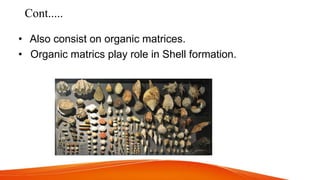
• Also consist on organic matrices.
• Organic matrics play role in Shell formation.
Phylum mollusca  presentation

Phylum mollusca presentation

  • 1.
  • 2.
  • 3.
     Introduction  Secondlargest phylum of invertebrate.  Member known as molluscs.  Around 85,000 extant species are recognized.  Largest marine phylum.  Divided into 8 or 9 taxonomic classes.
  • 4.
     Defination The phylummollusca is defined as : • The coelomate animal phylum whose member possess  Head  Foot  Mantle cavity • Also possess radula and calcareous shell.
  • 5.
     General Characteristics Body characters: • Soft • Unsegmented • Triploblastic • No jointed appendages  Symmetry: • Bilaterally symmetrical.  Shell: • Externally mantle secretes hard, brittle, calcareous shell. • Protects the soft body.
  • 6.
    Cont.....  Division ofbody: • Head: Carries mouth, eyes, tentacles. • Foot: Ventral, thick and muscular . Modified for creeping. • Mantle: Thick muscular fold of body wall. • Visceral mass: Contains all internal organs.  Digestive organs: • Alimentary canal is well developed and coiled.  Respiration: • Respiration by gills enclosed in mantle cavity.
  • 7.
    Cont.....  Circulatory system: •Open circulatory system in all except in one class Cephalopods.  Excretory organs: • Ome or two pairs of kidney.  Nervous system: • Comprises of paired cerebrals, plural, pedal and visceral ganglia.  Reproduction: • Dioecious or monoecious, gonads with one or two ducts.
  • 8.
  • 9.
     Classification • Thephylum mollusca is classified into six major classes: i. Monoplacophora ii. Amphineura iii. Scaphopoda iv. Gastropoda v. Bivalvia vi. Cephalopoda
  • 10.
    1. Class Monoplacophora ( Mono=single ; placo=plate ; phora=bearing)  Foot is broad and disc like.  Shell is cup-shaped.  Tentacles present on head.  E.g: Neopilina.
  • 11.
    2. Class Amphineura ( Amphi=both ; neura=nerve )  Primitive molluscs with darsoventrally flattened body.  Foot is flat and broad.  Shell is formed of many plates.  Head is reduced so tentacles are absent.  E.g: Chiton.
  • 12.
    3. Class Scaphopoda ( Skaphe=boat ; podos=foot)  Body is elongated and cylinderical.  Foot is conical and is adapted for creeping.  Shell is univalved and tubular.  Eyes absent but tentacles are present.  E.g: Dentalium( tusk shell).
  • 13.
    4. Class Gastropoda ( Gastro=stomach ; pods=foot )  Asymmetrical body.  Foot is broad, muscular and flattened.  Shell is univalved.  Anus situated close to mouth.  E.g: Helix ( garden snail )
  • 14.
    5. Class Bivalvia Burrowing molluscs.  Body is laterally compressed.  Eyes and tentacles are absent.  Shells consist of two valves.  E.g: Clams, Oysters, Mussels.
  • 15.
    6. Class Cephalopoda ( Kephale=head ; pods=foot )  Bilaterally symmetrical.  Head is large with pair of eyes and mouth.  Foot is modified into tentacles.  E.g: Octopus.
  • 16.
     Molluscs Shell A wormlike creatures lived in seas known as “Molluscs”.  Typically a calcareous exoskeletons.  Protects and supports soft parts of animals.  Some live on land and in fresh water.  Some of them are Snail, Oyster and Octopus etc. Characteristics : • Provide shelter • Security from predaitors • Without back bon • Made up of Calcium carbonate or Chitin.
  • 17.
    Cont..... • Also consiston organic matrices. • Organic matrics play role in Shell formation.