Making Solutions
Biotechnology I
Introduction
 Making solutions is important in any
area of biotechnology
 R&D QC Mfg
 Accuracy is critical as an incorrect
solution can destroy months or years
worth of work and could delay a
critical drug from being available to
the market place
Key Terms
 Solute: substances that are dissolved
 Solvent: substances in which solutes are
dissolved (often times this is water or a buffer)
 Concentration: amount per volume
 Solution: a homogeneous mixture in
which one or more substances are
dissolved in another.
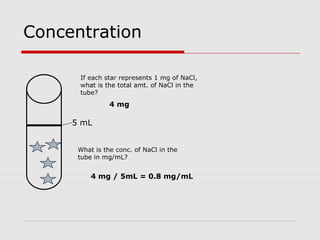
Concentration
5 mL
If each star represents 1 mg of NaCl,
what is the total amt. of NaCl in the
tube?
What is the conc. of NaCl in the
tube in mg/mL?
4 mg
4 mg / 5mL = 0.8 mg/mL
Calculations
 There are a few equations you need
to remember in order to determine
the required amount of solute and
solvent required.
 Take your time with your calculations
 Remember to cancel units
 Ask yourself if the answer makes sense
 Record all calculations and formulas used
Weight per Volume
 Simplest way of expressing a
concentration
 Example: 2mg / mL
 2mg is the weight of something in 1 mL
of solvent
Percents
 May be expressed as weight per
volume which is grams per 100 mL
(w/v%)
 Example: 20 grams of KCL in 100 mL of
solvent is a 20% solution (w/v)
Practice Problem
 How would you prepare 500 mL of a
5% (w/v) solution of NaCl?
 5% = 5g/100mL
 5 = x
100 500mL
100x = 2500 x=25grams of NaCl
 Weigh out 25 grams of NaCl and add it
to a 500 mL volumetric flask. Add
approximately 400 mL and mix. Once
dissolved, QS to 500 mL. Cap and store.
Percents continued
 May be expressed in volume percent
which is (v/v):
mL of solute
100 mL of solvent
 May be expressed in weight per
weight which is (w/w):
grams solute
100 grams solvent
Practice Problem
 How would you make 500 grams of a 5%
solution of NaCl by weight (w/w)?
% strength is 5% w/w, total weight is 500 grams
5 grams x 500 g = 25 grams of NaCl
100 grams
500 grams total weight – 25 grams NaCl = 475 grams of solvent
needed
Weigh out 25 grams of NaCl and add it to 475 grams of water.
Molarity
 Most common solution calculation used
 Definition: molarity (M) is equal to the
number of moles of solute that are
dissolved per Liter of solvent.
 In order to calculate molarity, you need to
know moles.
 Definition: moles are the molecular weight
or formula weight of a particular chemical.
 FW or MW can be found on the chemical
bottle or by adding up atomic weights of
each atom in that molecule.
 For example: what is the MW of H20
 2x1 + 16 = 18
Practice Calculations
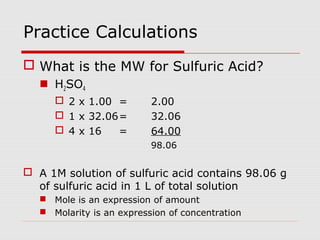
 What is the MW for Sulfuric Acid?
 H2SO4
 2 x 1.00 = 2.00
 1 x 32.06= 32.06
 4 x 16 = 64.00
98.06
 A 1M solution of sulfuric acid contains 98.06 g
of sulfuric acid in 1 L of total solution
 Mole is an expression of amount
 Molarity is an expression of concentration
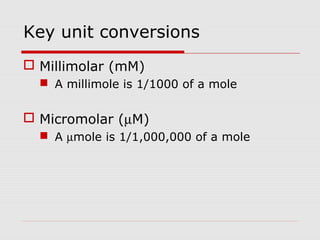
Key unit conversions
 Millimolar (mM)
 A millimole is 1/1000 of a mole
 Micromolar (µM)
 A µmole is 1/1,000,000 of a mole
Practice Problem
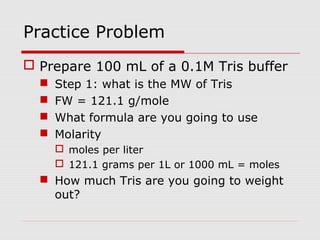
 Prepare 100 mL of a 0.1M Tris buffer
 Step 1: what is the MW of Tris
 FW = 121.1 g/mole
 What formula are you going to use
 Molarity
 moles per liter
 121.1 grams per 1L or 1000 mL = moles
 How much Tris are you going to weight
out?
Practice Problem continued
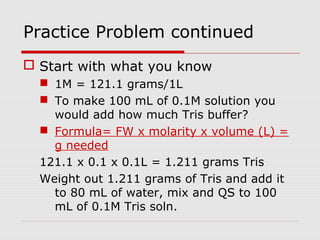
 Start with what you know
 1M = 121.1 grams/1L
 To make 100 mL of 0.1M solution you
would add how much Tris buffer?
 Formula= FW x molarity x volume (L) =
g needed
121.1 x 0.1 x 0.1L = 1.211 grams Tris
Weight out 1.211 grams of Tris and add it
to 80 mL of water, mix and QS to 100
mL of 0.1M Tris soln.
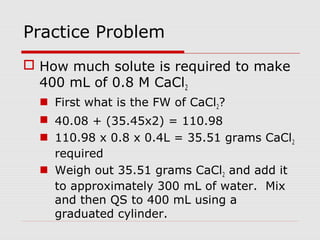
Practice Problem
 How much solute is required to make
400 mL of 0.8 M CaCl2
 First what is the FW of CaCl2?
 40.08 + (35.45x2) = 110.98
 110.98 x 0.8 x 0.4L = 35.51 grams CaCl2
required
 Weigh out 35.51 grams CaCl2 and add it
to approximately 300 mL of water. Mix
and then QS to 400 mL using a
graduated cylinder.
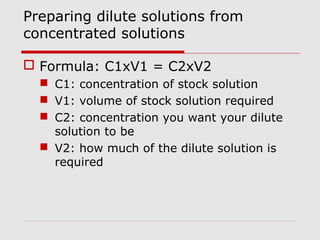
Preparing dilute solutions from
concentrated solutions
 Formula: C1xV1 = C2xV2
 C1: concentration of stock solution
 V1: volume of stock solution required
 C2: concentration you want your dilute
solution to be
 V2: how much of the dilute solution is
required
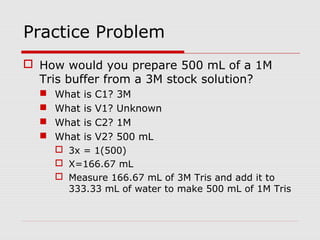
Practice Problem
 How would you prepare 500 mL of a 1M
Tris buffer from a 3M stock solution?
 What is C1? 3M
 What is V1? Unknown
 What is C2? 1M
 What is V2? 500 mL
 3x = 1(500)
 X=166.67 mL
 Measure 166.67 mL of 3M Tris and add it to
333.33 mL of water to make 500 mL of 1M Tris
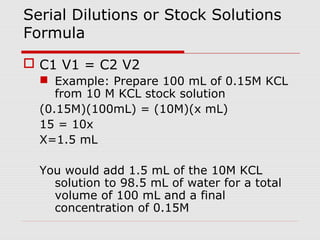
Serial Dilutions or Stock Solutions
Formula
 C1 V1 = C2 V2
 Example: Prepare 100 mL of 0.15M KCL
from 10 M KCL stock solution
(0.15M)(100mL) = (10M)(x mL)
15 = 10x
X=1.5 mL
You would add 1.5 mL of the 10M KCL
solution to 98.5 mL of water for a total
volume of 100 mL and a final
concentration of 0.15M
Serial Dilutions
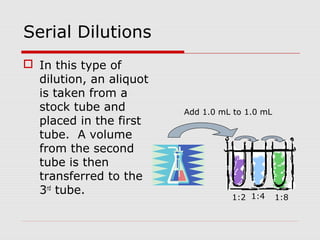
 In this type of
dilution, an aliquot
is taken from a
stock tube and
placed in the first
tube. A volume
from the second
tube is then
transferred to the
3rd
tube.
1:2
Add 1.0 mL to 1.0 mL
1:4 1:8

Making solutions

  • 1.
  • 2.
    Introduction  Making solutionsis important in any area of biotechnology  R&D QC Mfg  Accuracy is critical as an incorrect solution can destroy months or years worth of work and could delay a critical drug from being available to the market place
  • 3.
    Key Terms  Solute:substances that are dissolved  Solvent: substances in which solutes are dissolved (often times this is water or a buffer)  Concentration: amount per volume  Solution: a homogeneous mixture in which one or more substances are dissolved in another.
  • 4.
    Concentration 5 mL If eachstar represents 1 mg of NaCl, what is the total amt. of NaCl in the tube? What is the conc. of NaCl in the tube in mg/mL? 4 mg 4 mg / 5mL = 0.8 mg/mL
  • 5.
    Calculations  There area few equations you need to remember in order to determine the required amount of solute and solvent required.  Take your time with your calculations  Remember to cancel units  Ask yourself if the answer makes sense  Record all calculations and formulas used
  • 6.
    Weight per Volume Simplest way of expressing a concentration  Example: 2mg / mL  2mg is the weight of something in 1 mL of solvent
  • 7.
    Percents  May beexpressed as weight per volume which is grams per 100 mL (w/v%)  Example: 20 grams of KCL in 100 mL of solvent is a 20% solution (w/v)
  • 8.
    Practice Problem  Howwould you prepare 500 mL of a 5% (w/v) solution of NaCl?  5% = 5g/100mL  5 = x 100 500mL 100x = 2500 x=25grams of NaCl  Weigh out 25 grams of NaCl and add it to a 500 mL volumetric flask. Add approximately 400 mL and mix. Once dissolved, QS to 500 mL. Cap and store.
  • 9.
    Percents continued  Maybe expressed in volume percent which is (v/v): mL of solute 100 mL of solvent  May be expressed in weight per weight which is (w/w): grams solute 100 grams solvent
  • 10.
    Practice Problem  Howwould you make 500 grams of a 5% solution of NaCl by weight (w/w)? % strength is 5% w/w, total weight is 500 grams 5 grams x 500 g = 25 grams of NaCl 100 grams 500 grams total weight – 25 grams NaCl = 475 grams of solvent needed Weigh out 25 grams of NaCl and add it to 475 grams of water.
  • 11.
    Molarity  Most commonsolution calculation used  Definition: molarity (M) is equal to the number of moles of solute that are dissolved per Liter of solvent.  In order to calculate molarity, you need to know moles.  Definition: moles are the molecular weight or formula weight of a particular chemical.  FW or MW can be found on the chemical bottle or by adding up atomic weights of each atom in that molecule.  For example: what is the MW of H20  2x1 + 16 = 18
  • 12.
    Practice Calculations  Whatis the MW for Sulfuric Acid?  H2SO4  2 x 1.00 = 2.00  1 x 32.06= 32.06  4 x 16 = 64.00 98.06  A 1M solution of sulfuric acid contains 98.06 g of sulfuric acid in 1 L of total solution  Mole is an expression of amount  Molarity is an expression of concentration
  • 13.
    Key unit conversions Millimolar (mM)  A millimole is 1/1000 of a mole  Micromolar (µM)  A µmole is 1/1,000,000 of a mole
  • 14.
    Practice Problem  Prepare100 mL of a 0.1M Tris buffer  Step 1: what is the MW of Tris  FW = 121.1 g/mole  What formula are you going to use  Molarity  moles per liter  121.1 grams per 1L or 1000 mL = moles  How much Tris are you going to weight out?
  • 15.
    Practice Problem continued Start with what you know  1M = 121.1 grams/1L  To make 100 mL of 0.1M solution you would add how much Tris buffer?  Formula= FW x molarity x volume (L) = g needed 121.1 x 0.1 x 0.1L = 1.211 grams Tris Weight out 1.211 grams of Tris and add it to 80 mL of water, mix and QS to 100 mL of 0.1M Tris soln.
  • 16.
    Practice Problem  Howmuch solute is required to make 400 mL of 0.8 M CaCl2  First what is the FW of CaCl2?  40.08 + (35.45x2) = 110.98  110.98 x 0.8 x 0.4L = 35.51 grams CaCl2 required  Weigh out 35.51 grams CaCl2 and add it to approximately 300 mL of water. Mix and then QS to 400 mL using a graduated cylinder.
  • 17.
    Preparing dilute solutionsfrom concentrated solutions  Formula: C1xV1 = C2xV2  C1: concentration of stock solution  V1: volume of stock solution required  C2: concentration you want your dilute solution to be  V2: how much of the dilute solution is required
  • 18.
    Practice Problem  Howwould you prepare 500 mL of a 1M Tris buffer from a 3M stock solution?  What is C1? 3M  What is V1? Unknown  What is C2? 1M  What is V2? 500 mL  3x = 1(500)  X=166.67 mL  Measure 166.67 mL of 3M Tris and add it to 333.33 mL of water to make 500 mL of 1M Tris
  • 19.
    Serial Dilutions orStock Solutions Formula  C1 V1 = C2 V2  Example: Prepare 100 mL of 0.15M KCL from 10 M KCL stock solution (0.15M)(100mL) = (10M)(x mL) 15 = 10x X=1.5 mL You would add 1.5 mL of the 10M KCL solution to 98.5 mL of water for a total volume of 100 mL and a final concentration of 0.15M
  • 20.
    Serial Dilutions  Inthis type of dilution, an aliquot is taken from a stock tube and placed in the first tube. A volume from the second tube is then transferred to the 3rd tube. 1:2 Add 1.0 mL to 1.0 mL 1:4 1:8