Chemistry Semester 1 Jeopardy
Unit 1 100 Unit 5 Unit 4 Unit 3 Unit 2 200 300 400 500 100 100 100 100 200 300 400 500 200 300 400 500 200 200 300 300 400 400 500 500
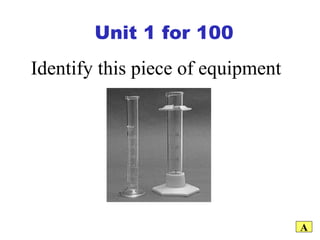
Identify this piece of equipment A Unit 1 for 100
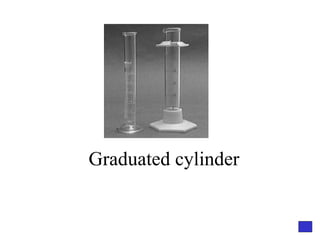
Graduated cylinder
How many significant figures are in 0.0024030? A Unit 1 for 200
How many significant figures are in 0.00 24030 ? Five significant figures
Convert 150 mm into km A Unit 1 for 300
Convert 150 mm into km 0.000150 km
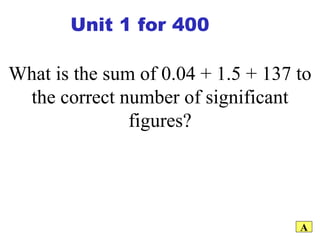
What is the sum of 0.04 + 1.5 + 137 to the correct number of significant figures? A Unit 1 for 400
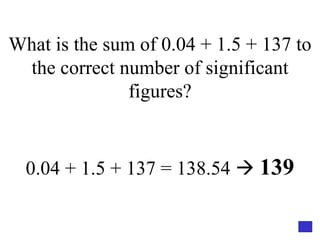
What is the sum of 0.04 + 1.5 + 137 to the correct number of significant figures? 0.04 + 1.5 + 137 = 138.54     139
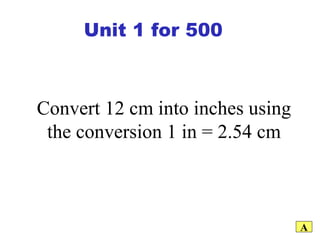
Convert 12 cm into inches using the conversion 1 in = 2.54 cm A Unit 1 for 500
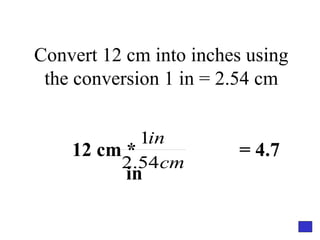
Convert 12 cm into inches using the conversion 1 in = 2.54 cm 12 cm *  = 4.7 in
Color is what type of property? A Unit 2 for 100
Color is what type of property? Physical Property
Freezing of water is what kind of change? A Unit 2 for 200
Freezing of water is what kind of change? Physical change
Define heterogeneous A Unit 2 for 300
Define heterogeneous A mixture with two or more distinctive parts (salad, pepperoni pizza)
What are the five ways to verify a chemical reaction? A Category 2 for 400
What are the five ways to verify a chemical reaction? Light emitted Heat emitted/absorbed Precipitate formed Bubbles produced Color Change
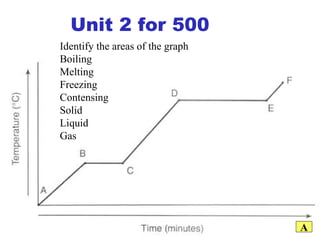
A Unit 2 for 500 Identify the areas of the graph Boiling Melting Freezing Contensing Solid Liquid Gas
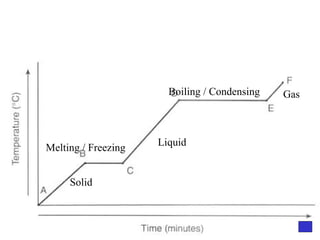
Solid Gas Liquid Boiling / Condensing Melting / Freezing
What is a positive ion called? A Unit 3 for 100
What is a positive ion called? A cation
Which particles are responsible for the mass of an atom? A Unit 3 for 200
Which particles are responsible for the mass of an atom? Protons & neutrons
How many neutrons are present in an atom of carbon with a mass of 14? A Unit 3 for 300
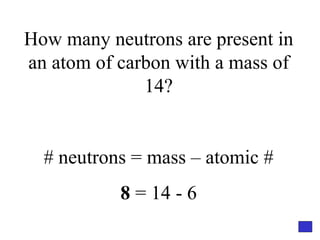
How many neutrons are present in an atom of carbon with a mass of 14? # neutrons = mass – atomic # 8  = 14 - 6
What is the correct symbol for an element with 11 protons, 10 electrons and 9 neutrons? A Unit 3 for 400
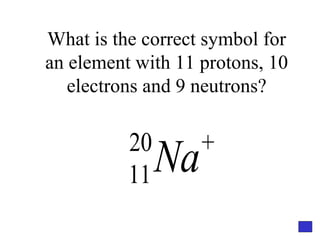
What is the correct symbol for an element with 11 protons, 10 electrons and 9 neutrons?
Explain Rutherford’s Gold Foil experiment and what he discovered about the atom A Unit 3 for 500
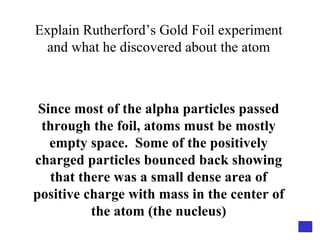
Explain Rutherford’s Gold Foil experiment and what he discovered about the atom Since most of the alpha particles passed through the foil, atoms must be mostly empty space.  Some of the positively charged particles bounced back showing that there was a small dense area of positive charge with mass in the center of the atom (the nucleus)
What part of a radioactive atom is unstable? A Unit 4 for 100
What part of a radioactive atom is unstable? The nucleus
The half life of radon-222 is 20 minutes.  After how many minutes is there only 12.5% of the parent isotope left?  A Unit 4 for 200
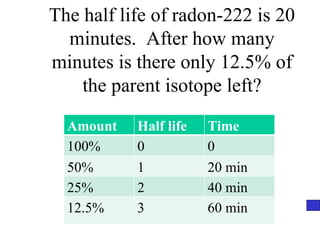
The half life of radon-222 is 20 minutes.  After how many minutes is there only 12.5% of the parent isotope left? Amount Half life Time 100% 0 0 50% 1 20 min 25% 2 40 min 12.5% 3 60 min
What particle is emitted when cabon-14 decays into nitrogen-14? A Unit 4 for 300
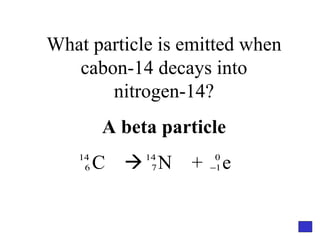
What particle is emitted when cabon-14 decays into nitrogen-14? A beta particle C    N  +  e
Which two types of decay produce the same product? A Unit 4 for 400
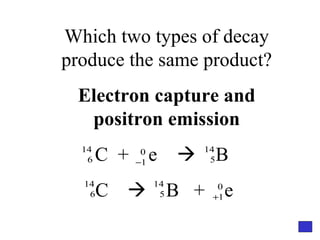
Which two types of decay produce the same product? Electron capture and positron emission C  +  e     B  C    B  +  e
Describe the mass and atomic number of an alpha particle AND its penetrating power A Unit 4 for 500
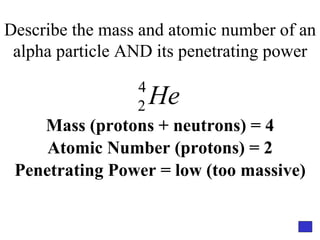
Describe the mass and atomic number of an alpha particle AND its penetrating power Mass (protons + neutrons) = 4 Atomic Number (protons) = 2 Penetrating Power = low (too massive)
What is the charge on an atom in group 5? A Unit 5 for 100
What is the charge on an atom in group 5? An atom in group 5 has 5 valence electrons, it wants to gain 3 more.  The charge will be -3
Give the electron configuration for Bromine A Unit 5 for 200
Give the electron configuration for Bromine Full: 1s 2 2s 2 2p 6 3s 2 3p 6 4s 2 3d 10 4p 5 Noble Gas Shorthand: [Ar] 4s 2 3d 10 4p 5
What happens to atomic radius (size) moving down a group? WHY? A Unit 5 for 300
What happens to atomic radius (size) moving down a group? Down a group the radius  increases  because each new period requires the use of new orbitals (1s to 2s to 3s…etc)
What happens to the atomic radius (size) moving across a period to the right? WHY? A Unit 5 for 400
What happens to the atomic radius (size) moving across a period to the right? The size of an atoms gets  smaller  moving across a period because the number of protons increase, pulling the electrons in the orbital in tighter
Is the trend for ionization energy the same or the opposite of the trend for atomic radius?  WHY? A Unit 5 for 500
Is the trend for ionization energy the same or the opposite of the trend for atomic radius?  WHY? The trend for ionization energy is  OPPOSITE ; as the size (radius) of the atom increases it is easier to remove an electron- therefore the energy required to form an ion is lower

Semester 1 Review Jeopardy

  • 1.
  • 2.
    Unit 1 100Unit 5 Unit 4 Unit 3 Unit 2 200 300 400 500 100 100 100 100 200 300 400 500 200 300 400 500 200 200 300 300 400 400 500 500
  • 3.
    Identify this pieceof equipment A Unit 1 for 100
  • 4.
  • 5.
    How many significantfigures are in 0.0024030? A Unit 1 for 200
  • 6.
    How many significantfigures are in 0.00 24030 ? Five significant figures
  • 7.
    Convert 150 mminto km A Unit 1 for 300
  • 8.
    Convert 150 mminto km 0.000150 km
  • 9.
    What is thesum of 0.04 + 1.5 + 137 to the correct number of significant figures? A Unit 1 for 400
  • 10.
    What is thesum of 0.04 + 1.5 + 137 to the correct number of significant figures? 0.04 + 1.5 + 137 = 138.54  139
  • 11.
    Convert 12 cminto inches using the conversion 1 in = 2.54 cm A Unit 1 for 500
  • 12.
    Convert 12 cminto inches using the conversion 1 in = 2.54 cm 12 cm * = 4.7 in
  • 13.
    Color is whattype of property? A Unit 2 for 100
  • 14.
    Color is whattype of property? Physical Property
  • 15.
    Freezing of wateris what kind of change? A Unit 2 for 200
  • 16.
    Freezing of wateris what kind of change? Physical change
  • 17.
    Define heterogeneous AUnit 2 for 300
  • 18.
    Define heterogeneous Amixture with two or more distinctive parts (salad, pepperoni pizza)
  • 19.
    What are thefive ways to verify a chemical reaction? A Category 2 for 400
  • 20.
    What are thefive ways to verify a chemical reaction? Light emitted Heat emitted/absorbed Precipitate formed Bubbles produced Color Change
  • 21.
    A Unit 2for 500 Identify the areas of the graph Boiling Melting Freezing Contensing Solid Liquid Gas
  • 22.
    Solid Gas LiquidBoiling / Condensing Melting / Freezing
  • 23.
    What is apositive ion called? A Unit 3 for 100
  • 24.
    What is apositive ion called? A cation
  • 25.
    Which particles areresponsible for the mass of an atom? A Unit 3 for 200
  • 26.
    Which particles areresponsible for the mass of an atom? Protons & neutrons
  • 27.
    How many neutronsare present in an atom of carbon with a mass of 14? A Unit 3 for 300
  • 28.
    How many neutronsare present in an atom of carbon with a mass of 14? # neutrons = mass – atomic # 8 = 14 - 6
  • 29.
    What is thecorrect symbol for an element with 11 protons, 10 electrons and 9 neutrons? A Unit 3 for 400
  • 30.
    What is thecorrect symbol for an element with 11 protons, 10 electrons and 9 neutrons?
  • 31.
    Explain Rutherford’s GoldFoil experiment and what he discovered about the atom A Unit 3 for 500
  • 32.
    Explain Rutherford’s GoldFoil experiment and what he discovered about the atom Since most of the alpha particles passed through the foil, atoms must be mostly empty space. Some of the positively charged particles bounced back showing that there was a small dense area of positive charge with mass in the center of the atom (the nucleus)
  • 33.
    What part ofa radioactive atom is unstable? A Unit 4 for 100
  • 34.
    What part ofa radioactive atom is unstable? The nucleus
  • 35.
    The half lifeof radon-222 is 20 minutes. After how many minutes is there only 12.5% of the parent isotope left? A Unit 4 for 200
  • 36.
    The half lifeof radon-222 is 20 minutes. After how many minutes is there only 12.5% of the parent isotope left? Amount Half life Time 100% 0 0 50% 1 20 min 25% 2 40 min 12.5% 3 60 min
  • 37.
    What particle isemitted when cabon-14 decays into nitrogen-14? A Unit 4 for 300
  • 38.
    What particle isemitted when cabon-14 decays into nitrogen-14? A beta particle C  N + e
  • 39.
    Which two typesof decay produce the same product? A Unit 4 for 400
  • 40.
    Which two typesof decay produce the same product? Electron capture and positron emission C + e  B C  B + e
  • 41.
    Describe the massand atomic number of an alpha particle AND its penetrating power A Unit 4 for 500
  • 42.
    Describe the massand atomic number of an alpha particle AND its penetrating power Mass (protons + neutrons) = 4 Atomic Number (protons) = 2 Penetrating Power = low (too massive)
  • 43.
    What is thecharge on an atom in group 5? A Unit 5 for 100
  • 44.
    What is thecharge on an atom in group 5? An atom in group 5 has 5 valence electrons, it wants to gain 3 more. The charge will be -3
  • 45.
    Give the electronconfiguration for Bromine A Unit 5 for 200
  • 46.
    Give the electronconfiguration for Bromine Full: 1s 2 2s 2 2p 6 3s 2 3p 6 4s 2 3d 10 4p 5 Noble Gas Shorthand: [Ar] 4s 2 3d 10 4p 5
  • 47.
    What happens toatomic radius (size) moving down a group? WHY? A Unit 5 for 300
  • 48.
    What happens toatomic radius (size) moving down a group? Down a group the radius increases because each new period requires the use of new orbitals (1s to 2s to 3s…etc)
  • 49.
    What happens tothe atomic radius (size) moving across a period to the right? WHY? A Unit 5 for 400
  • 50.
    What happens tothe atomic radius (size) moving across a period to the right? The size of an atoms gets smaller moving across a period because the number of protons increase, pulling the electrons in the orbital in tighter
  • 51.
    Is the trendfor ionization energy the same or the opposite of the trend for atomic radius? WHY? A Unit 5 for 500
  • 52.
    Is the trendfor ionization energy the same or the opposite of the trend for atomic radius? WHY? The trend for ionization energy is OPPOSITE ; as the size (radius) of the atom increases it is easier to remove an electron- therefore the energy required to form an ion is lower