PREPARING SOLUTIONS AND
REAGENTS
Chemical Solutions
(aqueous = water is the solvent)
Types of vessels (least to most precise):
 Beaker
 Erlennmeyer flask
 Graduated cylinder
 Volumetric flask
DEFINITIONS:
• SOLUTES -- substances that are
dissolved
• SOLVENTS -- substance in which
solutes are dissolved (usually water)
• AMOUNT -- how much
Goals
• Make solutions
• Dilute solutions
• Convert between different concentrations
of solutions
Facts of Life
• Mass is measured in Grams, mg, μg
1g = 1000mg = 1,000,000µg
• Volume is measured in liters, mL, μL
1L = 1000mL = 1,000,000 μL
• Density of water is 1 g / mL
Facts of life (cont’d)
• Concentration means: amount of solute in
a volume of solution
• Expressed in many ways:
– 1. percent
– 2. mg/ mL
– 3. molar
– 4. “X” solution
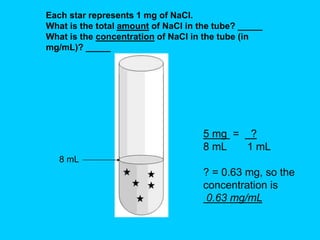
Each star represents 1 mg of NaCl.
What is the total amount of NaCl in the tube? _____
What is the concentration of NaCl in the tube (in
mg/mL)? _____
8 mL
5 mg = ?
8 mL 1 mL
? = 0.63 mg, so the
concentration is
0.63 mg/mL
Percent Solutions
• Per means “for every one”
• Cent means 100
• Example: a 5% sugar solution has
5 grams of sugar for 100g of solution, or
5g 100 g of water = 100 mL, and the
100mL solution is mostly water.
Make 250 mL of a 3% starch
solution
3 g / 100 g = 3 g / 100 mL because density of
water is 1 g / mL
Set up a ratio:
3 g / 100 mL = ?g / 250 mL
Use 7.5 g of starch and bring to a volume of (BTV)
250 mL with distilled water
• 5 mg/mL has 5 milligrams of solute in 1
milliliter of solution
mg / mL Solutions
Set up a ratio:
3 mg / 1 mL = ?mg / 250 mL
Use 750 mg of starch and bring to a volume
of (BTV) 250 mL with distilled water
Make a 250 mL of a 3 mg /mL
starch solution
Molar Solutions
• 1 mole is 6.02 x 10²³ items
• Molecular weight or Formula weight is
really the mass of 1 mole of molecules
(see periodic table)
Example: 1 mol of sodium chloride (NaCl)
has a mass of 58.44 g.
MOLARITY
• Molarity is: number of moles of a solute
that are dissolved per liter of total solution.
• A 1 M solution contains 1 mole of
solute per liter total volume.
MOLE
• How much is a mole?
EXAMPLE: SULFURIC ACID
For a particular compound, add the atomic weights
of the atoms that compose the compound.
H2SO4:
2 hydrogen atoms 2 X 1.00 g = 2.00 g
1 sulfur atom 1 X 32.06 g = 32.06 g
4 oxygen atoms 4 X 16.00 g = 64.00 g
98.06 g
EXAMPLE CONTINUED
• A 1M solution of sulfuric acid contains
98.06 g of sulfuric acid in 1 liter of total
solution.
• "mole" is an expression of amount
• "molarity" is an expression of
concentration.
DEFINITIONS
• "Millimolar", mM, millimole/L.
– A millimole is 1/1000 of a mole.
• "Micromolar", µM, µmole/L.
– A µmole is 1/1,000,000 of a mole.
FORMULA
HOW MUCH SOLUTE IS NEEDED FOR A SOLUTION OF
A PARTICULAR MOLARITY AND VOLUME?
(g solute ) X (mole) X (L) = g solute needed
1 mole L
or
FW X molarity x volume = g solute needed
EXAMPLE
How much solute is required to make 300
mL of 0.8 M CaCl2?
ANSWER
(111.0 g) x (0.8 mole) x (0.3 L) = 26.64 g
mole L
• Make 250 mL of a 3 molar NaCl solution
58.44g x 3 moles x 0.25 L = ? g
1 mole 1 L
? = 43.8g of NaCl
BTV of 250 mL
“X” solutions
• X means times
• A 40X buffer solution is 40 times more
concentrated than the standard working
solution
• Stock solutions / concentrates
• How much stock solution you need =
total volume you need divided by
the “X” number
Diluting Solutions
• Conc 1 x Vol. 1 = Conc 2 x Vol 2
• Usually want 1 X solutions
Example: Frozen Orange Juice
• Solution 1 is the frozen concentrate
• Solution 2 is the 1X juice you drink
• How concentrated is it?
• C1 V1 = C2 V2
• (? X) (250mL) = (1X) (1000 mL)
Answer:
Frozen OJ is 4X because ¼ of the
final volume is the concentrated oj
Example: bleach sterilant
• Solution 1 is 100% bleach – stock solution
• Solution 2 is 6% bleach – what you want
• How do you make 350 mL of 6% bleach?
• C1 V1 = C2 V2
• (100%) (?) = (6%) (350 mL)
Answer:
You need 21 mL of 100% bleach
BTV 350 mL.

Solutions.ppt

  • 1.
  • 2.
    Chemical Solutions (aqueous =water is the solvent) Types of vessels (least to most precise):  Beaker  Erlennmeyer flask  Graduated cylinder  Volumetric flask
  • 3.
    DEFINITIONS: • SOLUTES --substances that are dissolved • SOLVENTS -- substance in which solutes are dissolved (usually water) • AMOUNT -- how much
  • 4.
    Goals • Make solutions •Dilute solutions • Convert between different concentrations of solutions
  • 5.
    Facts of Life •Mass is measured in Grams, mg, μg 1g = 1000mg = 1,000,000µg • Volume is measured in liters, mL, μL 1L = 1000mL = 1,000,000 μL • Density of water is 1 g / mL
  • 6.
    Facts of life(cont’d) • Concentration means: amount of solute in a volume of solution • Expressed in many ways: – 1. percent – 2. mg/ mL – 3. molar – 4. “X” solution
  • 7.
    Each star represents1 mg of NaCl. What is the total amount of NaCl in the tube? _____ What is the concentration of NaCl in the tube (in mg/mL)? _____ 8 mL 5 mg = ? 8 mL 1 mL ? = 0.63 mg, so the concentration is 0.63 mg/mL
  • 8.
    Percent Solutions • Permeans “for every one” • Cent means 100 • Example: a 5% sugar solution has 5 grams of sugar for 100g of solution, or 5g 100 g of water = 100 mL, and the 100mL solution is mostly water.
  • 9.
    Make 250 mLof a 3% starch solution 3 g / 100 g = 3 g / 100 mL because density of water is 1 g / mL Set up a ratio: 3 g / 100 mL = ?g / 250 mL Use 7.5 g of starch and bring to a volume of (BTV) 250 mL with distilled water
  • 10.
    • 5 mg/mLhas 5 milligrams of solute in 1 milliliter of solution mg / mL Solutions
  • 11.
    Set up aratio: 3 mg / 1 mL = ?mg / 250 mL Use 750 mg of starch and bring to a volume of (BTV) 250 mL with distilled water Make a 250 mL of a 3 mg /mL starch solution
  • 12.
    Molar Solutions • 1mole is 6.02 x 10²³ items • Molecular weight or Formula weight is really the mass of 1 mole of molecules (see periodic table) Example: 1 mol of sodium chloride (NaCl) has a mass of 58.44 g.
  • 13.
    MOLARITY • Molarity is:number of moles of a solute that are dissolved per liter of total solution. • A 1 M solution contains 1 mole of solute per liter total volume.
  • 14.
  • 15.
    EXAMPLE: SULFURIC ACID Fora particular compound, add the atomic weights of the atoms that compose the compound. H2SO4: 2 hydrogen atoms 2 X 1.00 g = 2.00 g 1 sulfur atom 1 X 32.06 g = 32.06 g 4 oxygen atoms 4 X 16.00 g = 64.00 g 98.06 g
  • 16.
    EXAMPLE CONTINUED • A1M solution of sulfuric acid contains 98.06 g of sulfuric acid in 1 liter of total solution. • "mole" is an expression of amount • "molarity" is an expression of concentration.
  • 17.
    DEFINITIONS • "Millimolar", mM,millimole/L. – A millimole is 1/1000 of a mole. • "Micromolar", µM, µmole/L. – A µmole is 1/1,000,000 of a mole.
  • 18.
    FORMULA HOW MUCH SOLUTEIS NEEDED FOR A SOLUTION OF A PARTICULAR MOLARITY AND VOLUME? (g solute ) X (mole) X (L) = g solute needed 1 mole L or FW X molarity x volume = g solute needed
  • 19.
    EXAMPLE How much soluteis required to make 300 mL of 0.8 M CaCl2?
  • 20.
    ANSWER (111.0 g) x(0.8 mole) x (0.3 L) = 26.64 g mole L
  • 21.
    • Make 250mL of a 3 molar NaCl solution 58.44g x 3 moles x 0.25 L = ? g 1 mole 1 L ? = 43.8g of NaCl BTV of 250 mL
  • 22.
    “X” solutions • Xmeans times • A 40X buffer solution is 40 times more concentrated than the standard working solution • Stock solutions / concentrates • How much stock solution you need = total volume you need divided by the “X” number
  • 23.
    Diluting Solutions • Conc1 x Vol. 1 = Conc 2 x Vol 2 • Usually want 1 X solutions
  • 24.
    Example: Frozen OrangeJuice • Solution 1 is the frozen concentrate • Solution 2 is the 1X juice you drink • How concentrated is it? • C1 V1 = C2 V2 • (? X) (250mL) = (1X) (1000 mL)
  • 25.
    Answer: Frozen OJ is4X because ¼ of the final volume is the concentrated oj
  • 26.
    Example: bleach sterilant •Solution 1 is 100% bleach – stock solution • Solution 2 is 6% bleach – what you want • How do you make 350 mL of 6% bleach? • C1 V1 = C2 V2 • (100%) (?) = (6%) (350 mL)
  • 27.
    Answer: You need 21mL of 100% bleach BTV 350 mL.