End Show
© Copyright Pearson Prentice Hall
Slide
1 of 46
Concentrations of Solutions
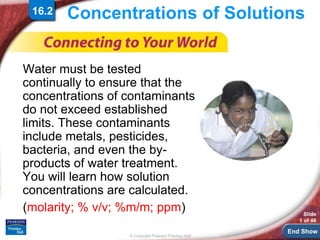
Water must be tested
continually to ensure that the
concentrations of contaminants
do not exceed established
limits. These contaminants
include metals, pesticides,
bacteria, and even the by-
products of water treatment.
You will learn how solution
concentrations are calculated.
(molarity; % v/v; %m/m; ppm)
16.2
End Show
Slide
2 of 46
© Copyright Pearson Prentice Hall
Concentrations of Solutions> Molarity
The concentration of a solution is a measure of
the amount of solute that is dissolved in a given
quantity of solvent.
• A dilute solution is one that contains a small
amount of solute.
• A concentrated solution contains a large
amount of solute.
16.2
End Show
© Copyright Pearson Prentice Hall
Concentrations of Solutions>
Slide
3 of 46
16.2 Molarity
Molarity
How do you calculate the molarity of a
solution?
End Show
Slide
4 of 46
© Copyright Pearson Prentice Hall
Concentrations of Solutions> Molarity
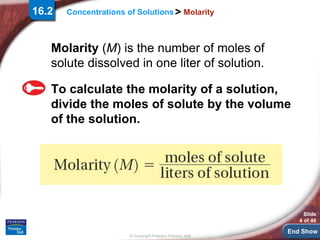
Molarity (M) is the number of moles of
solute dissolved in one liter of solution.
To calculate the molarity of a solution,
divide the moles of solute by the volume
of the solution.
16.2
End Show
Slide
5 of 46
© Copyright Pearson Prentice Hall
Concentrations of Solutions> Molarity
To make a 0.5-molar
(0.5M) solution, first
add 0.5 mol of solute
to a 1-L volumetric
flask half filled with
distilled water.
16.2
End Show
Slide
6 of 46
© Copyright Pearson Prentice Hall
Concentrations of Solutions> Molarity
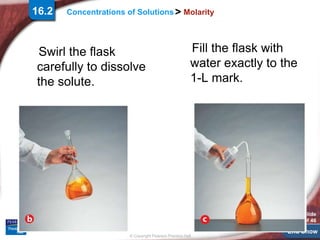
Swirl the flask
carefully to dissolve
the solute.
16.2
Fill the flask with
water exactly to the
1-L mark.
16.2
16.2
for Sample Problem 16.2
16.3
Sample Problem 16.3
16.3
for Sample Problem 16.3
End Show
© Copyright Pearson Prentice Hall
Slide
13 of 46
Concentrations of Solutions>
16.2 Making Dilutions
Making Dilutions
What effect does dilution have on the
total moles of solute in a solution?
Diluting a solution reduces the number
of moles of solute per unit volume, but
the total number of moles of solute in
solution does not change.
End Show
Slide
14 of 46
© Copyright Pearson Prentice Hall
Concentrations of Solutions> Making Dilutions
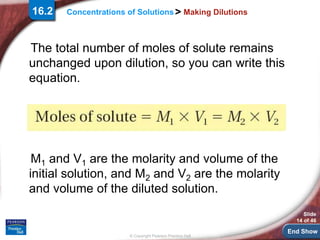
The total number of moles of solute remains
unchanged upon dilution, so you can write this
equation.
M1 and V1 are the molarity and volume of the
initial solution, and M2 and V2 are the molarity
and volume of the diluted solution.
16.2
End Show
Slide
15 of 46
© Copyright Pearson Prentice Hall
Concentrations of Solutions> Making Dilutions
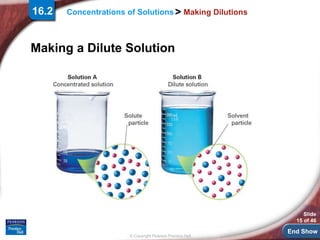
Making a Dilute Solution
16.2
End Show
Slide
16 of 46
© Copyright Pearson Prentice Hall
Concentrations of Solutions> Making Dilutions
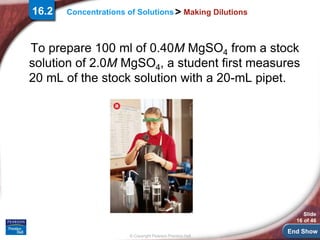
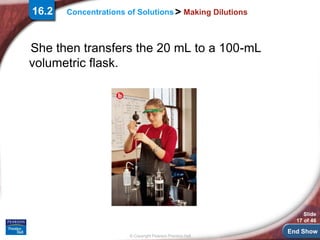
To prepare 100 ml of 0.40M MgSO4 from a stock
solution of 2.0M MgSO4, a student first measures
20 mL of the stock solution with a 20-mL pipet.
16.2
End Show
Slide
17 of 46
© Copyright Pearson Prentice Hall
Concentrations of Solutions> Making Dilutions
She then transfers the 20 mL to a 100-mL
volumetric flask.
16.2
End Show
Slide
18 of 46
© Copyright Pearson Prentice Hall
Concentrations of Solutions> Making Dilutions
Finally she carefully adds water to the mark to
make 100 mL of solution.
16.2
End Show
Slide
19 of 46
© Copyright Pearson Prentice Hall
Concentrations of Solutions> Making Dilutions
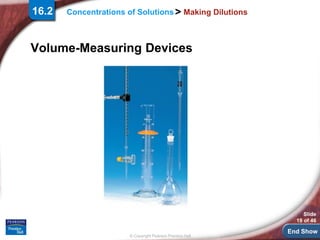
Volume-Measuring Devices
16.2
16.4
16.4
for Sample Problem 16.4
End Show
© Copyright Pearson Prentice Hall
Slide
23 of 46
Concentrations of Solutions> Percent Solutions
Percent Solutions
What are two ways to express the
percent concentration of a solution?
The concentration of a solution in
percent can be expressed in two ways:
as the ratio of the volume of the solute
to the volume of the solution or as the
ratio of the mass of the solute to the
mass of the solution.
16.2
End Show
Slide
24 of 46
© Copyright Pearson Prentice Hall
Concentrations of Solutions> Percent Solutions
Concentration in Percent (Volume/Volume)
16.2
End Show
Slide
25 of 46
© Copyright Pearson Prentice Hall
Concentrations of Solutions> Percent Solutions
Isopropyl alcohol (2-propanol) is sold as a 91%
solution. This solution consist of 91 mL of
isopropyl alcohol mixed with enough water to
make 100 mL of solution.
16.2
16.5
© Copyright Pearson Prentice Hall
SAMPLE PROBLEM
Slide
27 of 46
End Show
16.5
Practice Problems For Sample Problem 16.5
for Sample Problem 16.5
End Show
Slide
29 of 46
© Copyright Pearson Prentice Hall
Concentrations of Solutions> Percent Solutions
Concentration in percent (mass/mass)
16.2
End Show
Slide
30 of 46
© Copyright Pearson Prentice Hall
Concentrations of Solutions> Parts per million
Concentration in parts per million (ppm)
(To complete)
16.2
End Show
© Copyright Pearson Prentice Hall
Slide
31 of 46
Section Quiz
-or-
Continue to: Launch:
Assess students’ understanding
of the concepts in Section
16.2 Section Quiz.
16.1.
© Copyright Pearson Prentice Hall
Slide
32 of 46
End Show
16.2 Section Quiz.
1. To make a 1.00M aqueous solution of NaCl,
58.4 g of NaCl are dissolved in
a. 1.00 liter of water.
b. enough water to make 1.00 liter of solution
c. 1.00 kg of water.
d. 100 mL of water.
© Copyright Pearson Prentice Hall
Slide
33 of 46
End Show
16.2 Section Quiz.
2. What mass of sodium iodide (NaI) is contained
in 250 mL of a 0.500M solution?
a. 150 g
b. 75.0 g
c. 18.7 g
d. 0.50 g
© Copyright Pearson Prentice Hall
Slide
34 of 46
End Show
16.2 Section Quiz.
3. Diluting a solution does NOT change which of
the following?
a. concentration
b. volume
c. milliliters of solvent
d. moles of solute
© Copyright Pearson Prentice Hall
Slide
35 of 46
End Show
16.2 Section Quiz.
4. In a 2000 g solution of glucose that is labeled
5.0% (m/m), the mass of water is
a. 2000 g.
b. 100 g.
c. 1995 g.
d. 1900 g.
© Copyright Pearson Prentice Hall
Slide
36 of 46
End Show
16.2 Section Quiz.
4. In a 2000 g solution of glucose that is labeled
4.0 ppm, the mass of glucose is
a. 2000 g.
b. 100 g.
c. 1995 g.
d. 0.0080 g.
END OF SHOW

chapter16_section02_editedsmbsolutionscalculations.ppt

  • 1.
    End Show © CopyrightPearson Prentice Hall Slide 1 of 46 Concentrations of Solutions Water must be tested continually to ensure that the concentrations of contaminants do not exceed established limits. These contaminants include metals, pesticides, bacteria, and even the by- products of water treatment. You will learn how solution concentrations are calculated. (molarity; % v/v; %m/m; ppm) 16.2
  • 2.
    End Show Slide 2 of46 © Copyright Pearson Prentice Hall Concentrations of Solutions> Molarity The concentration of a solution is a measure of the amount of solute that is dissolved in a given quantity of solvent. • A dilute solution is one that contains a small amount of solute. • A concentrated solution contains a large amount of solute. 16.2
  • 3.
    End Show © CopyrightPearson Prentice Hall Concentrations of Solutions> Slide 3 of 46 16.2 Molarity Molarity How do you calculate the molarity of a solution?
  • 4.
    End Show Slide 4 of46 © Copyright Pearson Prentice Hall Concentrations of Solutions> Molarity Molarity (M) is the number of moles of solute dissolved in one liter of solution. To calculate the molarity of a solution, divide the moles of solute by the volume of the solution. 16.2
  • 5.
    End Show Slide 5 of46 © Copyright Pearson Prentice Hall Concentrations of Solutions> Molarity To make a 0.5-molar (0.5M) solution, first add 0.5 mol of solute to a 1-L volumetric flask half filled with distilled water. 16.2
  • 6.
    End Show Slide 6 of46 © Copyright Pearson Prentice Hall Concentrations of Solutions> Molarity Swirl the flask carefully to dissolve the solute. 16.2 Fill the flask with water exactly to the 1-L mark.
  • 7.
  • 8.
  • 9.
  • 10.
  • 11.
  • 12.
  • 13.
    End Show © CopyrightPearson Prentice Hall Slide 13 of 46 Concentrations of Solutions> 16.2 Making Dilutions Making Dilutions What effect does dilution have on the total moles of solute in a solution? Diluting a solution reduces the number of moles of solute per unit volume, but the total number of moles of solute in solution does not change.
  • 14.
    End Show Slide 14 of46 © Copyright Pearson Prentice Hall Concentrations of Solutions> Making Dilutions The total number of moles of solute remains unchanged upon dilution, so you can write this equation. M1 and V1 are the molarity and volume of the initial solution, and M2 and V2 are the molarity and volume of the diluted solution. 16.2
  • 15.
    End Show Slide 15 of46 © Copyright Pearson Prentice Hall Concentrations of Solutions> Making Dilutions Making a Dilute Solution 16.2
  • 16.
    End Show Slide 16 of46 © Copyright Pearson Prentice Hall Concentrations of Solutions> Making Dilutions To prepare 100 ml of 0.40M MgSO4 from a stock solution of 2.0M MgSO4, a student first measures 20 mL of the stock solution with a 20-mL pipet. 16.2
  • 17.
    End Show Slide 17 of46 © Copyright Pearson Prentice Hall Concentrations of Solutions> Making Dilutions She then transfers the 20 mL to a 100-mL volumetric flask. 16.2
  • 18.
    End Show Slide 18 of46 © Copyright Pearson Prentice Hall Concentrations of Solutions> Making Dilutions Finally she carefully adds water to the mark to make 100 mL of solution. 16.2
  • 19.
    End Show Slide 19 of46 © Copyright Pearson Prentice Hall Concentrations of Solutions> Making Dilutions Volume-Measuring Devices 16.2
  • 20.
  • 21.
  • 22.
  • 23.
    End Show © CopyrightPearson Prentice Hall Slide 23 of 46 Concentrations of Solutions> Percent Solutions Percent Solutions What are two ways to express the percent concentration of a solution? The concentration of a solution in percent can be expressed in two ways: as the ratio of the volume of the solute to the volume of the solution or as the ratio of the mass of the solute to the mass of the solution. 16.2
  • 24.
    End Show Slide 24 of46 © Copyright Pearson Prentice Hall Concentrations of Solutions> Percent Solutions Concentration in Percent (Volume/Volume) 16.2
  • 25.
    End Show Slide 25 of46 © Copyright Pearson Prentice Hall Concentrations of Solutions> Percent Solutions Isopropyl alcohol (2-propanol) is sold as a 91% solution. This solution consist of 91 mL of isopropyl alcohol mixed with enough water to make 100 mL of solution. 16.2
  • 26.
  • 27.
    © Copyright PearsonPrentice Hall SAMPLE PROBLEM Slide 27 of 46 End Show 16.5
  • 28.
    Practice Problems ForSample Problem 16.5 for Sample Problem 16.5
  • 29.
    End Show Slide 29 of46 © Copyright Pearson Prentice Hall Concentrations of Solutions> Percent Solutions Concentration in percent (mass/mass) 16.2
  • 30.
    End Show Slide 30 of46 © Copyright Pearson Prentice Hall Concentrations of Solutions> Parts per million Concentration in parts per million (ppm) (To complete) 16.2
  • 31.
    End Show © CopyrightPearson Prentice Hall Slide 31 of 46 Section Quiz -or- Continue to: Launch: Assess students’ understanding of the concepts in Section 16.2 Section Quiz. 16.1.
  • 32.
    © Copyright PearsonPrentice Hall Slide 32 of 46 End Show 16.2 Section Quiz. 1. To make a 1.00M aqueous solution of NaCl, 58.4 g of NaCl are dissolved in a. 1.00 liter of water. b. enough water to make 1.00 liter of solution c. 1.00 kg of water. d. 100 mL of water.
  • 33.
    © Copyright PearsonPrentice Hall Slide 33 of 46 End Show 16.2 Section Quiz. 2. What mass of sodium iodide (NaI) is contained in 250 mL of a 0.500M solution? a. 150 g b. 75.0 g c. 18.7 g d. 0.50 g
  • 34.
    © Copyright PearsonPrentice Hall Slide 34 of 46 End Show 16.2 Section Quiz. 3. Diluting a solution does NOT change which of the following? a. concentration b. volume c. milliliters of solvent d. moles of solute
  • 35.
    © Copyright PearsonPrentice Hall Slide 35 of 46 End Show 16.2 Section Quiz. 4. In a 2000 g solution of glucose that is labeled 5.0% (m/m), the mass of water is a. 2000 g. b. 100 g. c. 1995 g. d. 1900 g.
  • 36.
    © Copyright PearsonPrentice Hall Slide 36 of 46 End Show 16.2 Section Quiz. 4. In a 2000 g solution of glucose that is labeled 4.0 ppm, the mass of glucose is a. 2000 g. b. 100 g. c. 1995 g. d. 0.0080 g.
  • 37.