Digital Communication
Dr. S. M. Gulhane
Principal,
Pravara Rural Engineering College, Loni, Ahmednagar
Savitribai Phule Pune University, Maharashtra, India
Unit-2 : Channel Coding
1 1
0
0
1
1
0
1
1
0
0
0
1
Channel Coding
Channel Coding
2
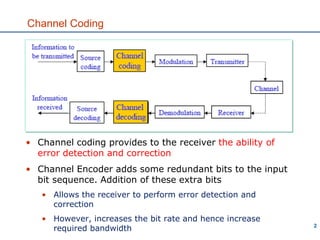
• Channel coding provides to the receiver the ability of
error detection and correction
• Channel Encoder adds some redundant bits to the input
bit sequence. Addition of these extra bits
• Allows the receiver to perform error detection and
correction
• However, increases the bit rate and hence increase
required bandwidth
Types of Error Control
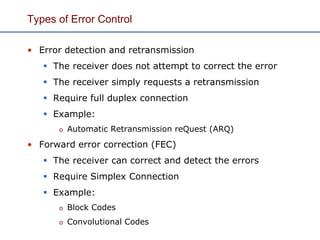
• Error detection and retransmission
 The receiver does not attempt to correct the error
 The receiver simply requests a retransmission
 Require full duplex connection
 Example:
o Automatic Retransmission reQuest (ARQ)
• Forward error correction (FEC)
 The receiver can correct and detect the errors
 Require Simplex Connection
 Example:
o Block Codes
o Convolutional Codes
4
Linear block codes
• The information bit stream is divided into blocks of k bits.
• Each block is encoded to a larger block of n bits.
• The coded bits are modulated and sent over channel.
• The reverse procedure is done at the receiver.
• Structure of Codeword
Data block
Channel
encoder
Codeword
k bits n bits
p1, p2,……pn-k m1m2,….mk
n-k parity bits k message bits
n bit codeword
Error Control Coding
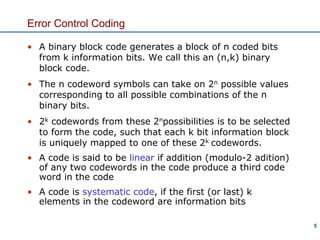
• A binary block code generates a block of n coded bits
from k information bits. We call this an (n,k) binary
block code.
• The n codeword symbols can take on 2n possible values
corresponding to all possible combinations of the n
binary bits.
• 2k codewords from these 2npossibilities is to be selected
to form the code, such that each k bit information block
is uniquely mapped to one of these 2k codewords.
• A code is said to be linear if addition (modulo-2 adition)
of any two codewords in the code produce a third code
word in the code
• A code is systematic code, if the first (or last) k
elements in the codeword are information bits
5
Linear Block Code
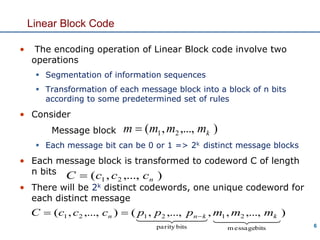
• The encoding operation of Linear Block code involve two
operations
 Segmentation of information sequences
 Transformation of each message block into a block of n bits
according to some predetermined set of rules
• Consider
Message block
 Each message bit can be 0 or 1 => 2k distinct message blocks
• Each message block is transformed to codeword C of length
n bits
• There will be 2k distinct codewords, one unique codeword for
each distinct message
6
),...,,,,...,,(),...,,(
bitsmessage
21
bitsparity
2121
   kknn mmmpppcccC 
),...,,( 21 kmmmm 
),...,,( 21 ncccC 
Linear Block Code
• In Systematic block code
• In matrix form
7
,...,1,
.........
.........
,22,11,
,12121111
nknknfor imc
and
mpmpmpc
mpmpmpc
ii
kknkkkkn
kkn






















100
010
001
][
,21
,22221
,11211
21





knkkk
kn
kn
k
ppp
ppp
ppp
mmmC
Linear Block Code
•
8
mGC 
matrixParity)(
matrixidentity
matrixGenerator][
knk
kkk
nkk


 
P
I
IPG
 
















100
010
001
,21
,22221
,11211





knkkk
kn
kn
k
ppp
ppp
ppp
IPG
Linear Block Code
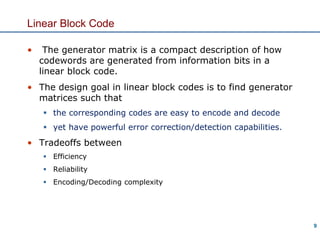
• The generator matrix is a compact description of how
codewords are generated from information bits in a
linear block code.
• The design goal in linear block codes is to find generator
matrices such that
 the corresponding codes are easy to encode and decode
 yet have powerful error correction/detection capabilities.
• Tradeoffs between
 Efficiency
 Reliability
 Encoding/Decoding complexity
9
Linear Block Code
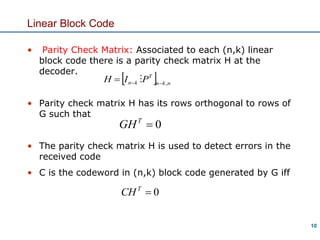
• Parity Check Matrix: Associated to each (n,k) linear
block code there is a parity check matrix H at the
decoder.
• Parity check matrix H has its rows orthogonal to rows of
G such that
• The parity check matrix H is used to detect errors in the
received code
• C is the codeword in (n,k) block code generated by G iff
10
0T
GH
  nkn
T
kn PIH , 
0T
CH
Linear Block Code
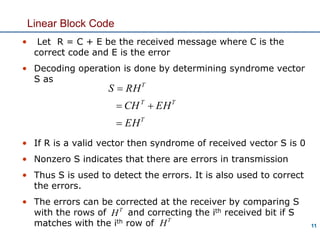
• Let R = C + E be the received message where C is the
correct code and E is the error
• Decoding operation is done by determining syndrome vector
S as
• If R is a valid vector then syndrome of received vector S is 0
• Nonzero S indicates that there are errors in transmission
• Thus S is used to detect the errors. It is also used to correct
the errors.
• The errors can be corrected at the receiver by comparing S
with the rows of and correcting the ith received bit if S
matches with the ith row of 11
T
TT
T
EH
EHCH
RHS



T
H
T
H
Linear Block Code
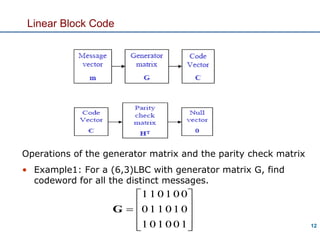
Operations of the generator matrix and the parity check matrix
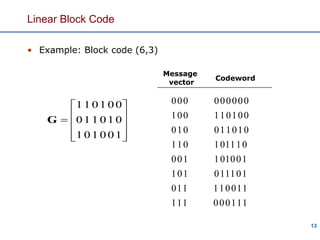
• Example1: For a (6,3)LBC with generator matrix G, find
codeword for all the distinct messages.
12










1
0
0
0
1
0
0
0
1
1
1
0
0
1
1
1
0
1
G
13
Linear Block Code
• Example: Block code (6,3)











1
0
0
0
1
0
0
0
1
1
1
0
0
1
1
1
0
1
G
1
1
1
1
1
0
0
0
0
1
0
1
1
1
1
1
1
0
1
1
0
0
0
1
1
0
1
1
1
1
1
0
0
0
1
1
1
1
0
0
0
1
1
0
1
0
0
0
1
0
0
0
1
0
1
0
0
1
1
0
0
1
0
0
0
0
1
0
0
0
1
0
Message
vector
Codeword
Linear Block Code
• In polynomial form the codeword c(x) can be written as
c(x) = m(x) g(x)
• where m(x) is the message polynomial and g(x) is the
generator polynomial, G is the generator matrix.
• G = [P | I],
• where Pi = Remainder of [xn-k+i-1/g(x)] for i=1, 2, .., k, and I
is unit matrix.
14































knkkk
kn
kn
k ppp
ppp
ppp
P
P
P
P
,21
,22221
,11211
2
1





Linear Block Code
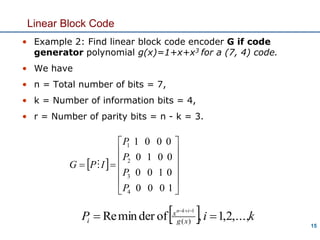
• Example 2: Find linear block code encoder G if code
generator polynomial g(x)=1+x+x3 for a (7, 4) code.
• We have
• n = Total number of bits = 7,
• k = Number of information bits = 4,
• r = Number of parity bits = n - k = 3.
15
 













1000
0100
0010
0001
4
3
2
1
P
P
P
P
IPG 
  kiP xg
x
i
ikn
,...,2,1,ofderminRe )(
1


Linear Block Code
16
• Example 3: Suppose that codeword U=101110 is transmitted and
the vector r=001110 is received. That means the leftmost bit is
received in error. Find the syndrome vector value S=rHT and
verify that is equal to eHT.











001011
010110
100101
H
Error detection and error correction capabilities
• Some important terms:
• Hamming Weight or Weight of a code vector : Number of
nonzero components in codeword
• Hamming distance: Hamming distance between two
codewords is the number of components in which they
differ.
• Minimum distance: Smallest distance between any pair of
codewords in the code
 The ability of a code to detect and correct the errors can be
specified in terms of minimum distance of the code
• Theorem: The minimum distance of a LBC is equal to the
minimum weight of any nonzero codeword in the code.
• Example4: For the code in example1 find out weights of
codewords and the minimum distance of the code.
)()( VUVU,  wd
Error detection and error correction capabilities of LBC
• Theorem: A LBC with a minimum distance dmin can detect
upto dmin -1 errors and correct upto [(dmin -1)/2] errors.
 Where [(dmin -1)/2] denotes the largest integer not greater than
(dmin -1)/2.
• Proof:
 Let C be the transmitted codeword and
 R is the received codeword.
 Let C’ be the any other codeword in the code.
• Then the Hamming distance between codeword d(C,C’),
d(C,R) and d(C’,R) satisfy
d(C,R)+ d(C’,R) ≥ d(C,C’) … 1
Let the received vector consist of t errors i.e. d(C,R)=t
Let dmin be the minimum distance of the code
d(C,C’) ≥ dmin
20
• Hamming codes
 Hamming codes are a subclass of linear block codes. It
is a single error correcting perfect code.
 To correct a single error LBC must have a minimum
distance dmin =3.
 The LBC code for which t=1 and dmin=3 is called
Hamming code.
 Hamming codes have following attributes
 Hamming Codes are simple to construct
Hamming codes
t
mk
n
m
m
1:capabilitycorrectionError
3d:distanceMinimum
12:bitsninformatioofNumber
12:lengthCode
3k-nm:bitsparityofnumber
min





• For a LBC code, the required no. of bits in the codeword for
the message block size k is given by
• Proof:
 Occurrence of single error in the ith bit of codeword implies that the
syndrome of received vector is equal to the ith row of HT
 Since we have n rows in HT, for the syndrome of all single errors to be
distinct, n rows of HT should be distinct.
While choosing H following points should be consider
 There should not be a row of zeros since syndrome of 0 error does not
correspond to error.
 The last n-k rows of HT must be chosen to form identity matrix
 Each rows of HT has n-k entries which implies 2n-k distinct rows out of
which we can use 2n-k -1 distinct rows
 Since matrix has n rows, for all of them to be distinct, we need
)1(log2  nkn
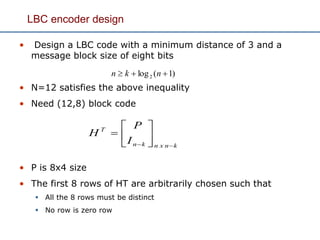
LBC encoder design
)1(log)1(log12 22 
nknnknnkn
• Design a LBC code with a minimum distance of 3 and a
message block size of eight bits
• N=12 satisfies the above inequality
• Need (12,8) block code
• P is 8x4 size
• The first 8 rows of HT are arbitrarily chosen such that
 All the 8 rows must be distinct
 No row is zero row
)1(log2  nkn
LBC encoder design
knxnkn
T
I
P
H








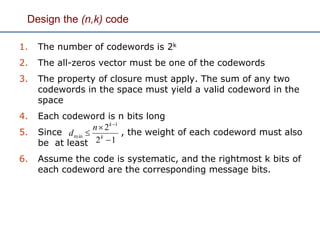
Design the (n,k) code
1. The number of codewords is 2k
2. The all-zeros vector must be one of the codewords
3. The property of closure must apply. The sum of any two
codewords in the space must yield a valid codeword in the
space
4. Each codeword is n bits long
5. Since , the weight of each codeword must also
be at least
6. Assume the code is systematic, and the rightmost k bits of
each codeword are the corresponding message bits.
12
2 1
min




k
k
n
d
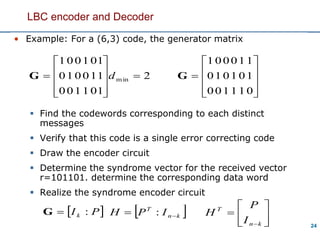
24
• Example: For a (6,3) code, the generator matrix
 Find the codewords corresponding to each distinct
messages
 Verify that this code is a single error correcting code
 Draw the encoder circuit
 Determine the syndrome vector for the received vector
r=101101. determine the corresponding data word
 Realize the syndrome encoder circuit
LBC encoder and Decoder
2
1
1
1
0
1
0
1
0
1
1
0
0
0
1
0
0
0
1
min 










 dG
 PIk :G  kn
T
IPH  : 






kn
T
I
P
H











0
1
1
1
0
1
1
1
0
1
0
0
0
1
0
0
0
1
G
25
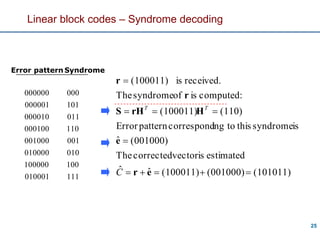
Linear block codes – Syndrome decoding
111010001
100100000
010010000
001001000
110000100
011000010
101000001
000000000
(101011)(001000)(100011)ˆˆ
estimatedisvectorcorrectedThe
(001000)ˆ
issyndromethistoingcorrespondpatternError
(110)(100011)
:computedisofsyndromeThe
received.is(100011)




er
e
HrHS
r
r
C
TT
Error pattern Syndrome
Example:
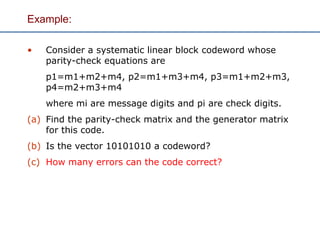
• Consider a systematic linear block codeword whose
parity-check equations are
p1=m1+m2+m4, p2=m1+m3+m4, p3=m1+m2+m3,
p4=m2+m3+m4
where mi are message digits and pi are check digits.
(a) Find the parity-check matrix and the generator matrix
for this code.
(b) Is the vector 10101010 a codeword?
(c) How many errors can the code correct?
Cyclic Codes
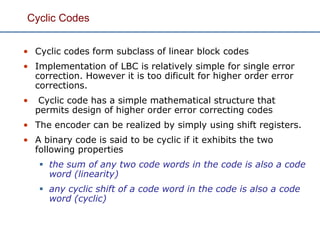
• Cyclic codes form subclass of linear block codes
• Implementation of LBC is relatively simple for single error
correction. However it is too dificult for higher order error
corrections.
• Cyclic code has a simple mathematical structure that
permits design of higher order error correcting codes
• The encoder can be realized by simply using shift registers.
• A binary code is said to be cyclic if it exhibits the two
following properties
 the sum of any two code words in the code is also a code
word (linearity)
 any cyclic shift of a code word in the code is also a code
word (cyclic)
Cyclic Codes
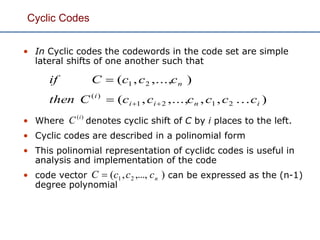
• In Cyclic codes the codewords in the code set are simple
lateral shifts of one another such that
• Where denotes cyclic shift of C by i places to the left.
• Cyclic codes are described in a polinomial form
• This polinomial representation of cyclidc codes is useful in
analysis and implementation of the code
• code vector can be expressed as the (n-1)
degree polynomial
),,,...,,(
),...,,(
2121
)(
21
inii
i
n
ccccccCthen
cccCif


)(i
C
),...,,( 21 ncccC 
Cyclic Codes
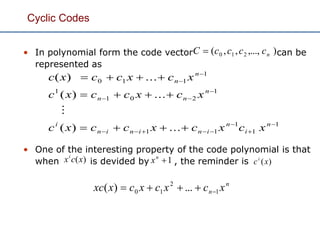
• In polynomial form the code vector can be
represented as
• One of the interesting property of the code polynomial is that
when is devided by , the reminder is
1
1
1
11
1
201
1
1
110
...)(
...)(
...)(











n
i
n
ininin
i
n
nn
n
n
xcxcxccxc
xcxccxc
xcxccxc

),...,,,( 210 nccccC 
)(xcxi
1n
x )(xci
n
n xcxcxcxxc 1
2
10 ...)( 
Cyclic Codes
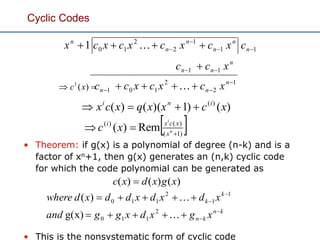
• Theorem: if g(x) is a polynomial of degree (n-k) and is a
factor of xn+1, then g(x) generates an (n,k) cyclic code
for which the code polynomial can be generated as
• This is the nonsystematic form of cyclic code
 )(1
xc
kn
kn
k
k
xgxdxggand
xdxdxddxdwhere








2
110
1
1
2
110
g(x)
)(
1
1
2
2
101
11
11
1
2
2
10









n
nn
n
nn
n
n
n
n
n
n
xcxcxcc
xcc
cxcxcxcxcx


 )1(
)()(
)(
Rem)(
)()1)(()(



n
i
x
xcxi
ini
xc
xcxxqxcx
)()()( xgxdxc 
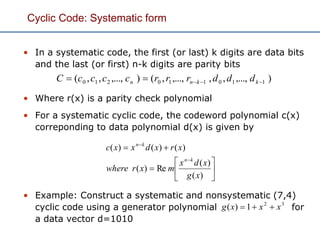
Cyclic Code: Systematic form
• In a systematic code, the first (or last) k digits are data bits
and the last (or first) n-k digits are parity bits
• Where r(x) is a parity check polynomial
• For a systematic cyclic code, the codeword polynomial c(x)
correponding to data polynomial d(x) is given by
• Example: Construct a systematic and nonsystematic (7,4)
cyclic code using a generator polynomial for
a data vector d=1010










)(
)(
Re)(
)()()(
xg
xdx
mxrwhere
xrxdxxc
kn
kn
32
1)( xxxg 
),...,,,,...,,(),...,,,( 110110210  kknn dddrrrccccC
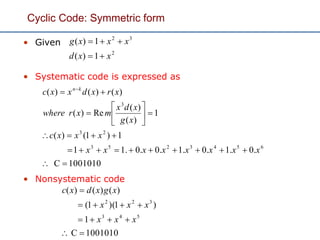
Cyclic Code: Symmetric form
• Given
• Systematic code is expressed as
• Nonsystematic code
1001010C
.0.1.0.1.0.0.11
1)1()(
1
)(
)(
Re)(
)()()(
6543253
23
3










 
xxxxxxxx
xxxc
xg
xdx
mxrwhere
xrxdxxc kn
2
32
1)(
1)(
xxd
xxxg


1001010C
1
)1)(1(
)()()(
543
322




xxx
xxx
xgxdxc
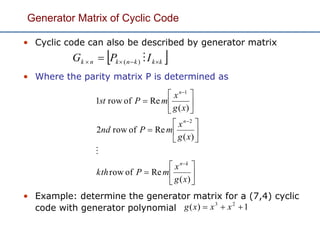
Generator Matrix of Cyclic Code
• Cyclic code can also be described by generator matrix
• Where the parity matrix P is determined as
• Example: determine the generator matrix for a (7,4) cyclic
code with generator polynomial
























)(
Reofrow
)(
Reofrow2
)(
Reofrow1
2
1
xg
x
mPkth
xg
x
mPnd
xg
x
mPst
kn
n
n

 kkknknk IPG   )(
1)( 23
 xxxg
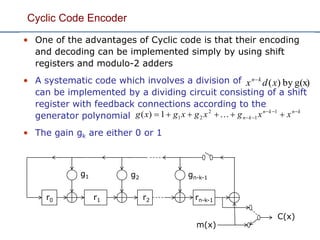
Cyclic Code Encoder
• One of the advantages of Cyclic code is that their encoding
and decoding can be implemented simply by using shift
registers and modulo-2 adders
• A systematic code which involves a division of
can be implemented by a dividing circuit consisting of a shift
register with feedback connections according to the
generator polynomial
• The gain gk are either 0 or 1
knkn
kn xxgxgxgxg 
  1
1
2
211)( 
g(x)by)(xdx kn
r0 r1 r2
gn-k-1g2
g1
rn-k-1
m(x)
C(x)
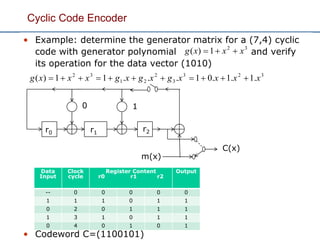
Cyclic Code Encoder
• Example: determine the generator matrix for a (7,4) cyclic
code with generator polynomial and verify
its operation for the data vector (1010)
• Codeword C=(1100101)
323
3
2
21
32
.1.1.01...11)( xxxxgxgxgxxxg 
Data
Input
Clock
cycle
Register Content
r0 r1 r2
Output
-- 0 0 0 0 0
1 1 1 0 1 1
0 2 0 1 1 1
1 3 1 0 1 1
0 4 0 1 0 1
32
1)( xxxg 
r2
10
m(x)
C(x)
r0 r1
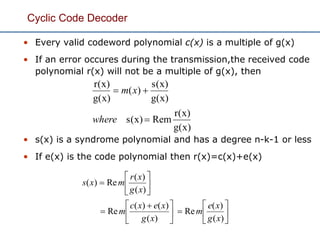
Cyclic Code Decoder
• Every valid codeword polynomial c(x) is a multiple of g(x)
• If an error occures during the transmission,the received code
polynomial r(x) will not be a multiple of g(x), then
• s(x) is a syndrome polynomial and has a degree n-k-1 or less
• If e(x) is the code polynomial then r(x)=c(x)+e(x)
g(x)
r(x)
Rems(x)
g(x)
s(x)
)(
g(x)
r(x)


where
xm











 








)(
)(
Re
)(
)()(
Re
)(
)(
Re)(
xg
xe
m
xg
xexc
m
xg
xr
mxs
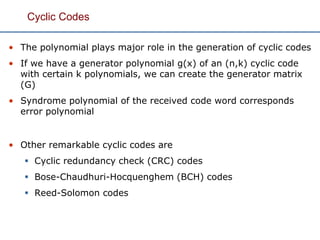
Cyclic Codes
• The polynomial plays major role in the generation of cyclic codes
• If we have a generator polynomial g(x) of an (n,k) cyclic code
with certain k polynomials, we can create the generator matrix
(G)
• Syndrome polynomial of the received code word corresponds
error polynomial
• Other remarkable cyclic codes are
 Cyclic redundancy check (CRC) codes
 Bose-Chaudhuri-Hocquenghem (BCH) codes
 Reed-Solomon codes

Digital Communication: Channel Coding

  • 1.
    Digital Communication Dr. S.M. Gulhane Principal, Pravara Rural Engineering College, Loni, Ahmednagar Savitribai Phule Pune University, Maharashtra, India Unit-2 : Channel Coding 1 1 0 0 1 1 0 1 1 0 0 0 1 Channel Coding
  • 2.
    Channel Coding 2 • Channelcoding provides to the receiver the ability of error detection and correction • Channel Encoder adds some redundant bits to the input bit sequence. Addition of these extra bits • Allows the receiver to perform error detection and correction • However, increases the bit rate and hence increase required bandwidth
  • 3.
    Types of ErrorControl • Error detection and retransmission  The receiver does not attempt to correct the error  The receiver simply requests a retransmission  Require full duplex connection  Example: o Automatic Retransmission reQuest (ARQ) • Forward error correction (FEC)  The receiver can correct and detect the errors  Require Simplex Connection  Example: o Block Codes o Convolutional Codes
  • 4.
    4 Linear block codes •The information bit stream is divided into blocks of k bits. • Each block is encoded to a larger block of n bits. • The coded bits are modulated and sent over channel. • The reverse procedure is done at the receiver. • Structure of Codeword Data block Channel encoder Codeword k bits n bits p1, p2,……pn-k m1m2,….mk n-k parity bits k message bits n bit codeword
  • 5.
    Error Control Coding •A binary block code generates a block of n coded bits from k information bits. We call this an (n,k) binary block code. • The n codeword symbols can take on 2n possible values corresponding to all possible combinations of the n binary bits. • 2k codewords from these 2npossibilities is to be selected to form the code, such that each k bit information block is uniquely mapped to one of these 2k codewords. • A code is said to be linear if addition (modulo-2 adition) of any two codewords in the code produce a third code word in the code • A code is systematic code, if the first (or last) k elements in the codeword are information bits 5
  • 6.
    Linear Block Code •The encoding operation of Linear Block code involve two operations  Segmentation of information sequences  Transformation of each message block into a block of n bits according to some predetermined set of rules • Consider Message block  Each message bit can be 0 or 1 => 2k distinct message blocks • Each message block is transformed to codeword C of length n bits • There will be 2k distinct codewords, one unique codeword for each distinct message 6 ),...,,,,...,,(),...,,( bitsmessage 21 bitsparity 2121    kknn mmmpppcccC  ),...,,( 21 kmmmm  ),...,,( 21 ncccC 
  • 7.
    Linear Block Code •In Systematic block code • In matrix form 7 ,...,1, ......... ......... ,22,11, ,12121111 nknknfor imc and mpmpmpc mpmpmpc ii kknkkkkn kkn                       100 010 001 ][ ,21 ,22221 ,11211 21      knkkk kn kn k ppp ppp ppp mmmC
  • 8.
    Linear Block Code • 8 mGC matrixParity)( matrixidentity matrixGenerator][ knk kkk nkk     P I IPG                   100 010 001 ,21 ,22221 ,11211      knkkk kn kn k ppp ppp ppp IPG
  • 9.
    Linear Block Code •The generator matrix is a compact description of how codewords are generated from information bits in a linear block code. • The design goal in linear block codes is to find generator matrices such that  the corresponding codes are easy to encode and decode  yet have powerful error correction/detection capabilities. • Tradeoffs between  Efficiency  Reliability  Encoding/Decoding complexity 9
  • 10.
    Linear Block Code •Parity Check Matrix: Associated to each (n,k) linear block code there is a parity check matrix H at the decoder. • Parity check matrix H has its rows orthogonal to rows of G such that • The parity check matrix H is used to detect errors in the received code • C is the codeword in (n,k) block code generated by G iff 10 0T GH   nkn T kn PIH ,  0T CH
  • 11.
    Linear Block Code •Let R = C + E be the received message where C is the correct code and E is the error • Decoding operation is done by determining syndrome vector S as • If R is a valid vector then syndrome of received vector S is 0 • Nonzero S indicates that there are errors in transmission • Thus S is used to detect the errors. It is also used to correct the errors. • The errors can be corrected at the receiver by comparing S with the rows of and correcting the ith received bit if S matches with the ith row of 11 T TT T EH EHCH RHS    T H T H
  • 12.
    Linear Block Code Operationsof the generator matrix and the parity check matrix • Example1: For a (6,3)LBC with generator matrix G, find codeword for all the distinct messages. 12           1 0 0 0 1 0 0 0 1 1 1 0 0 1 1 1 0 1 G
  • 13.
    13 Linear Block Code •Example: Block code (6,3)            1 0 0 0 1 0 0 0 1 1 1 0 0 1 1 1 0 1 G 1 1 1 1 1 0 0 0 0 1 0 1 1 1 1 1 1 0 1 1 0 0 0 1 1 0 1 1 1 1 1 0 0 0 1 1 1 1 0 0 0 1 1 0 1 0 0 0 1 0 0 0 1 0 1 0 0 1 1 0 0 1 0 0 0 0 1 0 0 0 1 0 Message vector Codeword
  • 14.
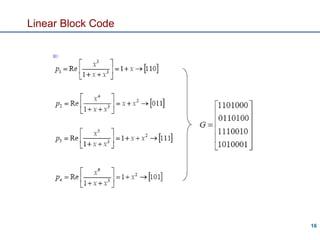
    Linear Block Code •In polynomial form the codeword c(x) can be written as c(x) = m(x) g(x) • where m(x) is the message polynomial and g(x) is the generator polynomial, G is the generator matrix. • G = [P | I], • where Pi = Remainder of [xn-k+i-1/g(x)] for i=1, 2, .., k, and I is unit matrix. 14                                knkkk kn kn k ppp ppp ppp P P P P ,21 ,22221 ,11211 2 1     
  • 15.
    Linear Block Code •Example 2: Find linear block code encoder G if code generator polynomial g(x)=1+x+x3 for a (7, 4) code. • We have • n = Total number of bits = 7, • k = Number of information bits = 4, • r = Number of parity bits = n - k = 3. 15                1000 0100 0010 0001 4 3 2 1 P P P P IPG    kiP xg x i ikn ,...,2,1,ofderminRe )( 1  
  • 16.
  • 17.
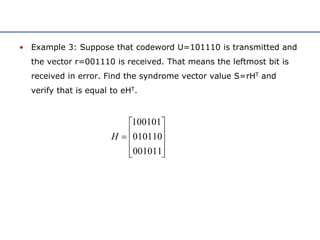
    • Example 3:Suppose that codeword U=101110 is transmitted and the vector r=001110 is received. That means the leftmost bit is received in error. Find the syndrome vector value S=rHT and verify that is equal to eHT.            001011 010110 100101 H
  • 18.
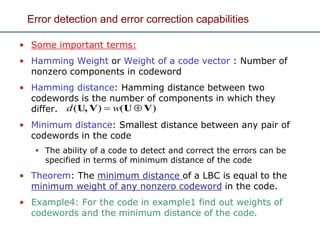
    Error detection anderror correction capabilities • Some important terms: • Hamming Weight or Weight of a code vector : Number of nonzero components in codeword • Hamming distance: Hamming distance between two codewords is the number of components in which they differ. • Minimum distance: Smallest distance between any pair of codewords in the code  The ability of a code to detect and correct the errors can be specified in terms of minimum distance of the code • Theorem: The minimum distance of a LBC is equal to the minimum weight of any nonzero codeword in the code. • Example4: For the code in example1 find out weights of codewords and the minimum distance of the code. )()( VUVU,  wd
  • 19.
    Error detection anderror correction capabilities of LBC • Theorem: A LBC with a minimum distance dmin can detect upto dmin -1 errors and correct upto [(dmin -1)/2] errors.  Where [(dmin -1)/2] denotes the largest integer not greater than (dmin -1)/2. • Proof:  Let C be the transmitted codeword and  R is the received codeword.  Let C’ be the any other codeword in the code. • Then the Hamming distance between codeword d(C,C’), d(C,R) and d(C’,R) satisfy d(C,R)+ d(C’,R) ≥ d(C,C’) … 1 Let the received vector consist of t errors i.e. d(C,R)=t Let dmin be the minimum distance of the code d(C,C’) ≥ dmin
  • 20.
    20 • Hamming codes Hamming codes are a subclass of linear block codes. It is a single error correcting perfect code.  To correct a single error LBC must have a minimum distance dmin =3.  The LBC code for which t=1 and dmin=3 is called Hamming code.  Hamming codes have following attributes  Hamming Codes are simple to construct Hamming codes t mk n m m 1:capabilitycorrectionError 3d:distanceMinimum 12:bitsninformatioofNumber 12:lengthCode 3k-nm:bitsparityofnumber min     
  • 21.
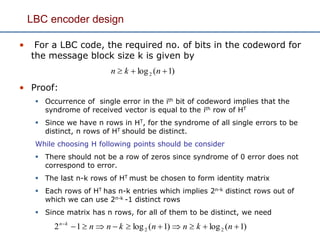
    • For aLBC code, the required no. of bits in the codeword for the message block size k is given by • Proof:  Occurrence of single error in the ith bit of codeword implies that the syndrome of received vector is equal to the ith row of HT  Since we have n rows in HT, for the syndrome of all single errors to be distinct, n rows of HT should be distinct. While choosing H following points should be consider  There should not be a row of zeros since syndrome of 0 error does not correspond to error.  The last n-k rows of HT must be chosen to form identity matrix  Each rows of HT has n-k entries which implies 2n-k distinct rows out of which we can use 2n-k -1 distinct rows  Since matrix has n rows, for all of them to be distinct, we need )1(log2  nkn LBC encoder design )1(log)1(log12 22  nknnknnkn
  • 22.
    • Design aLBC code with a minimum distance of 3 and a message block size of eight bits • N=12 satisfies the above inequality • Need (12,8) block code • P is 8x4 size • The first 8 rows of HT are arbitrarily chosen such that  All the 8 rows must be distinct  No row is zero row )1(log2  nkn LBC encoder design knxnkn T I P H        
  • 23.
    Design the (n,k)code 1. The number of codewords is 2k 2. The all-zeros vector must be one of the codewords 3. The property of closure must apply. The sum of any two codewords in the space must yield a valid codeword in the space 4. Each codeword is n bits long 5. Since , the weight of each codeword must also be at least 6. Assume the code is systematic, and the rightmost k bits of each codeword are the corresponding message bits. 12 2 1 min     k k n d
  • 24.
    24 • Example: Fora (6,3) code, the generator matrix  Find the codewords corresponding to each distinct messages  Verify that this code is a single error correcting code  Draw the encoder circuit  Determine the syndrome vector for the received vector r=101101. determine the corresponding data word  Realize the syndrome encoder circuit LBC encoder and Decoder 2 1 1 1 0 1 0 1 0 1 1 0 0 0 1 0 0 0 1 min             dG  PIk :G  kn T IPH  :        kn T I P H            0 1 1 1 0 1 1 1 0 1 0 0 0 1 0 0 0 1 G
  • 25.
    25 Linear block codes– Syndrome decoding 111010001 100100000 010010000 001001000 110000100 011000010 101000001 000000000 (101011)(001000)(100011)ˆˆ estimatedisvectorcorrectedThe (001000)ˆ issyndromethistoingcorrespondpatternError (110)(100011) :computedisofsyndromeThe received.is(100011)     er e HrHS r r C TT Error pattern Syndrome
  • 26.
    Example: • Consider asystematic linear block codeword whose parity-check equations are p1=m1+m2+m4, p2=m1+m3+m4, p3=m1+m2+m3, p4=m2+m3+m4 where mi are message digits and pi are check digits. (a) Find the parity-check matrix and the generator matrix for this code. (b) Is the vector 10101010 a codeword? (c) How many errors can the code correct?
  • 27.
    Cyclic Codes • Cycliccodes form subclass of linear block codes • Implementation of LBC is relatively simple for single error correction. However it is too dificult for higher order error corrections. • Cyclic code has a simple mathematical structure that permits design of higher order error correcting codes • The encoder can be realized by simply using shift registers. • A binary code is said to be cyclic if it exhibits the two following properties  the sum of any two code words in the code is also a code word (linearity)  any cyclic shift of a code word in the code is also a code word (cyclic)
  • 28.
    Cyclic Codes • InCyclic codes the codewords in the code set are simple lateral shifts of one another such that • Where denotes cyclic shift of C by i places to the left. • Cyclic codes are described in a polinomial form • This polinomial representation of cyclidc codes is useful in analysis and implementation of the code • code vector can be expressed as the (n-1) degree polynomial ),,,...,,( ),...,,( 2121 )( 21 inii i n ccccccCthen cccCif   )(i C ),...,,( 21 ncccC 
  • 29.
    Cyclic Codes • Inpolynomial form the code vector can be represented as • One of the interesting property of the code polynomial is that when is devided by , the reminder is 1 1 1 11 1 201 1 1 110 ...)( ...)( ...)(            n i n ininin i n nn n n xcxcxccxc xcxccxc xcxccxc  ),...,,,( 210 nccccC  )(xcxi 1n x )(xci n n xcxcxcxxc 1 2 10 ...)( 
  • 30.
    Cyclic Codes • Theorem:if g(x) is a polynomial of degree (n-k) and is a factor of xn+1, then g(x) generates an (n,k) cyclic code for which the code polynomial can be generated as • This is the nonsystematic form of cyclic code  )(1 xc kn kn k k xgxdxggand xdxdxddxdwhere         2 110 1 1 2 110 g(x) )( 1 1 2 2 101 11 11 1 2 2 10          n nn n nn n n n n n n xcxcxcc xcc cxcxcxcxcx    )1( )()( )( Rem)( )()1)(()(    n i x xcxi ini xc xcxxqxcx )()()( xgxdxc 
  • 31.
    Cyclic Code: Systematicform • In a systematic code, the first (or last) k digits are data bits and the last (or first) n-k digits are parity bits • Where r(x) is a parity check polynomial • For a systematic cyclic code, the codeword polynomial c(x) correponding to data polynomial d(x) is given by • Example: Construct a systematic and nonsystematic (7,4) cyclic code using a generator polynomial for a data vector d=1010           )( )( Re)( )()()( xg xdx mxrwhere xrxdxxc kn kn 32 1)( xxxg  ),...,,,,...,,(),...,,,( 110110210  kknn dddrrrccccC
  • 32.
    Cyclic Code: Symmetricform • Given • Systematic code is expressed as • Nonsystematic code 1001010C .0.1.0.1.0.0.11 1)1()( 1 )( )( Re)( )()()( 6543253 23 3             xxxxxxxx xxxc xg xdx mxrwhere xrxdxxc kn 2 32 1)( 1)( xxd xxxg   1001010C 1 )1)(1( )()()( 543 322     xxx xxx xgxdxc
  • 33.
    Generator Matrix ofCyclic Code • Cyclic code can also be described by generator matrix • Where the parity matrix P is determined as • Example: determine the generator matrix for a (7,4) cyclic code with generator polynomial                         )( Reofrow )( Reofrow2 )( Reofrow1 2 1 xg x mPkth xg x mPnd xg x mPst kn n n   kkknknk IPG   )( 1)( 23  xxxg
  • 34.
    Cyclic Code Encoder •One of the advantages of Cyclic code is that their encoding and decoding can be implemented simply by using shift registers and modulo-2 adders • A systematic code which involves a division of can be implemented by a dividing circuit consisting of a shift register with feedback connections according to the generator polynomial • The gain gk are either 0 or 1 knkn kn xxgxgxgxg    1 1 2 211)(  g(x)by)(xdx kn r0 r1 r2 gn-k-1g2 g1 rn-k-1 m(x) C(x)
  • 35.
    Cyclic Code Encoder •Example: determine the generator matrix for a (7,4) cyclic code with generator polynomial and verify its operation for the data vector (1010) • Codeword C=(1100101) 323 3 2 21 32 .1.1.01...11)( xxxxgxgxgxxxg  Data Input Clock cycle Register Content r0 r1 r2 Output -- 0 0 0 0 0 1 1 1 0 1 1 0 2 0 1 1 1 1 3 1 0 1 1 0 4 0 1 0 1 32 1)( xxxg  r2 10 m(x) C(x) r0 r1
  • 36.
    Cyclic Code Decoder •Every valid codeword polynomial c(x) is a multiple of g(x) • If an error occures during the transmission,the received code polynomial r(x) will not be a multiple of g(x), then • s(x) is a syndrome polynomial and has a degree n-k-1 or less • If e(x) is the code polynomial then r(x)=c(x)+e(x) g(x) r(x) Rems(x) g(x) s(x) )( g(x) r(x)   where xm                      )( )( Re )( )()( Re )( )( Re)( xg xe m xg xexc m xg xr mxs
  • 37.
    Cyclic Codes • Thepolynomial plays major role in the generation of cyclic codes • If we have a generator polynomial g(x) of an (n,k) cyclic code with certain k polynomials, we can create the generator matrix (G) • Syndrome polynomial of the received code word corresponds error polynomial • Other remarkable cyclic codes are  Cyclic redundancy check (CRC) codes  Bose-Chaudhuri-Hocquenghem (BCH) codes  Reed-Solomon codes