



By   Indika Rathninda
"You can't teach people everything
they need to know. The best you
can do is position them where they
can find what they need to know
when they need to know it."  Seymour Papert
•   Elearning
•   E-learning
•   elearning
•   e-learning
•   Online learning
•   Web based learning
•   Distance learning
•   Technology based learning
•   Ubiquitous learning

    What is this stuff anyway?
What is e-learning?

“E-learning” is the collective name for the design of
learning situations (formal and informal) using
information and communication technology
(particularly Internet technology).
E-learning is used in corporate training and in
education.


eLearning is the use of technology to enable people to
learn anytime and anywhere.
Six Winning Features of e-Learning


 1. Anytime, anywhere
 2. Cost Effective
 3. Global Reach
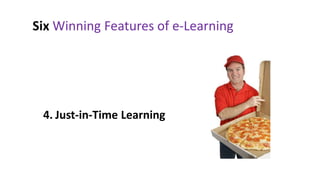
 4. Just-in-Time Learning
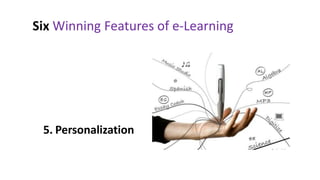
 5. Personalization
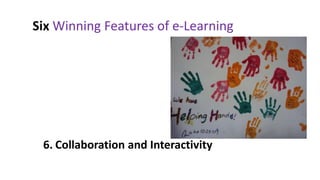
 6. Collaboration and Interactivity
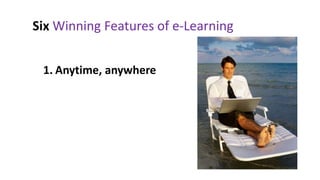
Six Winning Features of e-Learning


 1. Anytime, anywhere
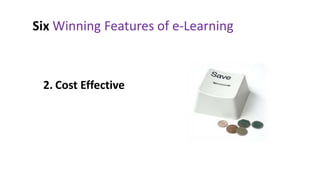
Six Winning Features of e-Learning


 1. Anytime, anywhere
 2. Cost Effective
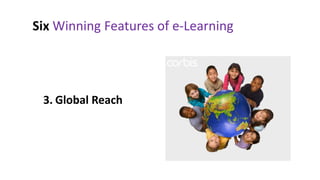
Six Winning Features of e-Learning


 1. Anytime, anywhere
 2. Cost Effective
 3. Global Reach
 4. Just-in-Time Learning
 5. Personalization
 6. Collaboration and Interactivity
Six Winning Features of e-Learning


 1. Anytime, anywhere
 2. Cost Effective
 3. Global Reach
 4. Just-in-Time Learning
 5. Personalization
 6. Collaboration and Interactivity
Six Winning Features of e-Learning


 1. Anytime, anywhere
 2. Cost Effective
 3. Global Reach
 4. Just-in-Time Learning
 5. Personalization
 6. Collaboration and Interactivity
Six Winning Features of e-Learning


 1. Anytime, anywhere
 2. Cost Effective
 3. Global Reach
 4. Just-in-Time Learning
 5. Personalization
 6. Collaboration and Interactivity
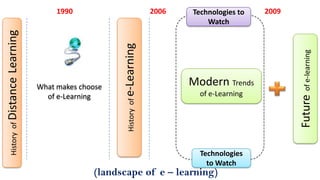
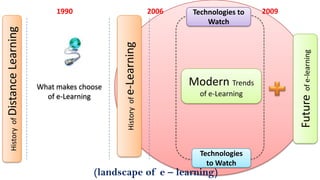
1990                                   2006   Technologies to   2009
                                                                             Watch
Learning


                                          History of e-Learning


                                                                                                  Future of e-learning
                                                                         Modern Trends
History of Distance


                      What makes choose
                        of e-Learning                                      of e-Learning


                                                                           Technologies
                                                                             to Watch
                                    (landscape of e – learning)
1990                                   2006   Technologies to   2009
                                                                             Watch
Learning


                                          History of e-Learning


                                                                                                  Future of e-learning
History of Distance


                      What makes choose                                  Modern Trends
                        of e-Learning                                      of e-Learning


                                                                           Technologies
                                                                             to Watch
                                    (landscape of e – learning)
History of Distance Learning
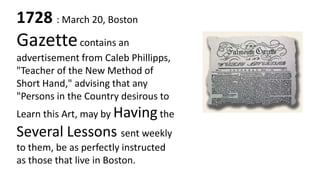
1728 : March 20, Boston
Gazette contains an
advertisement from Caleb Phillipps,
"Teacher of the New Method of
Short Hand," advising that any
"Persons in the Country desirous to
Learn this Art, may by Having the
Several Lessons sent weekly
to them, be as perfectly instructed
as those that live in Boston.
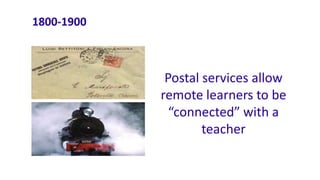
1800-1900


             Postal services allow
            remote learners to be
              “connected” with a
                    teacher
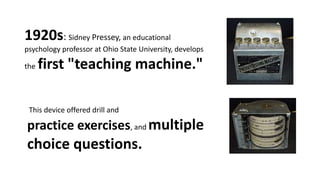
1920s: Sidney Pressey, an educational
psychology professor at Ohio State University, develops

the   first "teaching machine."

 This device offered drill and

practice exercises, and multiple
choice questions.
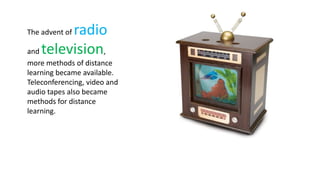
radio
The advent of

and television,
more methods of distance
learning became available.
Teleconferencing, video and
audio tapes also became
methods for distance
learning.
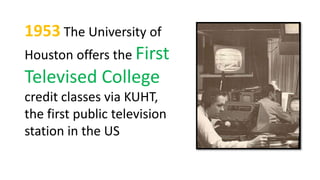
1953 The University of
Houston offers the First
Televised College
credit classes via KUHT,
the first public television
station in the US
History of e-Learning


e-Learning emerges as the dot-com term for distance education
In the information society, learners require
rich learning environments supported by
well-designed resources.


They expect  flexible  learning
environments with good support services.
1990-1999: The era of custom CBT


e-Learning began as
computer-based training (CBT),
standalone CDROM training courses (and
before them, videodisc courses)
Desktop-based multimedia authoring
             systems


Very slow to develop
Very expensive
High-level programming languages
1997-1999: The rise of the Learning
  Management System (LMS)


CMI - Computer-Managed Instruction system
CMS -Course Management System
TMS-Training Management Systems


       new breed of Learning Management System   - LMS
1990 - In the history of virtual
learning environments, the
1990s was a time of growth,
primarily due to advent of

the   Internet.
From 1999: Everyone moves to the Web, or at
  least wants to

Web-based training helped to
      justify the cost of the intranet.

Implementation of online     Learning

Learning could be taken “anywhere,
                             anytime,”
                            browserbased
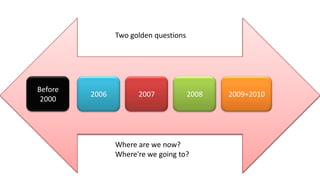
Two golden questions


Before
         2006         2007             2008   2009+2010
 2000


                Where are we now?
                Where're we going to?
Modern Trends of e-Learning
"Online learning is not the
next big thing, it is the now
big thing."
                    Donna J. Abernathy
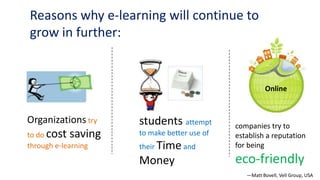
Reasons why e-learning will continue to
grow in further:


                                                        Online


Organizations try    students attempt        companies try to
to do cost saving    to make better use of   establish a reputation
through e-learning   their Time and          for being

                     Money                   eco-friendly
                                                —Matt Bovell, Vell Group, USA
Trend-01


Mobiles & personal
technology is increasingly being
viewed as a delivery platform


Mobile computing
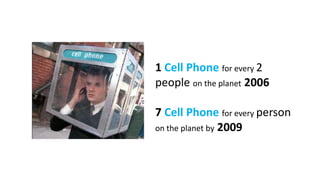
1 Cell Phone for every 2
people on the planet 2006

7 Cell Phone for every person
on the planet by 2009
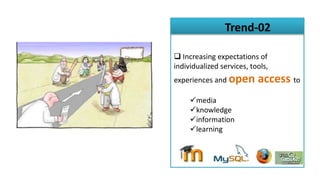
Trend-02

 Increasing expectations of
individualized services, tools,
experiences and open       access to
     media
     knowledge
     information
     learning
Trend-03


Dynamic knowledge creation and

social computing tools &
processes
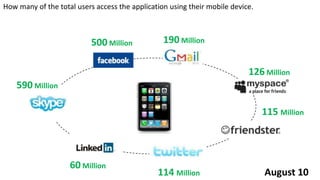
How many of the total users access the application using their mobile device.


                           500 Million           190 Million

                                                                           126 Million
    590 Million

                                                                                115 Million


                    60 Million
                                               114 Million                      August 10
Trend-04


  Collaboration               is critical
across the range of educational
activities, inter and intra any size or
scope
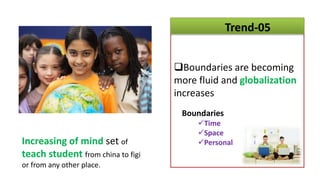
Trend-05


                                   Boundaries are becoming
                                   more fluid and globalization
                                   increases
                                    Boundaries
                                        Time
                                        Space
Increasing of mind set of               Personal
teach student from china to figi
or from any other place.
Trend-06


 Information literacy
should not be considered a
given
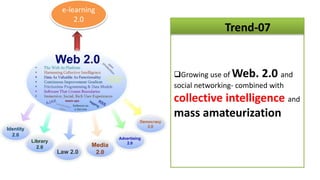
e-learning
    2.0
                          Trend-07


             Growing use of Web. 2.0 and
             social networking- combined with
             collective intelligence and
             mass amateurization
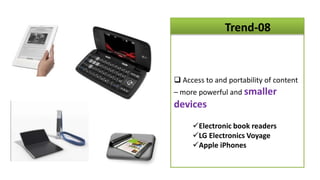
Trend-08


 Access to and portability of content
– more powerful and smaller
devices
     Electronic book readers
     LG Electronics Voyage
     Apple iPhones
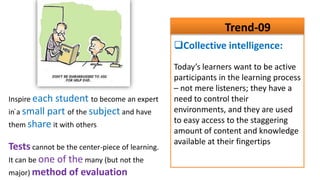
Trend-09
                                                Collective intelligence:
                                                Today’s learners want to be active
                                                participants in the learning process
                                                – not mere listeners; they have a
Inspire each student to become an expert        need to control their
  .                                             environments, and they are used
in a small part of the subject and have
them share it with others
                                                to easy access to the staggering
                                                amount of content and knowledge
                                                available at their fingertips
Tests cannot be the center-piece of learning.
It can be one of the many (but not the
major) method of evaluation
Trend-10

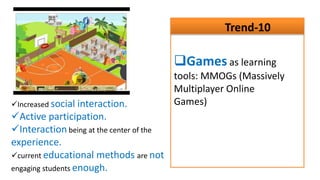
                                          Games as learning
                                          tools: MMOGs (Massively
                                          Multiplayer Online
Increased social interaction.            Games)
Active participation.
Interaction being at the center of the
experience.
current educational methods are not
engaging students enough.
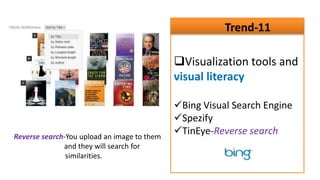
Trend-11

                                             Visualization tools and
                                             visual literacy

                                             Bing Visual Search Engine
                                             Spezify
Reverse search-You upload an image to them
                                             TinEye-Reverse search
              and they will search for
               similarities.
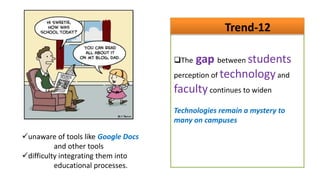
Trend-12

                                     The  gap between students
                                     perception of technology and
                                     faculty continues to widen
                                     Technologies remain a mystery to
                                     many on campuses

unaware of tools like Google Docs
          and other tools
difficulty integrating them into
          educational processes.
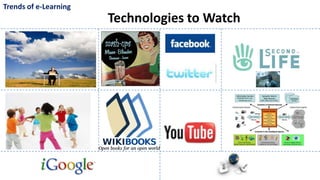
Trends of e-Learning
                       Technologies to Watch
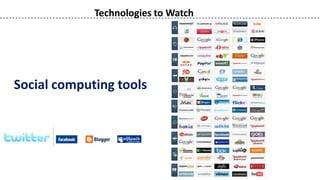
Technologies to Watch


Social computing tools
Technologies to Watch


Personal
broadcasting
Technologies to Watch


User Created Content

     Facebook’s friends
     Twitter’s followers
     Yahoo Answers
Technologies to Watch


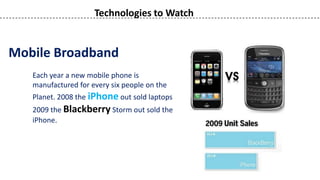
Mobile Broadband
   Each year a new mobile phone is
   manufactured for every six people on the
   Planet. 2008 the iPhone out sold laptops
   2009 the Blackberry Storm out sold the
   iPhone.
Technologies to Watch


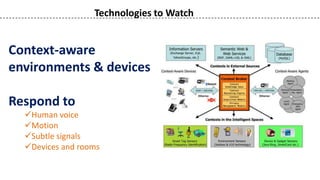
Context-aware
environments & devices

Respond to
  Human voice
  Motion
  Subtle signals
  Devices and rooms
Technologies to Watch


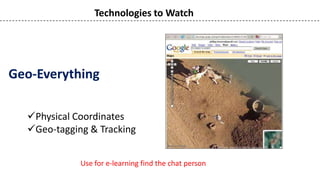
Geo-Everything

  Physical Coordinates
  Geo-tagging & Tracking


             Use for e-learning find the chat person
Technologies to Watch


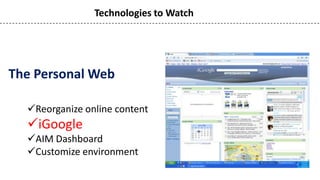
The Personal Web

  Reorganize online content
  iGoogle
  AIM Dashboard
  Customize environment
Technologies to Watch


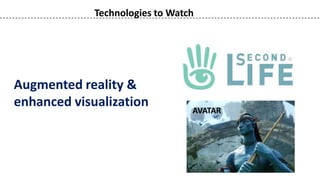
Augmented reality &
enhanced visualization
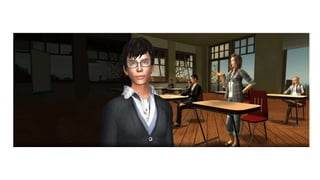
                                 AVATAR
Technologies to Watch


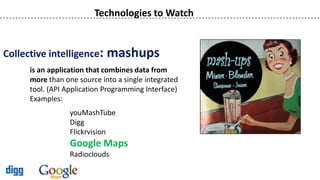
Collective intelligence:     mashups
      is an application that combines data from
      more than one source into a single integrated
      tool. (API Application Programming Interface)
      Examples:
                  youMashTube
                  Digg
                  Flickrvision
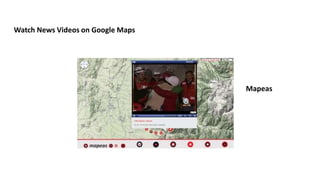
                  Google Maps
                  Radioclouds
Watch News Videos on Google Maps


                                   Mapeas
Technologies to Watch


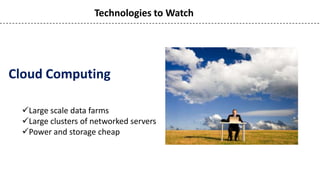
Cloud Computing

 Large scale data farms
 Large clusters of networked servers
 Power and storage cheap
Technologies to Watch


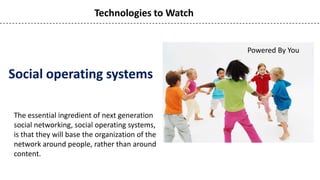
                                                  Powered By You


Social operating systems

The essential ingredient of next generation
social networking, social operating systems,
is that they will base the organization of the
network around people, rather than around
content.
Future of learning
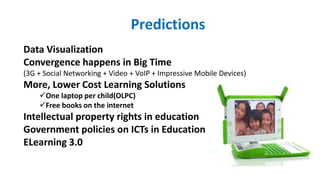
Predictions
Data Visualization
Convergence happens in Big Time
(3G + Social Networking + Video + VoIP + Impressive Mobile Devices)
More, Lower Cost Learning Solutions
    One laptop per child(OLPC)
    Free books on the internet
Intellectual property rights in education
Government policies on ICTs in Education
ELearning 3.0
Well, hmmm...

• Internet is an HOME – not a tool.
• Mind is SOCIAL(networked) and DISTIBUTED – not individual.
• Life Long Learning is impossible without the web: Face-to-
  Face learning is for 5-7% (max) of the people (it is
  expensive!).
• Times changing is
   – very fast for technology
   – very slow for culture and social systems
References
http://www.internettime.com/Learning/articles/DNA.pdf
http://zaidlearn.blogspot.com/2008/04/free-learning-tool-for-every-learning.html
http://www.slideshare.net/kiranb/elearning-21st-century-perspectives-on-teaching-learning-and-technology
http://en.wikipedia.org/wiki/History_of_virtual_learning_environments
http://compassioninpolitics.wordpress.com/2009/06/05/top-future-trends-in-e-learning-and-educational-technology/
http://elearningtech.blogspot.com/2007/03/elearning-trends.html
http://www.e-learning.nl/subpage.aspx?l1=4&l2=54
http://compassioninpolitics.wordpress.com/2009/06/05/top-future-trends-in-e-learning-and-educational-technology/
http://wp.nmc.org/horizon2006/
http://wp.nmc.org/horizon2007/
http://wp.nmc.org/horizon2008/
http://wp.nmc.org/horizon2009/
http://wp.nmc.org/horizon2010/
http://www.internettime.com/Learning/articles/DNA.pdf
http://www.elearning-africa.com/programme_themes.php
http://en.wikipedia.org/wiki/MLearning
Thank you !
Modern trends in e learning -Part 01

Modern trends in e learning -Part 01

Editor's Notes