Get Homework/Assignment Done
Homeworkping.com
Homework Help
https://www.homeworkping.com/
Research Paper help
https://www.homeworkping.com/
Online Tutoring
https://www.homeworkping.com/
click here for freelancing tutoring sites
THE ROLE OF E-LEARNING – A REVIEW.
© John Wall 2004
INTRODUCTION AND BACKGROUND
The E-Learning industry has undergone radical changes over the past five years.
From a position of strength where it was perceived as the ideal solution to almost
all learning and training needs E-Learning is now viewed with scepticism and
caution in many quarters. The purpose of this review is to investigate the
effectiveness of E-Learning in general and in a number of specific case studies
that have implemented E-Learning solutions. The results of this review will
inform the instructional design strategy for the WIT/WCEB blended learning pilot
project.
CHALLENGE TO EDUCATIONAL INSTITUTIONS
E-Learning has been identified by many commentators as an essential element of
the total learning package offered by educational institutions. A model that can
be quite useful to illustrate the position of traditional learning and the integration
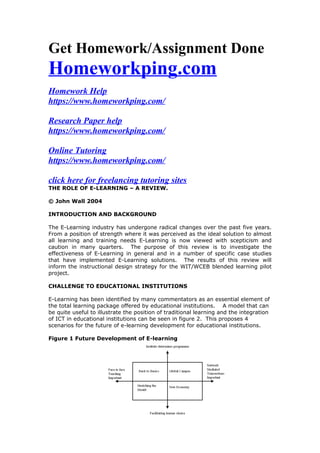
of ICT in educational institutions can be seen in figure 2. This proposes 4
scenarios for the future of e-learning development for educational institutions.
Figure 1 Future Development of E-learning
Source: cited by Devine (2003) from Collis and van der Wende (2002)
Much research on Higher Educational Institutes in Europe indicates that the model
most educational bodies are adopting is ‘Stretching the Mould’ often referred to
as ‘blended learning’. Blended learning at its most basic level is “the thoughtful
integration of classroom face to face learning experiences with online
experiences” (Garrison and Kanuka 2004). Blended learning can affect the way
people learn and can help to promote the experiential learning experience and
enable or empower the learner. Blended learning may bring about major changes
in the way educational material is designed, developed and delivered to people
who want to access learning but have other constraints that affect the process of
learning (Pailing 2002).
Attempts to exploit the ‘Global Campus’ model (where there are highly developed
programmes, fully supported on-line, are offered and services in a global rather
than national or local environment) have been more prevalent in the US, however
not always successfully (Collis and van der Wende 2002). The crash of NYU
Online is a more recent example illustrating the dangers for educational
institutions in embarking on a ‘Global Campus’ pathway.
Often it is in an eagerness to embrace technology that an understanding of the
fundamentals of learning and how it occurs is overlooked (Hamid 2002). This
coupled with the “dot-com” crash resulted in the sharp decline of many e-learning
providers and on-line institutions.
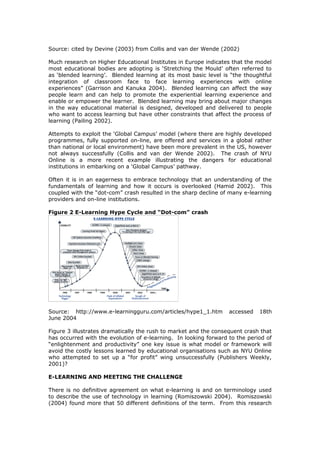
Figure 2 E-Learning Hype Cycle and “Dot-com” crash
Source: http://www.e-learningguru.com/articles/hype1_1.htm accessed 18th
June 2004
Figure 3 illustrates dramatically the rush to market and the consequent crash that
has occurred with the evolution of e-learning. In looking forward to the period of
“enlightenment and productivity” one key issue is what model or framework will
avoid the costly lessons learned by educational organisations such as NYU Online
who attempted to set up a “for profit” wing unsuccessfully (Publishers Weekly,
2001)?
E-LEARNING AND MEETING THE CHALLENGE
There is no definitive agreement on what e-learning is and on terminology used
to describe the use of technology in learning (Romiszowski 2004). Romiszowski
(2004) found more that 50 different definitions of the term. From this research
Romiszowski developed what he terms “structured definition of e-learning”. The
framework developed is as illustrated in table 1.
Table 1 Structured definition of e-learning
INDIVIDUAL SELF STUDY
Computer Based
Instruction/Learning/Teaching
(CBI/L/T)
GROUP
COLLABORATIVE
Computer Mediated
Communication
(CMC)
ONLINE STUDY
Synchronous
Communication
(“REAL-TIME”)
Surfing the Internet, accessing
websites to obtain information or
to learn (knowledge or skill)
Chat rooms with(out)
video
Audio/Video
conferencing
OFFLINE STUDY
Asynchronous
Communication
(“FLEXI-TIME”)
Using stand-alone courseware /
Downloading material from the
Internet for later local study
Asynchronous
communication by
email, discussion lists
or a Learning
Management System
Source: taken from Romiszowski 2004 page 6
This framework emphasises that e-learning may be either a solitary individual
activity or a collaborative group activity where both synchronous and
asynchronous communication can take place or a combination of all of these.
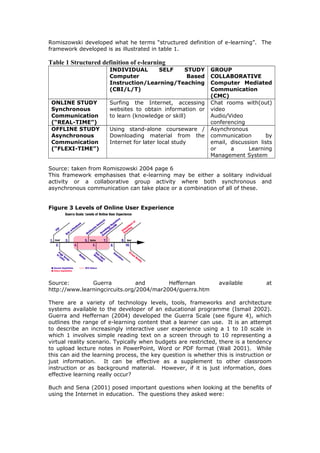
Figure 3 Levels of Online User Experience
Source: Guerra and Heffernan available at
http://www.learningcircuits.org/2004/mar2004/guerra.htm
There are a variety of technology levels, tools, frameworks and architecture
systems available to the developer of an educational programme (Ismail 2002).
Guerra and Heffernan (2004) developed the Guerra Scale (see figure 4), which
outlines the range of e-learning content that a learner can use. It is an attempt
to describe an increasingly interactive user experience using a 1 to 10 scale in
which 1 involves simple reading text on a screen through to 10 representing a
virtual reality scenario. Typically when budgets are restricted, there is a tendency
to upload lecture notes in PowerPoint, Word or PDF format (Wall 2001). While
this can aid the learning process, the key question is whether this is instruction or
just information. It can be effective as a supplement to other classroom
instruction or as background material. However, if it is just information, does
effective learning really occur?
Buch and Sena (2001) posed important questions when looking at the benefits of
using the Internet in education. The questions they asked were:
1 Do individuals learn differently with on-line instruction than traditional
classroom situations?
2 Can the same teaching strategies be used with on-line as traditional
methods and will they be as effective?
3 Do individuals’ react differently to on-line instruction and how can
individual differences in learners be accommodated?
The challenge that faces educational institutions is that in a situation where
learning is recognised as complex set of interrelated cognitive processes and the
evolution of ICT continues unabated developing a framework to address the
lifelong learning needs of targeted learners becomes a challenge.
HOW LEARNING OCCURS
Learning can be defined as the acquisition of knowledge or skill (Oxford English
Dictionary, 1991). Learning is not a simple act. The Chinese proverb, attributed
to Confucius (450 B.C.), summarises the importance of understanding the
pedagogical processes that take place when learning occurs:
“Tell me, and I will forget, show me, and I may
remember, involve me, and I will understand.”
Key to understanding cognitive processes is an understanding of learning
theories. Learning theories have evolved from psychological studies and have
changed in response to, and because of, advancing theories of cognitive
development (Ertmer and Newby, 1993). For any type of learning to be effective,
whether it is classroom based or computer based, it has to be built on sound
pedagogical principles. What has changed considerably in more recent times is
the evolution of ICT and how technology can be configured to incorporate the
“tell”, “show” and “involve” that are prerequisites of effective learning (Sit, 2001).
A number of pedagogies and approaches to learning are referenced in literature,
from behaviourism and constructivism in terms of learning theories, to
experiential and organisational learning (Ertmer and Newby 1993, Kolb 1984).
Three of the principle learning theories can be identified as behavioural, cognitive
and constructivist (Ertmer and Newby, 1993). In designing learning it helps to
understand the principal attributes, strengths and weaknesses of behaviourism,
cognitivism and constructivism.
Table 2 Principal Attributes, Strengths and Weaknesses of major learning
theories
Learning
Theory
Principle
Attributes
Strengths Weaknesses
Behaviourism Based on
observable
changes in
behaviour.
Behaviourism
focuses on a new
behavioural
pattern being
repeated until it
becomes
automatic.
The learner is
focused on a clear
goal and can
respond
automatically to the
cues of that goal.
Pilots in simulators
can be conditioned
to react to in a
particular way when
an emergency
landing is required
so that the response
becomes automatic.
The learner may find
himself or herself in a
situation where the
stimulus for the correct
response does not
occur, therefore the
learner cannot respond.
A school child that has
been conditioned to
respond to an action by
a teacher in a particular
way is unsure as to do
when a new teacher
arrives.
Cognitivism Based on the
thought process
behind the
behaviour.
Changes in
behaviour are
observed, and
used as indicators
as to what is
happening inside
the learner's mind.
The goal is to train
learners to do a
task the same way
to enable
consistency.
Logging onto and
off of a workplace
computer is the
same for all
employees, it may
be important do an
exact routine to
avoid problems.
The learner learns a
way to accomplish a
task, but it may not be
the best way, or suited
to the learner or the
situation. For example,
logging onto the
Internet on one
computer may not be
the same as logging in
on another computer.
Constructivist Based on the
premise that we
all construct our
own perspective of
the world, through
individual
experiences and
schema.
Constructivism
focuses on
preparing the
learner to problem
solve in
ambiguous
situations.
Because the learner
is able to interpret
multiple realities,
the learner is better
able to deal with
real life situations.
If a learner can
problem solve, they
may better apply
their existing
knowledge to a
novel situation.
In a situation where
conformity is essential
and divergent thinking
and action may cause
problems. Imagine the
problems that would
arise if every person
decided to report their
taxes in their own way
- although, there
probably are some very
“constructive”
approaches used within
the system we have.
Source: compiled from Ertmer and Newby (1993)
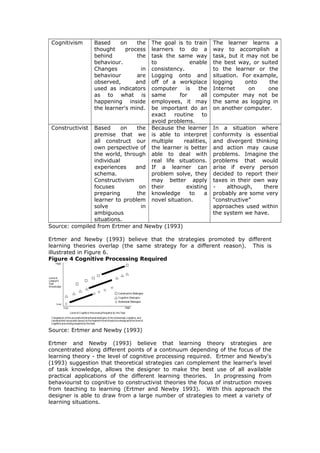
Ertmer and Newby (1993) believe that the strategies promoted by different
learning theories overlap (the same strategy for a different reason). This is
illustrated in Figure 6.
Figure 4 Cognitive Processing Required
Source: Ertmer and Newby (1993)
Ertmer and Newby (1993) believe that learning theory strategies are
concentrated along different points of a continuum depending of the focus of the
learning theory - the level of cognitive processing required. Ertmer and Newby's
(1993) suggestion that theoretical strategies can complement the learner's level
of task knowledge, allows the designer to make the best use of all available
practical applications of the different learning theories. In progressing from
behaviourist to cognitive to constructivist theories the focus of instruction moves
from teaching to learning (Ertmer and Newby 1993). With this approach the
designer is able to draw from a large number of strategies to meet a variety of
learning situations.
A key question posed by Ertmer and Newby (1993) is how does one facilitate a
proper match between learner, content and instructional approaches when one
considers that both the instructional strategies used and the content addressed
would vary depending on the level of a group of learners. Different learners have
different cognitive processes, learning style preferences and past experiences that
they apply when learning takes place (Kolb 1984, Riding 1996). An individual’s
learning style will affect the manner in which information is processed during
learning and thinking, having a considerable effect on the learning effectiveness
and efficiency (Riding 1996). Kolb (1984) conceptualised learning as a four-
phase process starting with concrete experience, followed by reflective
observation, then abstract conceptualisation and the active experimentation.
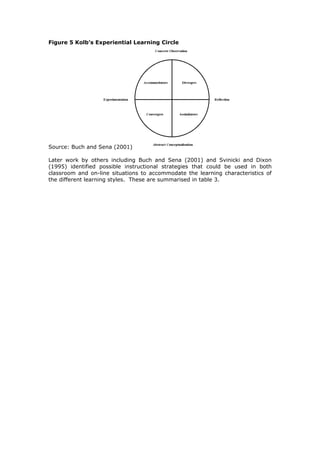
Kolb (1984) observed that learners do not engage with each step of the process
but rather have a particular affinity for certain aspects of the cycle (Sena and
Buch 2001). Kolb (1984) identified individual differences in the process along 2
axes, on a vertical axis representing how an individual prefers to apprehend
information and a horizontal axis denoting a preference for how an individual
processes information. Kolb (1984) classified these as four preferences or
learning styles that learners have and he referred to these as accommodators,
divergers, convergers and assimilators.
Figure 5 Kolb’s Experiential Learning Circle
Source: Buch and Sena (2001)
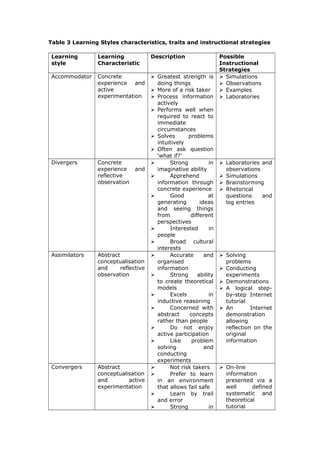
Later work by others including Buch and Sena (2001) and Svinicki and Dixon
(1995) identified possible instructional strategies that could be used in both
classroom and on-line situations to accommodate the learning characteristics of
the different learning styles. These are summarised in table 3.
Table 3 Learning Styles characteristics, traits and instructional strategies
Learning
style
Learning
Characteristic
Description Possible
Instructional
Strategies
Accommodator Concrete
experience and
active
experimentation
 Greatest strength is
doing things
 More of a risk taker
 Process information
actively
 Performs well when
required to react to
immediate
circumstances
 Solves problems
intuitively
 Often ask question
‘what if?’
 Simulations
 Observations
 Examples
 Laboratories
Divergers Concrete
experience and
reflective
observation
 Strong in
imaginative ability
 Apprehend
information through
concrete experience
 Good at
generating ideas
and seeing things
from different
perspectives
 Interested in
people
 Broad cultural
interests
 Laboratories and
observations
 Simulations
 Brainstorming
 Rhetorical
questions and
log entries
Assimilators Abstract
conceptualisation
and reflective
observation
 Accurate and
organised
information
 Strong ability
to create theoretical
models
 Excels in
inductive reasoning
 Concerned with
abstract concepts
rather than people
 Do not enjoy
active participation
 Like problem
solving and
conducting
experiments
 Solving
problems
 Conducting
experiments
 Demonstrations
 A logical step-
by-step Internet
tutorial
 An Internet
demonstration
allowing
reflection on the
original
information
Convergers Abstract
conceptualisation
and active
experimentation
 Not risk takers
 Prefer to learn
in an environment
that allows fail safe
 Learn by trail
and error
 Strong in
 On-line
information
presented via a
well defined
systematic and
theoretical
tutorial
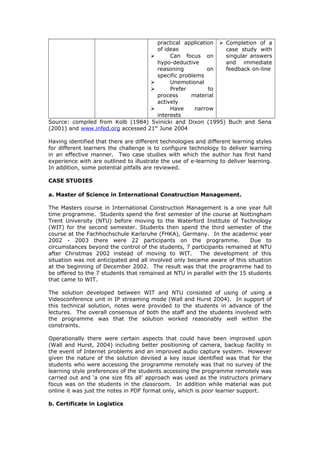
practical application
of ideas
 Can focus on
hypo-deductive
reasoning on
specific problems
 Unemotional
 Prefer to
process material
actively
 Have narrow
interests
 Completion of a
case study with
singular answers
and immediate
feedback on-line
Source: compiled from Kolb (1984) Svinicki and Dixon (1995) Buch and Sena
(2001) and www.infed.org accessed 21st
June 2004
Having identified that there are different technologies and different learning styles
for different learners the challenge is to configure technology to deliver learning
in an effective manner. Two case studies with which the author has first hand
experience with are outlined to illustrate the use of e-learning to deliver learning.
In addition, some potential pitfalls are reviewed.
CASE STUDIES
a. Master of Science in International Construction Management.
The Masters course in International Construction Management is a one year full
time programme. Students spend the first semester of the course at Nottingham
Trent University (NTU) before moving to the Waterford Institute of Technology
(WIT) for the second semester. Students then spend the third semester of the
course at the Fachhochschule Karlsruhe (FHKA), Germany. In the academic year
2002 - 2003 there were 22 participants on the programme. Due to
circumstances beyond the control of the students, 7 participants remained at NTU
after Christmas 2002 instead of moving to WIT. The development of this
situation was not anticipated and all involved only became aware of this situation
at the beginning of December 2002. The result was that the programme had to
be offered to the 7 students that remained at NTU in parallel with the 15 students
that came to WIT.
The solution developed between WIT and NTU consisted of using of using a
Videoconference unit in IP streaming mode (Wall and Hurst 2004). In support of
this technical solution, notes were provided to the students in advance of the
lectures. The overall consensus of both the staff and the students involved with
the programme was that the solution worked reasonably well within the
constraints.
Operationally there were certain aspects that could have been improved upon
(Wall and Hurst, 2004) including better positioning of camera, backup facility in
the event of Internet problems and an improved audio capture system. However
given the nature of the solution devised a key issue identified was that for the
students who were accessing the programme remotely was that no survey of the
learning style preferences of the students accessing the programme remotely was
carried out and ‘a one size fits all’ approach was used as the instructors primary
focus was on the students in the classroom. In addition while material was put
online it was just the notes in PDF format only, which is poor learner support.
b. Certificate in Logistics
In 2001 the Chartered Institute of Logistics and Transport and Multimedia
Instructional Design Ltd. came together to develop a new programme that is
offered to practitioners in the logistics industry – Certificate in Logistics. This
partnership involved Multimedia Instructional Design developing approximately 30
hours of e-learning content that is delivered on a CD ROM. The Chartered
Institute of Logistics and Transport developed all support material, administered
the programme, market the course and administered exams. This industry
accredited Certificate in Logistics was launched in October 2002 by the Irish
Minister for Transport.
To date over 120 participants have undertaken the programme. However
disappointingly, only one individual has successfully completed the programme
with eight other individuals in the process of submitting assignments. Preliminary
research into reasons for the low completion of the programme include, lack of
online support, little recognition of variations in learning styles, a ‘one size fits all’
approach and the lack of opportunity for collaborative learning. The option of
using instructor lead training in conjunction with the distance learning material is
currently being explored by Waterford Institute of Technology and this
programme will be offered in the academic year 2004-2005 in an attempt to
overcome some of the reasons for low completion rates of the programme.
(Kearney, 2004)
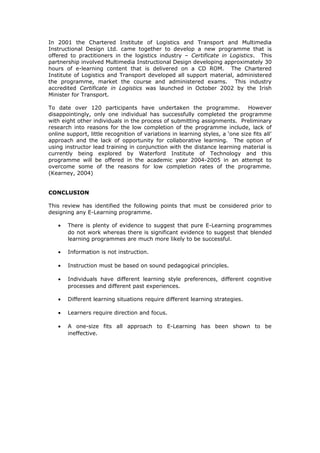
CONCLUSION
This review has identified the following points that must be considered prior to
designing any E-Learning programme.
• There is plenty of evidence to suggest that pure E-Learning programmes
do not work whereas there is significant evidence to suggest that blended
learning programmes are much more likely to be successful.
• Information is not instruction.
• Instruction must be based on sound pedagogical principles.
• Individuals have different learning style preferences, different cognitive
processes and different past experiences.
• Different learning situations require different learning strategies.
• Learners require direction and focus.
• A one-size fits all approach to E-Learning has been shown to be
ineffective.
BIBLIOGRAPHY
Bridges Alan & Grierson Hilary The use of Internet Technologies in Delivering
Architectural CPD Construction Information Technology 2000 taking the industry
into the 21st Century Volume 1 2000 pp 136 - 144
Brosnan Kevin and Burgess Robin C. Web based continuing professional
development – a learning architecture approach Journal of Workplace learning
Volume 15 Number 1 2003 pp24- 33
Buch Kim and Sena Chris Accommodating Diverse Learning Styles in the Design
and Delivery of On-line Learning Experiences International Journal of Engineering
Education 2001 Volume 17 Issue 1 pp93-98
Compagnia Collaborative software in the construction industry (2003) available to
download at http://cobweb.businesscollaborator.com/pub/english.cgi/0/6618106?
op=rdb_add_record&template=10555902
Collis, B. and van der Wende, M.[Eds., 2002]. Models of Technology and Change
in Higher Education: An international comparative survey on the current and
future uses of ICT in Higher Education. Centre for Higher Education Policy,
Twente University, Netherlands. http://www.utwente.nl/cheps/publications.
accessed 19th May 2004
Construction Industry Council Built Environment Professional Services Skills
Survey 2003/2004 Survey Results 2004 report available at
http://www.cic.org.uk/services/publicationsCIC.shtml accessed 20th May 2004
Devine, Jim Introducing eLearning: Strategy to Actuality: The Experience at IADT
Irish Learning Technology Association Conference 2003 Waterford, Ireland paper
available at http://www.ilta.net/EdTech2003/index.html
Dublin L. and Cross J. Implementing eLearning: getting the most from your
elearning investment Conference Proceedings ASTD International Conference
2003
Egan, Sir Michael Rethinking Construction The Report of the Construction Task
Force to the Deputy Prime Minister, John Prescott, on the scope for improving the
quality and efficiency of UK construction (1998) Department of the Environment,
Transport and the Regions London
Ellis Robert, Thorpe Tony and Wood Gerard E-learning for project management
Proceedings of the Institution of Civil Engineers August 2003 Volume 156 Issue 3
pp 137 – 141
Ertmer P.A. and Newby, T.J. Behaviorism, Cognitivism, Constructivism:
Comparing Critical Features from and Instructional Design Perspective
Performance Improvement Quarterly Volume 6 Issue 4 1993pp 50-72
Forfas The Demand and Supply of Engineers and Engineering Technicians Expert
Group on Future Skills Needs Report To the Tanaiste, and Minister for Enterprise,
Trade and Employment and the Minister for Education and Science 2003
Garrison D. Randy and Kanuka Heather Blended learning: Uncovering its
transformative potential in higher education Internet and Higher Education
Volume 7 Issue 2 2nd Quarter 2004 pp 95-105
Guerra Tim and Heffernan Dan The Guerra Scale paper available to download at
http://www.learningcircuits.org/2004/mar2004/guerra.htm accessed 7th May
2004
Hamid Azma Abdul e-learning Is it the “e” or the Learning that matters? The
Internet and Higher Education Volume 4. 2002 pp311-316
Ismail Johan The design of an e-learning system Beyond the hype Internet and
Higher Education 2002 Volume 4 pp329-336
Kearney Jim, Education Manager of the Chartered Institute of Logistics and
Transport, Summary of Interview conducted 22nd
March 2004
Klein Donald and Ware Mark E-Learning: new opportunities in continuing
professional development Learned Publishing Volume 16 No. 1 January 2003.
pp34-46
Kolb David A. Experiential Learning: Experience as the Source of Learning and
Development Prentice Hall Englewood Cliffs, NJ 1984
Latham Sir Michael Construction The Team Joint Review of Procurement and
Constractual Arrangements in the United Kingdom Construction Industry 1994
HMSO
Wall J. Delivering Effective E-Learning (Dec. 2001) pp19 – 21 HRD Ireland.
Oxford English Dictionary 1991 Third Edition
Pailing Marcus E-learning: is it really the best thing since sliced bread? Industrial
and Commercial Training Volume 34 Number 4 2002 pp151-155.
Publishers Weekly NYU online Folds Volume 248 No. 50 pp14 2001
Riding Richard Learning Styles and Technology-Based Training University of
Birmingham 1996 Department of Education and Employment UK
Romiszowski Alexander J. How’s the E-learning Baby? Factors Leading to Success
or Failure of an Education Technology Innovation Education Technology Jan-Feb
2004 pp5 48
Sit K. H. Facilitating the Shift from 'Tell Me' to 'Involve me' in GER 2001 Article
available at URL: http://www.cdtl.nus.edu.sg/link/nov2001/teach2.htm access
date: 24th April 2004
Svinicki M.D. and Dixon N.M. The Kolb model modified for classroom activities
College Teaching Volume 34 Number 4 1995 pp141-146
Wall J. and Hurst A. Delivering Training Simultaneously in a Classroom and
Remotely on a Budget 30th-31st March 2004 1st International SCRI Symposium
pp497-506
Wang Catherine L. and Ahmed Pervaiz K. Organisational Learning: A critical
Review The Learning Organisation Volume 10 Issue1 2003 pp 8-18
Wearne, Stephen Professional engineers' needs for managerial skills and
expertise Proceeding of the Institution of Civil Engineers February 2004 Volume
157 No. 1 pp44-48
Wilkie Robert and Giddings Robert Constructing the Future The Way Forward for
Higher Education in Construction Chartered Institute of Builders 2003
http://www.infed.org/biblio/b-explrn.htm accessed 21st
June 2004
http://www.iei.ie/Education/Education.pasp accessed 19th June 2004
http://www.scs.ie/careerzone/cpdwhatis.asp accessed 21st June 2004
http://www.riba.org/go/RIBA/Member/CPD_495.html accessed 22nd June 2004
http://www.riai.ie/cpd_public1.html accessed 22nd June 2004
http://www.ice.org.uk/icextra/icextra_continuous.asp accessed 22nd June 2004
http://www.irishconstruction.com accessed 20th
May 2004
http://www.cif.ie accessed 20th
May 2004
http://www.thejournalnews.com/newsroom/081202/12online.html accessed 23rd
June 2004

222660158 the-role-of-e-learning

  • 1.
    Get Homework/Assignment Done Homeworkping.com HomeworkHelp https://www.homeworkping.com/ Research Paper help https://www.homeworkping.com/ Online Tutoring https://www.homeworkping.com/ click here for freelancing tutoring sites THE ROLE OF E-LEARNING – A REVIEW. © John Wall 2004 INTRODUCTION AND BACKGROUND The E-Learning industry has undergone radical changes over the past five years. From a position of strength where it was perceived as the ideal solution to almost all learning and training needs E-Learning is now viewed with scepticism and caution in many quarters. The purpose of this review is to investigate the effectiveness of E-Learning in general and in a number of specific case studies that have implemented E-Learning solutions. The results of this review will inform the instructional design strategy for the WIT/WCEB blended learning pilot project. CHALLENGE TO EDUCATIONAL INSTITUTIONS E-Learning has been identified by many commentators as an essential element of the total learning package offered by educational institutions. A model that can be quite useful to illustrate the position of traditional learning and the integration of ICT in educational institutions can be seen in figure 2. This proposes 4 scenarios for the future of e-learning development for educational institutions. Figure 1 Future Development of E-learning
  • 2.
    Source: cited byDevine (2003) from Collis and van der Wende (2002) Much research on Higher Educational Institutes in Europe indicates that the model most educational bodies are adopting is ‘Stretching the Mould’ often referred to as ‘blended learning’. Blended learning at its most basic level is “the thoughtful integration of classroom face to face learning experiences with online experiences” (Garrison and Kanuka 2004). Blended learning can affect the way people learn and can help to promote the experiential learning experience and enable or empower the learner. Blended learning may bring about major changes in the way educational material is designed, developed and delivered to people who want to access learning but have other constraints that affect the process of learning (Pailing 2002). Attempts to exploit the ‘Global Campus’ model (where there are highly developed programmes, fully supported on-line, are offered and services in a global rather than national or local environment) have been more prevalent in the US, however not always successfully (Collis and van der Wende 2002). The crash of NYU Online is a more recent example illustrating the dangers for educational institutions in embarking on a ‘Global Campus’ pathway. Often it is in an eagerness to embrace technology that an understanding of the fundamentals of learning and how it occurs is overlooked (Hamid 2002). This coupled with the “dot-com” crash resulted in the sharp decline of many e-learning providers and on-line institutions. Figure 2 E-Learning Hype Cycle and “Dot-com” crash Source: http://www.e-learningguru.com/articles/hype1_1.htm accessed 18th June 2004 Figure 3 illustrates dramatically the rush to market and the consequent crash that has occurred with the evolution of e-learning. In looking forward to the period of “enlightenment and productivity” one key issue is what model or framework will avoid the costly lessons learned by educational organisations such as NYU Online who attempted to set up a “for profit” wing unsuccessfully (Publishers Weekly, 2001)? E-LEARNING AND MEETING THE CHALLENGE There is no definitive agreement on what e-learning is and on terminology used to describe the use of technology in learning (Romiszowski 2004). Romiszowski (2004) found more that 50 different definitions of the term. From this research
  • 3.
    Romiszowski developed whathe terms “structured definition of e-learning”. The framework developed is as illustrated in table 1. Table 1 Structured definition of e-learning INDIVIDUAL SELF STUDY Computer Based Instruction/Learning/Teaching (CBI/L/T) GROUP COLLABORATIVE Computer Mediated Communication (CMC) ONLINE STUDY Synchronous Communication (“REAL-TIME”) Surfing the Internet, accessing websites to obtain information or to learn (knowledge or skill) Chat rooms with(out) video Audio/Video conferencing OFFLINE STUDY Asynchronous Communication (“FLEXI-TIME”) Using stand-alone courseware / Downloading material from the Internet for later local study Asynchronous communication by email, discussion lists or a Learning Management System Source: taken from Romiszowski 2004 page 6 This framework emphasises that e-learning may be either a solitary individual activity or a collaborative group activity where both synchronous and asynchronous communication can take place or a combination of all of these. Figure 3 Levels of Online User Experience Source: Guerra and Heffernan available at http://www.learningcircuits.org/2004/mar2004/guerra.htm There are a variety of technology levels, tools, frameworks and architecture systems available to the developer of an educational programme (Ismail 2002). Guerra and Heffernan (2004) developed the Guerra Scale (see figure 4), which outlines the range of e-learning content that a learner can use. It is an attempt to describe an increasingly interactive user experience using a 1 to 10 scale in which 1 involves simple reading text on a screen through to 10 representing a virtual reality scenario. Typically when budgets are restricted, there is a tendency to upload lecture notes in PowerPoint, Word or PDF format (Wall 2001). While this can aid the learning process, the key question is whether this is instruction or just information. It can be effective as a supplement to other classroom instruction or as background material. However, if it is just information, does effective learning really occur? Buch and Sena (2001) posed important questions when looking at the benefits of using the Internet in education. The questions they asked were:
  • 4.
    1 Do individualslearn differently with on-line instruction than traditional classroom situations? 2 Can the same teaching strategies be used with on-line as traditional methods and will they be as effective? 3 Do individuals’ react differently to on-line instruction and how can individual differences in learners be accommodated? The challenge that faces educational institutions is that in a situation where learning is recognised as complex set of interrelated cognitive processes and the evolution of ICT continues unabated developing a framework to address the lifelong learning needs of targeted learners becomes a challenge. HOW LEARNING OCCURS Learning can be defined as the acquisition of knowledge or skill (Oxford English Dictionary, 1991). Learning is not a simple act. The Chinese proverb, attributed to Confucius (450 B.C.), summarises the importance of understanding the pedagogical processes that take place when learning occurs: “Tell me, and I will forget, show me, and I may remember, involve me, and I will understand.” Key to understanding cognitive processes is an understanding of learning theories. Learning theories have evolved from psychological studies and have changed in response to, and because of, advancing theories of cognitive development (Ertmer and Newby, 1993). For any type of learning to be effective, whether it is classroom based or computer based, it has to be built on sound pedagogical principles. What has changed considerably in more recent times is the evolution of ICT and how technology can be configured to incorporate the “tell”, “show” and “involve” that are prerequisites of effective learning (Sit, 2001). A number of pedagogies and approaches to learning are referenced in literature, from behaviourism and constructivism in terms of learning theories, to experiential and organisational learning (Ertmer and Newby 1993, Kolb 1984). Three of the principle learning theories can be identified as behavioural, cognitive and constructivist (Ertmer and Newby, 1993). In designing learning it helps to understand the principal attributes, strengths and weaknesses of behaviourism, cognitivism and constructivism. Table 2 Principal Attributes, Strengths and Weaknesses of major learning theories Learning Theory Principle Attributes Strengths Weaknesses Behaviourism Based on observable changes in behaviour. Behaviourism focuses on a new behavioural pattern being repeated until it becomes automatic. The learner is focused on a clear goal and can respond automatically to the cues of that goal. Pilots in simulators can be conditioned to react to in a particular way when an emergency landing is required so that the response becomes automatic. The learner may find himself or herself in a situation where the stimulus for the correct response does not occur, therefore the learner cannot respond. A school child that has been conditioned to respond to an action by a teacher in a particular way is unsure as to do when a new teacher arrives.
  • 5.
    Cognitivism Based onthe thought process behind the behaviour. Changes in behaviour are observed, and used as indicators as to what is happening inside the learner's mind. The goal is to train learners to do a task the same way to enable consistency. Logging onto and off of a workplace computer is the same for all employees, it may be important do an exact routine to avoid problems. The learner learns a way to accomplish a task, but it may not be the best way, or suited to the learner or the situation. For example, logging onto the Internet on one computer may not be the same as logging in on another computer. Constructivist Based on the premise that we all construct our own perspective of the world, through individual experiences and schema. Constructivism focuses on preparing the learner to problem solve in ambiguous situations. Because the learner is able to interpret multiple realities, the learner is better able to deal with real life situations. If a learner can problem solve, they may better apply their existing knowledge to a novel situation. In a situation where conformity is essential and divergent thinking and action may cause problems. Imagine the problems that would arise if every person decided to report their taxes in their own way - although, there probably are some very “constructive” approaches used within the system we have. Source: compiled from Ertmer and Newby (1993) Ertmer and Newby (1993) believe that the strategies promoted by different learning theories overlap (the same strategy for a different reason). This is illustrated in Figure 6. Figure 4 Cognitive Processing Required Source: Ertmer and Newby (1993) Ertmer and Newby (1993) believe that learning theory strategies are concentrated along different points of a continuum depending of the focus of the learning theory - the level of cognitive processing required. Ertmer and Newby's (1993) suggestion that theoretical strategies can complement the learner's level of task knowledge, allows the designer to make the best use of all available practical applications of the different learning theories. In progressing from behaviourist to cognitive to constructivist theories the focus of instruction moves from teaching to learning (Ertmer and Newby 1993). With this approach the designer is able to draw from a large number of strategies to meet a variety of learning situations.
  • 6.
    A key questionposed by Ertmer and Newby (1993) is how does one facilitate a proper match between learner, content and instructional approaches when one considers that both the instructional strategies used and the content addressed would vary depending on the level of a group of learners. Different learners have different cognitive processes, learning style preferences and past experiences that they apply when learning takes place (Kolb 1984, Riding 1996). An individual’s learning style will affect the manner in which information is processed during learning and thinking, having a considerable effect on the learning effectiveness and efficiency (Riding 1996). Kolb (1984) conceptualised learning as a four- phase process starting with concrete experience, followed by reflective observation, then abstract conceptualisation and the active experimentation. Kolb (1984) observed that learners do not engage with each step of the process but rather have a particular affinity for certain aspects of the cycle (Sena and Buch 2001). Kolb (1984) identified individual differences in the process along 2 axes, on a vertical axis representing how an individual prefers to apprehend information and a horizontal axis denoting a preference for how an individual processes information. Kolb (1984) classified these as four preferences or learning styles that learners have and he referred to these as accommodators, divergers, convergers and assimilators.
  • 7.
    Figure 5 Kolb’sExperiential Learning Circle Source: Buch and Sena (2001) Later work by others including Buch and Sena (2001) and Svinicki and Dixon (1995) identified possible instructional strategies that could be used in both classroom and on-line situations to accommodate the learning characteristics of the different learning styles. These are summarised in table 3.
  • 8.
    Table 3 LearningStyles characteristics, traits and instructional strategies Learning style Learning Characteristic Description Possible Instructional Strategies Accommodator Concrete experience and active experimentation  Greatest strength is doing things  More of a risk taker  Process information actively  Performs well when required to react to immediate circumstances  Solves problems intuitively  Often ask question ‘what if?’  Simulations  Observations  Examples  Laboratories Divergers Concrete experience and reflective observation  Strong in imaginative ability  Apprehend information through concrete experience  Good at generating ideas and seeing things from different perspectives  Interested in people  Broad cultural interests  Laboratories and observations  Simulations  Brainstorming  Rhetorical questions and log entries Assimilators Abstract conceptualisation and reflective observation  Accurate and organised information  Strong ability to create theoretical models  Excels in inductive reasoning  Concerned with abstract concepts rather than people  Do not enjoy active participation  Like problem solving and conducting experiments  Solving problems  Conducting experiments  Demonstrations  A logical step- by-step Internet tutorial  An Internet demonstration allowing reflection on the original information Convergers Abstract conceptualisation and active experimentation  Not risk takers  Prefer to learn in an environment that allows fail safe  Learn by trail and error  Strong in  On-line information presented via a well defined systematic and theoretical tutorial
  • 9.
    practical application of ideas Can focus on hypo-deductive reasoning on specific problems  Unemotional  Prefer to process material actively  Have narrow interests  Completion of a case study with singular answers and immediate feedback on-line Source: compiled from Kolb (1984) Svinicki and Dixon (1995) Buch and Sena (2001) and www.infed.org accessed 21st June 2004 Having identified that there are different technologies and different learning styles for different learners the challenge is to configure technology to deliver learning in an effective manner. Two case studies with which the author has first hand experience with are outlined to illustrate the use of e-learning to deliver learning. In addition, some potential pitfalls are reviewed. CASE STUDIES a. Master of Science in International Construction Management. The Masters course in International Construction Management is a one year full time programme. Students spend the first semester of the course at Nottingham Trent University (NTU) before moving to the Waterford Institute of Technology (WIT) for the second semester. Students then spend the third semester of the course at the Fachhochschule Karlsruhe (FHKA), Germany. In the academic year 2002 - 2003 there were 22 participants on the programme. Due to circumstances beyond the control of the students, 7 participants remained at NTU after Christmas 2002 instead of moving to WIT. The development of this situation was not anticipated and all involved only became aware of this situation at the beginning of December 2002. The result was that the programme had to be offered to the 7 students that remained at NTU in parallel with the 15 students that came to WIT. The solution developed between WIT and NTU consisted of using of using a Videoconference unit in IP streaming mode (Wall and Hurst 2004). In support of this technical solution, notes were provided to the students in advance of the lectures. The overall consensus of both the staff and the students involved with the programme was that the solution worked reasonably well within the constraints. Operationally there were certain aspects that could have been improved upon (Wall and Hurst, 2004) including better positioning of camera, backup facility in the event of Internet problems and an improved audio capture system. However given the nature of the solution devised a key issue identified was that for the students who were accessing the programme remotely was that no survey of the learning style preferences of the students accessing the programme remotely was carried out and ‘a one size fits all’ approach was used as the instructors primary focus was on the students in the classroom. In addition while material was put online it was just the notes in PDF format only, which is poor learner support. b. Certificate in Logistics
  • 10.
    In 2001 theChartered Institute of Logistics and Transport and Multimedia Instructional Design Ltd. came together to develop a new programme that is offered to practitioners in the logistics industry – Certificate in Logistics. This partnership involved Multimedia Instructional Design developing approximately 30 hours of e-learning content that is delivered on a CD ROM. The Chartered Institute of Logistics and Transport developed all support material, administered the programme, market the course and administered exams. This industry accredited Certificate in Logistics was launched in October 2002 by the Irish Minister for Transport. To date over 120 participants have undertaken the programme. However disappointingly, only one individual has successfully completed the programme with eight other individuals in the process of submitting assignments. Preliminary research into reasons for the low completion of the programme include, lack of online support, little recognition of variations in learning styles, a ‘one size fits all’ approach and the lack of opportunity for collaborative learning. The option of using instructor lead training in conjunction with the distance learning material is currently being explored by Waterford Institute of Technology and this programme will be offered in the academic year 2004-2005 in an attempt to overcome some of the reasons for low completion rates of the programme. (Kearney, 2004) CONCLUSION This review has identified the following points that must be considered prior to designing any E-Learning programme. • There is plenty of evidence to suggest that pure E-Learning programmes do not work whereas there is significant evidence to suggest that blended learning programmes are much more likely to be successful. • Information is not instruction. • Instruction must be based on sound pedagogical principles. • Individuals have different learning style preferences, different cognitive processes and different past experiences. • Different learning situations require different learning strategies. • Learners require direction and focus. • A one-size fits all approach to E-Learning has been shown to be ineffective.
  • 11.
    BIBLIOGRAPHY Bridges Alan &Grierson Hilary The use of Internet Technologies in Delivering Architectural CPD Construction Information Technology 2000 taking the industry into the 21st Century Volume 1 2000 pp 136 - 144 Brosnan Kevin and Burgess Robin C. Web based continuing professional development – a learning architecture approach Journal of Workplace learning Volume 15 Number 1 2003 pp24- 33 Buch Kim and Sena Chris Accommodating Diverse Learning Styles in the Design and Delivery of On-line Learning Experiences International Journal of Engineering Education 2001 Volume 17 Issue 1 pp93-98 Compagnia Collaborative software in the construction industry (2003) available to download at http://cobweb.businesscollaborator.com/pub/english.cgi/0/6618106? op=rdb_add_record&template=10555902 Collis, B. and van der Wende, M.[Eds., 2002]. Models of Technology and Change in Higher Education: An international comparative survey on the current and future uses of ICT in Higher Education. Centre for Higher Education Policy, Twente University, Netherlands. http://www.utwente.nl/cheps/publications. accessed 19th May 2004 Construction Industry Council Built Environment Professional Services Skills Survey 2003/2004 Survey Results 2004 report available at http://www.cic.org.uk/services/publicationsCIC.shtml accessed 20th May 2004 Devine, Jim Introducing eLearning: Strategy to Actuality: The Experience at IADT Irish Learning Technology Association Conference 2003 Waterford, Ireland paper available at http://www.ilta.net/EdTech2003/index.html Dublin L. and Cross J. Implementing eLearning: getting the most from your elearning investment Conference Proceedings ASTD International Conference 2003 Egan, Sir Michael Rethinking Construction The Report of the Construction Task Force to the Deputy Prime Minister, John Prescott, on the scope for improving the quality and efficiency of UK construction (1998) Department of the Environment, Transport and the Regions London Ellis Robert, Thorpe Tony and Wood Gerard E-learning for project management Proceedings of the Institution of Civil Engineers August 2003 Volume 156 Issue 3 pp 137 – 141 Ertmer P.A. and Newby, T.J. Behaviorism, Cognitivism, Constructivism: Comparing Critical Features from and Instructional Design Perspective Performance Improvement Quarterly Volume 6 Issue 4 1993pp 50-72 Forfas The Demand and Supply of Engineers and Engineering Technicians Expert Group on Future Skills Needs Report To the Tanaiste, and Minister for Enterprise, Trade and Employment and the Minister for Education and Science 2003 Garrison D. Randy and Kanuka Heather Blended learning: Uncovering its transformative potential in higher education Internet and Higher Education Volume 7 Issue 2 2nd Quarter 2004 pp 95-105
  • 12.
    Guerra Tim andHeffernan Dan The Guerra Scale paper available to download at http://www.learningcircuits.org/2004/mar2004/guerra.htm accessed 7th May 2004 Hamid Azma Abdul e-learning Is it the “e” or the Learning that matters? The Internet and Higher Education Volume 4. 2002 pp311-316 Ismail Johan The design of an e-learning system Beyond the hype Internet and Higher Education 2002 Volume 4 pp329-336 Kearney Jim, Education Manager of the Chartered Institute of Logistics and Transport, Summary of Interview conducted 22nd March 2004 Klein Donald and Ware Mark E-Learning: new opportunities in continuing professional development Learned Publishing Volume 16 No. 1 January 2003. pp34-46 Kolb David A. Experiential Learning: Experience as the Source of Learning and Development Prentice Hall Englewood Cliffs, NJ 1984 Latham Sir Michael Construction The Team Joint Review of Procurement and Constractual Arrangements in the United Kingdom Construction Industry 1994 HMSO Wall J. Delivering Effective E-Learning (Dec. 2001) pp19 – 21 HRD Ireland. Oxford English Dictionary 1991 Third Edition Pailing Marcus E-learning: is it really the best thing since sliced bread? Industrial and Commercial Training Volume 34 Number 4 2002 pp151-155. Publishers Weekly NYU online Folds Volume 248 No. 50 pp14 2001 Riding Richard Learning Styles and Technology-Based Training University of Birmingham 1996 Department of Education and Employment UK Romiszowski Alexander J. How’s the E-learning Baby? Factors Leading to Success or Failure of an Education Technology Innovation Education Technology Jan-Feb 2004 pp5 48 Sit K. H. Facilitating the Shift from 'Tell Me' to 'Involve me' in GER 2001 Article available at URL: http://www.cdtl.nus.edu.sg/link/nov2001/teach2.htm access date: 24th April 2004 Svinicki M.D. and Dixon N.M. The Kolb model modified for classroom activities College Teaching Volume 34 Number 4 1995 pp141-146 Wall J. and Hurst A. Delivering Training Simultaneously in a Classroom and Remotely on a Budget 30th-31st March 2004 1st International SCRI Symposium pp497-506 Wang Catherine L. and Ahmed Pervaiz K. Organisational Learning: A critical Review The Learning Organisation Volume 10 Issue1 2003 pp 8-18 Wearne, Stephen Professional engineers' needs for managerial skills and expertise Proceeding of the Institution of Civil Engineers February 2004 Volume 157 No. 1 pp44-48
  • 13.
    Wilkie Robert andGiddings Robert Constructing the Future The Way Forward for Higher Education in Construction Chartered Institute of Builders 2003 http://www.infed.org/biblio/b-explrn.htm accessed 21st June 2004 http://www.iei.ie/Education/Education.pasp accessed 19th June 2004 http://www.scs.ie/careerzone/cpdwhatis.asp accessed 21st June 2004 http://www.riba.org/go/RIBA/Member/CPD_495.html accessed 22nd June 2004 http://www.riai.ie/cpd_public1.html accessed 22nd June 2004 http://www.ice.org.uk/icextra/icextra_continuous.asp accessed 22nd June 2004 http://www.irishconstruction.com accessed 20th May 2004 http://www.cif.ie accessed 20th May 2004 http://www.thejournalnews.com/newsroom/081202/12online.html accessed 23rd June 2004