The Next Evolutionary
Step in Online Learning
         Fabio Chacon, Ph D
               Chacon Ph.D.
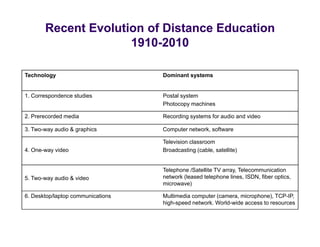
Recent Evolution of Distance Education
                     1910-
                     1910-2010

Technology                         Dominant systems


1. Correspondence studies          Postal system
                                   Photocopy machines

2. Prerecorded media               Recording systems for audio and video

3. Two-way audio & graphics        Computer network, software

                                   Television classroom
4. One-way video                   Broadcasting (cable, satellite)


                                   Telephone /Satellite TV array Telecommunication
                                                           array,
5. Two-way audio & video           network (leased telephone lines, ISDN, fiber optics,
                                   microwave)

6. Desktop/laptop communications   Multimedia computer (camera, microphone), TCP-IP,
                                   high-speed network. World-wide access t resources
                                   hi h     d t     k W ld id            to
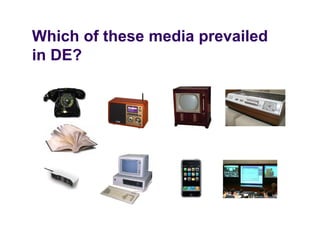
Which of these media prevailed
in DE?
General principles
G     l i i l
   Technology has been the motor of change in
    distance education (DE)
   Prior to d ti by DE, technologies h
    P i t adoption b DE t h l i where
    widely accepted in society
   Many technologies were b i fl adopted and
    M      t h l i           briefly d t d d
    later discarded
   “Survival” f technologies is determined b
    “S i l” of t h l i i d t           i d by
    ecological laws
Which are some of these laws?
(Shaw and Chacon, 2010)

   Reduction of transactional distance
   Equivalence
   Industrialization
   Convergence
   Requisite variety (multimodality vs. single
    modality)
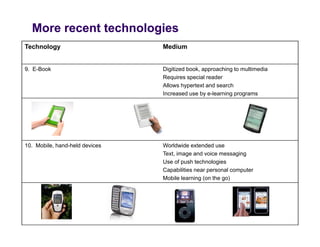
More recent technologies
Technology                      Medium


9. E-Book                       Digitized book, approaching to multimedia
                                Requires special reader
                                Allows hypertext and search
                                Increased use by e-learning programs


10. Mobile, hand-held devices   Worldwide extended use
                                Text, image and voice messaging
                                Use of push technologies
                                Capabilities near personal computer
                                Mobile learning (on the go)
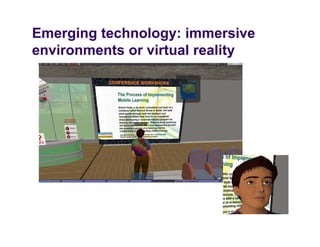
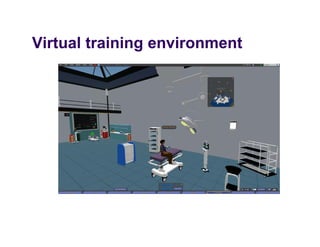
Emerging technology: immersive
environments or virtual reality
   i       t     it l      lit
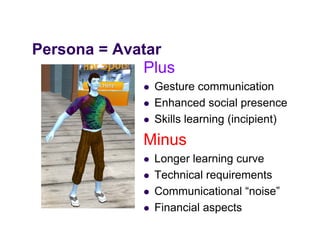
Persona = Avatar
P         A t
             Plus
                Gesture communication
                Enhanced social presence
                                    p
                Skills learning (incipient)
             Minus
                Longer learning curve
                Technical requirements
                Communicational “noise”
                Financial aspects
Virtual training environment
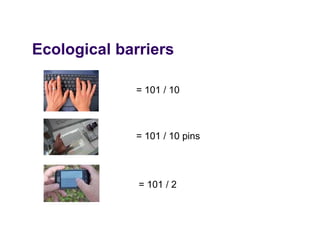
Ecological b i
E l i l barriers

           = 101 / 10


           = 101 / 10 pins


            = 101 / 2
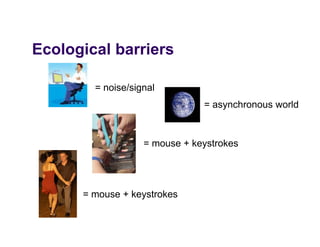
Ecological b i
E l i l barriers

       = noise/signal
                              = asynchronous world
                                  y


                  = mouse + keystrokes


     = mouse + keystrokes
¿What is then an instructional
medium?
  di   ?
   Device(s) able to transport and manipulate
    information in different formats
   Enables user to perform operations with
    information (read, edit, store, create, etc.)
   Physical form adapted to preferred use
   Capabilities and standards converge across
    media
   Physical differences become marginal to
    users
Human dimension (Palloff & Pratt):
 Virtual Learning Community (VCL)
C
 Community = social group th t can b
           it      i l     that     be
 distinguished from a category or conglomerate

 Traditional concept = group with a territory base

 Modern concept= group with diffuse limits,
  distributed in
  di t ib t d i a geographic space and with
                            hi       d ith
  capability for interaction
What is a virtual community?
 Wh t i     it l         it ?
 Still a social group, with a sort of territory
                 group
 The territory is electronic/virtual so all
  intervening objects, processes and people are
  digitally represented
 Virtual communities support and strengthen
  knowledge acquisition (Palloff and Pratt)
 Three integrative forces: goals, interaction and
  common language
              g g
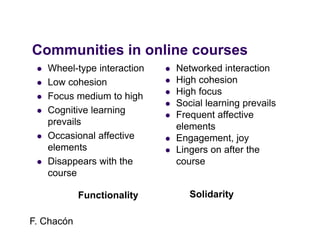
Communities in online courses

C     iti i      li
    Wheel-type interaction      Networked interaction
    Low cohesion                High h i
                                  Hi h cohesion
    Focus medium to high        High focus
                                 Social learning p
                                                g prevails
    Cognitive l
     C    iti learning
                    i            Frequent affective
     prevails                     elements
    Occasional affective        Engagement,
                                  Engagement joy
     elements                    Lingers on after the
    Disappears with the          course
     course

            Functionality            Solidarity

F. Chacón
Principles
Pi i l
   Learning community is difficult to achieve in a
    distance course
   However,
    However it is one key factor of success
   In the formation of the virtual community
    there are factors of:
       Course organization
       Instructor
       Students
       Learning Management System

                                        F. Chacon
WEB 2.0
How media contribute to the
emergence of learning
    g               g
communities?
p
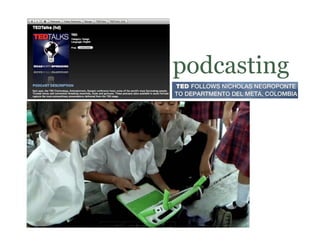
podcasting
         g
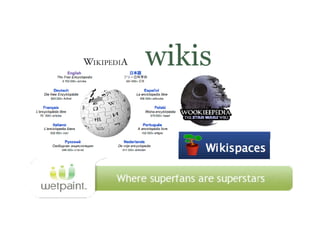
wikis
 iki
social
networking
  t    ki
social bookmarking
                 g
blogging
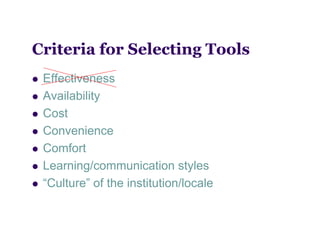
Criteria f S l ti
C it i for Selecting Tools
                     T l
   Effectiveness
   Availability
   Cost
   Convenience
   Comfort
   Learning/communication styles
            g                     y
   “Culture” of the institution/locale
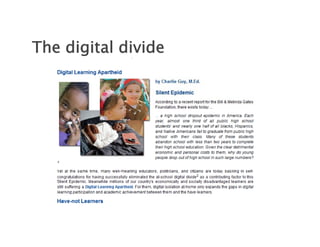
The digital divide
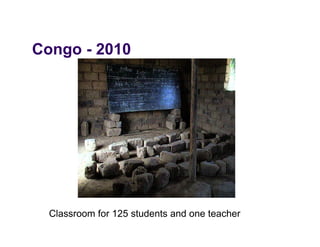
Congo - 2010
C


  Classroom for 125 students and one teacher
The great forces of change in
DE at the beginning of the
decade of the 2010
d   d f h 2010s

   Technology
   Virtual communities
    Virt al comm nities
   The new pedagogies


    Let us examine them, briefly
                               y
Future Technology
               gy
   The bandwidth is unlimited
   The
    Th processing power is unlimited
                  i          i   li it d
   Computers will become more specialized
   Personal media will be (more) embedded in
    everyday life
   Converging: Operating systems, CMS / LMS,
    libraries, student information systems, etc.
   Keywords: simplicity, integration and
    modularity
   Learning systems are tailored to the user and
    not vice versa.
Future Communities
   The community technologies around us are
    creating a new culture of learners
             g
   Today students prefer to work in teams in peer-
    to-peer situations within a structured
    environment that affords a fair amount of
    flexibility
   We are getting closer to a new apprenticeship
    era fostered by virtual communities
   Universities and colleges must b ready f
    U i       iti   d ll            t be   d for
    “edgeless design”, recognizing that students
    belong to various communities of practice
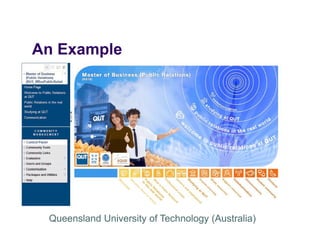
An Example
A E     l


 Queensland University of Technology (Australia)
To what extent does
 technology and virtual
 t h l          d it l
communities change the
   nature of learning?
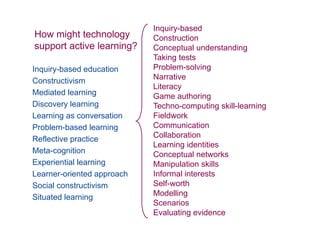
Inquiry-based
How might technology        Construction
support active learning?    Conceptual understanding
                            C       t l d t di
                            Taking tests
Inquiry-based education     Problem-solving
Constructivism              Narrative
                            Literacy
Mediated learning           Game authoring
Discovery learning
         y        g         Techno computing skill-learning
                            Techno-computing skill learning
Learning as conversation    Fieldwork
Problem-based learning      Communication
Reflective practice         Collaboration
                            Learning identities
Meta-cognition              Conceptual networks
Experiential learning       Manipulation skills
Learner-oriented approach   Informal interests
Social constructivism       Self-worth
Situated learning
                g           Modelling
                            Scenarios
                            Evaluating evidence
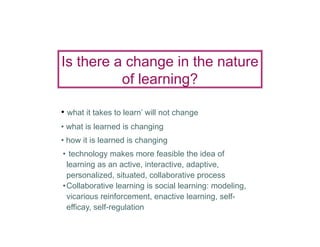
Is there a change in the nature
          of learning?

• what it takes to learn’ will not change
• what is learned is changing
• how it is learned is changing
• technology makes more feasible the idea of
 learning as an active, interactive, adaptive,
 personalized, situated, collaborative process
•Collaborative learning is social learning: modeling,
 vicarious reinforcement, enactive learning, self-
 efficay, self-regulation
WHAT INTERNATIONAL TRENDS
ARE SHAPING DISTANCE
EDUCATION?
Source:


http://www.studymentor.com/
The
Th trends
       d
   Large-scale
    Large scale programs
       More than 100,000 students
       Decentralized systems
       Large investments in technology
       Industrialized model predominant
       There seems no growth limit
Source:


http://www.ambientinsight.com/Reports/eLearn
ing.aspx
Example
E    l
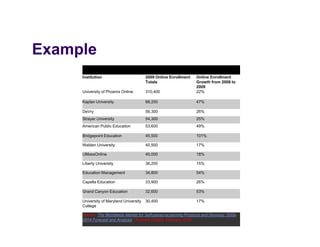
          2009: Top U.S. Higher Education Online Institutions by Enrollment Totals

     Institution                         2009 Online Enrollment   Online Enrollment
                                         Totals                   Growth from 2008 to
                                                                  2009
     University of Phoenix Online        310,400                  22%

     Kaplan University                   68,200                   47%

     DeVry                               56,300                   26%
     Strayer University                  54,300                   25%
     American Public Education           53,600                   49%

     Bridgepoint Education               45,500                   101%

     Walden University                   40,500                   17%

     UMassOnline                         40,000                   18%

     Liberty University                  36,200                   15%

     Education Management                34,800                   54%

     Capella Education                   33,900                   26%

     Grand Canyon Education              32,600                   53%

     University of Maryland University   30,400
                                         30 400                   17%
     College

     Source: The Worldwide Market for Self-paced eLearning Products and Services: 2009-
     2014 Forecast and Analysis , Ambient Insight, February 2010.
The trends
   System Integration
       Convergence between CMS / LMS, student
        information system and library support systems
       There are still many gaps that indicate areas of
        Th             till            th t i di t          f
        possible development
       Rapid changes in technology and software make
        it difficult to integrate – e.g. mobile learning blues
       The greater the integration, the lower the cost
               g                g       ,
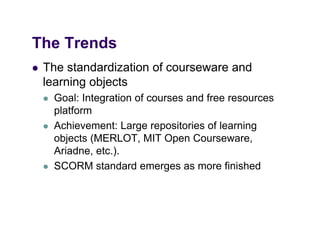
The Trends
   The standardization of courseware and
    learning objects
       Goal: Integration of courses and free resources
        platform
         l tf
       Achievement: Large repositories of learning
        objects (MERLOT MIT Open Courseware
                (MERLOT,              Courseware,
        Ariadne, etc.).
       SCORM standard emerges as more finished
                                g
The trends
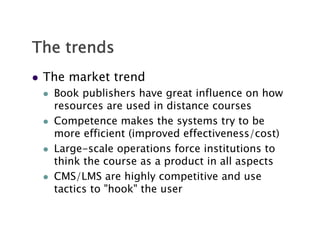
   The market trend
       Book publishers have great influence on how
        resources are used in distance courses
       Competence makes the systems try to be
        more efficient (improved effectiveness/cost)
       Large-scale operations force institutions to
        think the course as a product in all aspects
       CMS/LMS are highly competitive and use
        tactics to "hook" the user
The trends
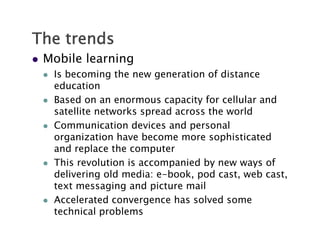
   Mobile learning
       Is becoming the new generation of distance
        education
       Based on an enormous capacity for cellular and
        satellite networks spread across the world
            lli         k       d         h     ld
       Communication devices and personal
        organization have become more sophisticated
        and replace the computer
       This revolution is accompanied by new ways of
        delivering old media: e-book, pod cast, web cast,
        d l          ld   d     b k      d         b
        text messaging and picture mail
       Accelerated convergence has solved some
        technical problems
The trends
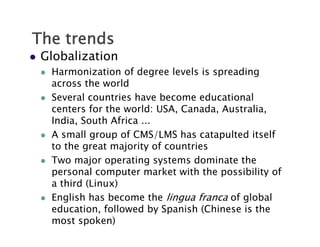
   Globalization
       Harmonization of degree levels is spreading
                              g             p      g
        across the world
       Several countries have become educational
        centers for the world: USA Canada, Australia,
                                 USA, Canada Australia
        India, South Africa ...
       A small group of CMS/LMS has catapulted itself
                 g   p          /            p
        to the great majority of countries
       Two major operating systems dominate the
        personal computer market with the possibility of
        a third (Linux)
       English has become the lingua franca of global
           g                         g           g
        education, followed by Spanish (Chinese is the
        most spoken)
Today's News: The College of 2020
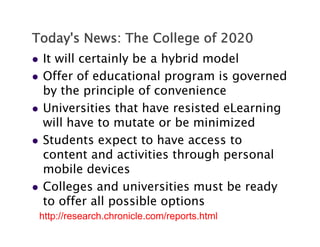
   It will certainly be a hybrid model
   Offer of educational program is governed
    by the principle of convenience
   Universities that have resisted eLearning
    will have to mutate or be minimized
   Students expect to have access to
    content and activities through personal
    mobile devices
   Colleges and universities must be ready
    to offer all possible options
    http://research.chronicle.com/reports.html
Today’s News: The third p
     y                  phase of
eLearning
   Near monopoly of Blackboard Inc has
    caused a resurgence of open source
           d              f
    software
   Enrollment i online programs i growing
    E    ll     in   li             is     i
    faster than HE in general (17% in the US in
    2009)
   The student-teacher interaction and
    student student
    student-student interaction in virtual
    environments are getting closer to real time
   Sophisticated measurement tools enable a
    360 º assessment of the student
The
Th next evolutionary step
      t    l ti       t
   The technology
       Ubiquitous computing
       Two or three devices supported instead of one
       Seamless integration between devices
       Asynchronous communication dominates
       Convergence of three macro-systems: LMS, SIS
        and the Library
       Integration with Web 2 technologies (more open)
       C oud computing
        Cloud co pu g will e a ce co abo a o
                             enhance collaboration
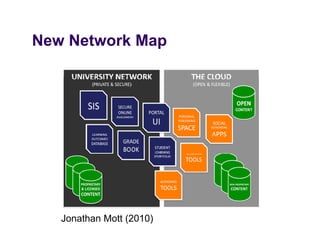
New Network Map


   Jonathan Mott (2010)
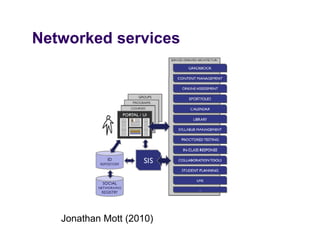
Networked services


   Jonathan Mott (2010)
The
Th next evolutionary step
      t    l ti       t
   The course
       A branched structure rather than a sequence
       Collaborative and experiential
       Social-cognitive learning models prevail
       Engagement and student retention is the key
       Multiple resources available in multiple digital
        formats
       Downloadable courses preferred to only web-
        based
       Agents keep track of students and facilitate
        communications
The
Th next evolutionary step
      t    l ti       t
   The program/institution
        p g
       Provisions to counteract the digital divide
       Small footprint, large extension
       Many tasks are outsourced
       Tight interaction with publishers and open
        repositories
       Multi-language programs and staff (prevalence of
        English,
        English Spanish and Chinese)
       Student retention and graduation strategies in place
       Catering multiple needs of students: connections to
        students’ lives, jobs, and communities
THE END

Chacon future online_learn

  • 1.
    The Next Evolutionary Stepin Online Learning Fabio Chacon, Ph D Chacon Ph.D.
  • 2.
    Recent Evolution ofDistance Education 1910- 1910-2010 Technology Dominant systems 1. Correspondence studies Postal system Photocopy machines 2. Prerecorded media Recording systems for audio and video 3. Two-way audio & graphics Computer network, software Television classroom 4. One-way video Broadcasting (cable, satellite) Telephone /Satellite TV array Telecommunication array, 5. Two-way audio & video network (leased telephone lines, ISDN, fiber optics, microwave) 6. Desktop/laptop communications Multimedia computer (camera, microphone), TCP-IP, high-speed network. World-wide access t resources hi h d t k W ld id to
  • 3.
    Which of thesemedia prevailed in DE?
  • 4.
    General principles G l i i l  Technology has been the motor of change in distance education (DE)  Prior to d ti by DE, technologies h P i t adoption b DE t h l i where widely accepted in society  Many technologies were b i fl adopted and M t h l i briefly d t d d later discarded  “Survival” f technologies is determined b “S i l” of t h l i i d t i d by ecological laws
  • 5.
    Which are someof these laws? (Shaw and Chacon, 2010)  Reduction of transactional distance  Equivalence  Industrialization  Convergence  Requisite variety (multimodality vs. single modality)
  • 6.
    More recent technologies Technology Medium 9. E-Book Digitized book, approaching to multimedia Requires special reader Allows hypertext and search Increased use by e-learning programs 10. Mobile, hand-held devices Worldwide extended use Text, image and voice messaging Use of push technologies Capabilities near personal computer Mobile learning (on the go)
  • 7.
    Emerging technology: immersive environmentsor virtual reality i t it l lit
  • 8.
    Persona = Avatar P A t Plus  Gesture communication  Enhanced social presence p  Skills learning (incipient) Minus  Longer learning curve  Technical requirements  Communicational “noise”  Financial aspects
  • 9.
  • 10.
    Ecological b i El i l barriers = 101 / 10 = 101 / 10 pins = 101 / 2
  • 11.
    Ecological b i El i l barriers = noise/signal = asynchronous world y = mouse + keystrokes = mouse + keystrokes
  • 12.
    ¿What is thenan instructional medium? di ?  Device(s) able to transport and manipulate information in different formats  Enables user to perform operations with information (read, edit, store, create, etc.)  Physical form adapted to preferred use  Capabilities and standards converge across media  Physical differences become marginal to users
  • 13.
    Human dimension (Palloff& Pratt): Virtual Learning Community (VCL) C Community = social group th t can b it i l that be distinguished from a category or conglomerate  Traditional concept = group with a territory base  Modern concept= group with diffuse limits, distributed in di t ib t d i a geographic space and with hi d ith capability for interaction
  • 14.
    What is avirtual community? Wh t i it l it ?  Still a social group, with a sort of territory group  The territory is electronic/virtual so all intervening objects, processes and people are digitally represented  Virtual communities support and strengthen knowledge acquisition (Palloff and Pratt)  Three integrative forces: goals, interaction and common language g g
  • 15.
    Communities in onlinecourses C iti i li  Wheel-type interaction  Networked interaction  Low cohesion  High h i Hi h cohesion  Focus medium to high  High focus  Social learning p g prevails  Cognitive l C iti learning i  Frequent affective prevails elements  Occasional affective  Engagement, Engagement joy elements  Lingers on after the  Disappears with the course course Functionality Solidarity F. Chacón
  • 16.
    Principles Pi i l  Learning community is difficult to achieve in a distance course  However, However it is one key factor of success  In the formation of the virtual community there are factors of:  Course organization  Instructor  Students  Learning Management System F. Chacon
  • 17.
    WEB 2.0 How mediacontribute to the emergence of learning g g communities?
  • 18.
  • 19.
  • 20.
  • 21.
  • 22.
  • 23.
    Criteria f Sl ti C it i for Selecting Tools T l  Effectiveness  Availability  Cost  Convenience  Comfort  Learning/communication styles g y  “Culture” of the institution/locale
  • 24.
  • 25.
    Congo - 2010 C Classroom for 125 students and one teacher
  • 26.
    The great forcesof change in DE at the beginning of the decade of the 2010 d d f h 2010s  Technology  Virtual communities Virt al comm nities  The new pedagogies Let us examine them, briefly y
  • 27.
    Future Technology gy  The bandwidth is unlimited  The Th processing power is unlimited i i li it d  Computers will become more specialized  Personal media will be (more) embedded in everyday life  Converging: Operating systems, CMS / LMS, libraries, student information systems, etc.  Keywords: simplicity, integration and modularity  Learning systems are tailored to the user and not vice versa.
  • 28.
    Future Communities  The community technologies around us are creating a new culture of learners g  Today students prefer to work in teams in peer- to-peer situations within a structured environment that affords a fair amount of flexibility  We are getting closer to a new apprenticeship era fostered by virtual communities  Universities and colleges must b ready f U i iti d ll t be d for “edgeless design”, recognizing that students belong to various communities of practice
  • 29.
    An Example A E l Queensland University of Technology (Australia)
  • 30.
    To what extentdoes technology and virtual t h l d it l communities change the nature of learning?
  • 31.
    Inquiry-based How might technology Construction support active learning? Conceptual understanding C t l d t di Taking tests Inquiry-based education Problem-solving Constructivism Narrative Literacy Mediated learning Game authoring Discovery learning y g Techno computing skill-learning Techno-computing skill learning Learning as conversation Fieldwork Problem-based learning Communication Reflective practice Collaboration Learning identities Meta-cognition Conceptual networks Experiential learning Manipulation skills Learner-oriented approach Informal interests Social constructivism Self-worth Situated learning g Modelling Scenarios Evaluating evidence
  • 32.
    Is there achange in the nature of learning? • what it takes to learn’ will not change • what is learned is changing • how it is learned is changing • technology makes more feasible the idea of learning as an active, interactive, adaptive, personalized, situated, collaborative process •Collaborative learning is social learning: modeling, vicarious reinforcement, enactive learning, self- efficay, self-regulation
  • 33.
    WHAT INTERNATIONAL TRENDS ARESHAPING DISTANCE EDUCATION?
  • 34.
  • 35.
    The Th trends d  Large-scale Large scale programs  More than 100,000 students  Decentralized systems  Large investments in technology  Industrialized model predominant  There seems no growth limit
  • 36.
  • 37.
    Example E l 2009: Top U.S. Higher Education Online Institutions by Enrollment Totals Institution 2009 Online Enrollment Online Enrollment Totals Growth from 2008 to 2009 University of Phoenix Online 310,400 22% Kaplan University 68,200 47% DeVry 56,300 26% Strayer University 54,300 25% American Public Education 53,600 49% Bridgepoint Education 45,500 101% Walden University 40,500 17% UMassOnline 40,000 18% Liberty University 36,200 15% Education Management 34,800 54% Capella Education 33,900 26% Grand Canyon Education 32,600 53% University of Maryland University 30,400 30 400 17% College Source: The Worldwide Market for Self-paced eLearning Products and Services: 2009- 2014 Forecast and Analysis , Ambient Insight, February 2010.
  • 38.
    The trends  System Integration  Convergence between CMS / LMS, student information system and library support systems  There are still many gaps that indicate areas of Th till th t i di t f possible development  Rapid changes in technology and software make it difficult to integrate – e.g. mobile learning blues  The greater the integration, the lower the cost g g ,
  • 39.
    The Trends  The standardization of courseware and learning objects  Goal: Integration of courses and free resources platform l tf  Achievement: Large repositories of learning objects (MERLOT MIT Open Courseware (MERLOT, Courseware, Ariadne, etc.).  SCORM standard emerges as more finished g
  • 40.
    The trends  The market trend  Book publishers have great influence on how resources are used in distance courses  Competence makes the systems try to be more efficient (improved effectiveness/cost)  Large-scale operations force institutions to think the course as a product in all aspects  CMS/LMS are highly competitive and use tactics to "hook" the user
  • 41.
    The trends  Mobile learning  Is becoming the new generation of distance education  Based on an enormous capacity for cellular and satellite networks spread across the world lli k d h ld  Communication devices and personal organization have become more sophisticated and replace the computer  This revolution is accompanied by new ways of delivering old media: e-book, pod cast, web cast, d l ld d b k d b text messaging and picture mail  Accelerated convergence has solved some technical problems
  • 42.
    The trends  Globalization  Harmonization of degree levels is spreading g p g across the world  Several countries have become educational centers for the world: USA Canada, Australia, USA, Canada Australia India, South Africa ...  A small group of CMS/LMS has catapulted itself g p / p to the great majority of countries  Two major operating systems dominate the personal computer market with the possibility of a third (Linux)  English has become the lingua franca of global g g g education, followed by Spanish (Chinese is the most spoken)
  • 43.
    Today's News: TheCollege of 2020  It will certainly be a hybrid model  Offer of educational program is governed by the principle of convenience  Universities that have resisted eLearning will have to mutate or be minimized  Students expect to have access to content and activities through personal mobile devices  Colleges and universities must be ready to offer all possible options http://research.chronicle.com/reports.html
  • 44.
    Today’s News: Thethird p y phase of eLearning  Near monopoly of Blackboard Inc has caused a resurgence of open source d f software  Enrollment i online programs i growing E ll in li is i faster than HE in general (17% in the US in 2009)  The student-teacher interaction and student student student-student interaction in virtual environments are getting closer to real time  Sophisticated measurement tools enable a 360 º assessment of the student
  • 45.
    The Th next evolutionarystep t l ti t  The technology  Ubiquitous computing  Two or three devices supported instead of one  Seamless integration between devices  Asynchronous communication dominates  Convergence of three macro-systems: LMS, SIS and the Library  Integration with Web 2 technologies (more open)  C oud computing Cloud co pu g will e a ce co abo a o enhance collaboration
  • 46.
    New Network Map Jonathan Mott (2010)
  • 47.
    Networked services Jonathan Mott (2010)
  • 48.
    The Th next evolutionarystep t l ti t  The course  A branched structure rather than a sequence  Collaborative and experiential  Social-cognitive learning models prevail  Engagement and student retention is the key  Multiple resources available in multiple digital formats  Downloadable courses preferred to only web- based  Agents keep track of students and facilitate communications
  • 49.
    The Th next evolutionarystep t l ti t  The program/institution p g  Provisions to counteract the digital divide  Small footprint, large extension  Many tasks are outsourced  Tight interaction with publishers and open repositories  Multi-language programs and staff (prevalence of English, English Spanish and Chinese)  Student retention and graduation strategies in place  Catering multiple needs of students: connections to students’ lives, jobs, and communities
  • 50.