The Counseling
Process
PRAVEEN
1116121
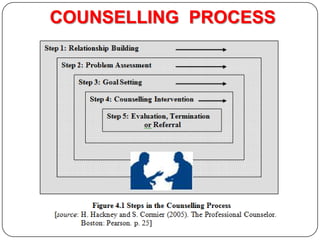
COUNSELLING PROCESS
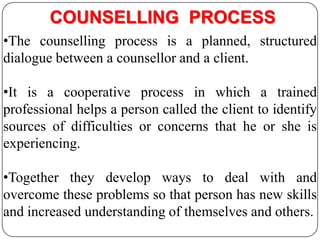
•The counselling process is a planned, structured
dialogue between a counsellor and a client.
•It is a cooperative process in which a trained
professional helps a person called the client to identify
sources of difficulties or concerns that he or she is
experiencing.
•Together they develop ways to deal with and
overcome these problems so that person has new skills
and increased understanding of themselves and others.
COUNSELLING PROCESS
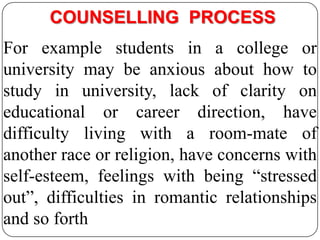
For example students in a college or
university may be anxious about how to
study in university, lack of clarity on
educational or career direction, have
difficulty living with a room-mate of
another race or religion, have concerns with
self-esteem, feelings with being “stressed
out”, difficulties in romantic relationships
and so forth
COUNSELLING PROCESS
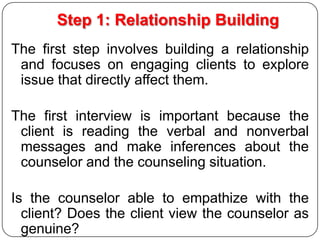
Step 1: Relationship Building
The first step involves building a relationship
and focuses on engaging clients to explore
issue that directly affect them.
The first interview is important because the
client is reading the verbal and nonverbal
messages and make inferences about the
counselor and the counseling situation.

Is the counselor able to empathize with the
client? Does the client view the counselor as
genuine?
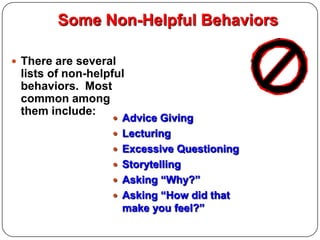
Some Non-Helpful Behaviors
 There are several

lists of non-helpful
behaviors. Most
common among
them include:

 Advice Giving
 Lecturing
 Excessive Questioning
 Storytelling
 Asking “Why?”

 Asking “How did that

make you feel?”
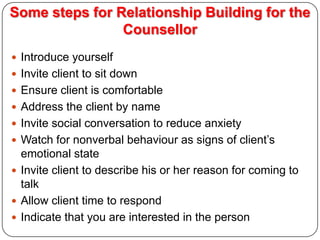
Some steps for Relationship Building for the
Counsellor
 Introduce yourself
 Invite client to sit down
 Ensure client is comfortable
 Address the client by name
 Invite social conversation to reduce anxiety

 Watch for nonverbal behaviour as signs of client’s

emotional state
 Invite client to describe his or her reason for coming to
talk
 Allow client time to respond
 Indicate that you are interested in the person
Step 2: Problem Assessment
While the counselor and the client are in the
process of establishing a relationship, a second
process is taking place, i.e. problem
assessment.
This step involves the collection and clasification
of information about the client’s life situation and
reasons for seeking counseling
Step 3: GOAL SETTING
 Like any other activity, counseling must have a

focus.
 Goals are the results or outcomes that client

wants to achieve at the end of counselling.
 Sometimes, you hear both counselor and client

complain that the counseling session is going
nowhere.
 This is where goals play an important role in

giving direction.
GUIDELINES FOR SETTING
GOALS
 Goals should be selected and defined with care.

 Below are some guidelines for goal selection that can be








used with students:
Goals should relate to the desired end or ends sought by the
student.
Goals should be defined in explicit and measurable terms.
Goals should be feasible.
Goals should be within the range of the counsellor’s knowledge
and skills.
Goals should be stated in positive terms that emphasise growth.
Goals should be consistent with the school’s mission and school
health policy.
Step 4: INTERVENTION
 There are different points of view concerning

what a good counselor should do with clients
depending on the theoretical positions that the
counselor subscribes to.
 For

example, the person-centred approach
suggests that the counselor gets involved rather
than intervenes by placing emphasis on the
relationship.

 The behavioural approach attempts to initiate
Step 5: EVALUATION, FOLLOW-UP,
TERMINATION 0R REFERAL
 For the beginning counselor, it is difficult to think

of terminating the counseling process, as they
are more concerned with beginning the
counseling process.
 However,

all counseling
successful termination.

aims

towards

 Terminating the counseling process will have to

be conducted with sensitivity with the client
knowing that it will have to end.
Step 5: EVALUATION, FOLLOW-UP,
TERMINATION 0R REFERAL
 Counselor always mindful of avoiding fostering

dependency and is aware of own needs

 Preparation for termination begins long before
 Open door / plan for possibility of future need

 Termination

considered not just at end of
successful relationship, but also is considered
when it seems counseling is not being helpful

 Think of this as a means of empowering client
 Role to review progress, create closure in client

counselor
THANK YOU

COUNSELING PROCESS

  • 1.
  • 2.
    COUNSELLING PROCESS •The counsellingprocess is a planned, structured dialogue between a counsellor and a client. •It is a cooperative process in which a trained professional helps a person called the client to identify sources of difficulties or concerns that he or she is experiencing. •Together they develop ways to deal with and overcome these problems so that person has new skills and increased understanding of themselves and others.
  • 3.
    COUNSELLING PROCESS For examplestudents in a college or university may be anxious about how to study in university, lack of clarity on educational or career direction, have difficulty living with a room-mate of another race or religion, have concerns with self-esteem, feelings with being “stressed out”, difficulties in romantic relationships and so forth
  • 4.
  • 5.
    Step 1: RelationshipBuilding The first step involves building a relationship and focuses on engaging clients to explore issue that directly affect them. The first interview is important because the client is reading the verbal and nonverbal messages and make inferences about the counselor and the counseling situation. Is the counselor able to empathize with the client? Does the client view the counselor as genuine?
  • 6.
    Some Non-Helpful Behaviors There are several lists of non-helpful behaviors. Most common among them include:  Advice Giving  Lecturing  Excessive Questioning  Storytelling  Asking “Why?”  Asking “How did that make you feel?”
  • 7.
    Some steps forRelationship Building for the Counsellor  Introduce yourself  Invite client to sit down  Ensure client is comfortable  Address the client by name  Invite social conversation to reduce anxiety  Watch for nonverbal behaviour as signs of client’s emotional state  Invite client to describe his or her reason for coming to talk  Allow client time to respond  Indicate that you are interested in the person
  • 8.
    Step 2: ProblemAssessment While the counselor and the client are in the process of establishing a relationship, a second process is taking place, i.e. problem assessment. This step involves the collection and clasification of information about the client’s life situation and reasons for seeking counseling
  • 9.
    Step 3: GOALSETTING  Like any other activity, counseling must have a focus.  Goals are the results or outcomes that client wants to achieve at the end of counselling.  Sometimes, you hear both counselor and client complain that the counseling session is going nowhere.  This is where goals play an important role in giving direction.
  • 10.
    GUIDELINES FOR SETTING GOALS Goals should be selected and defined with care.  Below are some guidelines for goal selection that can be       used with students: Goals should relate to the desired end or ends sought by the student. Goals should be defined in explicit and measurable terms. Goals should be feasible. Goals should be within the range of the counsellor’s knowledge and skills. Goals should be stated in positive terms that emphasise growth. Goals should be consistent with the school’s mission and school health policy.
  • 11.
    Step 4: INTERVENTION There are different points of view concerning what a good counselor should do with clients depending on the theoretical positions that the counselor subscribes to.  For example, the person-centred approach suggests that the counselor gets involved rather than intervenes by placing emphasis on the relationship.  The behavioural approach attempts to initiate
  • 12.
    Step 5: EVALUATION,FOLLOW-UP, TERMINATION 0R REFERAL  For the beginning counselor, it is difficult to think of terminating the counseling process, as they are more concerned with beginning the counseling process.  However, all counseling successful termination. aims towards  Terminating the counseling process will have to be conducted with sensitivity with the client knowing that it will have to end.
  • 13.
    Step 5: EVALUATION,FOLLOW-UP, TERMINATION 0R REFERAL  Counselor always mindful of avoiding fostering dependency and is aware of own needs  Preparation for termination begins long before  Open door / plan for possibility of future need  Termination considered not just at end of successful relationship, but also is considered when it seems counseling is not being helpful  Think of this as a means of empowering client  Role to review progress, create closure in client counselor
  • 14.