E-Learning
       Trends & Issues
                    By
             Usman Arshad
http://e-learning-teaching.blogspot.com
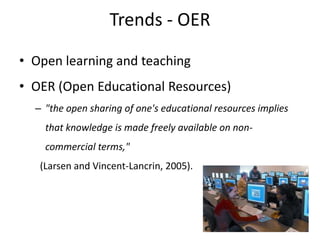
Trends - OER

• Open learning and teaching
• OER (Open Educational Resources)
  – "the open sharing of one's educational resources implies
    that knowledge is made freely available on non-
    commercial terms,"
   (Larsen and Vincent-Lancrin, 2005).
Trends - OER
• Shared educational resources used by
   – learners, instructors and lifelong learners
• Intentions including
   – learning, teaching, research, training and professional
      development
• Resources in the form of
   – textbooks, journals, games, simulations, PowerPoint
      presentations, templates, modules, guides, templates
   – any other electronic educational and training resources
• Has no or little cost
Trends - OER
          Benefits for stakeholders?
• Students
  – access to a wide body of high quality learning content easily
  – Diverse and flexible learning
  – learn from each others learning styles
  – use technology/methods they are comfortable with
  – Enhance critical thinking and creativity skills
  – Exploring other cultures thinking and beliefs
  – no cost or geographical barriers
  – formal learning becoming more expensive
  – students want more for their money
Trends - OER
           Benefits for stakeholders?
• Instructors
  – technology beyond the institution standards
  – globally exchange teaching styles, guides, templates and
      learning resources
  –   less pressure to track latest learning and teaching advancements
  –   more time to design learning and reuse learning content
  –   more time to support students individually.
  –   hand pick, use, and modify individual resources in unique ways
        • guarantees greater diversity of learning environments
Trends - OER
           Benefits for stakeholders?
• Institutions
  –   supporting and widening participation of learning and teaching
  –   more diverse student body
  –   transparency - openly show procedures, teaching, and research
  –   increased recognition for their scholarships
  –   promote use of use of new technologies
  –   attracting local and international students
  –   allow less formal collaborations and partnerships
  –   rising costs sustained
  –   solution for expenses and course fees etc
  –   less staff training costs
Trends - OER
                                    Who’s using it?
•   Massachusetts Institute of Technology
     –   early adopters in 2002
     –   OpenCourseWare project
     –   Currently holds course materials from around 2,000 MIT courses.
•   Nationally funded e-learning hosting website
     –   Jorum
     –   nationally funded e-learning hosting website
     –   used by any UK academic
     –   find, share and discuss learning and teaching resources, shared by the UK Further and HE community.
•   iTunes U
     –   provides lectures as audio and video content from:
            •   museums, universities, cultural institutions and public television stations
     –   Institutions can sign-up and upload content
•   Since April 2009 The Higher Education Academy and JISC are working in partnership to support the HEFCE OER
    pilot programme (HEA, 2010).
Trends - OER
            personal experiences
•   Youtube interview with Siemens on MOOC
•   Twitter search ‘#eAssessment’
•   Access and print blank storyboard templates
•   Learning objects - existing flash games for
    mouse training
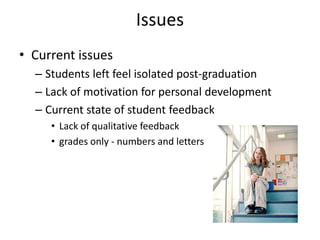
Issues
• Current issues
  – Students left feel isolated post-graduation
  – Lack of motivation for personal development
  – Current state of student feedback
     • Lack of qualitative feedback
     • grades only - numbers and letters
Issues
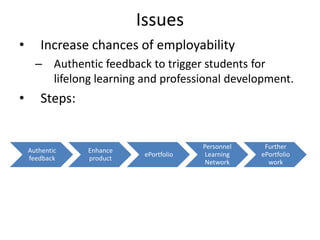
•       Increase chances of employability
      – Authentic feedback to trigger students for
        lifelong learning and professional development.
•       Steps:


                                         Personnel    Further
    Authentic    Enhance
                            ePortfolio    Learning   ePortfolio
    feedback     product
                                          Network      work
Issues
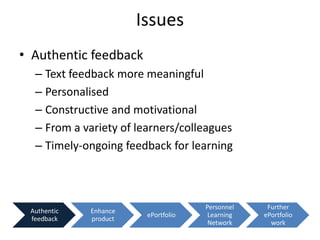
• Authentic feedback
  – Text feedback more meaningful
  – Personalised
  – Constructive and motivational
  – From a variety of learners/colleagues
  – Timely-ongoing feedback for learning


                                     Personnel    Further
 Authentic   Enhance
                        ePortfolio    Learning   ePortfolio
 feedback    product
                                      Network      work
Issues
• Peer review feedback
  – benefit for both the learner and peer
  – Learner
      • anonymous peers less apprehensive
      • diversity of opinions
      • learn from honest feedback
      • tweak work from early stage
  – Peer
      • flavour of expectations
      • clearer idea of the intensity and requirements of the activity/assessment
      • learn good practice, techniques and methods
      • Identify and diagnose and solve own errors

                                                     Personnel          Further
 Authentic        Enhance
                                    ePortfolio        Learning         ePortfolio
 feedback         product
                                                      Network            work
Issues
• Enhance product
  – using the feedback take a step further
  – Constructive feedback = motivation
  – Further enhancement of the product
  – turn into ePortfolio piece


                                     Personnel    Further
 Authentic   Enhance
                        ePortfolio    Learning   ePortfolio
 feedback    product
                                      Network      work
Issues
• ePortfolio
  – modern approach of an e-Portfolio described by
    Sutherland and Powell in 2007 as:
  – “A purposeful aggregation of digital items - ideas,
    evidence, reflections, feedback, etc. which
    ‘presents’ a selected audience with evidence of a
    person’s learning and/or ability.”


                                       Personnel    Further
 Authentic     Enhance
                          ePortfolio    Learning   ePortfolio
 feedback      product
                                        Network      work
Issues
• ePortfolio
  –   take control of learning
  –    reflecting on activities/products
  –   planning future directions
  –   connections among formal and informal learning
      experiences
  –   continuity during breaks through lifelong learning
  –   linking achievements/work with skills required by
      employers
  –   model professionalism
  –   Helps identify learning needs and closing gaps
                                           Personnel        Further
 Authentic      Enhance
                             ePortfolio     Learning       ePortfolio
 feedback       product
                                            Network          work
Issues
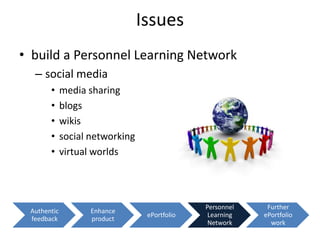
• build a Personnel Learning Network
  – social media
       •     media sharing
       •     blogs
       •     wikis
       •     social networking
       •     virtual worlds


                                               Personnel    Further
 Authentic          Enhance
                                  ePortfolio    Learning   ePortfolio
 feedback           product
                                                Network      work
Issues
• Benefits of social media as PLN
  – Community of practice which continues to grow
  – Any time, any place, any device learning
  – Widely distributed, accessible and immediate format
  – new things discovered, and continue to discover every day
  – continue to learn from others
  –  motivation to share what you have learnt
  – stronger social and intellectual ties with your community
    of practice
  – sharing knowledge comes back to you with interest
Issues
• Further work for portfolio
  – Motivated by learning new
    techniques, methods, concepts and interventions
• Further quality work to showcase employers
Issues
•    Authentic feedback to trigger students for
     lifelong learning and professional
     development.
    1.   Authentic feedback
    2.   enhance product
    3.   ePortfolio
    4.   Personnel Learning Network
    5.   Further portfolio work
The End
Thank you
http://e-learning-teaching.blogspot.com

E-Learning trends & issues

  • 1.
    E-Learning Trends & Issues By Usman Arshad http://e-learning-teaching.blogspot.com
  • 2.
    Trends - OER •Open learning and teaching • OER (Open Educational Resources) – "the open sharing of one's educational resources implies that knowledge is made freely available on non- commercial terms," (Larsen and Vincent-Lancrin, 2005).
  • 3.
    Trends - OER •Shared educational resources used by – learners, instructors and lifelong learners • Intentions including – learning, teaching, research, training and professional development • Resources in the form of – textbooks, journals, games, simulations, PowerPoint presentations, templates, modules, guides, templates – any other electronic educational and training resources • Has no or little cost
  • 4.
    Trends - OER Benefits for stakeholders? • Students – access to a wide body of high quality learning content easily – Diverse and flexible learning – learn from each others learning styles – use technology/methods they are comfortable with – Enhance critical thinking and creativity skills – Exploring other cultures thinking and beliefs – no cost or geographical barriers – formal learning becoming more expensive – students want more for their money
  • 5.
    Trends - OER Benefits for stakeholders? • Instructors – technology beyond the institution standards – globally exchange teaching styles, guides, templates and learning resources – less pressure to track latest learning and teaching advancements – more time to design learning and reuse learning content – more time to support students individually. – hand pick, use, and modify individual resources in unique ways • guarantees greater diversity of learning environments
  • 6.
    Trends - OER Benefits for stakeholders? • Institutions – supporting and widening participation of learning and teaching – more diverse student body – transparency - openly show procedures, teaching, and research – increased recognition for their scholarships – promote use of use of new technologies – attracting local and international students – allow less formal collaborations and partnerships – rising costs sustained – solution for expenses and course fees etc – less staff training costs
  • 7.
    Trends - OER Who’s using it? • Massachusetts Institute of Technology – early adopters in 2002 – OpenCourseWare project – Currently holds course materials from around 2,000 MIT courses. • Nationally funded e-learning hosting website – Jorum – nationally funded e-learning hosting website – used by any UK academic – find, share and discuss learning and teaching resources, shared by the UK Further and HE community. • iTunes U – provides lectures as audio and video content from: • museums, universities, cultural institutions and public television stations – Institutions can sign-up and upload content • Since April 2009 The Higher Education Academy and JISC are working in partnership to support the HEFCE OER pilot programme (HEA, 2010).
  • 8.
    Trends - OER personal experiences • Youtube interview with Siemens on MOOC • Twitter search ‘#eAssessment’ • Access and print blank storyboard templates • Learning objects - existing flash games for mouse training
  • 9.
    Issues • Current issues – Students left feel isolated post-graduation – Lack of motivation for personal development – Current state of student feedback • Lack of qualitative feedback • grades only - numbers and letters
  • 10.
    Issues • Increase chances of employability – Authentic feedback to trigger students for lifelong learning and professional development. • Steps: Personnel Further Authentic Enhance ePortfolio Learning ePortfolio feedback product Network work
  • 11.
    Issues • Authentic feedback – Text feedback more meaningful – Personalised – Constructive and motivational – From a variety of learners/colleagues – Timely-ongoing feedback for learning Personnel Further Authentic Enhance ePortfolio Learning ePortfolio feedback product Network work
  • 12.
    Issues • Peer reviewfeedback – benefit for both the learner and peer – Learner • anonymous peers less apprehensive • diversity of opinions • learn from honest feedback • tweak work from early stage – Peer • flavour of expectations • clearer idea of the intensity and requirements of the activity/assessment • learn good practice, techniques and methods • Identify and diagnose and solve own errors Personnel Further Authentic Enhance ePortfolio Learning ePortfolio feedback product Network work
  • 13.
    Issues • Enhance product – using the feedback take a step further – Constructive feedback = motivation – Further enhancement of the product – turn into ePortfolio piece Personnel Further Authentic Enhance ePortfolio Learning ePortfolio feedback product Network work
  • 14.
    Issues • ePortfolio – modern approach of an e-Portfolio described by Sutherland and Powell in 2007 as: – “A purposeful aggregation of digital items - ideas, evidence, reflections, feedback, etc. which ‘presents’ a selected audience with evidence of a person’s learning and/or ability.” Personnel Further Authentic Enhance ePortfolio Learning ePortfolio feedback product Network work
  • 15.
    Issues • ePortfolio – take control of learning – reflecting on activities/products – planning future directions – connections among formal and informal learning experiences – continuity during breaks through lifelong learning – linking achievements/work with skills required by employers – model professionalism – Helps identify learning needs and closing gaps Personnel Further Authentic Enhance ePortfolio Learning ePortfolio feedback product Network work
  • 16.
    Issues • build aPersonnel Learning Network – social media • media sharing • blogs • wikis • social networking • virtual worlds Personnel Further Authentic Enhance ePortfolio Learning ePortfolio feedback product Network work
  • 17.
    Issues • Benefits ofsocial media as PLN – Community of practice which continues to grow – Any time, any place, any device learning – Widely distributed, accessible and immediate format – new things discovered, and continue to discover every day – continue to learn from others – motivation to share what you have learnt – stronger social and intellectual ties with your community of practice – sharing knowledge comes back to you with interest
  • 18.
    Issues • Further workfor portfolio – Motivated by learning new techniques, methods, concepts and interventions • Further quality work to showcase employers
  • 19.
    Issues • Authentic feedback to trigger students for lifelong learning and professional development. 1. Authentic feedback 2. enhance product 3. ePortfolio 4. Personnel Learning Network 5. Further portfolio work
  • 20.