
Learning Management System
An Essential Educational Technology
Dr. Sarita Anand
Assistant Professor
Department of Education
Vinaya Bhavana
Visva-Bharati
(A Central University and an Institution of
National Importance)
Santiniketan, West-Bengal
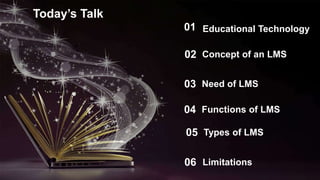
Today’s Talk
Concept of an LMS
02
Need of LMS
03
Types of LMS
05
Educational Technology
01
Limitations
06
Functions of LMS
04
Previous Knowledge of
Educational Technology
Basically Theoretical Concepts Taught in B.Ed. and M.Ed.
Classes
Definition
Association of Educational communications and Technology (AECT)
defined educational technology as "the study and ethical
practice of facilitating learning and improving performance by
creating, using and managing appropriate technological
processes and resources“.
It denoted instructional technology as "the theory and practice
of design, development, utilization, management, and
evaluation of processes and resources for learning".
Educational technology is the process of integrating technology
into education in a positive manner that promotes a more
diverse learning environment and a way for students to learn
how to use technology as well as their common assignments.
So,
Educational technology is a systematic approach to designing
and evaluating learning and teaching methods, methodologies
and to the application and exploitation of media and current
knowledge of communication techniques in education both
formal and informal.
General contents on Educational Technology
Forms of Educational Technology
Teaching Technology
Instructional Technology
Behavioral Technology
Instructional Design Technology
Approaches of Educational Technology
Hardware Approach
Software Approach
Systems Approach
General contents on Educational Technology
Teaching and Learning
Communication in Teaching and Learning
Management of Teaching and Learning
Micro-Teaching, Simulated Teaching, Role Playing
Internship
Behavior Modification and Interaction Analysis
Programmed Learning, PSI, LCI, CAI, CMI,CBT
Team Teaching, Cooperative Learning, Distance and
Open Education
e-learning, Virtual classrooms, ICT,
CIET, ET Cells, NRCs
NME-ICT, MOOCs/SWAYAM, OER
Learning Management System?
Teaching and Learning
Concepts of Teaching and Learning
Tasks/Phases of Teaching
Theories of Teaching
Models of Teaching
Principles and Maxims of Teaching
Methods/Skills/Strategies of Teaching
Bloom’s Taxonomy, Lesson and Unit Planning
Teaching Aids-A,V, A/V, Projected/Non-Projected
Source: https://www.ispringsolutions.com/blog/what-is-lms
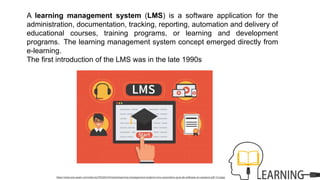
A learning management system (LMS) is a software application for the
administration, documentation, tracking, reporting, automation and delivery of
educational courses, training programs, or learning and development
programs. The learning management system concept emerged directly from
e-learning.
The first introduction of the LMS was in the late 1990s
https://www.erp-spain.com/articulo/76325/rrhh/todos/learning-management-systems-lms-corporativo-guia-de-software-en-espanol-pdf-12-pags
Key Features of LMS
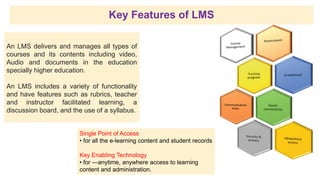
An LMS delivers and manages all types of
courses and its contents including video,
Audio and documents in the education
specially higher education.
An LMS includes a variety of functionality
and have features such as rubrics, teacher
and instructor facilitated learning, a
discussion board, and the use of a syllabus.
Single Point of Access
• for all the e-learning content and student records
Key Enabling Technology
• for ―anytime, anywhere access to learning
content and administration.
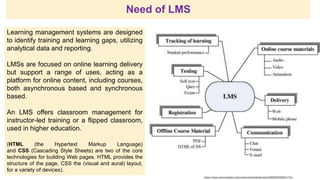
Learning management systems are designed
to identify training and learning gaps, utilizing
analytical data and reporting.
LMSs are focused on online learning delivery
but support a range of uses, acting as a
platform for online content, including courses,
both asynchronous based and synchronous
based.
An LMS offers classroom management for
instructor-led training or a flipped classroom,
used in higher education.
(HTML (the Hypertext Markup Language)
and CSS (Cascading Style Sheets) are two of the core
technologies for building Web pages. HTML provides the
structure of the page, CSS the (visual and aural) layout,
for a variety of devices).
https://www.sciencedirect.com/science/article/abs/pii/S0965997809001744
Need of LMS
https://www.promptcloud.com/blog/open-source-learning-management-system/
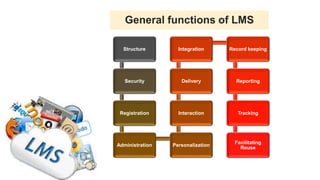
General functions of LMS
Structure
Security
Registration
Administration Personalization
Interaction
Delivery
Integration Record keeping
Reporting
Tracking
Facilitating
Reuse
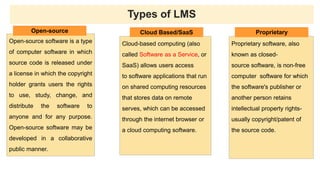
Open-source software is a type
of computer software in which
source code is released under
a license in which the copyright
holder grants users the rights
to use, study, change, and
distribute the software to
anyone and for any purpose.
Open-source software may be
developed in a collaborative
public manner.
Cloud-based computing (also
called Software as a Service, or
SaaS) allows users access
to software applications that run
on shared computing resources
that stores data on remote
serves, which can be accessed
through the internet browser or
a cloud computing software.
Proprietary software, also
known as closed-
source software, is non-free
computer software for which
the software's publisher or
another person retains
intellectual property rights-
usually copyright/patent of
the source code.
Types of LMS
Open-source Cloud Based/SaaS Proprietary
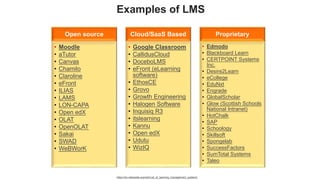
Examples of LMS
Open source
• Moodle
• aTutor
• Canvas
• Chamilo
• Claroline
• eFront
• ILIAS
• LAMS
• LON-CAPA
• Open edX
• OLAT
• OpenOLAT
• Sakai
• SWAD
• WeBWorK
Cloud/SaaS Based
• Google Classroom
• CallidusCloud
• DoceboLMS
• eFront (eLearning
software)
• EthosCE
• Grovo
• Growth Engineering
• Halogen Software
• Inquisiq R3
• itslearning
• Kannu
• Open edX
• Udutu
• WizIQ
Proprietary
• Edmodo
• Blackboard Learn
• CERTPOINT Systems
Inc.
• Desire2Learn
• eCollege
• EduNxt
• Engrade
• GlobalScholar
• Glow (Scottish Schools
National Intranet)
• HotChalk
• SAP
• Schoology
• Skillsoft
• Spongelab
• SuccessFactors
• SumTotal Systems
• Taleo
https://en.wikipedia.org/wiki/List_of_learning_management_systems
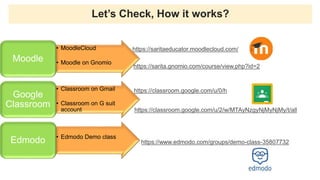
Let’s Check, How it works?
https://saritaeducator.moodlecloud.com/
https://classroom.google.com/u/0/h
https://classroom.google.com/u/2/w/MTAyNzgyNjMyNjMy/t/all
https://sarita.gnomio.com/course/view.php?id=2
• MoodleCloud
• Moodle on Gnomio
Moodle
• Classroom on Gmail
• Classroom on G suit
account
Google
Classroom
• Edmodo Demo class
Edmodo https://www.edmodo.com/groups/demo-class-35807732
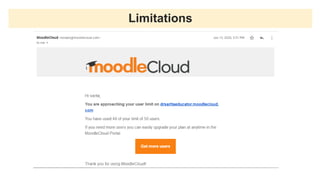
Limitations
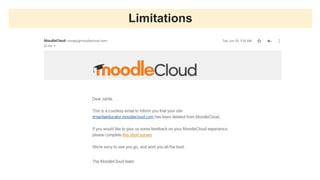
Limitations
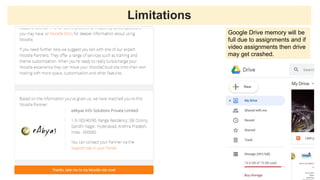
Limitations
Google Drive memory will be
full due to assignments and if
video assignments then drive
may get crashed.
Let’s conclude the session with an Animation Video
https://youtu.be/xILIfCGBpDU
THANK YOU
Be Active Keep Learning
sarita.anand@visva-bharati.ac.in

Learning Management System: An Essential Educational Technology

  • 1.
    Learning Management System AnEssential Educational Technology Dr. Sarita Anand Assistant Professor Department of Education Vinaya Bhavana Visva-Bharati (A Central University and an Institution of National Importance) Santiniketan, West-Bengal
  • 2.
    Today’s Talk Concept ofan LMS 02 Need of LMS 03 Types of LMS 05 Educational Technology 01 Limitations 06 Functions of LMS 04
  • 3.
    Previous Knowledge of EducationalTechnology Basically Theoretical Concepts Taught in B.Ed. and M.Ed. Classes
  • 4.
    Definition Association of Educationalcommunications and Technology (AECT) defined educational technology as "the study and ethical practice of facilitating learning and improving performance by creating, using and managing appropriate technological processes and resources“. It denoted instructional technology as "the theory and practice of design, development, utilization, management, and evaluation of processes and resources for learning". Educational technology is the process of integrating technology into education in a positive manner that promotes a more diverse learning environment and a way for students to learn how to use technology as well as their common assignments.
  • 5.
    So, Educational technology isa systematic approach to designing and evaluating learning and teaching methods, methodologies and to the application and exploitation of media and current knowledge of communication techniques in education both formal and informal.
  • 6.
    General contents onEducational Technology Forms of Educational Technology Teaching Technology Instructional Technology Behavioral Technology Instructional Design Technology Approaches of Educational Technology Hardware Approach Software Approach Systems Approach
  • 7.
    General contents onEducational Technology Teaching and Learning Communication in Teaching and Learning Management of Teaching and Learning Micro-Teaching, Simulated Teaching, Role Playing Internship Behavior Modification and Interaction Analysis Programmed Learning, PSI, LCI, CAI, CMI,CBT Team Teaching, Cooperative Learning, Distance and Open Education e-learning, Virtual classrooms, ICT, CIET, ET Cells, NRCs NME-ICT, MOOCs/SWAYAM, OER Learning Management System? Teaching and Learning Concepts of Teaching and Learning Tasks/Phases of Teaching Theories of Teaching Models of Teaching Principles and Maxims of Teaching Methods/Skills/Strategies of Teaching Bloom’s Taxonomy, Lesson and Unit Planning Teaching Aids-A,V, A/V, Projected/Non-Projected
  • 8.
  • 9.
    A learning managementsystem (LMS) is a software application for the administration, documentation, tracking, reporting, automation and delivery of educational courses, training programs, or learning and development programs. The learning management system concept emerged directly from e-learning. The first introduction of the LMS was in the late 1990s https://www.erp-spain.com/articulo/76325/rrhh/todos/learning-management-systems-lms-corporativo-guia-de-software-en-espanol-pdf-12-pags
  • 10.
    Key Features ofLMS An LMS delivers and manages all types of courses and its contents including video, Audio and documents in the education specially higher education. An LMS includes a variety of functionality and have features such as rubrics, teacher and instructor facilitated learning, a discussion board, and the use of a syllabus. Single Point of Access • for all the e-learning content and student records Key Enabling Technology • for ―anytime, anywhere access to learning content and administration.
  • 11.
    Learning management systemsare designed to identify training and learning gaps, utilizing analytical data and reporting. LMSs are focused on online learning delivery but support a range of uses, acting as a platform for online content, including courses, both asynchronous based and synchronous based. An LMS offers classroom management for instructor-led training or a flipped classroom, used in higher education. (HTML (the Hypertext Markup Language) and CSS (Cascading Style Sheets) are two of the core technologies for building Web pages. HTML provides the structure of the page, CSS the (visual and aural) layout, for a variety of devices). https://www.sciencedirect.com/science/article/abs/pii/S0965997809001744 Need of LMS
  • 12.
  • 13.
    General functions ofLMS Structure Security Registration Administration Personalization Interaction Delivery Integration Record keeping Reporting Tracking Facilitating Reuse
  • 14.
    Open-source software isa type of computer software in which source code is released under a license in which the copyright holder grants users the rights to use, study, change, and distribute the software to anyone and for any purpose. Open-source software may be developed in a collaborative public manner. Cloud-based computing (also called Software as a Service, or SaaS) allows users access to software applications that run on shared computing resources that stores data on remote serves, which can be accessed through the internet browser or a cloud computing software. Proprietary software, also known as closed- source software, is non-free computer software for which the software's publisher or another person retains intellectual property rights- usually copyright/patent of the source code. Types of LMS Open-source Cloud Based/SaaS Proprietary
  • 15.
    Examples of LMS Opensource • Moodle • aTutor • Canvas • Chamilo • Claroline • eFront • ILIAS • LAMS • LON-CAPA • Open edX • OLAT • OpenOLAT • Sakai • SWAD • WeBWorK Cloud/SaaS Based • Google Classroom • CallidusCloud • DoceboLMS • eFront (eLearning software) • EthosCE • Grovo • Growth Engineering • Halogen Software • Inquisiq R3 • itslearning • Kannu • Open edX • Udutu • WizIQ Proprietary • Edmodo • Blackboard Learn • CERTPOINT Systems Inc. • Desire2Learn • eCollege • EduNxt • Engrade • GlobalScholar • Glow (Scottish Schools National Intranet) • HotChalk • SAP • Schoology • Skillsoft • Spongelab • SuccessFactors • SumTotal Systems • Taleo https://en.wikipedia.org/wiki/List_of_learning_management_systems
  • 16.
    Let’s Check, Howit works? https://saritaeducator.moodlecloud.com/ https://classroom.google.com/u/0/h https://classroom.google.com/u/2/w/MTAyNzgyNjMyNjMy/t/all https://sarita.gnomio.com/course/view.php?id=2 • MoodleCloud • Moodle on Gnomio Moodle • Classroom on Gmail • Classroom on G suit account Google Classroom • Edmodo Demo class Edmodo https://www.edmodo.com/groups/demo-class-35807732
  • 17.
  • 18.
  • 19.
    Limitations Google Drive memorywill be full due to assignments and if video assignments then drive may get crashed.
  • 20.
    Let’s conclude thesession with an Animation Video https://youtu.be/xILIfCGBpDU
  • 21.
    THANK YOU Be ActiveKeep Learning sarita.anand@visva-bharati.ac.in