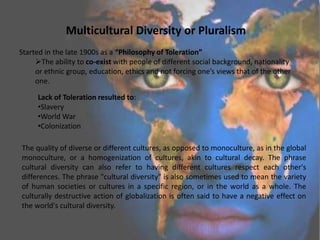
Multicultural Diversity or Pluralism
Started in the late 1900s as a “Philosophy of Toleration”
The ability to co-exist with people of different social background, nationality
or ethnic group, education, ethics and not forcing one’s views that of the other
one.
Lack of Toleration resulted to:
•Slavery
•World War
•Colonization
The quality of diverse or different cultures, as opposed to monoculture, as in the global
monoculture, or a homogenization of cultures, akin to cultural decay. The phrase
cultural diversity can also refer to having different cultures respect each other's
differences. The phrase "cultural diversity" is also sometimes used to mean the variety
of human societies or cultures in a specific region, or in the world as a whole. The
culturally destructive action of globalization is often said to have a negative effect on
the world's cultural diversity.
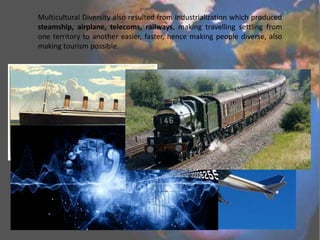
Multicultural Diversity also resulted from industrialization which produced
steamship, airplane, telecoms, railways, making travelling settling from
one territory to another easier, faster, hence making people diverse, also
making tourism possible.
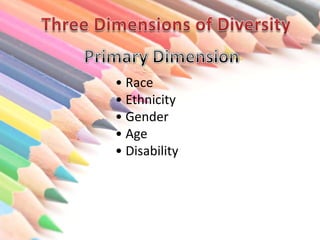
• Race
• Ethnicity
• Gender
• Age
• Disability
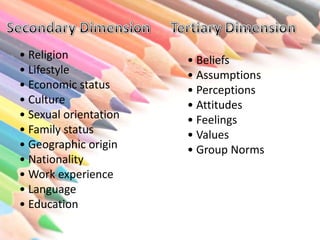
• Religion
• Lifestyle
• Economic status
• Culture
• Sexual orientation
• Family status
• Geographic origin
• Nationality
• Work experience
• Language
• Education

• Beliefs
• Assumptions
• Perceptions
• Attitudes
• Feelings
• Values
• Group Norms
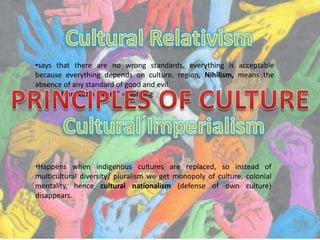
•says that there are no wrong standards, everything is acceptable
because everything depends on culture, region, Nihilism, means the
absence of any standard of good and evil.
 from Latin “NIHIL” = nothing

•Happens when indigenous cultures are replaced, so instead of
multicultural diversity/ pluralism we get monopoly of culture, colonial
mentality, hence cultural nationalism (defense of own culture)
disappears.
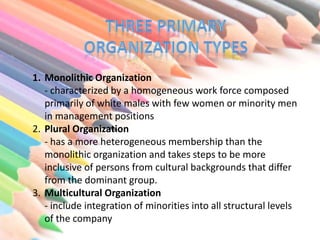
1. Monolithic Organization
- characterized by a homogeneous work force composed
primarily of white males with few women or minority men
in management positions
2. Plural Organization
- has a more heterogeneous membership than the
monolithic organization and takes steps to be more
inclusive of persons from cultural backgrounds that differ
from the dominant group.
3. Multicultural Organization
- include integration of minorities into all structural levels
of the company
1. Increased Adaptability
2. Broader service range

3. Variety of Viewpoints
4. More effective execution
1. Increased Adaptability
Organizations employing a diverse workforce can supply a
greater variety of solutions to problems in service.
Sourcing, and allocation of resources. Employees from diverse
backgrounds bring individual talents and experiences in
suggesting ideas that are flexible in adapting to fluctuating
markets and customer demands.
2. Broader Service Range
A diverse collection of skills and experiences (e.g.
languages, cultural understanding) allows a company to provide
products/service to customers worldwide.
3. Variety of Viewpoints
A diverse workforce that feels comfortable communicating
varying points of view provides a larger pool of ideas and
experiences. The organization can draw from that pool to
meet business strategy needs and the needs of customers
more effectively.
4. More Effective Execution
Companies that encourage diversity in the workplace inspire all
their employees to perform to their highest ability. Companywide strategies can then be executed; resulting in higher
productivity, profit, and return on investment.
•Diversity renders communications and integration more difficult.
People from different culture fail to understand one another. They do
not work in the same ways or at the same place.
•The potential for increased ambiguity, complexity and confusion
becomes highest when the organization or project requires direction
and clarity- convergence (Adler, 2002). Cox (2001) mentions that
increasing diversity presents a double edged sword; hence the
challenge of managing diversity is to create conditions that minimize
its potential to be a performance barrier while maximizing its
potential to enhance organizational performance.
•Communication Barriers
•Resistance to Change
•Socio-cultural Factors
•Education, age, and gender
•Personality and Background
1. Communication Barriers
Ineffective communication of key objectives results in confusion, lack
of teamwork and low morale.
Barriers to communication are factors that block or significantly
destroy successful communication.
2. Resistance to change
Refusing to accept new policies
Why change something that works
We’ve always done it this way
Scared of failure and not being able to learn/adapt to new things
Not wanting to spend time and effort changing
Not understanding what is expected (the fear of the unknown)
3. Socio-cultural Factors
•How one was raised, will give them certain beliefs at a young age. Their believes may
be a slightly different than those that we were brought up to believe.
•In any form, our behavior was established, regardless of your background. Rules and
behavior that one models is what they were taught. Beliefs may be different, making it
difficult to understand the reason why you may have offended someone, if you are not
familiar with their background.
4. Education, age, and gender
education. Different education levels can impact effective communication. Complex
words and explanations may not be understood by a person less educated, or not
educated in a certain field. Imagine a doctor explaining that you have a broken leg in
medicalterms!
Age is another challenge in today’s workplace. People may not be used to
communicating with different age groups . Older people may use old
phrases/words to explain things not understood by a younger audience.
Younger people may also use words too modern and not understood by an
older generation.
Gender can affect communication as men and women often think about
things differently. In Islamic culture especially, when a female and male
communicate, certain traditions are followed, such as lack of eye contact
and shaking hands, affecting perception and communication.
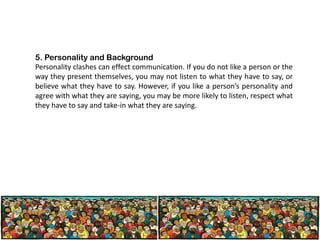
5. Personality and Background
Personality clashes can effect communication. If you do not like a person or the
way they present themselves, you may not listen to what they have to say, or
believe what they have to say. However, if you like a person’s personality and
agree with what they are saying, you may be more likely to listen, respect what
they have to say and take-in what they are saying.
1.
2.
3.
4.
5.

Manage and Recognize Cultural Diversity
Define and Establish Cultural Diversity.
Transforming Organizational Behavior
Influencing Cultural Diversity.
Sustaining Positive Influence Programs
BESA, ALLAN PAUL
BUTIONG, JOSE RAFAEL
IBASCO, JAMEE NOELLE
UPAO, CHARLENE

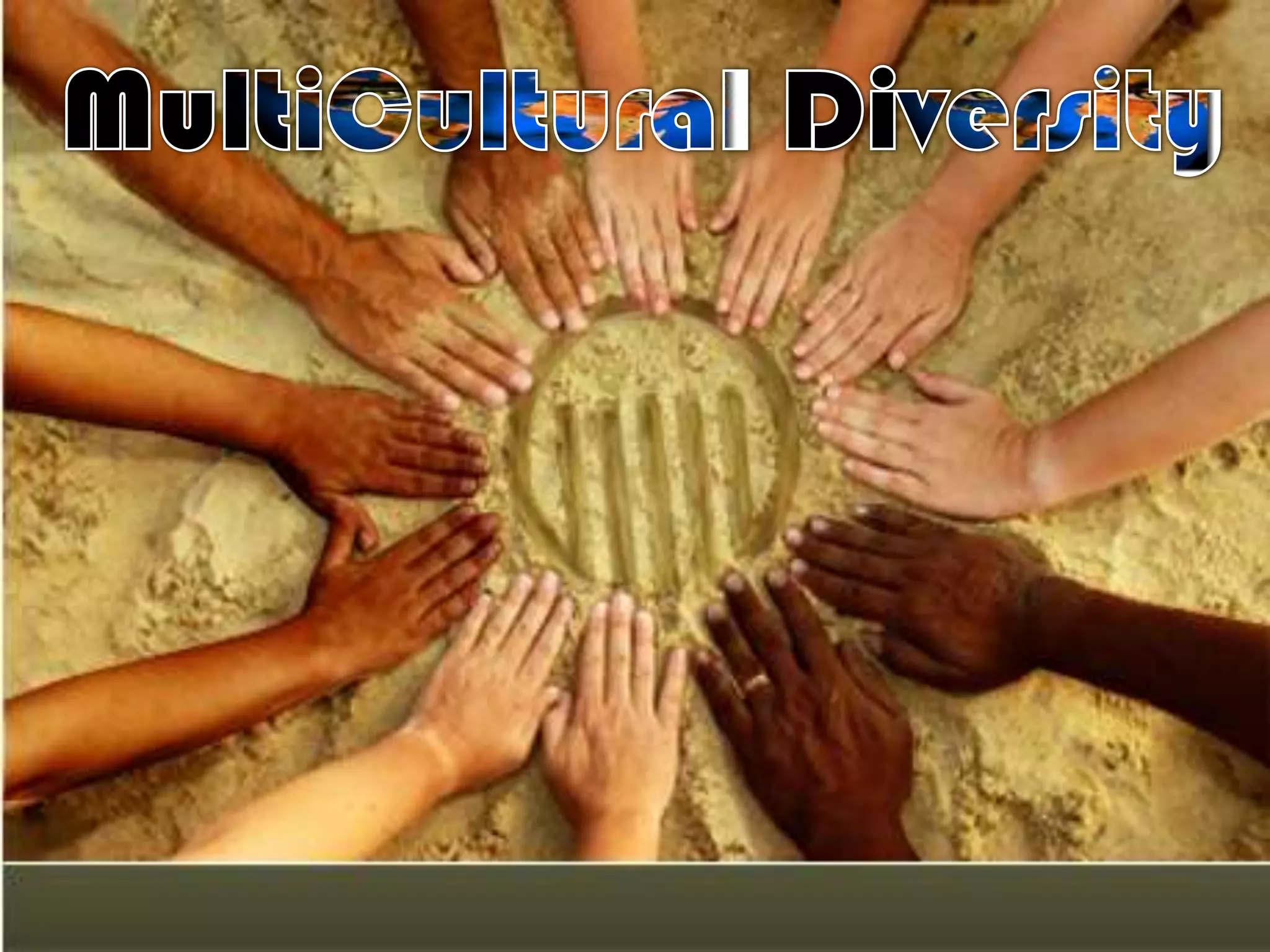
Multicultural diversity

  • 3.
    Multicultural Diversity orPluralism Started in the late 1900s as a “Philosophy of Toleration” The ability to co-exist with people of different social background, nationality or ethnic group, education, ethics and not forcing one’s views that of the other one. Lack of Toleration resulted to: •Slavery •World War •Colonization The quality of diverse or different cultures, as opposed to monoculture, as in the global monoculture, or a homogenization of cultures, akin to cultural decay. The phrase cultural diversity can also refer to having different cultures respect each other's differences. The phrase "cultural diversity" is also sometimes used to mean the variety of human societies or cultures in a specific region, or in the world as a whole. The culturally destructive action of globalization is often said to have a negative effect on the world's cultural diversity.
  • 4.
    Multicultural Diversity alsoresulted from industrialization which produced steamship, airplane, telecoms, railways, making travelling settling from one territory to another easier, faster, hence making people diverse, also making tourism possible.
  • 5.
    • Race • Ethnicity •Gender • Age • Disability
  • 6.
    • Religion • Lifestyle •Economic status • Culture • Sexual orientation • Family status • Geographic origin • Nationality • Work experience • Language • Education • Beliefs • Assumptions • Perceptions • Attitudes • Feelings • Values • Group Norms
  • 7.
    •says that thereare no wrong standards, everything is acceptable because everything depends on culture, region, Nihilism, means the absence of any standard of good and evil.  from Latin “NIHIL” = nothing •Happens when indigenous cultures are replaced, so instead of multicultural diversity/ pluralism we get monopoly of culture, colonial mentality, hence cultural nationalism (defense of own culture) disappears.
  • 8.
    1. Monolithic Organization -characterized by a homogeneous work force composed primarily of white males with few women or minority men in management positions 2. Plural Organization - has a more heterogeneous membership than the monolithic organization and takes steps to be more inclusive of persons from cultural backgrounds that differ from the dominant group. 3. Multicultural Organization - include integration of minorities into all structural levels of the company
  • 9.
    1. Increased Adaptability 2.Broader service range 3. Variety of Viewpoints 4. More effective execution
  • 10.
    1. Increased Adaptability Organizationsemploying a diverse workforce can supply a greater variety of solutions to problems in service. Sourcing, and allocation of resources. Employees from diverse backgrounds bring individual talents and experiences in suggesting ideas that are flexible in adapting to fluctuating markets and customer demands. 2. Broader Service Range A diverse collection of skills and experiences (e.g. languages, cultural understanding) allows a company to provide products/service to customers worldwide.
  • 11.
    3. Variety ofViewpoints A diverse workforce that feels comfortable communicating varying points of view provides a larger pool of ideas and experiences. The organization can draw from that pool to meet business strategy needs and the needs of customers more effectively. 4. More Effective Execution Companies that encourage diversity in the workplace inspire all their employees to perform to their highest ability. Companywide strategies can then be executed; resulting in higher productivity, profit, and return on investment.
  • 12.
    •Diversity renders communicationsand integration more difficult. People from different culture fail to understand one another. They do not work in the same ways or at the same place. •The potential for increased ambiguity, complexity and confusion becomes highest when the organization or project requires direction and clarity- convergence (Adler, 2002). Cox (2001) mentions that increasing diversity presents a double edged sword; hence the challenge of managing diversity is to create conditions that minimize its potential to be a performance barrier while maximizing its potential to enhance organizational performance.
  • 13.
    •Communication Barriers •Resistance toChange •Socio-cultural Factors •Education, age, and gender •Personality and Background
  • 14.
    1. Communication Barriers Ineffectivecommunication of key objectives results in confusion, lack of teamwork and low morale. Barriers to communication are factors that block or significantly destroy successful communication. 2. Resistance to change Refusing to accept new policies Why change something that works We’ve always done it this way Scared of failure and not being able to learn/adapt to new things Not wanting to spend time and effort changing Not understanding what is expected (the fear of the unknown)
  • 15.
    3. Socio-cultural Factors •Howone was raised, will give them certain beliefs at a young age. Their believes may be a slightly different than those that we were brought up to believe. •In any form, our behavior was established, regardless of your background. Rules and behavior that one models is what they were taught. Beliefs may be different, making it difficult to understand the reason why you may have offended someone, if you are not familiar with their background. 4. Education, age, and gender education. Different education levels can impact effective communication. Complex words and explanations may not be understood by a person less educated, or not educated in a certain field. Imagine a doctor explaining that you have a broken leg in medicalterms!
  • 16.
    Age is anotherchallenge in today’s workplace. People may not be used to communicating with different age groups . Older people may use old phrases/words to explain things not understood by a younger audience. Younger people may also use words too modern and not understood by an older generation. Gender can affect communication as men and women often think about things differently. In Islamic culture especially, when a female and male communicate, certain traditions are followed, such as lack of eye contact and shaking hands, affecting perception and communication.
  • 17.
    5. Personality andBackground Personality clashes can effect communication. If you do not like a person or the way they present themselves, you may not listen to what they have to say, or believe what they have to say. However, if you like a person’s personality and agree with what they are saying, you may be more likely to listen, respect what they have to say and take-in what they are saying.
  • 18.
    1. 2. 3. 4. 5. Manage and RecognizeCultural Diversity Define and Establish Cultural Diversity. Transforming Organizational Behavior Influencing Cultural Diversity. Sustaining Positive Influence Programs
  • 19.
    BESA, ALLAN PAUL BUTIONG,JOSE RAFAEL IBASCO, JAMEE NOELLE UPAO, CHARLENE