E-LEARNING
Siti Munawati
Ade Suci Lestari
Dera Frana Kusuma
Arini Irbahtaqiyanis Kiki Rizky Illahi
Nurul Syawalina
What is E-Learning?
E-learning is a learning
system which is used for long
distance education.
Why have to e-learning?
E-learning is one solution for students who
have problem of distance from their house to
the school.
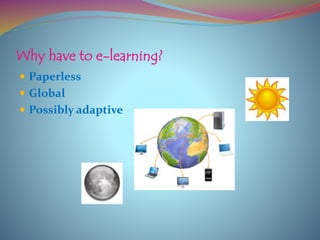
Why have to e-learning?
 Paperless
 Global
 Possibly adaptive
E-learning concept strongly correlated to the use of
computer and internet.
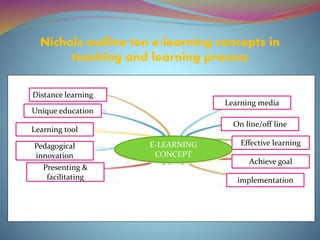
Nichols outline ten e-learning concepts in
teaching and learning process
Distance learning
Learning tool
Pedagogical
innovation
Presenting &
facilitating implementation
Achieve goal
Effective learning
On line/off line
Learning media
Unique education
E-LEARNING
CONCEPT
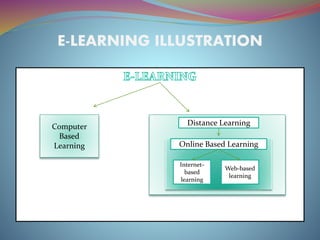
E-LEARNING ILLUSTRATION
Internet-
based
learning
Web-based
learning
Distance Learning
Online Based Learning
Computer
Based
Learning
COMUNICATION
Different ways
Within communication we distinguish different
directions/ways to communicate:
 one to one
 one to many
 many to one
 many to many
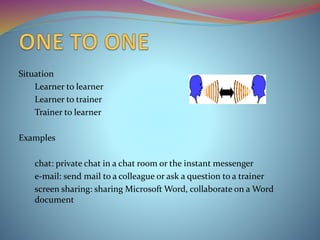
Situation
Learner to learner
Learner to trainer
Trainer to learner
Examples
chat: private chat in a chat room or the instant messenger
e-mail: send mail to a colleague or ask a question to a trainer
screen sharing: sharing Microsoft Word, collaborate on a Word
document
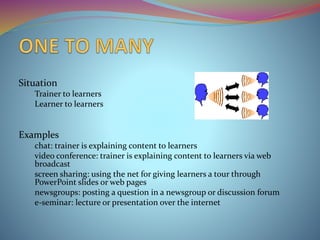
Situation
Trainer to learners
Learner to learners
Examples
chat: trainer is explaining content to learners
video conference: trainer is explaining content to learners via web
broadcast
screen sharing: using the net for giving learners a tour through
PowerPoint slides or web pages
newsgroups: posting a question in a newsgroup or discussion forum
e-seminar: lecture or presentation over the internet
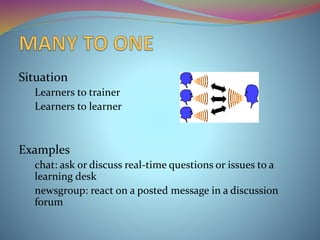
Situation
Learners to trainer
Learners to learner
Examples
chat: ask or discuss real-time questions or issues to a
learning desk
newsgroup: react on a posted message in a discussion
forum
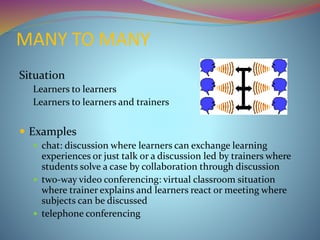
MANY TO MANY
Situation
Learners to learners
Learners to learners and trainers
 Examples
 chat: discussion where learners can exchange learning
experiences or just talk or a discussion led by trainers where
students solve a case by collaboration through discussion
 two-way video conferencing: virtual classroom situation
where trainer explains and learners react or meeting where
subjects can be discussed
 telephone conferencing
E-LEARNING PURPOSE
To increase spare energy from student on material that
learned.
Increase active participation from them.
Increase independent learn skills, and
Increase learning material quality.
E-LEARNING FUTURE IN INDONESIA
For student:
 doesn’t need to come in the class,
 able to collect assignments or test through the internet,
 able to open their minded,
 able to study by their own.
The implementations of e-learning:
 Website or webpage;
 Links;
 Chat client;
 Quizzes;
 Database management;
 Record system and logs.
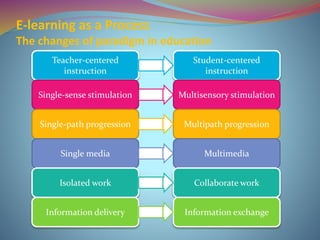
E-learning as a Process
The changes of paradigm in education
Student-centered
instruction
Multisensory stimulation
Multipath progression
Multimedia
Teacher-centered
instruction
Single-sense stimulation
Single-path progression
Single media
Collaborate workIsolated work
Information delivery Information exchange
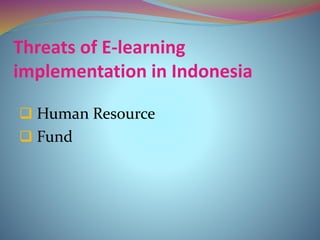
Threats of E-learning
implementation in Indonesia
 Human Resource
 Fund
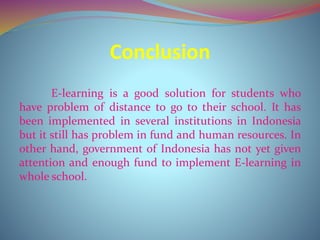
Conclusion
E-learning is a good solution for students who
have problem of distance to go to their school. It has
been implemented in several institutions in Indonesia
but it still has problem in fund and human resources. In
other hand, government of Indonesia has not yet given
attention and enough fund to implement E-learning in
whole school.
Thank you

E learning concept

  • 1.
    E-LEARNING Siti Munawati Ade SuciLestari Dera Frana Kusuma Arini Irbahtaqiyanis Kiki Rizky Illahi Nurul Syawalina
  • 2.
    What is E-Learning? E-learningis a learning system which is used for long distance education.
  • 3.
    Why have toe-learning? E-learning is one solution for students who have problem of distance from their house to the school.
  • 4.
    Why have toe-learning?  Paperless  Global  Possibly adaptive
  • 5.
    E-learning concept stronglycorrelated to the use of computer and internet.
  • 6.
    Nichols outline tene-learning concepts in teaching and learning process Distance learning Learning tool Pedagogical innovation Presenting & facilitating implementation Achieve goal Effective learning On line/off line Learning media Unique education E-LEARNING CONCEPT
  • 7.
  • 8.
    COMUNICATION Different ways Within communicationwe distinguish different directions/ways to communicate:  one to one  one to many  many to one  many to many
  • 9.
    Situation Learner to learner Learnerto trainer Trainer to learner Examples chat: private chat in a chat room or the instant messenger e-mail: send mail to a colleague or ask a question to a trainer screen sharing: sharing Microsoft Word, collaborate on a Word document
  • 10.
    Situation Trainer to learners Learnerto learners Examples chat: trainer is explaining content to learners video conference: trainer is explaining content to learners via web broadcast screen sharing: using the net for giving learners a tour through PowerPoint slides or web pages newsgroups: posting a question in a newsgroup or discussion forum e-seminar: lecture or presentation over the internet
  • 11.
    Situation Learners to trainer Learnersto learner Examples chat: ask or discuss real-time questions or issues to a learning desk newsgroup: react on a posted message in a discussion forum
  • 12.
    MANY TO MANY Situation Learnersto learners Learners to learners and trainers  Examples  chat: discussion where learners can exchange learning experiences or just talk or a discussion led by trainers where students solve a case by collaboration through discussion  two-way video conferencing: virtual classroom situation where trainer explains and learners react or meeting where subjects can be discussed  telephone conferencing
  • 13.
    E-LEARNING PURPOSE To increasespare energy from student on material that learned. Increase active participation from them. Increase independent learn skills, and Increase learning material quality.
  • 14.
    E-LEARNING FUTURE ININDONESIA For student:  doesn’t need to come in the class,  able to collect assignments or test through the internet,  able to open their minded,  able to study by their own.
  • 15.
    The implementations ofe-learning:  Website or webpage;  Links;  Chat client;  Quizzes;  Database management;  Record system and logs.
  • 16.
    E-learning as aProcess The changes of paradigm in education Student-centered instruction Multisensory stimulation Multipath progression Multimedia Teacher-centered instruction Single-sense stimulation Single-path progression Single media Collaborate workIsolated work Information delivery Information exchange
  • 17.
    Threats of E-learning implementationin Indonesia  Human Resource  Fund
  • 18.
    Conclusion E-learning is agood solution for students who have problem of distance to go to their school. It has been implemented in several institutions in Indonesia but it still has problem in fund and human resources. In other hand, government of Indonesia has not yet given attention and enough fund to implement E-learning in whole school.
  • 19.