December 1st 2008 eLearning in Higher Education & Training Lisa Sayers, Peter Sullivan,  Jonathan Coleman & Kris McElhinney
December 1st 2008 Practical Examples Peter Sullivan -  Introduction >  Examples of eLearning - Positives of eLearning - Challenged of eLearning - Concluding Remarks
If someone is learning in a way that uses information and communications technologies (ICTs), they are using e-learning  (Department for Education and Skills UK, 2003) e-Learning is a broader concept [than online learning], encompassing a wide set of applications and processes which use all available electronic media to deliver vocational education and training more flexibly… the general intent to support a broad range of electronic media (internet, intranets, extranets, satellite broadcast, audio/video tape, interactive TV and CD-ROM) to make vocational learning more flexible for clients (Australian National Training Authority, 2004) eLearning defined December 1st 2008
Many different ways to classify forms of elearning: Learning Management  Brower Based Training Distance Learning December 1st 2008 Forms of eLearning Course Management System Learning Management Systems Virtual Learning Environment
Modular Object Orientated Dynamic Learning Environment (Moodle) ‘ Open Source’  - 38,896 registered sites Created by Martin Dougiamas as an on-line learning community and incorporates varied techniques to do this: Interactivity eg Quizes / Testing Communications eg eForums Instant messaging ecourse materials Forms of eLearning December 1st 2008 Moodle
Many different way to classify forms of elearning: Learning Management  Brower Based Training Distance Learning December 1st 2008 CD / Online Demo Instructional Graphics Forms of eLearning
“ The ECDL Foundation mission is to enable proficient use of ICT that empowers individuals, organisations and society, through the development, promotion and delivery of quality certification programmes throughout the world.“ Currently recognized in +148 countries 8 million candidates worldwide   HQ in Dublin  22,000 test centres, even in CTB! December 1st 2008 Forms of eLearning Browser Based Training
Many different ways to classify forms of E-learning: Learning Management  Brower Based Training Distance Learning December 1st 2008 Est. 1973 by Eric Devenport  6,000 graduates annually Today more than 180,000 users Forms of eLearning
A nationally accredited university in both America and the Europe Just four institutions — Cambridge, Loughborough, York and the LSE — have a better teaching record than the Open University (The Sunday Times Universities Guide, 2004) The Open University, OU Business School and Centre for Professional Learning and Development OU Business School is ranked in the world's top ten for distance learning MBAs (Economist Intelligence Unit, 2008 ) Forms of eLearning December 1st 2008 Open University
-  Introduction - Examples of eLearning > Positives of eLearning - Challenged of eLearning - Concluding Remarks December 1st 2008 Why is the e-Important? Kris McElhinney
“ Information technology is dramatically reshaping the classroom.  As we enter the Digital Age, technology will become an integral part of the learning environment at every level of education…” (Forbairt, 1996, p.19) Peter Drucker predicted that  “ universities won’t survive … as a residential institution”  (quoted from The Guardian, April 13, 2004) “ Web-ucation” December 1st 2008
Market Driven:  the changing nature of the education market for higher education Policy Driven:  influence of government policies and the changing ways in which IT is affecting the way society functions Academically driven:  to respond to the impact of IT on academic subjects themselves and on teaching and learning of those subjects Rationale December 1st 2008
“ The first benefit to academics from Blackboard is a cut in time standing at the photocopier however, it should be used as much more than a storage location for slides.  One of the key benefits is that students can be encouraged to actively engage with the material. I find it useful to post a comment... with links to material and a question for the students to think about. Online assessments... is a great facility for practising questions and allows tutorials to be much more than an exercise in transcribing” Seamus Coffey, Department of Economics (2006 Presidents Award for Teaching) December 1st 2008 Testimonial: “ Student Engagement”
Pedagogic rationale: enhances teaching and learning by account of diversity and varied learning styles Enhancing learning rationale  developing intellectual reasoning skills (e.g. Laurillard, 1993a, 1993b)  learning relationships between scientific concepts (Scanlon, Morris & Di Paolo, 2002)  learning new representations of knowledge (Cheng, Lowe & Scaife, 2001) increases self-confidence (Gardner, Dukes & Discenza, 1993) Students as Partners Academically driven: December 1st 2008
Academically driven: Blended Model December 1st 2008
“ Comment Comment Comment” Dr Robert Cosgrave, Learning Technology Unit UCC (Blackboard Expert, NAIRTL / Ionaid Bairre) December 1st 2008 Testimonial: “ Institutional Benefits”
Students as Consumers Teaching at a distance - reducing teaching costs Teaching more students for the same costs Reducing the number of lectures Different learning routes to suit the individual student Drive to match the IT practices in HE with those in industry and commerce: email and Web communications; asynchronous communication Social rationale: students need to experience E-learning to understand how IT is used in society and how it effects the way society works and is organised December 1st 2008 Market driven:
“ A blended system of traditional and e-learning approaches will be made available to students as appropriate and relevant. The balance between campus-based students and distance students will change and will be facilitated by technological advances in teaching and learning, including electronic and web-based learning.” p9 “ UCC will be defined by a diverse population of students of high calibre that represent a wide variety of social and cultural backgrounds, who will experience an intellectually demanding and rewarding education that will provide them with skills relevant to the twenty first century.” p10 (UCC Strategic Framework 2006-11) UCC’s Teaching Strategy December 1st 2008
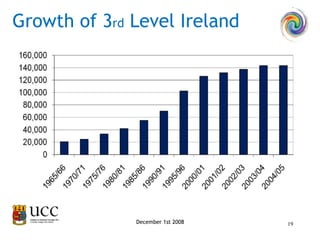
Growth of 3 rd  Level Ireland December 1st 2008
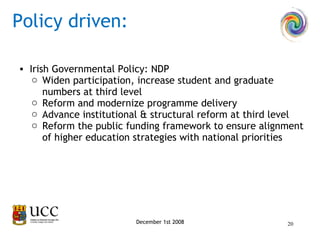
Irish Governmental Policy: NDP Widen participation, increase student and graduate numbers at third level Reform and modernize programme delivery Advance institutional & structural reform at third level Reform the public funding framework to ensure alignment of higher education strategies with national priorities Policy driven: December 1st 2008
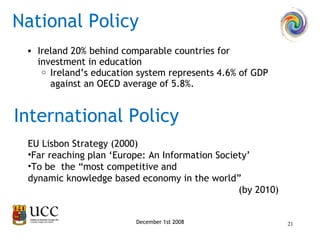
National Policy December 1st 2008 Ireland 20% behind comparable countries for investment in education Ireland’s education system represents 4.6% of GDP against an OECD average of 5.8%.  International Policy EU Lisbon Strategy (2000)  Far reaching plan ‘Europe: An Information Society’  To be  the “most competitive and dynamic knowledge based economy in the world”  (by 2010)
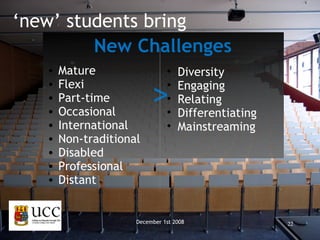
> December 1st 2008 ‘ new’ students bring New Challenges Mature Flexi Part-time Occasional International Non-traditional Disabled Professional Distant Diversity Engaging Relating Differentiating Mainstreaming
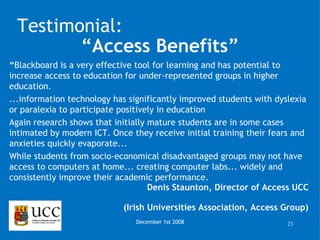
“ Blackboard is a very effective tool for learning and has potential to increase access to education for under-represented groups in higher education.  ...information technology has significantly improved students with dyslexia or paralexia to participate positively in education  Again research shows that initially mature students are in some cases intimated by modern ICT. Once they receive initial training their fears and anxieties quickly evaporate... While students from socio-economical disadvantaged groups may not have access to computers at home... creating computer labs... widely and consistently improve their academic performance. Denis Staunton, Director of Access UCC (Irish Universities Association, Access Group) December 1st 2008 Testimonial: “ Access Benefits”
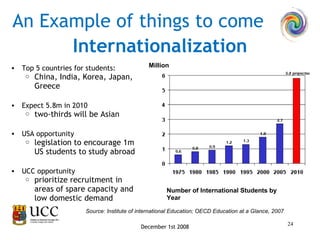
Top 5 countries for students: China, India, Korea, Japan, Greece Expect 5.8m in 2010 two-thirds will be Asian USA opportunity legislation to encourage 1m US students to study abroad UCC opportunity prioritize recruitment in areas of spare capacity and low domestic demand  Source: Institute of international Education; OECD Education at a Glance, 2007  Million Number of International Students by Year An Example of things to come Internationalization December 1st 2008
-  Introduction - Examples of eLearning - Positives of eLearning > Challenges of eLearning - Concluding Remarks Challenges to manage Jonathan Coleman December 1st 2008
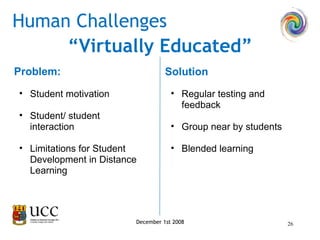
Problem: Human Challenges Student motivation Student/ student interaction Limitations for Student Development in Distance Learning Regular testing and feedback Group near by students Blended learning Solution “ Virtually Educated” December 1st 2008
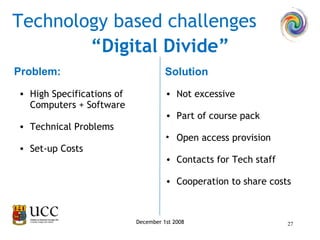
Problem: Technology based challenges High Specifications of Computers + Software Technical Problems Set-up Costs Not excessive Part of course pack  Open access provision Contacts for Tech staff Cooperation to share costs Solution “ Digital Divide” December 1st 2008
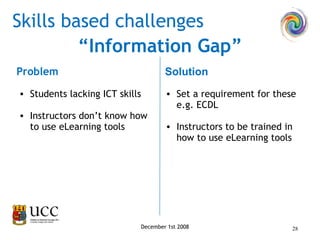
Problem Skills based challenges Solution Students lacking ICT skills Instructors don’t know how to use eLearning tools Set a requirement for these e.g. ECDL Instructors to be trained in how to use eLearning tools “ Information Gap” December 1st 2008
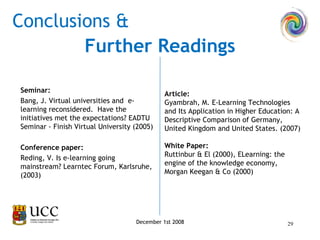
Seminar:   Bang, J. Virtual universities and  e-learning reconsidered.  Have the initiatives met the expectations? EADTU Seminar - Finish Virtual University (2005)   Conference paper: Reding, V. Is e-learning going mainstream? Learntec Forum, Karlsruhe, (2003)   Conclusions & December 1st 2008 Article: Gyambrah, M. E-Learning Technologies and Its Application in Higher Education: A Descriptive Comparison of Germany, United Kingdom and United States. (2007)   White Paper: Ruttinbur & El (2000), ELearning: the engine of the knowledge economy, Morgan Keegan & Co (2000)   Further Readings
Contact details: ⌨  [email_address] ⌨  [email_address] ⌨  [email_address] ⌨  [email_address] December 1st 2008 This presentation was a collaborative project via Google Docs Comments & Questions Thank you for your attention For more information visit: krismac.com/mimas/ under module 6215

E Learning Presentation

  • 1.
    December 1st 2008eLearning in Higher Education & Training Lisa Sayers, Peter Sullivan, Jonathan Coleman & Kris McElhinney
  • 2.
    December 1st 2008Practical Examples Peter Sullivan - Introduction > Examples of eLearning - Positives of eLearning - Challenged of eLearning - Concluding Remarks
  • 3.
    If someone islearning in a way that uses information and communications technologies (ICTs), they are using e-learning (Department for Education and Skills UK, 2003) e-Learning is a broader concept [than online learning], encompassing a wide set of applications and processes which use all available electronic media to deliver vocational education and training more flexibly… the general intent to support a broad range of electronic media (internet, intranets, extranets, satellite broadcast, audio/video tape, interactive TV and CD-ROM) to make vocational learning more flexible for clients (Australian National Training Authority, 2004) eLearning defined December 1st 2008
  • 4.
    Many different waysto classify forms of elearning: Learning Management Brower Based Training Distance Learning December 1st 2008 Forms of eLearning Course Management System Learning Management Systems Virtual Learning Environment
  • 5.
    Modular Object OrientatedDynamic Learning Environment (Moodle) ‘ Open Source’ - 38,896 registered sites Created by Martin Dougiamas as an on-line learning community and incorporates varied techniques to do this: Interactivity eg Quizes / Testing Communications eg eForums Instant messaging ecourse materials Forms of eLearning December 1st 2008 Moodle
  • 6.
    Many different wayto classify forms of elearning: Learning Management Brower Based Training Distance Learning December 1st 2008 CD / Online Demo Instructional Graphics Forms of eLearning
  • 7.
    “ The ECDLFoundation mission is to enable proficient use of ICT that empowers individuals, organisations and society, through the development, promotion and delivery of quality certification programmes throughout the world.“ Currently recognized in +148 countries 8 million candidates worldwide   HQ in Dublin 22,000 test centres, even in CTB! December 1st 2008 Forms of eLearning Browser Based Training
  • 8.
    Many different waysto classify forms of E-learning: Learning Management Brower Based Training Distance Learning December 1st 2008 Est. 1973 by Eric Devenport 6,000 graduates annually Today more than 180,000 users Forms of eLearning
  • 9.
    A nationally accrediteduniversity in both America and the Europe Just four institutions — Cambridge, Loughborough, York and the LSE — have a better teaching record than the Open University (The Sunday Times Universities Guide, 2004) The Open University, OU Business School and Centre for Professional Learning and Development OU Business School is ranked in the world's top ten for distance learning MBAs (Economist Intelligence Unit, 2008 ) Forms of eLearning December 1st 2008 Open University
  • 10.
    - Introduction- Examples of eLearning > Positives of eLearning - Challenged of eLearning - Concluding Remarks December 1st 2008 Why is the e-Important? Kris McElhinney
  • 11.
    “ Information technologyis dramatically reshaping the classroom. As we enter the Digital Age, technology will become an integral part of the learning environment at every level of education…” (Forbairt, 1996, p.19) Peter Drucker predicted that “ universities won’t survive … as a residential institution” (quoted from The Guardian, April 13, 2004) “ Web-ucation” December 1st 2008
  • 12.
    Market Driven: the changing nature of the education market for higher education Policy Driven: influence of government policies and the changing ways in which IT is affecting the way society functions Academically driven: to respond to the impact of IT on academic subjects themselves and on teaching and learning of those subjects Rationale December 1st 2008
  • 13.
    “ The firstbenefit to academics from Blackboard is a cut in time standing at the photocopier however, it should be used as much more than a storage location for slides. One of the key benefits is that students can be encouraged to actively engage with the material. I find it useful to post a comment... with links to material and a question for the students to think about. Online assessments... is a great facility for practising questions and allows tutorials to be much more than an exercise in transcribing” Seamus Coffey, Department of Economics (2006 Presidents Award for Teaching) December 1st 2008 Testimonial: “ Student Engagement”
  • 14.
    Pedagogic rationale: enhancesteaching and learning by account of diversity and varied learning styles Enhancing learning rationale developing intellectual reasoning skills (e.g. Laurillard, 1993a, 1993b) learning relationships between scientific concepts (Scanlon, Morris & Di Paolo, 2002) learning new representations of knowledge (Cheng, Lowe & Scaife, 2001) increases self-confidence (Gardner, Dukes & Discenza, 1993) Students as Partners Academically driven: December 1st 2008
  • 15.
    Academically driven: BlendedModel December 1st 2008
  • 16.
    “ Comment CommentComment” Dr Robert Cosgrave, Learning Technology Unit UCC (Blackboard Expert, NAIRTL / Ionaid Bairre) December 1st 2008 Testimonial: “ Institutional Benefits”
  • 17.
    Students as ConsumersTeaching at a distance - reducing teaching costs Teaching more students for the same costs Reducing the number of lectures Different learning routes to suit the individual student Drive to match the IT practices in HE with those in industry and commerce: email and Web communications; asynchronous communication Social rationale: students need to experience E-learning to understand how IT is used in society and how it effects the way society works and is organised December 1st 2008 Market driven:
  • 18.
    “ A blendedsystem of traditional and e-learning approaches will be made available to students as appropriate and relevant. The balance between campus-based students and distance students will change and will be facilitated by technological advances in teaching and learning, including electronic and web-based learning.” p9 “ UCC will be defined by a diverse population of students of high calibre that represent a wide variety of social and cultural backgrounds, who will experience an intellectually demanding and rewarding education that will provide them with skills relevant to the twenty first century.” p10 (UCC Strategic Framework 2006-11) UCC’s Teaching Strategy December 1st 2008
  • 19.
    Growth of 3rd Level Ireland December 1st 2008
  • 20.
    Irish Governmental Policy:NDP Widen participation, increase student and graduate numbers at third level Reform and modernize programme delivery Advance institutional & structural reform at third level Reform the public funding framework to ensure alignment of higher education strategies with national priorities Policy driven: December 1st 2008
  • 21.
    National Policy December1st 2008 Ireland 20% behind comparable countries for investment in education Ireland’s education system represents 4.6% of GDP against an OECD average of 5.8%. International Policy EU Lisbon Strategy (2000) Far reaching plan ‘Europe: An Information Society’ To be the “most competitive and dynamic knowledge based economy in the world” (by 2010)
  • 22.
    > December 1st2008 ‘ new’ students bring New Challenges Mature Flexi Part-time Occasional International Non-traditional Disabled Professional Distant Diversity Engaging Relating Differentiating Mainstreaming
  • 23.
    “ Blackboard isa very effective tool for learning and has potential to increase access to education for under-represented groups in higher education. ...information technology has significantly improved students with dyslexia or paralexia to participate positively in education Again research shows that initially mature students are in some cases intimated by modern ICT. Once they receive initial training their fears and anxieties quickly evaporate... While students from socio-economical disadvantaged groups may not have access to computers at home... creating computer labs... widely and consistently improve their academic performance. Denis Staunton, Director of Access UCC (Irish Universities Association, Access Group) December 1st 2008 Testimonial: “ Access Benefits”
  • 24.
    Top 5 countriesfor students: China, India, Korea, Japan, Greece Expect 5.8m in 2010 two-thirds will be Asian USA opportunity legislation to encourage 1m US students to study abroad UCC opportunity prioritize recruitment in areas of spare capacity and low domestic demand Source: Institute of international Education; OECD Education at a Glance, 2007 Million Number of International Students by Year An Example of things to come Internationalization December 1st 2008
  • 25.
    - Introduction- Examples of eLearning - Positives of eLearning > Challenges of eLearning - Concluding Remarks Challenges to manage Jonathan Coleman December 1st 2008
  • 26.
    Problem: Human ChallengesStudent motivation Student/ student interaction Limitations for Student Development in Distance Learning Regular testing and feedback Group near by students Blended learning Solution “ Virtually Educated” December 1st 2008
  • 27.
    Problem: Technology basedchallenges High Specifications of Computers + Software Technical Problems Set-up Costs Not excessive Part of course pack Open access provision Contacts for Tech staff Cooperation to share costs Solution “ Digital Divide” December 1st 2008
  • 28.
    Problem Skills basedchallenges Solution Students lacking ICT skills Instructors don’t know how to use eLearning tools Set a requirement for these e.g. ECDL Instructors to be trained in how to use eLearning tools “ Information Gap” December 1st 2008
  • 29.
    Seminar: Bang, J. Virtual universities and e-learning reconsidered. Have the initiatives met the expectations? EADTU Seminar - Finish Virtual University (2005)   Conference paper: Reding, V. Is e-learning going mainstream? Learntec Forum, Karlsruhe, (2003)   Conclusions & December 1st 2008 Article: Gyambrah, M. E-Learning Technologies and Its Application in Higher Education: A Descriptive Comparison of Germany, United Kingdom and United States. (2007)   White Paper: Ruttinbur & El (2000), ELearning: the engine of the knowledge economy, Morgan Keegan & Co (2000)   Further Readings
  • 30.
    Contact details: ⌨ [email_address] ⌨ [email_address] ⌨ [email_address] ⌨ [email_address] December 1st 2008 This presentation was a collaborative project via Google Docs Comments & Questions Thank you for your attention For more information visit: krismac.com/mimas/ under module 6215

Editor's Notes

  • #2 Welcome to our presentation. Our group consists of Myself, Lisa, Kris and Jonathan. We have developed a white paper focusing on the potential of eLearning – with particular reference for the Higher education sector Internationally within Ireland and specifically UCC. For the next 20 mins though we will be providing a short introduction to the issue that is E Learning.