Mode
Dr. RMKV
Assistant Professor
MODE
 The mode is the number that appears most frequently in a data set
 It is an actual value, which has the highest concentration of items
in and around it.
 For example, in placing an order for shoes or ready-made
garments the modal size helps because this sizes and other sizes
around in common demand.
Mode is 6
Formula
 Individual observation: For ungrouped data or a series of
individual observations, mode is often found by mere
 Discrete Series: For Discrete distribution, see the highest
frequency and corresponding value of X is mode.
Formula
 Continuous Series: See the highest frequency then the
corresponding value of class interval is called the modal class.
apply the formula.
 Mode = Mo =𝒍 +
𝚫𝟏
𝚫𝟏+𝚫𝟐
∗ 𝒄
 l = Lower limit of the model class Δ1= f1-f0 Δ2 = f1-f2 f1 =
= frequency of the modal class f0 = frequency of the class
the modal class f2 = frequency of the class succeeding the
class
Illustration _Individual Observation
 2 , 7, 10, 15, 10, 17, 8, 10, 2
 Mode = M0=10
 In some cases the mode may be absent while in some cases there
may be more than one mode.
 12, 10, 15, 24, 30 (no mode)
 7, 10, 15, 12, 7, 14, 24, 10, 7, 20, 10
 The modes are 7 and 10
Illustration _Discrete Series
 From the following data, find the value of Mode
 The Mode is 5380 because Rs. 5380 have high frequency
Income 4000 4500 5060 5380 5800 6600
No. of
Person
24 26 20 30 16 6
Illustration _Discrete Series
1. The following data pertaining to the number of members in a
family. Find mode size of the family.
 The Mode size of family is 6 because 6 have high frequency
No. of
family
numb
er
1 2 3 4 5 6 7 8 9 10 11 12
No. of
family
1 3 5 6 10 13 9 5 3 2 2 1
Illustration_ Continuous Series
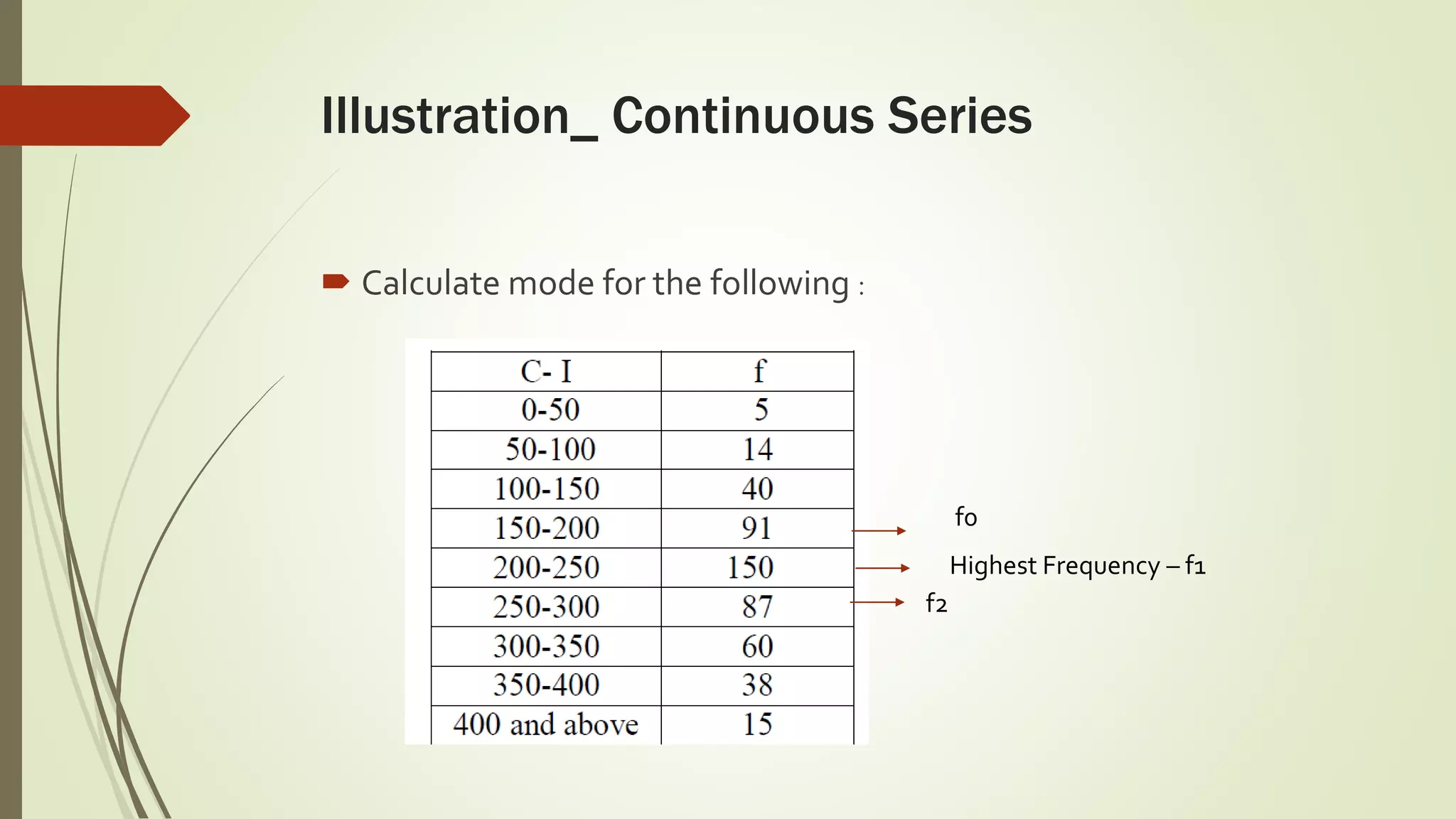
 Calculate mode for the following :
Highest Frequency – f1
f0
f2
 The highest frequency is 150 and corresponding class interval is
200 – 250, which is the modal class.
 Here L =200,f1=150,f0=91, f2=87, C=50
 𝛥1= f1 - f0 = 150 – 91 = 59
 𝛥2 = f1 - f2 = 150 – 87 = 63
 Mode = M0 = 𝑙 +
𝛥1
𝛥1+𝛥2
∗ 𝑐
 = 200+
59
59+63
x 50
 = 200+
59
122
x 50
 = 200+0.484 x 50
 = 200 + 24.2 =224.2
 Mode is 224.2
Illustration_ Continuous Series
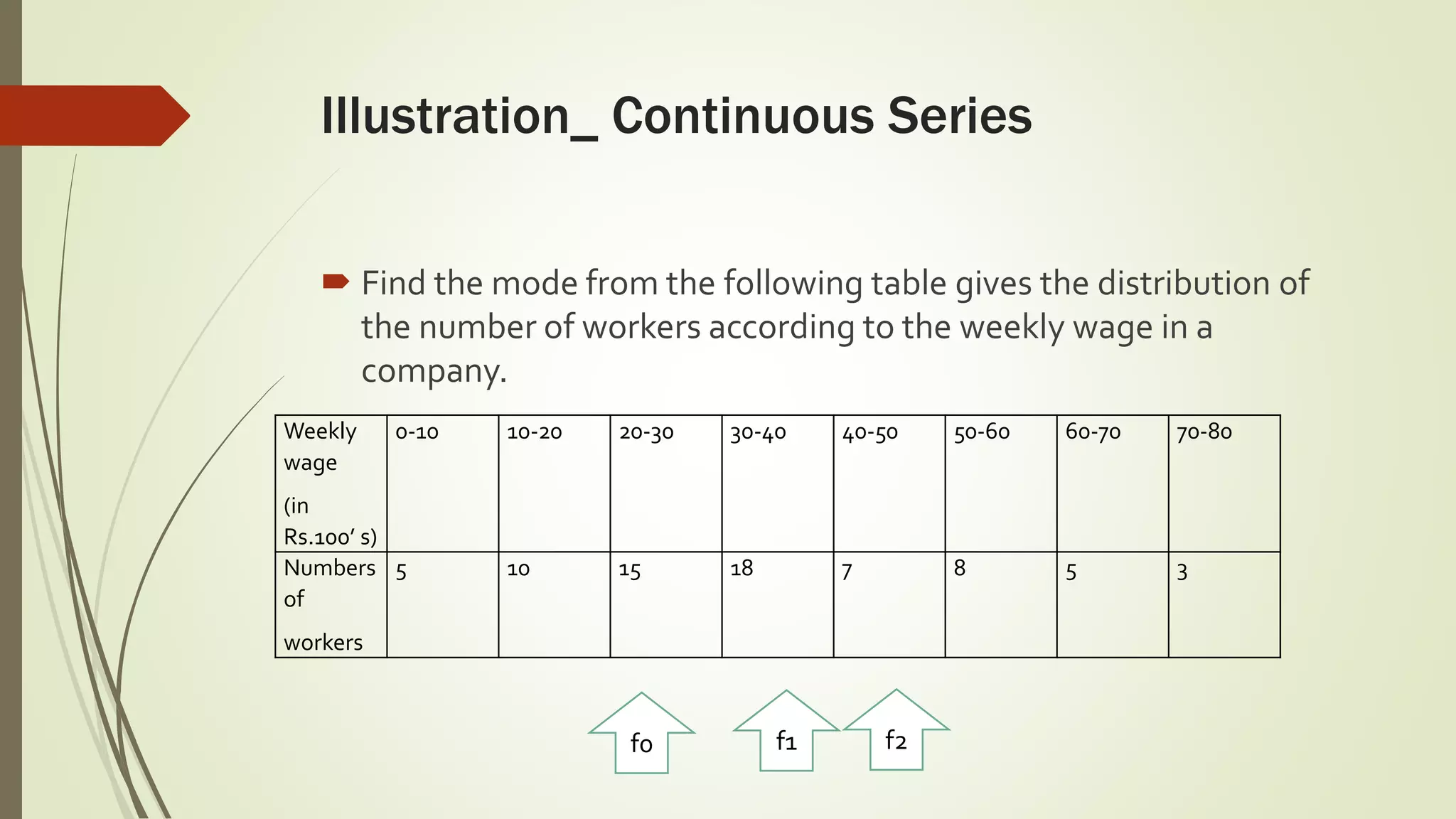
 Find the mode from the following table gives the distribution of
the number of workers according to the weekly wage in a
company.
Weekly
wage
(in
Rs.100’ s)
0-10 10-20 20-30 30-40 40-50 50-60 60-70 70-80
Numbers
of
workers
5 10 15 18 7 8 5 3
f1
f0 f2
 The highest frequency is 18 and corresponding class interval is 30 –
40, which is the modal class.
 Here L =30, f1=18,f0=15, f2=7, C=10
 𝛥1= f1 - f0 = 18 -15 = 3
 𝛥2 = f1 - f2 = 18 – 7 = 11
 Mode = M0 = 𝑙 +
𝛥1
𝛥1+𝛥2
∗ 𝑐
 = 30 +
3
3+11
x 10
 = 30+
3
14
x 10
 = 30+0.214 x 10
 = 30 + 2.14 = 32.14
 Mode is 32.14

Mode in Business Statistics

  • 1.
  • 2.
    MODE  The modeis the number that appears most frequently in a data set  It is an actual value, which has the highest concentration of items in and around it.  For example, in placing an order for shoes or ready-made garments the modal size helps because this sizes and other sizes around in common demand.
  • 3.
  • 4.
    Formula  Individual observation:For ungrouped data or a series of individual observations, mode is often found by mere  Discrete Series: For Discrete distribution, see the highest frequency and corresponding value of X is mode.
  • 5.
    Formula  Continuous Series:See the highest frequency then the corresponding value of class interval is called the modal class. apply the formula.  Mode = Mo =𝒍 + 𝚫𝟏 𝚫𝟏+𝚫𝟐 ∗ 𝒄  l = Lower limit of the model class Δ1= f1-f0 Δ2 = f1-f2 f1 = = frequency of the modal class f0 = frequency of the class the modal class f2 = frequency of the class succeeding the class
  • 6.
    Illustration _Individual Observation 2 , 7, 10, 15, 10, 17, 8, 10, 2  Mode = M0=10  In some cases the mode may be absent while in some cases there may be more than one mode.  12, 10, 15, 24, 30 (no mode)  7, 10, 15, 12, 7, 14, 24, 10, 7, 20, 10  The modes are 7 and 10
  • 7.
    Illustration _Discrete Series From the following data, find the value of Mode  The Mode is 5380 because Rs. 5380 have high frequency Income 4000 4500 5060 5380 5800 6600 No. of Person 24 26 20 30 16 6
  • 8.
    Illustration _Discrete Series 1.The following data pertaining to the number of members in a family. Find mode size of the family.  The Mode size of family is 6 because 6 have high frequency No. of family numb er 1 2 3 4 5 6 7 8 9 10 11 12 No. of family 1 3 5 6 10 13 9 5 3 2 2 1
  • 9.
    Illustration_ Continuous Series Calculate mode for the following : Highest Frequency – f1 f0 f2
  • 10.
     The highestfrequency is 150 and corresponding class interval is 200 – 250, which is the modal class.  Here L =200,f1=150,f0=91, f2=87, C=50  𝛥1= f1 - f0 = 150 – 91 = 59  𝛥2 = f1 - f2 = 150 – 87 = 63  Mode = M0 = 𝑙 + 𝛥1 𝛥1+𝛥2 ∗ 𝑐  = 200+ 59 59+63 x 50  = 200+ 59 122 x 50  = 200+0.484 x 50  = 200 + 24.2 =224.2  Mode is 224.2
  • 11.
    Illustration_ Continuous Series Find the mode from the following table gives the distribution of the number of workers according to the weekly wage in a company. Weekly wage (in Rs.100’ s) 0-10 10-20 20-30 30-40 40-50 50-60 60-70 70-80 Numbers of workers 5 10 15 18 7 8 5 3 f1 f0 f2
  • 12.
     The highestfrequency is 18 and corresponding class interval is 30 – 40, which is the modal class.  Here L =30, f1=18,f0=15, f2=7, C=10  𝛥1= f1 - f0 = 18 -15 = 3  𝛥2 = f1 - f2 = 18 – 7 = 11  Mode = M0 = 𝑙 + 𝛥1 𝛥1+𝛥2 ∗ 𝑐  = 30 + 3 3+11 x 10  = 30+ 3 14 x 10  = 30+0.214 x 10  = 30 + 2.14 = 32.14  Mode is 32.14