EDUCATIONAL
RESEAECH
PRESENTED TO:
MA’AM AMNA
PRESENTED BY:
AMENAH
GONDAL
SAMEEN FATIMA
AIMEN SHAHID
ZAINAB UMAIR
CLASS:
WE WILL DISCUSS:
 DESCRIPTIVE RESEARCH
 CHARACTERISTICS & APPLICATIONS
 DESCRIPTIVE RESEARCH METHODS
 EXAMPLES OF DESCRIPTIVE RESEARCH
 ADVANTAGES AND DISADVANTAGES
 SURVEY RESEARCH
 TYPES OF SURVEY RESEARCH
 PURPOSES AND USES
 STEPS IN SURVEY RESEARCH
OBJECTIVES
DESCRIPTIVE
RESEARCH
Definition:
“Descriptive research is defined as a research method that describes the
characteristics of the population or phenomenon that is being studied. This
methodology focuses more on the “what” of the research subject rather
than the “why” of the research subject.”
Characteristics of Descriptive
Research
Some distinctive characteristics of descriptive research are:
◦ Quantitative research: Descriptive research is a quantitative research method that attempts to
collect quantifiable information to be used for statistical analysis of the population sample.
◦ Uncontrolled variables: In descriptive research, none of the variables are influenced in any way.
This uses observational methods to conduct the research.
◦ Cross-sectional studies: Descriptive research is generally a cross-sectional study where different
sections belonging to the same group are studied.
◦ Basis for further research: The data collected and analyzed from descriptive research can then
be further researched using different research techniques.
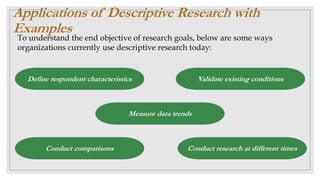
Applications of Descriptive Research with
Examples
To understand the end objective of research goals, below are some ways
organizations currently use descriptive research today:
Define respondent characteristics
Measure data trends
Conduct comparisons Conduct research at different times
Validate existing conditions
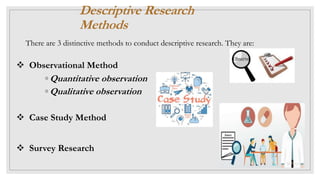
 Observational Method
◦ Quantitative observation
◦ Qualitative observation
 Case Study Method
 Survey Research
Descriptive Research
Methods
There are 3 distinctive methods to conduct descriptive research. They are:
Observational Method
The observational method is the most effective method to conduct descriptive research and
both quantitative observation and qualitative observation are used in this research method.
◦ Quantitative observation is the objective collection of data which is primarily focused
on numbers and values – it suggests “associated to, of or depicted in terms of a
quantity”.
◦ Qualitative observation doesn’t involve measurements or numbers but instead just
monitoring characteristics.
Case Study Method
Case studies involve in-depth research and study of individuals or groups. Case studies lead to
a hypothesis and widen a further scope of studying a phenomenon.
Survey Research
In survey research, respondents answer through surveys or questionnaires, or polls. They are a
popular market research tool to collect feedback from respondents.
Examples of Descriptive
Research
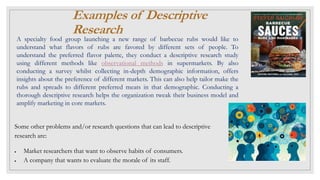
A specialty food group launching a new range of barbecue rubs would like to
understand what flavors of rubs are favored by different sets of people. To
understand the preferred flavor palette, they conduct a descriptive research study
using different methods like observational methods in supermarkets. By also
conducting a survey whilst collecting in-depth demographic information, offers
insights about the preference of different markets. This can also help tailor make the
rubs and spreads to different preferred meats in that demographic. Conducting a
thorough descriptive research helps the organization tweak their business model and
amplify marketing in core markets.
Some other problems and/or research questions that can lead to descriptive
research are:
 Market researchers that want to observe habits of consumers.
 A company that wants to evaluate the morale of its staff.
Advantages of Descriptive
Research
◦ Data collection
◦ Varied
◦ Natural environment
◦ Quick to conduct and cheap
◦ Forms basis for decision-making
Disadvantages of Descriptive
Research
◦ Confidentiality
◦ Halo effect
◦ Sample isn’t representative
◦ No scope to learn cause
SURVEY
RESEARCH
What Is Survey?
Surveys represent one of the most common types of quantitative, social science research.
Why Are Surveys
Conducted?
o To describe the characteristics of a population
o As in other types of research, the population as a whole is rarely studied
o A researcher might be interested in describing how certain characteristics (age, gender,
ethnicity, political involvement, and so on) of teachers in inner-city high schools are
distributed within the group. The researcher would select a sample of teachers from inner-
city high schools to survey.
Survey Research
“A type of research to collect the data and facts about some
certain situation or issue from the target population existing in
surroundings having relevance to the nature of study.”
OR
“Survey research is the research strategy to study the
relationships and characteristics.”
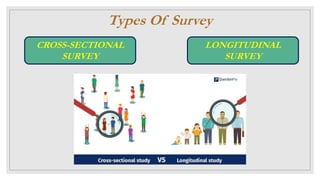
Types Of Survey
CROSS-SECTIONAL
SURVEY
LONGITUDINAL
SURVEY
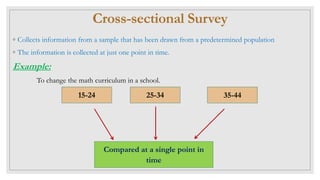
Cross-sectional Survey
◦ Collects information from a sample that has been drawn from a predetermined population
◦ The information is collected at just one point in time.
Example:
To change the math curriculum in a school.
15-24 25-34 35-44
Compared at a single point in
time
Longitudinal Survey
Information is collected at different points in time in order to study changes over time
◦ Four longitudinal designs are commonly employed in survey research:
1. Trend survey
2. Cohort survey
3. Panel survey
4. Follow-up survey
TREND SURVEY
In a trend survey, different sample from a population whose members may change are surveyed at
different points in time.
Example:
Assume a researcher wants to study trends in female valedictorians’ attitudes toward gender
equality. The survey would be administered annually, and each annual sample would include female
valedictorians graduating that year.
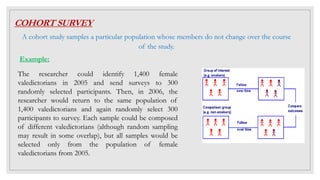
COHORT SURVEY
A cohort study samples a particular population whose members do not change over the course
of the study.
Example:
The researcher could identify 1,400 female
valedictorians in 2005 and send surveys to 300
randomly selected participants. Then, in 2006, the
researcher would return to the same population of
1,400 valedictorians and again randomly select 300
participants to survey. Each sample could be composed
of different valedictorians (although random sampling
may result in some overlap), but all samples would be
selected only from the population of female
valedictorians from 2005.
PANEL SURVEY
A panel survey involves a sample in which the same individuals are studied over time.
Example:
In a 3-year panel study of female valedictorians of the class of 2000 who graduated from inner-
city high schools in Los Angeles and San Francisco, the exact same individuals would be surveyed
in each of the 3 years of the study. A frequent problem with panel studies (and cohort studies to a
lesser degree) is loss of individuals from the study because of relocation, name change, lack of
interest, or death. This attrition is especially problematic the longer a longitudinal study continues.
FOLLOW-UP SURVEY
A follow-up survey addresses development or change in a previously studied population, some
time after the original survey was given.
Example:
A researcher who wanted to study female valedictorians in California a number of years after the
original study was concluded would identify individuals who had participated in the original study
and survey them again to examine changes in the attitudes, behaviors, or beliefs.
PURPOSE AND USES
To measure the change
To study attitudes, behaviour and habits
 To examine the cause-effect relationship
 To study the characteristics
To formulate a hypothesis
To test a hypothesis
Decision making
STEPS IN SURVEY RESEARCH
◦ Defining the Problem
◦ Identifying the Target Population
◦ Choosing the Mode of Data
Collection
◦ Selecting the Sample
◦ Preparing the Instrument
◦ Types of Questions
• Pretesting the questionnaire.
• Overall format
• Preparing the cover letter
• Training interviewers
• Nonresponse
• Data Analysis in Survey Research
Descriptive  Research

Descriptive Research

  • 2.
    EDUCATIONAL RESEAECH PRESENTED TO: MA’AM AMNA PRESENTEDBY: AMENAH GONDAL SAMEEN FATIMA AIMEN SHAHID ZAINAB UMAIR CLASS:
  • 3.
    WE WILL DISCUSS: DESCRIPTIVE RESEARCH  CHARACTERISTICS & APPLICATIONS  DESCRIPTIVE RESEARCH METHODS  EXAMPLES OF DESCRIPTIVE RESEARCH  ADVANTAGES AND DISADVANTAGES  SURVEY RESEARCH  TYPES OF SURVEY RESEARCH  PURPOSES AND USES  STEPS IN SURVEY RESEARCH OBJECTIVES
  • 4.
  • 5.
    Definition: “Descriptive research isdefined as a research method that describes the characteristics of the population or phenomenon that is being studied. This methodology focuses more on the “what” of the research subject rather than the “why” of the research subject.”
  • 6.
    Characteristics of Descriptive Research Somedistinctive characteristics of descriptive research are: ◦ Quantitative research: Descriptive research is a quantitative research method that attempts to collect quantifiable information to be used for statistical analysis of the population sample. ◦ Uncontrolled variables: In descriptive research, none of the variables are influenced in any way. This uses observational methods to conduct the research. ◦ Cross-sectional studies: Descriptive research is generally a cross-sectional study where different sections belonging to the same group are studied. ◦ Basis for further research: The data collected and analyzed from descriptive research can then be further researched using different research techniques.
  • 7.
    Applications of DescriptiveResearch with Examples To understand the end objective of research goals, below are some ways organizations currently use descriptive research today: Define respondent characteristics Measure data trends Conduct comparisons Conduct research at different times Validate existing conditions
  • 8.
     Observational Method ◦Quantitative observation ◦ Qualitative observation  Case Study Method  Survey Research Descriptive Research Methods There are 3 distinctive methods to conduct descriptive research. They are:
  • 9.
    Observational Method The observationalmethod is the most effective method to conduct descriptive research and both quantitative observation and qualitative observation are used in this research method. ◦ Quantitative observation is the objective collection of data which is primarily focused on numbers and values – it suggests “associated to, of or depicted in terms of a quantity”. ◦ Qualitative observation doesn’t involve measurements or numbers but instead just monitoring characteristics. Case Study Method Case studies involve in-depth research and study of individuals or groups. Case studies lead to a hypothesis and widen a further scope of studying a phenomenon. Survey Research In survey research, respondents answer through surveys or questionnaires, or polls. They are a popular market research tool to collect feedback from respondents.
  • 10.
    Examples of Descriptive Research Aspecialty food group launching a new range of barbecue rubs would like to understand what flavors of rubs are favored by different sets of people. To understand the preferred flavor palette, they conduct a descriptive research study using different methods like observational methods in supermarkets. By also conducting a survey whilst collecting in-depth demographic information, offers insights about the preference of different markets. This can also help tailor make the rubs and spreads to different preferred meats in that demographic. Conducting a thorough descriptive research helps the organization tweak their business model and amplify marketing in core markets. Some other problems and/or research questions that can lead to descriptive research are:  Market researchers that want to observe habits of consumers.  A company that wants to evaluate the morale of its staff.
  • 11.
    Advantages of Descriptive Research ◦Data collection ◦ Varied ◦ Natural environment ◦ Quick to conduct and cheap ◦ Forms basis for decision-making Disadvantages of Descriptive Research ◦ Confidentiality ◦ Halo effect ◦ Sample isn’t representative ◦ No scope to learn cause
  • 12.
  • 13.
    What Is Survey? Surveysrepresent one of the most common types of quantitative, social science research. Why Are Surveys Conducted? o To describe the characteristics of a population o As in other types of research, the population as a whole is rarely studied o A researcher might be interested in describing how certain characteristics (age, gender, ethnicity, political involvement, and so on) of teachers in inner-city high schools are distributed within the group. The researcher would select a sample of teachers from inner- city high schools to survey.
  • 14.
    Survey Research “A typeof research to collect the data and facts about some certain situation or issue from the target population existing in surroundings having relevance to the nature of study.” OR “Survey research is the research strategy to study the relationships and characteristics.”
  • 15.
  • 16.
    Cross-sectional Survey ◦ Collectsinformation from a sample that has been drawn from a predetermined population ◦ The information is collected at just one point in time. Example: To change the math curriculum in a school. 15-24 25-34 35-44 Compared at a single point in time
  • 17.
    Longitudinal Survey Information iscollected at different points in time in order to study changes over time ◦ Four longitudinal designs are commonly employed in survey research: 1. Trend survey 2. Cohort survey 3. Panel survey 4. Follow-up survey
  • 18.
    TREND SURVEY In atrend survey, different sample from a population whose members may change are surveyed at different points in time. Example: Assume a researcher wants to study trends in female valedictorians’ attitudes toward gender equality. The survey would be administered annually, and each annual sample would include female valedictorians graduating that year.
  • 19.
    COHORT SURVEY A cohortstudy samples a particular population whose members do not change over the course of the study. Example: The researcher could identify 1,400 female valedictorians in 2005 and send surveys to 300 randomly selected participants. Then, in 2006, the researcher would return to the same population of 1,400 valedictorians and again randomly select 300 participants to survey. Each sample could be composed of different valedictorians (although random sampling may result in some overlap), but all samples would be selected only from the population of female valedictorians from 2005.
  • 20.
    PANEL SURVEY A panelsurvey involves a sample in which the same individuals are studied over time. Example: In a 3-year panel study of female valedictorians of the class of 2000 who graduated from inner- city high schools in Los Angeles and San Francisco, the exact same individuals would be surveyed in each of the 3 years of the study. A frequent problem with panel studies (and cohort studies to a lesser degree) is loss of individuals from the study because of relocation, name change, lack of interest, or death. This attrition is especially problematic the longer a longitudinal study continues.
  • 21.
    FOLLOW-UP SURVEY A follow-upsurvey addresses development or change in a previously studied population, some time after the original survey was given. Example: A researcher who wanted to study female valedictorians in California a number of years after the original study was concluded would identify individuals who had participated in the original study and survey them again to examine changes in the attitudes, behaviors, or beliefs.
  • 22.
    PURPOSE AND USES Tomeasure the change To study attitudes, behaviour and habits  To examine the cause-effect relationship  To study the characteristics To formulate a hypothesis To test a hypothesis Decision making
  • 23.
    STEPS IN SURVEYRESEARCH ◦ Defining the Problem ◦ Identifying the Target Population ◦ Choosing the Mode of Data Collection ◦ Selecting the Sample ◦ Preparing the Instrument ◦ Types of Questions • Pretesting the questionnaire. • Overall format • Preparing the cover letter • Training interviewers • Nonresponse • Data Analysis in Survey Research