G.U.H.S
YELLAGONDAPALAYA
Mean
Median
Mode
ON LINE
2020 – 21
Vidyagamma
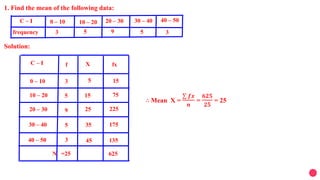
1. Find the mean of the following data:
Solution:
C – I
frequency
0 – 10 10 – 20 20 – 30 30 – 40 40 – 50
3 5 9 5 3
C – I f X fx
0 – 10
10 – 20
20 – 30
30 – 40
40 – 50
3
5
9
5
3
5
15
25
35
45
15
75
225
175
135
N =25 625
∴ Mean X =
𝒇𝒙
𝒏
=
𝟔𝟐𝟓
𝟐𝟓
= 25
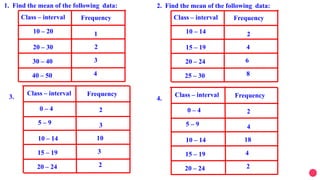
1. Find the mean of the following data:
Class – interval Frequency
10 – 20
20 – 30
30 – 40
40 – 50
1
2
3
4
2. Find the mean of the following data:
Class – interval Frequency
10 – 14
15 – 19
20 – 24
25 – 30
2
4
6
8
3.
Class – interval Frequency
5 – 9
10 – 14
15 – 19
20 – 24
3
10
3
2
0 – 4 2
4.
Class – interval Frequency
5 – 9
10 – 14
15 – 19
20 – 24
4
18
4
2
0 – 4 2
[2]Calculate the median for the following data
C – I
F
50 – 60 60 – 70 70 – 80 80 – 90 90 – 100
12 14 8 6 10
Solution:
Class
intervals
50 – 60
60 – 70
70 – 80
80 – 90
90 – 100
Frequency
Cumulative
frequency
12
14
8
6
10
12
26
34
40
50
Now n = 50,
𝒏
𝟐
=
𝟓𝟎
𝟐
=25 this observation
lies in the class 60 – 70 then
l = [the lower limit] = 60
cf = [the cumulative frequency of class
preceding 60 – 70] = 12
f = [the frequency of the median class 60 – 70 ] = 14
h= [the class size] = 10
Using the formula, Median = l +
𝒏
𝟐
−𝒄𝒇
𝒇
x h
Median = 60 +
25 −12
14
x 10
= 60 + 130
14
= 60 +9.3 = 69.3
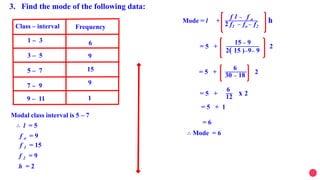
3. Find the mode of the following data:
Class – interval Frequency
1 – 3 6
9
15
9
3 – 5
5 – 7
7 – 9
9 – 11 1
Modal class interval is 5 – 7
∴ l = 5
f o = 9
f 1 = 15
f 2 = 9
h = 2
Mode = l +
f 1 − f o
2 f1 − fo − f2
h
= 5 +
15 − 9
2( 15 )−9− 9
2
= 5 +
6
30 − 18
2
= 5 +
6
12
x 2
= 5 + 1
= 6
∴ Mode = 6
[4]Calculate the median for the following data
C – I
F
0 – 20 20 – 40 40– 60 60 – 80 80 – 100 100 – 120 120 – 140
2 6 10 12 2 5 3
Solution:
Class
intervals
0 – 20
20 – 40
40– 60
60 – 80
80 – 100
100 – 120
120 – 140
Frequency
Cumulative
frequency
2
6
10
12
2
5
3
2
18
30
32
37
40
Now n = 50,
𝒏
𝟐
=
𝟒𝟎
𝟐
=20 this observation
lies in the class 60 – 80 then
l = [the lower limit] = 60
cf = [the cumulative frequency of class
preceding 60 – 80] = 18
f = [the frequency of the median class 40 – 60 ] = 12
h= [the class size] = 20
Using the formula, Median = l +
𝒏
𝟐
−𝒄𝒇
𝒇
x h
Median = 60 +
𝟐𝟎−𝟏𝟖
𝟏𝟐
x 20
= 60 +
𝟒𝟎
𝟏𝟐
= 60 + 3.33 = 63.33
8
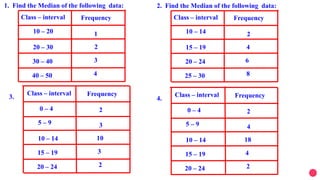
1. Find the Median of the following data:
Class – interval Frequency
10 – 20
20 – 30
30 – 40
40 – 50
1
2
3
4
2. Find the Median of the following data:
Class – interval Frequency
10 – 14
15 – 19
20 – 24
25 – 30
2
4
6
8
3.
Class – interval Frequency
5 – 9
10 – 14
15 – 19
20 – 24
3
10
3
2
0 – 4 2
4.
Class – interval Frequency
5 – 9
10 – 14
15 – 19
20 – 24
4
18
4
2
0 – 4 2
[5]Calculate the Mode for the following frequency distribution
C – I
F
5 – 15 15 – 25 25– 35 35 – 45 45 – 55 55 – 65
6 11 21 23 14 5
f1
Now, let us substitute these values in the formula:
Mode = l +
𝒇 𝟏
−𝒇 𝟎
𝟐𝒇 𝟏
−𝒇 𝟎
−𝒇 𝟐
x h
Mode = 35 +
𝟐𝟑−𝟐𝟏
𝟐 x 𝟐𝟑 −𝟐𝟏 −𝟏𝟒
x 10
Mode = 35 +
𝟐
𝟒𝟔 −𝟑𝟓
x 10
= 35 +
𝟐
𝟏𝟏
x 10
Mode = 35 + 1.81= 36 .81
Mode = 35 +
𝟐𝟎
𝟏𝟏
Therefore the mode of the data is 36.81
fO f2h = 10
[6]Calculate the Mode for the following frequency distribution
C – I
F
5 – 15 15 – 25 25– 35 35 – 45 45 – 55 55 – 65
6 11 21 23 14 5
Solution: Here the maximum class frequency is 23, and the class corresponding to
this frequency is 35 – 45. So, the modal class is 35 – 45
Now, modal class = 35 – 45 , lower limit ( l )
of modal class = 35, class size is (h) = 10
Frequency ( f1 ) of the modal class =23
Frequency ( f0 ) of class preceding the modal class =21
Frequency ( f2 ) of class succeeding the modal class =14
Now, let us substitute these values in the formula:
Mode = l +
𝒇 𝟏
−𝒇 𝟎
𝟐𝒇 𝟏
−𝒇 𝟎
−𝒇 𝟐
x h
Mode = 35 +
𝟐𝟑−𝟐𝟏
𝟐 x 𝟐𝟑 −𝟐𝟏 −𝟏𝟒
x 10
Mode = 35 +
𝟐
𝟒𝟔 −𝟑𝟓
x 10
= 35 +
𝟐
𝟏𝟏
x 10
Mode = 35 + 1.81= 36 .81
Mode = 35 +
𝟐𝟎
𝟏𝟏
Therefore the mode of the data is 36.81
[7]Calculate the Mode for the following frequency distribution
C – I
F
5 – 15 15 – 25 25– 35 35 – 45 45 – 55 55 – 65
4 20 24 6 4 2
Solution: Here the maximum class frequency is 23, and the class corresponding to
this frequency is 35 – 45. So, the modal class is 35 – 45
Now, modal class = 35 – 45 , lower limit ( l )
of modal class = 35, class size is (h) = 10
Frequency ( f1 ) of the modal class =24
Frequency ( f0 ) of class preceding the modal class =20
Frequency ( f2 ) of class succeeding the modal class =6
Now, let us substitute these values in the formula:
Mode = l +
𝒇 𝟏
−𝒇 𝟎
𝟐𝒇 𝟏
−𝒇 𝟎
−𝒇 𝟐
x h
Mode = 35 +
𝟐𝟒−𝟐𝟎
𝟐 x 𝟐𝟒 −𝟐𝟎 −𝟔
x 10
Mode = 25 +
𝟒
𝟒𝟖 −𝟐𝟔
x 10
= 25 +
𝟒
𝟐𝟐
x 10
Mode = 25 + 3.63= 28 .63
Mode = 25 +
𝟒𝟎
𝟏𝟏
Therefore the mode of the data is 28.63
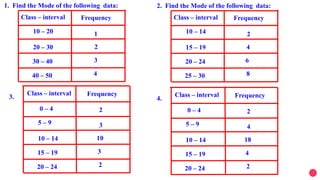
1. Find the Mode of the following data:
Class – interval Frequency
10 – 20
20 – 30
30 – 40
40 – 50
1
2
3
4
2. Find the Mode of the following data:
Class – interval Frequency
10 – 14
15 – 19
20 – 24
25 – 30
2
4
6
8
3.
Class – interval Frequency
5 – 9
10 – 14
15 – 19
20 – 24
3
10
3
2
0 – 4 2
4.
Class – interval Frequency
5 – 9
10 – 14
15 – 19
20 – 24
4
18
4
2
0 – 4 2
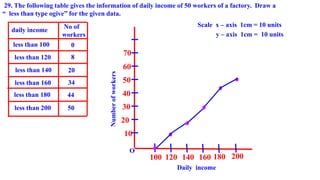
29. The following table gives the information of daily income of 50 workers of a factory. Draw a
“ less than type ogive” for the given data.
daily income No of
workers
less than 100
less than 120
less than 140
less than 160
less than 180
less than 200
0
8
20
34
44
50
10
O
20
30
40
50
60
70
100 120 140 160 180 200
Numberofworkers
Daily income
Scale x – axis 1cm = 10 units
y – axis 1cm = 10 units
CLASS 10 MEAN MEDIAN MODE

CLASS 10 MEAN MEDIAN MODE

  • 1.
  • 2.
    1. Find themean of the following data: Solution: C – I frequency 0 – 10 10 – 20 20 – 30 30 – 40 40 – 50 3 5 9 5 3 C – I f X fx 0 – 10 10 – 20 20 – 30 30 – 40 40 – 50 3 5 9 5 3 5 15 25 35 45 15 75 225 175 135 N =25 625 ∴ Mean X = 𝒇𝒙 𝒏 = 𝟔𝟐𝟓 𝟐𝟓 = 25
  • 3.
    1. Find themean of the following data: Class – interval Frequency 10 – 20 20 – 30 30 – 40 40 – 50 1 2 3 4 2. Find the mean of the following data: Class – interval Frequency 10 – 14 15 – 19 20 – 24 25 – 30 2 4 6 8 3. Class – interval Frequency 5 – 9 10 – 14 15 – 19 20 – 24 3 10 3 2 0 – 4 2 4. Class – interval Frequency 5 – 9 10 – 14 15 – 19 20 – 24 4 18 4 2 0 – 4 2
  • 4.
    [2]Calculate the medianfor the following data C – I F 50 – 60 60 – 70 70 – 80 80 – 90 90 – 100 12 14 8 6 10 Solution: Class intervals 50 – 60 60 – 70 70 – 80 80 – 90 90 – 100 Frequency Cumulative frequency 12 14 8 6 10 12 26 34 40 50 Now n = 50, 𝒏 𝟐 = 𝟓𝟎 𝟐 =25 this observation lies in the class 60 – 70 then l = [the lower limit] = 60 cf = [the cumulative frequency of class preceding 60 – 70] = 12 f = [the frequency of the median class 60 – 70 ] = 14 h= [the class size] = 10 Using the formula, Median = l + 𝒏 𝟐 −𝒄𝒇 𝒇 x h Median = 60 + 25 −12 14 x 10 = 60 + 130 14 = 60 +9.3 = 69.3
  • 5.
    3. Find themode of the following data: Class – interval Frequency 1 – 3 6 9 15 9 3 – 5 5 – 7 7 – 9 9 – 11 1 Modal class interval is 5 – 7 ∴ l = 5 f o = 9 f 1 = 15 f 2 = 9 h = 2 Mode = l + f 1 − f o 2 f1 − fo − f2 h = 5 + 15 − 9 2( 15 )−9− 9 2 = 5 + 6 30 − 18 2 = 5 + 6 12 x 2 = 5 + 1 = 6 ∴ Mode = 6
  • 6.
    [4]Calculate the medianfor the following data C – I F 0 – 20 20 – 40 40– 60 60 – 80 80 – 100 100 – 120 120 – 140 2 6 10 12 2 5 3 Solution: Class intervals 0 – 20 20 – 40 40– 60 60 – 80 80 – 100 100 – 120 120 – 140 Frequency Cumulative frequency 2 6 10 12 2 5 3 2 18 30 32 37 40 Now n = 50, 𝒏 𝟐 = 𝟒𝟎 𝟐 =20 this observation lies in the class 60 – 80 then l = [the lower limit] = 60 cf = [the cumulative frequency of class preceding 60 – 80] = 18 f = [the frequency of the median class 40 – 60 ] = 12 h= [the class size] = 20 Using the formula, Median = l + 𝒏 𝟐 −𝒄𝒇 𝒇 x h Median = 60 + 𝟐𝟎−𝟏𝟖 𝟏𝟐 x 20 = 60 + 𝟒𝟎 𝟏𝟐 = 60 + 3.33 = 63.33 8
  • 7.
    1. Find theMedian of the following data: Class – interval Frequency 10 – 20 20 – 30 30 – 40 40 – 50 1 2 3 4 2. Find the Median of the following data: Class – interval Frequency 10 – 14 15 – 19 20 – 24 25 – 30 2 4 6 8 3. Class – interval Frequency 5 – 9 10 – 14 15 – 19 20 – 24 3 10 3 2 0 – 4 2 4. Class – interval Frequency 5 – 9 10 – 14 15 – 19 20 – 24 4 18 4 2 0 – 4 2
  • 8.
    [5]Calculate the Modefor the following frequency distribution C – I F 5 – 15 15 – 25 25– 35 35 – 45 45 – 55 55 – 65 6 11 21 23 14 5 f1 Now, let us substitute these values in the formula: Mode = l + 𝒇 𝟏 −𝒇 𝟎 𝟐𝒇 𝟏 −𝒇 𝟎 −𝒇 𝟐 x h Mode = 35 + 𝟐𝟑−𝟐𝟏 𝟐 x 𝟐𝟑 −𝟐𝟏 −𝟏𝟒 x 10 Mode = 35 + 𝟐 𝟒𝟔 −𝟑𝟓 x 10 = 35 + 𝟐 𝟏𝟏 x 10 Mode = 35 + 1.81= 36 .81 Mode = 35 + 𝟐𝟎 𝟏𝟏 Therefore the mode of the data is 36.81 fO f2h = 10
  • 9.
    [6]Calculate the Modefor the following frequency distribution C – I F 5 – 15 15 – 25 25– 35 35 – 45 45 – 55 55 – 65 6 11 21 23 14 5 Solution: Here the maximum class frequency is 23, and the class corresponding to this frequency is 35 – 45. So, the modal class is 35 – 45 Now, modal class = 35 – 45 , lower limit ( l ) of modal class = 35, class size is (h) = 10 Frequency ( f1 ) of the modal class =23 Frequency ( f0 ) of class preceding the modal class =21 Frequency ( f2 ) of class succeeding the modal class =14 Now, let us substitute these values in the formula: Mode = l + 𝒇 𝟏 −𝒇 𝟎 𝟐𝒇 𝟏 −𝒇 𝟎 −𝒇 𝟐 x h Mode = 35 + 𝟐𝟑−𝟐𝟏 𝟐 x 𝟐𝟑 −𝟐𝟏 −𝟏𝟒 x 10 Mode = 35 + 𝟐 𝟒𝟔 −𝟑𝟓 x 10 = 35 + 𝟐 𝟏𝟏 x 10 Mode = 35 + 1.81= 36 .81 Mode = 35 + 𝟐𝟎 𝟏𝟏 Therefore the mode of the data is 36.81
  • 10.
    [7]Calculate the Modefor the following frequency distribution C – I F 5 – 15 15 – 25 25– 35 35 – 45 45 – 55 55 – 65 4 20 24 6 4 2 Solution: Here the maximum class frequency is 23, and the class corresponding to this frequency is 35 – 45. So, the modal class is 35 – 45 Now, modal class = 35 – 45 , lower limit ( l ) of modal class = 35, class size is (h) = 10 Frequency ( f1 ) of the modal class =24 Frequency ( f0 ) of class preceding the modal class =20 Frequency ( f2 ) of class succeeding the modal class =6 Now, let us substitute these values in the formula: Mode = l + 𝒇 𝟏 −𝒇 𝟎 𝟐𝒇 𝟏 −𝒇 𝟎 −𝒇 𝟐 x h Mode = 35 + 𝟐𝟒−𝟐𝟎 𝟐 x 𝟐𝟒 −𝟐𝟎 −𝟔 x 10 Mode = 25 + 𝟒 𝟒𝟖 −𝟐𝟔 x 10 = 25 + 𝟒 𝟐𝟐 x 10 Mode = 25 + 3.63= 28 .63 Mode = 25 + 𝟒𝟎 𝟏𝟏 Therefore the mode of the data is 28.63
  • 11.
    1. Find theMode of the following data: Class – interval Frequency 10 – 20 20 – 30 30 – 40 40 – 50 1 2 3 4 2. Find the Mode of the following data: Class – interval Frequency 10 – 14 15 – 19 20 – 24 25 – 30 2 4 6 8 3. Class – interval Frequency 5 – 9 10 – 14 15 – 19 20 – 24 3 10 3 2 0 – 4 2 4. Class – interval Frequency 5 – 9 10 – 14 15 – 19 20 – 24 4 18 4 2 0 – 4 2
  • 12.
    29. The followingtable gives the information of daily income of 50 workers of a factory. Draw a “ less than type ogive” for the given data. daily income No of workers less than 100 less than 120 less than 140 less than 160 less than 180 less than 200 0 8 20 34 44 50 10 O 20 30 40 50 60 70 100 120 140 160 180 200 Numberofworkers Daily income Scale x – axis 1cm = 10 units y – axis 1cm = 10 units