T-AND Z-TEST
1
Learning Objectives
 To understand the meaning of small and large sample
size.
 In which condition, t-test and z-test may be employed
 Practical session on t-test and z-test
Quick Overview
3
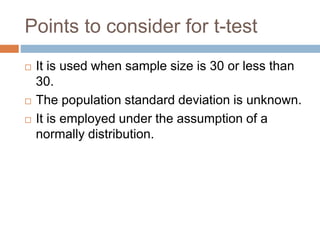
Points to consider for t-test
 It is used when sample size is 30 or less than
30.
 The population standard deviation is unknown.
 It is employed under the assumption of a
normally distribution.
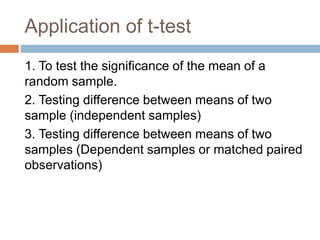
Application of t-test
1. To test the significance of the mean of a
random sample.
2. Testing difference between means of two
sample (independent samples)
3. Testing difference between means of two
samples (Dependent samples or matched paired
observations)
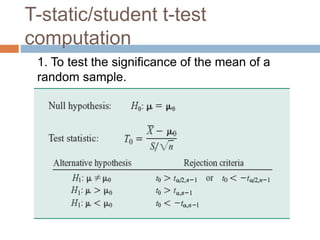
T-static/student t-test
computation
1. To test the significance of the mean of a
random sample.
Testing the significance of the
mean of a random sample.
Q1. The manufacturer of a certain make of electric
bulbs claims that his bulbs have a mean life of 25
months with a standard deviation of 5 months. A
random sample of 6 such bulbs gave the following
values:
Life of months: 24, 26, 30, 20, 20, 18
Can you regard the producer’s claim to be valid at
1% level of significance? (Given that the table value
of the appropriate test statistics at the said level are
4.032, 3.707 and 3.499 for 5, 6, and 7 degrees
freedom respectively)
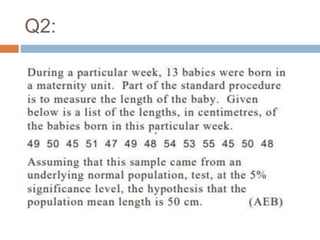
Q2:
2.Testing difference between
means of two sample
3. Testing difference between means of two
samples (Dependent samples or matched
paired observations)
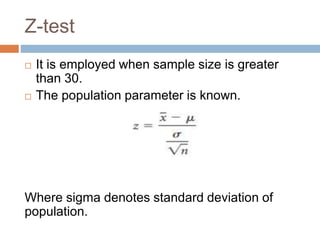
Z-test
 It is employed when sample size is greater
than 30.
 The population parameter is known.
Where sigma denotes standard deviation of
population.
THANK YOU
12

Test for Small and Large sample size (1).pptx

  • 1.
  • 2.
    Learning Objectives  Tounderstand the meaning of small and large sample size.  In which condition, t-test and z-test may be employed  Practical session on t-test and z-test
  • 3.
  • 4.
    Points to considerfor t-test  It is used when sample size is 30 or less than 30.  The population standard deviation is unknown.  It is employed under the assumption of a normally distribution.
  • 5.
    Application of t-test 1.To test the significance of the mean of a random sample. 2. Testing difference between means of two sample (independent samples) 3. Testing difference between means of two samples (Dependent samples or matched paired observations)
  • 6.
    T-static/student t-test computation 1. Totest the significance of the mean of a random sample.
  • 7.
    Testing the significanceof the mean of a random sample. Q1. The manufacturer of a certain make of electric bulbs claims that his bulbs have a mean life of 25 months with a standard deviation of 5 months. A random sample of 6 such bulbs gave the following values: Life of months: 24, 26, 30, 20, 20, 18 Can you regard the producer’s claim to be valid at 1% level of significance? (Given that the table value of the appropriate test statistics at the said level are 4.032, 3.707 and 3.499 for 5, 6, and 7 degrees freedom respectively)
  • 8.
  • 9.
  • 10.
    3. Testing differencebetween means of two samples (Dependent samples or matched paired observations)
  • 11.
    Z-test  It isemployed when sample size is greater than 30.  The population parameter is known. Where sigma denotes standard deviation of population.
  • 12.

Editor's Notes