SAMPLING
BY
D.SUNDARA MEENAKSHI.
Meaning of sampling
The process of testing some data
based on a small sample is called
sampling.
Eg: From a cup of tea, a tea-taster
determines the quality of the brand of
tea.
Definition of sampling
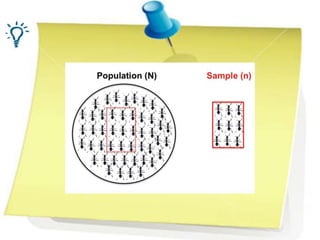
Sampling is the process by which inference is
made to the whole by examining a part.
THE PURPOSE OF SAMPLING
The purpose of sampling is to provide
various types of statistical information of a
qualitative or quantitative nature about the
whole by examining a few selected units.
ADVANTAGES OF SAMPLING
• Greater economy
• Greater scope
• It takes less time
LIMITATIONS OF SAMPLING
•Errors due to sampling may be high for
small administrative areas.
•Sampling may not be feasible for problems
that require very high accuracy.
TYPES OF SAMPLING
1. Probability sampling:
• Simple Random Sampling
• Stratified Random Sampling
• Systematic Random Sampling
• Cluster Or Multistage Sampling
2. Non-probability sampling:
• Convenience/ opportunity sampling.
• Purposive/ judgemental sampling
• Quota sampling
• Snowball sampling
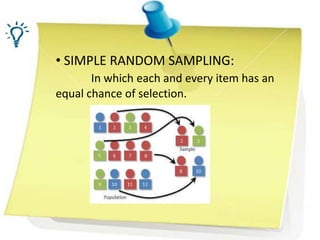
• SIMPLE RANDOM SAMPLING:
In which each and every item has an
equal chance of selection.
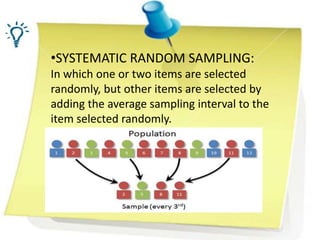
•SYSTEMATIC RANDOM SAMPLING:
In which one or two items are selected
randomly, but other items are selected by
adding the average sampling interval to the
item selected randomly.
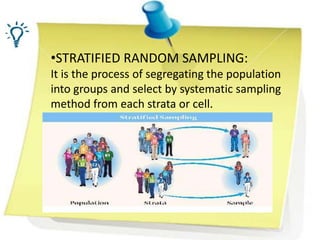
•STRATIFIED RANDOM SAMPLING:
It is the process of segregating the population
into groups and select by systematic sampling
method from each strata or cell.
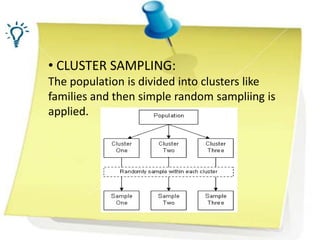
• CLUSTER SAMPLING:
The population is divided into clusters like
families and then simple random sampliing is
applied.
• CONVENIENCE SAMPLING:
The process of including whoever happens to be
available at the time.
It also called “accidental” or “haphazard”
sampling
• JUDGEMENTAL SAMPLING:
The process whereby the researcher selects a
sample based on experience or knowledge of
the group to be sampled.
It is also called purposive sampling
• QUOTA SAMPLING:
The process whereby a researcher gathers data
from individuals possessing identified
characteristics and quotas.
For example, an interviewer may be told to sample 200
females and 300 males between the age of 45 and 60.
• SNOWBALL SAMPLING:
The sampling procedure in which the initial
respondents are chosen by probability or non-
probability methods, and then additional
respondents are obtained by information
provided by the initial respondents
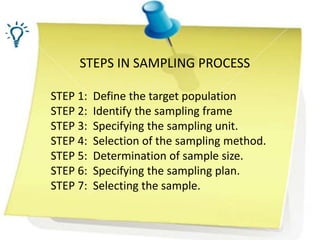
STEPS IN SAMPLING PROCESS
STEP 1: Define the target population
STEP 2: Identify the sampling frame
STEP 3: Specifying the sampling unit.
STEP 4: Selection of the sampling method.
STEP 5: Determination of sample size.
STEP 6: Specifying the sampling plan.
STEP 7: Selecting the sample.
THANK YOU
SO MUCH
FOR YOUR
TIME !!!

Sampling Methods

  • 1.
  • 2.
    Meaning of sampling Theprocess of testing some data based on a small sample is called sampling. Eg: From a cup of tea, a tea-taster determines the quality of the brand of tea.
  • 4.
    Definition of sampling Samplingis the process by which inference is made to the whole by examining a part.
  • 5.
    THE PURPOSE OFSAMPLING The purpose of sampling is to provide various types of statistical information of a qualitative or quantitative nature about the whole by examining a few selected units.
  • 6.
    ADVANTAGES OF SAMPLING •Greater economy • Greater scope • It takes less time
  • 7.
    LIMITATIONS OF SAMPLING •Errorsdue to sampling may be high for small administrative areas. •Sampling may not be feasible for problems that require very high accuracy.
  • 8.
    TYPES OF SAMPLING 1.Probability sampling: • Simple Random Sampling • Stratified Random Sampling • Systematic Random Sampling • Cluster Or Multistage Sampling
  • 9.
    2. Non-probability sampling: •Convenience/ opportunity sampling. • Purposive/ judgemental sampling • Quota sampling • Snowball sampling
  • 10.
    • SIMPLE RANDOMSAMPLING: In which each and every item has an equal chance of selection.
  • 11.
    •SYSTEMATIC RANDOM SAMPLING: Inwhich one or two items are selected randomly, but other items are selected by adding the average sampling interval to the item selected randomly.
  • 12.
    •STRATIFIED RANDOM SAMPLING: Itis the process of segregating the population into groups and select by systematic sampling method from each strata or cell.
  • 13.
    • CLUSTER SAMPLING: Thepopulation is divided into clusters like families and then simple random sampliing is applied.
  • 14.
    • CONVENIENCE SAMPLING: Theprocess of including whoever happens to be available at the time. It also called “accidental” or “haphazard” sampling
  • 15.
    • JUDGEMENTAL SAMPLING: Theprocess whereby the researcher selects a sample based on experience or knowledge of the group to be sampled. It is also called purposive sampling
  • 16.
    • QUOTA SAMPLING: Theprocess whereby a researcher gathers data from individuals possessing identified characteristics and quotas. For example, an interviewer may be told to sample 200 females and 300 males between the age of 45 and 60.
  • 17.
    • SNOWBALL SAMPLING: Thesampling procedure in which the initial respondents are chosen by probability or non- probability methods, and then additional respondents are obtained by information provided by the initial respondents
  • 18.
    STEPS IN SAMPLINGPROCESS STEP 1: Define the target population STEP 2: Identify the sampling frame STEP 3: Specifying the sampling unit. STEP 4: Selection of the sampling method. STEP 5: Determination of sample size. STEP 6: Specifying the sampling plan. STEP 7: Selecting the sample.
  • 19.
    THANK YOU SO MUCH FORYOUR TIME !!!