2.092/2.093—FiniteElementAnalysisofSolids&FluidsI Fall‘09 
Lecture2-TheFiniteElementAnalysisProcess 
Prof.K.J.Bathe MITOpenCourseWare 
Readingassignment:Chapter1,Sections3.1,3.2,4.1 
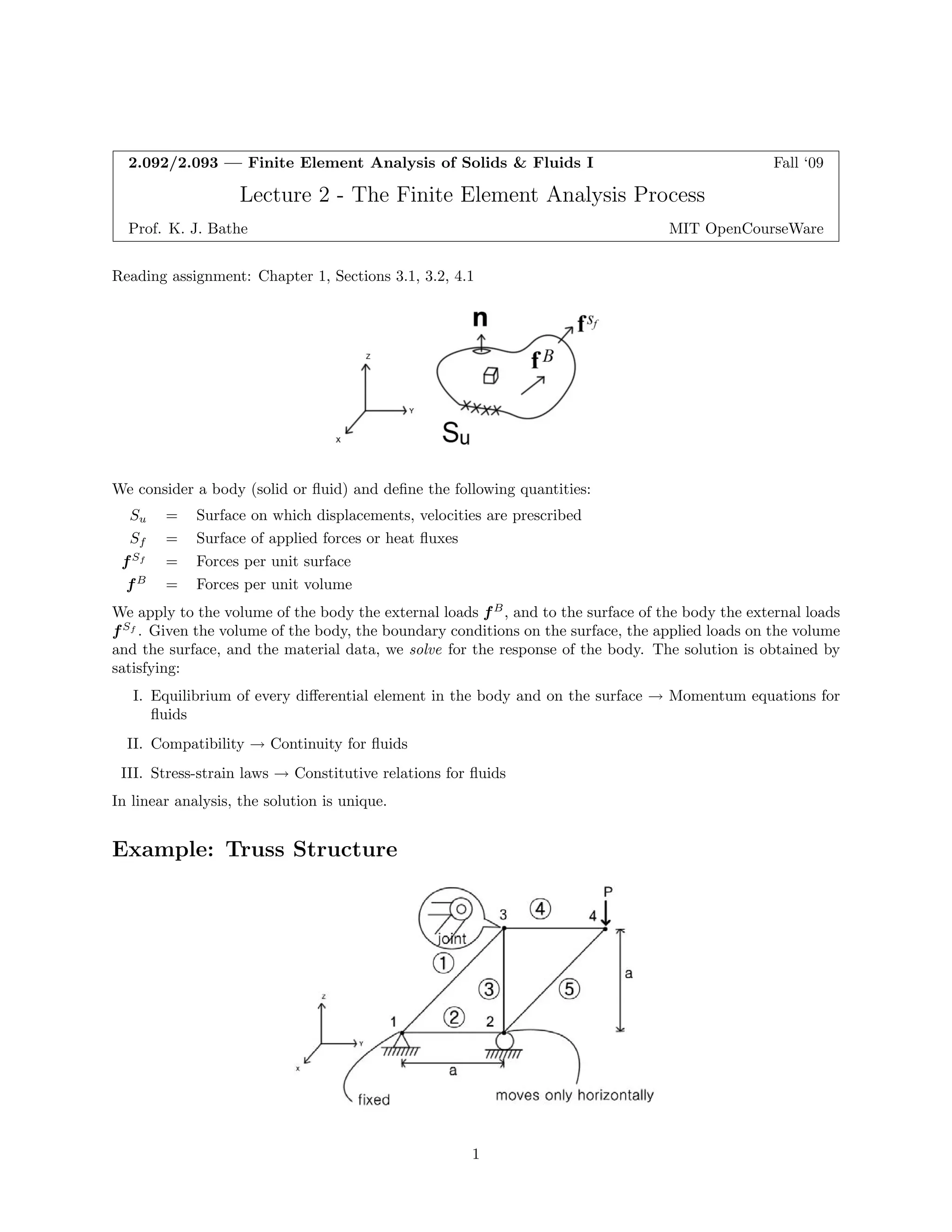
Weconsiderabody(solidorfluid)anddefinethefollowingquantities: 
Su = Surfaceonwhichdisplacements,velocitiesareprescribed 
Sf = Surfaceofappliedforcesorheatfluxes 
fSf = Forcesperunitsurface 
fB = Forcesperunitvolume 
Weapplytothevolumeofthebodytheexternalloads fB, andtothesurfaceofthebodytheexternalloads 
fSf . Giventhevolumeofthebody,theboundaryconditionsonthesurface,theappliedloadsonthevolume 
andthesurface,andthematerialdata,we solve fortheresponseofthebody.Thesolutionisobtainedby 
satisfying: 
I. Equilibriumofeverydifferentialelementinthebodyandonthesurface ! Momentumequationsfor 
fluids 
II.Compatibility ! Continuityforfluids 
III.Stress-strainlaws ! Constitutiverelationsforfluids 
In linearanalysis,thesolutionisunique. 
Example:TrussStructure 
1
Lecture 2 The Finite Element Analysis Process 2.092/2.093, Fall ‘09 
Assume: 
• 
frictionless joints 
• 
weightless bars 
• 
loads applied only at the joints 
joints and elements cannot take moments truss element does not bend 
• → 
• concentrated loads only at the joints 
static condition no vibrations/no transient response 
• → 
• infinitesimally small displacements, stress below yield stress 
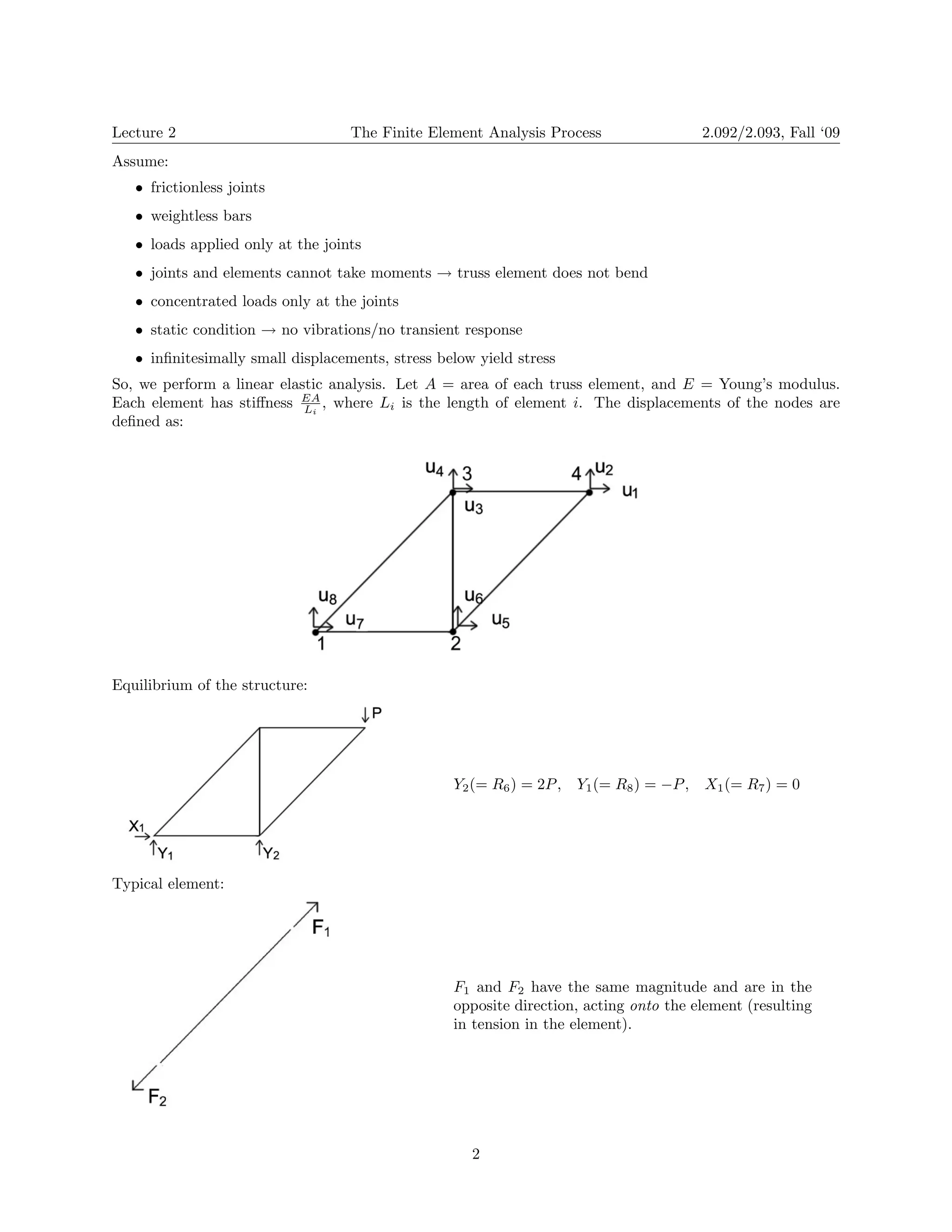
So, we perform a linear elastic analysis. Let A = area of each truss element, and E = Young’s modulus. Each element has stiffness EA , where Li is the length of element i. The displacements of the nodes are 
Li 
defined as: 
Equilibrium of the structure: 
Y2(= R6)=2P , Y1(= R8)= −P , X1(= R7)=0 
Typical element: 
F1 and F2 have the same magnitude and are in the opposite direction, acting onto the element (resulting in tension in the element). 2
Lecture 2 The Finite Element Analysis Process 2.092/2.093, Fall ‘09 
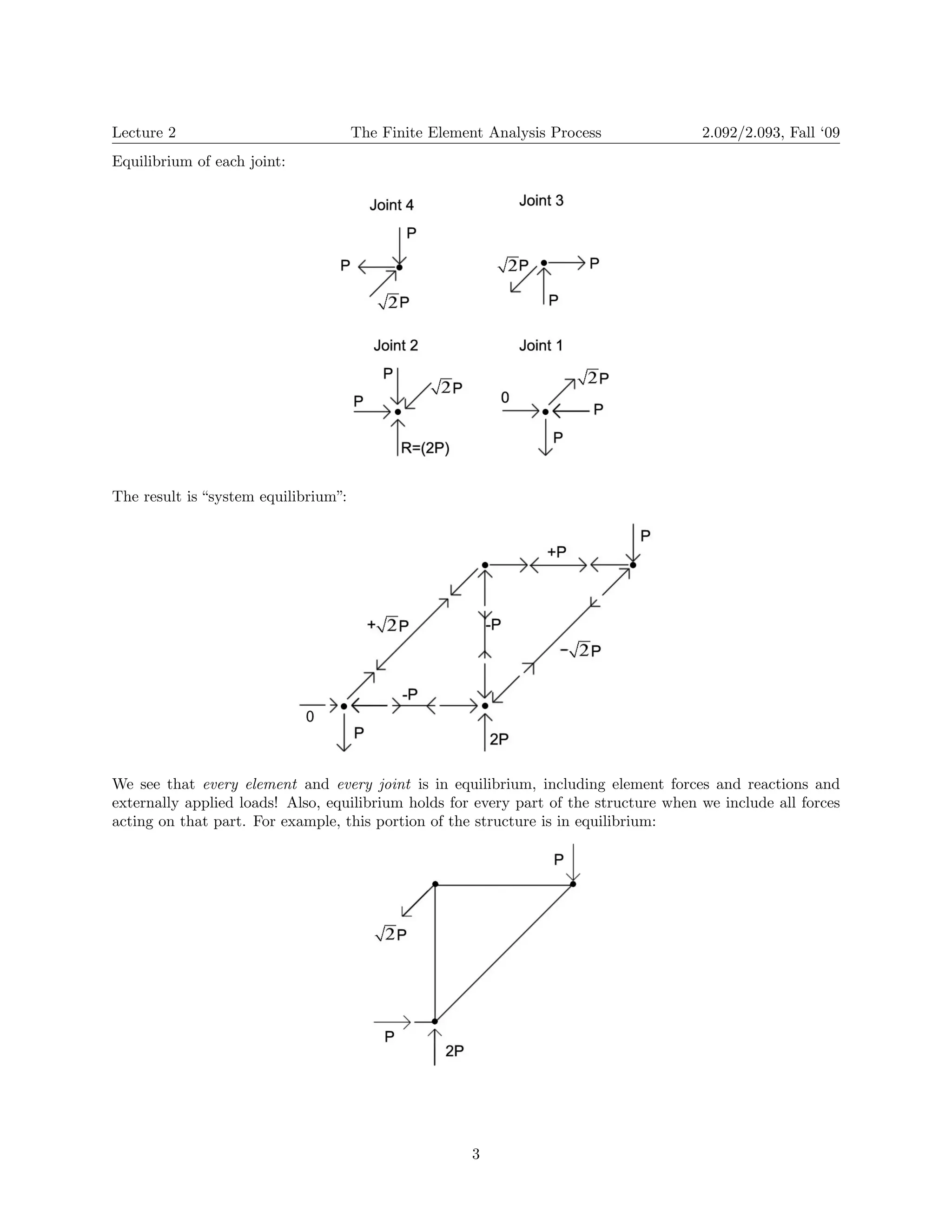
Equilibrium of each joint: 
The result is “system equilibrium”: 
We see that every element and every joint is in equilibrium, including element forces and reactions and externally applied loads! Also, equilibrium holds for every part of the structure when we include all forces acting on that part. For example, this portion of the structure is in equilibrium: 3
Lecture 2 
The Finite Element Analysis Process 
2.092/2.093, Fall ‘09 
Actual Solution 
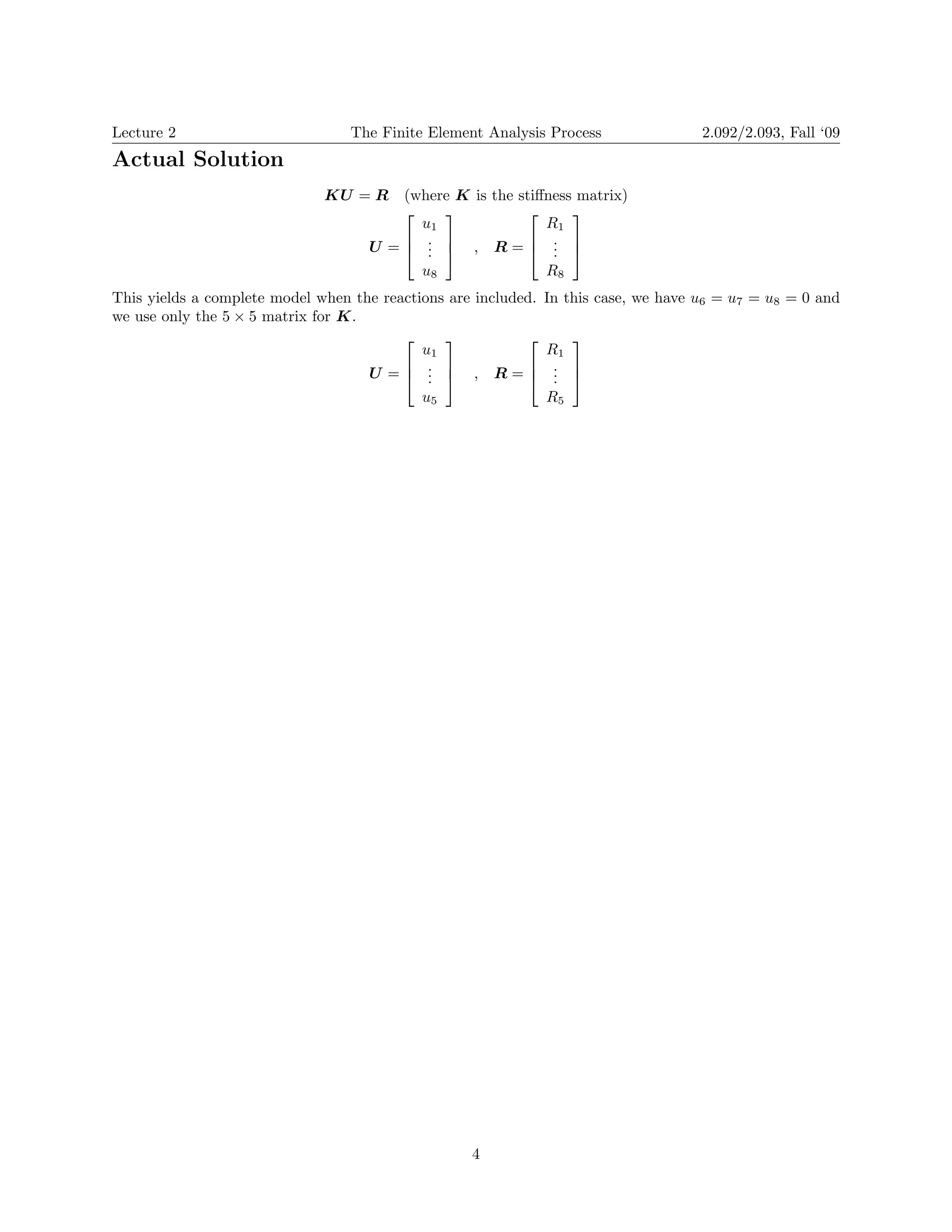
KU = R 
(where K is the stiffness matrix) 
⎤⎡ 
⎤⎡ u1 R1 
U = 
u8 R8 
This yields a complete model when the reactions are included. In this case, we have u6 = u7 = u8 = 0 and we use only the 5 × 5 matrix for K. 
U = 
⎢⎣ ⎢⎣ ⎥⎦ ⎢⎣ ⎥⎦ 
. . 
R = 
. . ,. . 
⎤⎡ 
⎤⎡ 
u1 R1 
⎥⎦ ⎢⎣ ⎥⎦ 
. . 
R = 
. . ,. . 
u5 R5 4
MIT OpenCourseWare 
http://ocw.mit.edu 
2.092 / 2.093 Finite Element Analysis of Solids and Fluids I 
Fall 2009 
For information about citing these materials or our Terms of Use, visit: http://ocw.mit.edu/terms.

Mit2 092 f09_lec02

  • 1.
    2.092/2.093—FiniteElementAnalysisofSolids&FluidsI Fall‘09 Lecture2-TheFiniteElementAnalysisProcess Prof.K.J.Bathe MITOpenCourseWare Readingassignment:Chapter1,Sections3.1,3.2,4.1 Weconsiderabody(solidorfluid)anddefinethefollowingquantities: Su = Surfaceonwhichdisplacements,velocitiesareprescribed Sf = Surfaceofappliedforcesorheatfluxes fSf = Forcesperunitsurface fB = Forcesperunitvolume Weapplytothevolumeofthebodytheexternalloads fB, andtothesurfaceofthebodytheexternalloads fSf . Giventhevolumeofthebody,theboundaryconditionsonthesurface,theappliedloadsonthevolume andthesurface,andthematerialdata,we solve fortheresponseofthebody.Thesolutionisobtainedby satisfying: I. Equilibriumofeverydifferentialelementinthebodyandonthesurface ! Momentumequationsfor fluids II.Compatibility ! Continuityforfluids III.Stress-strainlaws ! Constitutiverelationsforfluids In linearanalysis,thesolutionisunique. Example:TrussStructure 1
  • 2.
    Lecture 2 TheFinite Element Analysis Process 2.092/2.093, Fall ‘09 Assume: • frictionless joints • weightless bars • loads applied only at the joints joints and elements cannot take moments truss element does not bend • → • concentrated loads only at the joints static condition no vibrations/no transient response • → • infinitesimally small displacements, stress below yield stress So, we perform a linear elastic analysis. Let A = area of each truss element, and E = Young’s modulus. Each element has stiffness EA , where Li is the length of element i. The displacements of the nodes are Li defined as: Equilibrium of the structure: Y2(= R6)=2P , Y1(= R8)= −P , X1(= R7)=0 Typical element: F1 and F2 have the same magnitude and are in the opposite direction, acting onto the element (resulting in tension in the element). 2
  • 3.
    Lecture 2 TheFinite Element Analysis Process 2.092/2.093, Fall ‘09 Equilibrium of each joint: The result is “system equilibrium”: We see that every element and every joint is in equilibrium, including element forces and reactions and externally applied loads! Also, equilibrium holds for every part of the structure when we include all forces acting on that part. For example, this portion of the structure is in equilibrium: 3
  • 4.
    Lecture 2 TheFinite Element Analysis Process 2.092/2.093, Fall ‘09 Actual Solution KU = R (where K is the stiffness matrix) ⎤⎡ ⎤⎡ u1 R1 U = u8 R8 This yields a complete model when the reactions are included. In this case, we have u6 = u7 = u8 = 0 and we use only the 5 × 5 matrix for K. U = ⎢⎣ ⎢⎣ ⎥⎦ ⎢⎣ ⎥⎦ . . R = . . ,. . ⎤⎡ ⎤⎡ u1 R1 ⎥⎦ ⎢⎣ ⎥⎦ . . R = . . ,. . u5 R5 4
  • 5.
    MIT OpenCourseWare http://ocw.mit.edu 2.092 / 2.093 Finite Element Analysis of Solids and Fluids I Fall 2009 For information about citing these materials or our Terms of Use, visit: http://ocw.mit.edu/terms.