ENZYME KINETICS
By
KAUSHAL KUMAR SAHU
Assistant Professor (Ad Hoc)
Department of Biotechnology
Govt. Digvijay Autonomous P. G. College
Raj-Nandgaon ( C. G. )
-:SYNOPSIS:-
• What is enzyme?
• How enzyme catalyze the reaction
• Enzyme kinetics
• History
• Enzyme kinetic equation
• Michaelis-menten equation
• Michaelis-menten curve
• Michaelis-menten equation derivation
• Reversible inhibition
• Two substrate reaction
• Conclusion
• References
-:ENZYME:-
• Enzyme is a complex protein.
• Apo enzyme + co-enz/co-factor/prosthetic grp
Holoenzyme
• The protein part such an enzyme is called Apo enzyme.
• A complex organic molecule called Coenzyme.
• A coenzyme or metal ion that is very tightly covelently
bound to the enzyme protein called a Prosthetic group.
• A complete,catalytically active enzyme bound with
coenzyme called Holoenzyme.
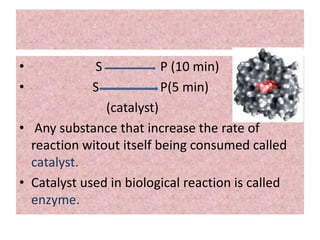
• S P (10 min)
• S P(5 min)
(catalyst)
• Any substance that increase the rate of
reaction witout itself being consumed called
catalyst.
• Catalyst used in biological reaction is called
enzyme.
-:HOW ENZYME CATALYZE THE
REACTION:-
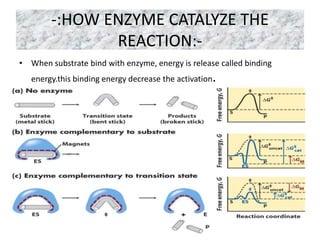
• When substrate bind with enzyme, energy is release called binding
energy.this binding energy decrease the activation.
-:ENZYME KINETICS:-
 Enzyme kinetics is the investigation of how
enzyme bind substrates and turn them into
product.
-:HISTORY:-
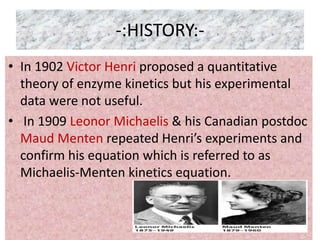
• In 1902 Victor Henri proposed a quantitative
theory of enzyme kinetics but his experimental
data were not useful.
• In 1909 Leonor Michaelis & his Canadian postdoc
Maud Menten repeated Henri’s experiments and
confirm his equation which is referred to as
Michaelis-Menten kinetics equation.
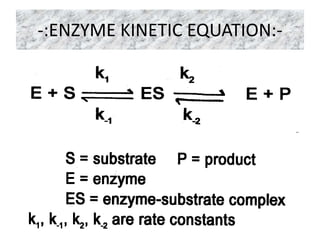
-:ENZYME KINETIC EQUATION:-
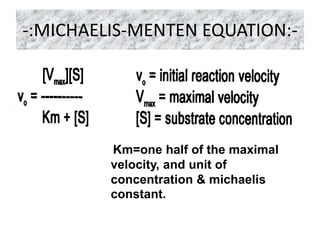
-:MICHAELIS-MENTEN EQUATION:-
Km=one half of the maximal
velocity, and unit of
concentration & michaelis
constant.
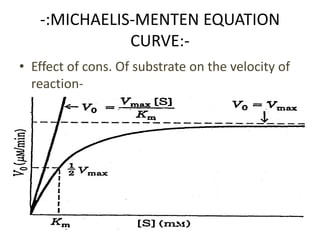
-:MICHAELIS-MENTEN EQUATION
CURVE:-
• Effect of cons. Of substrate on the velocity of
reaction-
-:MICHAELIS-MENTEN EQUATION
DERIVATION:-
• E+S  ES  EP E+P (1)
• (2)
• Michaelis and Menten derived this equation starting from their basic
hypothesis that the rate-limiting step in enzymatic reactions is the
breakdown of the ES complex to product and free enzme. The important
terms are [S], Vo, Vmax, and a constant called the Michaelis constant.
•
• (3)
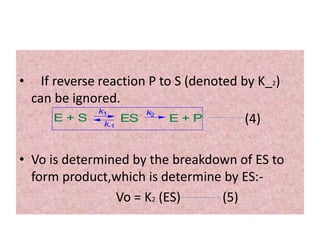
• If reverse reaction P to S (denoted by K_2)
can be ignored.
(4)
• Vo is determined by the breakdown of ES to
form product,which is determine by ES:-
Vo = K2 (ES) (5)
E + S ES E + P
k1 k2
k-1
• Rate of ES formation = k1([ET] - [ES])[S]
(where [ET] is total concentration of
enzyme E and k-2 is considered
neglible)
• Rate of ES breakdown to product = k-
1[ES] + k2[ES]
k1([ET] - [ES])[S] = k-1[ES] + k2[ES] (6)
Rate of formation of ES is equal to the rate
of its breakdown. This is called “Steady-
state assumption.”
• k1[ET][S]-k1[ES][S]=[k-1 + k2] [ES] (7)
Left side is multiplied out and the right side
simplified given.
• k1[ET][S]=(k1 [S]+ k-1 + k2 )[ES] (8)
• We solve the equation for[ES]
k1[ET][S]
[ES]= (9)
k1 [S]+ k-1 + k2
[ET][S]
• [ES]= (10)
[S]+ (k-1 + k2 )/ k1
[ET][S]
• [ES] = (11)
Km + [S]
The term (k-1 + k2 )/ k1 is defined as the
Michaelis constant, Km.
k2 [ET][S]
• Vo = (12)
Km + [S]
Here Vo = k2 [ ES ] in the equation 5.
• (13)
• Maximum velocity occurs when the enzyme is
saturated(that is [ES]= [ ET ])Vmax can be
defined as k2 (ET ).This is Michaelis-
Menten equation.
Vmax Vmax [S]
= (14)
2 Km + [S]
Vo is exactly one-half Vmax .
• 1 [S]
= (15)
2 Km + [S]
on dividing by Vmax .
 solving for Km we get Km +S=2S
or
• Km =[S], when Vo = 1/2 Vmax.
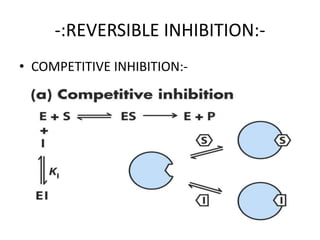
-:REVERSIBLE INHIBITION:-
• COMPETITIVE INHIBITION:-
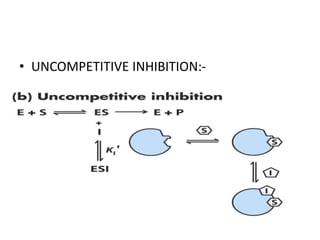
• UNCOMPETITIVE INHIBITION:-
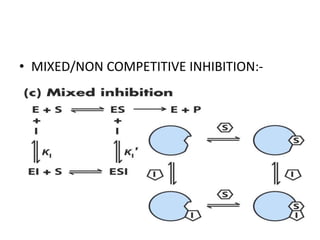
• MIXED/NON COMPETITIVE INHIBITION:-
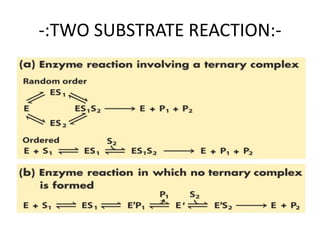
-:TWO SUBSTRATE REACTION:-
CONCLUSION
• enzyme kinetics is the study of how biological
catalyst increase the reaction.
• In enzyme kinetics when target molecules bind
to an enzymes active site and are transformed
into product through series of step .
REFERENCES
• PRINCIPLE OF BIOCHEMISTRY:- NELSON & COX
5TH Edition.
• www.wikipedia.com .

Enzyme kinectics, by kk sahu

  • 1.
    ENZYME KINETICS By KAUSHAL KUMARSAHU Assistant Professor (Ad Hoc) Department of Biotechnology Govt. Digvijay Autonomous P. G. College Raj-Nandgaon ( C. G. )
  • 2.
    -:SYNOPSIS:- • What isenzyme? • How enzyme catalyze the reaction • Enzyme kinetics • History • Enzyme kinetic equation • Michaelis-menten equation • Michaelis-menten curve • Michaelis-menten equation derivation • Reversible inhibition • Two substrate reaction • Conclusion • References
  • 3.
    -:ENZYME:- • Enzyme isa complex protein. • Apo enzyme + co-enz/co-factor/prosthetic grp Holoenzyme • The protein part such an enzyme is called Apo enzyme. • A complex organic molecule called Coenzyme. • A coenzyme or metal ion that is very tightly covelently bound to the enzyme protein called a Prosthetic group. • A complete,catalytically active enzyme bound with coenzyme called Holoenzyme.
  • 4.
    • S P(10 min) • S P(5 min) (catalyst) • Any substance that increase the rate of reaction witout itself being consumed called catalyst. • Catalyst used in biological reaction is called enzyme.
  • 5.
    -:HOW ENZYME CATALYZETHE REACTION:- • When substrate bind with enzyme, energy is release called binding energy.this binding energy decrease the activation.
  • 6.
    -:ENZYME KINETICS:-  Enzymekinetics is the investigation of how enzyme bind substrates and turn them into product.
  • 7.
    -:HISTORY:- • In 1902Victor Henri proposed a quantitative theory of enzyme kinetics but his experimental data were not useful. • In 1909 Leonor Michaelis & his Canadian postdoc Maud Menten repeated Henri’s experiments and confirm his equation which is referred to as Michaelis-Menten kinetics equation.
  • 8.
  • 9.
    -:MICHAELIS-MENTEN EQUATION:- Km=one halfof the maximal velocity, and unit of concentration & michaelis constant.
  • 10.
    -:MICHAELIS-MENTEN EQUATION CURVE:- • Effectof cons. Of substrate on the velocity of reaction-
  • 11.
    -:MICHAELIS-MENTEN EQUATION DERIVATION:- • E+S ES  EP E+P (1) • (2) • Michaelis and Menten derived this equation starting from their basic hypothesis that the rate-limiting step in enzymatic reactions is the breakdown of the ES complex to product and free enzme. The important terms are [S], Vo, Vmax, and a constant called the Michaelis constant. • • (3)
  • 12.
    • If reversereaction P to S (denoted by K_2) can be ignored. (4) • Vo is determined by the breakdown of ES to form product,which is determine by ES:- Vo = K2 (ES) (5) E + S ES E + P k1 k2 k-1
  • 13.
    • Rate ofES formation = k1([ET] - [ES])[S] (where [ET] is total concentration of enzyme E and k-2 is considered neglible) • Rate of ES breakdown to product = k- 1[ES] + k2[ES]
  • 14.
    k1([ET] - [ES])[S]= k-1[ES] + k2[ES] (6) Rate of formation of ES is equal to the rate of its breakdown. This is called “Steady- state assumption.”
  • 15.
    • k1[ET][S]-k1[ES][S]=[k-1 +k2] [ES] (7) Left side is multiplied out and the right side simplified given.
  • 16.
    • k1[ET][S]=(k1 [S]+k-1 + k2 )[ES] (8) • We solve the equation for[ES] k1[ET][S] [ES]= (9) k1 [S]+ k-1 + k2
  • 17.
  • 18.
    [ET][S] • [ES] =(11) Km + [S] The term (k-1 + k2 )/ k1 is defined as the Michaelis constant, Km.
  • 19.
    k2 [ET][S] • Vo= (12) Km + [S] Here Vo = k2 [ ES ] in the equation 5.
  • 20.
    • (13) • Maximumvelocity occurs when the enzyme is saturated(that is [ES]= [ ET ])Vmax can be defined as k2 (ET ).This is Michaelis- Menten equation.
  • 21.
    Vmax Vmax [S] =(14) 2 Km + [S] Vo is exactly one-half Vmax .
  • 22.
    • 1 [S] =(15) 2 Km + [S] on dividing by Vmax .
  • 23.
     solving forKm we get Km +S=2S or • Km =[S], when Vo = 1/2 Vmax.
  • 24.
  • 25.
  • 26.
  • 27.
  • 28.
    CONCLUSION • enzyme kineticsis the study of how biological catalyst increase the reaction. • In enzyme kinetics when target molecules bind to an enzymes active site and are transformed into product through series of step .
  • 29.
    REFERENCES • PRINCIPLE OFBIOCHEMISTRY:- NELSON & COX 5TH Edition. • www.wikipedia.com .