610 Chapter 8 Vibration and Time Response 
Sample Problem 8/2 
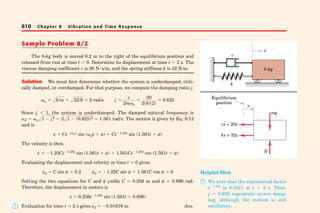
The 8-kg body is moved 0.2 m to the right of the equilibrium position and 
released from rest at time t  0. Determine its displacement at time t  2 s. The 
viscous damping coefficient c is 20 N s/m, 
and the spring stiffness k is 32 N/m. 
Solution. We must first determine whether the system is underdamped, criti-cally 
damped, or overdamped. For that purpose, we compute the damping ratio . 
n  k/m  32/8  2 rad/s   c 
2mn 
 20 
2(8)(2) 
 0.625 
Since   1, the system is underdamped. The damped natural frequency is 
 1  2  21  (0.625)2 
dn 1.561 rad/s. The motion is given by Eq. 8/12 
and is 
x  Cent sin (dt  )  Ce1.25t sin (1.561t  ) 
The velocity is then 
x˙  1.25Ce1.25t sin (1.561t  )  1.561Ce1.25t cos (1.561t  ) 
Evaluating the displacement and velocity at time t  0 gives 
x0  C sin   0.2 x˙0  1.25C sin   1.561C cos   0 
Solving the two equations for C and  yields C  0.256 m and   0.896 rad. 
Therefore, the displacement in meters is 
x  0.256e1.25t sin (1.561t  0.896) 
Evaluation for time t  2 s gives x20.01616 m. Ans. 
k 
x 
c 
8 kg 
x 
Equilibrium 
position 
mg 
N 
· 
cx · 
= 20x kx = 32x 
 
Helpful Hint 
 We note that the exponential factor 
e1.25t is 0.0821 at t  2 s. Thus, 
  0.625 represents severe damp-ing, 
although the motion is still 
oscillatory.
Sample Problem 8/8 
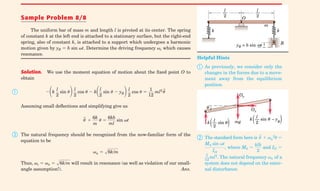
The uniform bar of mass m and length l is pivoted at its center. The spring 
of constant k at the left end is attached to a stationary surface, but the right-end 
spring, also of constant k, is attached to a support which undergoes a harmonic 
motion given by yB  b sin t. Determine the driving frequency c which causes 
resonance. 
Solution. We use the moment equation of motion about the fixed point O to 
obtain 
k l 
2 
sin 	 l 
2 
cos 	  kl 
2 
sin 	  yB l 
Assuming small deflections and simplifying give us 
	¨  6k 
m 
	  6kb 
ml 
2 
sin t 
cos 	  1 
12 
ml2 	¨ 
The natural frequency should be recognized from the now-familiar form of the 
equation to be 
6k/m 
n  6k/m 
Thus, c  n  will result in resonance (as well as violation of our small-angle 
assumption!). Ans. 
yB O 
= b sin ωt 
B 
m 
k 
l—2 
l—2 
k 
Helpful Hints 
 As previously, we consider only the 
changes in the forces due to a move-ment 
away from the equilibrium 
Oy 
mg 
Ox 
θ 
2 
k ( sin θ 
) l—k 2 
l—( sin θ 
– y) Bposition. 
	¨ 2	 
 The standard form here is   
where M0  and IO  
The natural frequency n of a 
system does not depend on the exter-nal 
disturbance. 
1 
12 
ml2. 
klb 
2 
M0 sin t 
IO 
, 
n
Sample Problem 8/9 
Derive the equation of motion for the homogeneous circular cylinder, which 
rolls without slipping. If the cylinder mass is 50 kg, the cylinder radius 0.5 m, 
the spring constant 75 N/m, and the damping coefficient 10 determine 
(a) the undamped natural frequency 
(b) the damping ratio 
(c) the damped natural frequency 
(d) the period of the damped system. 
In addition, determine x as a function of time if the cylinder is released from rest 
at the position x0.2 m when t  0. 
Solution. We have a choice of motion variables in that either x or the angular 
displacement 	 of the cylinder may be used. Since the problem statement in-volves 
x, we draw the free-body diagram for an arbitrary, positive value of x and 
write the two motion equations for the cylinder as 
[ΣFx  m¨x] c˙x  kx  F  m¨x 
¨x r	¨. 
The condition of rolling with no slip is  Substitution of this condition 
into the moment equation gives F  Inserting this expression for the 
friction force into the force equation for the x-direction yields 
12 
Comparing the above equation with that for the standard damped 
oscillator, Eq. 8/9, allows us to state directly 
(a) Ans. 
2n  2 
c 
m 
  1 
c 
mn 
 10 
3(50)(1) 
(b) Ans. 
3 
3 
 0.0667 
Hence, the damped natural frequency and the damped period are 
(c) d  n1  2  (1)1  (0.0667)2  0.998 rad/s 
Ans. 
(d) Ans. 
d  2/d  2/0.998  6.30 s 
From Eq. 8/12, the underdamped solution to the equation of motion is 
x  Cent sin (dt  )  Ce(0.0667)(1)t sin (0.998t  ) 
The velocity is ˙x  0.0667Ce0.0667t sin (0.998t  ) 
x˙ 
 0.998Ce0.0667t cos (0.998t  ) 
At time t  0, x and become 
x0  C sin   0.2 
x˙0  0.0667C sin   0.998C cos   0 
The solution to the two equations in C and  gives 
C  0.200 m   1.504 rad 
Thus, the motion is given by 
x  0.200e0.0667t sin (0.998t  1.504) m Ans. 
n 
2  2 
3 
k 
m 
cx˙  kx  1 
2 
mx¨  mx¨ or x¨  2 
3 
c 
m 
x˙  2 
3 
k 
m 
x  0 
 
mx¨. 
Fr  12 
[ΣMG  I 	¨] mr2 	¨ 
N s/m, 
Article 8/4 Vibration of Rigid Bodies 637 
 
 
x 
m 
k r c 
Helpful Hints 
 The angle 	 is taken positive clock-wise 
to be kinematically consistent 
 The friction force F may be as-sumed 
in either direction. We will 
find that the actual direction is to 
the right for x  0 and to the left 
for x  0; F  0 when x  0. 
F 
mg 
O 
N 
with x. 
Equilibrium 
position 
x 
+θ 
kx cx· 
n 2 
3 
k 
m 2 
3 
75 
50  1 rad/s
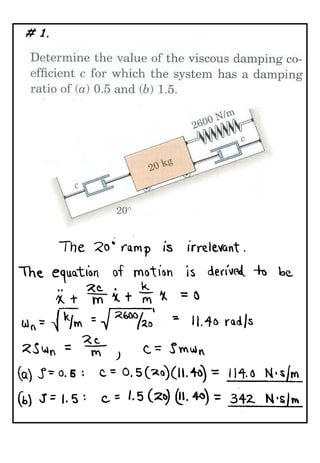
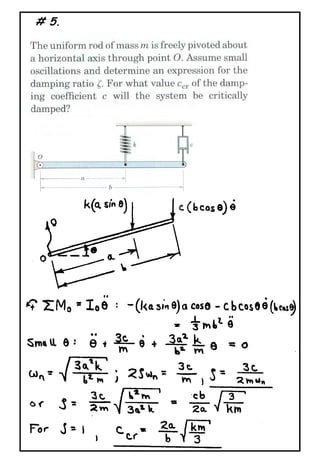
# 1.
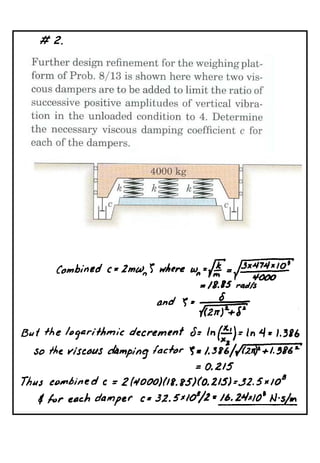
# 2.
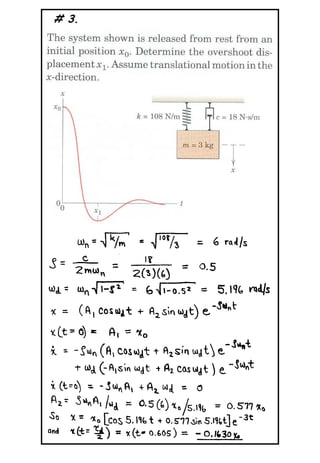
# 3.
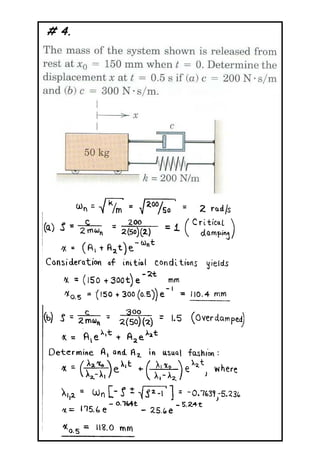
# 4.
# 5.
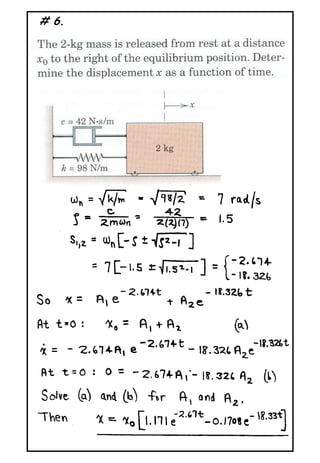
# 6.
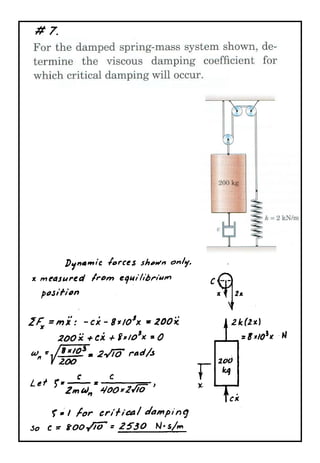
# 7.
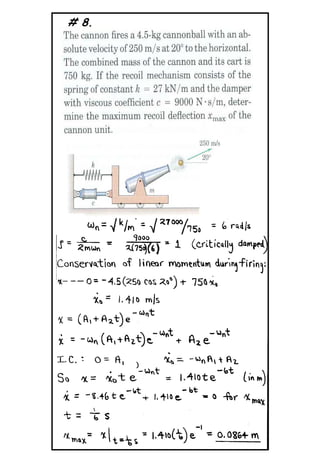
# 8.
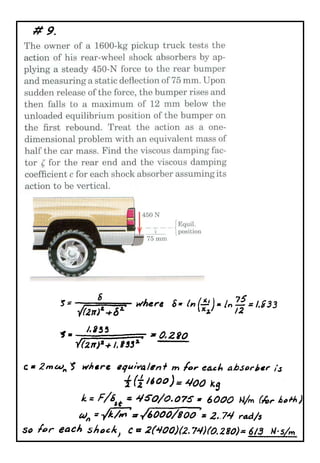
# 9.
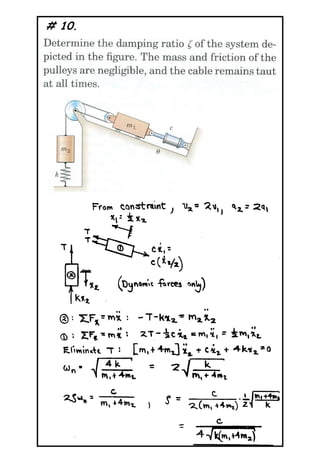
# 10.
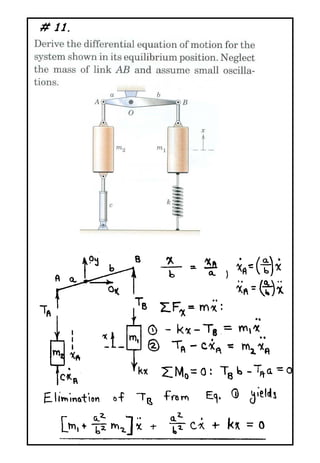
# 11.
# 11 
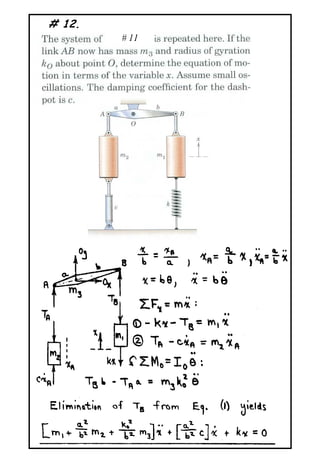
# 12.
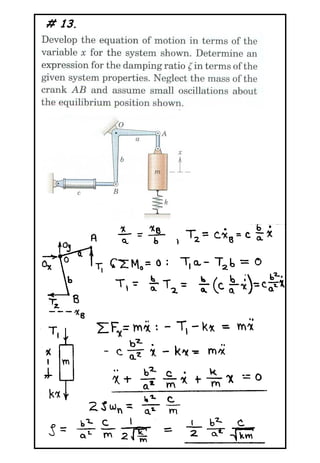
# 13.
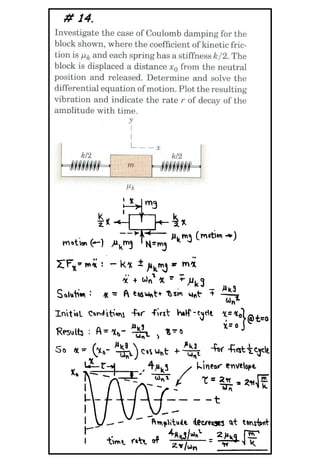
# 14.
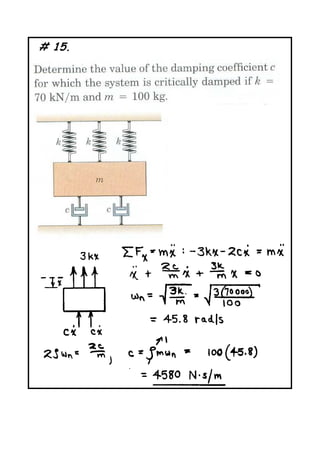
# 15.
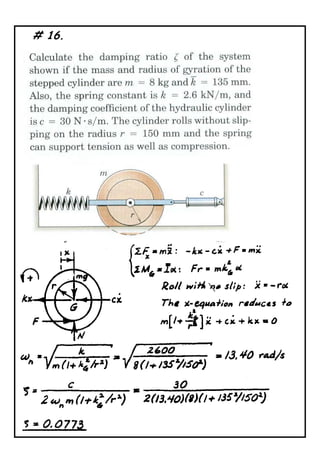
# 16.

Get bebas redaman_2014

  • 1.
    610 Chapter 8Vibration and Time Response Sample Problem 8/2 The 8-kg body is moved 0.2 m to the right of the equilibrium position and released from rest at time t 0. Determine its displacement at time t 2 s. The viscous damping coefficient c is 20 N s/m, and the spring stiffness k is 32 N/m. Solution. We must first determine whether the system is underdamped, criti-cally damped, or overdamped. For that purpose, we compute the damping ratio . n k/m 32/8 2 rad/s c 2mn 20 2(8)(2) 0.625 Since 1, the system is underdamped. The damped natural frequency is 1 2 21 (0.625)2 dn 1.561 rad/s. The motion is given by Eq. 8/12 and is x Cent sin (dt ) Ce1.25t sin (1.561t ) The velocity is then x˙ 1.25Ce1.25t sin (1.561t ) 1.561Ce1.25t cos (1.561t ) Evaluating the displacement and velocity at time t 0 gives x0 C sin 0.2 x˙0 1.25C sin 1.561C cos 0 Solving the two equations for C and yields C 0.256 m and 0.896 rad. Therefore, the displacement in meters is x 0.256e1.25t sin (1.561t 0.896) Evaluation for time t 2 s gives x20.01616 m. Ans. k x c 8 kg x Equilibrium position mg N · cx · = 20x kx = 32x Helpful Hint We note that the exponential factor e1.25t is 0.0821 at t 2 s. Thus, 0.625 represents severe damp-ing, although the motion is still oscillatory.
  • 2.
    Sample Problem 8/8 The uniform bar of mass m and length l is pivoted at its center. The spring of constant k at the left end is attached to a stationary surface, but the right-end spring, also of constant k, is attached to a support which undergoes a harmonic motion given by yB b sin t. Determine the driving frequency c which causes resonance. Solution. We use the moment equation of motion about the fixed point O to obtain k l 2 sin l 2 cos kl 2 sin yB l Assuming small deflections and simplifying give us ¨ 6k m 6kb ml 2 sin t cos 1 12 ml2 ¨ The natural frequency should be recognized from the now-familiar form of the equation to be 6k/m n 6k/m Thus, c n will result in resonance (as well as violation of our small-angle assumption!). Ans. yB O = b sin ωt B m k l—2 l—2 k Helpful Hints As previously, we consider only the changes in the forces due to a move-ment away from the equilibrium Oy mg Ox θ 2 k ( sin θ ) l—k 2 l—( sin θ – y) Bposition. ¨ 2 The standard form here is where M0 and IO The natural frequency n of a system does not depend on the exter-nal disturbance. 1 12 ml2. klb 2 M0 sin t IO , n
  • 3.
    Sample Problem 8/9 Derive the equation of motion for the homogeneous circular cylinder, which rolls without slipping. If the cylinder mass is 50 kg, the cylinder radius 0.5 m, the spring constant 75 N/m, and the damping coefficient 10 determine (a) the undamped natural frequency (b) the damping ratio (c) the damped natural frequency (d) the period of the damped system. In addition, determine x as a function of time if the cylinder is released from rest at the position x0.2 m when t 0. Solution. We have a choice of motion variables in that either x or the angular displacement of the cylinder may be used. Since the problem statement in-volves x, we draw the free-body diagram for an arbitrary, positive value of x and write the two motion equations for the cylinder as [ΣFx m¨x] c˙x kx F m¨x ¨x r ¨. The condition of rolling with no slip is Substitution of this condition into the moment equation gives F Inserting this expression for the friction force into the force equation for the x-direction yields 12 Comparing the above equation with that for the standard damped oscillator, Eq. 8/9, allows us to state directly (a) Ans. 2n 2 c m 1 c mn 10 3(50)(1) (b) Ans. 3 3 0.0667 Hence, the damped natural frequency and the damped period are (c) d n1 2 (1)1 (0.0667)2 0.998 rad/s Ans. (d) Ans. d 2/d 2/0.998 6.30 s From Eq. 8/12, the underdamped solution to the equation of motion is x Cent sin (dt ) Ce(0.0667)(1)t sin (0.998t ) The velocity is ˙x 0.0667Ce0.0667t sin (0.998t ) x˙ 0.998Ce0.0667t cos (0.998t ) At time t 0, x and become x0 C sin 0.2 x˙0 0.0667C sin 0.998C cos 0 The solution to the two equations in C and gives C 0.200 m 1.504 rad Thus, the motion is given by x 0.200e0.0667t sin (0.998t 1.504) m Ans. n 2 2 3 k m cx˙ kx 1 2 mx¨ mx¨ or x¨ 2 3 c m x˙ 2 3 k m x 0 mx¨. Fr 12 [ΣMG I ¨] mr2 ¨ N s/m, Article 8/4 Vibration of Rigid Bodies 637 x m k r c Helpful Hints The angle is taken positive clock-wise to be kinematically consistent The friction force F may be as-sumed in either direction. We will find that the actual direction is to the right for x 0 and to the left for x 0; F 0 when x 0. F mg O N with x. Equilibrium position x +θ kx cx· n 2 3 k m 2 3 75 50 1 rad/s
  • 4.
  • 5.
  • 6.
  • 7.
  • 8.
  • 9.
  • 10.
  • 11.
  • 12.
  • 13.
  • 14.
  • 15.
    # 11 #12.
  • 16.
  • 17.
  • 18.
  • 19.