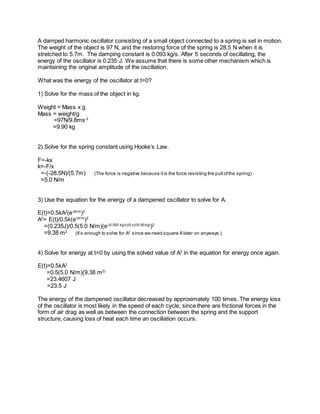
A damped harmonic oscillator consisting of a small object connected to a spring is set in motion.
The weight of the object is 97 N, and the restoring force of the spring is 28.5 N when it is
stretched to 5.7m. The damping constant is 0.093 kg/s. After 5 seconds of oscillating, the
energy of the oscillator is 0.235 J. We assume that there is some other mechanism which is
maintaining the original amplitude of the oscillation.
What was the energy of the oscillator at t=0?
1) Solve for the mass of the object in kg.
Weight = Mass x g
Mass = weight/g
=97N/9.8ms-2
=9.90 kg
2) Solve for the spring constant using Hooke’s Law.
F=-kx
k=-F/x
=-(-28.5N)/(5.7m) (The force is negative because itis the force resisting the pull ofthe spring)
=5.0 N/m
3) Use the equation for the energy of a dampened oscillator to solve for A.
E(t)=0.5kA2
(e-bt/m
)2
A2
= E(t)/0.5k(e-bt/m
)2
=(0.235J)/0.5(5.0 N/m)(e-(0.093 kg/s)(5 s)/(9.90 kg)
)2
=9.38 m2
(It’s enough to solve for A2
since we need square A later on anyways.)
4) Solve for energy at t=0 by using the solved value of A2
in the equation for energy once again.
E(t)=0.5kA2
=0.5(5.0 N/m)(9.38 m2)
=23.4607 J
=23.5 J
The energy of the dampened oscillator decreased by approximately 100 times. The energy loss
of the oscillator is most likely in the speed of each cycle, since there are frictional forces in the
form of air drag as well as between the connection between the spring and the support
structure, causing loss of heat each time an oscillation occurs.

Lo1

  • 1.
    A damped harmonicoscillator consisting of a small object connected to a spring is set in motion. The weight of the object is 97 N, and the restoring force of the spring is 28.5 N when it is stretched to 5.7m. The damping constant is 0.093 kg/s. After 5 seconds of oscillating, the energy of the oscillator is 0.235 J. We assume that there is some other mechanism which is maintaining the original amplitude of the oscillation. What was the energy of the oscillator at t=0? 1) Solve for the mass of the object in kg. Weight = Mass x g Mass = weight/g =97N/9.8ms-2 =9.90 kg 2) Solve for the spring constant using Hooke’s Law. F=-kx k=-F/x =-(-28.5N)/(5.7m) (The force is negative because itis the force resisting the pull ofthe spring) =5.0 N/m 3) Use the equation for the energy of a dampened oscillator to solve for A. E(t)=0.5kA2 (e-bt/m )2 A2 = E(t)/0.5k(e-bt/m )2 =(0.235J)/0.5(5.0 N/m)(e-(0.093 kg/s)(5 s)/(9.90 kg) )2 =9.38 m2 (It’s enough to solve for A2 since we need square A later on anyways.) 4) Solve for energy at t=0 by using the solved value of A2 in the equation for energy once again. E(t)=0.5kA2 =0.5(5.0 N/m)(9.38 m2) =23.4607 J =23.5 J The energy of the dampened oscillator decreased by approximately 100 times. The energy loss of the oscillator is most likely in the speed of each cycle, since there are frictional forces in the form of air drag as well as between the connection between the spring and the support structure, causing loss of heat each time an oscillation occurs.