Questions
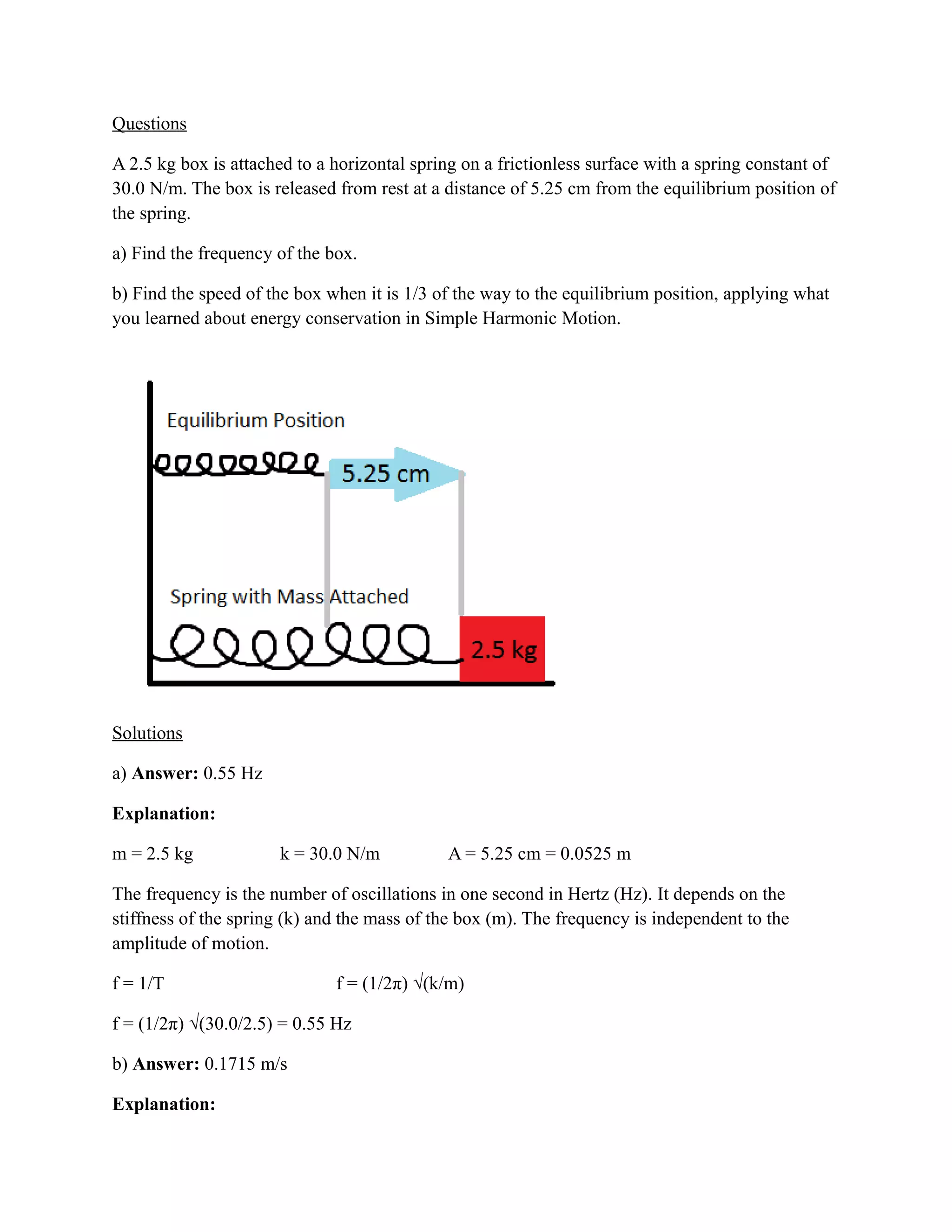
A 2.5 kg box is attached to a horizontal spring on a frictionless surface with a spring constant of
30.0 N/m. The box is released from rest at a distance of 5.25 cm from the equilibrium position of
the spring.
a) Find the frequency of the box.
b) Find the speed of the box when it is 1/3 of the way to the equilibrium position, applying what
you learned about energy conservation in Simple Harmonic Motion.
Solutions
a) Answer: 0.55 Hz
Explanation:
m = 2.5 kg k = 30.0 N/m A = 5.25 cm = 0.0525 m
The frequency is the number of oscillations in one second in Hertz (Hz). It depends on the
stiffness of the spring (k) and the mass of the box (m). The frequency is independent to the
amplitude of motion.
f = 1/T f = (1/2π) √(k/m)
f = (1/2π) √(30.0/2.5) = 0.55 Hz
b) Answer: 0.1715 m/s
Explanation:
As you read in the pre-reading from Physics for Scientists and Engineers - 1e by Hawkes, Iqbal,
Mansour, Milner-Bolotin, and Williams; "Since there are no friction forces, the total energy is the
sum of the kinetic energy (K) of the mass and the electric potential energy (U) of the spring."
As explained in the text, when the mass is pulled from its equilibrium position to x = A and held
stationary, work is done to stretch the string by length A. The work is then stored as the electric
potential energy of the string. At x = A, the total energy of the mass-spring system is E = K+U =
0+(1/2)kA^2 where total energy is at x = A. The work done is equal to (1/2)kA^2.
When the mass is released, it accelerates toward the equilibrium position so the velocity
increases, and the length of the spring decreases. The total E = (1/2)mv^2+(1/2)kx^2. Combining
the two equations, we get E = (1/2)kA^2 = (1/2)mv^2+(1/2)kx^2.
(1/2)mv^2 = (1/2)k(A^2-x^2)
v = √[(k/m)(A^2-x^2)] We can find the velocity of the mass for a given location x.
x = 1/3 of the way to the equilibrium position (A) = 0.0525 / 3 = 0.0175 m
v = √[(30.0/2.5)[(0.0525)^2 - (0.0175)^2]]
v = √[(12)(0.00245)]
v = 0.1715 m/s is the speed of the box when it is 1/3 of the way to the equilibrium position.

Lo

  • 1.
    Questions A 2.5 kgbox is attached to a horizontal spring on a frictionless surface with a spring constant of 30.0 N/m. The box is released from rest at a distance of 5.25 cm from the equilibrium position of the spring. a) Find the frequency of the box. b) Find the speed of the box when it is 1/3 of the way to the equilibrium position, applying what you learned about energy conservation in Simple Harmonic Motion. Solutions a) Answer: 0.55 Hz Explanation: m = 2.5 kg k = 30.0 N/m A = 5.25 cm = 0.0525 m The frequency is the number of oscillations in one second in Hertz (Hz). It depends on the stiffness of the spring (k) and the mass of the box (m). The frequency is independent to the amplitude of motion. f = 1/T f = (1/2π) √(k/m) f = (1/2π) √(30.0/2.5) = 0.55 Hz b) Answer: 0.1715 m/s Explanation:
  • 2.
    As you readin the pre-reading from Physics for Scientists and Engineers - 1e by Hawkes, Iqbal, Mansour, Milner-Bolotin, and Williams; "Since there are no friction forces, the total energy is the sum of the kinetic energy (K) of the mass and the electric potential energy (U) of the spring." As explained in the text, when the mass is pulled from its equilibrium position to x = A and held stationary, work is done to stretch the string by length A. The work is then stored as the electric potential energy of the string. At x = A, the total energy of the mass-spring system is E = K+U = 0+(1/2)kA^2 where total energy is at x = A. The work done is equal to (1/2)kA^2. When the mass is released, it accelerates toward the equilibrium position so the velocity increases, and the length of the spring decreases. The total E = (1/2)mv^2+(1/2)kx^2. Combining the two equations, we get E = (1/2)kA^2 = (1/2)mv^2+(1/2)kx^2. (1/2)mv^2 = (1/2)k(A^2-x^2) v = √[(k/m)(A^2-x^2)] We can find the velocity of the mass for a given location x. x = 1/3 of the way to the equilibrium position (A) = 0.0525 / 3 = 0.0175 m v = √[(30.0/2.5)[(0.0525)^2 - (0.0175)^2]] v = √[(12)(0.00245)] v = 0.1715 m/s is the speed of the box when it is 1/3 of the way to the equilibrium position.