ENZYME KINETICS
Enzymes
• Living organisms must be able to carry
out chemical reactions which are
thermodynamically very unfavorable
– Break and form covalent bonds
– Move large structures
– Effect three dimensional structure
– Regulate gene expression
• Do so through catalysis
Catalytic Power
• Enzymes can accelerate reactions as
much as 1016 over uncatalyzed rates!
• Urease is a good example:
– Catalyzed rate: 3x10⁴/sec
– Uncatalyzed rate: 3x10 -10/sec
– Ratio is 1x10¹⁴ !
Effect of enzymes
• A common biological reaction can take
place without enzyme catalysis
– Will take 750,000,000 years
• With enzyme 22 milliseconds
• Even improvement of a factor of 1,000
would not be good enough
– Only 750,000 years
– Living systems would be impossible
Specificity
• Enzymes selectively recognize proper
substrates over other molecules
• Enzymes produce products in very high
yields - often much greater than 95%
• Specificity is controlled by structure -
the unique fit of substrate with enzyme
controls the selectivity for substrate and
the product yield
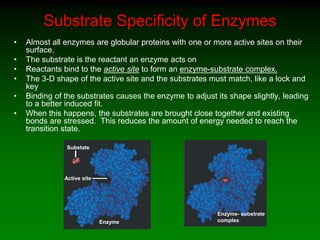
Substrate Specificity of Enzymes
• Almost all enzymes are globular proteins with one or more active sites on their
surface.
• The substrate is the reactant an enzyme acts on
• Reactants bind to the active site to form an enzyme-substrate complex.
• The 3-D shape of the active site and the substrates must match, like a lock and
key
• Binding of the substrates causes the enzyme to adjust its shape slightly, leading
to a better induced fit.
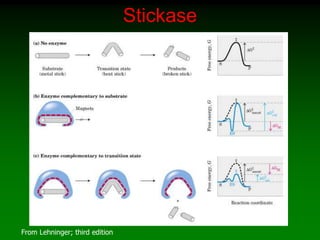
• When this happens, the substrates are brought close together and existing
bonds are stressed. This reduces the amount of energy needed to reach the
transition state.
Substate
Active site
Enzyme
Enzyme- substrate
complex
Stickase
From Lehninger; third edition
Enzymes
• Have immense importance in a number of
fields.
– Genetic diseases are frequently defects in
enzymes or increased/decreased levels of
enzymes
• Important diagnostic tools
– Drugs exert effects by interacting with enzymes
• MAO inhibitors
– Used in food processing and in chemical industry
– Enzyme inhibitors are a foundation of biological
weapons
– Genetic Engineering and Biotechnology use a lot
of enzymes!
Kinetics
• Is the science that describes the properties of
a chemical reaction including those mediated
by enzymes (catalysis)
• Measures the concentration of substrate
and/or products of a reaction to determine the
velocity of the reaction
• Measures the effects of concentration,
temperature, pH, etc. to characterize the
properties of the enzyme catalyzing the
reaction
Enzyme Kinetics
• An approach to understanding the
mechanism of action of enzymes
• An approach to understanding how
mutations may effect function
• An approach to understanding how
changes in the physical and chemical
environments change function
Rate Constant: k
• A B
• Velocity of Rx
– V=d[B]/dt
• d=change
– V=-d[A]/dt
• V=d[B]/dt = -d[A]/dt = k[A]
• Large k rapid Rx
• Small k slow Rx
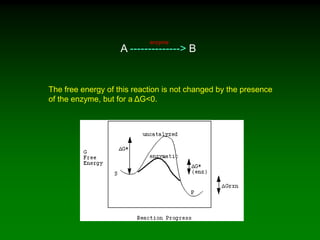
The free energy of this reaction is not changed by the presence
of the enzyme, but for a ΔG<0.
A --------------> B
enzyme
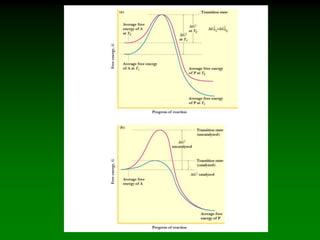
The Transition State
Understand the difference between ΔG
and ΔG*
• The overall free energy change for a
reaction is related to the equilibrium
constant
• The free energy of activation for a reaction
is related to the rate constant
• It is extremely important to appreciate this
distinction!
1) Velocity is dependent on [S].
2) The more enzyme added, the
faster the reaction goes.
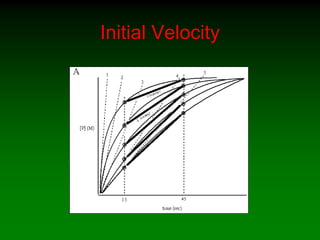
Initial velocity Vo
• When enzyme is mixed with high
concentration of substrate [S] reaction goes
rapidly to steady state.
– Does not allow characterization
• Use low starting [S] and increase
• Hold [enzyme] constant
• Measure rate of reaction, Vo as [S] increases
– Until rate becomes constant: approaches Vmax
Effect of [Substrate]
A -------------> B
k1
A + B -----------> C
k2
d[A]/dt = k1[A]
For a first order reaction:
For a second order reaction:
The rate equation is:
d[A]/dt = k2[A][B]
E + S <=====> ES <=====> P + E
k2
k-2k-1
k1
In an enzymatic reaction:
But:
[ES] cannot be measured!
Nonetheless:
Initial [S] is known
[P] can be measured
[E]tot is known
Can we find [ES]?
Note: on initial conditions
[P] is negligibly small, So,
k-2[P]=0
Thus,
Vo=k2[ES] (1)
YES!
If we assume "steady state kinetic conditions". That is, [S] and [P] are
changing, but [ES] does not change (a constant flux of S "through" the
enzyme).
d[ES]/dt = 0 (1)
Also (from conservation of matter):
[E]tot = [E]free + [ES] (2)
Now, divide eq. 1 by [E]tot :
Vo/[E]tot = k2[ES]/[E]tot
Since d[ES]/dt = 0 the rate of formation of [ES] must equal the rate of
breakdown of [ES]
Vformation = k1[E]free[S] (2nd order rate equation)
Vbreakdown= k2[ES] + k-1[ES]
= (k2 + k-1)[ES] (Two 1st order rate equations)
k1[E]free[S] = (k2 + k-1)[ES] (Rates must be equal)
E + S <=====> ES <=====> P + E
k2
k-2k-1
k1
Rearranging, solving for [ES]:
[ES] = k1[E]free[S]/(k2 + k-1) (3)
If we define the Michaelis-Menten constant as Km = (k2 + k-1)/k1
and we substitute into eq. 3, we get:
[ES] = [E][S]/Km (4)
Now, let´s rearrange eq. 2 to [E]free = [E]tot - [ES] and then substitute into eq. 4
giving:
[ES] = ([E]tot - [ES])[S]/Km
Solving for [ES] gives:
[ES] = [E]tot(([S]/Km)/(1 + [S]/Km))
and then multiply top and bottom by Km, we get:
[ES] = [E]tot([S]/[S] + Km)
[ES] = [E]tot([S]/[S] + Km)
Finally, substitute into eq. 1 to get:
Vo = k2[E]tot([S]/[S] + Km) (5)
this is the expression for Vo in terms of known quantities, let’s try it!!
If [S] very large
[S] >> Km. The enzyme is saturated with substrate.
In this case, [S] + Km = [S], so eq. 5 becomes:
Vo = k2[E]tot([S]/[S]) or Vo = k2[E]tot
This is the rate at large substrate concentration, the maximal rate for
[E], which is called Vmax
Vmax = k2[E]tot
Substituting into eq. 5 gives the Michaelis-Menten Equation:
Vo = Vmax[S]/Km + [S] (6)
Note: This equation is derived from Vo, very little [P] has formed.
Vo = k2[E]tot([S]/[S] + Km)
If [S] is small:
[S] << Km Then the activity is in linear range.
[S] + Km = Km so eq. 6 becomes:
Vo = Vmax[S]/Km or Vo α [S]
Vo = k2[E]tot([S]/[S] + Km)
If [S] = Km
The definition of Km
Vo = Vmax[S]/[S] + [S] or
Vo = Vmax/2 = Km
Km is defined as the [S] that results in half maximal rate
Km and Vmax are
experimentally determined for
each enzyme using Vo vs. [S]
plots.
As V max is difficult to
determine (hyperbolic) the
Lineweaver-Burke plot is used.
Rearrange eq. 6 into linear form:
(1/Vo) = Km/Vmax(1/[S]) + 1/Vmax
So the plotted data looks like:
Understanding Km
The "kinetic activator constant"
• Km is a constant
• Km is a constant derived from rate constants
• Km is, under true Michaelis-Menten
conditions, an estimate of the dissociation
constant of E from S
• Small Km means tight binding; high Km
means weak binding
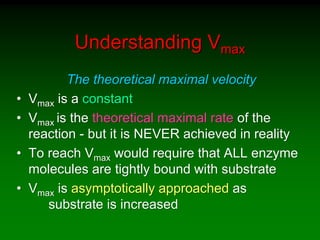
Understanding Vmax
The theoretical maximal velocity
• Vmax is a constant
• Vmax is the theoretical maximal rate of the
reaction - but it is NEVER achieved in reality
• To reach Vmax would require that ALL enzyme
molecules are tightly bound with substrate
• Vmax is asymptotically approached as
substrate is increased
Derivation of KCAT or turnover number:
For all catalyzed reactions:
[E]tot = [E]free + [ES] (2)
And with [S] >> Km:
Vmax = k2[E]tot or
k2 = Vmax/ [E]tot
For this reason k2 is also known as KCAT when the enzyme is saturated, so:
KCAT = Vmax/ [E]tot (7)
Therefore, when [S] is low, from eq. 7 and the Michaelis-Menten equation:
V = Vmax[S]/Km
then
V = KCAT/Km[S][E]
Therefore, KCAT/Km is a measure of how
rapidly and enzyme works and is referred as
the specificity constant or catalytic efficiency
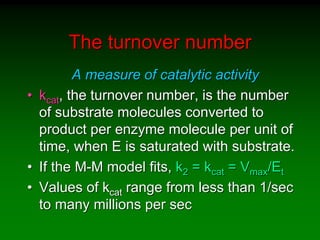
The turnover number
A measure of catalytic activity
• kcat, the turnover number, is the number
of substrate molecules converted to
product per enzyme molecule per unit of
time, when E is saturated with substrate.
• If the M-M model fits, k2 = kcat = Vmax/Et
• Values of kcat range from less than 1/sec
to many millions per sec
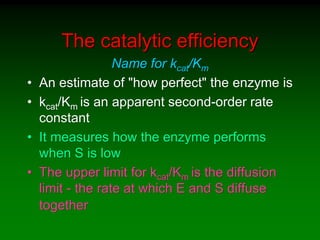
The catalytic efficiency
Name for kcat/Km
• An estimate of "how perfect" the enzyme is
• kcat/Km is an apparent second-order rate
constant
• It measures how the enzyme performs
when S is low
• The upper limit for kcat/Km is the diffusion
limit - the rate at which E and S diffuse
together
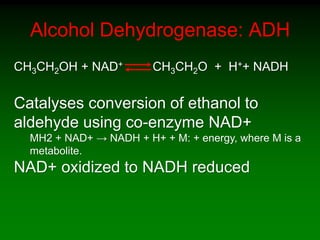
Alcohol Dehydrogenase: ADH
CH3CH2OH + NAD+ CH3CH2O + H++ NADH
Catalyses conversion of ethanol to
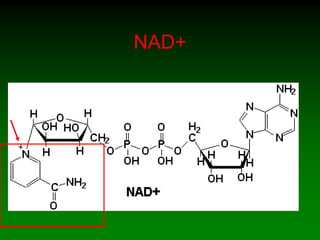
aldehyde using co-enzyme NAD+
MH2 + NAD+ → NADH + H+ + M: + energy, where M is a
metabolite.
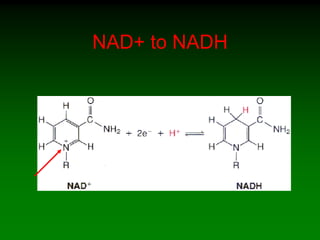
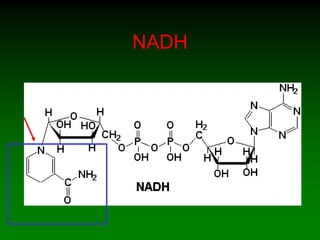
NAD+ oxidized to NADH reduced
NAD+ to NADH
NAD+
NADH
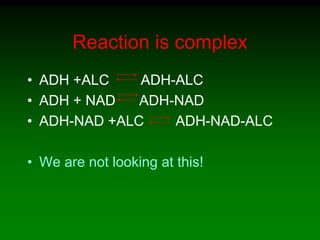
Reaction is complex
• ADH +ALC ADH-ALC
• ADH + NAD ADH-NAD
• ADH-NAD +ALC ADH-NAD-ALC
• We are not looking at this!
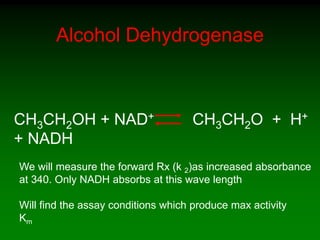
Alcohol Dehydrogenase
CH3CH2OH + NAD+ CH3CH2O + H+
+ NADH
We will measure the forward Rx (k 2)as increased absorbance
at 340. Only NADH absorbs at this wave length
Will find the assay conditions which produce max activity
Km
WHAT ARE WE MEASURING ?
• Production of NADH
– NAD+ NADH
– Wavelength shift
• Depends on participation of Alcohol and ADH
• How can you do this
• Ensure that NAD is not a rate limiting
component.
– [NAD] constant and high
– [ADH] constant
– [ETOH] low and increasing
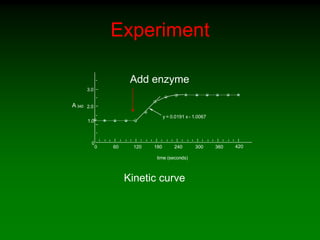
Experiment
1.0
2.0
3.0
0
60 120 180 240 300 360 4200
time (seconds)
A 340
y = 0.0191 x - 1.0067
Kinetic curve
Add enzyme
Initial Velocity
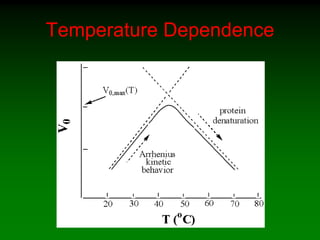
Temperature Dependence
Effect of enzyme concentration
I
II
[E]std
[P]
time (min)
0 2 4 6 8 10
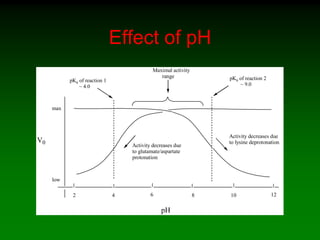
Effect of pH
V0
pH
pKa of reaction 1
~ 4.0
pKa of reaction 2
~ 9.0
2 124 6 8 10
max
low
Activity decreases due
to lysine deprotonation
Activity decreases due
to glutamate/aspartate
protonation
Maximal activity
range
ENZYME INHIBITORS
Enzyme Co-factors
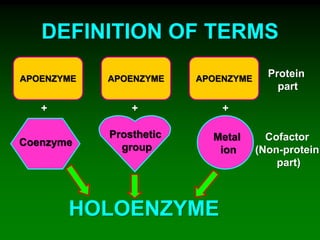
APOENZYME APOENZYME APOENZYME
DEFINITION OF TERMS
Protein
part
Cofactor
(Non-protein
part)
Coenzyme
Prosthetic
group
Metal
ion
HOLOENZYME
+ ++
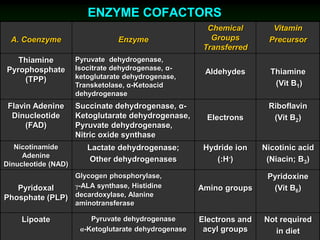
ENZYME COFACTORS
A. Coenzyme Enzyme
Chemical
Groups
Transferred
Vitamin
Precursor
Thiamine
Pyrophosphate
(TPP)
Pyruvate dehydrogenase,
Isocitrate dehydrogenase, α-
ketoglutarate dehydrogenase,
Transketolase, α-Ketoacid
dehydrogenase
Aldehydes Thiamine
(Vit B1)
Flavin Adenine
Dinucleotide
(FAD)
Succinate dehydrogenase, α-
Ketoglutarate dehydrogenase,
Pyruvate dehydrogenase,
Nitric oxide synthase
Electrons
Riboflavin
(Vit B2)
Nicotinamide
Adenine
Dinucleotide (NAD)
Lactate dehydrogenase;
Other dehydrogenases
Hydride ion
(:H-)
Nicotinic acid
(Niacin; B3)
Pyridoxal
Phosphate (PLP)
Glycogen phosphorylase,
γ-ALA synthase, Histidine
decardoxylase, Alanine
aminotransferase
Amino groups
Pyridoxine
(Vit B6)
Lipoate Pyruvate dehydrogenase
α-Ketoglutarate dehydrogenase
Electrons and
acyl groups
Not required
in diet
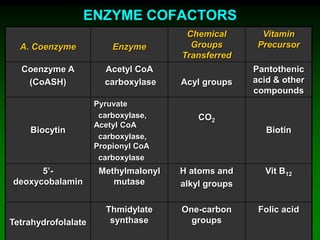
ENZYME COFACTORS
A. Coenzyme Enzyme
Chemical
Groups
Transferred
Vitamin
Precursor
Coenzyme A
(CoASH)
Acetyl CoA
carboxylase Acyl groups
Pantothenic
acid & other
compounds
Biocytin
Pyruvate
carboxylase,
Acetyl CoA
carboxylase,
Propionyl CoA
carboxylase
CO2
Biotin
5’-
deoxycobalamin
Methylmalonyl
mutase
H atoms and
alkyl groups
Vit B12
Tetrahydrofolalate
Thmidylate
synthase
One-carbon
groups
Folic acid
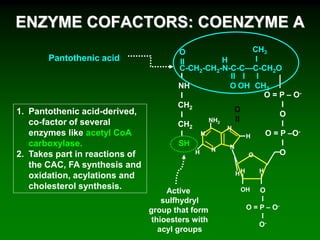
ENZYME COFACTORS: COENZYME A
C-CH2-CH2-N-C-C—C-CH2O
O
II
O
II
I
OH
H
II
O
I
CH3
CH3
I
I
NH
I
CH2
I
CH2
I
SH
O = P – O-
I
O
I
O = P –O-
I
O
NH2
N
N
N N
O
I
O = P – O-
I
O-
O
OH
Pantothenic acid
1. Pantothenic acid-derived,
co-factor of several
enzymes like acetyl CoA
carboxylase.
2. Takes part in reactions of
the CAC, FA synthesis and
oxidation, acylations and
cholesterol synthesis.
H
H
HH H
Active
sulfhydryl
group that form
thioesters with
acyl groups
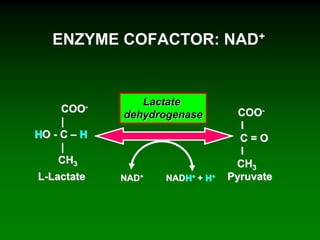
ENZYME COFACTOR: NAD+
COO-
|
HO - C – H
|
CH3
COO-
I
C = O
I
CH3
Lactate
dehydrogenase
L-Lactate PyruvateNAD+ NADH+ + H+
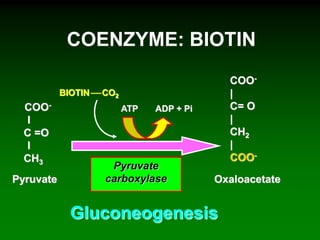
COENZYME: BIOTIN
Pyruvate
Gluconeogenesis
Oxaloacetate
ATP ADP + Pi
Pyruvate
carboxylase
CO2BIOTIN
COO-
I
C =O
I
CH3
COO-
|
C= O
|
CH2
|
COO-
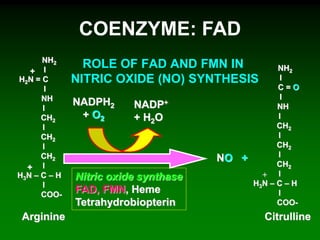
ROLE OF FAD AND FMN IN
NITRIC OXIDE (NO) SYNTHESIS
Arginine
NO +
NADPH2
+ O2
NADP+
+ H2O
Nitric oxide synthase
FAD, FMN, Heme
Tetrahydrobiopterin
COENZYME: FAD
NH2
I
H2N = C
I
NH
I
CH2
I
CH2
I
CH2
I
H3N – C – H
I
COO-
NH2
I
C = O
I
NH
I
CH2
I
CH2
I
CH2
I
H3N – C – H
I
COO-
+
Citrulline
+
+
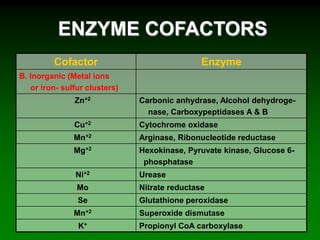
Cofactor Enzyme
B. Inorganic (Metal ions
or iron- sulfur clusters)
Zn+2 Carbonic anhydrase, Alcohol dehydroge-
nase, Carboxypeptidases A & B
Cu+2 Cytochrome oxidase
Mn+2 Arginase, Ribonucleotide reductase
Mg+2 Hexokinase, Pyruvate kinase, Glucose 6-
phosphatase
Ni+2 Urease
Mo Nitrate reductase
Se Glutathione peroxidase
Mn+2 Superoxide dismutase
K+ Propionyl CoA carboxylase
ENZYME COFACTORS
METALLOENZYMES
Enzymes that require
a metal in their
composition
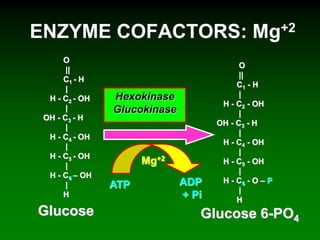
ENZYME COFACTORS: Mg+2
Glucose Glucose 6-PO4
Hexokinase
Glucokinase
ATP ADP
+ Pi
Mg+2
O
||
C1 - H
|
H - C2 - OH
|
OH - C3 - H
|
H - C4 - OH
|
H - C5 - OH
|
H - C6 – OH
|
H
O
||
C1 - H
|
H - C2 - OH
|
OH - C3 - H
|
H - C4 - OH
|
H - C5 - OH
|
H - C6 - O – P
|
H
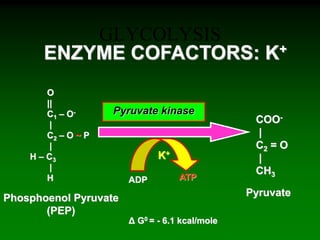
GLYCOLYSIS
COO-
|
C2 = O
|
CH3
O
||
C1 – O-
|
C2 – O ~ P
|
H – C3
|
H
Phosphoenol Pyruvate
(PEP)
Pyruvate
ADP ATP
K+
Δ G0 = - 6.1 kcal/mole
ENZYME COFACTORS: K+
Pyruvate kinase
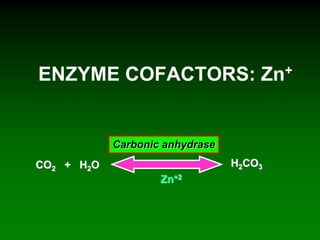
ENZYME COFACTORS: Zn+
CO2 + H2O H2CO3
Carbonic anhydrase
Zn+2
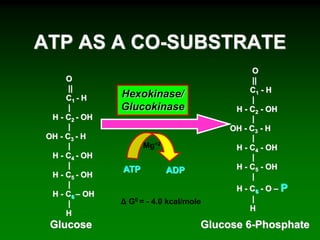
Hexokinase/
Glucokinase
ATP ADP
Δ G0 = - 4.0 kcal/mole
O
||
C1 - H
|
H - C2 - OH
|
OH - C3 - H
|
H - C4 - OH
|
H - C5 - OH
|
H - C6 – OH
|
H
Glucose
O
||
C1 - H
|
H - C2 - OH
|
OH - C3 - H
|
H - C4 - OH
|
H - C5 - OH
|
H - C6 - O – P
|
H
Glucose 6-Phosphate
ATP AS A CO-SUBSTRATE
Mg+2
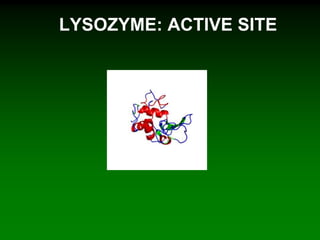
LYSOZYME: ACTIVE SITE
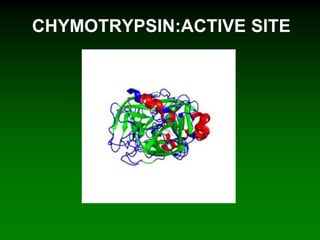
CHYMOTRYPSIN:ACTIVE SITE
REGULATORY ENZYME
The enzyme that catalyzes the
rate-limiting or committed
step of a metabolic
pathway.
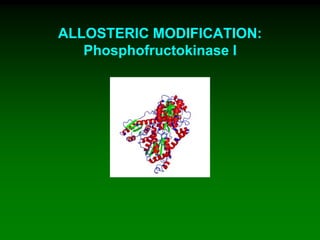
ALLOSTERIC MODIFICATION:
Phosphofructokinase I
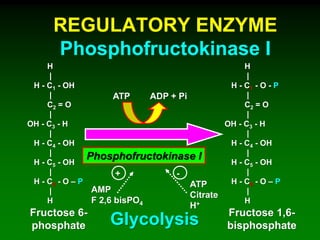
REGULATORY ENZYME
Phosphofructokinase I
Fructose 6-
phosphate
Fructose 1,6-
bisphosphate
ATP ADP + Pi
Phosphofructokinase I
Glycolysis
H
|
H - C1 - OH
|
C2 = O
|
OH - C3 - H
|
H - C4 - OH
|
H - C5 - OH
|
H - C6 - O – P
|
H
H
|
H - C1 - O - P
|
C2 = O
|
OH - C3 - H
|
H - C4 - OH
|
H - C5 - OH
|
H - C6 - O – P
|
H
AMP
F 2,6 bisPO4
ATP
Citrate
H+
+ -
ISOENZYME
 Different structural forms of an
enzyme which catalyze the same
chemical reactions → act on the
same substrate(s) and produce the
same product(s) but exhibit differing
degrees of efficiency.
 Different isoenzymes are expressed in
specific tissues of the body.
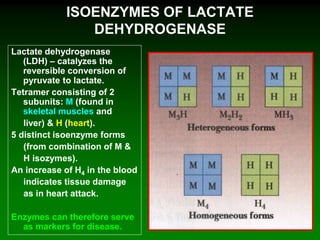
ISOENZYMES OF LACTATE
DEHYDROGENASE
Lactate dehydrogenase
(LDH) – catalyzes the
reversible conversion of
pyruvate to lactate.
Tetramer consisting of 2
subunits: M (found in
skeletal muscles and
liver) & H (heart).
5 distinct isoenzyme forms
(from combination of M &
H isozymes).
An increase of H4 in the blood
indicates tissue damage
as in heart attack.
Enzymes can therefore serve
as markers for disease.
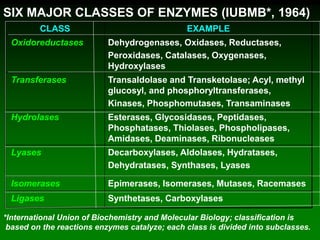
SIX MAJOR CLASSES OF ENZYMES (IUBMB*, 1964)
CLASS EXAMPLE
Oxidoreductases Dehydrogenases, Oxidases, Reductases,
Peroxidases, Catalases, Oxygenases,
Hydroxylases
Transferases Transaldolase and Transketolase; Acyl, methyl
glucosyl, and phosphoryltransferases,
Kinases, Phosphomutases, Transaminases
Hydrolases Esterases, Glycosidases, Peptidases,
Phosphatases, Thiolases, Phospholipases,
Amidases, Deaminases, Ribonucleases
Lyases Decarboxylases, Aldolases, Hydratases,
Dehydratases, Synthases, Lyases
Isomerases Epimerases, Isomerases, Mutases, Racemases
Ligases Synthetases, Carboxylases
*International Union of Biochemistry and Molecular Biology; classification is
based on the reactions enzymes catalyze; each class is divided into subclasses.
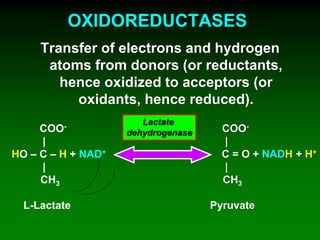
OXIDOREDUCTASES
Transfer of electrons and hydrogen
atoms from donors (or reductants,
hence oxidized to acceptors (or
oxidants, hence reduced).
COO-
|
HO – C – H + NAD+
|
CH3
L-Lactate
COO-
|
C = O + NADH + H+
|
CH3
Pyruvate
Lactate
dehydrogenase
TRANSFERASES
Transfer functional groups (like C-, N-, or
P-) from donors to acceptors; utilize 2
substrates to produce 2 products.
COO-
|
H3N – C – H + C = O
| |
CH3 (CH2)2
L-Alanine |
COO-
α-Ketoglutarate
(keto acid)
COO- COO-
| |
C = O + H3N – C – O
| |
CH3 (CH2)2
Pyruvate |
COO-
L-Glutamate
(amino acid)
Alanine
transaminase
PLP
(amino acid) (keto acid)
substrate
substrate
product
product
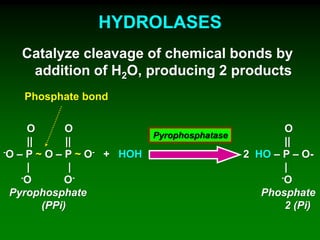
HYDROLASES
Catalyze cleavage of chemical bonds by
addition of H2O, producing 2 products
O O
|| ||
-O – P ~ O – P ~ O- + HOH
| |
-O O-
Pyrophosphate
(PPi)
O
||
2 HO – P – O-
|
-O
Phosphate
2 (Pi)
Pyrophosphatase
Phosphate bond
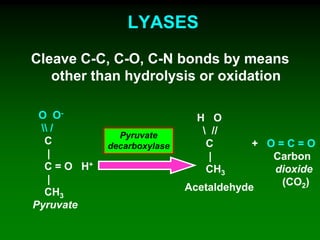
LYASES
Cleave C-C, C-O, C-N bonds by means
other than hydrolysis or oxidation
O O-
 /
C
|
C = O H+
|
CH3
Pyruvate
H O
 //
C + O = C = O
| Carbon
CH3 dioxide
(CO2)
Pyruvate
decarboxylase
Acetaldehyde
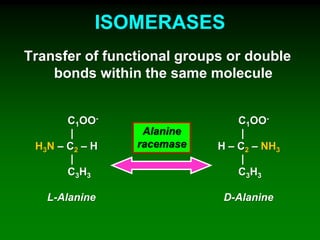
ISOMERASES
Transfer of functional groups or double
bonds within the same molecule
C1OO-
|
H3N – C2 – H
|
C3H3
L-Alanine
C1OO-
|
H – C2 – NH3
|
C3H3
D-Alanine
Alanine
racemase
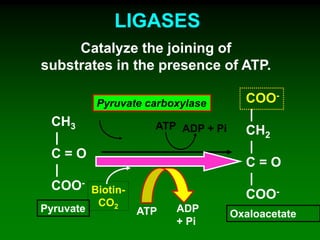
CH3
|
C = O
|
COO-
COO-
|
CH2
|
C = O
|
COO-Biotin-
CO2
ATP ADP + Pi
Oxaloacetate
Pyruvate
Pyruvate carboxylase
ATP ADP
+ Pi
LIGASES
Catalyze the joining of
substrates in the presence of ATP.
REGULATION
REGULATION OF ENZYME
ACTIVITY
Feedback Inhibition
Allosteric (Non-covalent)
Modification
Covalent Modification
Zymogen Activation
Induction or Repression
of Enzyme Synthesis
98
Saturation curve of allosteric enzymes is sigmoidal
[S]
vo aktivace
inhibicebez
efektoru
activation
without
effector
inhibition
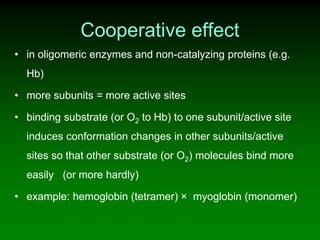
Cooperative effect
• in oligomeric enzymes and non-catalyzing proteins (e.g.
Hb)
• more subunits = more active sites
• binding substrate (or O2 to Hb) to one subunit/active site
induces conformation changes in other subunits/active
sites so that other substrate (or O2) molecules bind more
easily (or more hardly)
• example: hemoglobin (tetramer) × myoglobin (monomer)
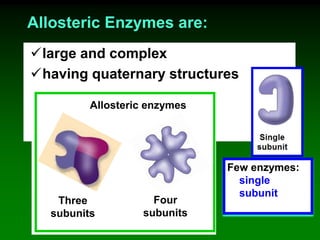
large and complex
having quaternary structures
Allosteric Enzymes are:
Few enzymes:
single
subunit
Three
subunits
Four
subunits
Allosteric enzymes
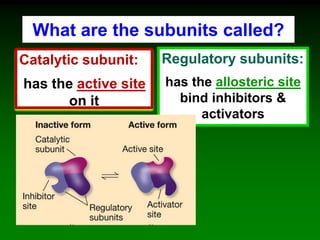
What are the subunits called?
Catalytic subunit:
has the active site
on it
Regulatory subunits:
has the allosteric site
bind inhibitors &
activators
‘Allostery’ means ‘different
shape’ [refers to the two shapes
of the enzyme]
Allosteric enzymes have TWO sites:
E
Active site
Allosteric site
Substrate
cannot fit into
the active site
Inhibitor
molecule
Inhibitor fits into
allosteric site
E
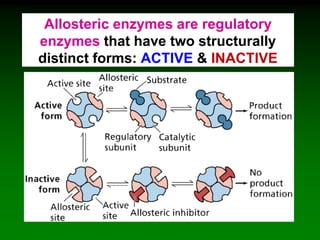
Allosteric enzymes are regulatory
enzymes that have two structurally
distinct forms: ACTIVE & INACTIVE
are regulatory enzymes that have two
structurally distinct forms:
are regulatory enzymes that have two
structurally distinct forms:
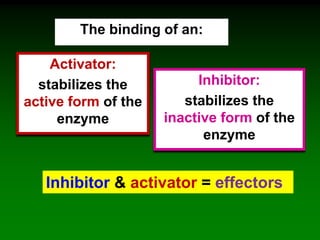
The binding of an:
Inhibitor & activator = effectors
Activator:
stabilizes the
active form of the
enzyme
Inhibitor:
stabilizes the
inactive form of the
enzyme
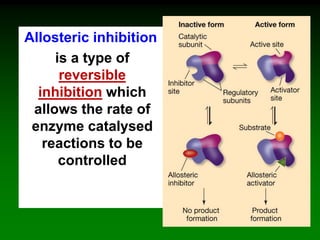
Allosteric inhibition
is a type of
reversible
inhibition which
allows the rate of
enzyme catalysed
reactions to be
controlled
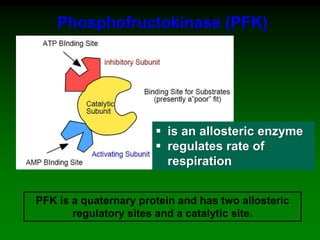
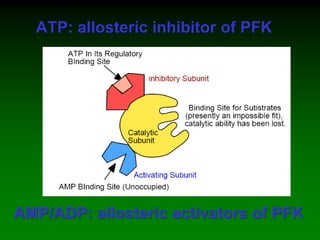
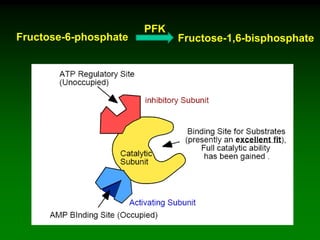
PFK is a quaternary protein and has two allosteric
regulatory sites and a catalytic site.
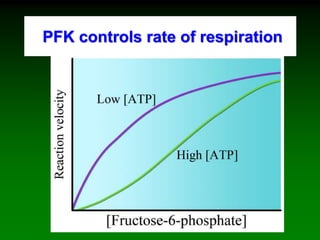
Phosphofructokinase (PFK)
 is an allosteric enzyme
 regulates rate of
respiration
ATP: allosteric inhibitor of PFK
AMP/ADP: allosteric activators of PFK
Fructose-6-phosphate
PFK
Fructose-1,6-bisphosphate
PFK controls rate of respiration
End-product
regulation of a
pathway:
a case of allosteric
inhibition
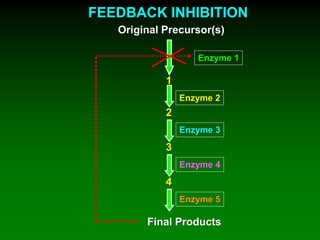
FEEDBACK INHIBITION
Original Precursor(s)
Enzyme 1
Enzyme 2
Enzyme 3
Enzyme 4
Enzyme 5
1
2
3
Final Products
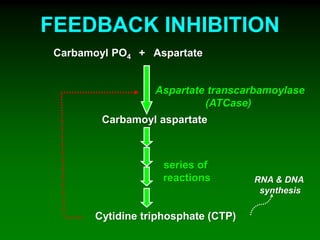
FEEDBACK INHIBITION
Carbamoyl PO4 + Aspartate
Carbamoyl aspartate
Aspartate transcarbamoylase
(ATCase)
series of
reactions
Cytidine triphosphate (CTP)
RNA & DNA
synthesis
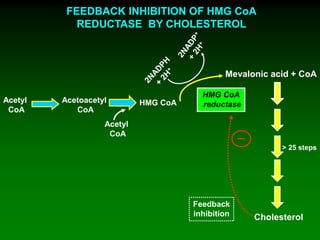
FEEDBACK INHIBITION OF HMG CoA
REDUCTASE BY CHOLESTEROL
Acetyl
CoA
Acetyl
CoA
HMG CoA
Mevalonic acid + CoA
HMG CoA
reductase
Cholesterol
Feedback
inhibition
Acetoacetyl
CoA
> 25 steps
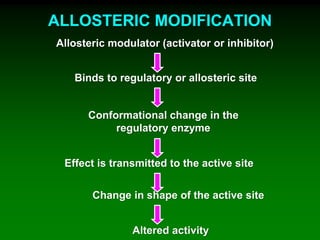
ALLOSTERIC MODIFICATION
Allosteric modulator (activator or inhibitor)
Binds to regulatory or allosteric site
Conformational change in the
regulatory enzyme
Effect is transmitted to the active site
Change in shape of the active site
Altered activity
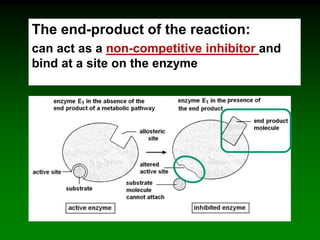
The end-product of the reaction:
can act as a non-competitive inhibitor and
bind at a site on the enzyme
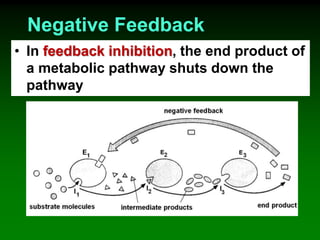
Negative Feedback
• In feedback inhibition, the end product of
a metabolic pathway shuts down the
pathway
What is the value of negative
feedback inhibition to a cell?
Prevents a cell from wasting
chemical resources by
synthesizing more product than
is needed
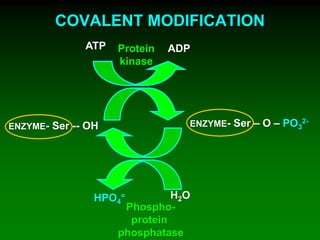
COVALENT MODIFICATION
ATP ADP
ENZYME- Ser -- OH
HPO4
= H2O
Protein
kinase
Phospho-
protein
phosphatase
ENZYME- Ser – O – PO3
2-
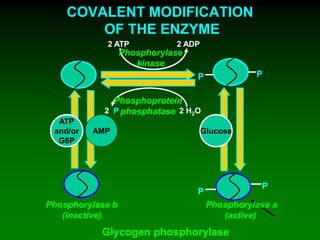
COVALENT MODIFICATION
OF THE ENZYME
Glycogen phosphorylase
AMP
ATP
and/or
G6P
Glucose
2 ATP 2 ADP
2 H2O2 P
Phosphorylase
kinase
Phosphorylase b
(inactive)
Phosphorylase a
(active)
P
P
P P
Phosphoprotein
phosphatase
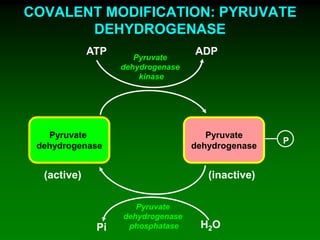
COVALENT MODIFICATION: PYRUVATE
DEHYDROGENASE
Pyruvate
dehydrogenase
Pyruvate
dehydrogenase
P
Pyruvate
dehydrogenase
kinase
ATP ADP
Pyruvate
dehydrogenase
phosphatasePi H2O
(inactive)(active)
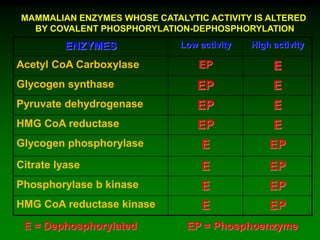
ENZYMES Low activity High activity
Acetyl CoA Carboxylase EP E
Glycogen synthase EP E
Pyruvate dehydrogenase EP E
HMG CoA reductase EP E
Glycogen phosphorylase E EP
Citrate lyase E EP
Phosphorylase b kinase E EP
HMG CoA reductase kinase E EP
MAMMALIAN ENZYMES WHOSE CATALYTIC ACTIVITY IS ALTERED
BY COVALENT PHOSPHORYLATION-DEPHOSPHORYLATION
E = Dephosphorylated EP = Phosphoenzyme
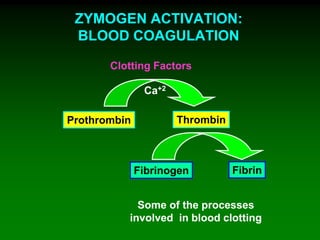
ZYMOGEN ACTIVATION:
BLOOD COAGULATION
Clotting Factors
Prothrombin Thrombin
Fibrinogen Fibrin
Ca+2
Some of the processes
involved in blood clotting
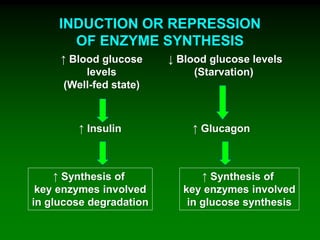
INDUCTION OR REPRESSION
OF ENZYME SYNTHESIS
↑ Blood glucose
levels
(Well-fed state)
↑ Insulin
↑ Synthesis of
key enzymes involved
in glucose degradation
↓ Blood glucose levels
(Starvation)
↑ Glucagon
↑ Synthesis of
key enzymes involved
in glucose synthesis
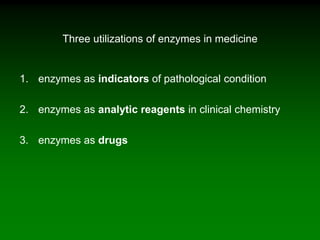
Three utilizations of enzymes in medicine
1. enzymes as indicators of pathological condition
2. enzymes as analytic reagents in clinical chemistry
3. enzymes as drugs
125
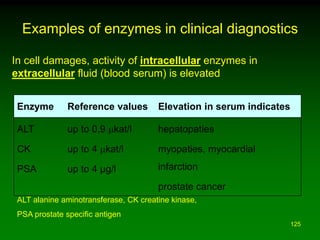
Examples of enzymes in clinical diagnostics
Enzyme Reference values Elevation in serum indicates
ALT
CK
PSA
up to 0,9 kat/l
up to 4 kat/l
up to 4 μg/l
hepatopaties
myopaties, myocardial
infarction
prostate cancer
ALT alanine aminotransferase, CK creatine kinase,
PSA prostate specific antigen
In cell damages, activity of intracellular enzymes in
extracellular fluid (blood serum) is elevated
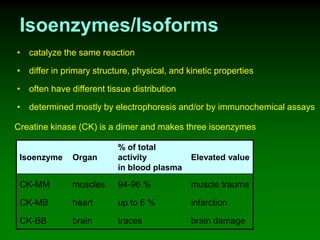
Creatine kinase (CK) is a dimer and makes three isoenzymes
Isoenzyme Organ
% of total
activity
in blood plasma
Elevated value
CK-MM
CK-MB
CK-BB
muscles
heart
brain
94-96 %
up to 6 %
traces
muscle trauma
infarction
brain damage
• catalyze the same reaction
• differ in primary structure, physical, and kinetic properties
• often have different tissue distribution
• determined mostly by electrophoresis and/or by immunochemical assays
Isoenzymes/Isoforms
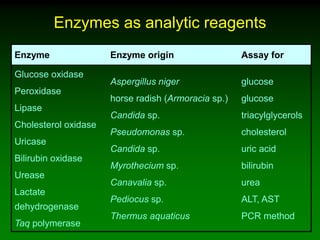
Enzymes as analytic reagents
Enzyme Enzyme origin Assay for
Glucose oxidase
Peroxidase
Lipase
Cholesterol oxidase
Uricase
Bilirubin oxidase
Urease
Lactate
dehydrogenase
Taq polymerase
Aspergillus niger
horse radish (Armoracia sp.)
Candida sp.
Pseudomonas sp.
Candida sp.
Myrothecium sp.
Canavalia sp.
Pediocus sp.
Thermus aquaticus
glucose
glucose
triacylglycerols
cholesterol
uric acid
bilirubin
urea
ALT, AST
PCR method
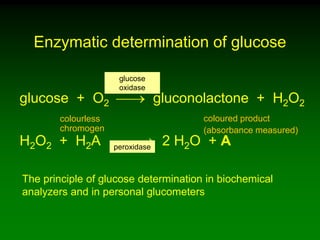
Enzymatic determination of glucose
glucose + O2  gluconolactone + H2O2
H2O2 + H2A  2 H2O + A
glucose
oxidase
peroxidase
colourless
chromogen
coloured product
(absorbance measured)
The principle of glucose determination in biochemical
analyzers and in personal glucometers
129
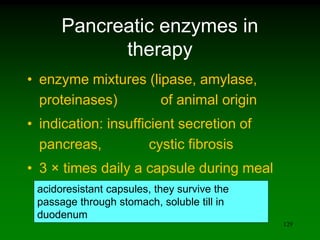
Pancreatic enzymes in
therapy
• enzyme mixtures (lipase, amylase,
proteinases) of animal origin
• indication: insufficient secretion of
pancreas, cystic fibrosis
• 3 × times daily a capsule during meal
acidoresistant capsules, they survive the
passage through stomach, soluble till in
duodenum
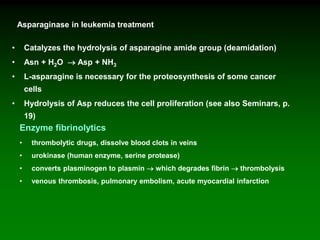
Asparaginase in leukemia treatment
• Catalyzes the hydrolysis of asparagine amide group (deamidation)
• Asn + H2O  Asp + NH3
• L-asparagine is necessary for the proteosynthesis of some cancer
cells
• Hydrolysis of Asp reduces the cell proliferation (see also Seminars, p.
19)
Enzyme fibrinolytics
• thrombolytic drugs, dissolve blood clots in veins
• urokinase (human enzyme, serine protease)
• converts plasminogen to plasmin  which degrades fibrin  thrombolysis
• venous thrombosis, pulmonary embolism, acute myocardial infarction
Proteases in enzyme therapy
Local treatment
• fibrinolysin, chymotrypsin, collagenase and other
• degrade necrotic tissue, clean wounds, decubital ulcers etc.
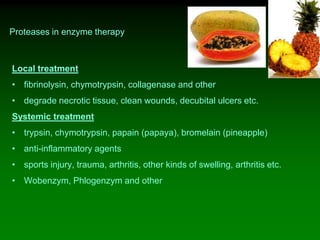
Systemic treatment
• trypsin, chymotrypsin, papain (papaya), bromelain (pineapple)
• anti-inflammatory agents
• sports injury, trauma, arthritis, other kinds of swelling, arthritis etc.
• Wobenzym, Phlogenzym and other

Enzkinetics 2014

  • 1.
  • 2.
    Enzymes • Living organismsmust be able to carry out chemical reactions which are thermodynamically very unfavorable – Break and form covalent bonds – Move large structures – Effect three dimensional structure – Regulate gene expression • Do so through catalysis
  • 3.
    Catalytic Power • Enzymescan accelerate reactions as much as 1016 over uncatalyzed rates! • Urease is a good example: – Catalyzed rate: 3x10⁴/sec – Uncatalyzed rate: 3x10 -10/sec – Ratio is 1x10¹⁴ !
  • 4.
    Effect of enzymes •A common biological reaction can take place without enzyme catalysis – Will take 750,000,000 years • With enzyme 22 milliseconds • Even improvement of a factor of 1,000 would not be good enough – Only 750,000 years – Living systems would be impossible
  • 5.
    Specificity • Enzymes selectivelyrecognize proper substrates over other molecules • Enzymes produce products in very high yields - often much greater than 95% • Specificity is controlled by structure - the unique fit of substrate with enzyme controls the selectivity for substrate and the product yield
  • 6.
    Substrate Specificity ofEnzymes • Almost all enzymes are globular proteins with one or more active sites on their surface. • The substrate is the reactant an enzyme acts on • Reactants bind to the active site to form an enzyme-substrate complex. • The 3-D shape of the active site and the substrates must match, like a lock and key • Binding of the substrates causes the enzyme to adjust its shape slightly, leading to a better induced fit. • When this happens, the substrates are brought close together and existing bonds are stressed. This reduces the amount of energy needed to reach the transition state. Substate Active site Enzyme Enzyme- substrate complex
  • 7.
  • 8.
    Enzymes • Have immenseimportance in a number of fields. – Genetic diseases are frequently defects in enzymes or increased/decreased levels of enzymes • Important diagnostic tools – Drugs exert effects by interacting with enzymes • MAO inhibitors – Used in food processing and in chemical industry – Enzyme inhibitors are a foundation of biological weapons – Genetic Engineering and Biotechnology use a lot of enzymes!
  • 9.
    Kinetics • Is thescience that describes the properties of a chemical reaction including those mediated by enzymes (catalysis) • Measures the concentration of substrate and/or products of a reaction to determine the velocity of the reaction • Measures the effects of concentration, temperature, pH, etc. to characterize the properties of the enzyme catalyzing the reaction
  • 10.
    Enzyme Kinetics • Anapproach to understanding the mechanism of action of enzymes • An approach to understanding how mutations may effect function • An approach to understanding how changes in the physical and chemical environments change function
  • 11.
    Rate Constant: k •A B • Velocity of Rx – V=d[B]/dt • d=change – V=-d[A]/dt • V=d[B]/dt = -d[A]/dt = k[A] • Large k rapid Rx • Small k slow Rx
  • 12.
    The free energyof this reaction is not changed by the presence of the enzyme, but for a ΔG<0. A --------------> B enzyme
  • 13.
    The Transition State Understandthe difference between ΔG and ΔG* • The overall free energy change for a reaction is related to the equilibrium constant • The free energy of activation for a reaction is related to the rate constant • It is extremely important to appreciate this distinction!
  • 15.
    1) Velocity isdependent on [S]. 2) The more enzyme added, the faster the reaction goes.
  • 16.
    Initial velocity Vo •When enzyme is mixed with high concentration of substrate [S] reaction goes rapidly to steady state. – Does not allow characterization • Use low starting [S] and increase • Hold [enzyme] constant • Measure rate of reaction, Vo as [S] increases – Until rate becomes constant: approaches Vmax
  • 17.
  • 18.
    A -------------> B k1 A+ B -----------> C k2 d[A]/dt = k1[A] For a first order reaction: For a second order reaction: The rate equation is: The rate equation is: d[A]/dt = k2[A][B]
  • 19.
    E + S<=====> ES <=====> P + E k2 k-2k-1 k1 In an enzymatic reaction: But: [ES] cannot be measured! Nonetheless: Initial [S] is known [P] can be measured [E]tot is known Can we find [ES]? Note: on initial conditions [P] is negligibly small, So, k-2[P]=0 Thus, Vo=k2[ES] (1)
  • 20.
    YES! If we assume"steady state kinetic conditions". That is, [S] and [P] are changing, but [ES] does not change (a constant flux of S "through" the enzyme). d[ES]/dt = 0 (1) Also (from conservation of matter): [E]tot = [E]free + [ES] (2) Now, divide eq. 1 by [E]tot : Vo/[E]tot = k2[ES]/[E]tot Since d[ES]/dt = 0 the rate of formation of [ES] must equal the rate of breakdown of [ES] Vformation = k1[E]free[S] (2nd order rate equation) Vbreakdown= k2[ES] + k-1[ES] = (k2 + k-1)[ES] (Two 1st order rate equations) k1[E]free[S] = (k2 + k-1)[ES] (Rates must be equal) E + S <=====> ES <=====> P + E k2 k-2k-1 k1
  • 21.
    Rearranging, solving for[ES]: [ES] = k1[E]free[S]/(k2 + k-1) (3) If we define the Michaelis-Menten constant as Km = (k2 + k-1)/k1 and we substitute into eq. 3, we get: [ES] = [E][S]/Km (4) Now, let´s rearrange eq. 2 to [E]free = [E]tot - [ES] and then substitute into eq. 4 giving: [ES] = ([E]tot - [ES])[S]/Km Solving for [ES] gives: [ES] = [E]tot(([S]/Km)/(1 + [S]/Km)) and then multiply top and bottom by Km, we get: [ES] = [E]tot([S]/[S] + Km)
  • 22.
    [ES] = [E]tot([S]/[S]+ Km) Finally, substitute into eq. 1 to get: Vo = k2[E]tot([S]/[S] + Km) (5) this is the expression for Vo in terms of known quantities, let’s try it!!
  • 23.
    If [S] verylarge [S] >> Km. The enzyme is saturated with substrate. In this case, [S] + Km = [S], so eq. 5 becomes: Vo = k2[E]tot([S]/[S]) or Vo = k2[E]tot This is the rate at large substrate concentration, the maximal rate for [E], which is called Vmax Vmax = k2[E]tot Substituting into eq. 5 gives the Michaelis-Menten Equation: Vo = Vmax[S]/Km + [S] (6) Note: This equation is derived from Vo, very little [P] has formed. Vo = k2[E]tot([S]/[S] + Km)
  • 24.
    If [S] issmall: [S] << Km Then the activity is in linear range. [S] + Km = Km so eq. 6 becomes: Vo = Vmax[S]/Km or Vo α [S] Vo = k2[E]tot([S]/[S] + Km) If [S] = Km The definition of Km Vo = Vmax[S]/[S] + [S] or Vo = Vmax/2 = Km Km is defined as the [S] that results in half maximal rate
  • 25.
    Km and Vmaxare experimentally determined for each enzyme using Vo vs. [S] plots. As V max is difficult to determine (hyperbolic) the Lineweaver-Burke plot is used. Rearrange eq. 6 into linear form: (1/Vo) = Km/Vmax(1/[S]) + 1/Vmax So the plotted data looks like:
  • 26.
    Understanding Km The "kineticactivator constant" • Km is a constant • Km is a constant derived from rate constants • Km is, under true Michaelis-Menten conditions, an estimate of the dissociation constant of E from S • Small Km means tight binding; high Km means weak binding
  • 27.
    Understanding Vmax The theoreticalmaximal velocity • Vmax is a constant • Vmax is the theoretical maximal rate of the reaction - but it is NEVER achieved in reality • To reach Vmax would require that ALL enzyme molecules are tightly bound with substrate • Vmax is asymptotically approached as substrate is increased
  • 28.
    Derivation of KCATor turnover number: For all catalyzed reactions: [E]tot = [E]free + [ES] (2) And with [S] >> Km: Vmax = k2[E]tot or k2 = Vmax/ [E]tot For this reason k2 is also known as KCAT when the enzyme is saturated, so: KCAT = Vmax/ [E]tot (7) Therefore, when [S] is low, from eq. 7 and the Michaelis-Menten equation: V = Vmax[S]/Km then V = KCAT/Km[S][E] Therefore, KCAT/Km is a measure of how rapidly and enzyme works and is referred as the specificity constant or catalytic efficiency
  • 29.
    The turnover number Ameasure of catalytic activity • kcat, the turnover number, is the number of substrate molecules converted to product per enzyme molecule per unit of time, when E is saturated with substrate. • If the M-M model fits, k2 = kcat = Vmax/Et • Values of kcat range from less than 1/sec to many millions per sec
  • 30.
    The catalytic efficiency Namefor kcat/Km • An estimate of "how perfect" the enzyme is • kcat/Km is an apparent second-order rate constant • It measures how the enzyme performs when S is low • The upper limit for kcat/Km is the diffusion limit - the rate at which E and S diffuse together
  • 32.
    Alcohol Dehydrogenase: ADH CH3CH2OH+ NAD+ CH3CH2O + H++ NADH Catalyses conversion of ethanol to aldehyde using co-enzyme NAD+ MH2 + NAD+ → NADH + H+ + M: + energy, where M is a metabolite. NAD+ oxidized to NADH reduced
  • 33.
  • 34.
  • 35.
  • 36.
    Reaction is complex •ADH +ALC ADH-ALC • ADH + NAD ADH-NAD • ADH-NAD +ALC ADH-NAD-ALC • We are not looking at this!
  • 37.
    Alcohol Dehydrogenase CH3CH2OH +NAD+ CH3CH2O + H+ + NADH We will measure the forward Rx (k 2)as increased absorbance at 340. Only NADH absorbs at this wave length Will find the assay conditions which produce max activity Km
  • 38.
    WHAT ARE WEMEASURING ? • Production of NADH – NAD+ NADH – Wavelength shift • Depends on participation of Alcohol and ADH • How can you do this • Ensure that NAD is not a rate limiting component. – [NAD] constant and high – [ADH] constant – [ETOH] low and increasing
  • 39.
    Experiment 1.0 2.0 3.0 0 60 120 180240 300 360 4200 time (seconds) A 340 y = 0.0191 x - 1.0067 Kinetic curve Add enzyme
  • 40.
  • 41.
  • 42.
    Effect of enzymeconcentration I II [E]std [P] time (min) 0 2 4 6 8 10
  • 43.
    Effect of pH V0 pH pKaof reaction 1 ~ 4.0 pKa of reaction 2 ~ 9.0 2 124 6 8 10 max low Activity decreases due to lysine deprotonation Activity decreases due to glutamate/aspartate protonation Maximal activity range
  • 45.
  • 68.
  • 69.
    APOENZYME APOENZYME APOENZYME DEFINITIONOF TERMS Protein part Cofactor (Non-protein part) Coenzyme Prosthetic group Metal ion HOLOENZYME + ++
  • 70.
    ENZYME COFACTORS A. CoenzymeEnzyme Chemical Groups Transferred Vitamin Precursor Thiamine Pyrophosphate (TPP) Pyruvate dehydrogenase, Isocitrate dehydrogenase, α- ketoglutarate dehydrogenase, Transketolase, α-Ketoacid dehydrogenase Aldehydes Thiamine (Vit B1) Flavin Adenine Dinucleotide (FAD) Succinate dehydrogenase, α- Ketoglutarate dehydrogenase, Pyruvate dehydrogenase, Nitric oxide synthase Electrons Riboflavin (Vit B2) Nicotinamide Adenine Dinucleotide (NAD) Lactate dehydrogenase; Other dehydrogenases Hydride ion (:H-) Nicotinic acid (Niacin; B3) Pyridoxal Phosphate (PLP) Glycogen phosphorylase, γ-ALA synthase, Histidine decardoxylase, Alanine aminotransferase Amino groups Pyridoxine (Vit B6) Lipoate Pyruvate dehydrogenase α-Ketoglutarate dehydrogenase Electrons and acyl groups Not required in diet
  • 71.
    ENZYME COFACTORS A. CoenzymeEnzyme Chemical Groups Transferred Vitamin Precursor Coenzyme A (CoASH) Acetyl CoA carboxylase Acyl groups Pantothenic acid & other compounds Biocytin Pyruvate carboxylase, Acetyl CoA carboxylase, Propionyl CoA carboxylase CO2 Biotin 5’- deoxycobalamin Methylmalonyl mutase H atoms and alkyl groups Vit B12 Tetrahydrofolalate Thmidylate synthase One-carbon groups Folic acid
  • 72.
    ENZYME COFACTORS: COENZYMEA C-CH2-CH2-N-C-C—C-CH2O O II O II I OH H II O I CH3 CH3 I I NH I CH2 I CH2 I SH O = P – O- I O I O = P –O- I O NH2 N N N N O I O = P – O- I O- O OH Pantothenic acid 1. Pantothenic acid-derived, co-factor of several enzymes like acetyl CoA carboxylase. 2. Takes part in reactions of the CAC, FA synthesis and oxidation, acylations and cholesterol synthesis. H H HH H Active sulfhydryl group that form thioesters with acyl groups
  • 73.
    ENZYME COFACTOR: NAD+ COO- | HO- C – H | CH3 COO- I C = O I CH3 Lactate dehydrogenase L-Lactate PyruvateNAD+ NADH+ + H+
  • 74.
    COENZYME: BIOTIN Pyruvate Gluconeogenesis Oxaloacetate ATP ADP+ Pi Pyruvate carboxylase CO2BIOTIN COO- I C =O I CH3 COO- | C= O | CH2 | COO-
  • 75.
    ROLE OF FADAND FMN IN NITRIC OXIDE (NO) SYNTHESIS Arginine NO + NADPH2 + O2 NADP+ + H2O Nitric oxide synthase FAD, FMN, Heme Tetrahydrobiopterin COENZYME: FAD NH2 I H2N = C I NH I CH2 I CH2 I CH2 I H3N – C – H I COO- NH2 I C = O I NH I CH2 I CH2 I CH2 I H3N – C – H I COO- + Citrulline + +
  • 76.
    Cofactor Enzyme B. Inorganic(Metal ions or iron- sulfur clusters) Zn+2 Carbonic anhydrase, Alcohol dehydroge- nase, Carboxypeptidases A & B Cu+2 Cytochrome oxidase Mn+2 Arginase, Ribonucleotide reductase Mg+2 Hexokinase, Pyruvate kinase, Glucose 6- phosphatase Ni+2 Urease Mo Nitrate reductase Se Glutathione peroxidase Mn+2 Superoxide dismutase K+ Propionyl CoA carboxylase ENZYME COFACTORS
  • 77.
    METALLOENZYMES Enzymes that require ametal in their composition
  • 78.
    ENZYME COFACTORS: Mg+2 GlucoseGlucose 6-PO4 Hexokinase Glucokinase ATP ADP + Pi Mg+2 O || C1 - H | H - C2 - OH | OH - C3 - H | H - C4 - OH | H - C5 - OH | H - C6 – OH | H O || C1 - H | H - C2 - OH | OH - C3 - H | H - C4 - OH | H - C5 - OH | H - C6 - O – P | H
  • 79.
    GLYCOLYSIS COO- | C2 = O | CH3 O || C1– O- | C2 – O ~ P | H – C3 | H Phosphoenol Pyruvate (PEP) Pyruvate ADP ATP K+ Δ G0 = - 6.1 kcal/mole ENZYME COFACTORS: K+ Pyruvate kinase
  • 80.
    ENZYME COFACTORS: Zn+ CO2+ H2O H2CO3 Carbonic anhydrase Zn+2
  • 81.
    Hexokinase/ Glucokinase ATP ADP Δ G0= - 4.0 kcal/mole O || C1 - H | H - C2 - OH | OH - C3 - H | H - C4 - OH | H - C5 - OH | H - C6 – OH | H Glucose O || C1 - H | H - C2 - OH | OH - C3 - H | H - C4 - OH | H - C5 - OH | H - C6 - O – P | H Glucose 6-Phosphate ATP AS A CO-SUBSTRATE Mg+2
  • 82.
  • 83.
  • 84.
    REGULATORY ENZYME The enzymethat catalyzes the rate-limiting or committed step of a metabolic pathway.
  • 85.
  • 86.
    REGULATORY ENZYME Phosphofructokinase I Fructose6- phosphate Fructose 1,6- bisphosphate ATP ADP + Pi Phosphofructokinase I Glycolysis H | H - C1 - OH | C2 = O | OH - C3 - H | H - C4 - OH | H - C5 - OH | H - C6 - O – P | H H | H - C1 - O - P | C2 = O | OH - C3 - H | H - C4 - OH | H - C5 - OH | H - C6 - O – P | H AMP F 2,6 bisPO4 ATP Citrate H+ + -
  • 87.
    ISOENZYME  Different structuralforms of an enzyme which catalyze the same chemical reactions → act on the same substrate(s) and produce the same product(s) but exhibit differing degrees of efficiency.  Different isoenzymes are expressed in specific tissues of the body.
  • 88.
    ISOENZYMES OF LACTATE DEHYDROGENASE Lactatedehydrogenase (LDH) – catalyzes the reversible conversion of pyruvate to lactate. Tetramer consisting of 2 subunits: M (found in skeletal muscles and liver) & H (heart). 5 distinct isoenzyme forms (from combination of M & H isozymes). An increase of H4 in the blood indicates tissue damage as in heart attack. Enzymes can therefore serve as markers for disease.
  • 89.
    SIX MAJOR CLASSESOF ENZYMES (IUBMB*, 1964) CLASS EXAMPLE Oxidoreductases Dehydrogenases, Oxidases, Reductases, Peroxidases, Catalases, Oxygenases, Hydroxylases Transferases Transaldolase and Transketolase; Acyl, methyl glucosyl, and phosphoryltransferases, Kinases, Phosphomutases, Transaminases Hydrolases Esterases, Glycosidases, Peptidases, Phosphatases, Thiolases, Phospholipases, Amidases, Deaminases, Ribonucleases Lyases Decarboxylases, Aldolases, Hydratases, Dehydratases, Synthases, Lyases Isomerases Epimerases, Isomerases, Mutases, Racemases Ligases Synthetases, Carboxylases *International Union of Biochemistry and Molecular Biology; classification is based on the reactions enzymes catalyze; each class is divided into subclasses.
  • 90.
    OXIDOREDUCTASES Transfer of electronsand hydrogen atoms from donors (or reductants, hence oxidized to acceptors (or oxidants, hence reduced). COO- | HO – C – H + NAD+ | CH3 L-Lactate COO- | C = O + NADH + H+ | CH3 Pyruvate Lactate dehydrogenase
  • 91.
    TRANSFERASES Transfer functional groups(like C-, N-, or P-) from donors to acceptors; utilize 2 substrates to produce 2 products. COO- | H3N – C – H + C = O | | CH3 (CH2)2 L-Alanine | COO- α-Ketoglutarate (keto acid) COO- COO- | | C = O + H3N – C – O | | CH3 (CH2)2 Pyruvate | COO- L-Glutamate (amino acid) Alanine transaminase PLP (amino acid) (keto acid) substrate substrate product product
  • 92.
    HYDROLASES Catalyze cleavage ofchemical bonds by addition of H2O, producing 2 products O O || || -O – P ~ O – P ~ O- + HOH | | -O O- Pyrophosphate (PPi) O || 2 HO – P – O- | -O Phosphate 2 (Pi) Pyrophosphatase Phosphate bond
  • 93.
    LYASES Cleave C-C, C-O,C-N bonds by means other than hydrolysis or oxidation O O- / C | C = O H+ | CH3 Pyruvate H O // C + O = C = O | Carbon CH3 dioxide (CO2) Pyruvate decarboxylase Acetaldehyde
  • 94.
    ISOMERASES Transfer of functionalgroups or double bonds within the same molecule C1OO- | H3N – C2 – H | C3H3 L-Alanine C1OO- | H – C2 – NH3 | C3H3 D-Alanine Alanine racemase
  • 95.
    CH3 | C = O | COO- COO- | CH2 | C= O | COO-Biotin- CO2 ATP ADP + Pi Oxaloacetate Pyruvate Pyruvate carboxylase ATP ADP + Pi LIGASES Catalyze the joining of substrates in the presence of ATP.
  • 96.
  • 97.
    REGULATION OF ENZYME ACTIVITY FeedbackInhibition Allosteric (Non-covalent) Modification Covalent Modification Zymogen Activation Induction or Repression of Enzyme Synthesis
  • 98.
    98 Saturation curve ofallosteric enzymes is sigmoidal [S] vo aktivace inhibicebez efektoru activation without effector inhibition
  • 99.
    Cooperative effect • inoligomeric enzymes and non-catalyzing proteins (e.g. Hb) • more subunits = more active sites • binding substrate (or O2 to Hb) to one subunit/active site induces conformation changes in other subunits/active sites so that other substrate (or O2) molecules bind more easily (or more hardly) • example: hemoglobin (tetramer) × myoglobin (monomer)
  • 100.
    large and complex havingquaternary structures Allosteric Enzymes are: Few enzymes: single subunit Three subunits Four subunits Allosteric enzymes
  • 101.
    What are thesubunits called? Catalytic subunit: has the active site on it Regulatory subunits: has the allosteric site bind inhibitors & activators
  • 102.
    ‘Allostery’ means ‘different shape’[refers to the two shapes of the enzyme] Allosteric enzymes have TWO sites: E Active site Allosteric site Substrate cannot fit into the active site Inhibitor molecule Inhibitor fits into allosteric site E
  • 103.
    Allosteric enzymes areregulatory enzymes that have two structurally distinct forms: ACTIVE & INACTIVE are regulatory enzymes that have two structurally distinct forms: are regulatory enzymes that have two structurally distinct forms:
  • 104.
    The binding ofan: Inhibitor & activator = effectors Activator: stabilizes the active form of the enzyme Inhibitor: stabilizes the inactive form of the enzyme
  • 105.
    Allosteric inhibition is atype of reversible inhibition which allows the rate of enzyme catalysed reactions to be controlled
  • 106.
    PFK is aquaternary protein and has two allosteric regulatory sites and a catalytic site. Phosphofructokinase (PFK)  is an allosteric enzyme  regulates rate of respiration
  • 107.
    ATP: allosteric inhibitorof PFK AMP/ADP: allosteric activators of PFK
  • 108.
  • 109.
    PFK controls rateof respiration
  • 110.
    End-product regulation of a pathway: acase of allosteric inhibition
  • 111.
    FEEDBACK INHIBITION Original Precursor(s) Enzyme1 Enzyme 2 Enzyme 3 Enzyme 4 Enzyme 5 1 2 3 Final Products
  • 112.
    FEEDBACK INHIBITION Carbamoyl PO4+ Aspartate Carbamoyl aspartate Aspartate transcarbamoylase (ATCase) series of reactions Cytidine triphosphate (CTP) RNA & DNA synthesis
  • 113.
    FEEDBACK INHIBITION OFHMG CoA REDUCTASE BY CHOLESTEROL Acetyl CoA Acetyl CoA HMG CoA Mevalonic acid + CoA HMG CoA reductase Cholesterol Feedback inhibition Acetoacetyl CoA > 25 steps
  • 114.
    ALLOSTERIC MODIFICATION Allosteric modulator(activator or inhibitor) Binds to regulatory or allosteric site Conformational change in the regulatory enzyme Effect is transmitted to the active site Change in shape of the active site Altered activity
  • 115.
    The end-product ofthe reaction: can act as a non-competitive inhibitor and bind at a site on the enzyme
  • 116.
    Negative Feedback • Infeedback inhibition, the end product of a metabolic pathway shuts down the pathway
  • 117.
    What is thevalue of negative feedback inhibition to a cell? Prevents a cell from wasting chemical resources by synthesizing more product than is needed
  • 118.
    COVALENT MODIFICATION ATP ADP ENZYME-Ser -- OH HPO4 = H2O Protein kinase Phospho- protein phosphatase ENZYME- Ser – O – PO3 2-
  • 119.
    COVALENT MODIFICATION OF THEENZYME Glycogen phosphorylase AMP ATP and/or G6P Glucose 2 ATP 2 ADP 2 H2O2 P Phosphorylase kinase Phosphorylase b (inactive) Phosphorylase a (active) P P P P Phosphoprotein phosphatase
  • 120.
  • 121.
    ENZYMES Low activityHigh activity Acetyl CoA Carboxylase EP E Glycogen synthase EP E Pyruvate dehydrogenase EP E HMG CoA reductase EP E Glycogen phosphorylase E EP Citrate lyase E EP Phosphorylase b kinase E EP HMG CoA reductase kinase E EP MAMMALIAN ENZYMES WHOSE CATALYTIC ACTIVITY IS ALTERED BY COVALENT PHOSPHORYLATION-DEPHOSPHORYLATION E = Dephosphorylated EP = Phosphoenzyme
  • 122.
    ZYMOGEN ACTIVATION: BLOOD COAGULATION ClottingFactors Prothrombin Thrombin Fibrinogen Fibrin Ca+2 Some of the processes involved in blood clotting
  • 123.
    INDUCTION OR REPRESSION OFENZYME SYNTHESIS ↑ Blood glucose levels (Well-fed state) ↑ Insulin ↑ Synthesis of key enzymes involved in glucose degradation ↓ Blood glucose levels (Starvation) ↑ Glucagon ↑ Synthesis of key enzymes involved in glucose synthesis
  • 124.
    Three utilizations ofenzymes in medicine 1. enzymes as indicators of pathological condition 2. enzymes as analytic reagents in clinical chemistry 3. enzymes as drugs
  • 125.
    125 Examples of enzymesin clinical diagnostics Enzyme Reference values Elevation in serum indicates ALT CK PSA up to 0,9 kat/l up to 4 kat/l up to 4 μg/l hepatopaties myopaties, myocardial infarction prostate cancer ALT alanine aminotransferase, CK creatine kinase, PSA prostate specific antigen In cell damages, activity of intracellular enzymes in extracellular fluid (blood serum) is elevated
  • 126.
    Creatine kinase (CK)is a dimer and makes three isoenzymes Isoenzyme Organ % of total activity in blood plasma Elevated value CK-MM CK-MB CK-BB muscles heart brain 94-96 % up to 6 % traces muscle trauma infarction brain damage • catalyze the same reaction • differ in primary structure, physical, and kinetic properties • often have different tissue distribution • determined mostly by electrophoresis and/or by immunochemical assays Isoenzymes/Isoforms
  • 127.
    Enzymes as analyticreagents Enzyme Enzyme origin Assay for Glucose oxidase Peroxidase Lipase Cholesterol oxidase Uricase Bilirubin oxidase Urease Lactate dehydrogenase Taq polymerase Aspergillus niger horse radish (Armoracia sp.) Candida sp. Pseudomonas sp. Candida sp. Myrothecium sp. Canavalia sp. Pediocus sp. Thermus aquaticus glucose glucose triacylglycerols cholesterol uric acid bilirubin urea ALT, AST PCR method
  • 128.
    Enzymatic determination ofglucose glucose + O2  gluconolactone + H2O2 H2O2 + H2A  2 H2O + A glucose oxidase peroxidase colourless chromogen coloured product (absorbance measured) The principle of glucose determination in biochemical analyzers and in personal glucometers
  • 129.
    129 Pancreatic enzymes in therapy •enzyme mixtures (lipase, amylase, proteinases) of animal origin • indication: insufficient secretion of pancreas, cystic fibrosis • 3 × times daily a capsule during meal acidoresistant capsules, they survive the passage through stomach, soluble till in duodenum
  • 130.
    Asparaginase in leukemiatreatment • Catalyzes the hydrolysis of asparagine amide group (deamidation) • Asn + H2O  Asp + NH3 • L-asparagine is necessary for the proteosynthesis of some cancer cells • Hydrolysis of Asp reduces the cell proliferation (see also Seminars, p. 19) Enzyme fibrinolytics • thrombolytic drugs, dissolve blood clots in veins • urokinase (human enzyme, serine protease) • converts plasminogen to plasmin  which degrades fibrin  thrombolysis • venous thrombosis, pulmonary embolism, acute myocardial infarction
  • 131.
    Proteases in enzymetherapy Local treatment • fibrinolysin, chymotrypsin, collagenase and other • degrade necrotic tissue, clean wounds, decubital ulcers etc. Systemic treatment • trypsin, chymotrypsin, papain (papaya), bromelain (pineapple) • anti-inflammatory agents • sports injury, trauma, arthritis, other kinds of swelling, arthritis etc. • Wobenzym, Phlogenzym and other