The Minimalist Program
Chomsky’s theories of language
Revolutionized Linguistics
X-bar theory
Notice that Phrases have heads!
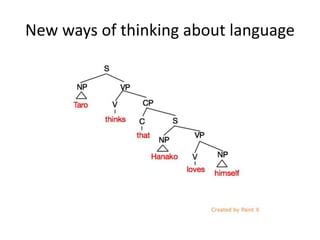
Binding
Language and the brain
New ways of thinking about language
Language is a special system
Language is innate
Very interesting ideas
The innateness hypothesis
• Language depends on a SEPARATE system in
the brain
• The Language Faculty (the Language Module)
• We are BORN with Universal Grammar in our
brains!
It’s an interesting idea
But it’s still just an idea
Children practice speaking a lot!
10,000 hours by the time they are 6
That’s a lot of practice!
They use language a LOT
Maybe language develops with USE?
Many people think so
Usage in social activity
Do we need a Language Faculty?
Maybe – but it’s NOT conclusive
Many disagree now
Chomsky’s theory is implausible!
Implausible = unbelievable
Unbelievable – not in a good way
And many people didn’t agree forty
years ago
Many didn’t like Chomsky’s ideas
about meaning?
Syntax is AUTONOMOUS!
Syntax is SEPARATE from meaning!?
Why should we believe that?
Tense is NOT meaning?
Agreement is NOT meaning?
Meaning is NOT in the words!!?
Everything comes from syntactic
movement
Isn’t binding about meaning?
No connection with semantics?!
Isn’t the tense of love part of the
meaning of the word?
Isn’t subject-verb agreement partly
meaning?
Is movement necessary for
agreement?
Lakoff said that language is connected
to the body
How can it be a separate system?
Chomsky’s big claims
• Syntax is separate from meaning
• Many people disagreed
• Language is separate in the mind
• Many people didn’t agree
• Where’s your evidence?
• Where’s your proof?
• But THEN …
The Minimalist Program
Chomsky’s NEW idea
Not ONLY is syntax separate
Not ONLY is language separate
Language is the perfect design!!
Wait!
The perfect design!
How do you know?!
How COULD we know!
Lots of people found this difficult to
believe
Why SHOULD language have a
PERFECT design?
Where’s the proof?
We’re still waiting
Then Minimalism gave us MORE
structure!
Before there was just an Inflectional
Phrase
IP split into AgrP and TP!
I thought Minimalist meant LESS!
Not MORE!
That’s a bit strange!
Around this time …
Unification grammars were improving
Unification Grammars have NO TP or
AgrP
Sentences are VPs
AgrP and TP is just fog
Get rid of it
Like this
Like this
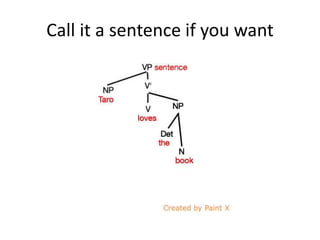
Call it a sentence if you want
But it’s a kind of VP
A Sentence is a VP PLUS a subject
There’s no tense phrase
There’s no Agr Phrase
Agreement and Tense are IN the words
In the lexicon
So what’s the problem?
Maybe there IS no language faculty
Who cares?
Maybe grammar and meaning work
together
We can do that
Grammar and meaning IN words!
Maybe there’s no movement
We don’t need movement
Pattern-matching instead
So what’s the problem?
Unification grammars
Complex feature structures
Very complex
Very, very COMPLEX
So pattern-matching is simple
Animals can match patterns, can’t
they?
But the patterns are COMPLEX
So how does this work?
Agreement
Information contained in words
How does the information match?
Words attract certain other words
And repel others
Valence or Subcategorization
Imagine this is our mental lexicon
Information about words – in our
heads
Walks: wants a 3rd person singular
noun phrase
Walk: really DOESN’T WANT a 3rd
person singular noun phrase
It seems natural that this information
matches
The information is shared
Features are matched
Chomsky needs information in the
lexicon
And he needs the information to
match
But he ALSO needs movement of
features
Unification grammars just unify the
information
No movement
Grammatical info and meaning info
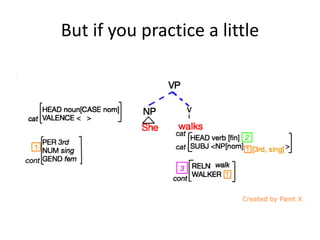
[She] is 3rd, sing, fem
Walks takes a subject that is 3rd, sing
The CONT (meaning) of [walks]
… matches the meaning of the subject
This information is in the lexicon
When the words [she] and [walks]
combine …
… the information MATCHES
The CONTENT information in the
subject …
… matches with the CONTENT
information in the verb
The same information appears in new
places
What about the purple [3]?
Rule: the content of a phrase = the
content of the head
It kind of LOOKS like movement
It looks like CONTENT is moving up the
tree
But it’s really information MATCHING
The CONTENT is carried up the HEAD
(it’s a rule)
So the purple [3] looks like it moves
But it’s just feature sharing (matching)
Let’s make it simple
Words carry information
She carries information
Walks carries information
Walks has partial information
About the subject it wants to attract
Match them up
And the information matches
If possible
From this
To this
I know … this looks complicated
But it’s ONE SIMPLE mechanism
Matching things up
Lots of information
But if you practice a little
You’ll get used to it
We WILL practice
But nothing difficult
So don’t worry
… the information MATCHES
Subcategorization
• SUBCAT or Valence features show what a verb
wants to ATTRACT.
Chomsky’s enemies
• Chomsky’s enemies suggest that language
develops in USE.
• What did Unification Grammar do with AgrP
and TP?
• It got rid of it
• It threw it in the garbage
• How do Unification Grammars deal with Tense
and Agreement?
• It’s partly in the meaning of the words
• They use pattern matching
What’s the problem with the PERFECT
DESIGN idea?
• Don’t know what it means
• Don’t know how to prove it
• There’s no reason to believe in it
Walks SUBCAT
• SUBCAT
• <NP[nom]
• PERSON 3rd
• NUMBER Sing
• NUMBER x >
What’s NP[nom]?
• He is nominative case
• Him is accusative case
• We is nominative case
• Us is accusative case
Kicks SUBCAT|SUBJ
• NP[nom]
• Anything but THIS:
• PERSON 3rd
• NUMBER Sing
• NUMBER x >
Kicks COMPLEMENT
<NP[acc] PERSON x
NUMBER x
GENDER x >
• So kicks will accept any accusative
complement
• But reject nominative complements
Thinks SUBCAT|SUBJ
• SUBCAT
• <NP[nom]
• PERSON 3rd
• NUMBER Sing
• NUMBER x >
Same as Walks SUBCAT|SUBJ
• SUBCAT
• <NP[nom]
• PERSON 3rd
• NUMBER Sing
• NUMBER x >
Thinks COMPLEMENT(OBJECT)
• SENTENCE (+ tense)
Think hates 3rd person singular
subjects

Minimalism