Critical Discourse Analysis
Prepared by: Haleema
Critical Discourse Analysis is the connection
between the use of language and the
social/political contexts in which is occurs.
For Example:
To Kill a Mocking Bird (Novel)
I Have a Dream (Speech)
Black Rights movement
CDA explores and reflects issues such as ethnicity,
gender, ideology and cultural differences in a text.
It has roots in critical linguistics.
The Principles of Critical Discourse
Analysis
1. Social and political issues are
constructed and reflected in
discourse.
2. Power relations are negotiated and
performed through discourse.
3. Discourse both reflects and
reproduces social relations.
4. Ideologies are reflected in the use of
discourse.
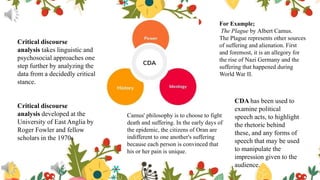
Critical discourse
analysis takes linguistic and
psychosocial approaches one
step further by analyzing the
data from a decidedly critical
stance.
Critical discourse
analysis developed at the
University of East Anglia by
Roger Fowler and fellow
scholars in the 1970s
CDA has been used to
examine political
speech acts, to highlight
the rhetoric behind
these, and any forms of
speech that may be used
to manipulate the
impression given to the
audience.
For Example;
The Plague by Albert Camus.
The Plague represents other sources
of suffering and alienation. First
and foremost, it is an allegory for
the rise of Nazi Germany and the
suffering that happened during
World War II.
Camus' philosophy is to choose to fight
death and suffering. In the early days of
the epidemic, the citizens of Oran are
indifferent to one another's suffering
because each person is convinced that
his or her pain is unique.
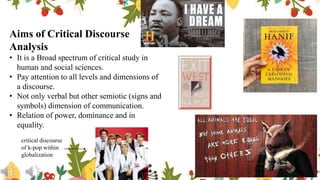
Aims of Critical Discourse
Analysis
• It is a Broad spectrum of critical study in
human and social sciences.
• Pay attention to all levels and dimensions of
a discourse.
• Not only verbal but other semiotic (signs and
symbols) dimension of communication.
• Relation of power, dominance and in
equality.
critical discourse
of k-pop within
globalization
The four traditional modes of discourse are narration, description,
exposition, and argument
Steps:
1) Establish the context
2) Explore the production process
3) Prepare your material for analysis
4) Code your material
5) Examine the structure of the text.
6) Collect and examine all statements
7) Identify cultural references

Critical discourse analysis

  • 1.
  • 2.
    Critical Discourse Analysisis the connection between the use of language and the social/political contexts in which is occurs. For Example: To Kill a Mocking Bird (Novel) I Have a Dream (Speech) Black Rights movement CDA explores and reflects issues such as ethnicity, gender, ideology and cultural differences in a text. It has roots in critical linguistics. The Principles of Critical Discourse Analysis 1. Social and political issues are constructed and reflected in discourse. 2. Power relations are negotiated and performed through discourse. 3. Discourse both reflects and reproduces social relations. 4. Ideologies are reflected in the use of discourse.
  • 3.
    Critical discourse analysis takeslinguistic and psychosocial approaches one step further by analyzing the data from a decidedly critical stance. Critical discourse analysis developed at the University of East Anglia by Roger Fowler and fellow scholars in the 1970s CDA has been used to examine political speech acts, to highlight the rhetoric behind these, and any forms of speech that may be used to manipulate the impression given to the audience. For Example; The Plague by Albert Camus. The Plague represents other sources of suffering and alienation. First and foremost, it is an allegory for the rise of Nazi Germany and the suffering that happened during World War II. Camus' philosophy is to choose to fight death and suffering. In the early days of the epidemic, the citizens of Oran are indifferent to one another's suffering because each person is convinced that his or her pain is unique.
  • 4.
    Aims of CriticalDiscourse Analysis • It is a Broad spectrum of critical study in human and social sciences. • Pay attention to all levels and dimensions of a discourse. • Not only verbal but other semiotic (signs and symbols) dimension of communication. • Relation of power, dominance and in equality. critical discourse of k-pop within globalization
  • 5.
    The four traditionalmodes of discourse are narration, description, exposition, and argument Steps: 1) Establish the context 2) Explore the production process 3) Prepare your material for analysis 4) Code your material 5) Examine the structure of the text. 6) Collect and examine all statements 7) Identify cultural references