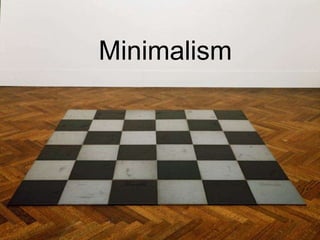
Minimalism
What is Minimalism?
• Never clearly defined movement
• Artists within the movement opposed each
  other
• “Much has been written about minimal art,
  but I have not discovered anyone who
  admits to doing this kind of thing” -LeWitt
How it began
• Against abstract expressionism

• Turn away from inner psychological
  expression toward observation and
  referencing everyday life

• Wanted a more American art form

• “Getting rid of the things that people used to
  think were essential to art” - Judd
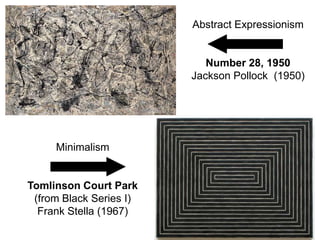
Abstract Expressionism


                            Number 28, 1950
                         Jackson Pollock (1950)


     Minimalism


Tomlinson Court Park
 (from Black Series I)
  Frank Stella (1967)
Physical Characteristics
•   Clean, bare, simple
•   Monochromatic colors
•   Geometric shapes, and clean lines
•   Repitition
•   Industrial materials (pre-made)
•   Installations
•   Gallery scale
Symbolic Characteristics
• Void of emotional meaning
• Void of political intent
• Void of associations and symbolism
• Some artists drew inspiration from
  things, but it wasn‟t meant to be hidden.
• “What you see, is what you see”-Stella
Main Artists
•   Frank Stella-1936 to Present
•   Sol LeWitt-1928 to 2007
•   Dan Flavin-1933 to1996
•   Donald Judd-1928 to 1994
•   Carl Andre-1935 to Present
•   Robert Morris- 1931 to Present
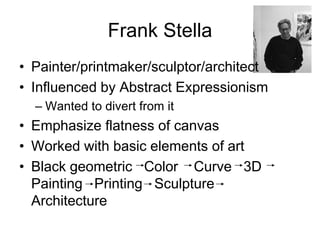
Frank Stella
• Painter/printmaker/sculptor/architect
• Influenced by Abstract Expressionism
  – Wanted to divert from it
• Emphasize flatness of canvas
• Worked with basic elements of art
• Black geometric Color Curve 3D
  Painting Printing Sculpture
  Architecture
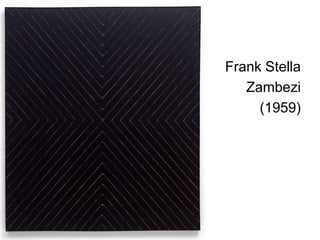
Frank Stella
   Zambezi
     (1959)
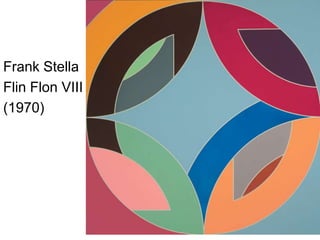
Frank Stella
Flin Flon VIII
(1970)
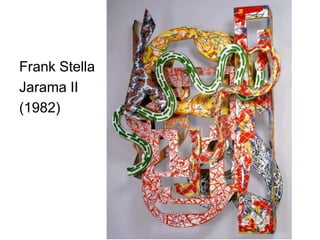
Frank Stella
Jarama II
(1982)
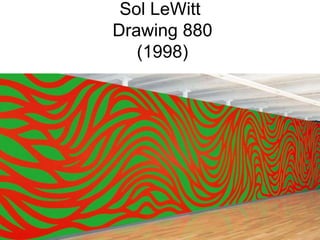
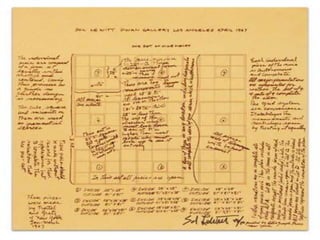
Sol LeWitt
•   Sculptor/painter/drawings
•   Wall Drawings
•   Both color and grayscale
•   Require massive teams
•   LeWitt was a director
•   Months to make
•   Interested in ideas not objects.
Sol LeWitt
Drawing 880
   (1998)
Sol LeWitt Wall Drawing
           Timelapse
• http://www.massmoca.org/lewitt/timelapse.
  php?id=1 (Rainbow Swirl)
Sol LeWitt cont.
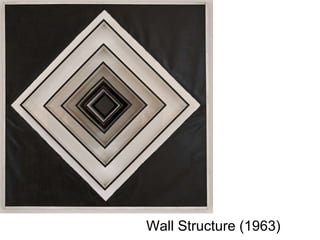
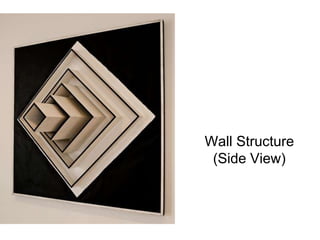
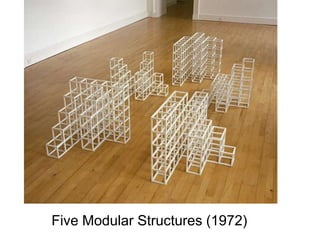
• Structures
  – Modular Structures
• Skeletal Framework
• Focused on texture
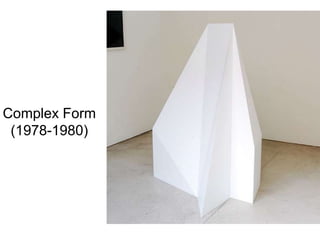
• Later moved on to complex forms
Wall Structure (1963)
Wall Structure
 (Side View)
Five Modular Structures (1972)
Complex Form
 (1978-1980)
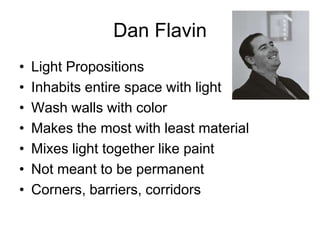
Dan Flavin
•   Light Propositions
•   Inhabits entire space with light
•   Wash walls with color
•   Makes the most with least material
•   Mixes light together like paint
•   Not meant to be permanent
•   Corners, barriers, corridors
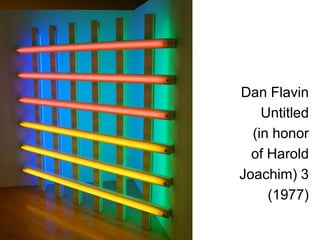
Dan Flavin
    Untitled
  (in honor
  of Harold
Joachim) 3
     (1977)
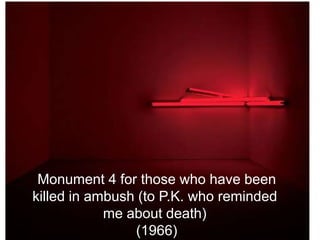
Monument 4 for those who have been
killed in ambush (to P.K. who reminded
            me about death)
                (1966)
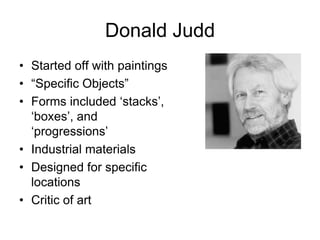
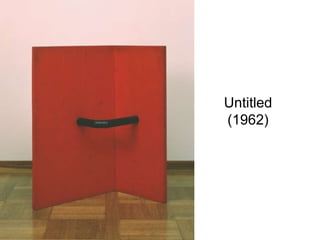
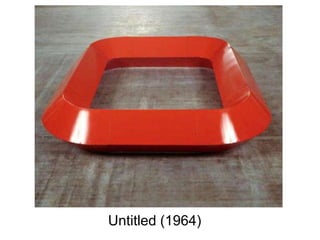
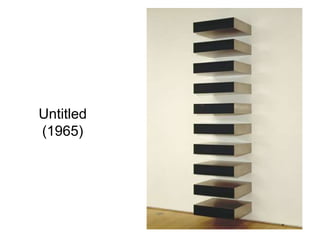
Donald Judd
• Started off with paintings
• “Specific Objects”
• Forms included „stacks‟,
  „boxes‟, and
  „progressions‟
• Industrial materials
• Designed for specific
  locations
• Critic of art
Untitled
(1962)
Untitled (1964)
Untitled
(1965)
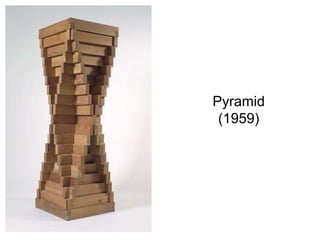
Carl Andre
• Sculptor
• Raw materials
• Sculpture-as-place
• Designed for specific
  locations
• Gallery scale
Pyramid
 (1959)
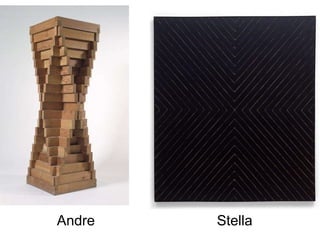
Andre   Stella
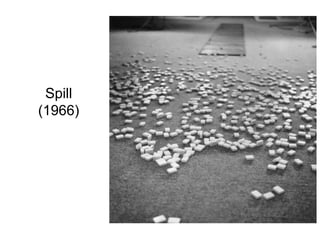
Spill
(1966)
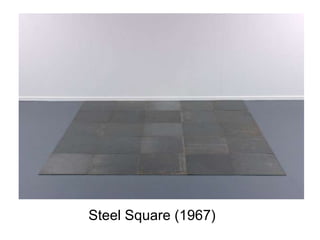
Steel Square (1967)
Minimalist Music
•   Repition
•   Short phrases
•   Long periods of time
•   Stasis
•   Steady, constant harmony and pulse
•   Hypnotic Effect
•   Composers
    – Phillip Glass, La Monte Young, Terry Riley,
      Steve Reich
Minimalist Music
• Phillip Glass – 600 Lines                http://www.youtube.com/watch?v=MYnDg7W6GpE


  – Repetitive
  – Quick switches in rhythm
  – Long period of time (player stamina)
• La Monte Young – The Well Tuned Piano
  – Monotonous                  http://www.youtube.com/watch?v=a7tmxHhcH0w


  – Deals with the physics of sound
  – How it sounds
  – Influenced by mathematical compositions
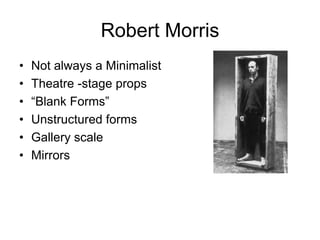
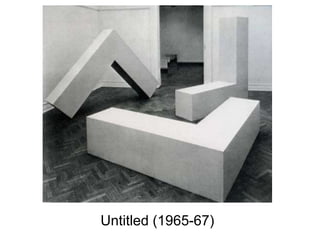
Robert Morris
•   Not always a Minimalist
•   Theatre -stage props
•   “Blank Forms”
•   Unstructured forms
•   Gallery scale
•   Mirrors
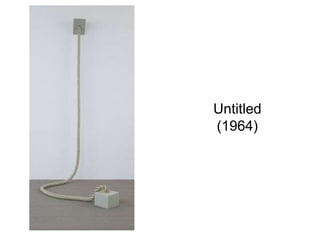
Untitled
(1964)
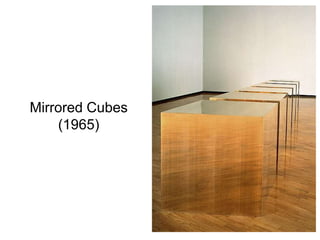
Mirrored Cubes
    (1965)
Untitled (1965-67)
Criticisms
•   Lack of complexity
•   Incoherent movement
•   Simple, no skill required
•   Only difference between this art and
    everyday life, is the setting of the gallery
Afterwards
• Lead to a contemporary form of
  minimalism

• Headed toward land art

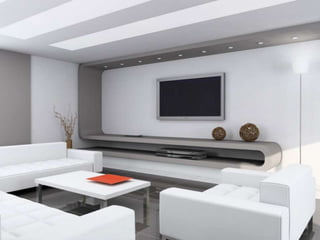
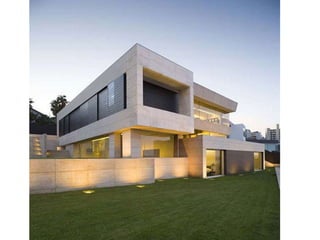
• Influenced Architecture and Interior Design
Minimalism
Minimalism

Minimalism

  • 1.
  • 2.
    What is Minimalism? •Never clearly defined movement • Artists within the movement opposed each other • “Much has been written about minimal art, but I have not discovered anyone who admits to doing this kind of thing” -LeWitt
  • 3.
    How it began •Against abstract expressionism • Turn away from inner psychological expression toward observation and referencing everyday life • Wanted a more American art form • “Getting rid of the things that people used to think were essential to art” - Judd
  • 4.
    Abstract Expressionism Number 28, 1950 Jackson Pollock (1950) Minimalism Tomlinson Court Park (from Black Series I) Frank Stella (1967)
  • 5.
    Physical Characteristics • Clean, bare, simple • Monochromatic colors • Geometric shapes, and clean lines • Repitition • Industrial materials (pre-made) • Installations • Gallery scale
  • 6.
    Symbolic Characteristics • Voidof emotional meaning • Void of political intent • Void of associations and symbolism • Some artists drew inspiration from things, but it wasn‟t meant to be hidden. • “What you see, is what you see”-Stella
  • 7.
    Main Artists • Frank Stella-1936 to Present • Sol LeWitt-1928 to 2007 • Dan Flavin-1933 to1996 • Donald Judd-1928 to 1994 • Carl Andre-1935 to Present • Robert Morris- 1931 to Present
  • 8.
    Frank Stella • Painter/printmaker/sculptor/architect •Influenced by Abstract Expressionism – Wanted to divert from it • Emphasize flatness of canvas • Worked with basic elements of art • Black geometric Color Curve 3D Painting Printing Sculpture Architecture
  • 9.
    Frank Stella Zambezi (1959)
  • 10.
  • 11.
  • 12.
    Sol LeWitt • Sculptor/painter/drawings • Wall Drawings • Both color and grayscale • Require massive teams • LeWitt was a director • Months to make • Interested in ideas not objects.
  • 13.
  • 14.
    Sol LeWitt WallDrawing Timelapse • http://www.massmoca.org/lewitt/timelapse. php?id=1 (Rainbow Swirl)
  • 15.
    Sol LeWitt cont. •Structures – Modular Structures • Skeletal Framework • Focused on texture • Later moved on to complex forms
  • 16.
  • 17.
  • 18.
  • 19.
  • 21.
    Dan Flavin • Light Propositions • Inhabits entire space with light • Wash walls with color • Makes the most with least material • Mixes light together like paint • Not meant to be permanent • Corners, barriers, corridors
  • 22.
    Dan Flavin Untitled (in honor of Harold Joachim) 3 (1977)
  • 23.
    Monument 4 forthose who have been killed in ambush (to P.K. who reminded me about death) (1966)
  • 24.
    Donald Judd • Startedoff with paintings • “Specific Objects” • Forms included „stacks‟, „boxes‟, and „progressions‟ • Industrial materials • Designed for specific locations • Critic of art
  • 25.
  • 26.
  • 27.
  • 28.
    Carl Andre • Sculptor •Raw materials • Sculpture-as-place • Designed for specific locations • Gallery scale
  • 29.
  • 30.
    Andre Stella
  • 31.
  • 32.
  • 33.
    Minimalist Music • Repition • Short phrases • Long periods of time • Stasis • Steady, constant harmony and pulse • Hypnotic Effect • Composers – Phillip Glass, La Monte Young, Terry Riley, Steve Reich
  • 34.
    Minimalist Music • PhillipGlass – 600 Lines http://www.youtube.com/watch?v=MYnDg7W6GpE – Repetitive – Quick switches in rhythm – Long period of time (player stamina) • La Monte Young – The Well Tuned Piano – Monotonous http://www.youtube.com/watch?v=a7tmxHhcH0w – Deals with the physics of sound – How it sounds – Influenced by mathematical compositions
  • 35.
    Robert Morris • Not always a Minimalist • Theatre -stage props • “Blank Forms” • Unstructured forms • Gallery scale • Mirrors
  • 36.
  • 37.
  • 38.
  • 39.
    Criticisms • Lack of complexity • Incoherent movement • Simple, no skill required • Only difference between this art and everyday life, is the setting of the gallery
  • 40.
    Afterwards • Lead toa contemporary form of minimalism • Headed toward land art • Influenced Architecture and Interior Design