
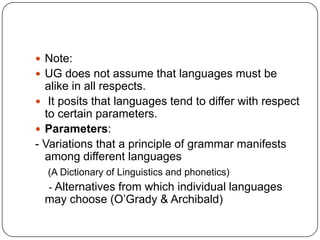
![Examples of parameters in syntax :
(1) head-direction parameter
whether heads, such as Verb, Noun, and Preposition precede or follow
their complement
English: head precedes complement (eg took some money)
Malay?
Tamil?
(2) the null-subject (or ‘pro-drop’) parameter
whether finite clauses can have empty pronominal subjects
Eg. Italian:
Non vuole mangiare.
[She] "Does not want to eat."](https://image.slidesharecdn.com/ug-130611223956-phpapp02/85/Universal-grammar-11-320.jpg)
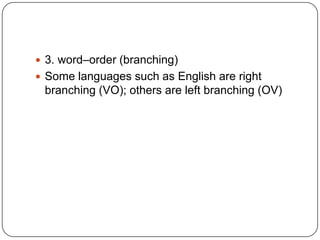


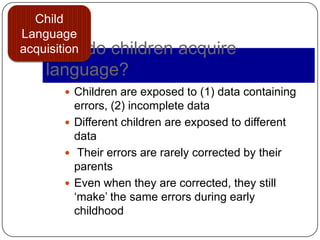
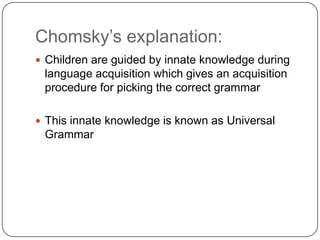
Children are able to acquire language despite being exposed to incomplete and erroneous data. Chomsky's theory of Universal Grammar (UG) explains this by proposing that the human brain contains innate knowledge about language in the form of principles and parameters. According to UG, all languages share common structural properties governed by principles, but they can vary in terms of parameters like word order. UG allows for both systematicity and variation across languages during language acquisition.


