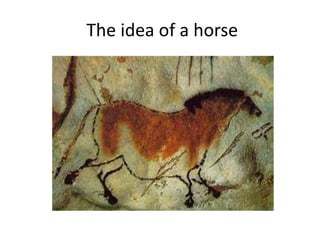
The document discusses the origins and nature of language. It explores the relationship between words, grammar, meaning, and thinking. A key point is that Noam Chomsky argues that grammar was present in the human brain before the first words or pictures, and that grammar was necessary for true thinking. The document also examines how the basic concept of "merging" or combining elements is crucial to language and allowed early humans to develop more advanced cognitive abilities.




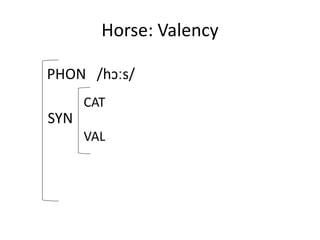
![Horse
PHON /hɔːs/
SYN
CAT [ ]
VAL](https://image.slidesharecdn.com/sem6up-191128082021/85/Sem6-up-32-320.jpg)
![Horse
PHON /hɔːs/
SYN
CAT [noun]
VAL [ ]](https://image.slidesharecdn.com/sem6up-191128082021/85/Sem6-up-33-320.jpg)
![Horse
PHON /hɔːs/
SYN
CAT [noun]
VAL [Determiner]](https://image.slidesharecdn.com/sem6up-191128082021/85/Sem6-up-34-320.jpg)
![Horse
PHON /hɔːs/
SYN
CAT [noun]
VAL [Determiner]](https://image.slidesharecdn.com/sem6up-191128082021/85/Sem6-up-35-320.jpg)
![Horse
PHON /hɔːs/
SYN
CAT [noun]
VAL [Determiner]](https://image.slidesharecdn.com/sem6up-191128082021/85/Sem6-up-36-320.jpg)
![Horse
PHON /hɔːs/
SYN
CAT [noun]
VAL [Determiner]](https://image.slidesharecdn.com/sem6up-191128082021/85/Sem6-up-37-320.jpg)
![Horse
PHON /hɔːs/
SYN
CAT [noun]
VAL [Determiner]
SEM](https://image.slidesharecdn.com/sem6up-191128082021/85/Sem6-up-38-320.jpg)
![Horse
PHON /hɔːs/
SYN
CAT [noun]
VAL [Determiner]
SEM ??????](https://image.slidesharecdn.com/sem6up-191128082021/85/Sem6-up-39-320.jpg)
![Horse
PHON /hɔːs/
SYN
CAT [noun]
VAL [Determiner]
SEM [identity of referent (actual thing)](https://image.slidesharecdn.com/sem6up-191128082021/85/Sem6-up-40-320.jpg)
![Horse
PHON /hɔːs/
SYN
CAT [noun]
VAL [Determiner]
SEM [identity of referent
+ general meaning ]](https://image.slidesharecdn.com/sem6up-191128082021/85/Sem6-up-41-320.jpg)
![Horse
PHON /hɔːs/
SYN
CAT [noun]
VAL [Determiner]
SEM [identity of referent
+ general meaning ]](https://image.slidesharecdn.com/sem6up-191128082021/85/Sem6-up-42-320.jpg)
![PHON /hɔːs/
SYN
CAT [noun]
VAL [Determiner]
SEM [identity of referent
+ general meaning ]](https://image.slidesharecdn.com/sem6up-191128082021/85/Sem6-up-43-320.jpg)
![PHON /hɔːs/
SYN
CAT [noun]
VAL [Determiner]
SEM](https://image.slidesharecdn.com/sem6up-191128082021/85/Sem6-up-44-320.jpg)
![PHON /hɔːs/
SYN
CAT [noun]
VAL [Determiner]
SEM ID
GENERAL
MEANING](https://image.slidesharecdn.com/sem6up-191128082021/85/Sem6-up-45-320.jpg)
![PHON /hɔːs/
SYN
CAT [noun]
VAL [Determiner]
SEM ID](https://image.slidesharecdn.com/sem6up-191128082021/85/Sem6-up-46-320.jpg)
![PHON /hɔːs/
SYN
CAT [noun]
VAL [Determiner]
SEM INDEX](https://image.slidesharecdn.com/sem6up-191128082021/85/Sem6-up-47-320.jpg)
![PHON /hɔːs/
SYN
CAT [noun]
VAL [Determiner]
SEM INDEX X](https://image.slidesharecdn.com/sem6up-191128082021/85/Sem6-up-48-320.jpg)
![PHON /hɔːs/
SYN
CAT [noun]
VAL [Determiner]
SEM INDEX Y](https://image.slidesharecdn.com/sem6up-191128082021/85/Sem6-up-49-320.jpg)
![PHON /hɔːs/
SYN
CAT [noun]
VAL [Determiner]
SEM INDEX Z](https://image.slidesharecdn.com/sem6up-191128082021/85/Sem6-up-50-320.jpg)
![PHON /hɔːs/
SYN
CAT [noun]
VAL [Determiner]
SEM INDEX 1](https://image.slidesharecdn.com/sem6up-191128082021/85/Sem6-up-51-320.jpg)
![PHON /hɔːs/
SYN
CAT [noun]
VAL [Determiner]
SEM INDEX 2](https://image.slidesharecdn.com/sem6up-191128082021/85/Sem6-up-52-320.jpg)
![PHON /hɔːs/
SYN
CAT [noun]
VAL [Determiner]
SEM INDEX X](https://image.slidesharecdn.com/sem6up-191128082021/85/Sem6-up-53-320.jpg)
![PHON /hɔːs/
SYN
CAT [noun]
VAL [Determiner]
SEM INDEX 3rd Person
Singular](https://image.slidesharecdn.com/sem6up-191128082021/85/Sem6-up-54-320.jpg)
![PHON /hɔːs/
SYN
CAT [noun]
VAL [Determiner]
SEM INDEX X](https://image.slidesharecdn.com/sem6up-191128082021/85/Sem6-up-55-320.jpg)
![PHON /hɔːs/
SYN
CAT [noun]
VAL [Determiner]
SEM
INDEX X](https://image.slidesharecdn.com/sem6up-191128082021/85/Sem6-up-56-320.jpg)
![PHON /hɔːs/
SYN
CAT [noun]
VAL [Determiner]
SEM
INDEX X
FRAMES](https://image.slidesharecdn.com/sem6up-191128082021/85/Sem6-up-57-320.jpg)
![PHON /hɔːs/
SYN
CAT [noun]
VAL [Determiner]
SEM
INDEX X
FRAMES: GENERAL MEANING](https://image.slidesharecdn.com/sem6up-191128082021/85/Sem6-up-58-320.jpg)
![PHON /hɔːs/
SYN
CAT [noun]
VAL [Determiner]
SEM
INDEX X
FRAMES <
Horse-Frame](https://image.slidesharecdn.com/sem6up-191128082021/85/Sem6-up-59-320.jpg)
![PHON /hɔːs/
SYN
CAT [noun]
VAL [Determiner]
SEM
INDEX X
FRAMES <
Horse-Frame
Entity X](https://image.slidesharecdn.com/sem6up-191128082021/85/Sem6-up-60-320.jpg)
![PHON /hɔːs/
SYN
CAT [noun]
VAL [Determiner]
SEM
INDEX X
FRAMES <
Horse-Frame
Entity X
X = 3rd Person, Singular](https://image.slidesharecdn.com/sem6up-191128082021/85/Sem6-up-61-320.jpg)
![PHON /hɔːs/
SYN
CAT [noun]
VAL [Determiner]
SEM
INDEX X
FRAMES <
Horse-Frame
Entity X](https://image.slidesharecdn.com/sem6up-191128082021/85/Sem6-up-62-320.jpg)
![PHON /hɔːs/
SYN
CAT [noun]
VAL [Determiner]
SEM
INDEX X
FRAMES <
Horse-Frame
Entity X
>](https://image.slidesharecdn.com/sem6up-191128082021/85/Sem6-up-63-320.jpg)








![PHON /ʃiː/
SYN
CAT [ CASE [ ]]
VAL [ ]
SEM
INDEX
FRAMES <
–Frame
Entity
>](https://image.slidesharecdn.com/sem6up-191128082021/85/Sem6-up-132-320.jpg)
![PHON /ʃiː/
SYN
CAT [ noun CASE [ ]]
VAL [ ]
SEM
INDEX
FRAMES <
–Frame
Entity
>](https://image.slidesharecdn.com/sem6up-191128082021/85/Sem6-up-133-320.jpg)
![PHON /ʃiː/
SYN
CAT [ noun CASE [ nom ]]
VAL [ ]
SEM
INDEX
FRAMES <
–Frame
Entity
>](https://image.slidesharecdn.com/sem6up-191128082021/85/Sem6-up-134-320.jpg)
![PHON /ʃiː/
SYN
CAT [ noun CASE [ nom ]]
VAL [ ???? ]
SEM
INDEX
FRAMES <
–Frame
Entity
>](https://image.slidesharecdn.com/sem6up-191128082021/85/Sem6-up-135-320.jpg)
![PHON /ʃiː/
SYN
CAT [ noun CASE [ nom ]]
VAL [ ]
SEM
INDEX
FRAMES <
–Frame
Entity
>](https://image.slidesharecdn.com/sem6up-191128082021/85/Sem6-up-136-320.jpg)
![PHON /ʃiː/
SYN
CAT [ noun CASE [ nom ]]
VAL [ ]
SEM
INDEX X
FRAMES <
–Frame
Entity
>](https://image.slidesharecdn.com/sem6up-191128082021/85/Sem6-up-137-320.jpg)
![PHON /ʃiː/
SYN
CAT [ noun CASE [ nom ]]
VAL [ ]
SEM
INDEX X
FRAMES <
female –Frame
Entity
>](https://image.slidesharecdn.com/sem6up-191128082021/85/Sem6-up-138-320.jpg)
![PHON /ʃiː/
SYN
CAT [ noun CASE [ nom ]]
VAL [ ]
SEM
INDEX X
FRAMES <
female –Frame
Entity X
>](https://image.slidesharecdn.com/sem6up-191128082021/85/Sem6-up-139-320.jpg)
![PHON /hɪm/
SYN
CAT [ CASE [ ]]
VAL < >
SEM
INDEX
FRAMES <
–Frame
Entity
>](https://image.slidesharecdn.com/sem6up-191128082021/85/Sem6-up-140-320.jpg)
![PHON /hɪm/
SYN
CAT [ noun CASE [ acc ]]
VAL < >
SEM
INDEX Y
FRAMES <
Male –Frame
Entity Y
>](https://image.slidesharecdn.com/sem6up-191128082021/85/Sem6-up-141-320.jpg)
![PHON /sliːps/
SYN
CAT [ ]
VAL <NP[CASE ] X= PER: NUM: >
SEM
INDEX
FRAMES <
–Frame
Entity
>](https://image.slidesharecdn.com/sem6up-191128082021/85/Sem6-up-142-320.jpg)
![PHON /sliːps/
SYN
CAT [ ? ]
VAL <NP[CASE ? ] X= PER:? NUM: ? >
SEM
INDEX ??
?
FRAMES <
? –Frame
Entity ??
>](https://image.slidesharecdn.com/sem6up-191128082021/85/Sem6-up-143-320.jpg)
![PHON /sliːps/
SYN
CAT [ verb ]
VAL <NP[CASE nom] X= PER: 3 NUM:sing>
SEM
INDEX S
FRAMES <
Sleeping–Frame
Entity X
>](https://image.slidesharecdn.com/sem6up-191128082021/85/Sem6-up-144-320.jpg)
![PHON /siːz/
SYN
CAT [ ]
VAL <NP[CASE ] X= PER: NUM: ,
NP[CASE ] Y= PER: NUM: >
SEM
INDEX
FRAMES <
–Frame
>SEER
SEEN](https://image.slidesharecdn.com/sem6up-191128082021/85/Sem6-up-145-320.jpg)
![PHON /siːz/
SYN
CAT [ ]
VAL <NP[CASE ] X= PER: NUM: ,
NP[CASE ] Y= PER: NUM: >
SEM
INDEX
FRAMES <
–Frame
>SEER
SEEN](https://image.slidesharecdn.com/sem6up-191128082021/85/Sem6-up-146-320.jpg)
![PHON /siːz/
SYN
CAT [ ? ]
VAL <NP[CASE ? ] X= PER:? NUM: ? ,
NP[CASE ? ] Y= PER: ? NUM:?
>
SEM
INDEX ?
FRAMES <
? –Frame
>SEER
SEEN
?
?](https://image.slidesharecdn.com/sem6up-191128082021/85/Sem6-up-147-320.jpg)
![PHON /siːz/
SYN
CAT [ verb ]
VAL <NP[CASE nom ] X= PER:3 NUM: 1 ,
NP[CASE acc ] Y= PER: NUM: >
SEM
INDEX S
FRAMES <
Seeing –Frame
>SEER
SEEN
X
Y](https://image.slidesharecdn.com/sem6up-191128082021/85/Sem6-up-148-320.jpg)




![PHON /siːz/
SYN
CAT [ verb ]
VAL <NP[CASE nom ] X= PER:3 NUM: 1 ,
NP[CASE acc ] Y= PER: NUM: >
SEM
INDEX S
FRAMES <
Seeing –Frame
>SEER
SEEN
X
Y
VALENCY and
SEM SPECS](https://image.slidesharecdn.com/sem6up-191128082021/85/Sem6-up-212-320.jpg)


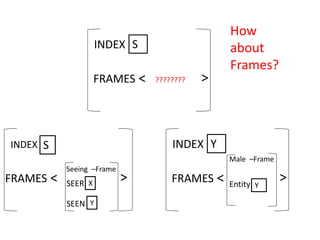


![PHON /siːz/
SYN
CAT [ verb ]
VAL <NP[CASE nom ] X= PER:3 NUM: 1 ,
NP[CASE acc ] Y= PER: NUM: >
SEM
INDEX S
FRAMES <
Seeing –Frame
>SEER
SEEN
X
Y](https://image.slidesharecdn.com/sem6up-191128082021/85/Sem6-up-236-320.jpg)
![PHON /hɪm/
SYN
CAT [ noun CASE [ acc ]]
VAL < >
SEM
INDEX X
FRAMES <
Male –Frame
Entity X
>](https://image.slidesharecdn.com/sem6up-191128082021/85/Sem6-up-237-320.jpg)
![SYNTAX for “sees”
CAT [ verb ]
VAL <NP[CASE nom ] X,
NP[CASE acc ] Y>](https://image.slidesharecdn.com/sem6up-191128082021/85/Sem6-up-238-320.jpg)
![SYNTAX for “him”
CAT [ verb ]
VAL <NP[CASE nom ] X,
NP[CASE acc ] Y>
CAT [noun [CASE acc]]
VAL < >](https://image.slidesharecdn.com/sem6up-191128082021/85/Sem6-up-239-320.jpg)
![SYNTAX for “ sees him”?
CAT [ verb ]
VAL <NP[CASE nom ] X,
NP[CASE acc ] Y>
CAT [noun [CASE acc]]
VAL < >](https://image.slidesharecdn.com/sem6up-191128082021/85/Sem6-up-240-320.jpg)
![What do you think?
CAT [ verb ]
VAL <NP[CASE nom ] X,
NP[CASE acc ] Y>
CAT [noun [CASE acc]]
VAL < >](https://image.slidesharecdn.com/sem6up-191128082021/85/Sem6-up-241-320.jpg)
![CAT [ verb ]
VAL <NP[CASE nom ] X,
NP[CASE acc ] Y>
CAT [noun [CASE acc]]
VAL < >
SYNTAX of “sees him”](https://image.slidesharecdn.com/sem6up-191128082021/85/Sem6-up-242-320.jpg)
![CAT [ verb ]
VAL <NP[CASE nom ] X,
NP[CASE acc ] Y>
CAT [noun [CASE acc]]
VAL < >
CAT [ verb ]
VAL <NP[CASE nom ] X,
NP[CASE acc ] Y>
Exactly
the same
as the
SYNTAX of
the verb …](https://image.slidesharecdn.com/sem6up-191128082021/85/Sem6-up-243-320.jpg)
![CAT [ verb ]
VAL <NP[CASE nom ] X,
NP[CASE acc ] Y>
CAT [noun [CASE acc]]
VAL < >
CAT [ verb ]
VAL <NP[CASE nom ] X>
… minus
the object
in the
VALENCY
list](https://image.slidesharecdn.com/sem6up-191128082021/85/Sem6-up-244-320.jpg)


![unit I [Autosaved].ppt](https://cdn.slidesharecdn.com/ss_thumbnails/unitiautosaved-230112124016-90655782-thumbnail.jpg?width=640&height=640&fit=bounds)


