


SECOND LANGAUGE ACQUITION
Presentation
Presented By: Laiba Yaseen
Topic: “ SFL’’
Presented To: Ma’am Maryam
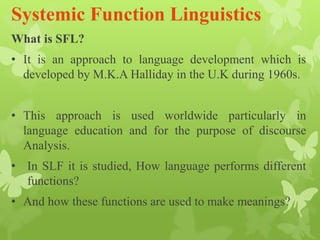
Systemic Function Linguistics
What is SFL?
• It is an approach to language development which is
developed by M.K.A Halliday in the U.K during 1960s.
• This approach is used worldwide particularly in
language education and for the purpose of discourse
Analysis.
• In SLF it is studied, How language performs different
functions?
• And how these functions are used to make meanings?
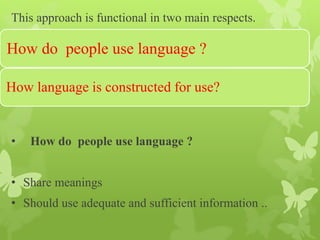
This approach is functional in two main respects.
• How do people use language ?
• Share meanings
• Should use adequate and sufficient information ..
How do people use language ?
How language is constructed for use?
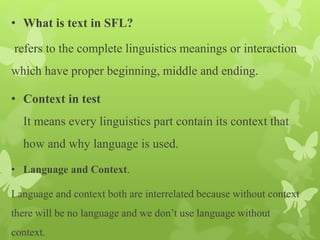
• What is text in SFL?
refers to the complete linguistics meanings or interaction
which have proper beginning, middle and ending.
• Context in test
It means every linguistics part contain its context that
how and why language is used.
• Language and Context.
Language and context both are interrelated because without context
there will be no language and we don’t use language without
context.
Language and context help us to understand the functions
of language.
Choice of words indicates the context.
• e.g. Let’s go on cigarette shop.
• I ordered him to attack on reds.
• Register
The immediate context of situation is called register.
It can vary on the basis of mode, tenor and field.
Tenor:
Tenor is 'the social role relationships.
For example, roles such as student/lecturer, customer/salesperson,
friend/ friend.
Field:
Field can be glossed as the 'topic' of the situation. Martin's broader
definition in terms of institutional focus or social activity type is
more useful to capture the field in situations where language is
accompanying action.
• Mode
Channel of communication such as writing and speaking,
newspapers.
Language can be organized with help of novel, drama,
poetry. But in SFL it refers to the impacts of context of
situation on language.
Genre
Ideology
it is the higher level of context.
e.g. to write something to parents.
or to write something to VC.
1. How language is constructed for use?
The fundamental functions of language are to make,
construct and establish meanings.
Overall of language is associated with Semantics which
deals with the meanings and meanings in SFL have
different metafunctions.
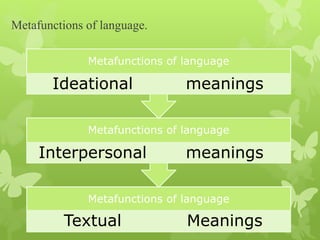
Metafunctions of language.
Metafunctions of language
Textual Meanings
Metafunctions of language
Interpersonal meanings
Metafunctions of language
Ideational meanings
Ideational metafunctions are identified with the help of
ideas because these meanings are deduced from the
experience.
It generally refers to how meaning is represented in clause.
It encodes how speaker reveals the language with the help
of mental picture and experiences.
Ideational Meanings
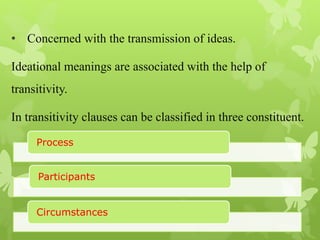
• Concerned with the transmission of ideas.
Ideational meanings are associated with the help of
transitivity.
In transitivity clauses can be classified in three constituent.
Process
Participants
Circumstances
Participants
that can be identified through the noun group.
Process and its type;
the process is identified through the verb and verb group.
Circumstances;
it is usually identified by the adverb group and prepositional
phrases.
e.g. He is delivering his lecture on the computer.
Text has interpersonal meanings which can be elucidated
with the relation ship of reader and writer or speaker and
listener.
The behavior and attitude of the speaker or writer towards
to the subject matter.
Interpersonal meanings
• The term involves all of the grammatical systems
responsible for managing the flow of discourse.
• Textual Meta-function involves the creation of text.
According to Halliday, Textual meta-function is
realized through thematic structure, information
structure and cohesion.
Textual Function
Thematic structure Includes ‘theme’ and ‘thematic
progression patterns’ , information structure include given
and new units of information and cohesion includes
reference, ellipsis, conjunction and lexical cohesion.
TYPES
1. Theme
2. Rheme
THEME
According to Halliday, theme is defined as “the point of
departure”. Theme of a clause “ends with the first
constituent that is either participant, circumstance or a
process”.
Theme Marked Theme & Unmarked Theme
RHEME
According to Halliday, theme is defined as “The reminder
of the message”. i.e everything which is not theme.
• e.g.
• Government should do something to reduce the price of
petroleum.
• In the 20th century, world has faced many calamities.
Semiotics meanings of system
• Semiotic means the study of sings and symbols is
called semiotics.
• These signs and symbols have meanings.
• Interpreted in accordance with experience.
• Semiotic system is arbitrary
• It establishes social conventions.
e.g. Traffic lights.
• SFL deals with relationship between grammar and
meaning, and grammar and context
• Describe the use of language.
• language as functionally related to its context of use.
• grammar is the kinds of discourses and texts that
people need to produce for different purposes in
different social contexts.
Why We study SFL in SLA?
Role of SFL in SLA
• Systemic linguists do not separate language and society.
Language is realized through text and context.
• This implies that texts do not have inherent meanings since
meaning emerges according to the way texts are used in social
contexts.
• In SFL, we understand how speakers express meaning and how
these are motivated by contextual factors.
• SFL has a crucial role in SLA because it focuses on both the
production and analysis of texts
• It offers the analysis of grammatical features in written texts,
such as: the different stages of texts, theme and rheme position,
lexical choices (technical vocabulary, descriptive vocabulary,
vocabulary of judgment or attitude), types of verbs, noun groups
(including nominalization, extended noun groups), cohesion
(types of conjunctions, types of reference, substitution, ellipsis,
lexical cohesion).
• When students of SLA are able to analyze these features, they can
predict the context of the text and at the same time they learn to
use these grammatical features in their written texts and improve
their level of learning.
Any Question?

Systemic Functional Linguistics

  • 1.
    SECOND LANGAUGE ACQUITION Presentation PresentedBy: Laiba Yaseen Topic: “ SFL’’ Presented To: Ma’am Maryam
  • 2.
    Systemic Function Linguistics Whatis SFL? • It is an approach to language development which is developed by M.K.A Halliday in the U.K during 1960s. • This approach is used worldwide particularly in language education and for the purpose of discourse Analysis. • In SLF it is studied, How language performs different functions? • And how these functions are used to make meanings?
  • 3.
    This approach isfunctional in two main respects. • How do people use language ? • Share meanings • Should use adequate and sufficient information .. How do people use language ? How language is constructed for use?
  • 4.
    • What istext in SFL? refers to the complete linguistics meanings or interaction which have proper beginning, middle and ending. • Context in test It means every linguistics part contain its context that how and why language is used. • Language and Context. Language and context both are interrelated because without context there will be no language and we don’t use language without context.
  • 5.
    Language and contexthelp us to understand the functions of language. Choice of words indicates the context. • e.g. Let’s go on cigarette shop. • I ordered him to attack on reds. • Register The immediate context of situation is called register. It can vary on the basis of mode, tenor and field.
  • 6.
    Tenor: Tenor is 'thesocial role relationships. For example, roles such as student/lecturer, customer/salesperson, friend/ friend. Field: Field can be glossed as the 'topic' of the situation. Martin's broader definition in terms of institutional focus or social activity type is more useful to capture the field in situations where language is accompanying action.
  • 7.
    • Mode Channel ofcommunication such as writing and speaking, newspapers. Language can be organized with help of novel, drama, poetry. But in SFL it refers to the impacts of context of situation on language. Genre
  • 8.
    Ideology it is thehigher level of context. e.g. to write something to parents. or to write something to VC.
  • 9.
    1. How languageis constructed for use? The fundamental functions of language are to make, construct and establish meanings. Overall of language is associated with Semantics which deals with the meanings and meanings in SFL have different metafunctions.
  • 10.
    Metafunctions of language. Metafunctionsof language Textual Meanings Metafunctions of language Interpersonal meanings Metafunctions of language Ideational meanings
  • 11.
    Ideational metafunctions areidentified with the help of ideas because these meanings are deduced from the experience. It generally refers to how meaning is represented in clause. It encodes how speaker reveals the language with the help of mental picture and experiences. Ideational Meanings
  • 12.
    • Concerned withthe transmission of ideas. Ideational meanings are associated with the help of transitivity. In transitivity clauses can be classified in three constituent. Process Participants Circumstances
  • 13.
    Participants that can beidentified through the noun group. Process and its type; the process is identified through the verb and verb group. Circumstances; it is usually identified by the adverb group and prepositional phrases. e.g. He is delivering his lecture on the computer.
  • 14.
    Text has interpersonalmeanings which can be elucidated with the relation ship of reader and writer or speaker and listener. The behavior and attitude of the speaker or writer towards to the subject matter. Interpersonal meanings
  • 15.
    • The terminvolves all of the grammatical systems responsible for managing the flow of discourse. • Textual Meta-function involves the creation of text. According to Halliday, Textual meta-function is realized through thematic structure, information structure and cohesion. Textual Function
  • 16.
    Thematic structure Includes‘theme’ and ‘thematic progression patterns’ , information structure include given and new units of information and cohesion includes reference, ellipsis, conjunction and lexical cohesion. TYPES 1. Theme 2. Rheme
  • 17.
    THEME According to Halliday,theme is defined as “the point of departure”. Theme of a clause “ends with the first constituent that is either participant, circumstance or a process”. Theme Marked Theme & Unmarked Theme RHEME According to Halliday, theme is defined as “The reminder of the message”. i.e everything which is not theme.
  • 18.
    • e.g. • Governmentshould do something to reduce the price of petroleum. • In the 20th century, world has faced many calamities.
  • 19.
    Semiotics meanings ofsystem • Semiotic means the study of sings and symbols is called semiotics. • These signs and symbols have meanings. • Interpreted in accordance with experience. • Semiotic system is arbitrary • It establishes social conventions. e.g. Traffic lights.
  • 20.
    • SFL dealswith relationship between grammar and meaning, and grammar and context • Describe the use of language. • language as functionally related to its context of use. • grammar is the kinds of discourses and texts that people need to produce for different purposes in different social contexts. Why We study SFL in SLA? Role of SFL in SLA
  • 21.
    • Systemic linguistsdo not separate language and society. Language is realized through text and context. • This implies that texts do not have inherent meanings since meaning emerges according to the way texts are used in social contexts. • In SFL, we understand how speakers express meaning and how these are motivated by contextual factors. • SFL has a crucial role in SLA because it focuses on both the production and analysis of texts
  • 22.
    • It offersthe analysis of grammatical features in written texts, such as: the different stages of texts, theme and rheme position, lexical choices (technical vocabulary, descriptive vocabulary, vocabulary of judgment or attitude), types of verbs, noun groups (including nominalization, extended noun groups), cohesion (types of conjunctions, types of reference, substitution, ellipsis, lexical cohesion). • When students of SLA are able to analyze these features, they can predict the context of the text and at the same time they learn to use these grammatical features in their written texts and improve their level of learning.
  • 23.