Prezentation by:M. Musilová
O.Chudada
L. Brychová
Background
 Principles and parameters is a linguistic theory largely
formulated by the linguists Noam
Chomsky and Howard Lasnik, though it was the
culmination of the research of many linguists.
 Today, many linguists have adopted this framework,
and it is considered the dominant form of mainstream
generative linguistics.
What are the Principles and
Parameters in syntax?
 An approach to the question of how children acquire
language.
 Ideas started shaping since the early days of modern
generative grammar.
 Syntax is described with the use of:
 A) general principles
 Abstract rules
 Grammar
 B) specific parameters
 Markers
 Switches
Previous ideas and observations
 Despite large variations, languages have many
common properties on an abstract level.
 Parts of language that are not present in the physical
world.
 Children learn languages easily, despite the fact that
language are often complex.
 Idea: the common properties of languages are present,
only variations need to be learned.
Principles and Parameters
Universal Grammar can be defined as:
 The set of Principles that are common to all languages.
 The initial state of language knowledge for human beings.
 Principles may include parameters, which represent
settings that may vary from language to language.
 Children ’simply’ need to learn the values of relevant
parameters to acquire the grammar of their native language
Goals of syntactic research
 The research on syntax should answer the following
questions:
 What are the Principles that are part of Universal
Grammar?
 What parameters are there in Universal Grammar, and
what are their possible values in individual languages?
 Within this framework, the goal of linguistics is to
identify all of the principles and parameters that are
universal to human language (Universal Grammar).
Framework
 The central idea of principles and parameters is that a
person's syntactic knowledge can be modeled with
two formal mechanisms:
 A finite set of fundamental principles that are common
to all languages.
 Example: A sentence must always have a subject, even if it is
not overtly pronounced.
Framework
 A finite set of parameters that determine syntactic
variability amongst languages.
 binary parameter that determines whether or not the
subject of a sentence must be overtly pronounced (this
example is sometimes referred to as the Pro-drop
parameter).
 Example: [I (am)] going to the store.
Framework
 Any attempt to explain the syntax of a particular
language using a principle or parameter has to be
cross-examined with the evidence available in other
languages.
 Part of Comperative linquistics. Finding similarities and
common elements in languages.
Principles within the structure
 There are several principles present in the UG
acording to the Principles and parameters theory:
 Structure Preservation Principle:
 Deep Structures should be preserved by a movement
transformation, which simply rephrases the sentence.
 Projection Principle:
 The range of syntactic elements with which a lexical unit
combines can be ‘projected from’ a lexicon as restrictions on
structures that contain it.
Structure Preservation Principle
 The Structure Preservation Principle is a stipulation proposed
by Noam Chomsky as part of the Generative-Transformational
Grammar.
 Under the Structure Preservation Principle, Deep Structures should be
preserved by a movement transformation, which simply rephrases the
sentence.
Example of this Principle:
 Fabio strangled Prince Jamal. Can be transformed into:
 Prince Jamal was strangled by Fabio. and this Principle is fulfilled.
 Both sentences hold the same meaning, because their Deep Structure
remains equal. Only their Surface Structure changes, this is, just the
arrangement of the words changes. Of course, auxiliary words
like by are needed for the rearrangement to work.
Projection Principle
 The projection principle is used in the derivation of
phrases.
 Under the Projection Principle, the properties of lexical items
must be preserved while generating the phrase structure of a
sentence.
 The Principle, as formulated by Chomsky, states that
"lexical structure must be represented categorically at every
syntactic level" (Chomsky 1986: 84).
Projection Principle
 Chomsky further defined the projection principle as
"representations at each level of syntax are projected
from the lexicon in that they observe the sub-
categorisation properties of lexical items."
 For example, the verb strangle, apart from the subject,
has an obligatory argument, its object, which must
appear in the sentence.
Projection principle
 The following sub-categorization frame for the
verb strangle specifies its properties; the underlined gap for
the location of the verb is followed by the noun phrase (NP):
 Strangle- Verb, [NP]It is out of this frame that a sentence
like the following can be generated:
 Fabio strangled Prince Jamal.
A sentence without the object, in violation of the verb's
sub-categorization frame and the Projection Principle,
would be ill-formed:*Fabio strangled.
Specific parameters
• A finite set of parameters that determine
syntactic variability amongst languages;
 English is considered a non-pro-drop
language. Nonetheless, subject pronouns
are almost always dropped in imperative
sentences (e.g., Come here).
Specific parameters
 In informal speech, pronouns may
sometimes be dropped in other type of
sentences, together with some other words,
especially copulas and auxiliaries:
 [Have you] ever been there?
 [I'm] going to the shops. [[Do] you] want
to come [with [me]]?
Examples
 Head-directionality parameter
 Nominal mapping parameter
 Null subject parameter
 Polysynthesis parameter
 Serial verb parameter
 Topic prominent parameter
 Verb attraction parameter
Head-directionality parameter
 In linguistics, the head directionality parameter is a
proposed parameter that classifies word order
according to the placement of heads in phrases.
 Head directionality is also understood in terms of the
direction of branching.
Head-directionality parameter
One distinguishes between two major types of phrases:
 Head-initial (= right-branching) phrases: Heads precede
their dependents.
 English (head-initial): John has put the book on the table.
 Head-final (= left-branching) phrases: Heads follow
their dependents.
 German (head-final): Jan hat das Buch auf den Tisch
gelegt, [John-has the-book on-the-table put].
Pro-drop parameter
 (from "pronoun-dropping") is a language in which certain
classes of pronouns may be omitted when they are in some
sense pragmatically inferable.
 Can be common in some languages (Japanise, Slavic
languages).
 Or are part of the spoken part of language. (English)
 [Have you] ever been there?
 [I'm] going to the shops. [[Do] you] want to come [with [me]]?
Language acquisition
 According to this framework, principles and
parameters are part of a genetically innate universal
grammar (UG) which all humans possess.
 As such, principles and parameters do not need to be
learned by exposure to language. Rather, exposure to
language merely triggers the parameters to adopt the
correct setting.
Acquisition issues
 The first issues is the complexity of languages, yet
children seen to aquire it almost effortlessly..
 Languages differ, in pronunciation, word order,
grammar.
 Universals: language is universally acquired in the same
manner and the deepest structure is the same in all
languages.
 Principles: are universal:Word order, Question, Formation,
Agreement
 Parameters : vary across languages
Rules
 By specifying sentences into structural patterns,
linguistics believe it is possible to identify the general
rules in which languages are aquired and used.
 Two different typer of rules exist in this theory:
 Phrase structure rules.
 Relational dependenci rules.
Phrase structure rules
A phrase is a syntactic unit headed by a lexical
category such as Noun, Adjective, Adverb, Verb, or
Preposition.
•
Phrases are named for their heads:
• NP, VP, AdjP, AdvP, PP
How phrases are formed is governed by rules (=
„phrase structure rules´)
Phrase structure rules
Rules that determine:
what goes into a phrase („constituents‟)
how the constituents are ordered
Constituent is a word or group of words:
that function as a unit and can make up larger
grammatical units
 Phrase and head
Each rule “rewrites” a constituent into one or
more constituents
Phrase structure rules
are generative, allow recursion.
give different analyses of syntactically ambiguous
sentences.
have a hierarchical structure.
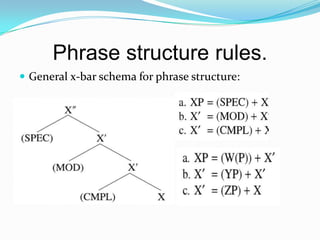
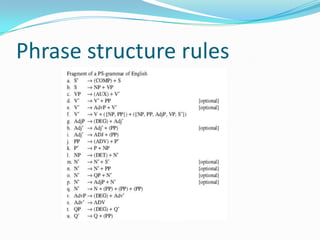
Phrase structure rules.
 General x-bar schema for phrase structure:
Phrase structure rules
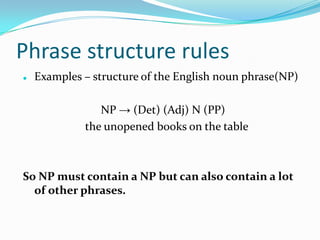
 Examples – structure of the English noun phrase(NP)
NP → (Det) (Adj) N (PP)
the unopened books on the table
So NP must contain a NP but can also contain a lot
of other phrases.
Phrase structure rules
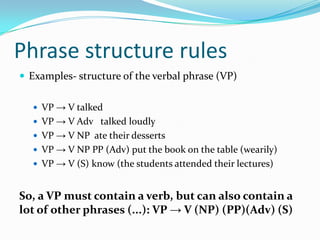
 Examples- structure of the verbal phrase (VP)
 VP → V talked
 VP → V Adv talked loudly
 VP → V NP ate their desserts
 VP → V NP PP (Adv) put the book on the table (wearily)
 VP → V (S) know (the students attended their lectures)
So, a VP must contain a verb, but can also contain a
lot of other phrases (...): VP → V (NP) (PP)(Adv) (S)
Phrase structure rules
Sentence/Clause-level PS Rules (English has quite a
fixed clause-level PS Rule)
1. S → NP VP (a sentence is obligatorily comprised of a NP
and a VP)
[NP The students] [VP attended their lectures]
2. S → NP (Aux) VP
The students will take exams.
Sentence must contain NP and VP, the auxiliary is
optional, we can indicate this with (...).
Phrase structure rules
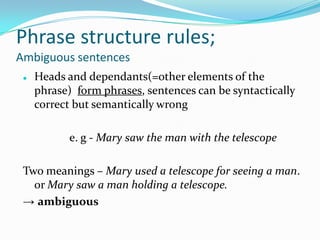
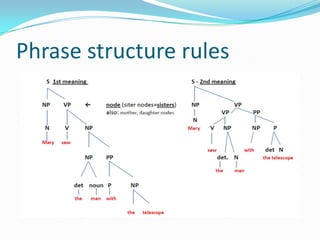
Phrase structure rules;
Ambiguous sentences
 Heads and dependants(=other elements of the
phrase) form phrases, sentences can be syntactically
correct but semantically wrong
e. g. - Mary saw the man with the telescope
Two meanings – Mary used a telescope for seeing a man.
or Mary saw a man holding a telescope.
→ ambiguous
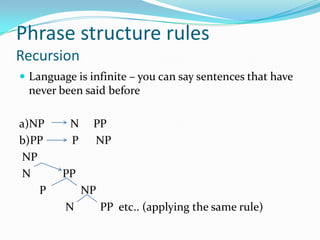
Phrase structure rules
Recursion
 Language is infinite – you can say sentences that have
never been said before
a)NP N PP
b)PP P NP
NP
N PP
P NP
N PP etc.. (applying the same rule)
The lexicon and sub-categorization
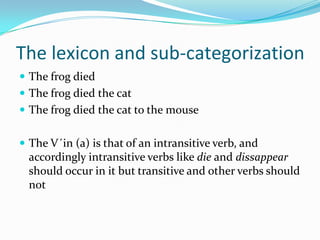
 The frog died
 The frog died the cat
 The frog died the cat to the mouse
 The V´in (a) is that of an intransitive verb, and
accordingly intransitive verbs like die and dissappear
should occur in it but transitive and other verbs should
not
The lexicon and sub-categorization
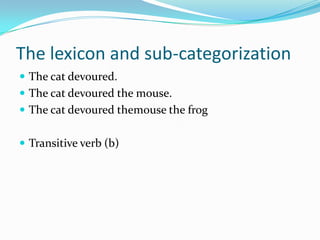
 The cat devoured.
 The cat devoured the mouse.
 The cat devoured themouse the frog
 Transitive verb (b)
The lexicon and sub-categorization
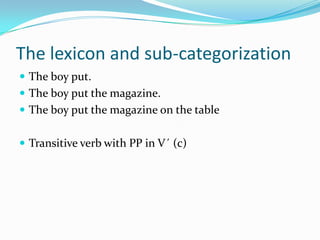
 The boy put.
 The boy put the magazine.
 The boy put the magazine on the table
 Transitive verb with PP in V´ (c)
How would such a principle be
realized formally in the kind of
grammar?
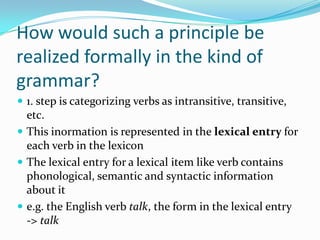
 1. step is categorizing verbs as intransitive, transitive,
etc.
 This inormation is represented in the lexical entry for
each verb in the lexicon
 The lexical entry for a lexical item like verb contains
phonological, semantic and syntactic information
about it
 e.g. the English verb talk, the form in the lexical entry
-> talk
The lexicon and sub-categorization
 The semantic information includes its argument
structure
 e.g. <Patient> for die or
 <Agent Theme recipient> for donate
Subcategorization frame
 a. die [v´_]
 b. devour [v´_NP]
 c. Put [v´_NP PP]
 The ´_´ indicates the possition occupied by the verb
 Die occurs in a V´ without any sister NPs - >
intransitive verb
Syntactic subcategorization frame
 If an argument is represented in the semantic
argument atructure of the verb and it would not bethe
subject, then it must be in the verb´s syntactic
subcategorization frame.
 a. die [v´_]
 <Patient>
 b. devour [v´_NP]
 <Agent Patient>
 c. put [v´_NP PP]
 <Agent Theme Location>
Conclusion
 In this prezentation we tried to explain what the
principles and paraments of language acquisition are,
as well as the issues that arise in explaining their
presence in language learning.
References
 Chomsky, N. (1981). Lectures on Government and Binding.
Mouton de Gruyter.
 Chomsky, N. and Lasnik, H. (1993) Principles and
Parameters Theory, in Syntax: An International Handbook
of Contemporary Research, Berlin: de Gruyter.

Principles of parameters

  • 1.
  • 2.
    Background  Principles andparameters is a linguistic theory largely formulated by the linguists Noam Chomsky and Howard Lasnik, though it was the culmination of the research of many linguists.  Today, many linguists have adopted this framework, and it is considered the dominant form of mainstream generative linguistics.
  • 3.
    What are thePrinciples and Parameters in syntax?  An approach to the question of how children acquire language.  Ideas started shaping since the early days of modern generative grammar.  Syntax is described with the use of:  A) general principles  Abstract rules  Grammar  B) specific parameters  Markers  Switches
  • 4.
    Previous ideas andobservations  Despite large variations, languages have many common properties on an abstract level.  Parts of language that are not present in the physical world.  Children learn languages easily, despite the fact that language are often complex.  Idea: the common properties of languages are present, only variations need to be learned.
  • 5.
    Principles and Parameters UniversalGrammar can be defined as:  The set of Principles that are common to all languages.  The initial state of language knowledge for human beings.  Principles may include parameters, which represent settings that may vary from language to language.  Children ’simply’ need to learn the values of relevant parameters to acquire the grammar of their native language
  • 6.
    Goals of syntacticresearch  The research on syntax should answer the following questions:  What are the Principles that are part of Universal Grammar?  What parameters are there in Universal Grammar, and what are their possible values in individual languages?  Within this framework, the goal of linguistics is to identify all of the principles and parameters that are universal to human language (Universal Grammar).
  • 7.
    Framework  The centralidea of principles and parameters is that a person's syntactic knowledge can be modeled with two formal mechanisms:  A finite set of fundamental principles that are common to all languages.  Example: A sentence must always have a subject, even if it is not overtly pronounced.
  • 8.
    Framework  A finiteset of parameters that determine syntactic variability amongst languages.  binary parameter that determines whether or not the subject of a sentence must be overtly pronounced (this example is sometimes referred to as the Pro-drop parameter).  Example: [I (am)] going to the store.
  • 9.
    Framework  Any attemptto explain the syntax of a particular language using a principle or parameter has to be cross-examined with the evidence available in other languages.  Part of Comperative linquistics. Finding similarities and common elements in languages.
  • 10.
    Principles within thestructure  There are several principles present in the UG acording to the Principles and parameters theory:  Structure Preservation Principle:  Deep Structures should be preserved by a movement transformation, which simply rephrases the sentence.  Projection Principle:  The range of syntactic elements with which a lexical unit combines can be ‘projected from’ a lexicon as restrictions on structures that contain it.
  • 11.
    Structure Preservation Principle The Structure Preservation Principle is a stipulation proposed by Noam Chomsky as part of the Generative-Transformational Grammar.  Under the Structure Preservation Principle, Deep Structures should be preserved by a movement transformation, which simply rephrases the sentence. Example of this Principle:  Fabio strangled Prince Jamal. Can be transformed into:  Prince Jamal was strangled by Fabio. and this Principle is fulfilled.  Both sentences hold the same meaning, because their Deep Structure remains equal. Only their Surface Structure changes, this is, just the arrangement of the words changes. Of course, auxiliary words like by are needed for the rearrangement to work.
  • 12.
    Projection Principle  Theprojection principle is used in the derivation of phrases.  Under the Projection Principle, the properties of lexical items must be preserved while generating the phrase structure of a sentence.  The Principle, as formulated by Chomsky, states that "lexical structure must be represented categorically at every syntactic level" (Chomsky 1986: 84).
  • 13.
    Projection Principle  Chomskyfurther defined the projection principle as "representations at each level of syntax are projected from the lexicon in that they observe the sub- categorisation properties of lexical items."  For example, the verb strangle, apart from the subject, has an obligatory argument, its object, which must appear in the sentence.
  • 14.
    Projection principle  Thefollowing sub-categorization frame for the verb strangle specifies its properties; the underlined gap for the location of the verb is followed by the noun phrase (NP):  Strangle- Verb, [NP]It is out of this frame that a sentence like the following can be generated:  Fabio strangled Prince Jamal. A sentence without the object, in violation of the verb's sub-categorization frame and the Projection Principle, would be ill-formed:*Fabio strangled.
  • 15.
    Specific parameters • Afinite set of parameters that determine syntactic variability amongst languages;  English is considered a non-pro-drop language. Nonetheless, subject pronouns are almost always dropped in imperative sentences (e.g., Come here).
  • 16.
    Specific parameters  Ininformal speech, pronouns may sometimes be dropped in other type of sentences, together with some other words, especially copulas and auxiliaries:  [Have you] ever been there?  [I'm] going to the shops. [[Do] you] want to come [with [me]]?
  • 17.
    Examples  Head-directionality parameter Nominal mapping parameter  Null subject parameter  Polysynthesis parameter  Serial verb parameter  Topic prominent parameter  Verb attraction parameter
  • 18.
    Head-directionality parameter  Inlinguistics, the head directionality parameter is a proposed parameter that classifies word order according to the placement of heads in phrases.  Head directionality is also understood in terms of the direction of branching.
  • 19.
    Head-directionality parameter One distinguishesbetween two major types of phrases:  Head-initial (= right-branching) phrases: Heads precede their dependents.  English (head-initial): John has put the book on the table.  Head-final (= left-branching) phrases: Heads follow their dependents.  German (head-final): Jan hat das Buch auf den Tisch gelegt, [John-has the-book on-the-table put].
  • 20.
    Pro-drop parameter  (from"pronoun-dropping") is a language in which certain classes of pronouns may be omitted when they are in some sense pragmatically inferable.  Can be common in some languages (Japanise, Slavic languages).  Or are part of the spoken part of language. (English)  [Have you] ever been there?  [I'm] going to the shops. [[Do] you] want to come [with [me]]?
  • 21.
    Language acquisition  Accordingto this framework, principles and parameters are part of a genetically innate universal grammar (UG) which all humans possess.  As such, principles and parameters do not need to be learned by exposure to language. Rather, exposure to language merely triggers the parameters to adopt the correct setting.
  • 22.
    Acquisition issues  Thefirst issues is the complexity of languages, yet children seen to aquire it almost effortlessly..  Languages differ, in pronunciation, word order, grammar.  Universals: language is universally acquired in the same manner and the deepest structure is the same in all languages.  Principles: are universal:Word order, Question, Formation, Agreement  Parameters : vary across languages
  • 23.
    Rules  By specifyingsentences into structural patterns, linguistics believe it is possible to identify the general rules in which languages are aquired and used.  Two different typer of rules exist in this theory:  Phrase structure rules.  Relational dependenci rules.
  • 24.
    Phrase structure rules Aphrase is a syntactic unit headed by a lexical category such as Noun, Adjective, Adverb, Verb, or Preposition. • Phrases are named for their heads: • NP, VP, AdjP, AdvP, PP How phrases are formed is governed by rules (= „phrase structure rules´)
  • 25.
    Phrase structure rules Rulesthat determine: what goes into a phrase („constituents‟) how the constituents are ordered Constituent is a word or group of words: that function as a unit and can make up larger grammatical units  Phrase and head Each rule “rewrites” a constituent into one or more constituents
  • 26.
    Phrase structure rules aregenerative, allow recursion. give different analyses of syntactically ambiguous sentences. have a hierarchical structure.
  • 27.
    Phrase structure rules. General x-bar schema for phrase structure:
  • 28.
    Phrase structure rules Examples – structure of the English noun phrase(NP) NP → (Det) (Adj) N (PP) the unopened books on the table So NP must contain a NP but can also contain a lot of other phrases.
  • 29.
    Phrase structure rules Examples- structure of the verbal phrase (VP)  VP → V talked  VP → V Adv talked loudly  VP → V NP ate their desserts  VP → V NP PP (Adv) put the book on the table (wearily)  VP → V (S) know (the students attended their lectures) So, a VP must contain a verb, but can also contain a lot of other phrases (...): VP → V (NP) (PP)(Adv) (S)
  • 30.
    Phrase structure rules Sentence/Clause-levelPS Rules (English has quite a fixed clause-level PS Rule) 1. S → NP VP (a sentence is obligatorily comprised of a NP and a VP) [NP The students] [VP attended their lectures] 2. S → NP (Aux) VP The students will take exams. Sentence must contain NP and VP, the auxiliary is optional, we can indicate this with (...).
  • 31.
  • 32.
    Phrase structure rules; Ambiguoussentences  Heads and dependants(=other elements of the phrase) form phrases, sentences can be syntactically correct but semantically wrong e. g. - Mary saw the man with the telescope Two meanings – Mary used a telescope for seeing a man. or Mary saw a man holding a telescope. → ambiguous
  • 33.
  • 34.
    Phrase structure rules Recursion Language is infinite – you can say sentences that have never been said before a)NP N PP b)PP P NP NP N PP P NP N PP etc.. (applying the same rule)
  • 35.
    The lexicon andsub-categorization  The frog died  The frog died the cat  The frog died the cat to the mouse  The V´in (a) is that of an intransitive verb, and accordingly intransitive verbs like die and dissappear should occur in it but transitive and other verbs should not
  • 36.
    The lexicon andsub-categorization  The cat devoured.  The cat devoured the mouse.  The cat devoured themouse the frog  Transitive verb (b)
  • 37.
    The lexicon andsub-categorization  The boy put.  The boy put the magazine.  The boy put the magazine on the table  Transitive verb with PP in V´ (c)
  • 38.
    How would sucha principle be realized formally in the kind of grammar?  1. step is categorizing verbs as intransitive, transitive, etc.  This inormation is represented in the lexical entry for each verb in the lexicon  The lexical entry for a lexical item like verb contains phonological, semantic and syntactic information about it  e.g. the English verb talk, the form in the lexical entry -> talk
  • 39.
    The lexicon andsub-categorization  The semantic information includes its argument structure  e.g. <Patient> for die or  <Agent Theme recipient> for donate
  • 40.
    Subcategorization frame  a.die [v´_]  b. devour [v´_NP]  c. Put [v´_NP PP]  The ´_´ indicates the possition occupied by the verb  Die occurs in a V´ without any sister NPs - > intransitive verb
  • 41.
    Syntactic subcategorization frame If an argument is represented in the semantic argument atructure of the verb and it would not bethe subject, then it must be in the verb´s syntactic subcategorization frame.  a. die [v´_]  <Patient>  b. devour [v´_NP]  <Agent Patient>  c. put [v´_NP PP]  <Agent Theme Location>
  • 42.
    Conclusion  In thisprezentation we tried to explain what the principles and paraments of language acquisition are, as well as the issues that arise in explaining their presence in language learning.
  • 43.
    References  Chomsky, N.(1981). Lectures on Government and Binding. Mouton de Gruyter.  Chomsky, N. and Lasnik, H. (1993) Principles and Parameters Theory, in Syntax: An International Handbook of Contemporary Research, Berlin: de Gruyter.