Minimalism
 Objects; and nothing more.
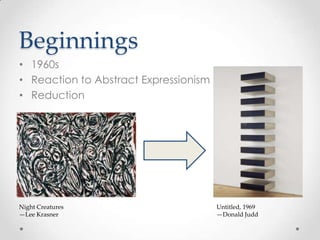
Beginnings
• 1960s
• Reaction to Abstract Expressionism
• Reduction


Night Creatures                        Untitled, 1969
—Lee Krasner                           —Donald Judd
Philosophy
•   Eliminate emotions, allusions, and meanings
•   Create a single object
•   Move away from illusions and alternate perceptions
•   Experience reality more directly


Artists
• Frank Stella      • Carl Andre     • Robert Morris
• Donald Judd       • Sol LeWitt     • Dan Flavin
Frank Stella
                                            •   Born 1936
                                            •   First minimalist
                                            •   Black paintings
                                            •   Portrait series
                                            •   Valparaiso series
                                            •   Ironic titles


“My painting is based on the fact that only what can be seen is
there. It really is an object […] you can see the whole without
confusion […] What you see is what you see.”
Frank Stella
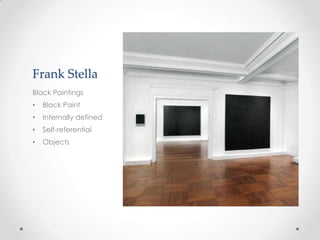
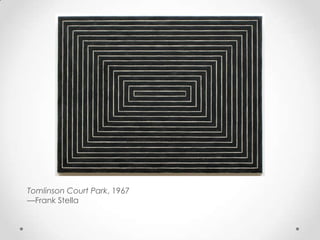
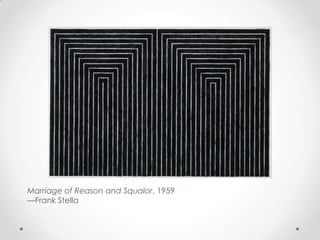
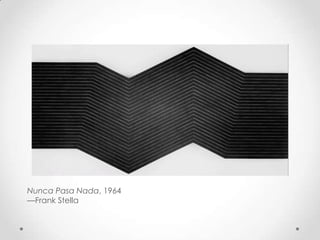
Black Paintings
•   Black Paint
•   Internally defined
•   Self-referential
•   Objects
Tomlinson Court Park, 1967
—Frank Stella
Marriage of Reason and Squalor, 1959
—Frank Stella
Nunca Pasa Nada, 1964
—Frank Stella
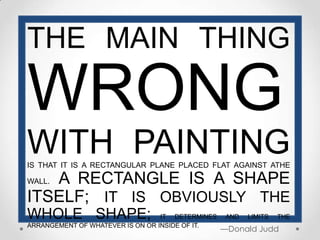
THE MAIN THING

WRONG
WITH PAINTING
IS THAT IT IS A RECTANGULAR PLANE PLACED FLAT AGAINST ATHE

   A RECTANGLE IS A SHAPE
WALL.

ITSELF; IT IS OBVIOUSLY THE
WHOLE SHAPE;                      IT DETERMINES    AND   LIMITS   THE
ARRANGEMENT OF WHATEVER IS ON OR INSIDE OF IT.
                                                  —Donald Judd
Frank Stella
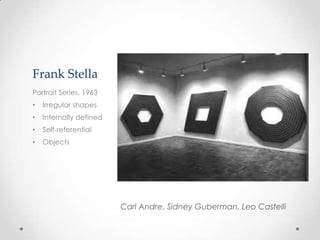
Portrait Series, 1963
•   Irregular shapes
•   Internally defined
•   Self-referential
•   Objects


                         Carl Andre, Sidney Guberman, Leo Castelli
Frank Stella
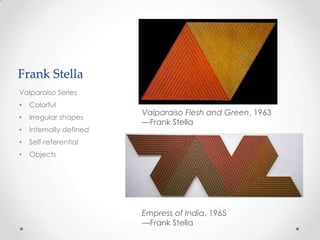
Valparaiso Series
•   Colorful
                         Valparaiso Flesh and Green, 1963
•   Irregular shapes
                         —Frank Stella
•   Internally defined
•   Self-referential
•   Objects


                         Empress of India, 1965
                         —Frank Stella
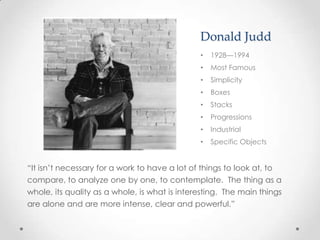
Donald Judd
                                               •   1928—1994
                                               •   Most Famous
                                               •   Simplicity
                                               •   Boxes
                                               •   Stacks
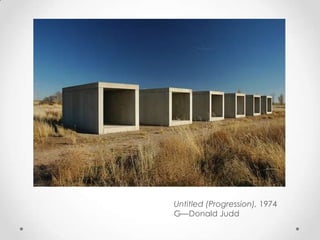
                                               •   Progressions
                                               •   Industrial
                                               •   Specific Objects


“It isn’t necessary for a work to have a lot of things to look at, to
compare, to analyze one by one, to contemplate. The thing as a
whole, its quality as a whole, is what is interesting. The main things
are alone and are more intense, clear and powerful.”
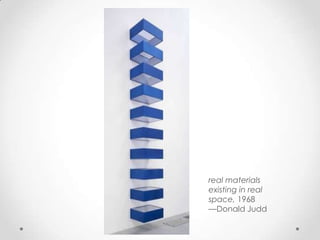
real materials
existing in real
space, 1968
—Donald Judd
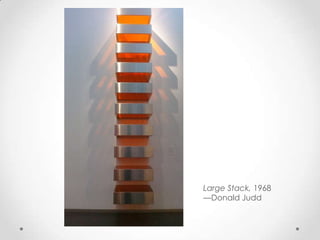
Large Stack, 1968
—Donald Judd
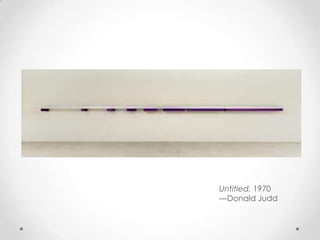
Untitled, 1970
—Donald Judd
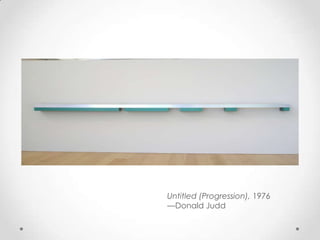
Untitled (Progression), 1976
—Donald Judd
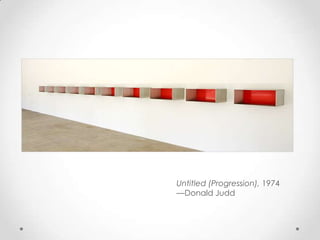
Untitled (Progression), 1974
—Donald Judd
Untitled (Progression), 1974
G—Donald Judd
Carl Andre
   •   Born 1935
   •   Close friend with Frank
       Stella
   •   Influenced by
       “constructivist” technique
       and works by Ezra Pound
       among other pieces of
       literature


“Art excludes the unnecessary.
[…] I’m not interested in
expression or sensitivity.”
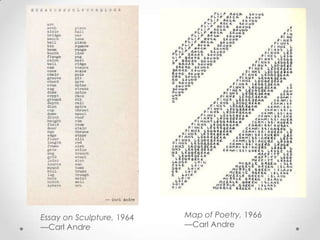
Essay on Sculpture, 1964   Map of Poetry, 1966
—Carl Andre                —Carl Andre
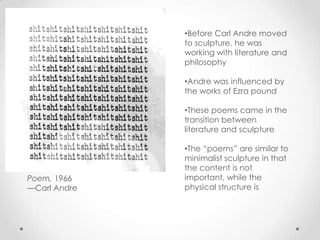
•Before Carl Andre moved
              to sculpture, he was
              working with literature and
              philosophy

              •Andre was influenced by
              the works of Ezra pound

              •These poems came in the
              transition between
              literature and sculpture

              •The “poems” are similar to
              minimalist sculpture in that
              the content is not
Poem, 1966    important, while the
—Carl Andre   physical structure is
Carl Andre
Andre worked with three types of
minimalist sculpture in his career:

1. Sculpture as form
2. Sculpture as structure
3. Sculpture as place
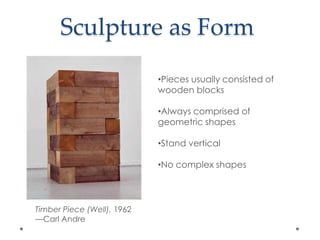
Sculpture as Form
                            •Pieces usually consisted of
                            wooden blocks

                            •Always comprised of
                            geometric shapes

                            •Stand vertical

                            •No complex shapes


Timber Piece (Well), 1962
—Carl Andre
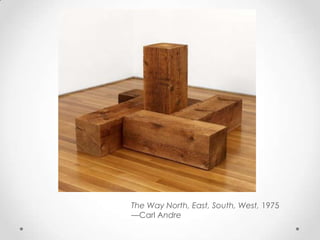
The Way North, East, South, West, 1975
—Carl Andre
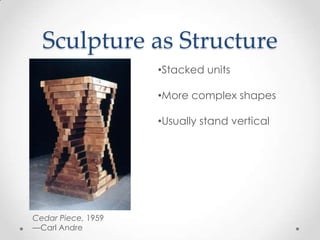
Sculpture as Structure
                    •Stacked units

                    •More complex shapes

                    •Usually stand vertical


Cedar Piece, 1959
—Carl Andre
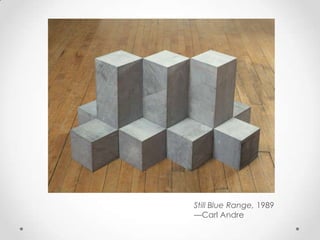
Still Blue Range, 1989
—Carl Andre
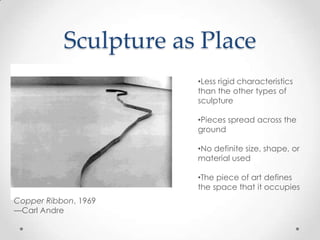
Sculpture as Place
                       •Less rigid characteristics
                       than the other types of
                       sculpture

                       •Pieces spread across the
                       ground

                       •No definite size, shape, or
                       material used

                       •The piece of art defines
                       the space that it occupies
Copper Ribbon, 1969
—Carl Andre
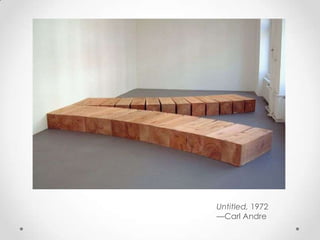
Untitled, 1972
—Carl Andre
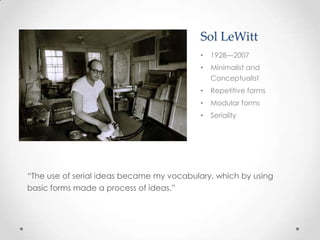
Sol LeWitt
                                          •   1928—2007
                                          •   Minimalist and
                                              Conceptualist
                                          •   Repetitive forms
                                          •   Modular forms
                                          •   Seriality


“The use of serial ideas became my vocabulary, which by using
basic forms made a process of ideas.”
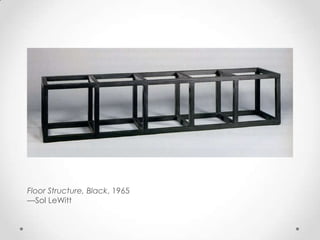
Floor Structure, Black, 1965
—Sol LeWitt
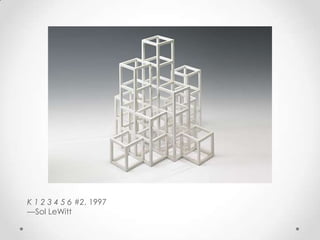
K 1 2 3 4 5 6 #2, 1997
—Sol LeWitt
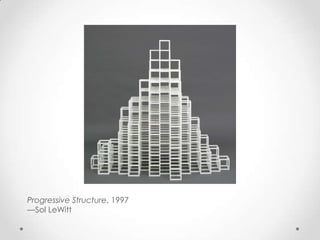
Progressive Structure, 1997
—Sol LeWitt
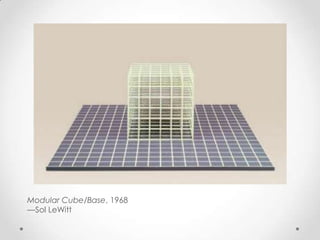
Modular Cube/Base, 1968
—Sol LeWitt
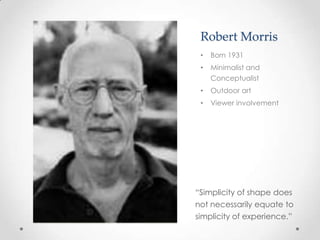
Robert Morris
 •   Born 1931
 •   Minimalist and
     Conceptualist
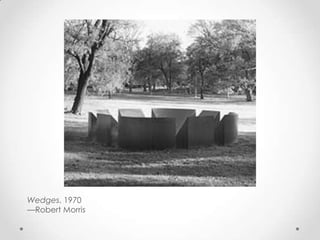
 •   Outdoor art
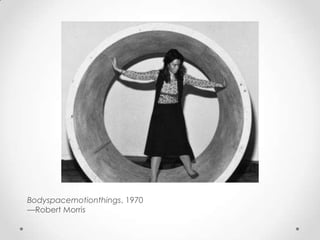
 •   Viewer involvement


“Simplicity of shape does
not necessarily equate to
simplicity of experience.”
Wedges, 1970
—Robert Morris
Bodyspacemotionthings, 1970
—Robert Morris
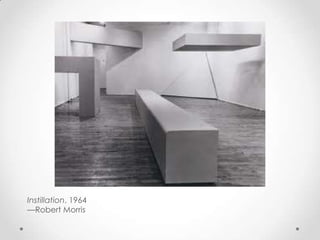
Instillation, 1964
—Robert Morris
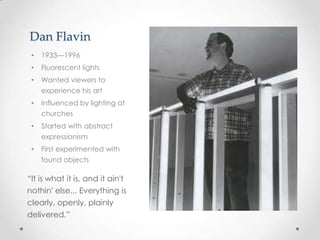
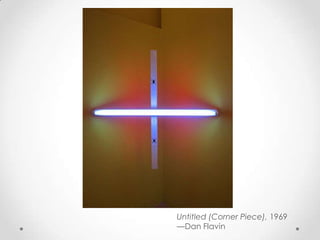
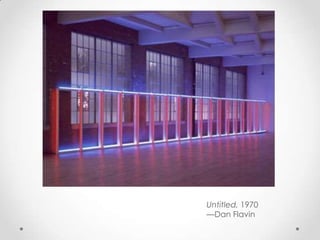
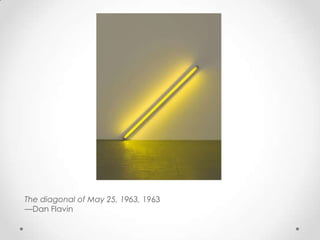
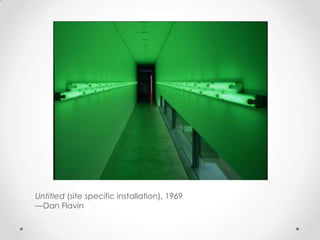
Dan Flavin
 •   1933—1996
 •   Fluorescent lights
 •   Wanted viewers to
     experience his art
 •   Influenced by lighting at
     churches
 •   Started with abstract
     expressionism
 •   First experimented with
     found objects

“It is what it is, and it ain't
nothin' else... Everything is
clearly, openly, plainly
delivered.”
Untitled (Corner Piece), 1969
—Dan Flavin
Untitled, 1970
—Dan Flavin
The diagonal of May 25, 1963, 1963
—Dan Flavin
Untitled (site specific installation), 1969
—Dan Flavin
Fluorescent light time lapse


http://flavin.pulitzerarts.org/#/installations/1/
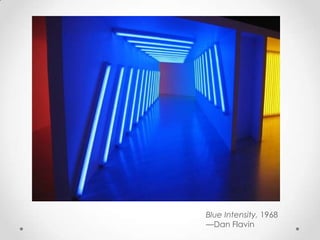
Blue Intensity, 1968
—Dan Flavin
Criticism
• Not the work of the
  artists
• No skill
• No meaning
• Not beautiful
• Not creative


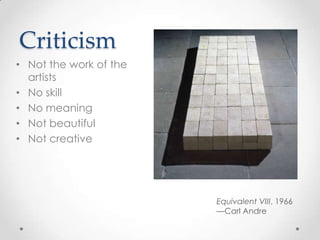
                        Equivalent VIII, 1966
                        —Carl Andre
Minimalism
• Eliminate the unnecessary
• Create a single object
• Experience reality in the most direct way


“Everything is still. Everything is repeated. Everything is
obvious. The accumulation of facts collapses perception.
The indicated sum of these simple series is irreducible
complexity. And impenetrable chaos. They astound.”

                                           —Mel Bochner

Minimalism powerpoint full

  • 1.
  • 2.
    Beginnings • 1960s • Reactionto Abstract Expressionism • Reduction Night Creatures Untitled, 1969 —Lee Krasner —Donald Judd
  • 3.
    Philosophy • Eliminate emotions, allusions, and meanings • Create a single object • Move away from illusions and alternate perceptions • Experience reality more directly Artists • Frank Stella • Carl Andre • Robert Morris • Donald Judd • Sol LeWitt • Dan Flavin
  • 4.
    Frank Stella • Born 1936 • First minimalist • Black paintings • Portrait series • Valparaiso series • Ironic titles “My painting is based on the fact that only what can be seen is there. It really is an object […] you can see the whole without confusion […] What you see is what you see.”
  • 5.
    Frank Stella Black Paintings • Black Paint • Internally defined • Self-referential • Objects
  • 6.
    Tomlinson Court Park,1967 —Frank Stella
  • 7.
    Marriage of Reasonand Squalor, 1959 —Frank Stella
  • 8.
    Nunca Pasa Nada,1964 —Frank Stella
  • 9.
    THE MAIN THING WRONG WITHPAINTING IS THAT IT IS A RECTANGULAR PLANE PLACED FLAT AGAINST ATHE A RECTANGLE IS A SHAPE WALL. ITSELF; IT IS OBVIOUSLY THE WHOLE SHAPE; IT DETERMINES AND LIMITS THE ARRANGEMENT OF WHATEVER IS ON OR INSIDE OF IT. —Donald Judd
  • 10.
    Frank Stella Portrait Series,1963 • Irregular shapes • Internally defined • Self-referential • Objects Carl Andre, Sidney Guberman, Leo Castelli
  • 11.
    Frank Stella Valparaiso Series • Colorful Valparaiso Flesh and Green, 1963 • Irregular shapes —Frank Stella • Internally defined • Self-referential • Objects Empress of India, 1965 —Frank Stella
  • 12.
    Donald Judd • 1928—1994 • Most Famous • Simplicity • Boxes • Stacks • Progressions • Industrial • Specific Objects “It isn’t necessary for a work to have a lot of things to look at, to compare, to analyze one by one, to contemplate. The thing as a whole, its quality as a whole, is what is interesting. The main things are alone and are more intense, clear and powerful.”
  • 13.
    real materials existing inreal space, 1968 —Donald Judd
  • 14.
  • 15.
  • 16.
  • 17.
  • 18.
  • 19.
    Carl Andre • Born 1935 • Close friend with Frank Stella • Influenced by “constructivist” technique and works by Ezra Pound among other pieces of literature “Art excludes the unnecessary. […] I’m not interested in expression or sensitivity.”
  • 20.
    Essay on Sculpture,1964 Map of Poetry, 1966 —Carl Andre —Carl Andre
  • 21.
    •Before Carl Andremoved to sculpture, he was working with literature and philosophy •Andre was influenced by the works of Ezra pound •These poems came in the transition between literature and sculpture •The “poems” are similar to minimalist sculpture in that the content is not Poem, 1966 important, while the —Carl Andre physical structure is
  • 22.
    Carl Andre Andre workedwith three types of minimalist sculpture in his career: 1. Sculpture as form 2. Sculpture as structure 3. Sculpture as place
  • 23.
    Sculpture as Form •Pieces usually consisted of wooden blocks •Always comprised of geometric shapes •Stand vertical •No complex shapes Timber Piece (Well), 1962 —Carl Andre
  • 24.
    The Way North,East, South, West, 1975 —Carl Andre
  • 25.
    Sculpture as Structure •Stacked units •More complex shapes •Usually stand vertical Cedar Piece, 1959 —Carl Andre
  • 26.
    Still Blue Range,1989 —Carl Andre
  • 27.
    Sculpture as Place •Less rigid characteristics than the other types of sculpture •Pieces spread across the ground •No definite size, shape, or material used •The piece of art defines the space that it occupies Copper Ribbon, 1969 —Carl Andre
  • 28.
  • 29.
    Sol LeWitt • 1928—2007 • Minimalist and Conceptualist • Repetitive forms • Modular forms • Seriality “The use of serial ideas became my vocabulary, which by using basic forms made a process of ideas.”
  • 30.
    Floor Structure, Black,1965 —Sol LeWitt
  • 31.
    K 1 23 4 5 6 #2, 1997 —Sol LeWitt
  • 32.
  • 33.
  • 34.
    Robert Morris • Born 1931 • Minimalist and Conceptualist • Outdoor art • Viewer involvement “Simplicity of shape does not necessarily equate to simplicity of experience.”
  • 35.
  • 36.
  • 37.
  • 38.
    Dan Flavin • 1933—1996 • Fluorescent lights • Wanted viewers to experience his art • Influenced by lighting at churches • Started with abstract expressionism • First experimented with found objects “It is what it is, and it ain't nothin' else... Everything is clearly, openly, plainly delivered.”
  • 39.
    Untitled (Corner Piece),1969 —Dan Flavin
  • 40.
  • 41.
    The diagonal ofMay 25, 1963, 1963 —Dan Flavin
  • 42.
    Untitled (site specificinstallation), 1969 —Dan Flavin
  • 43.
    Fluorescent light timelapse http://flavin.pulitzerarts.org/#/installations/1/
  • 44.
  • 45.
    Criticism • Not thework of the artists • No skill • No meaning • Not beautiful • Not creative Equivalent VIII, 1966 —Carl Andre
  • 46.
    Minimalism • Eliminate theunnecessary • Create a single object • Experience reality in the most direct way “Everything is still. Everything is repeated. Everything is obvious. The accumulation of facts collapses perception. The indicated sum of these simple series is irreducible complexity. And impenetrable chaos. They astound.” —Mel Bochner

Editor's Notes

  • #13 “I want it to be simple; also I want it to be non-naturalistic, non-imaginistic, and non-expressionistic.”
  • #20 “I want it to be simple; also I want it to be non-naturalistic, non-imaginistic, and non-expressionistic.” judd
  • #30 “I want it to be simple; also I want it to be non-naturalistic, non-imaginistic, and non-expressionistic.” judd
  • #35 “I want it to be simple; also I want it to be non-naturalistic, non-imaginistic, and non-expressionistic.” judd
  • #39 “I want it to be simple; also I want it to be non-naturalistic, non-imaginistic, and non-expressionistic.” judd