Propositional Logic
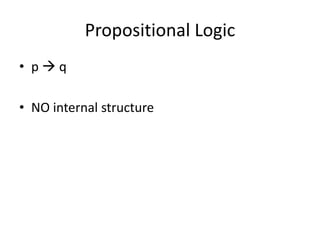
• p  q
• NO internal structure
Predicate logic
• Loves (j, m)
• DOES have internal structure
Japan is a country
Japan is a country
• Country (x)
• x = japan
• Country (japan)
Easy so far?
• Yes
• But what is the point?
• Good question
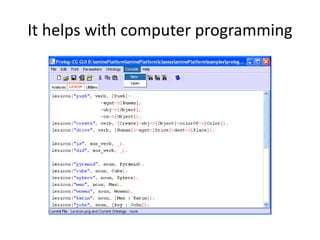
It helps with computer programming
We use it to input data
And write code
Data
• You can put in any information you want
Peter fell over
• Predicate?
• Fell_over
• How many arguments?
• One – peter
• Fell_over (peter)
Jim donated $100 to the city hospital
• Donated (x,…..n)
• Donated (jim, $100, city_hospital)
• Donated (x, y, z)
• X = Jim
• Y = $100
• Z= the city hospital
Ben hates computers
• Hate (ben, computers)
Eri gave up
• Gave_up (eri)
Emi is a genius
• Genius (emi)
No limits as long as it’s organized
• Visit (mary, familiymart, sat_15th_april,)
• Computational Linguistics:
• Verb
• Subject
• Complement
Hit
• Hit ( )
• Hit (x, )
• Hit (x, y)
• X = bill
• Y = ken
• Bill hit Ken
Quantifiers
The Little Prince is wearing a brown
scarf
• Wearing_a_brown_scarf (p)
• Wearing (p, b_s)
But the Little Prince is the only person
in this world
Everyone is wearing a brown scarf
Imagine simple little worlds
What do quantifiers mean?
All – upside-down A
Think of sets
• Two sets
• Set A
• Set B
• Set A = the set of Linguists
• Linguist (x)
• Set B = the set of crazy people
• Crazy_person (x)
Who is in these sets?
• Linguist (x)
• {evans,
• imai,
• ono}
Computer database
• Linguist (evans)
• Linguist (imai)
• Linguist (ono)
• Set of linguists =
• {evans, imai, ono}
Who is in the set of crazy people?
• Crazy_person (x)
• {ken,
• jim,
• ben,
• mary,
• evans}
Computer database
• Crazy_person (evans)
• Crazy_person (ken)
• Crazy_person (jim)
• Crazy_person (ben)
• Crazy_person (mary)
Linguist (x)  Crazy_person (x)
All linguists are crazy
• ∀x (Linguist (x)  Crazy_person (x))
• Is this true?
• For all individuals x, if x is in the set of
Linguists, x is also in the set of Crazy persons.
• Set A = the set of Linguists
• Linguist (x)
• Set B = the set of crazy people
• Crazy_person (x)
Who is in these sets?
• Linguist (x)
• {evans,
• imai,
• ono}
Who is in the set of crazy people?
• Crazy_person (x)
• {ken,
• jim,
• ben,
• mary,
• evans}
All linguists are crazy
• ∀x (Linguist (x)  Crazy_person (x))
• Is Untrue
• Because two members of the set of linguists
are not in the set of crazy people.
Some linguists are crazy
• Is this True?
• Linguist (x) & Crazy_person (x)
Some linguists are crazy
• ∃x (Linguist (x) & Crazy_person (x))
• Backward E
• Existential Quantifier
• There is at least one individual x
• x is a linguist
• And x is crazy
Who is in the set of crazy people?
• Crazy_person (x)
• {ken,
• jim,
• ben,
• mary,
• evans}
Evans is in the set of crazy people
• So this is true
• ∃x (Linguist (x) & Crazy_person (x))
• Backward E
• Existential Quantifier
• There is at least one individual x
• x is a linguist
• And x is crazy
Predicate
• Mary is a girl
• Girl
• Girl (mary)
Predicate
• Mary lives in Tsuru
• Lives_in_Tsuru (mary)
Set of girls
• Girl (mary)
• Girl (eri)
• Girl (rie)
• Girl = {mary, eri, rie}
Set of people who live in Tsuru
• Live_in_tsuru (ben)
• Live_in_tsuru (ken)
• Live_in_tsuru (mary)
• Live in Tsuru = {ben, ken, mary}
A girl lives in Tsuru
• ∃x
• (
• Girl (x)
• & Lives_in_tsuru (x)
• )
• ∃x (Girl (x) & Lives_in_tsuru (x))
Set of girls
• Girl (mary)
• Girl (eri)
• Girl (rie)
• Girl = {mary, eri, rie}
Set of people who live in Tsuru
• Live_in_tsuru (ben)
• Live_in_tsuru (ken)
• Live_in_tsuru (mary)
• Live in Tsuru = {ben, ken, mary}
• ∃x (Girl (x) & Lives_in_tsuru (x))
• Is True!
A girl lives in Fujiyoshida
• ∃x
• (
• Girl (x)
• & Lives_in_fujiyoshida (x)
• )
• ∃x (Girl (x) & Lives_in_fujiyoshida (x))
Set of girls
• Girl (mary)
• Girl (eri)
• Girl (rie)
• Girl = {mary, eri, rie}
Set of people who live in Fujiyoshida
• Live_in_tsuru (ben)
• Live_in_tsuru (len)
• Live_in_tsuru (stan)
• Live in Tsuru = {ben, len, stan}
• ∃x (Girl (x) & Lives_in_fujiyoshida (x))
• Is False!
• But
• ¬∃x (Girl (x) & Lives_in_fujiyoshida (x))
• Is true
• ~∃x (Girl (x) & Lives_in_fujiyoshida (x))
• Is true
• -∃x (Girl (x) & Lives_in_fujiyoshida (x))
• Is true
Any problems with Predicate Logic?
• Yes
• We are not always trying to say things that are
true
The sky is blue
We don’t say the sky is blue at night
Even though it’s true
• We sometimes say things that are not true
• “My brain exploded”
• And do we really think in Logical Form?
• ¬∃x (Girl (x) & Lives_in_fujiyoshida (x))
• And if I say “A girl lives in Fujiyoshida” …
• … is it really a statement about existence of an
individual?
• Or am I more concerned with number
• Or the fact that we’re talking about a girl
rather than a boy?
• Or a girl rather than a woman?
• Or something else related to CONTEXT?
New ideas about how we understand
meaning
Language connects to the body
NOT all in the brain!
Also strong evidence for IMAGES
rather than CODE
Strong evidence for ACTION simulation
Mental Models as IMAGES
Many people say Logical Form cannot
be real
But Logic is VERY important in
Linguistics!
• The nurse kissed every child on his birthday.
• [The nurse] kissed [every child] on his birthday.
• Kissed (nurse, every_child)
• ∀x (Child (x)  Kissed (nurse, x)) on x’s
birthday
• The nurse kissed every child on his birthday
But Logic is VERY important in
Linguistics
And logic is the basis of computer
science
∃ (existential)
• M(jen,mary)
• M = mother
• Jen is Mary’s mother
• ∃xM(x,y)
• Someone is the mother of y
• ∀y∃xM(x,y)
• Everyone has a mother
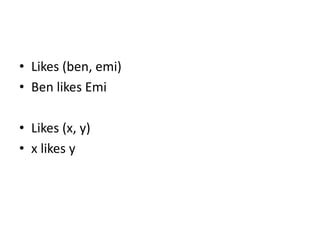
• Likes (ben, emi)
• Ben likes Emi
• Likes (x, y)
• x likes y
X = boys, Y = girls
• Likes (x, y)
• x likes y
• (let’s say x = boys and y = girls)
• ∃y (Likes (x, y)
• There is some girl that x likes
• ∃y (Likes (x, y)
• There is some girl that x likes
• ∀x∃y (Likes (x, y)
• Each boy likes a girl
Each boy likes a girl
Boys Girls
∀x∃y (Likes (x, y)
Boys Girls
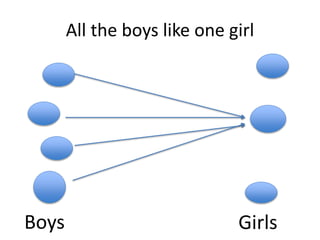
There’s one girl all the boys like
Boys Girls
All the boys like one girl
Boys Girls
∃y∀x (Likes (x, y)
Boys Girls
p → q
• p = Jim is dead
• q = Mary is sad
• p → q =
• If Jim is dead, Mary is sad
p V q
• p = My parrot is clever
• q = Taro fell over
• p V q =
• (either) my parrot is clever or Taro fell over
p → q
• p = I study hard
• q = I will pass the test
• p → q =
• If I study hard, I will pass the test
¬p → ¬q
• P = I study hard
• Q = I will pass the test
• ¬p → ¬q = If I do not study hard, I will not
pass the test
• If NOT(I study hard) then NOT (I will pass the
test)
p → q
• Normal everyday values for p and q
• p = a bear has warm blood
• q = a bear is a mammal
¬p → q
• Normal everyday values for p and q
• p = you study hard
• q = you will fail
• If you DON’T study hard, you will fail
Modern Linguistics
• Studying language helps us understand the
human brain
• Do you think the human brain works like
computer code?
• Do you think studying language tells us
something about the brain?

Predicate calculus

  • 1.
    Propositional Logic • p q • NO internal structure
  • 2.
    Predicate logic • Loves(j, m) • DOES have internal structure
  • 3.
    Japan is acountry
  • 4.
    Japan is acountry • Country (x) • x = japan • Country (japan)
  • 5.
    Easy so far? •Yes • But what is the point? • Good question
  • 6.
    It helps withcomputer programming
  • 7.
    We use itto input data
  • 8.
  • 9.
    Data • You canput in any information you want
  • 10.
    Peter fell over •Predicate? • Fell_over • How many arguments? • One – peter • Fell_over (peter)
  • 11.
    Jim donated $100to the city hospital • Donated (x,…..n) • Donated (jim, $100, city_hospital) • Donated (x, y, z) • X = Jim • Y = $100 • Z= the city hospital
  • 12.
    Ben hates computers •Hate (ben, computers)
  • 13.
    Eri gave up •Gave_up (eri)
  • 14.
    Emi is agenius • Genius (emi)
  • 15.
    No limits aslong as it’s organized • Visit (mary, familiymart, sat_15th_april,) • Computational Linguistics: • Verb • Subject • Complement
  • 16.
    Hit • Hit () • Hit (x, ) • Hit (x, y) • X = bill • Y = ken • Bill hit Ken
  • 17.
  • 18.
    The Little Princeis wearing a brown scarf
  • 19.
  • 20.
    But the LittlePrince is the only person in this world
  • 21.
    Everyone is wearinga brown scarf
  • 22.
  • 23.
  • 24.
  • 25.
  • 26.
    • Two sets •Set A • Set B
  • 27.
    • Set A= the set of Linguists • Linguist (x) • Set B = the set of crazy people • Crazy_person (x)
  • 28.
    Who is inthese sets? • Linguist (x) • {evans, • imai, • ono}
  • 29.
    Computer database • Linguist(evans) • Linguist (imai) • Linguist (ono) • Set of linguists = • {evans, imai, ono}
  • 30.
    Who is inthe set of crazy people? • Crazy_person (x) • {ken, • jim, • ben, • mary, • evans}
  • 31.
    Computer database • Crazy_person(evans) • Crazy_person (ken) • Crazy_person (jim) • Crazy_person (ben) • Crazy_person (mary)
  • 32.
    Linguist (x) Crazy_person (x)
  • 33.
    All linguists arecrazy • ∀x (Linguist (x)  Crazy_person (x)) • Is this true? • For all individuals x, if x is in the set of Linguists, x is also in the set of Crazy persons.
  • 34.
    • Set A= the set of Linguists • Linguist (x) • Set B = the set of crazy people • Crazy_person (x)
  • 35.
    Who is inthese sets? • Linguist (x) • {evans, • imai, • ono}
  • 36.
    Who is inthe set of crazy people? • Crazy_person (x) • {ken, • jim, • ben, • mary, • evans}
  • 37.
    All linguists arecrazy • ∀x (Linguist (x)  Crazy_person (x)) • Is Untrue • Because two members of the set of linguists are not in the set of crazy people.
  • 38.
    Some linguists arecrazy • Is this True?
  • 39.
    • Linguist (x)& Crazy_person (x)
  • 40.
    Some linguists arecrazy • ∃x (Linguist (x) & Crazy_person (x)) • Backward E • Existential Quantifier • There is at least one individual x • x is a linguist • And x is crazy
  • 41.
    Who is inthe set of crazy people? • Crazy_person (x) • {ken, • jim, • ben, • mary, • evans}
  • 42.
    Evans is inthe set of crazy people • So this is true • ∃x (Linguist (x) & Crazy_person (x)) • Backward E • Existential Quantifier • There is at least one individual x • x is a linguist • And x is crazy
  • 43.
    Predicate • Mary isa girl • Girl • Girl (mary)
  • 44.
    Predicate • Mary livesin Tsuru • Lives_in_Tsuru (mary)
  • 45.
    Set of girls •Girl (mary) • Girl (eri) • Girl (rie) • Girl = {mary, eri, rie}
  • 46.
    Set of peoplewho live in Tsuru • Live_in_tsuru (ben) • Live_in_tsuru (ken) • Live_in_tsuru (mary) • Live in Tsuru = {ben, ken, mary}
  • 47.
    A girl livesin Tsuru • ∃x • ( • Girl (x) • & Lives_in_tsuru (x) • ) • ∃x (Girl (x) & Lives_in_tsuru (x))
  • 48.
    Set of girls •Girl (mary) • Girl (eri) • Girl (rie) • Girl = {mary, eri, rie}
  • 49.
    Set of peoplewho live in Tsuru • Live_in_tsuru (ben) • Live_in_tsuru (ken) • Live_in_tsuru (mary) • Live in Tsuru = {ben, ken, mary}
  • 50.
    • ∃x (Girl(x) & Lives_in_tsuru (x)) • Is True!
  • 51.
    A girl livesin Fujiyoshida • ∃x • ( • Girl (x) • & Lives_in_fujiyoshida (x) • ) • ∃x (Girl (x) & Lives_in_fujiyoshida (x))
  • 52.
    Set of girls •Girl (mary) • Girl (eri) • Girl (rie) • Girl = {mary, eri, rie}
  • 53.
    Set of peoplewho live in Fujiyoshida • Live_in_tsuru (ben) • Live_in_tsuru (len) • Live_in_tsuru (stan) • Live in Tsuru = {ben, len, stan}
  • 54.
    • ∃x (Girl(x) & Lives_in_fujiyoshida (x)) • Is False!
  • 55.
    • But • ¬∃x(Girl (x) & Lives_in_fujiyoshida (x)) • Is true • ~∃x (Girl (x) & Lives_in_fujiyoshida (x)) • Is true • -∃x (Girl (x) & Lives_in_fujiyoshida (x)) • Is true
  • 56.
    Any problems withPredicate Logic? • Yes • We are not always trying to say things that are true
  • 57.
  • 58.
    We don’t saythe sky is blue at night
  • 59.
  • 60.
    • We sometimessay things that are not true • “My brain exploded” • And do we really think in Logical Form? • ¬∃x (Girl (x) & Lives_in_fujiyoshida (x))
  • 61.
    • And ifI say “A girl lives in Fujiyoshida” … • … is it really a statement about existence of an individual? • Or am I more concerned with number • Or the fact that we’re talking about a girl rather than a boy? • Or a girl rather than a woman? • Or something else related to CONTEXT?
  • 62.
    New ideas abouthow we understand meaning
  • 63.
  • 64.
    NOT all inthe brain!
  • 65.
    Also strong evidencefor IMAGES rather than CODE
  • 66.
    Strong evidence forACTION simulation
  • 67.
  • 68.
    Many people sayLogical Form cannot be real
  • 69.
    But Logic isVERY important in Linguistics! • The nurse kissed every child on his birthday. • [The nurse] kissed [every child] on his birthday. • Kissed (nurse, every_child)
  • 70.
    • ∀x (Child(x)  Kissed (nurse, x)) on x’s birthday • The nurse kissed every child on his birthday
  • 71.
    But Logic isVERY important in Linguistics
  • 72.
    And logic isthe basis of computer science
  • 73.
    ∃ (existential) • M(jen,mary) •M = mother • Jen is Mary’s mother • ∃xM(x,y) • Someone is the mother of y
  • 74.
  • 75.
    • Likes (ben,emi) • Ben likes Emi • Likes (x, y) • x likes y
  • 76.
    X = boys,Y = girls • Likes (x, y) • x likes y • (let’s say x = boys and y = girls) • ∃y (Likes (x, y) • There is some girl that x likes
  • 77.
    • ∃y (Likes(x, y) • There is some girl that x likes • ∀x∃y (Likes (x, y) • Each boy likes a girl
  • 78.
    Each boy likesa girl Boys Girls
  • 79.
    ∀x∃y (Likes (x,y) Boys Girls
  • 80.
    There’s one girlall the boys like Boys Girls
  • 81.
    All the boyslike one girl Boys Girls
  • 82.
    ∃y∀x (Likes (x,y) Boys Girls
  • 83.
    p → q •p = Jim is dead • q = Mary is sad • p → q = • If Jim is dead, Mary is sad
  • 84.
    p V q •p = My parrot is clever • q = Taro fell over • p V q = • (either) my parrot is clever or Taro fell over
  • 85.
    p → q •p = I study hard • q = I will pass the test • p → q = • If I study hard, I will pass the test
  • 86.
    ¬p → ¬q •P = I study hard • Q = I will pass the test • ¬p → ¬q = If I do not study hard, I will not pass the test • If NOT(I study hard) then NOT (I will pass the test)
  • 87.
    p → q •Normal everyday values for p and q • p = a bear has warm blood • q = a bear is a mammal
  • 88.
    ¬p → q •Normal everyday values for p and q • p = you study hard • q = you will fail • If you DON’T study hard, you will fail
  • 89.
    Modern Linguistics • Studyinglanguage helps us understand the human brain • Do you think the human brain works like computer code? • Do you think studying language tells us something about the brain?