MATTER: "anything that has mass and volume"
  3 PhasesSolid / Liquid /Gas

  Elements: can not be separated naturally into smaller parts
   C carbon
   N nitrogen
   O Oxygen


  Compounds: a chemical substance formed from 2 or more elements.
   Water (H2O)
   Halite (NaCl)        Chemical Formulas
   Calcite (CaCo3)


               Atoms to Minerals
              Mr. Thompson's Earth Science Class
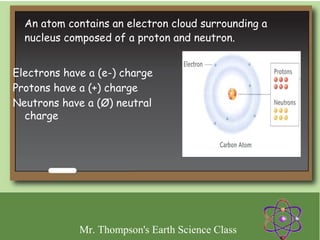
An atom contains an electron cloud surrounding a
  nucleus composed of a proton and neutron.


Electrons have a (e-) charge
Protons have a (+) charge
Neutrons have a (Ø) neutral
  charge


             Mr. Thompson's Earth Science Class
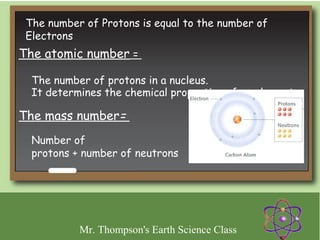
The number of Protons is equal to the number of
 Electrons
The atomic number =

  The number of protons in a nucleus.
  It determines the chemical properties of an element

The mass number=
  Number of
  protons + number of neutrons


           Mr. Thompson's Earth Science Class
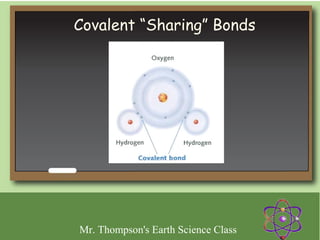
Covalent “Sharing” Bonds


Mr. Thompson's Earth Science Class
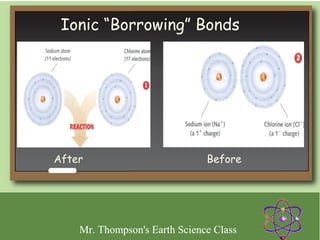
Ionic “Borrowing” Bonds


After                          Before


    Mr. Thompson's Earth Science Class
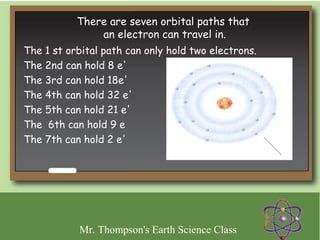
There are seven orbital paths that
               an electron can travel in.
The 1 st orbital path can only hold two electrons.
The 2nd can hold 8 e'
The 3rd can hold 18e'
The 4th can hold 32 e'
The 5th can hold 21 e'
The 6th can hold 9 e
The 7th can hold 2 e'


           Mr. Thompson's Earth Science Class
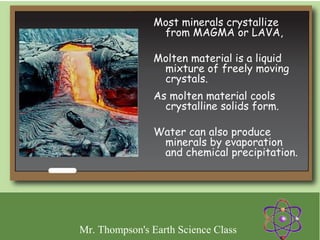
Most minerals crystallize
                 from MAGMA or LAVA,

                Molten material is a liquid
                 mixture of freely moving
                 crystals.
                As molten material cools
                  crystalline solids form.

                Water can also produce
                 minerals by evaporation
                 and chemical precipitation.


Mr. Thompson's Earth Science Class
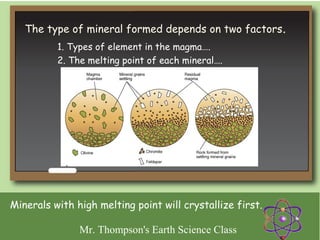
The type of mineral formed depends on two factors.
          1. Types of element in the magma….
          2. The melting point of each mineral….


Minerals with high melting point will crystallize first.

               Mr. Thompson's Earth Science Class
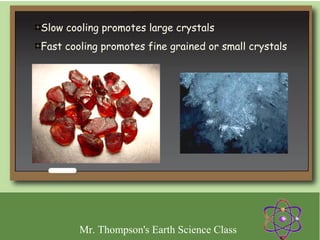
Slow cooling promotes large crystals
Fast cooling promotes fine grained or small crystals


        Mr. Thompson's Earth Science Class
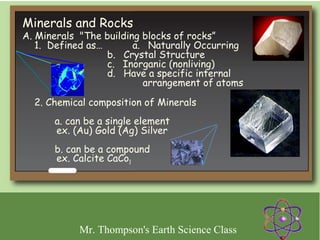
Minerals and Rocks
A. Minerals "The building blocks of rocks”


   1. Defined as…        a.   Naturally Occurring
                  b.   Crystal Structure
                  c.   Inorganic (nonliving)
                  d.   Have a specific internal
                            arrangement of atoms

    2. Chemical composition of Minerals
        a. can be a single element
        ex. (Au) Gold (Ag) Silver
        b. can be a compound
        ex. Calcite CaCo3


             Mr. Thompson's Earth Science Class
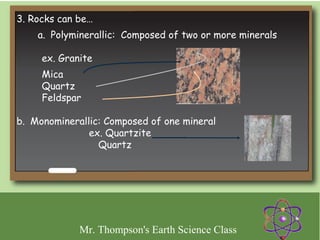
3. Rocks can be…
    a.  Polyminerallic: Composed of two or more minerals

     ex. Granite  
     Mica
     Quartz
     Feldspar

b.  Monominerallic: Composed of one mineral  
                  ex. Quartzite
                    Quartz


             Mr. Thompson's Earth Science Class
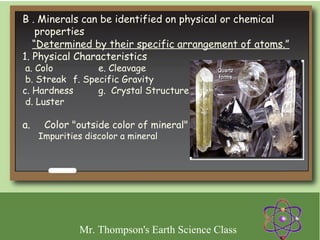
B . Minerals can be identified on physical or chemical
    properties
   “Determined by their specific arrangement of atoms.”
1. Physical Characteristics
 a. Colo         e. Cleavage
 b. Streak f. Specific Gravity
c. Hardness      g. Crystal Structure
 d. Luster

a.     Color "outside color of mineral"
    Impurities discolor a mineral


             Mr. Thompson's Earth Science Class
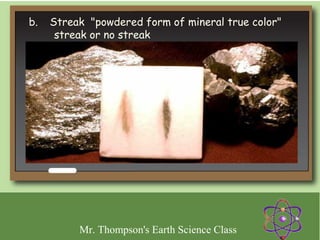
b.    Streak "powdered form of mineral true color"
       streak or no streak


         Mr. Thompson's Earth Science Class
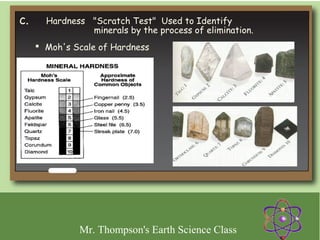
c.     Hardness   "Scratch Test" Used to Identify
                  minerals by the process of elimination.
    Moh's Scale of Hardness


             Mr. Thompson's Earth Science Class
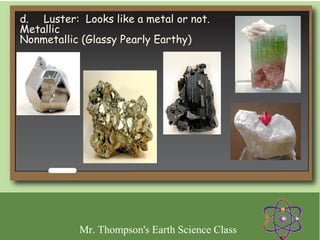
d.     Luster: Looks like a metal or not.
Metallic
Nonmetallic (Glassy Pearly Earthy)


            Mr. Thompson's Earth Science Class
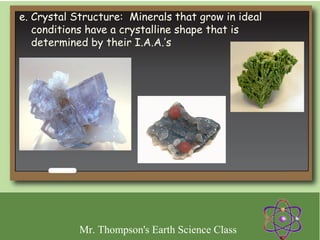
e. Crystal Structure: Minerals that grow in ideal
   conditions have a crystalline shape that is
   determined by their I.A.A.’s


            Mr. Thompson's Earth Science Class
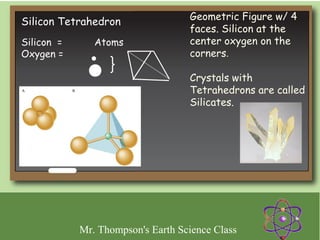
Geometric Figure w/ 4
Silicon Tetrahedron
                                   faces. Silicon at the
Silicon =      Atoms               center oxygen on the
Oxygen =                           corners.

                                   Crystals with
                                   Tetrahedrons are called
                                   Silicates.


            Mr. Thompson's Earth Science Class
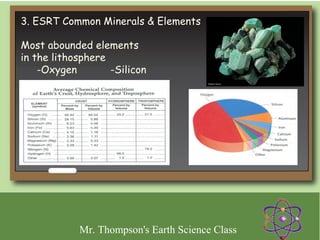
3. ESRT Common Minerals & Elements
 
Most abounded elements
in the lithosphere
    -Oxygen        -Silicon


           Mr. Thompson's Earth Science Class
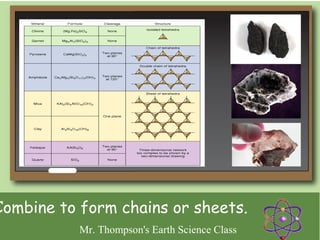
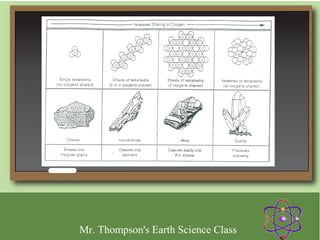
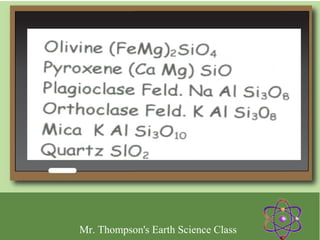
Combine to form chains or sheets.
           Mr. Thompson's Earth Science Class
Mr. Thompson's Earth Science Class
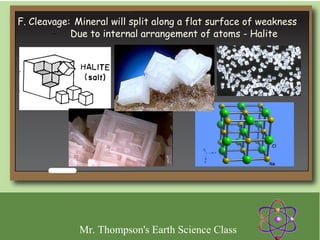
F. Cleavage: Mineral will split along a flat surface of weakness
        – Due to internal arrangement of atoms - Halite


              Mr. Thompson's Earth Science Class
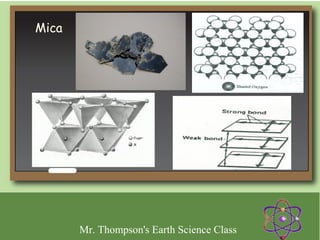
Mica


       Mr. Thompson's Earth Science Class
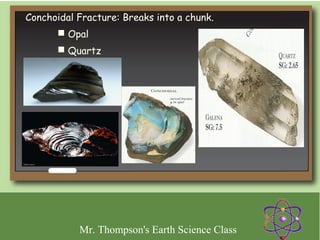
Conchoidal Fracture: Breaks into a chunk.
       Opal
       Quartz


           Mr. Thompson's Earth Science Class
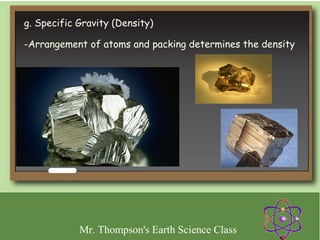
g. Specific Gravity (Density)

-Arrangement of atoms and packing determines the density


            Mr. Thompson's Earth Science Class
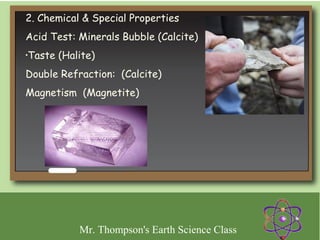
2. Chemical & Special Properties
Acid Test: Minerals Bubble (Calcite)
Taste (Halite)
•


Double Refraction: (Calcite)
Magnetism (Magnetite)


           Mr. Thompson's Earth Science Class
Mr. Thompson's Earth Science Class
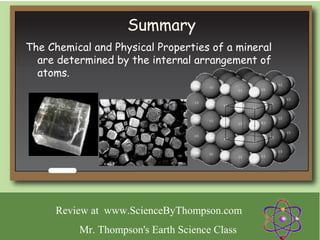
Summary
The Chemical and Physical Properties of a mineral
  are determined by the internal arrangement of
  atoms.


      Review at www.ScienceByThompson.com
          Mr. Thompson's Earth Science Class

Minerals and Formation

  • 1.
    MATTER: "anything thathas mass and volume" 3 PhasesSolid / Liquid /Gas Elements: can not be separated naturally into smaller parts C carbon N nitrogen O Oxygen Compounds: a chemical substance formed from 2 or more elements. Water (H2O) Halite (NaCl) Chemical Formulas Calcite (CaCo3) Atoms to Minerals Mr. Thompson's Earth Science Class
  • 2.
    An atom containsan electron cloud surrounding a nucleus composed of a proton and neutron. Electrons have a (e-) charge Protons have a (+) charge Neutrons have a (Ø) neutral charge Mr. Thompson's Earth Science Class
  • 3.
    The number ofProtons is equal to the number of Electrons The atomic number = The number of protons in a nucleus. It determines the chemical properties of an element The mass number= Number of protons + number of neutrons Mr. Thompson's Earth Science Class
  • 4.
    Covalent “Sharing” Bonds Mr.Thompson's Earth Science Class
  • 5.
    Ionic “Borrowing” Bonds After Before Mr. Thompson's Earth Science Class
  • 6.
    There are sevenorbital paths that an electron can travel in. The 1 st orbital path can only hold two electrons. The 2nd can hold 8 e' The 3rd can hold 18e' The 4th can hold 32 e' The 5th can hold 21 e' The 6th can hold 9 e The 7th can hold 2 e' Mr. Thompson's Earth Science Class
  • 7.
    Most minerals crystallize from MAGMA or LAVA, Molten material is a liquid mixture of freely moving crystals. As molten material cools crystalline solids form. Water can also produce minerals by evaporation and chemical precipitation. Mr. Thompson's Earth Science Class
  • 8.
    The type ofmineral formed depends on two factors. 1. Types of element in the magma…. 2. The melting point of each mineral…. Minerals with high melting point will crystallize first. Mr. Thompson's Earth Science Class
  • 9.
    Slow cooling promoteslarge crystals Fast cooling promotes fine grained or small crystals Mr. Thompson's Earth Science Class
  • 10.
    Minerals and Rocks A.Minerals "The building blocks of rocks”   1. Defined as… a.   Naturally Occurring b.   Crystal Structure c.   Inorganic (nonliving) d.   Have a specific internal arrangement of atoms 2. Chemical composition of Minerals a. can be a single element ex. (Au) Gold (Ag) Silver b. can be a compound ex. Calcite CaCo3 Mr. Thompson's Earth Science Class
  • 11.
    3. Rocks canbe… a.  Polyminerallic: Composed of two or more minerals ex. Granite   Mica Quartz Feldspar b.  Monominerallic: Composed of one mineral                 ex. Quartzite Quartz Mr. Thompson's Earth Science Class
  • 12.
    B . Mineralscan be identified on physical or chemical properties “Determined by their specific arrangement of atoms.” 1. Physical Characteristics a. Colo e. Cleavage b. Streak f. Specific Gravity c. Hardness g. Crystal Structure d. Luster a.     Color "outside color of mineral" Impurities discolor a mineral   Mr. Thompson's Earth Science Class
  • 13.
    b.    Streak "powdered formof mineral true color" streak or no streak Mr. Thompson's Earth Science Class
  • 14.
    c.     Hardness "Scratch Test" Used to Identify minerals by the process of elimination.  Moh's Scale of Hardness Mr. Thompson's Earth Science Class
  • 15.
    d.     Luster: Looks likea metal or not. Metallic Nonmetallic (Glassy Pearly Earthy) Mr. Thompson's Earth Science Class
  • 16.
    e. Crystal Structure:Minerals that grow in ideal conditions have a crystalline shape that is determined by their I.A.A.’s Mr. Thompson's Earth Science Class
  • 17.
    Geometric Figure w/4 Silicon Tetrahedron faces. Silicon at the Silicon = Atoms center oxygen on the Oxygen = corners. Crystals with Tetrahedrons are called Silicates. Mr. Thompson's Earth Science Class
  • 18.
    3. ESRT CommonMinerals & Elements   Most abounded elements in the lithosphere -Oxygen -Silicon Mr. Thompson's Earth Science Class
  • 19.
    Combine to formchains or sheets. Mr. Thompson's Earth Science Class
  • 20.
    Mr. Thompson's EarthScience Class
  • 21.
    F. Cleavage: Mineral willsplit along a flat surface of weakness – Due to internal arrangement of atoms - Halite Mr. Thompson's Earth Science Class
  • 22.
    Mica Mr. Thompson's Earth Science Class
  • 23.
    Conchoidal Fracture: Breaksinto a chunk.  Opal  Quartz Mr. Thompson's Earth Science Class
  • 24.
    g. Specific Gravity(Density) -Arrangement of atoms and packing determines the density     Mr. Thompson's Earth Science Class
  • 25.
    2. Chemical &Special Properties Acid Test: Minerals Bubble (Calcite) Taste (Halite) • Double Refraction: (Calcite) Magnetism (Magnetite) Mr. Thompson's Earth Science Class
  • 26.
    Mr. Thompson's EarthScience Class
  • 27.
    Summary The Chemical andPhysical Properties of a mineral are determined by the internal arrangement of atoms. Review at www.ScienceByThompson.com Mr. Thompson's Earth Science Class