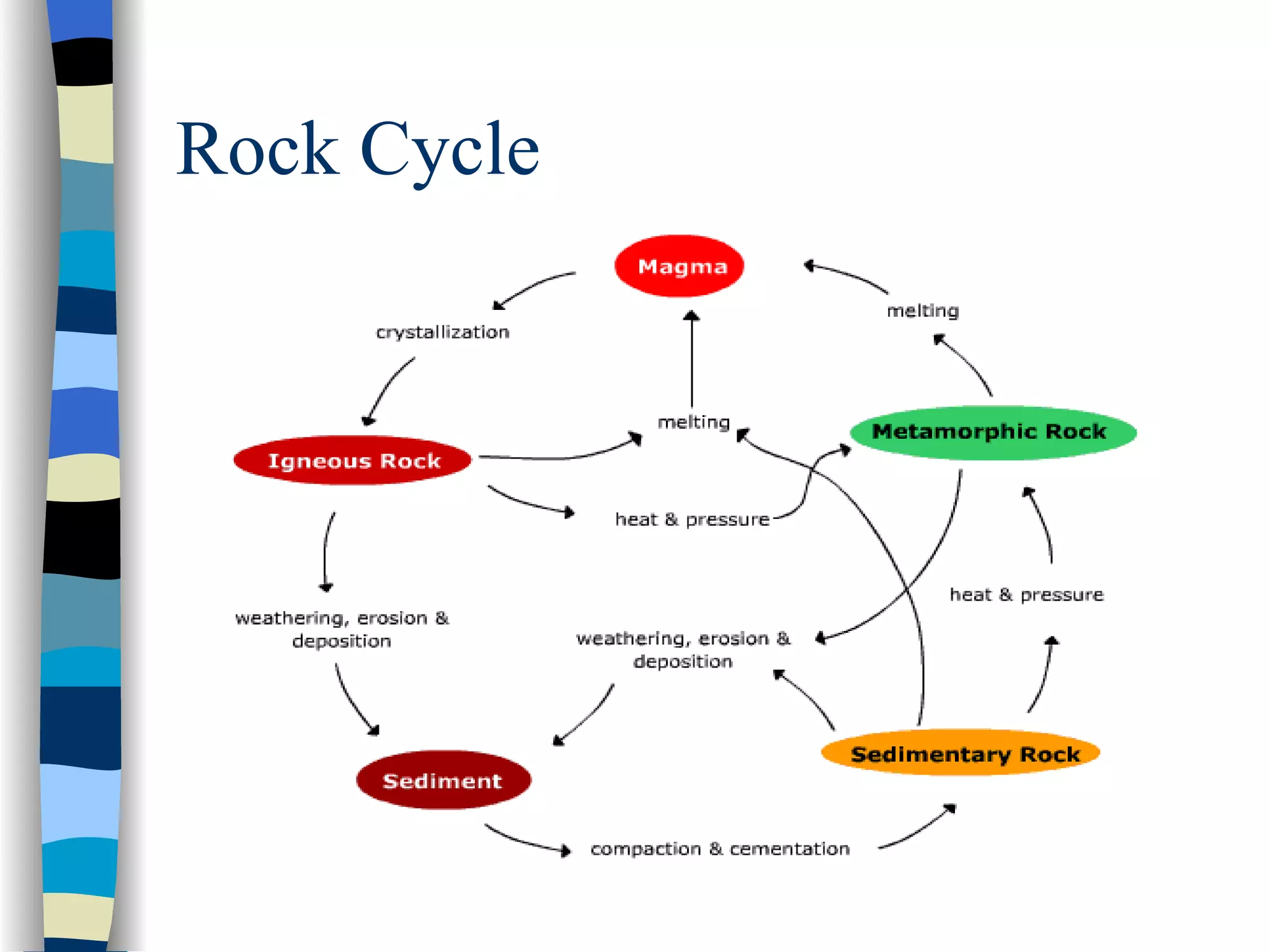
The document summarizes key concepts from chapters 4-6 about rocks and minerals. It defines minerals as naturally occurring inorganic solids with specific chemical compositions and crystalline structures. It describes the formation of igneous, sedimentary, and metamorphic rocks and how their characteristics are influenced by cooling rates, pressure, heat, and other factors. Identification properties of minerals like color, luster, hardness, and cleavage are also outlined.
Overview of chapters focused on Rocks and Minerals.
Minerals are inorganic solids with specific compositions and crystalline structures formed in nature.
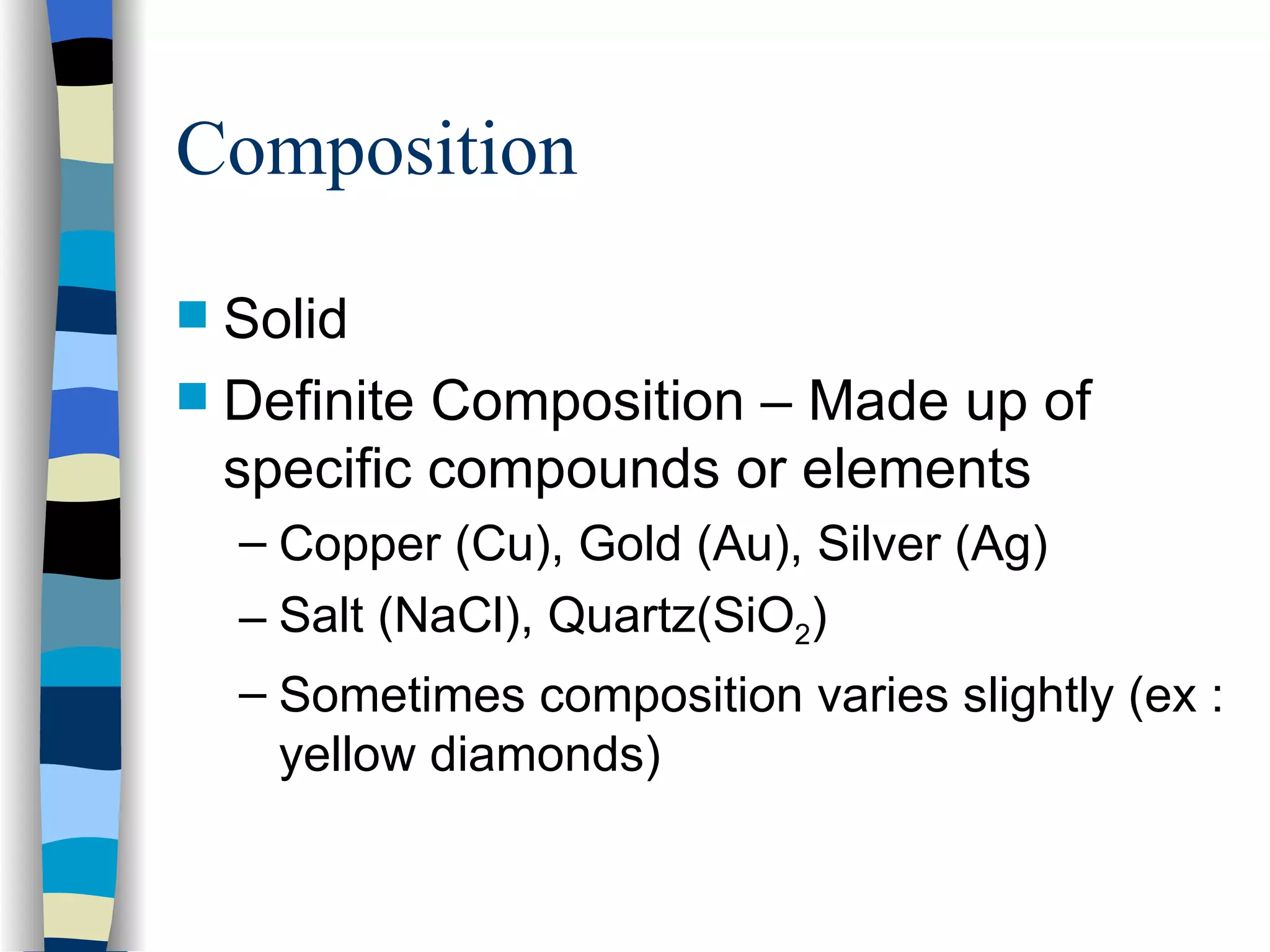
Discussion on mineral composition, with examples like Copper, Gold, and variations in natural minerals.
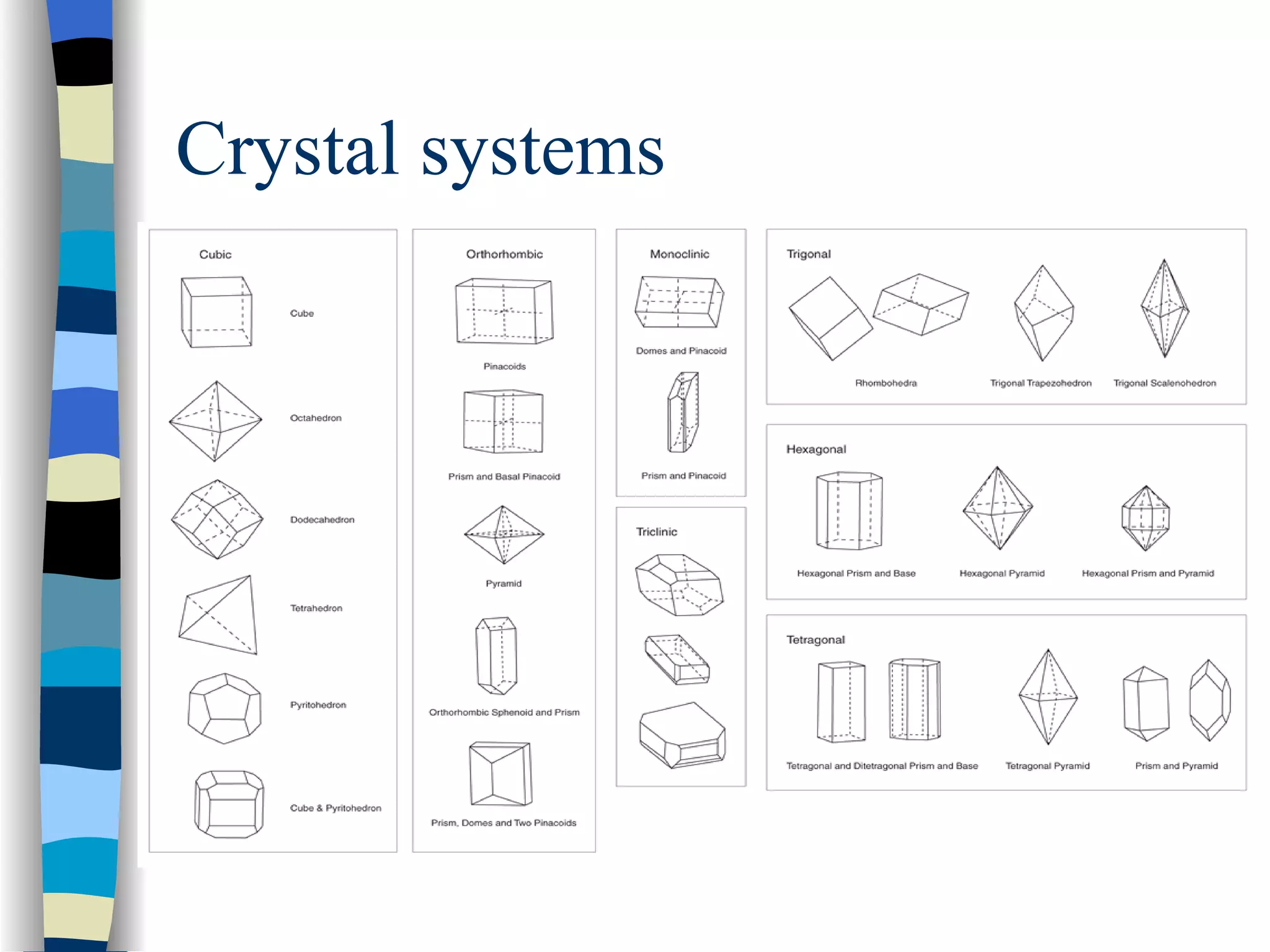
Minerals have a crystalline structure with various groups: Silicates, Carbonates, Oxides, Sulfides, and others.
Methods for identifying minerals include color, luster, texture, hardness, cleavage, fracture, and density.
Minerals have various uses; some are mined as ores for profit, while others are valuable gems.
Definition of rocks as mixtures of minerals with a focus on igneous rocks formed from magma.
Magma contains various elements and is influenced by temperature and composition factors during rock formation.
Processes such as fractional crystallization and layered intrusions affect the cooling of magma.
Classification based on mineral composition (felsic, mafic, ultra-mafic) and grain size.Igneous rocks yield valuable building materials and ores, such as diamonds found in kimberlites.
Factors in purchasing diamonds include color, clarity, cut, and carat weight.
Sedimentary rocks form from sediments through processes like weathering, erosion, and lithification.
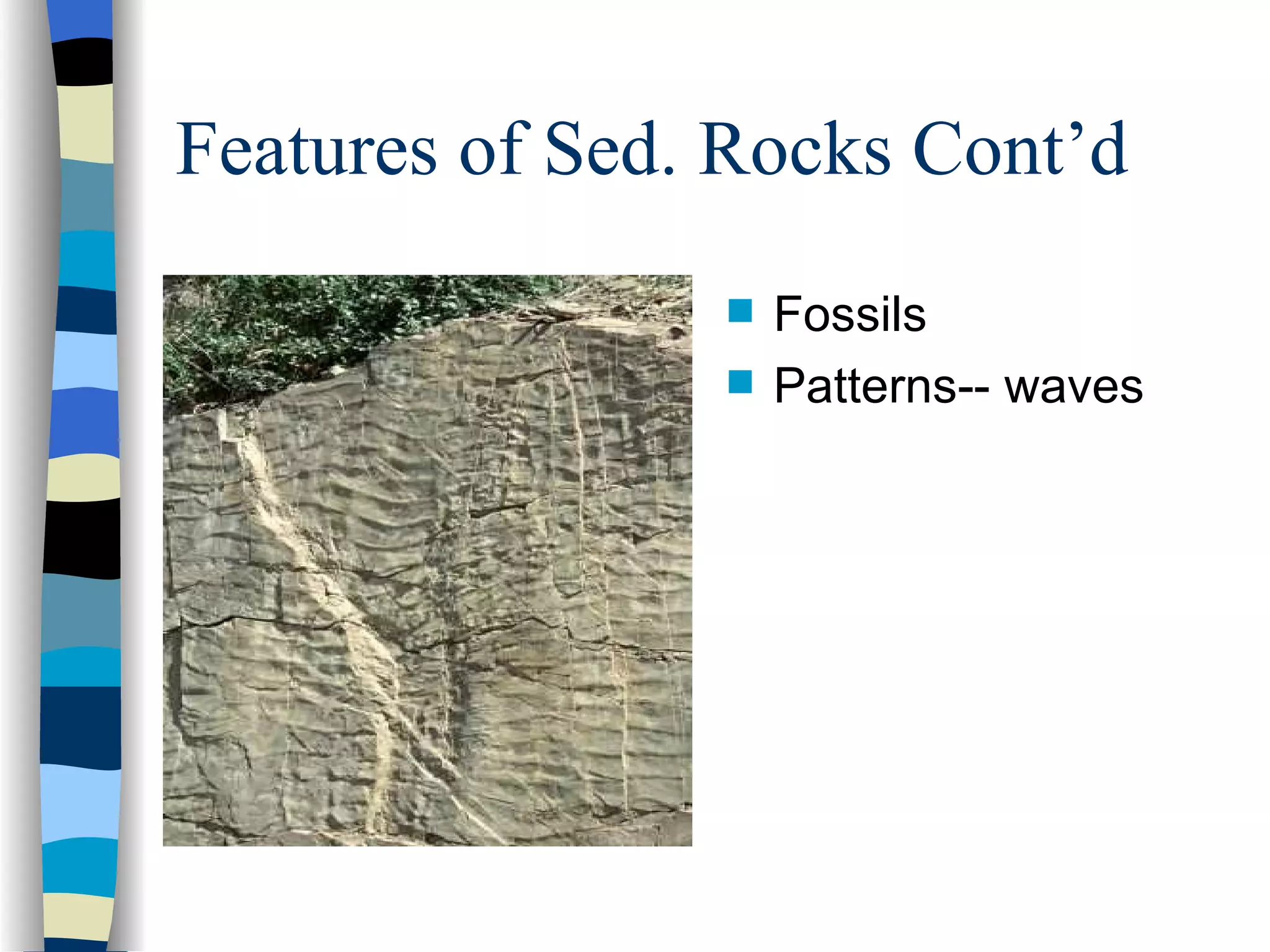
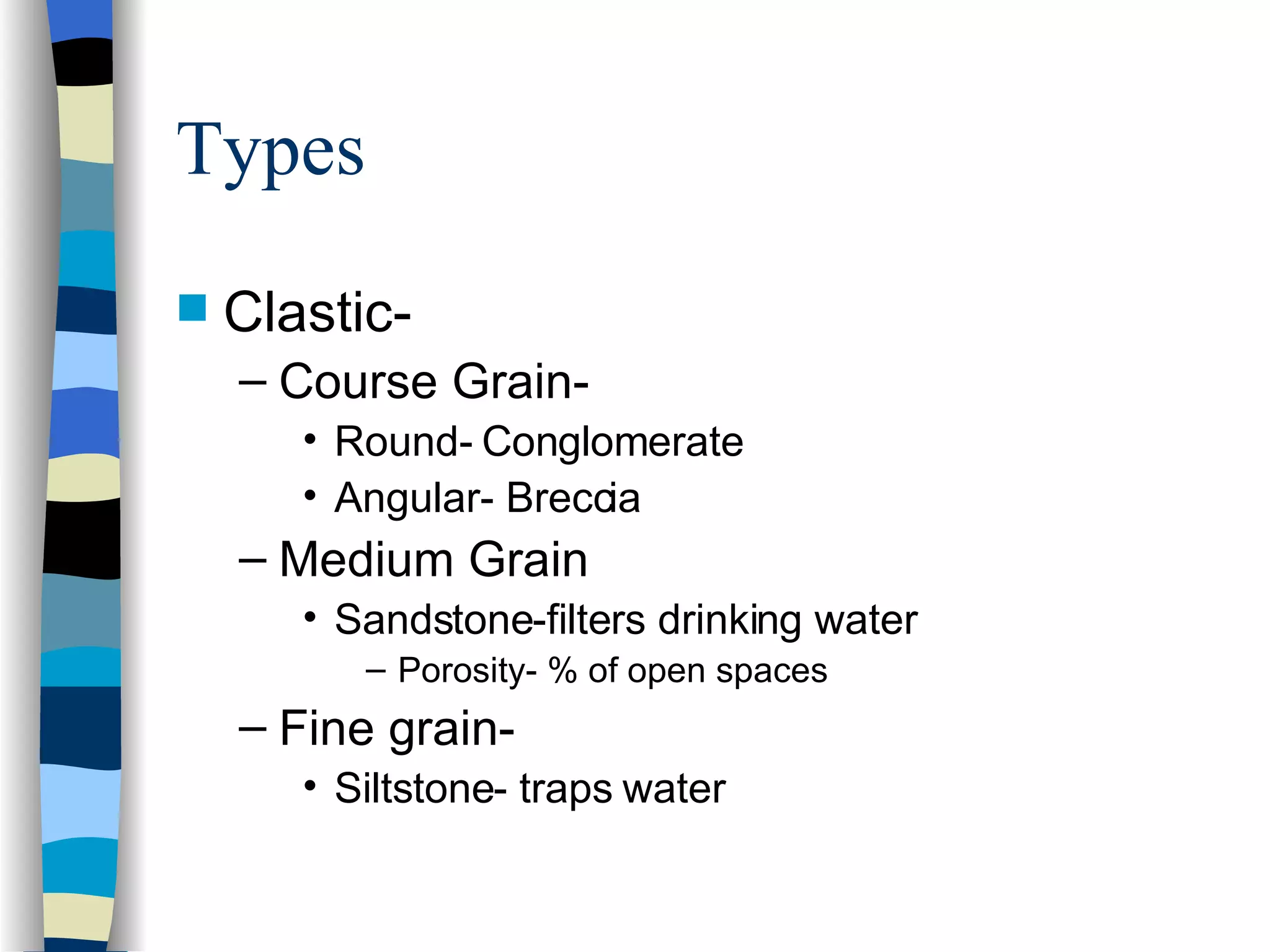
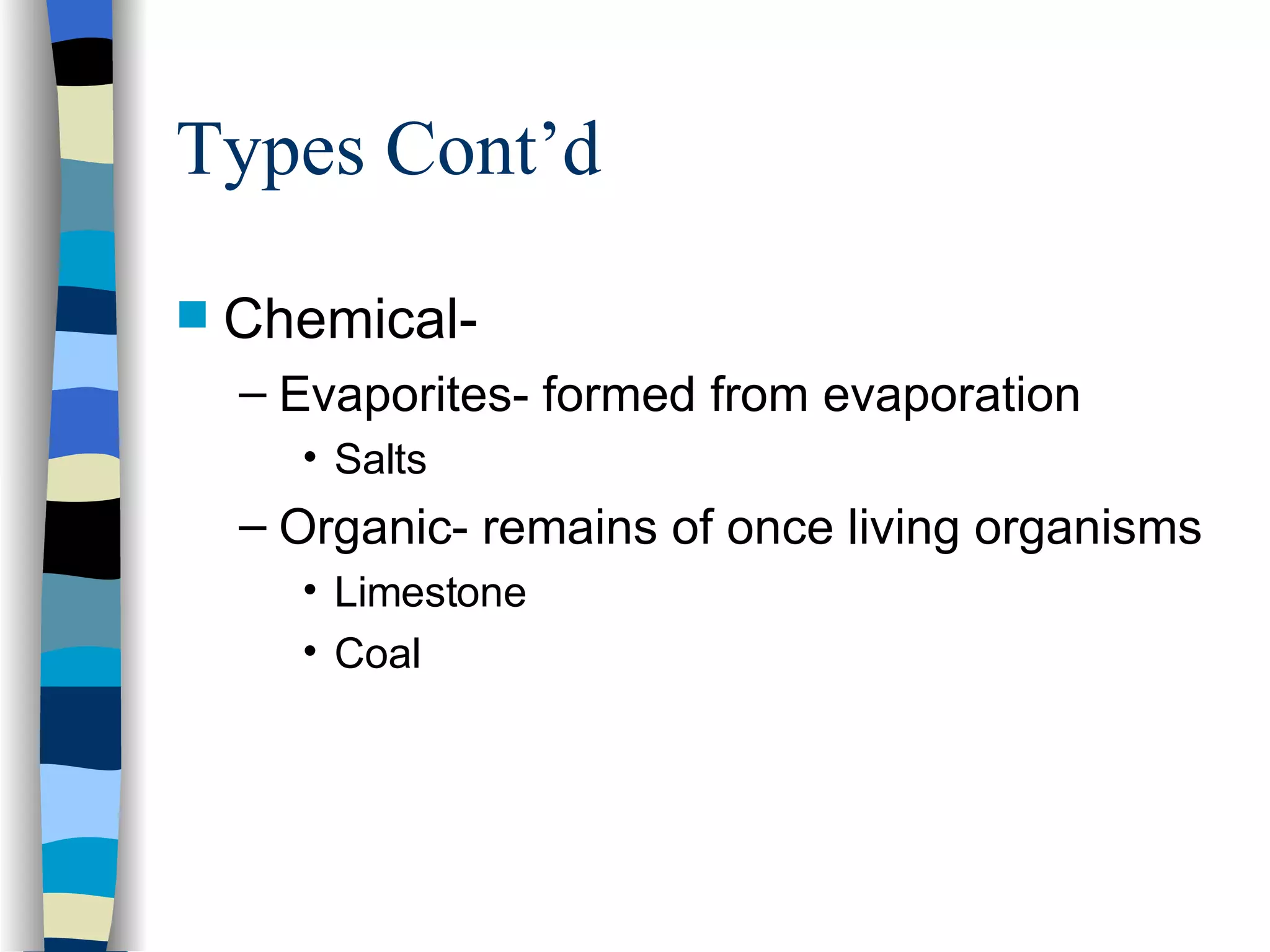
Characteristics include bedding, fossils, and various types such as clastic, chemical, and organic.
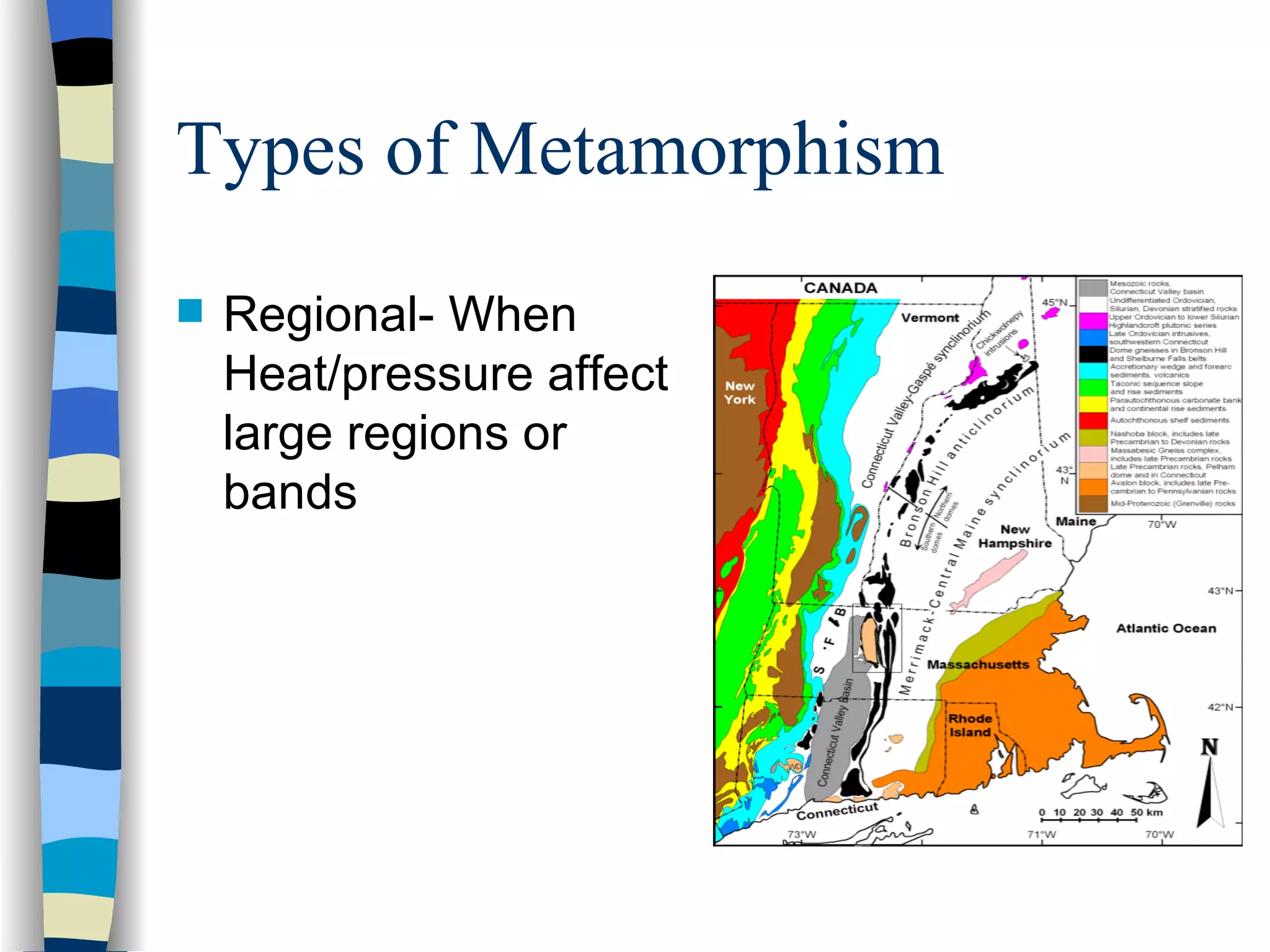
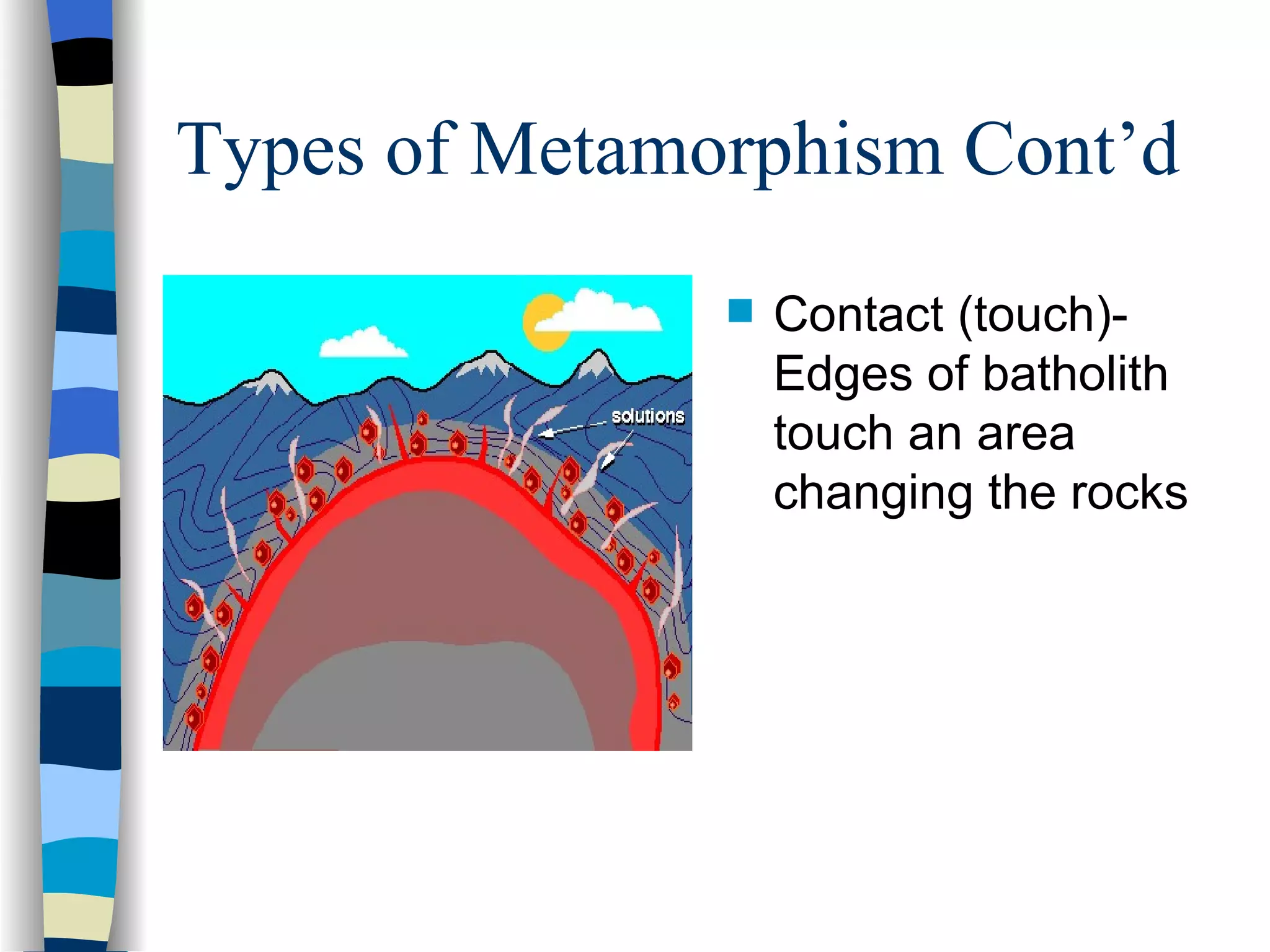
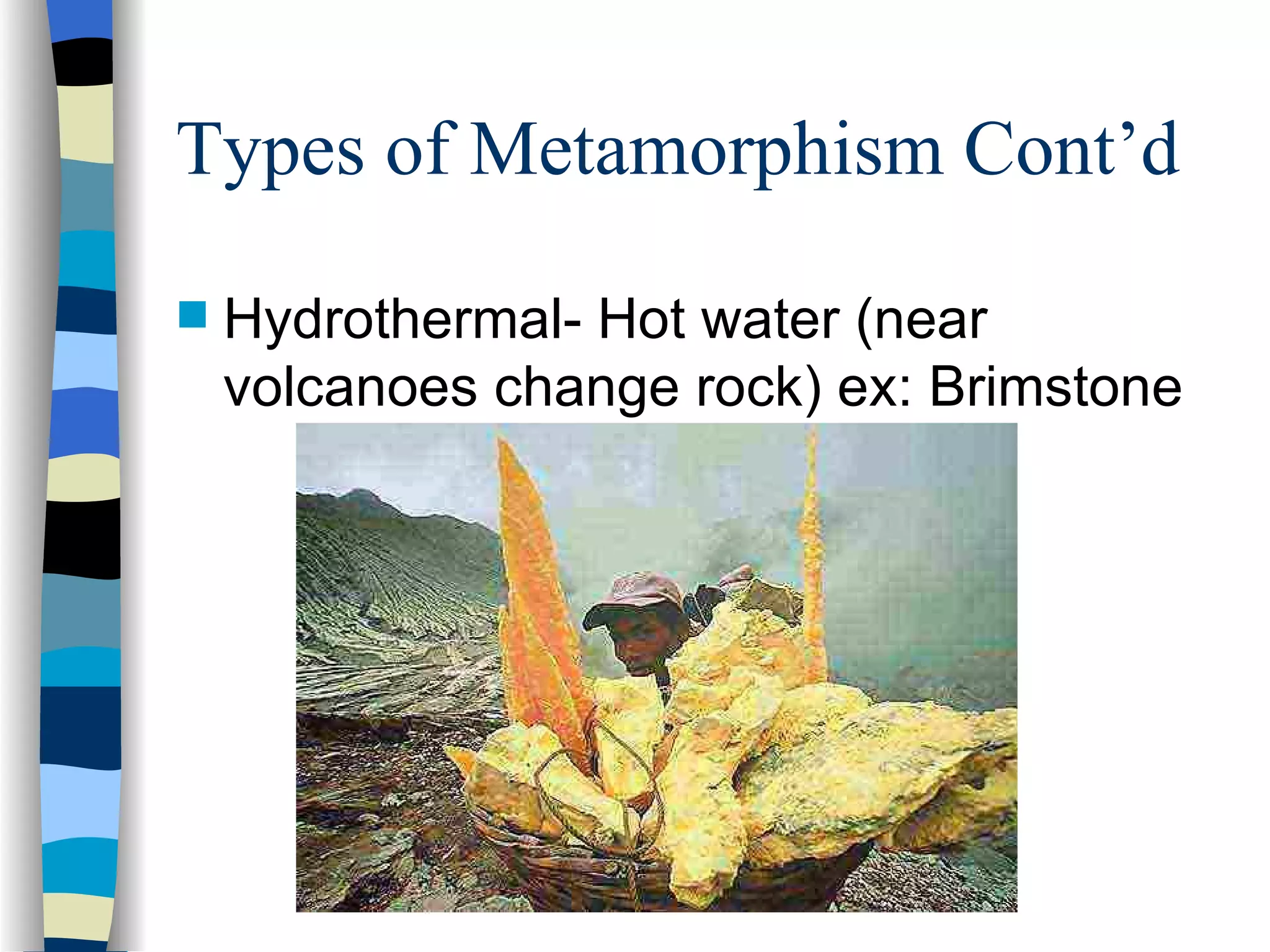
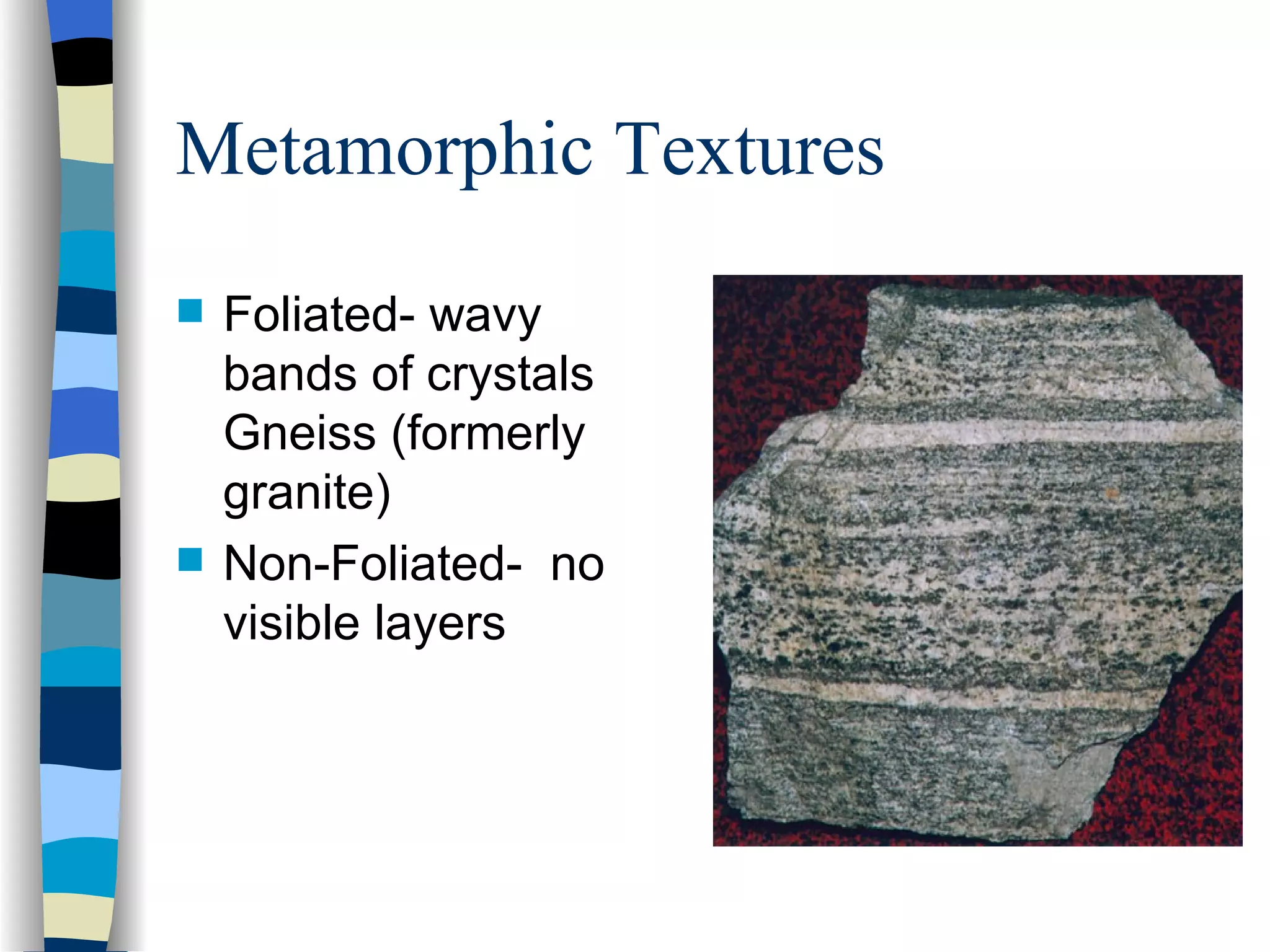
Metamorphic rocks change through heat and pressure, with types like regional and contact metamorphism.
Overview of the rock cycle, illustrating the processes involved in the transformation of rock types.
Composition Solid DefiniteComposition – Made up of specific compounds or elements Copper (Cu), Gold (Au), Silver (Ag) Salt (NaCl), Quartz(SiO 2 ) Sometimes composition varies slightly (ex : yellow diamonds)
6.
Crystalline structure Crystal– Solid in which atoms are arranged in repeating patterns. Atomic Viewer Minerals form in open spaces and crystals grow to fill the space
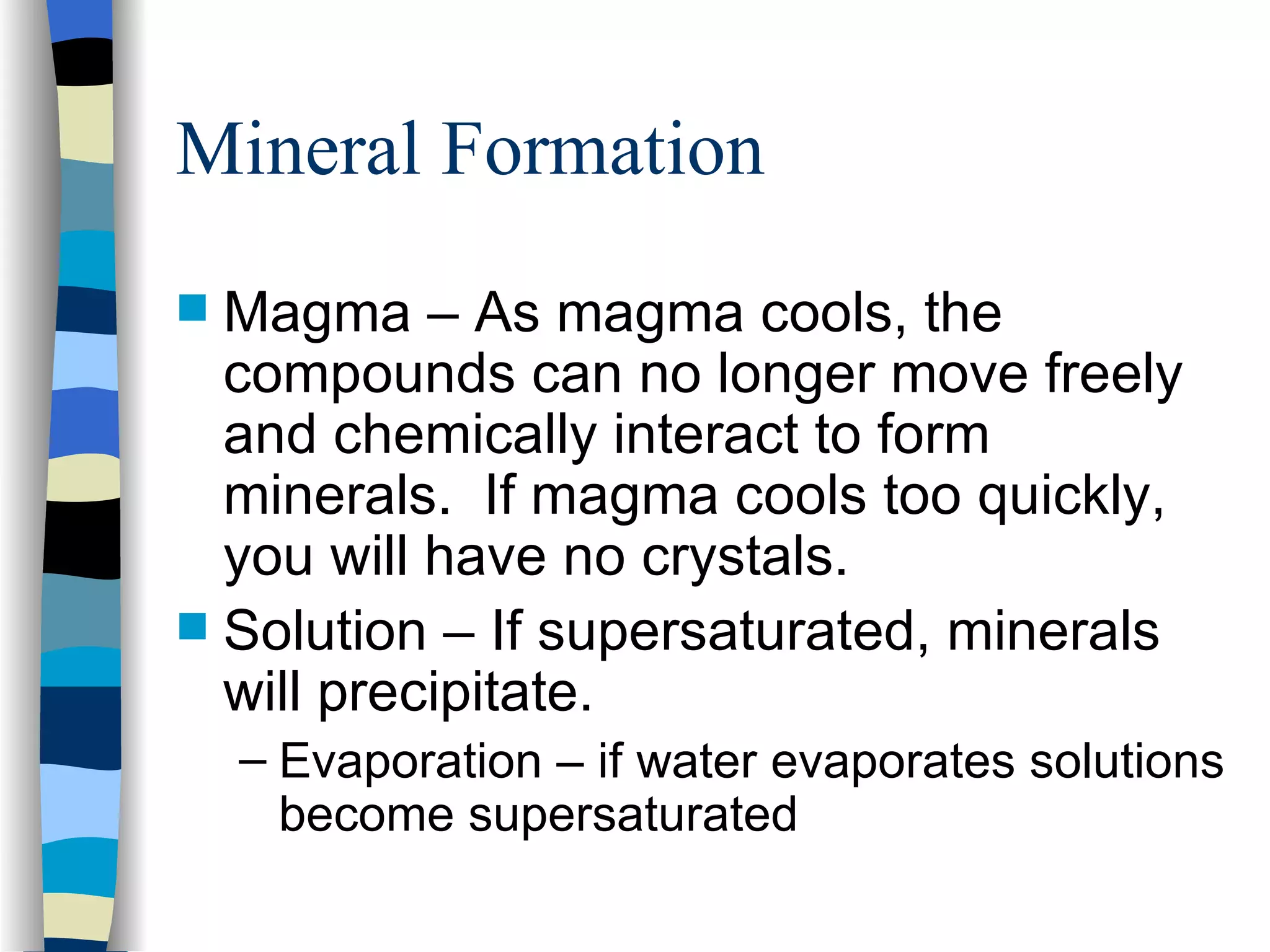
Mineral Formation Magma– As magma cools, the compounds can no longer move freely and chemically interact to form minerals. If magma cools too quickly, you will have no crystals. Solution – If supersaturated, minerals will precipitate. Evaporation – if water evaporates solutions become supersaturated
9.
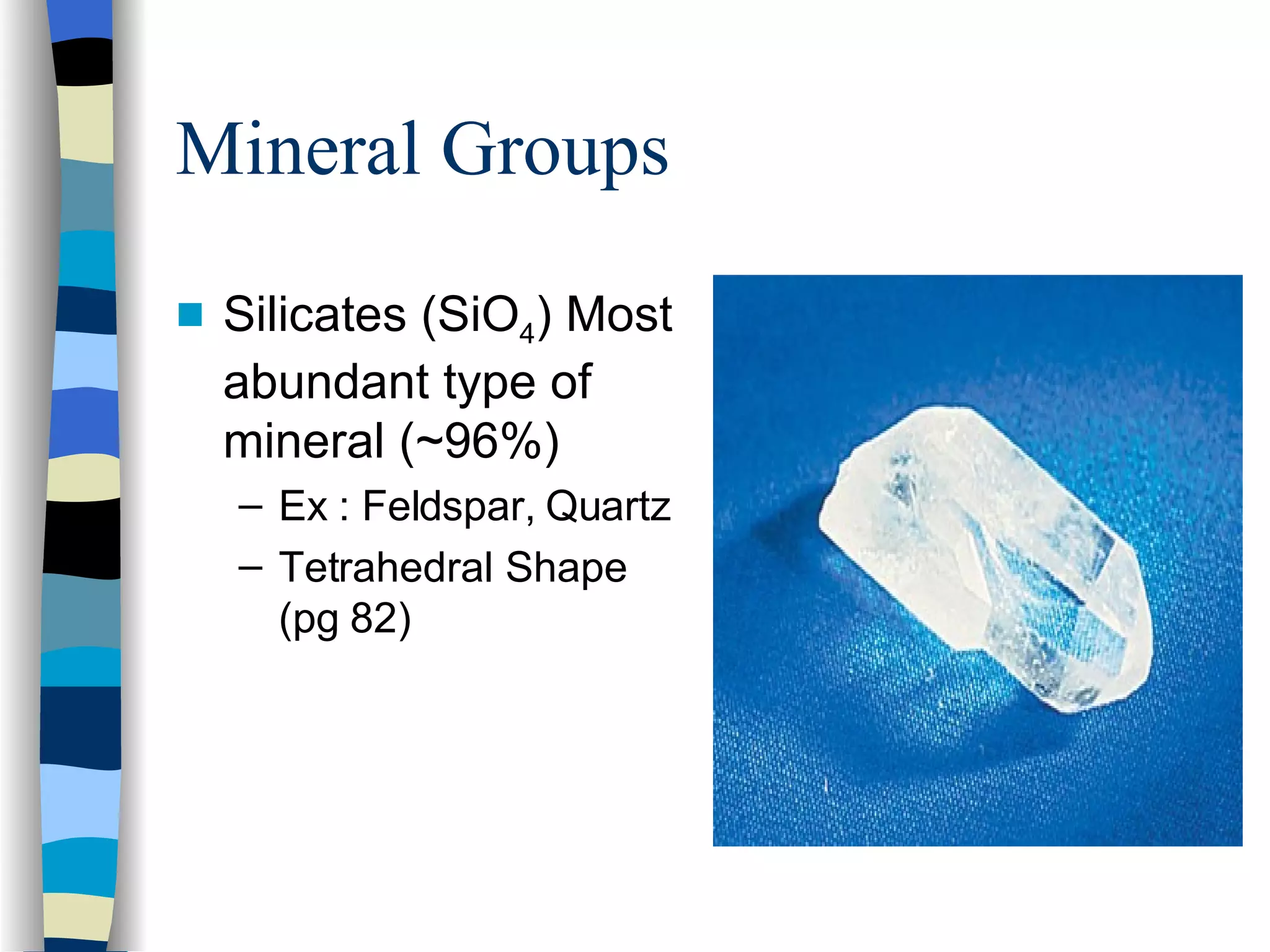
Mineral Groups Silicates(SiO 4 ) Most abundant type of mineral (~96%) Ex : Feldspar, Quartz Tetrahedral Shape (pg 82)
10.
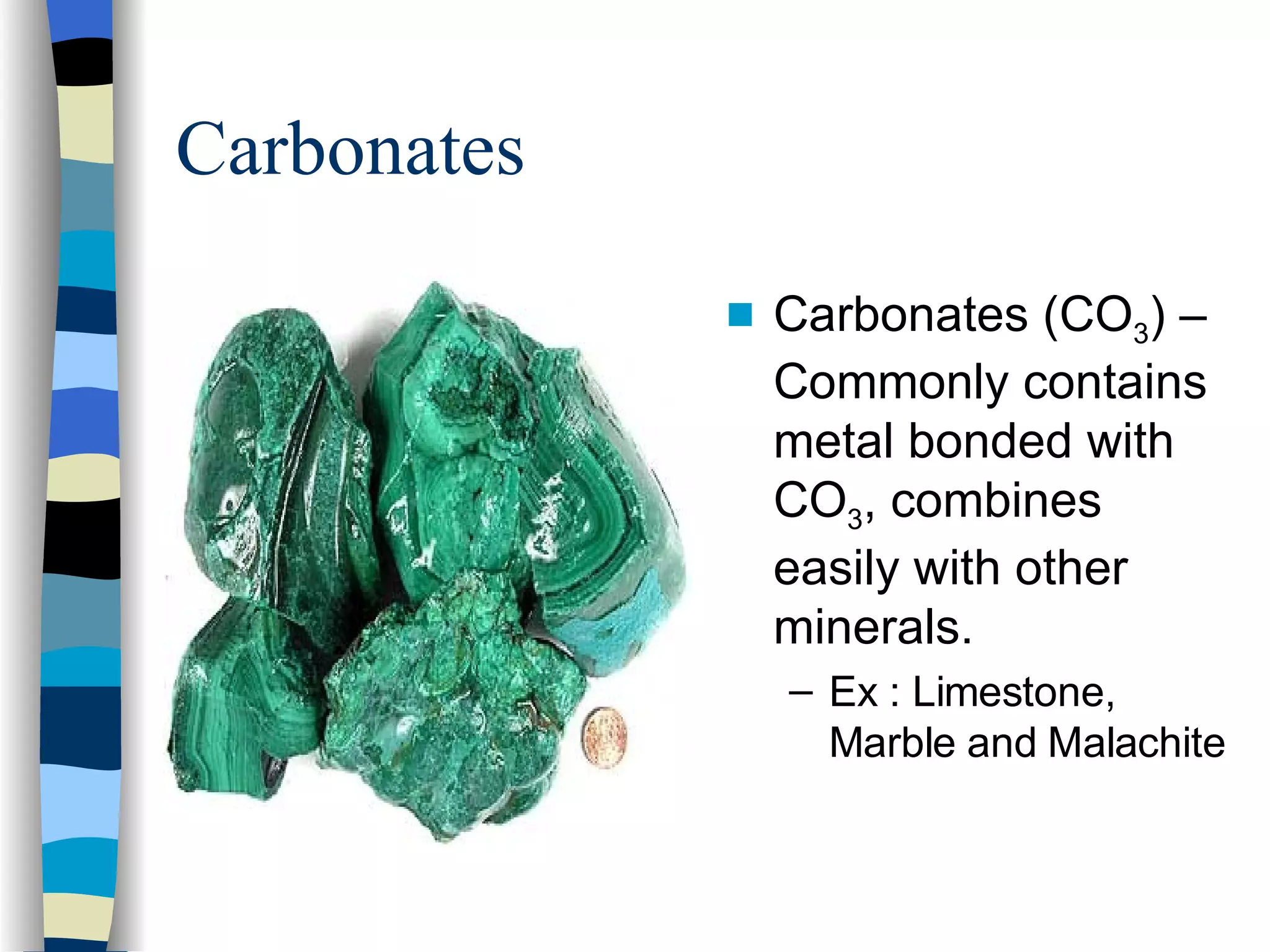
Carbonates Carbonates (CO3 ) – Commonly contains metal bonded with CO 3 , combines easily with other minerals. Ex : Limestone, Marble and Malachite
11.
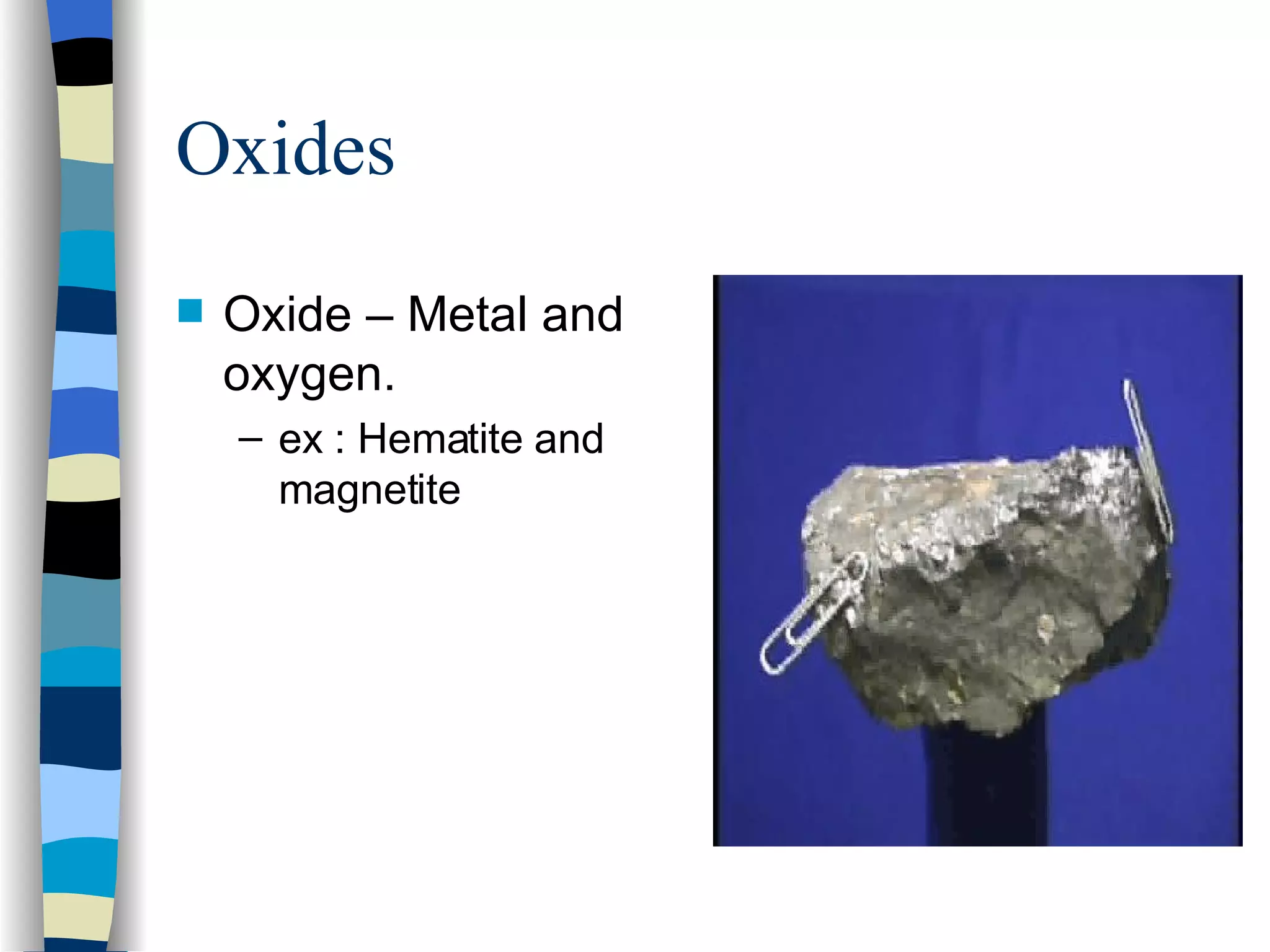
Oxides Oxide –Metal and oxygen. ex : Hematite and magnetite
12.
Other mineral groupsSulfides (Element + S 2 ) Sulfate (Element + SO 4 ) Halides (Element + Halide) – NaCl Native element (just an element)
13.
Mineral Identification Color– Caused by trace elements or compounds within a mineral Least reliable clue to mineral identity Luster – The way a mineral reflects light Metallic minerals reflect light Non-metallic do not shine Dull, pearly, waxy or silky
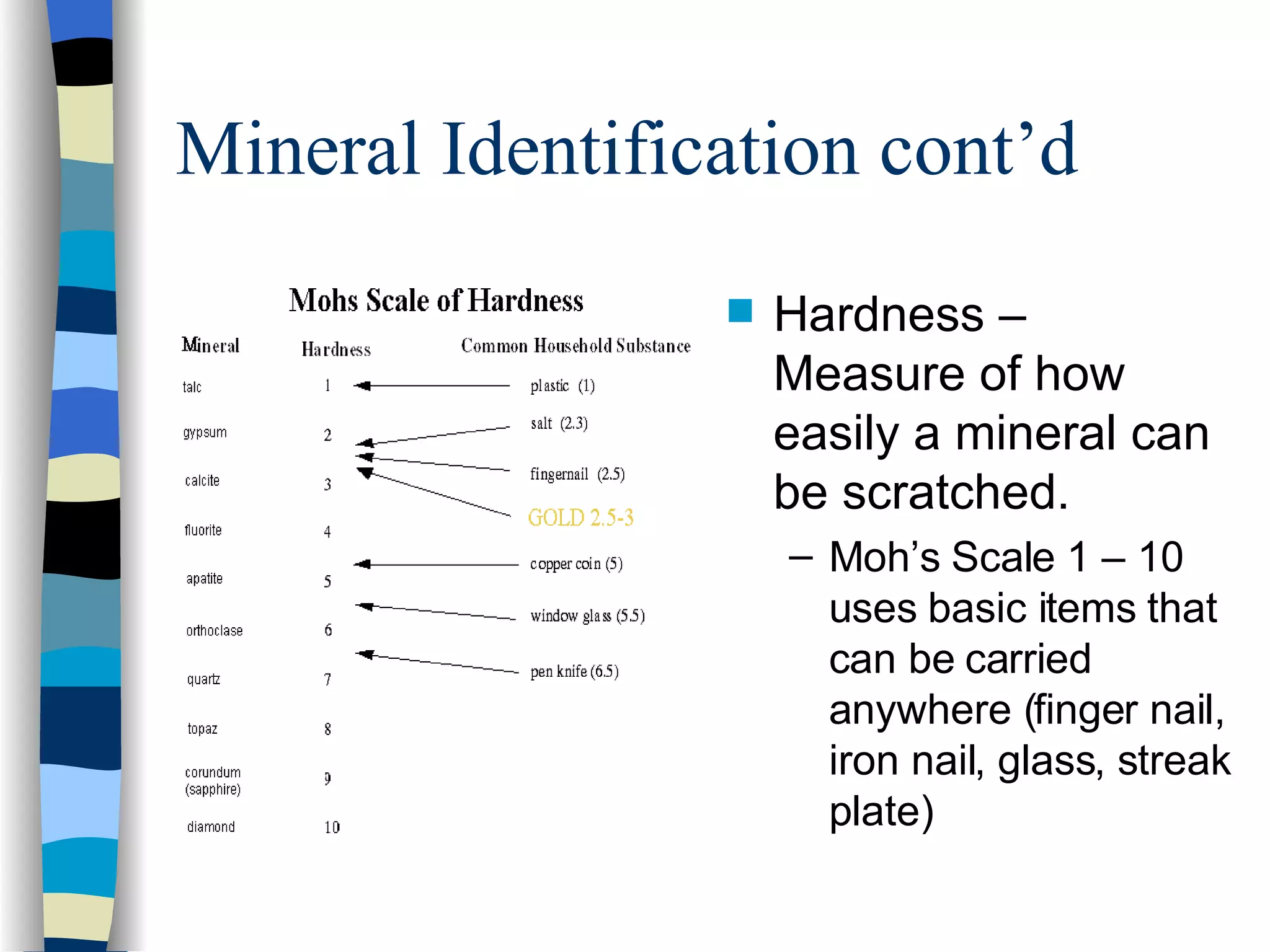
Mineral Identification cont’dHardness – Measure of how easily a mineral can be scratched. Moh’s Scale 1 – 10 uses basic items that can be carried anywhere (finger nail, iron nail, glass, streak plate)
17.
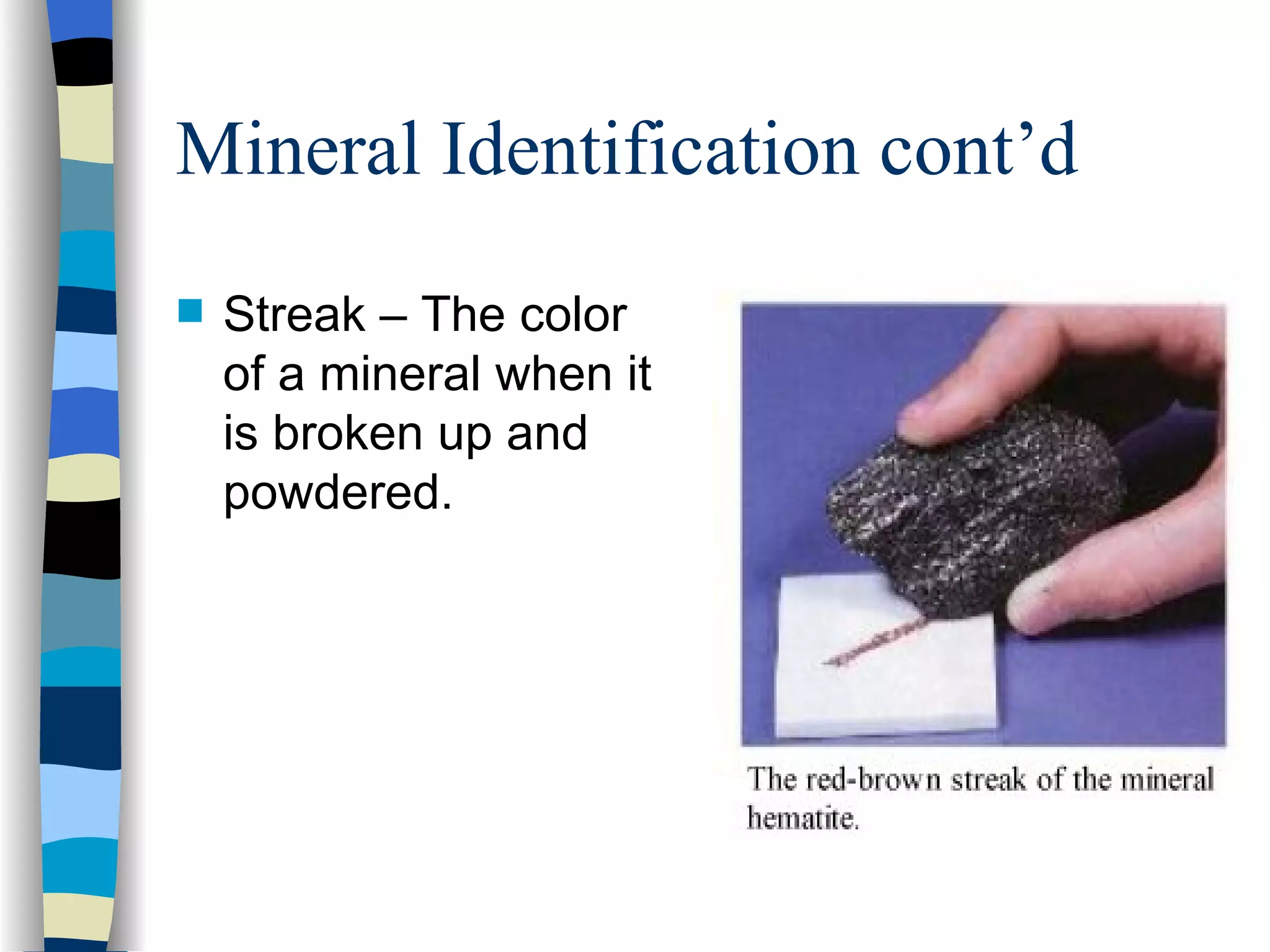
Mineral Identification cont’dMinerals break along planes where atomic bonding is weak (mica) Cleavage – A mineral that splits evenly along planes Fracture – Minerals that break with rough or jagged edges
18.
Mineral Identification cont’dDensity – Reflects atomic weight and structure of mineral D = M / V Specific Gravity – Measure of density using water Special properties Ex : Double refraction - Calcite
19.
Mineral Uses Ores– Mineral that can mined for a profit. Ex : Hematite Iron Ex : Bauxite Aluminum Gems – Valuable minerals prized for rarity and beauty. Ex : Rubies and Sapphires, both corundum with trace minerals Under Sea Deposits No owners international law Not enough technology Destroy oceans
Igneous Rocks Formedfrom the cooling of magma Crystallization- formation of crystals Ignis- Latin-”fire” Types Intrusive- cool slowly under Earth’s surface, large crystals Extrusive- cool quickly above Earth’s surface, small/no crystals
22.
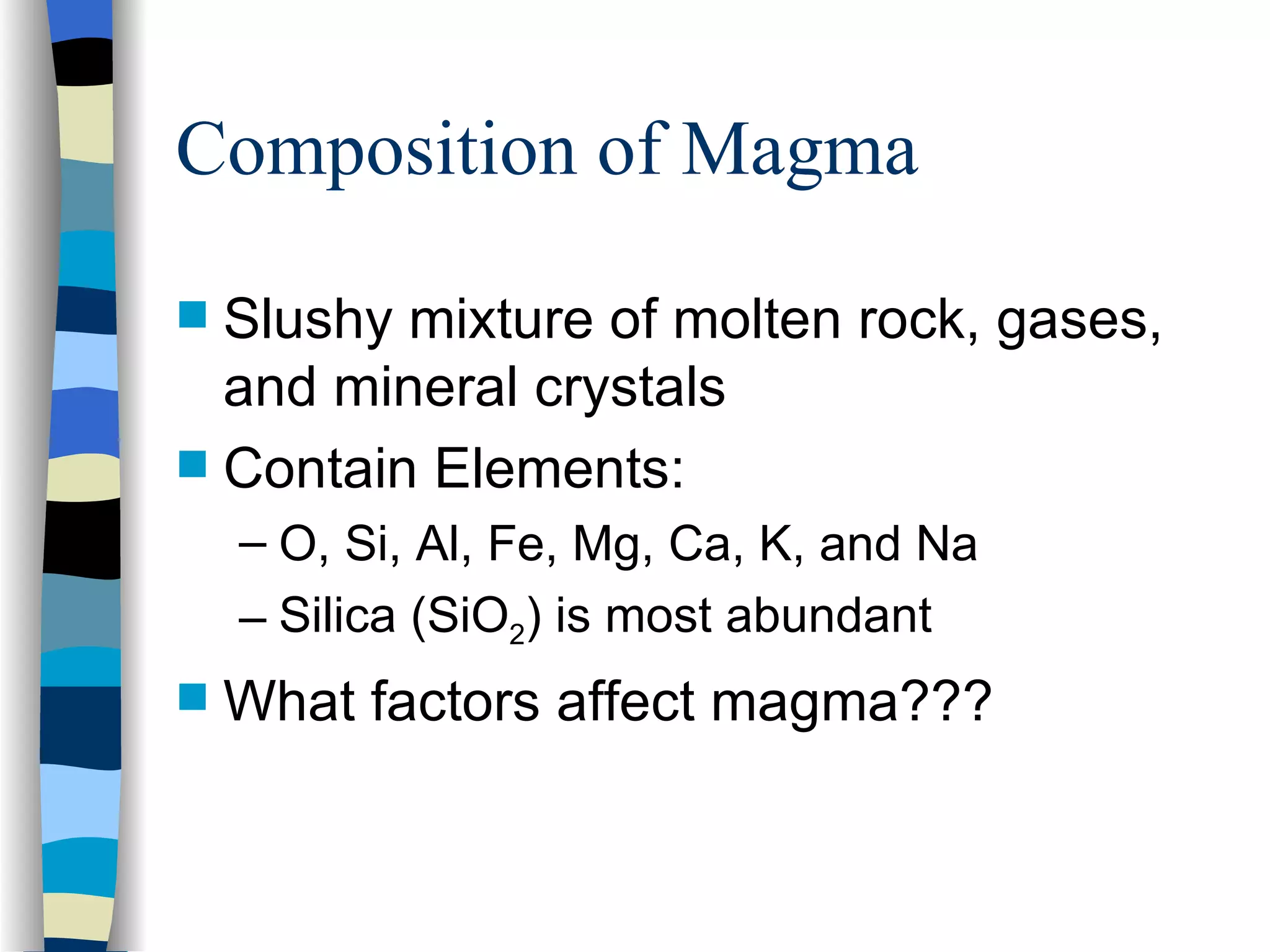
Composition of MagmaSlushy mixture of molten rock, gases, and mineral crystals Contain Elements: O, Si, Al, Fe, Mg, Ca, K, and Na Silica (SiO 2 ) is most abundant What factors affect magma???
23.
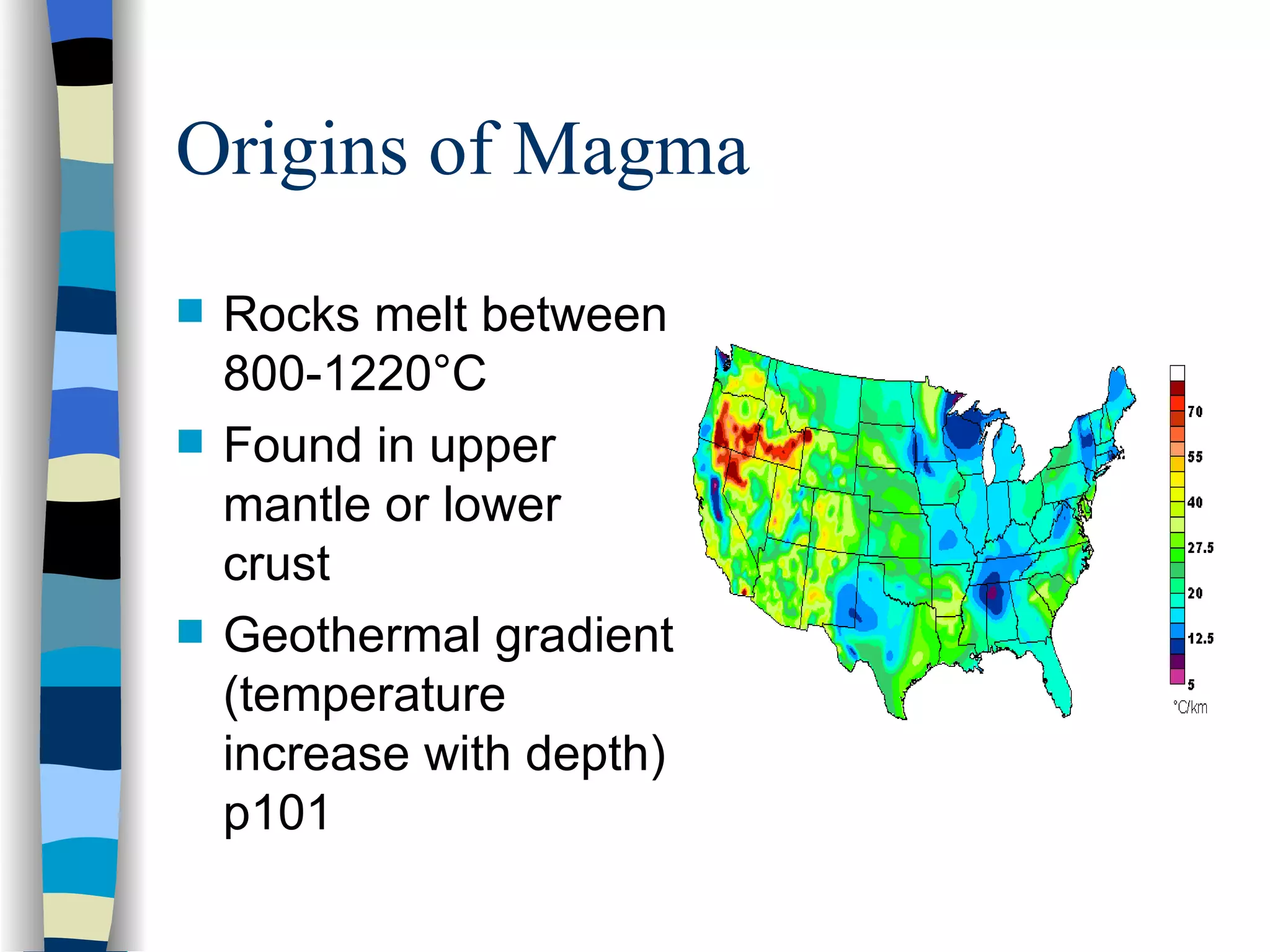
Origins of MagmaRocks melt between 800-1220 °C Found in upper mantle or lower crust Geothermal gradient (temperature increase with depth) p101
24.
Melting Temperatures Affectedby water content, silica content, Type of mineral in magma Oceanic Crust melts at higher temp, than continental crust b/c high magnesium and iron, low in water Partial Melting- Not all parts of a rock melt at the same time different minerals are added to magma at different times, changing type of rock formed
25.
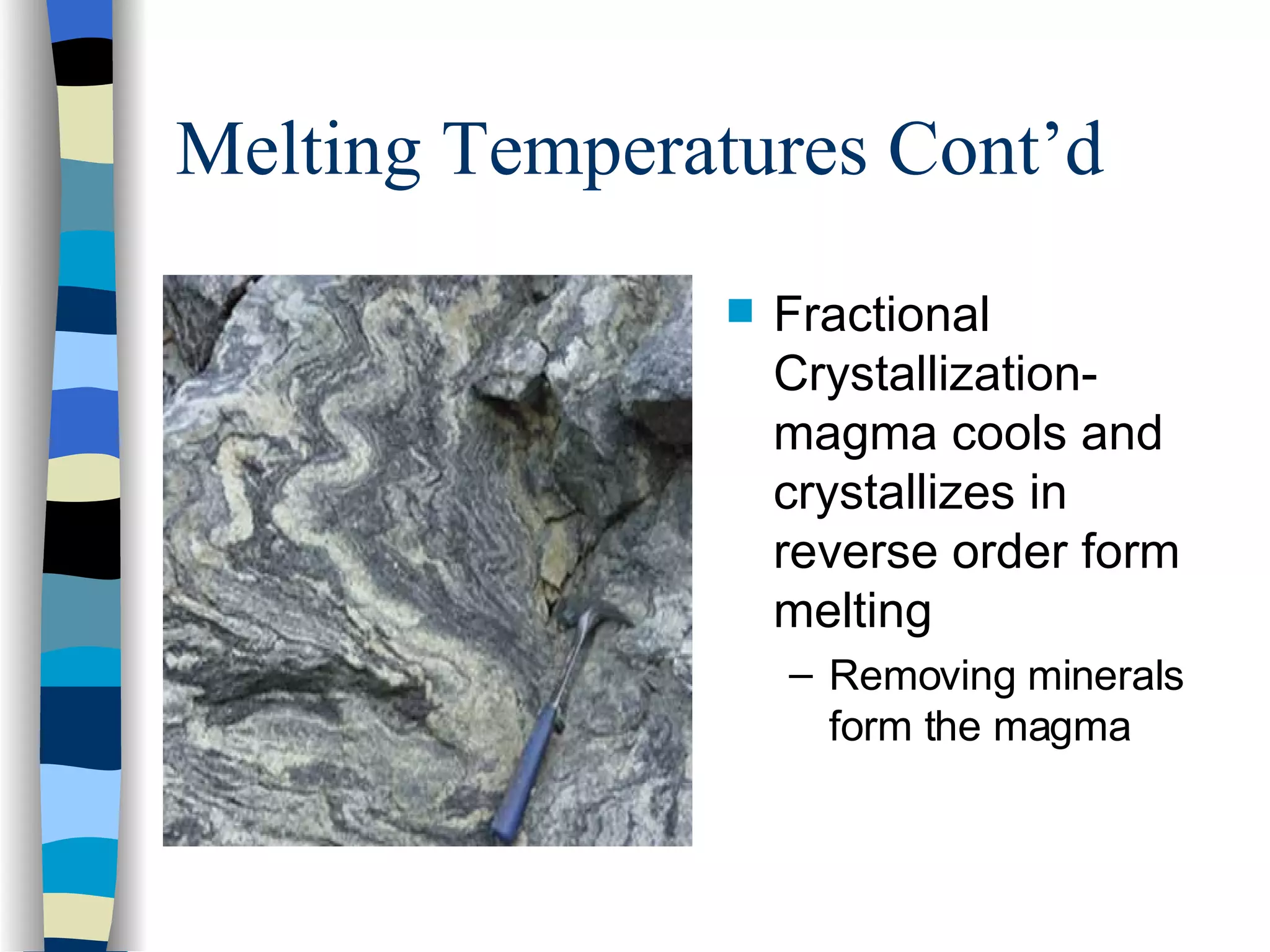
Melting Temperatures Cont’dFractional Crystallization- magma cools and crystallizes in reverse order form melting Removing minerals form the magma
26.
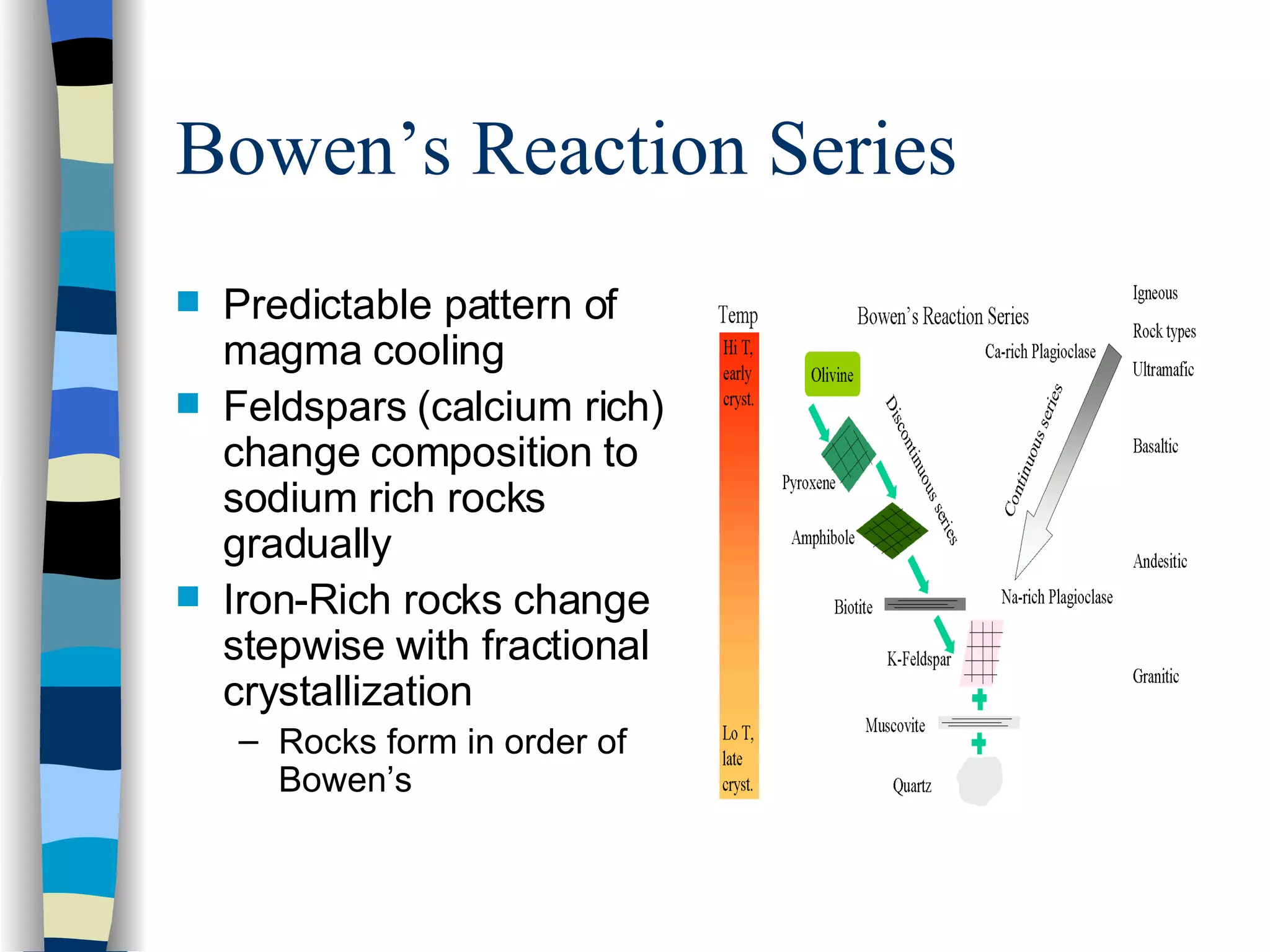
Bowen’s Reaction SeriesPredictable pattern of magma cooling Feldspars (calcium rich) change composition to sodium rich rocks gradually Iron-Rich rocks change stepwise with fractional crystallization Rocks form in order of Bowen’s
27.
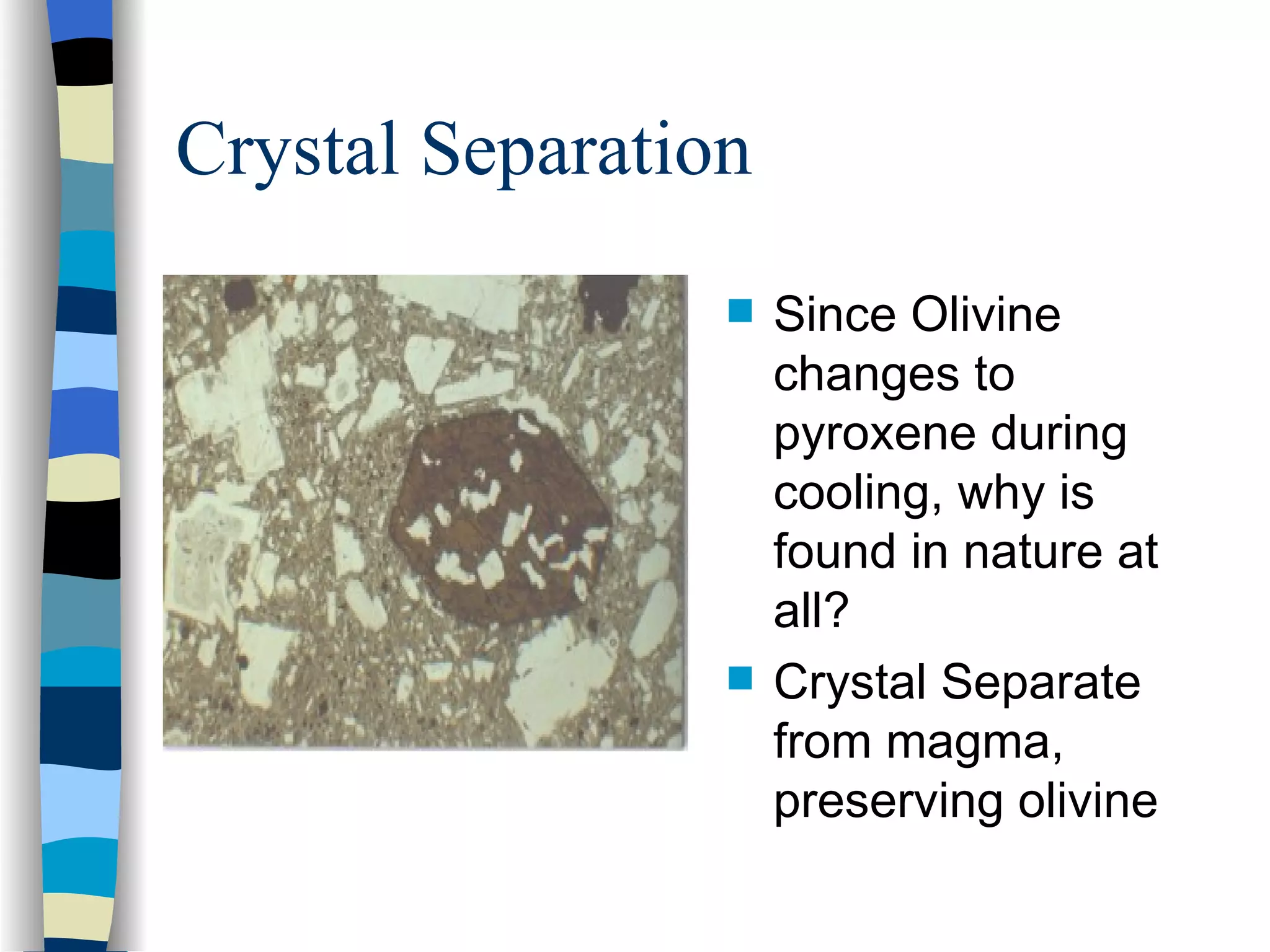
Crystal Separation SinceOlivine changes to pyroxene during cooling, why is found in nature at all? Crystal Separate from magma, preserving olivine
28.
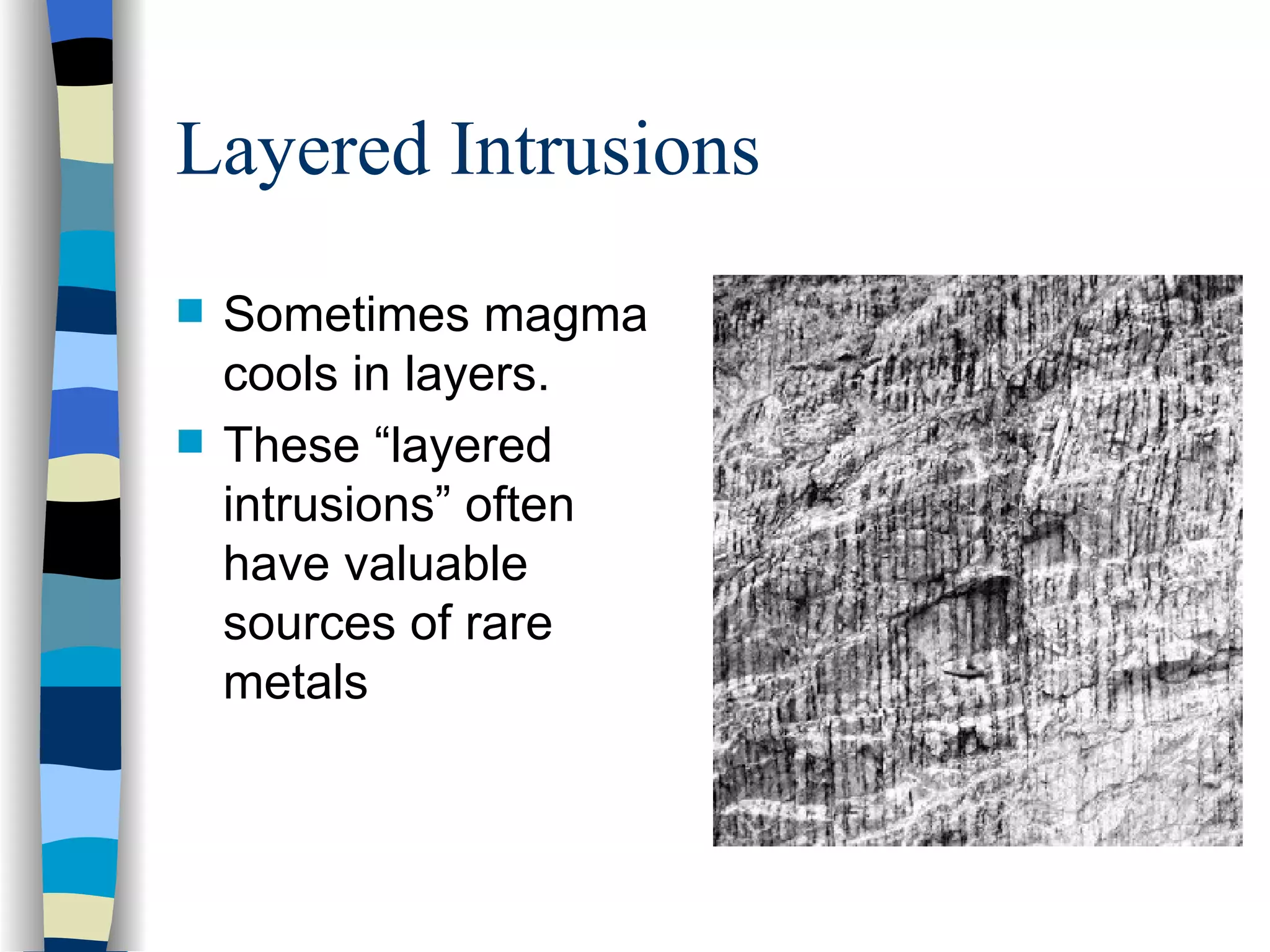
Layered Intrusions Sometimesmagma cools in layers. These “layered intrusions” often have valuable sources of rare metals
29.
Classifying Igneous RocksIntrusive/Extrusive Mineral Composition Felsic- light colored, high silica, Contain Quartz and Feldspars Ex: Granite Mafic- dark in color, lower silica, rich in iron and magnesium Ex: Olivine, Amphibole Ultra-Mafic-Very low silica and very high iron, Magnesium
30.
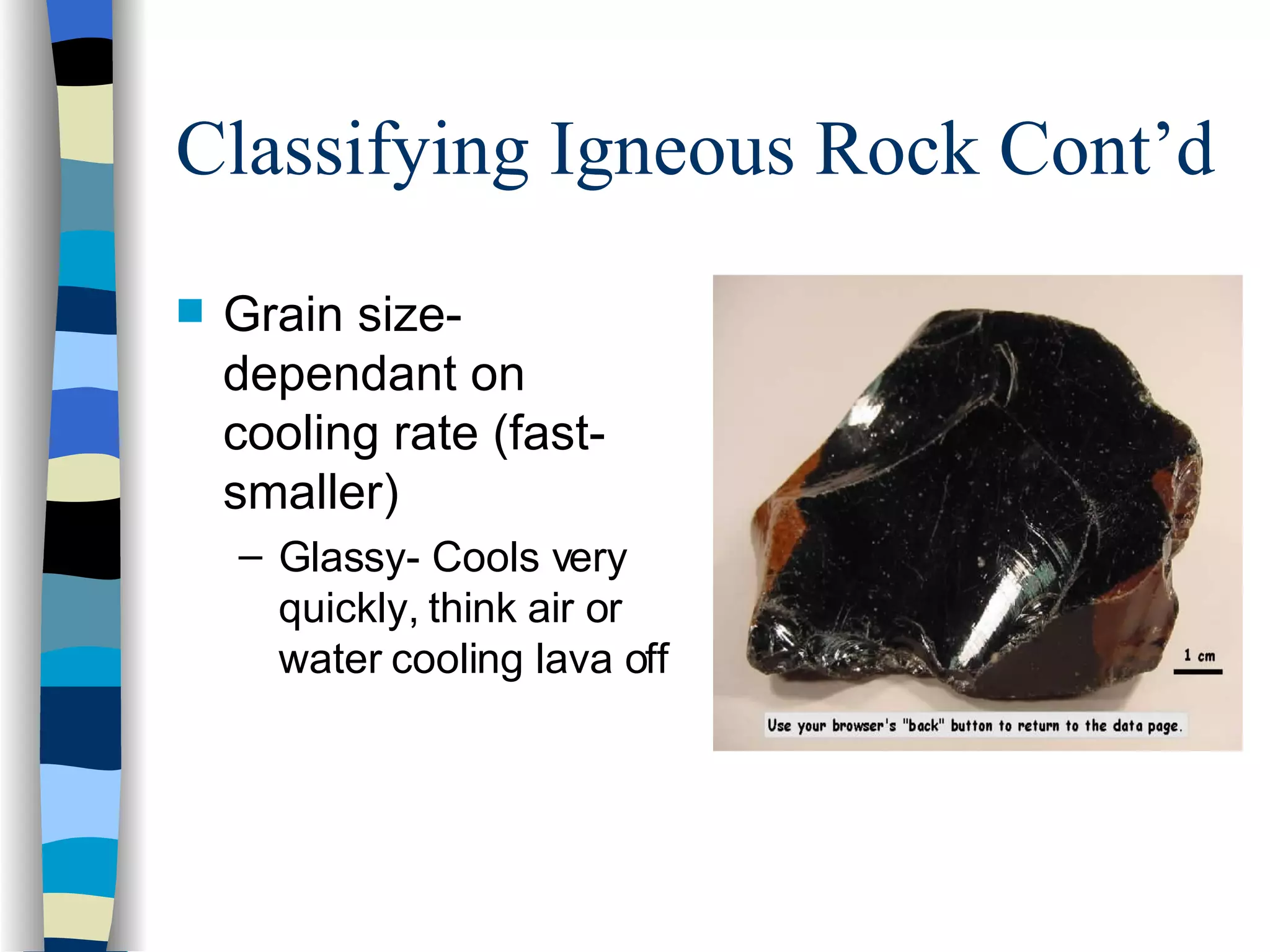
Classifying Igneous RockCont’d Grain size- dependant on cooling rate (fast-smaller) Glassy- Cools very quickly, think air or water cooling lava off
31.
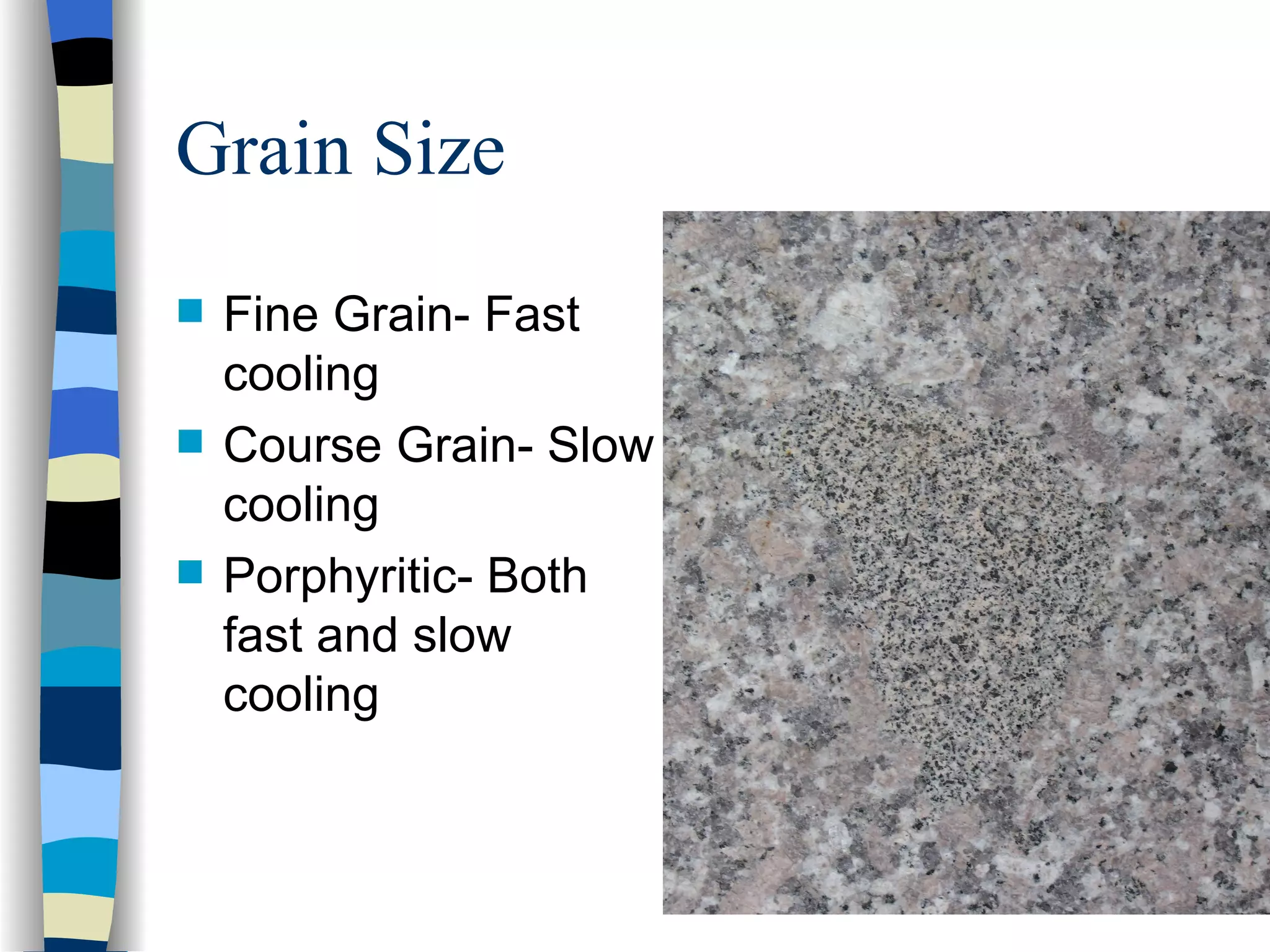
Grain Size FineGrain- Fast cooling Course Grain- Slow cooling Porphyritic- Both fast and slow cooling
32.
Igneous Rocks asResources Useful building materials interlocking crystals give strength Resists weathering Ore Deposits often found in igneous intrusions Veins- Left-overs from Bowen/s Reactions are often valuable gems (gold, silver, lead, copper) Pegmatites- Veins of very large grain minerals (ores and gemstones)
33.
34.
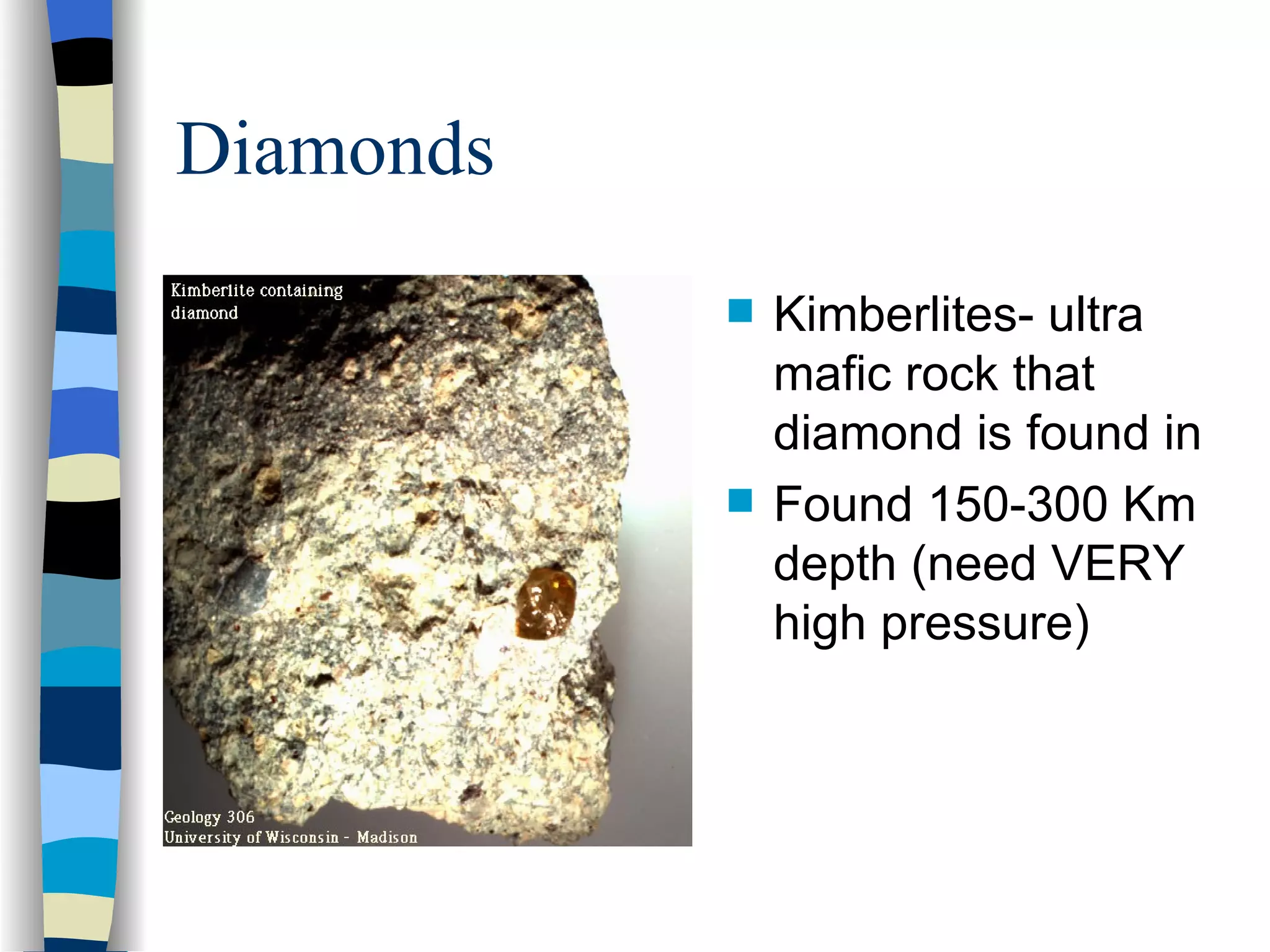
Diamonds Kimberlites- ultramafic rock that diamond is found in Found 150-300 Km depth (need VERY high pressure)
35.
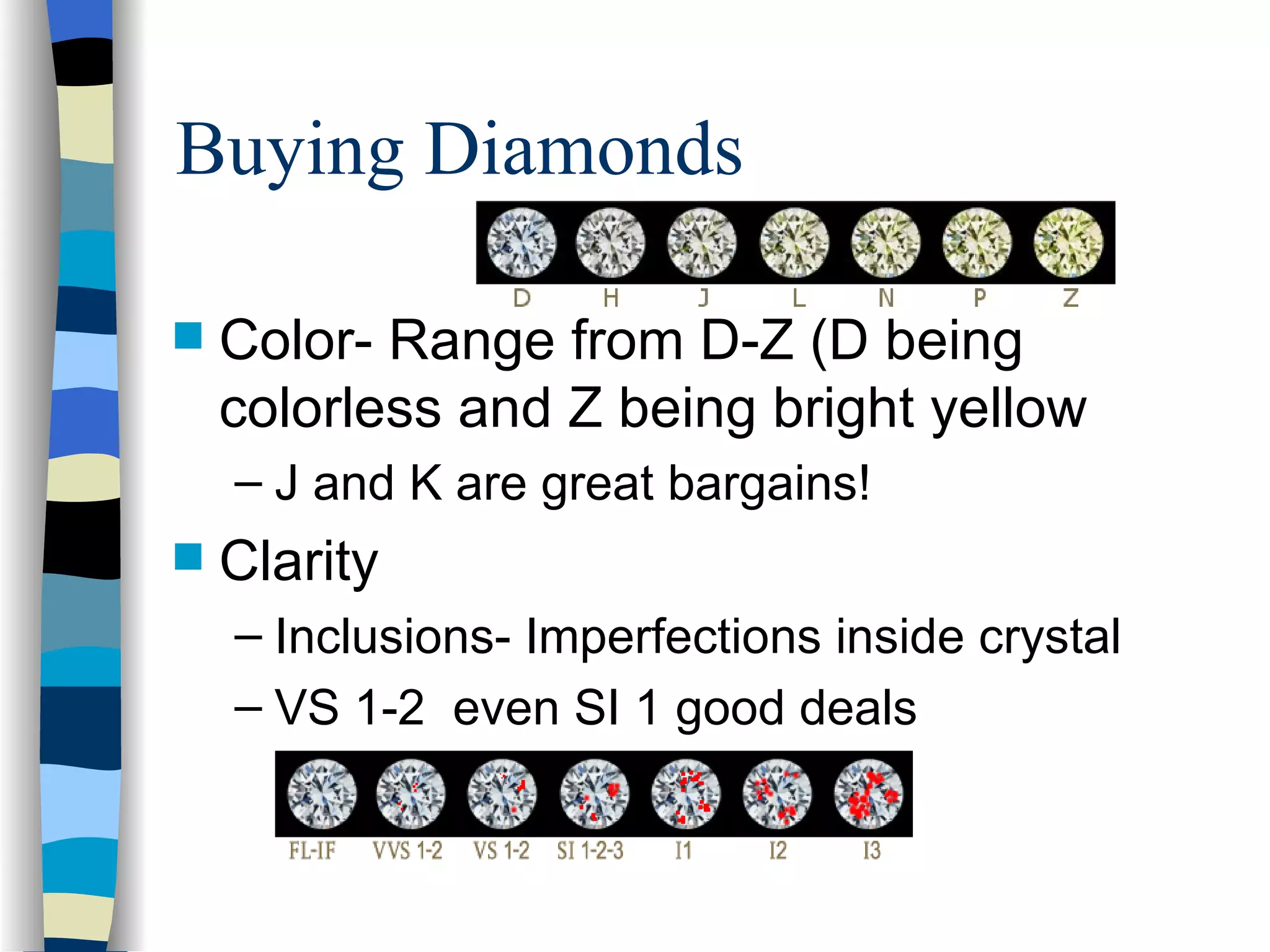
Buying Diamonds Color-Range from D-Z (D being colorless and Z being bright yellow J and K are great bargains! Clarity Inclusions- Imperfections inside crystal VS 1-2 even SI 1 good deals
36.
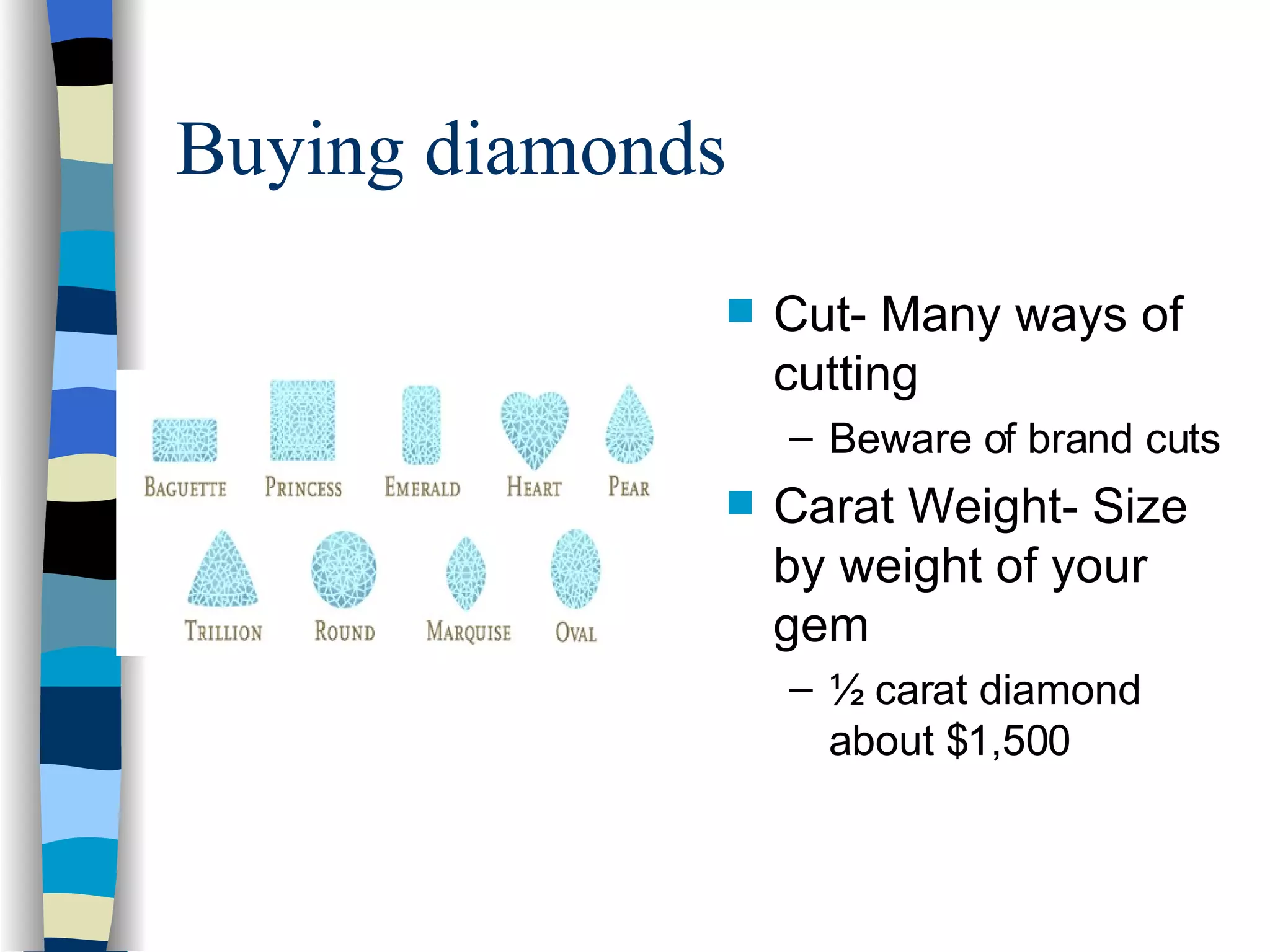
Buying diamonds Cut-Many ways of cutting Beware of brand cuts Carat Weight- Size by weight of your gem ½ carat diamond about $1,500
37.
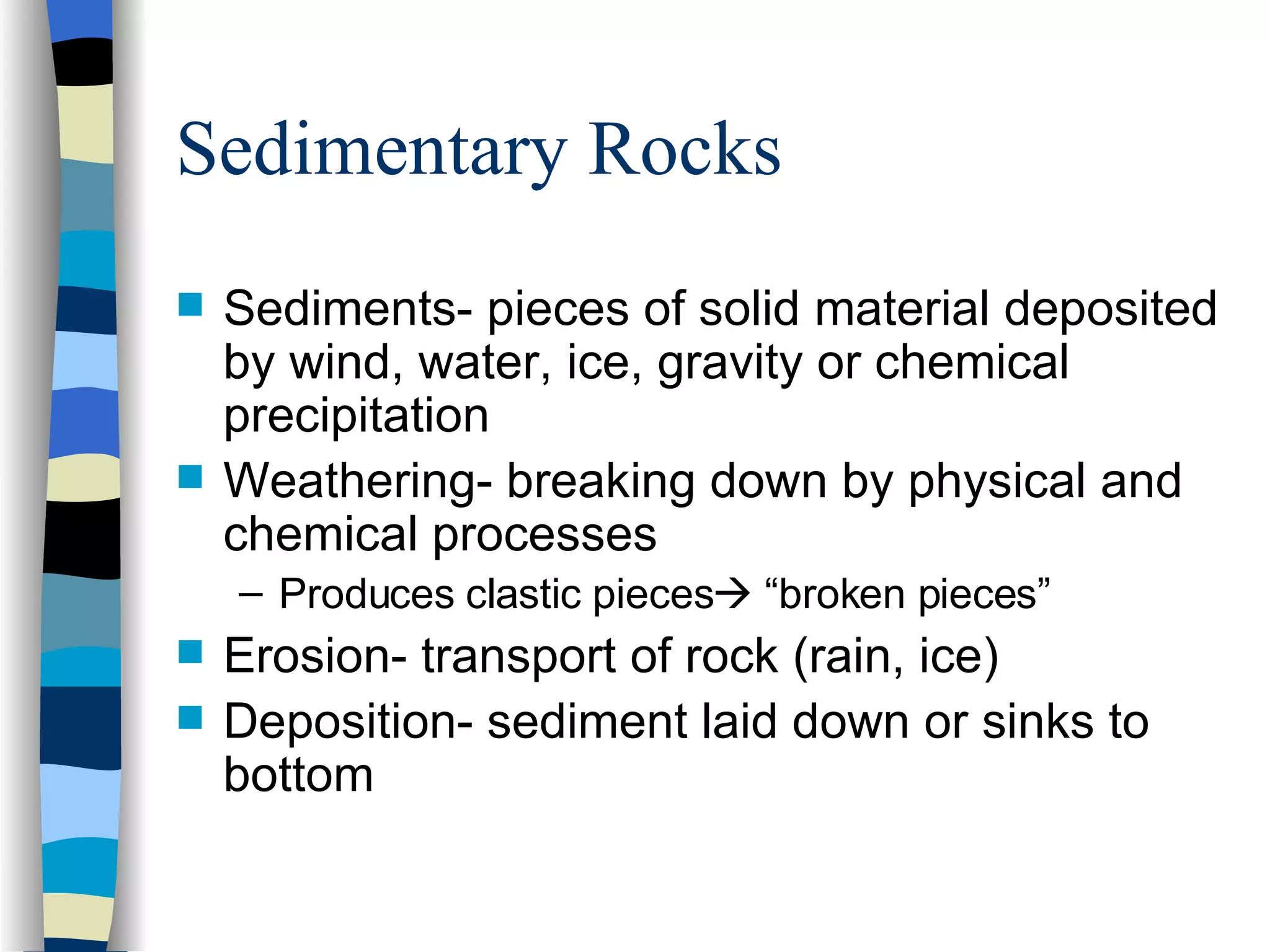
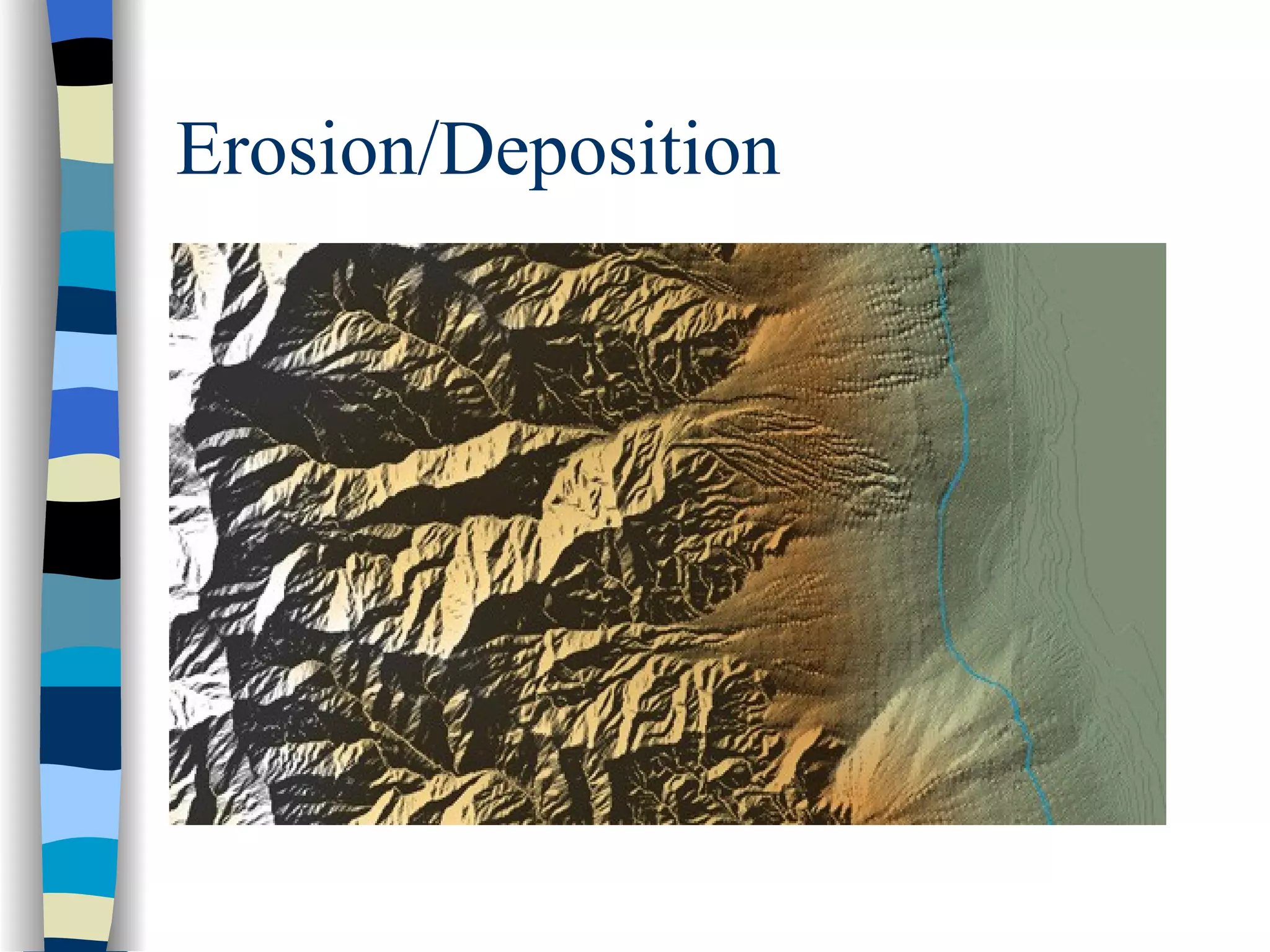
Sedimentary Rocks Sediments-pieces of solid material deposited by wind, water, ice, gravity or chemical precipitation Weathering- breaking down by physical and chemical processes Produces clastic pieces “broken pieces” Erosion- transport of rock (rain, ice) Deposition- sediment laid down or sinks to bottom
Formation of SedimentaryRocks Lithification- process by which sediments turn to rocks Must have thick layers of sediment, increasing pressure and temperature Cementation- a chemical process which mineral growth solidifies sediments
40.
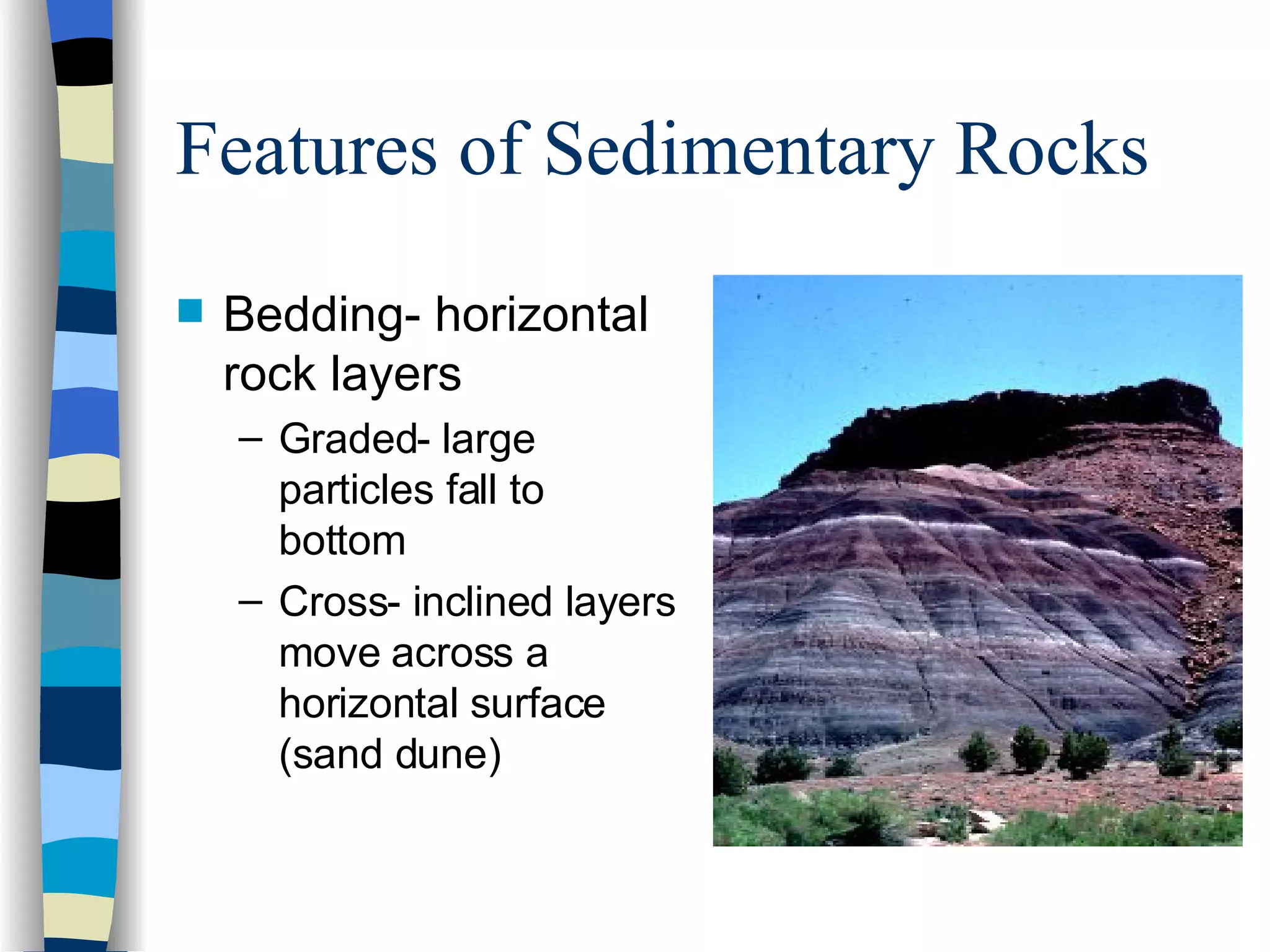
Features of SedimentaryRocks Bedding- horizontal rock layers Graded- large particles fall to bottom Cross- inclined layers move across a horizontal surface (sand dune)
Types Clastic- CourseGrain- Round- Conglomerate Angular- Breccia Medium Grain Sandstone-filters drinking water Porosity- % of open spaces Fine grain- Siltstone- traps water
43.
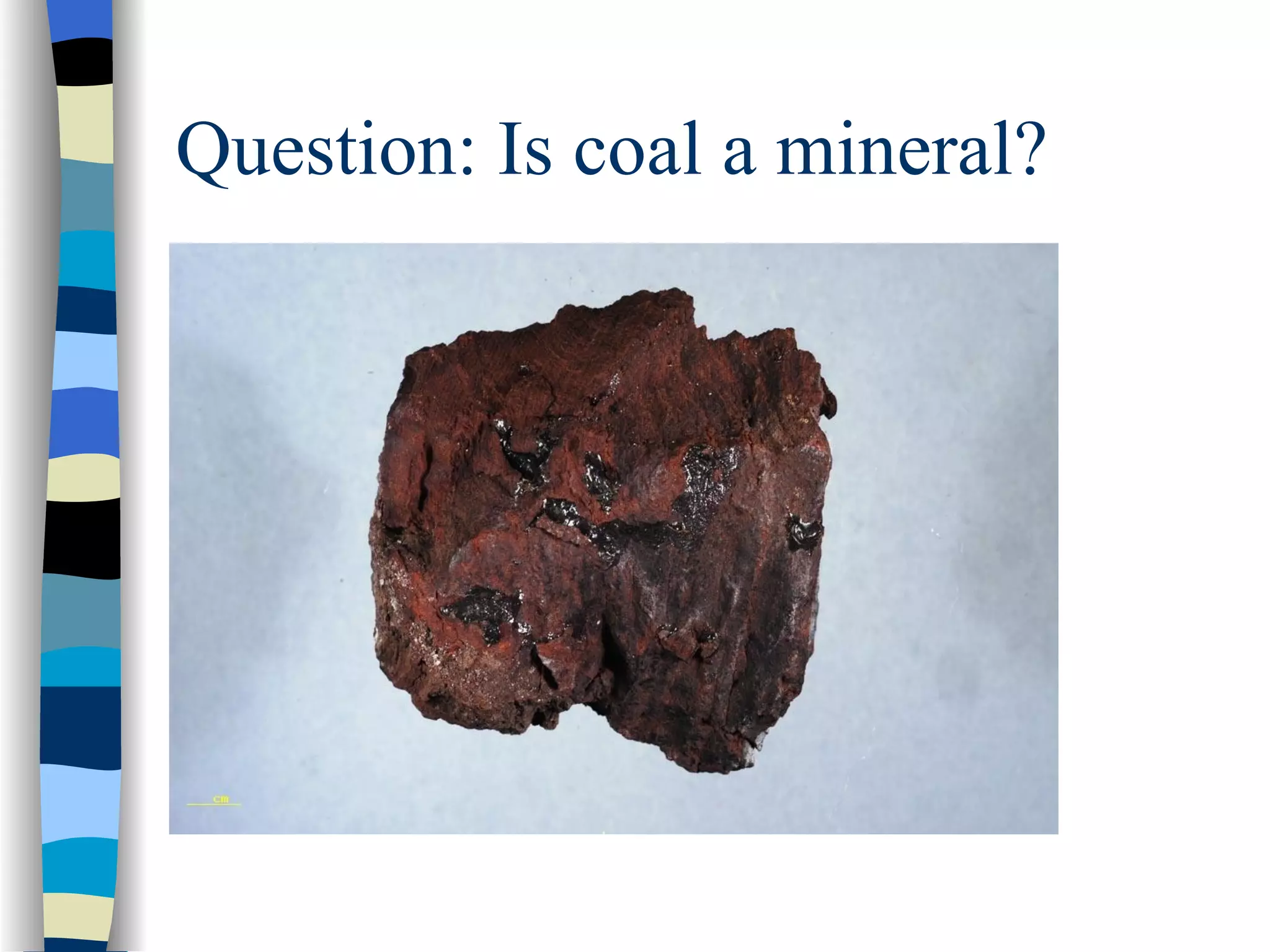
Types Cont’d Chemical-Evaporites- formed from evaporation Salts Organic- remains of once living organisms Limestone Coal