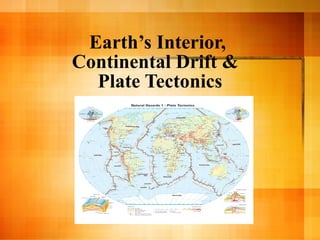
Earth ’s Interior,  Continental Drift &  Plate Tectonics
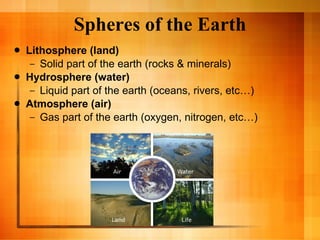
Spheres of the Earth Lithosphere (land) Solid part of the earth (rocks & minerals) Hydrosphere (water) Liquid part of the earth (oceans, rivers, etc…) Atmosphere (air) Gas part of the earth (oxygen, nitrogen, etc…)
Earth ’s Interior  (outside to inside) Crust  Oceanic  – Crust below the oceans Continental  – Crust that is made of land Mantle Liquid layer – magma (melted rock) Asthenosphere (Mantle)  Part of the mantle with Convection Currents Outer core Liquid layer – made up of iron and nickel Inner Core Solid layer –  made up of iron and nickel
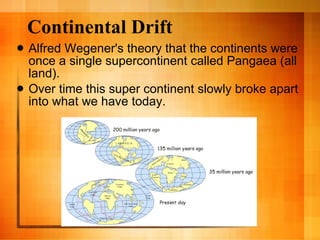
Continental Drift Alfred Wegener's theory that the continents were once a single supercontinent called Pangaea (all land). Over time this super continent slowly broke apart into what we have today.
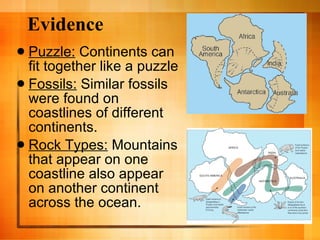
Evidence Puzzle:  Continents can fit together like a puzzle Fossils:  Similar fossils were found on coastlines of different continents. Rock Types:  Mountains that appear on one coastline also appear on another continent across the ocean.
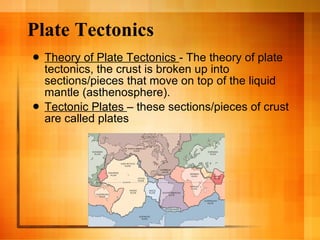
Plate Tectonics Theory of Plate Tectonics  - The theory of plate tectonics, the crust is broken up into sections/pieces that move on top of the liquid mantle (asthenosphere). Tectonic Plates  – these sections/pieces of crust are called plates
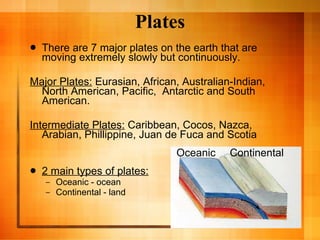
Plates There are 7 major plates on the earth that are moving extremely slowly but continuously. Major Plates:  Eurasian, African, Australian-Indian, North American, Pacific,  Antarctic and South American. Intermediate Plates:  Caribbean, Cocos, Nazca, Arabian, Phillippine, Juan de Fuca and Scotia 2 main types of plates:   Oceanic - ocean Continental - land Oceanic Continental
Earth ’s Tectonic Plates
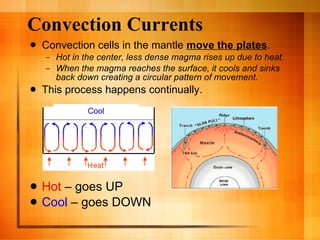
Convection Currents Convection cells in the mantle  move the plates . Hot in the center, less dense magma rises up due to heat. When the magma reaches the surface, it cools and sinks back down creating a circular pattern of movement. This process happens continually. Hot  – goes UP Cool  – goes DOWN Cool
Crust Density Oceanic Plates (dense) – heavy Sink (subduct) underneath continental crust Continental Plates (less dense) – lighter
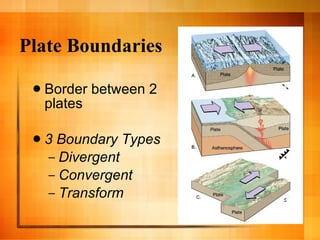
Plate Boundaries Border between 2 plates 3 Boundary Types  Divergent Convergent Transform
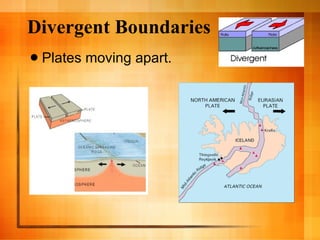
Divergent Boundaries Plates moving apart.
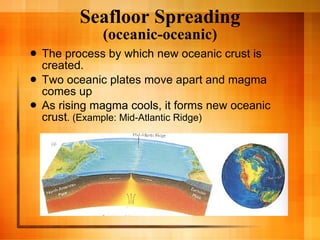
Seafloor Spreading (oceanic-oceanic) The process by which new oceanic crust is created. Two oceanic plates move apart and magma comes up As rising magma cools, it forms new oceanic crust . (Example: Mid-Atlantic Ridge)
Magnetic Reversals  (Paleomagnetism) Evidence of Sea-floor spreading Youngest crust is in the center, older as you go out Earth ’s magnetic poles reverse from North to South Young Older Older
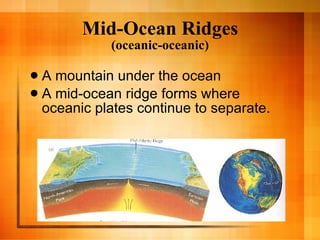
Mid-Ocean Ridges (oceanic-oceanic) A mountain under the ocean A mid-ocean ridge forms where oceanic plates continue to separate.
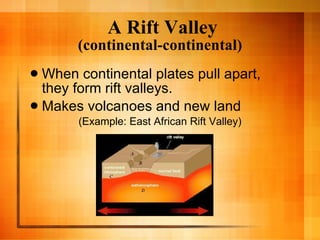
A Rift Valley (continental-continental) When continental plates pull apart, they form rift valleys. Makes volcanoes and new land (Example: East African Rift Valley)
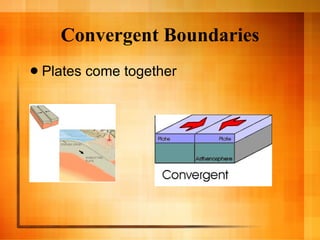
Convergent Boundaries Plates come together
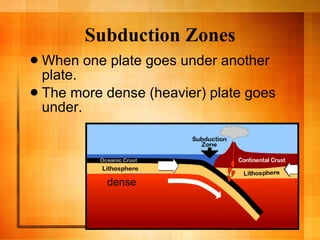
Subduction Zones When one plate goes under another plate. The more dense (heavier) plate goes under.  dense
Volcanic Arc ( Subduction: Oceanic-Continental) More dense (heavier) oceanic crust goes under the less dense continental crust. As the plate moves under the continental plate, the rock melts and rises, creating volcanoes.  Trenches are also created.
Deep-Sea Trench (oceanic-continental) A depression (hole) in the ocean floor at a subduction zone, it has sand in it.
Volcanic Island Chains ( Subduction: Oceanic-Oceanic) When 2 oceanic plates meet and one goes under the other. Forms Volcanic Islands .  (Example:  Aleutian Islands)
Mountains ( Subduction: Continental-Continental) When 2 continental plates come together. The plates push up and form mountains.  (Example: Himalayas)
Transform Fault Boundaries Plates slide past one another moving in opposite directions. Also called FAULTS Causes earthquakes/tsunamis to occur.
Faults Large fractures (a break) in the earth's crust. Types of Faults Normal Reverse (Thrust) Strike-Slip
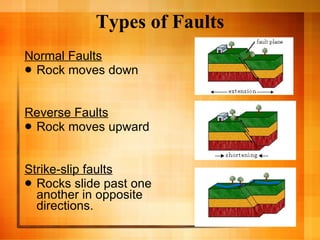
Types of Faults Normal Faults Rock moves down Reverse Faults Rock moves upward Strike-slip faults Rocks slide past one another in opposite directions.
Volcanoes An opening in the earth that erupts gases, ash and lava. Caused by plate movement along boundaries. Occur at both divergent and convergent plate boundaries. Magma  - melted rock under the surface (INSIDE) Lava  – Melted rock above the surface (OUTSIDE) LAVA MAGMA
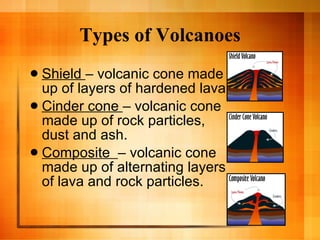
Types of Volcanoes Shield  – volcanic cone made up of layers of hardened lava Cinder cone  – volcanic cone made up of rock particles, dust and ash.  Composite  – volcanic cone made up of alternating layers of lava and rock particles.
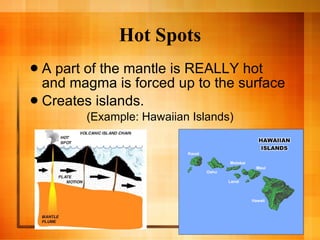
Hot Spots A part of the mantle is REALLY hot and magma is forced up to the surface Creates islands.  (Example: Hawaiian Islands)
Earthquakes Caused by movement along a fault. Occurs mainly at plate boundaries. Focus  – point under the earth ’s surface where an earthquake starts Epicenter  – place on earth ’s surface directly above the focus FAULT
Earthquake Waves Seismic Waves Seismograph  – instrument that  measures earthquake waves Types of Waves P-Wave (primary wave) – fastest Moves back and forth S-Wave (secondary wave) – slower Moves up and down L-Wave (surface wave) – most dangerous Moves both back and forth AND side to side
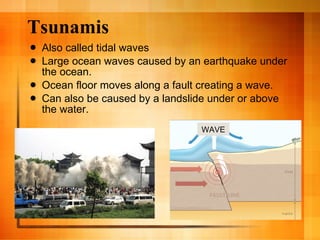
Tsunamis Also called tidal waves  Large ocean waves caused by an earthquake under the ocean. Ocean floor moves along a fault creating a wave. Can also be caused by a landslide under or above the water. WAVE
Plate Boundaries DIVERGENT BOUNDARY – move apart Sea-Floor Spreading oceanic-oceanic (o-o) New Ocean Crust Mid-Ocean Ridge oceanic-oceanic (o-o) Underwater Mountain Rift Valley continental-continental (c-c) Volcanoes/New Land CONVERGENT BOUNDARY- come together Mountains continental-continental Mountains created SUBDUCTION ZONES Deep-Sea Trench oceanic-continental Depression (hole in ground) Volcanic Arc oceanic-continental A line of volcanoes on land Island Arc oceanic-oceanic A line of islands in the ocean TRANSFORM BOUNDARY – slide past each other Faults All types Earthquakes/Tsunamis

Plate Tectonics

  • 1.
    Earth ’s Interior, Continental Drift & Plate Tectonics
  • 2.
    Spheres of theEarth Lithosphere (land) Solid part of the earth (rocks & minerals) Hydrosphere (water) Liquid part of the earth (oceans, rivers, etc…) Atmosphere (air) Gas part of the earth (oxygen, nitrogen, etc…)
  • 3.
    Earth ’s Interior (outside to inside) Crust Oceanic – Crust below the oceans Continental – Crust that is made of land Mantle Liquid layer – magma (melted rock) Asthenosphere (Mantle) Part of the mantle with Convection Currents Outer core Liquid layer – made up of iron and nickel Inner Core Solid layer – made up of iron and nickel
  • 4.
    Continental Drift AlfredWegener's theory that the continents were once a single supercontinent called Pangaea (all land). Over time this super continent slowly broke apart into what we have today.
  • 5.
    Evidence Puzzle: Continents can fit together like a puzzle Fossils: Similar fossils were found on coastlines of different continents. Rock Types: Mountains that appear on one coastline also appear on another continent across the ocean.
  • 6.
    Plate Tectonics Theoryof Plate Tectonics - The theory of plate tectonics, the crust is broken up into sections/pieces that move on top of the liquid mantle (asthenosphere). Tectonic Plates – these sections/pieces of crust are called plates
  • 7.
    Plates There are7 major plates on the earth that are moving extremely slowly but continuously. Major Plates: Eurasian, African, Australian-Indian, North American, Pacific, Antarctic and South American. Intermediate Plates: Caribbean, Cocos, Nazca, Arabian, Phillippine, Juan de Fuca and Scotia 2 main types of plates: Oceanic - ocean Continental - land Oceanic Continental
  • 8.
  • 9.
    Convection Currents Convectioncells in the mantle move the plates . Hot in the center, less dense magma rises up due to heat. When the magma reaches the surface, it cools and sinks back down creating a circular pattern of movement. This process happens continually. Hot – goes UP Cool – goes DOWN Cool
  • 10.
    Crust Density OceanicPlates (dense) – heavy Sink (subduct) underneath continental crust Continental Plates (less dense) – lighter
  • 11.
    Plate Boundaries Borderbetween 2 plates 3 Boundary Types Divergent Convergent Transform
  • 12.
  • 13.
    Seafloor Spreading (oceanic-oceanic)The process by which new oceanic crust is created. Two oceanic plates move apart and magma comes up As rising magma cools, it forms new oceanic crust . (Example: Mid-Atlantic Ridge)
  • 14.
    Magnetic Reversals (Paleomagnetism) Evidence of Sea-floor spreading Youngest crust is in the center, older as you go out Earth ’s magnetic poles reverse from North to South Young Older Older
  • 15.
    Mid-Ocean Ridges (oceanic-oceanic)A mountain under the ocean A mid-ocean ridge forms where oceanic plates continue to separate.
  • 16.
    A Rift Valley(continental-continental) When continental plates pull apart, they form rift valleys. Makes volcanoes and new land (Example: East African Rift Valley)
  • 17.
  • 18.
    Subduction Zones Whenone plate goes under another plate. The more dense (heavier) plate goes under. dense
  • 19.
    Volcanic Arc (Subduction: Oceanic-Continental) More dense (heavier) oceanic crust goes under the less dense continental crust. As the plate moves under the continental plate, the rock melts and rises, creating volcanoes. Trenches are also created.
  • 20.
    Deep-Sea Trench (oceanic-continental)A depression (hole) in the ocean floor at a subduction zone, it has sand in it.
  • 21.
    Volcanic Island Chains( Subduction: Oceanic-Oceanic) When 2 oceanic plates meet and one goes under the other. Forms Volcanic Islands . (Example: Aleutian Islands)
  • 22.
    Mountains ( Subduction:Continental-Continental) When 2 continental plates come together. The plates push up and form mountains. (Example: Himalayas)
  • 23.
    Transform Fault BoundariesPlates slide past one another moving in opposite directions. Also called FAULTS Causes earthquakes/tsunamis to occur.
  • 24.
    Faults Large fractures(a break) in the earth's crust. Types of Faults Normal Reverse (Thrust) Strike-Slip
  • 25.
    Types of FaultsNormal Faults Rock moves down Reverse Faults Rock moves upward Strike-slip faults Rocks slide past one another in opposite directions.
  • 26.
    Volcanoes An openingin the earth that erupts gases, ash and lava. Caused by plate movement along boundaries. Occur at both divergent and convergent plate boundaries. Magma - melted rock under the surface (INSIDE) Lava – Melted rock above the surface (OUTSIDE) LAVA MAGMA
  • 27.
    Types of VolcanoesShield – volcanic cone made up of layers of hardened lava Cinder cone – volcanic cone made up of rock particles, dust and ash. Composite – volcanic cone made up of alternating layers of lava and rock particles.
  • 28.
    Hot Spots Apart of the mantle is REALLY hot and magma is forced up to the surface Creates islands. (Example: Hawaiian Islands)
  • 29.
    Earthquakes Caused bymovement along a fault. Occurs mainly at plate boundaries. Focus – point under the earth ’s surface where an earthquake starts Epicenter – place on earth ’s surface directly above the focus FAULT
  • 30.
    Earthquake Waves SeismicWaves Seismograph – instrument that measures earthquake waves Types of Waves P-Wave (primary wave) – fastest Moves back and forth S-Wave (secondary wave) – slower Moves up and down L-Wave (surface wave) – most dangerous Moves both back and forth AND side to side
  • 31.
    Tsunamis Also calledtidal waves Large ocean waves caused by an earthquake under the ocean. Ocean floor moves along a fault creating a wave. Can also be caused by a landslide under or above the water. WAVE
  • 32.
    Plate Boundaries DIVERGENTBOUNDARY – move apart Sea-Floor Spreading oceanic-oceanic (o-o) New Ocean Crust Mid-Ocean Ridge oceanic-oceanic (o-o) Underwater Mountain Rift Valley continental-continental (c-c) Volcanoes/New Land CONVERGENT BOUNDARY- come together Mountains continental-continental Mountains created SUBDUCTION ZONES Deep-Sea Trench oceanic-continental Depression (hole in ground) Volcanic Arc oceanic-continental A line of volcanoes on land Island Arc oceanic-oceanic A line of islands in the ocean TRANSFORM BOUNDARY – slide past each other Faults All types Earthquakes/Tsunamis