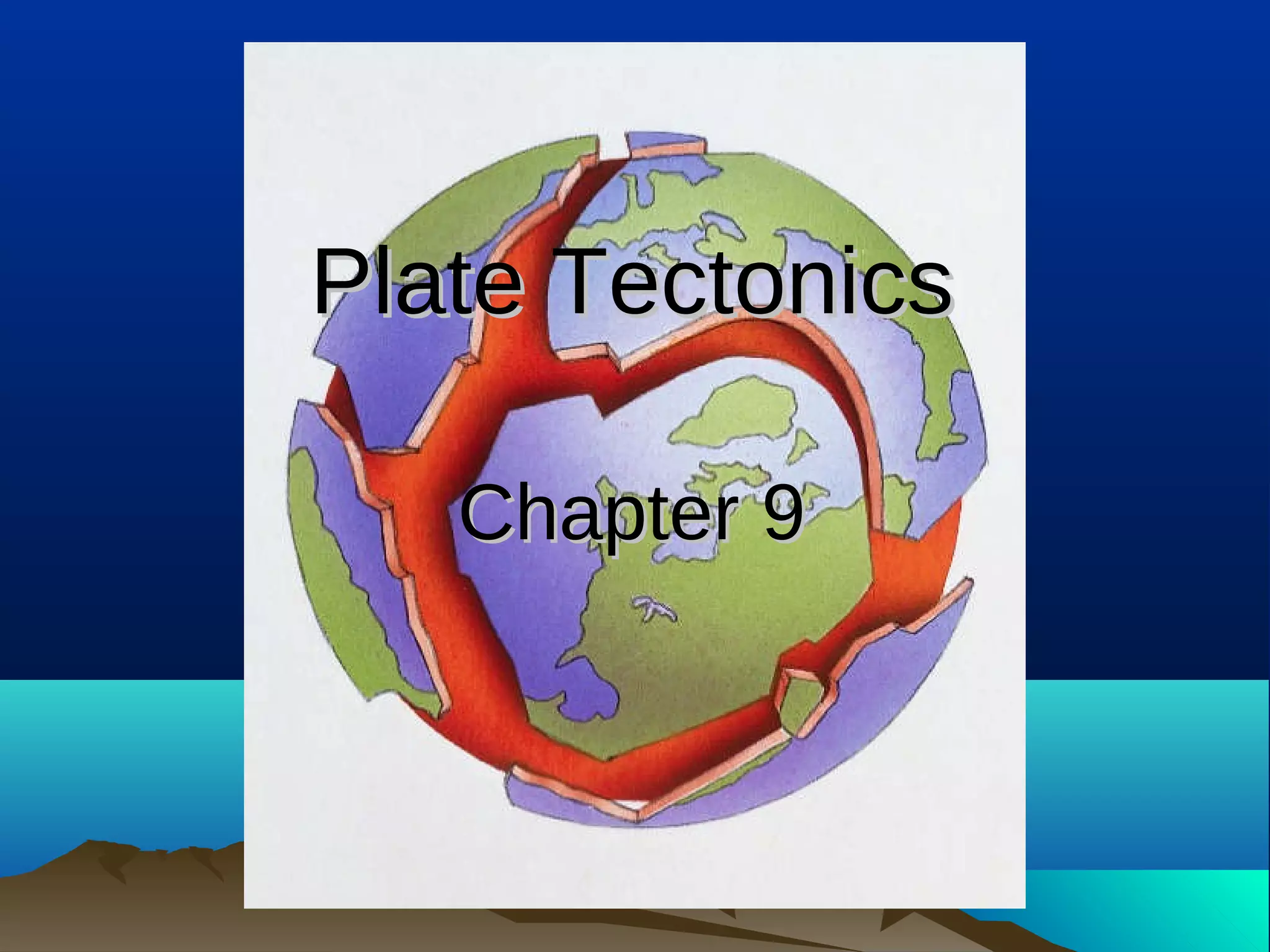
Plate TectonicsPlate Tectonics
Chapter 9Chapter 9
Rigid Earth TheoryRigid Earth Theory
It was once believed that Earth’s crust was
hard and brittle and could not bend
Plasticity
We now know that Earth’s crust can bend (like a
tough plastic) before breaking
33
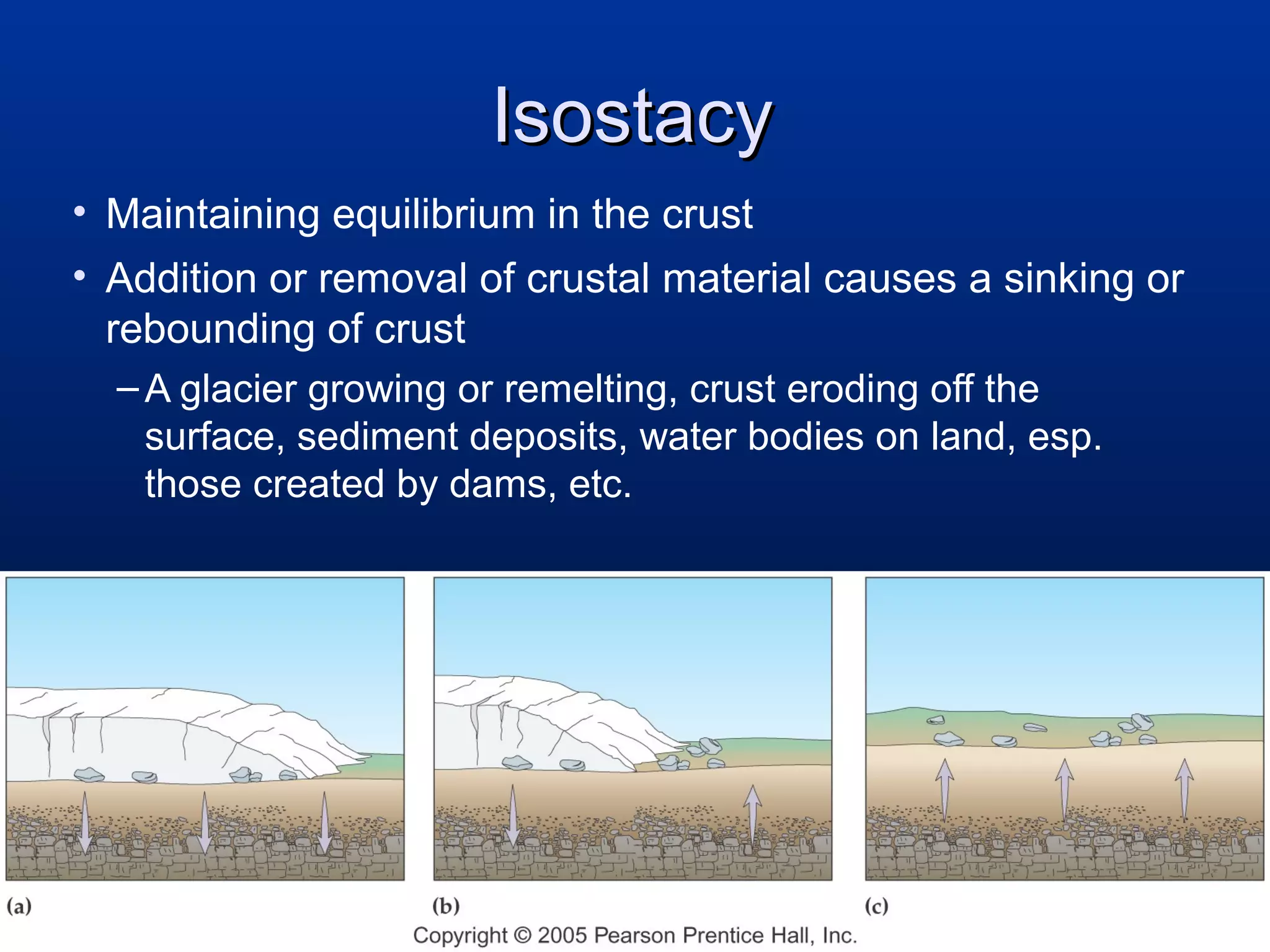
IsostacyIsostacy
• Maintaining equilibrium in the crust
• Addition or removal of crustal material causes a sinking or
rebounding of crust
–A glacier growing or remelting, crust eroding off the
surface, sediment deposits, water bodies on land, esp.
those created by dams, etc.
Alfred Wegener andAlfred Wegener and
His Continental Drift TheoryHis Continental Drift Theory
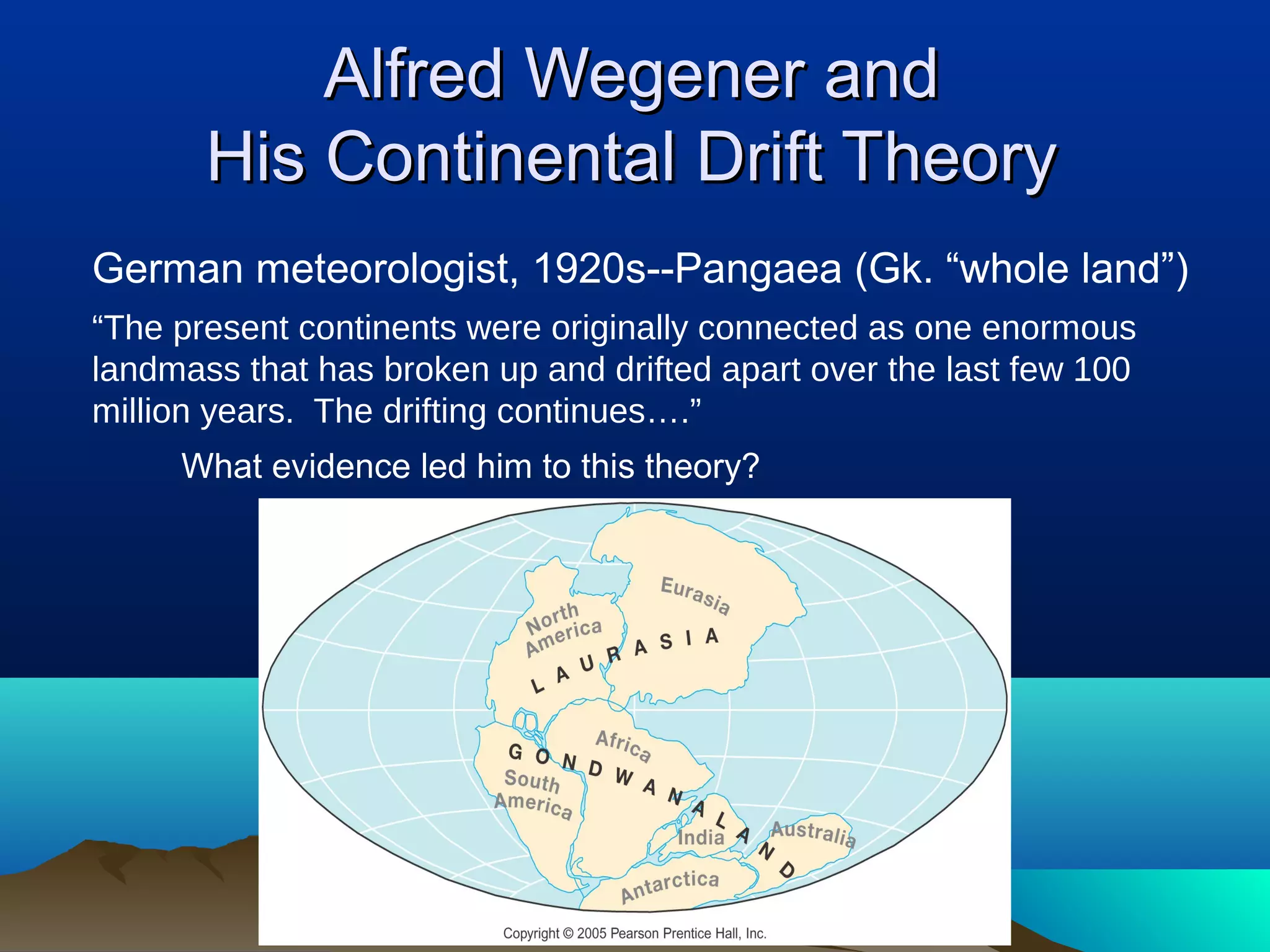
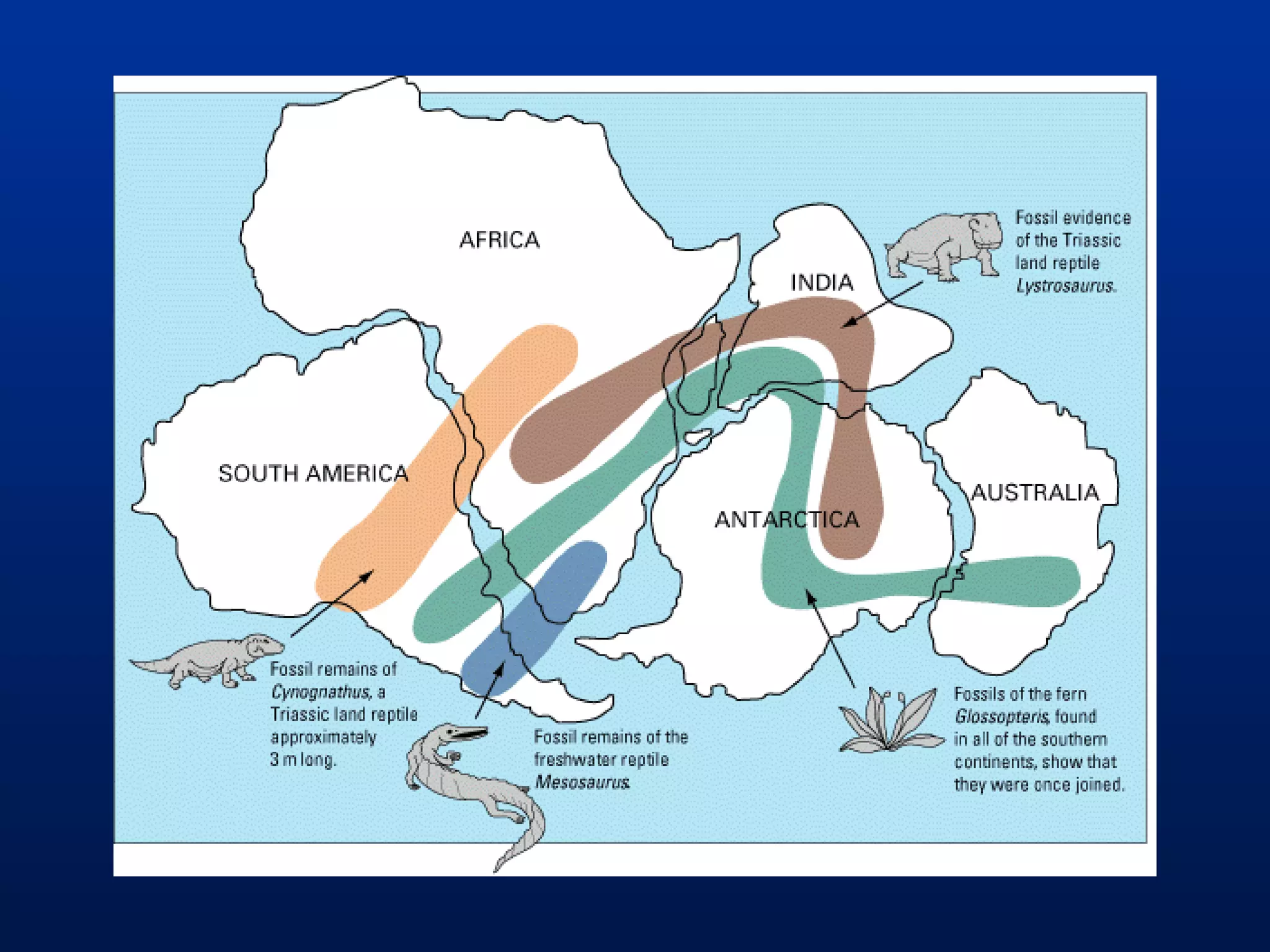
German meteorologist, 1920s--Pangaea (Gk. “whole land”)
“The present continents were originally connected as one enormous
landmass that has broken up and drifted apart over the last few 100
million years. The drifting continues….”
What evidence led him to this theory?
66
77
88
1010
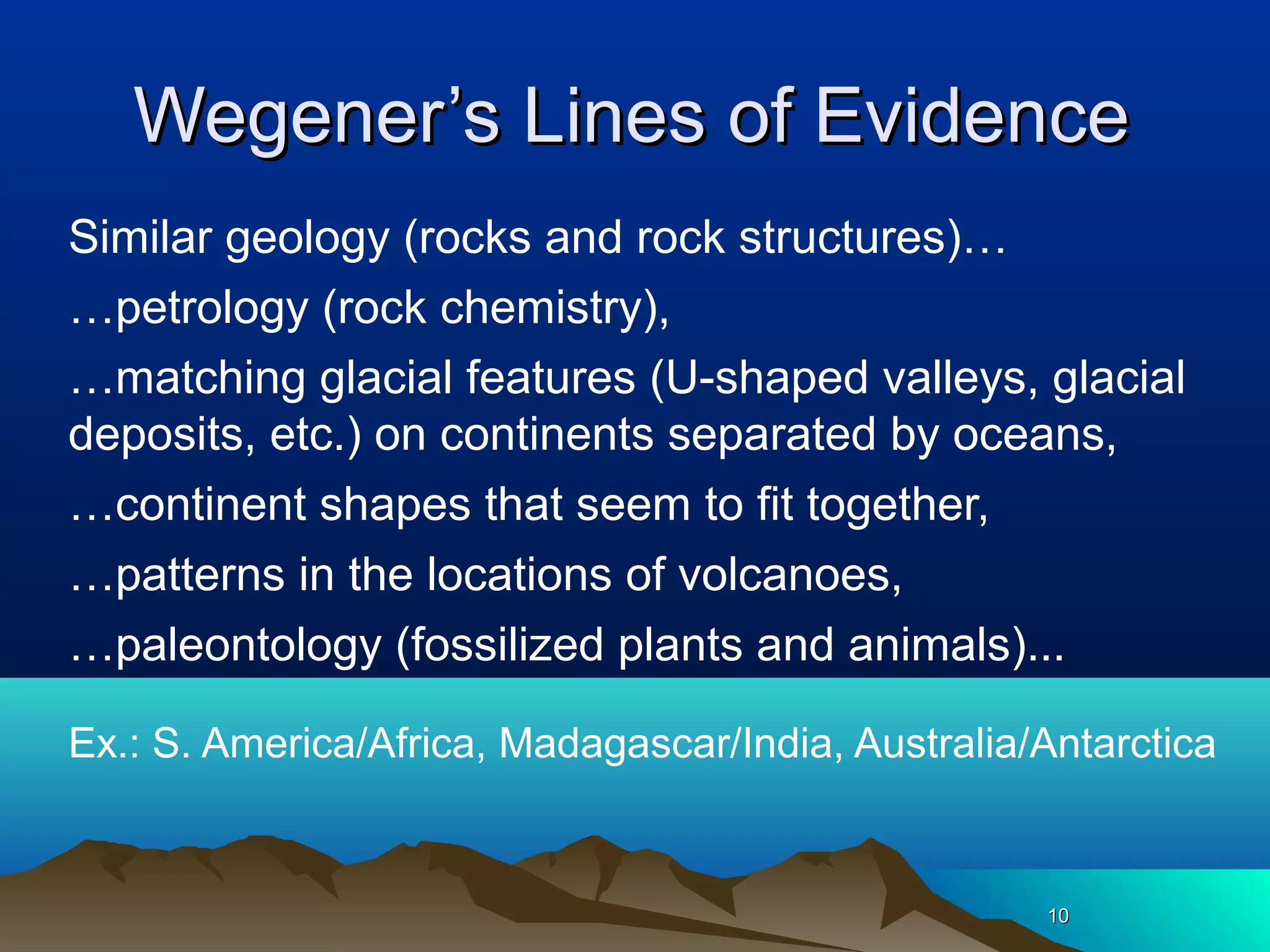
Wegener’s Lines of EvidenceWegener’s Lines of Evidence
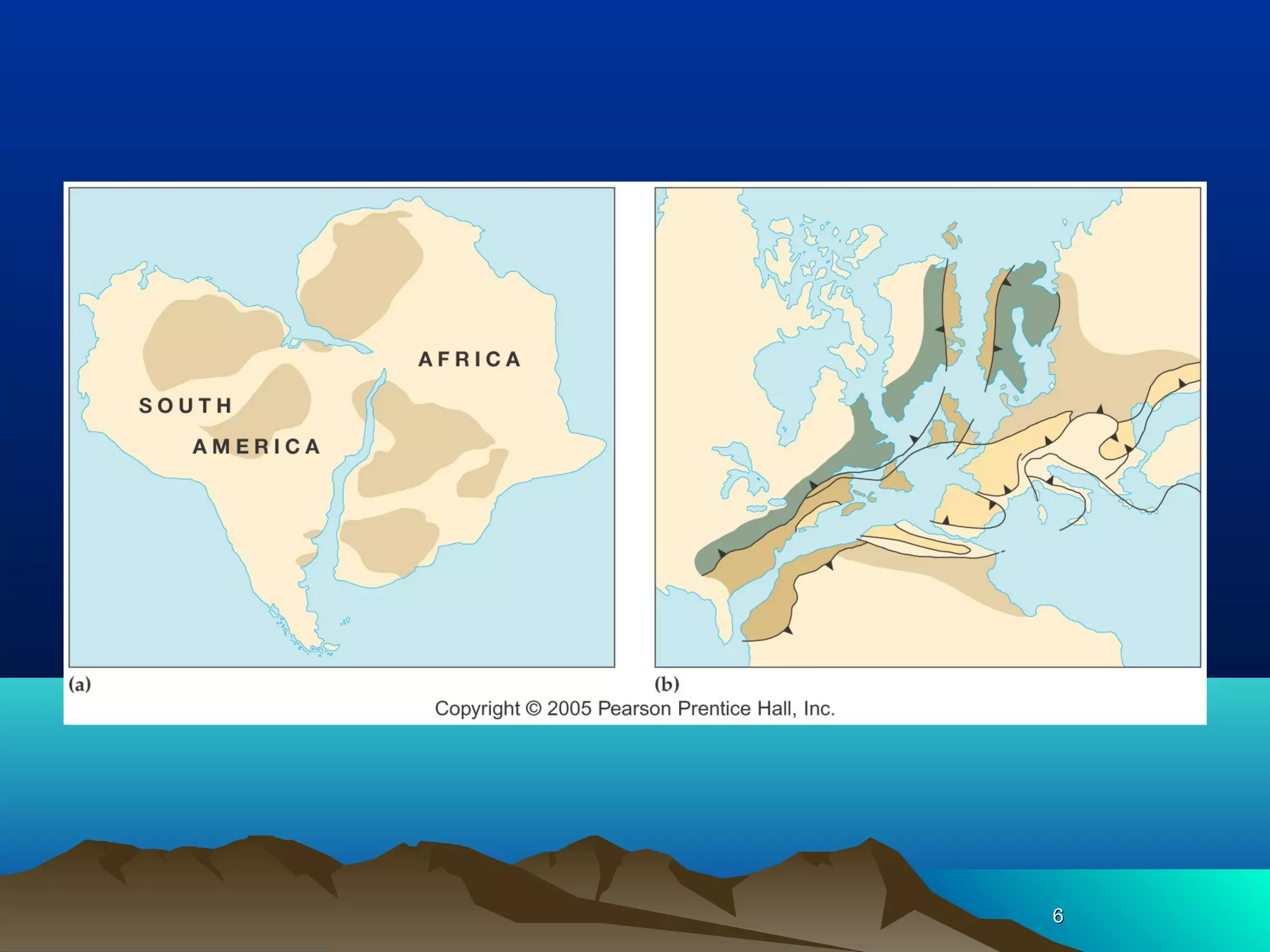
Similar geology (rocks and rock structures)…
…petrology (rock chemistry),
…matching glacial features (U-shaped valleys, glacial
deposits, etc.) on continents separated by oceans,
…continent shapes that seem to fit together,
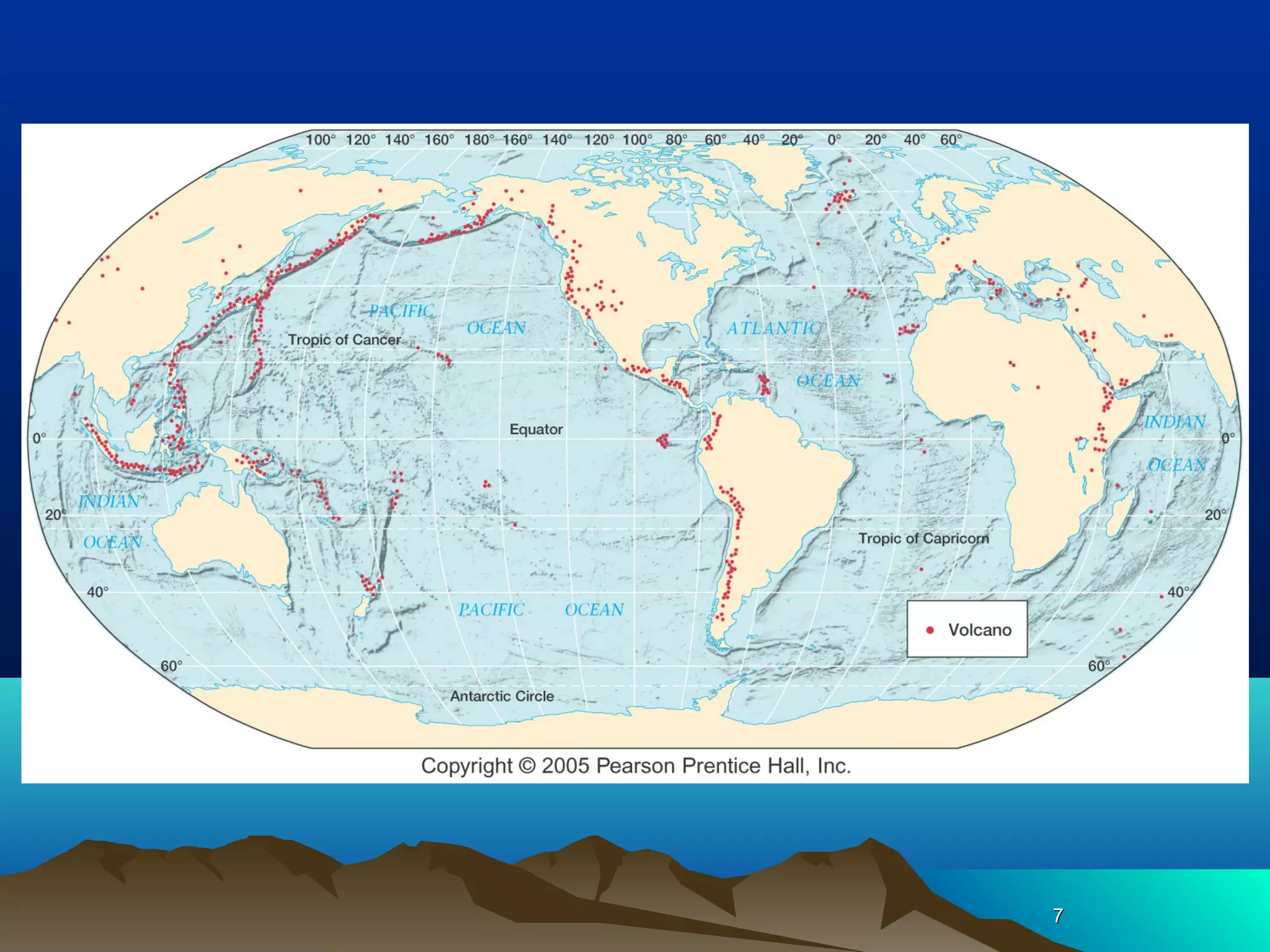
…patterns in the locations of volcanoes,
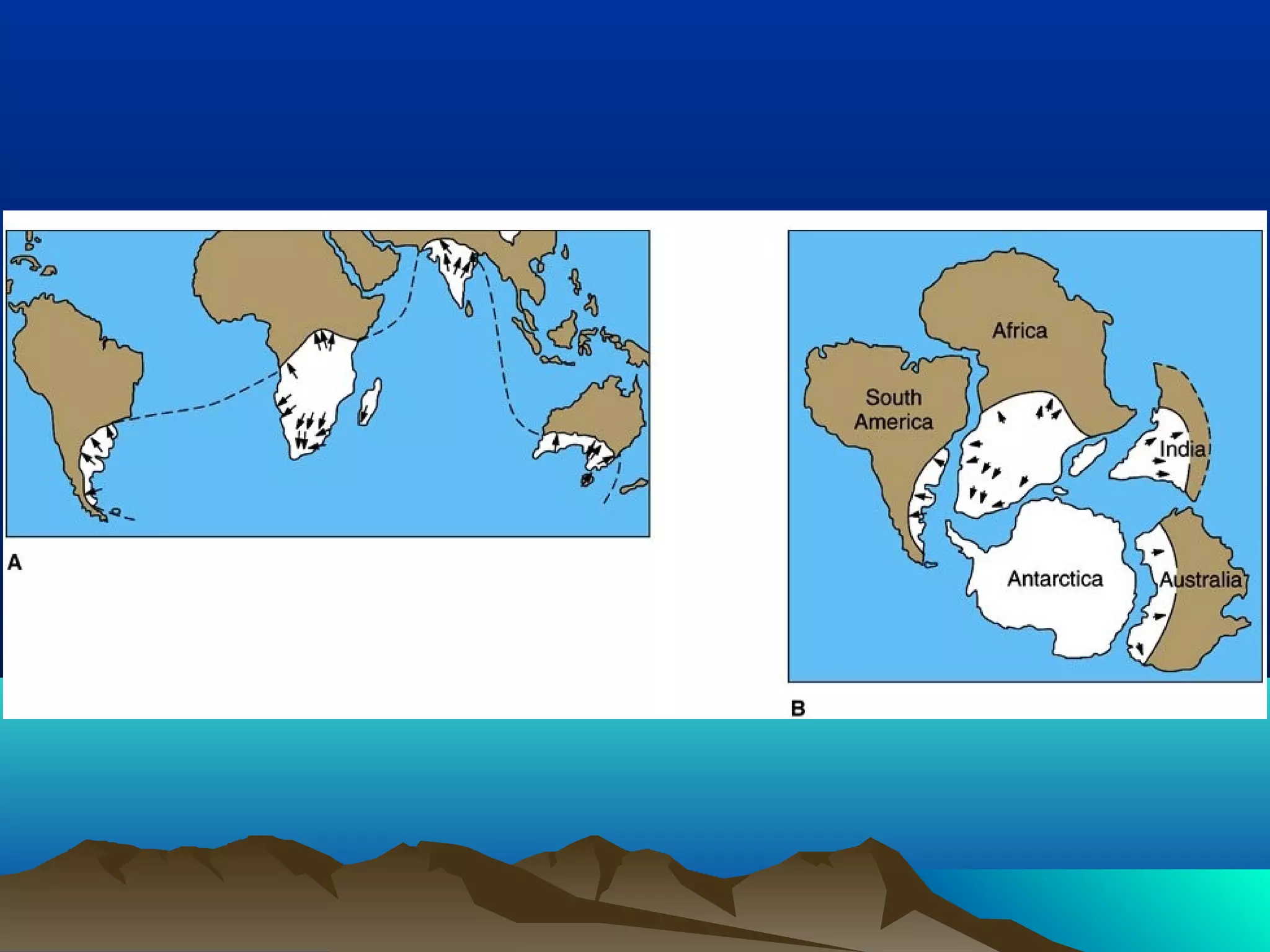
…paleontology (fossilized plants and animals)...
Ex.: S. America/Africa, Madagascar/India, Australia/Antarctica
1111
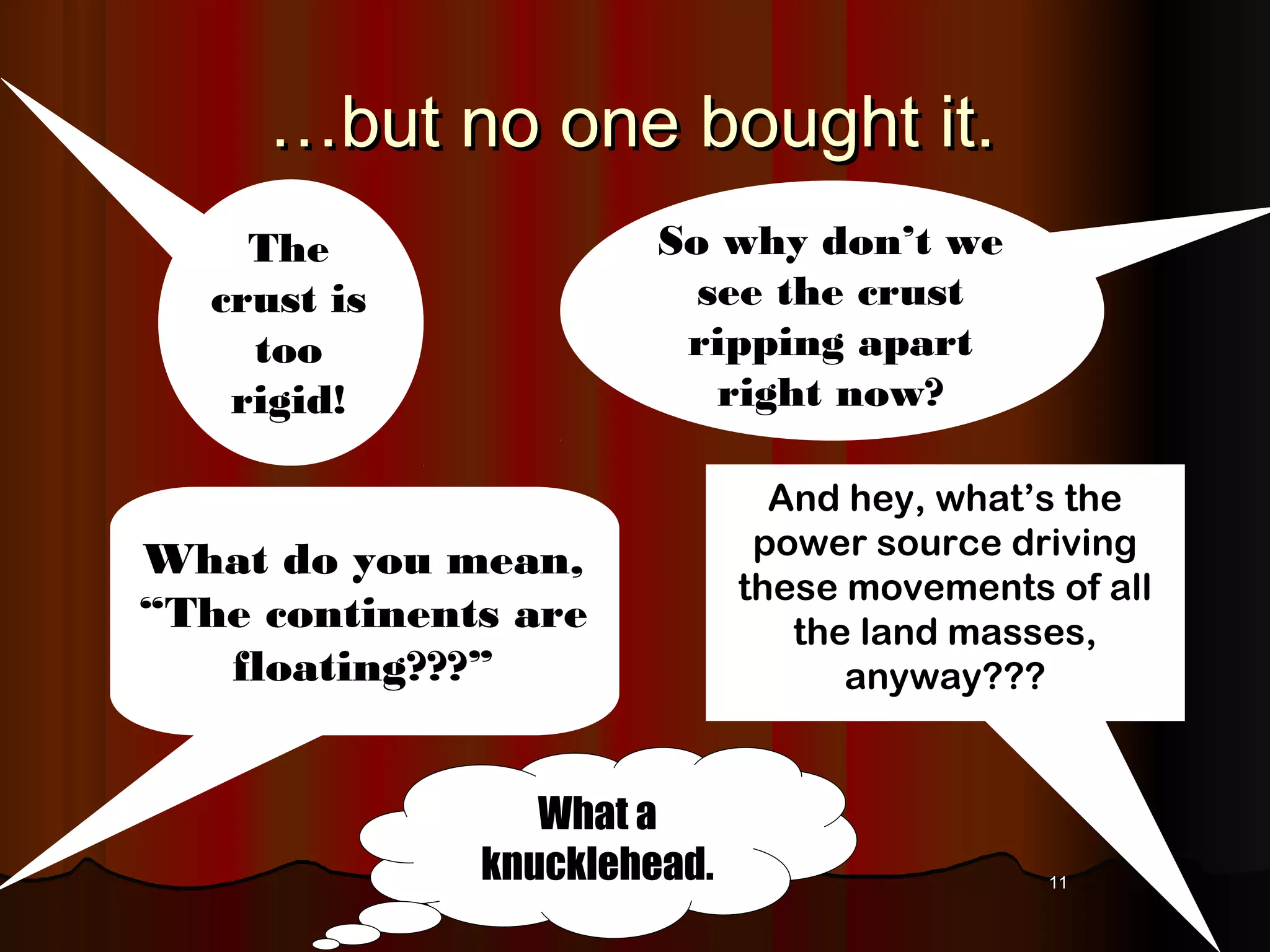
……but no one bought it.but no one bought it.
What do you mean,
“The continents are
floating???”
So why don’t we
see the crust
ripping apart
right now?
And hey, what’s the
power source driving
these movements of all
the land masses,
anyway???
The
crust is
too
rigid!
What a
knucklehead.
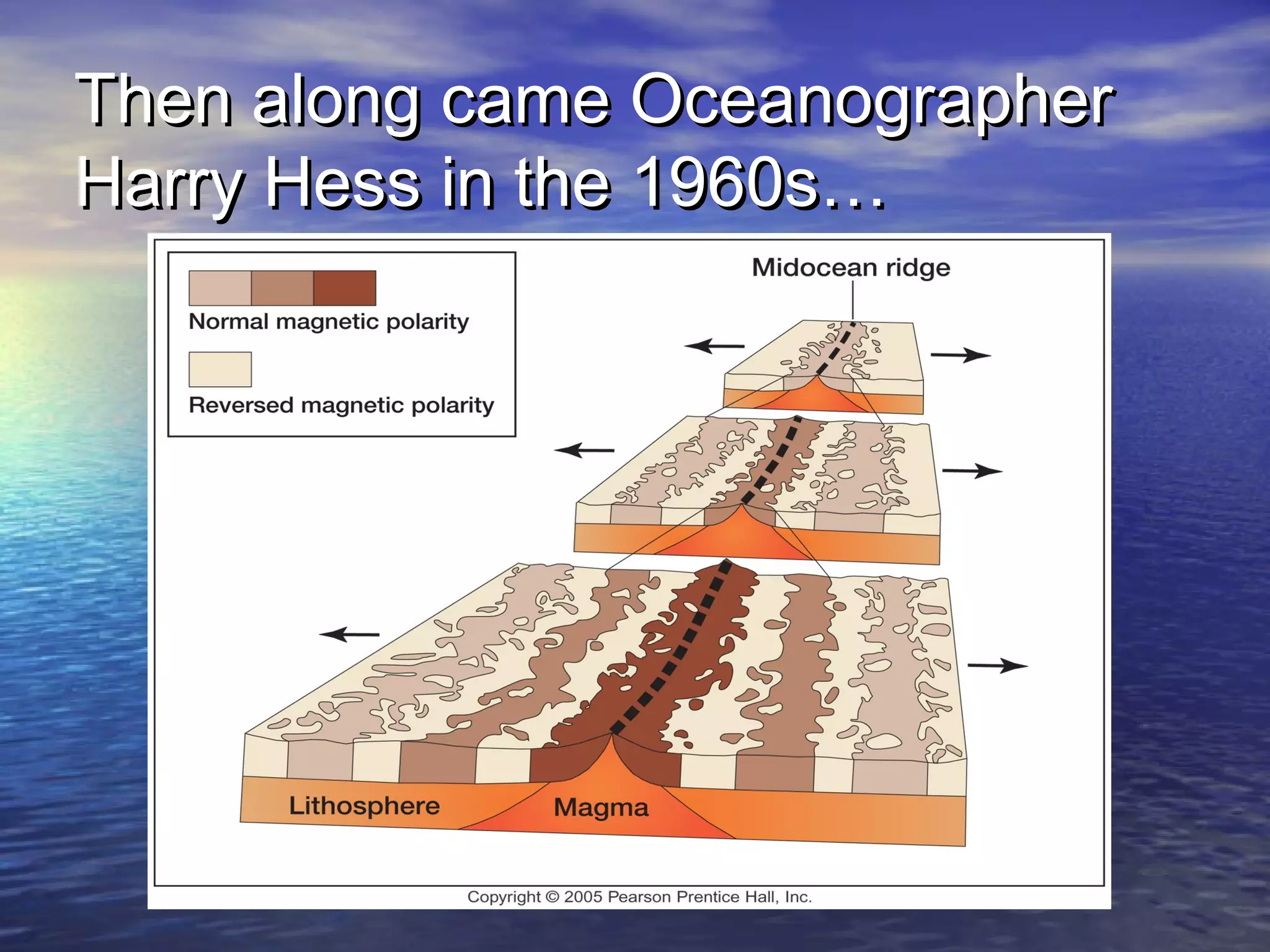
Then along came OceanographerThen along came Oceanographer
Harry Hess in the 1960s…Harry Hess in the 1960s…
The evidence continued to mount…The evidence continued to mount…
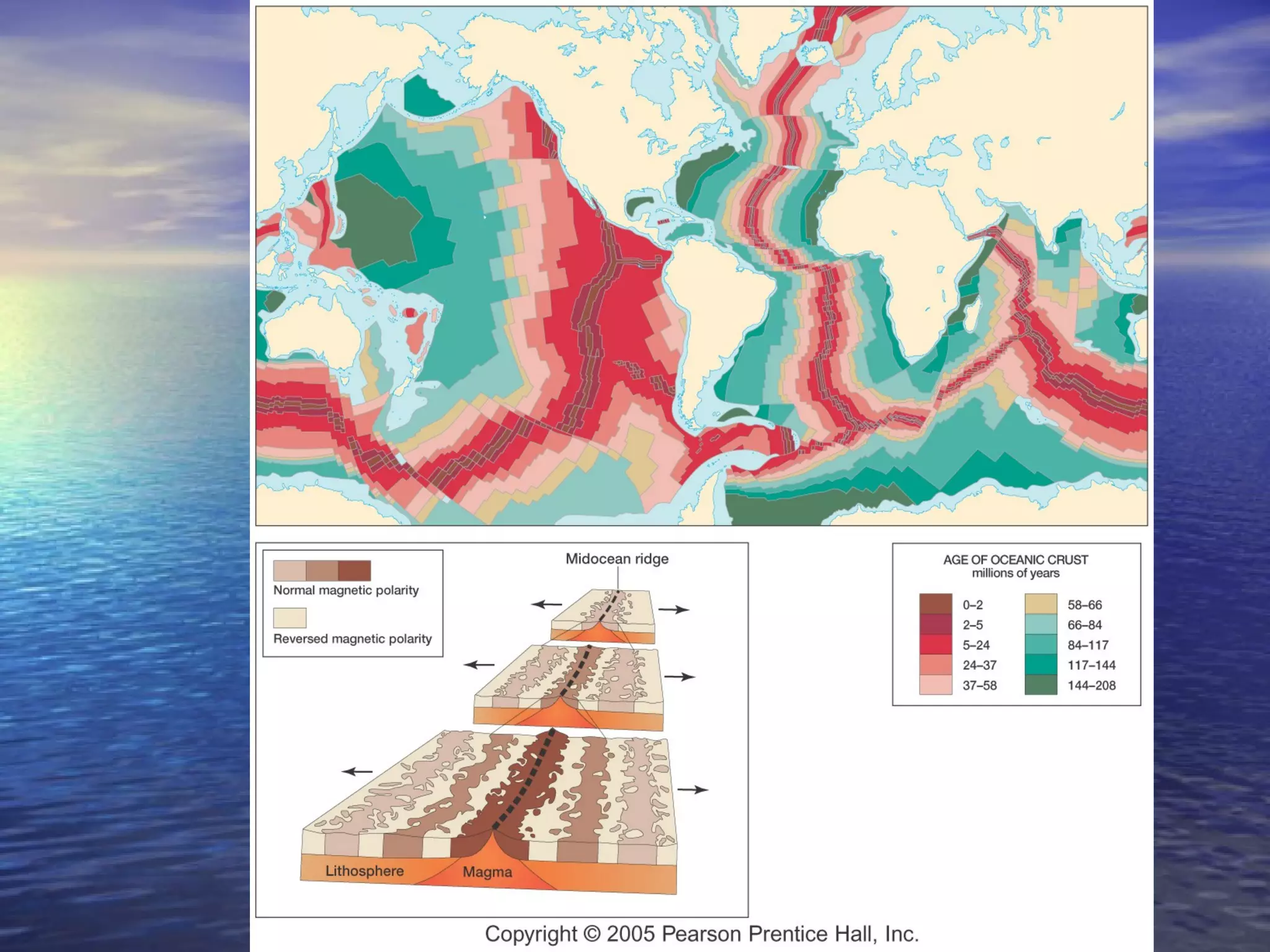
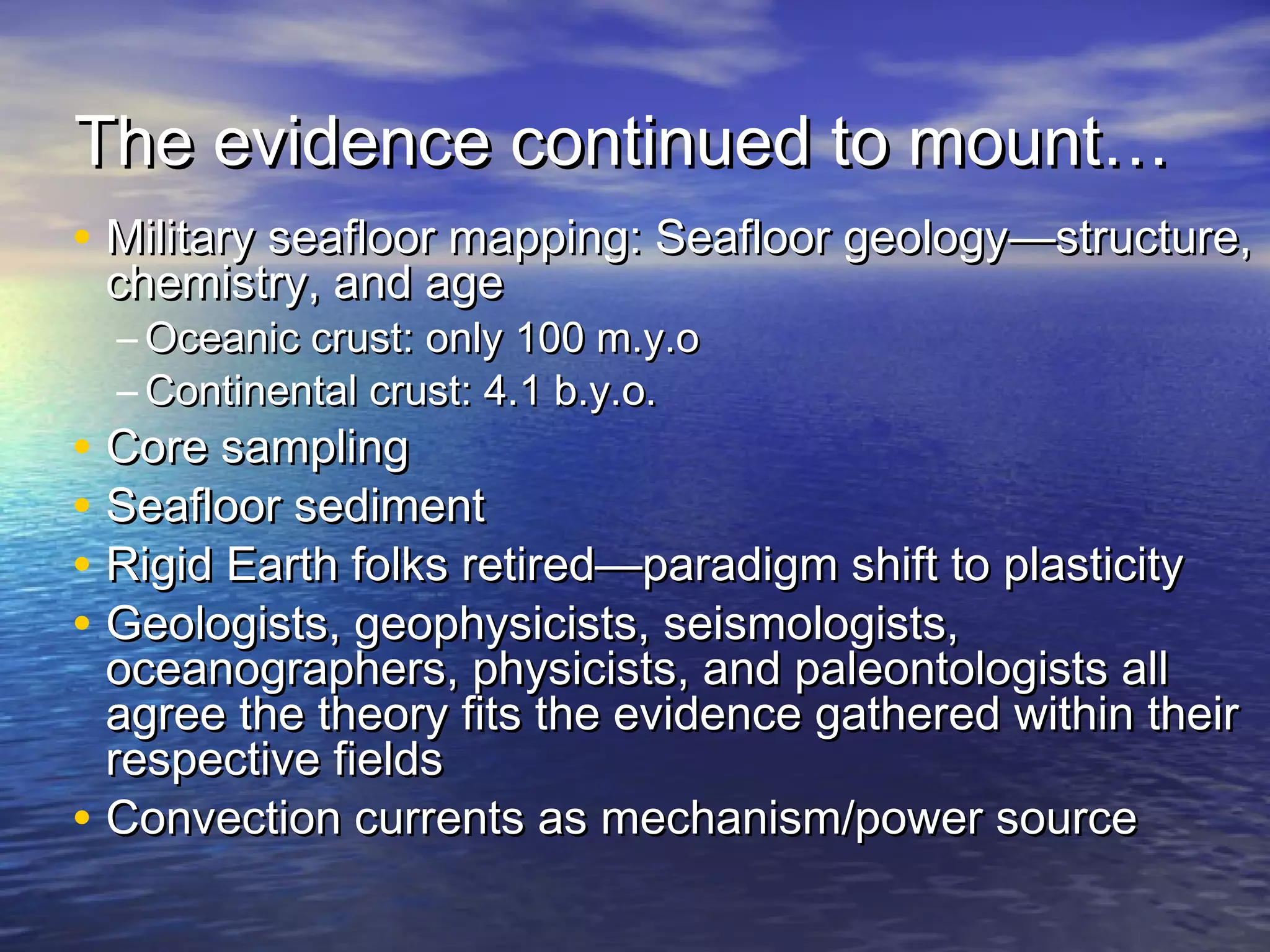
• Military seafloor mapping: Seafloor geology—structure,Military seafloor mapping: Seafloor geology—structure,
chemistry, and agechemistry, and age
– Oceanic crust: only 100 m.y.oOceanic crust: only 100 m.y.o
– Continental crust: 4.1 b.y.o.Continental crust: 4.1 b.y.o.
• Core samplingCore sampling
• Seafloor sedimentSeafloor sediment
• Rigid Earth folks retired—paradigm shift to plasticityRigid Earth folks retired—paradigm shift to plasticity
• Geologists, geophysicists, seismologists,Geologists, geophysicists, seismologists,
oceanographers, physicists, and paleontologists alloceanographers, physicists, and paleontologists all
agree the theory fits the evidence gathered within theiragree the theory fits the evidence gathered within their
respective fieldsrespective fields
• Convection currents as mechanism/power sourceConvection currents as mechanism/power source
1616
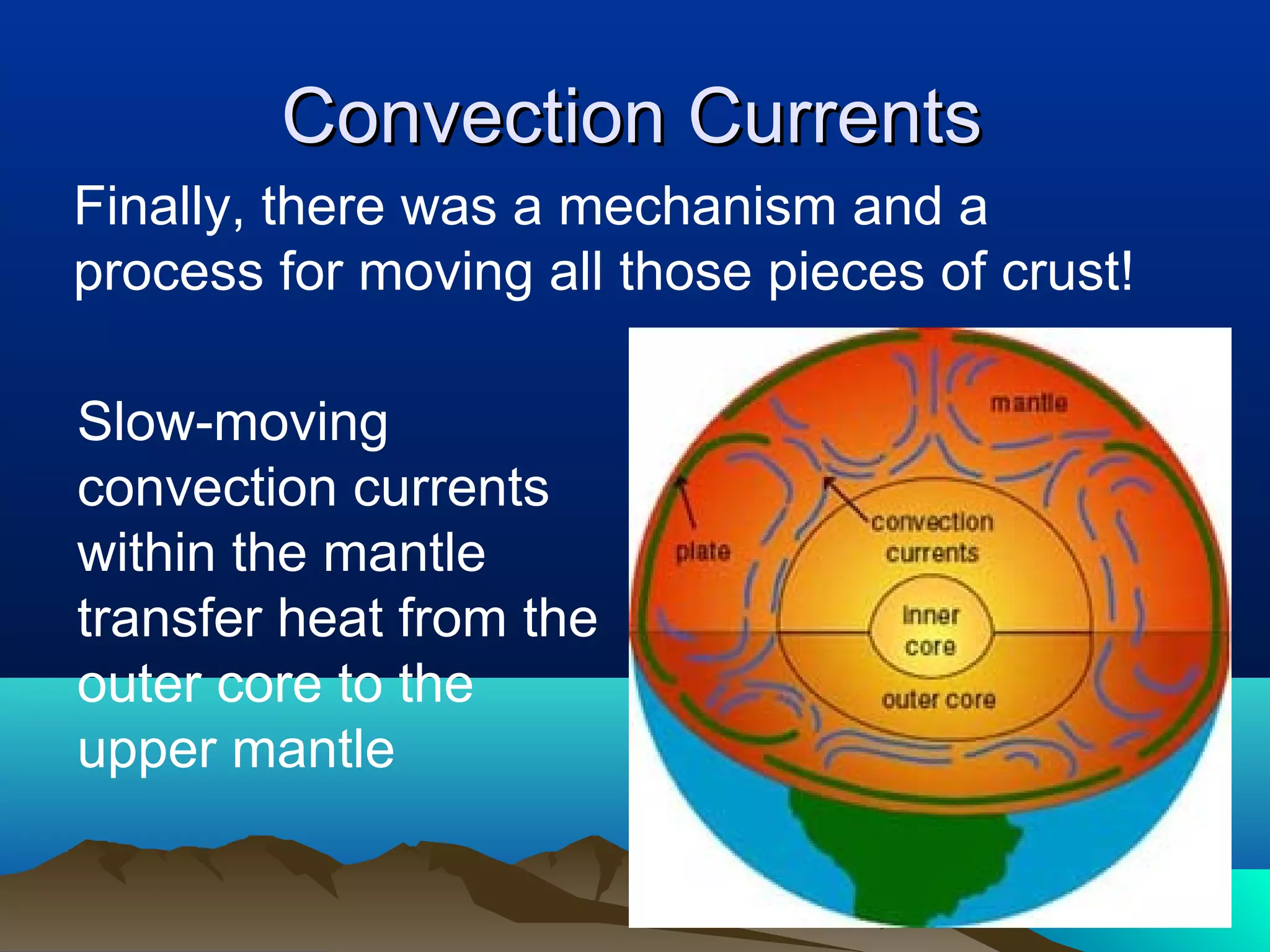
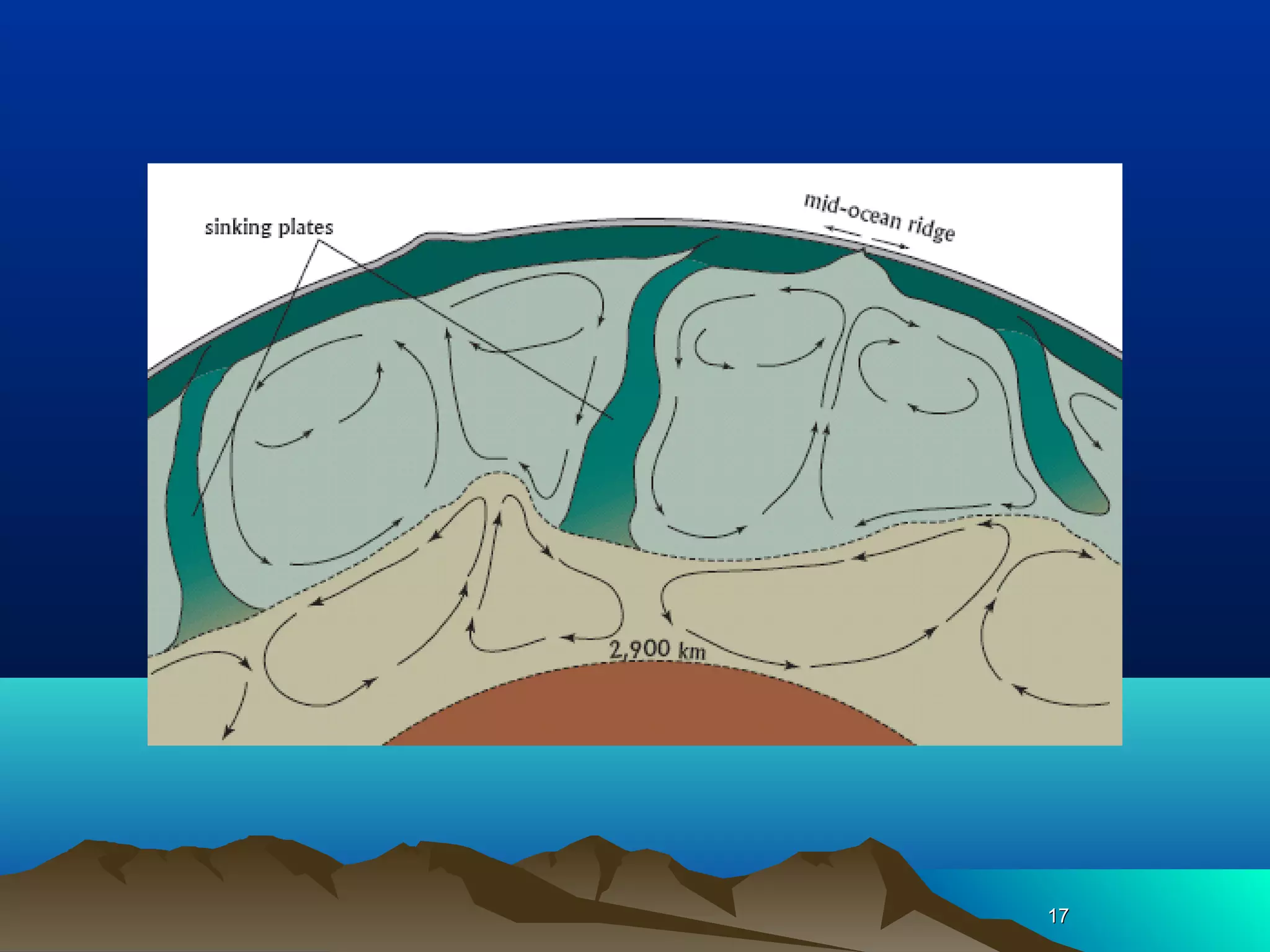
Convection CurrentsConvection Currents
Slow-moving
convection currents
within the mantle
transfer heat from the
outer core to the
upper mantle
Finally, there was a mechanism and a
process for moving all those pieces of crust!
17171717
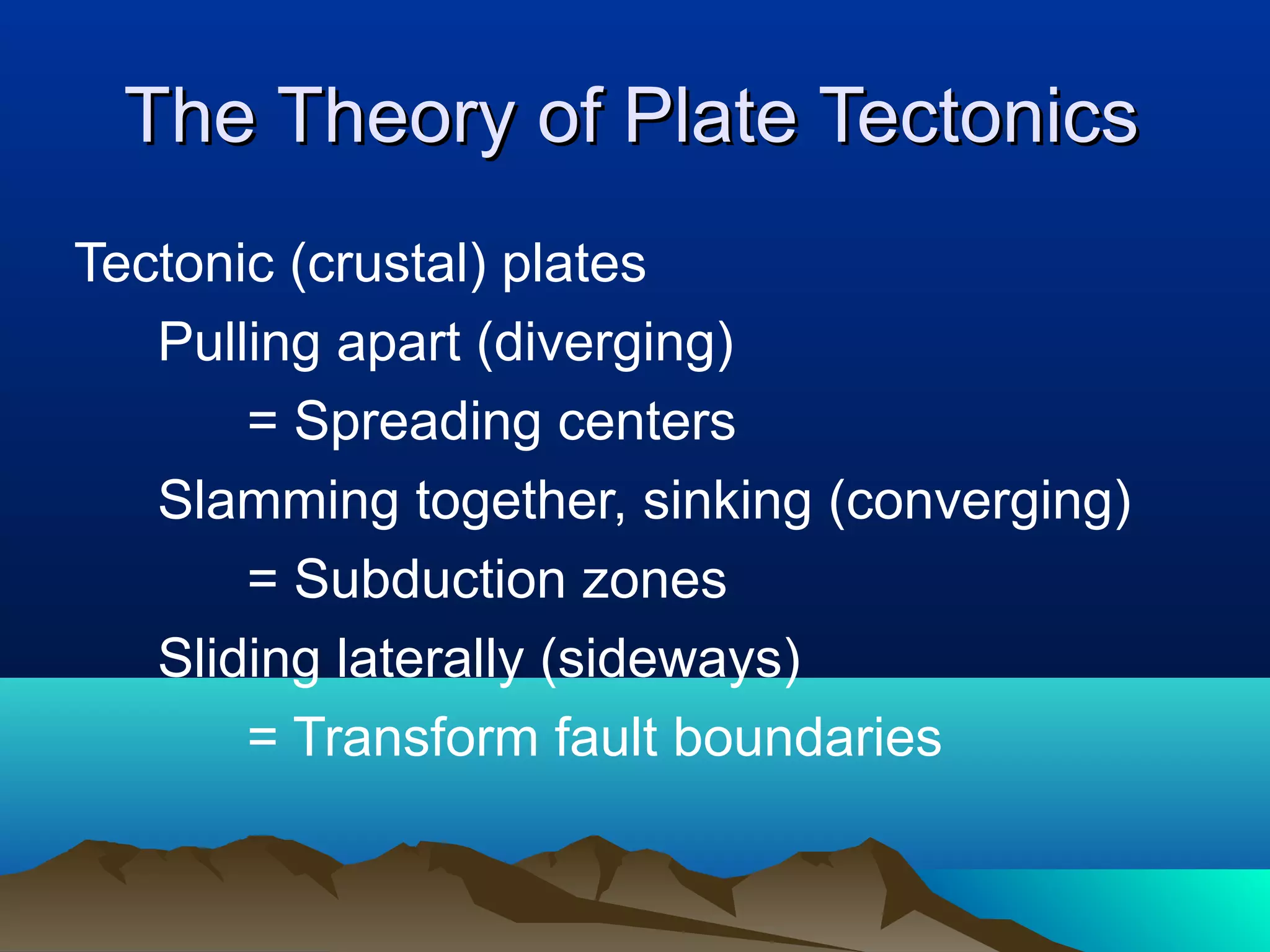
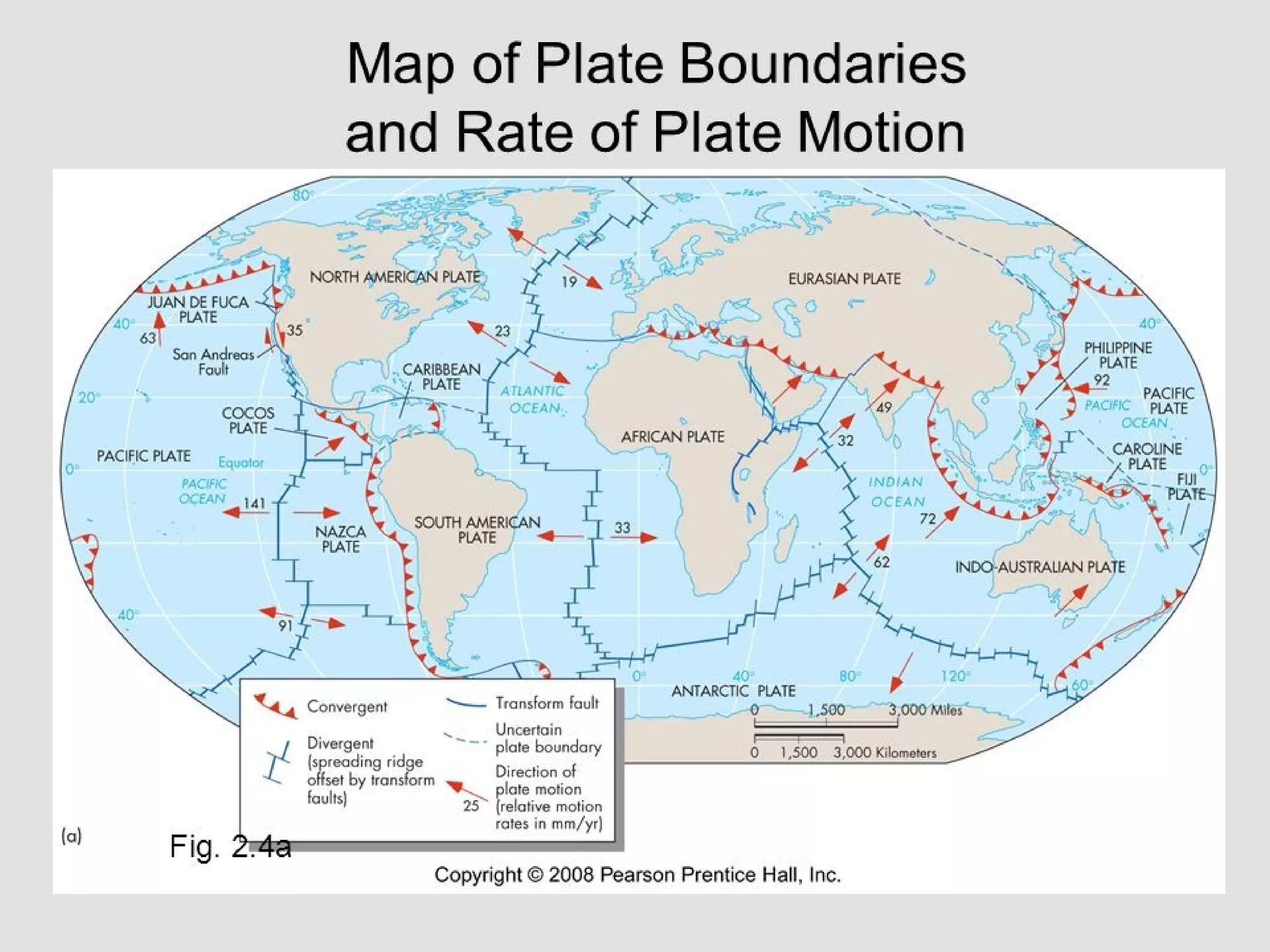
The Theory of Plate TectonicsThe Theory of Plate Tectonics
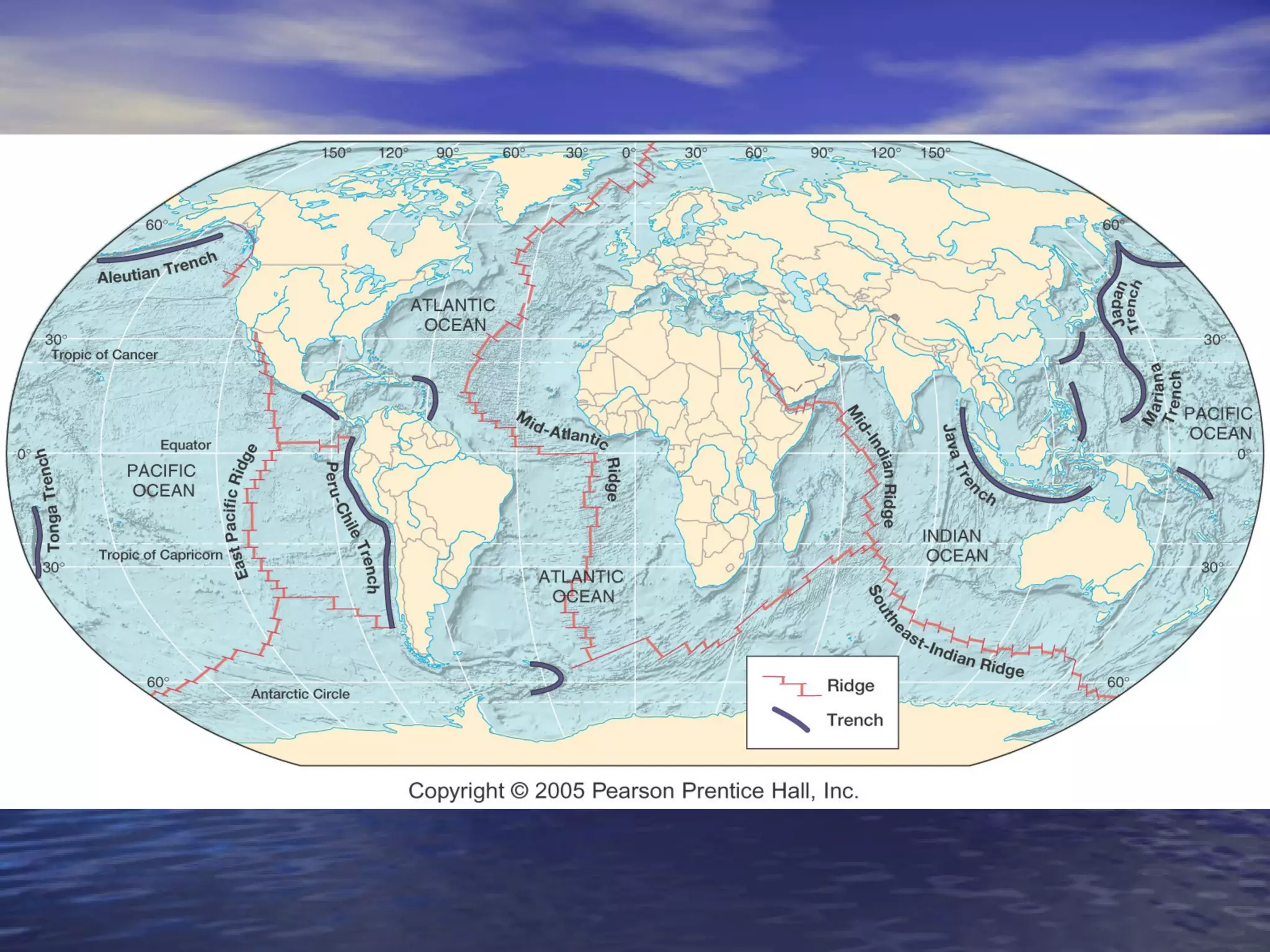
Tectonic (crustal) plates
Pulling apart (diverging)
= Spreading centers
Slamming together, sinking (converging)
= Subduction zones
Sliding laterally (sideways)
= Transform fault boundaries
1919
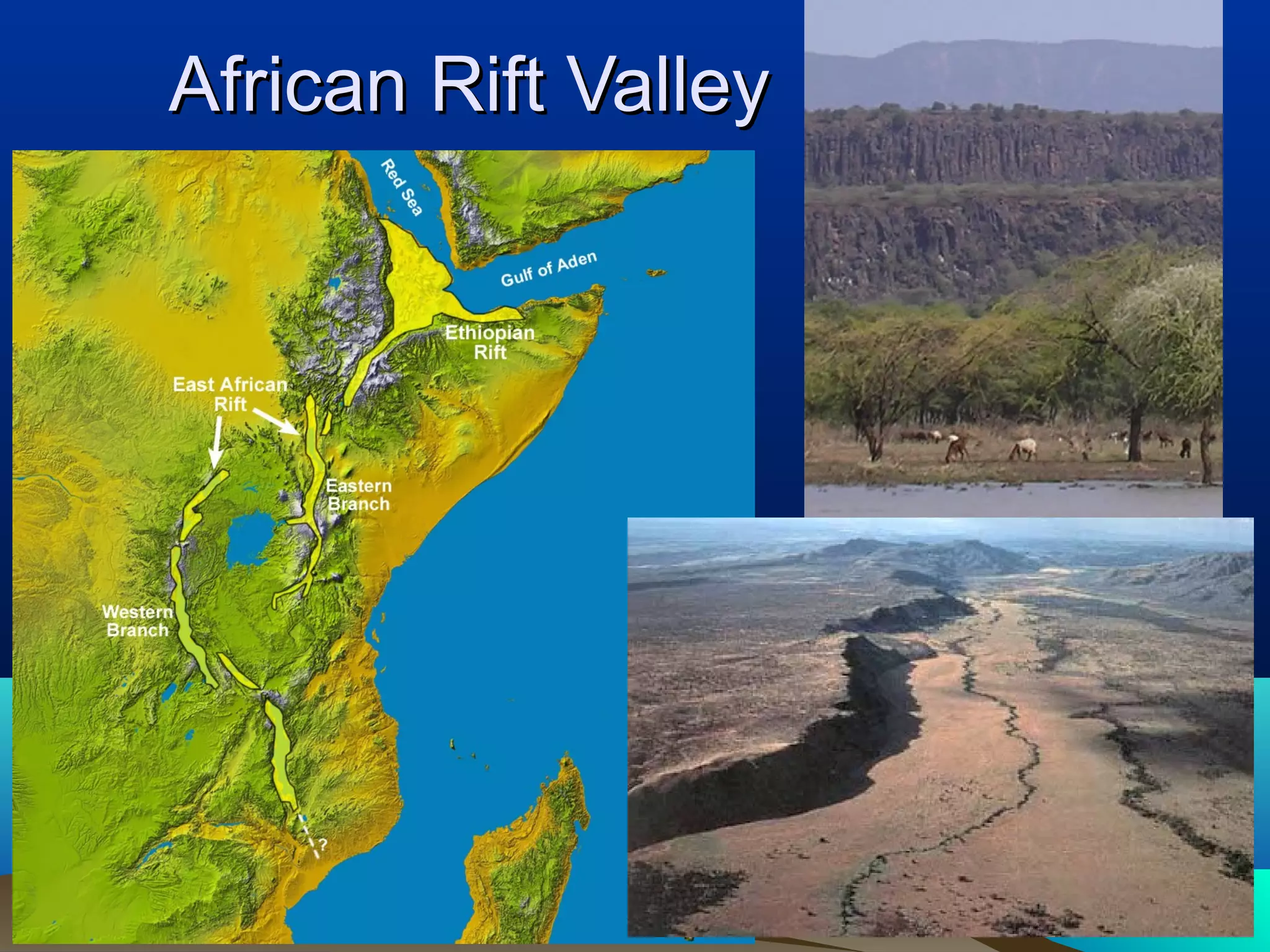
African Rift ValleyAfrican Rift Valley
1919
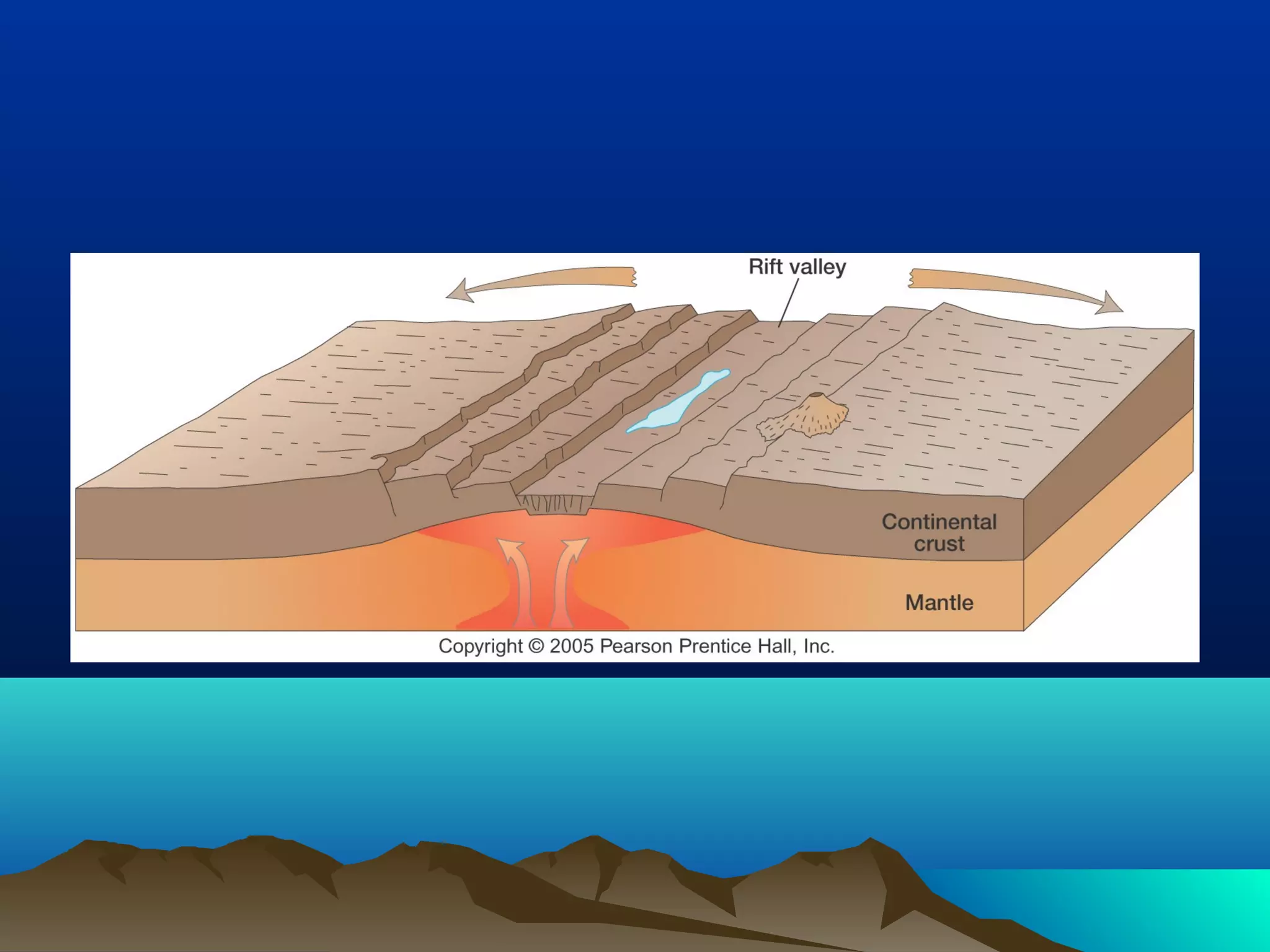
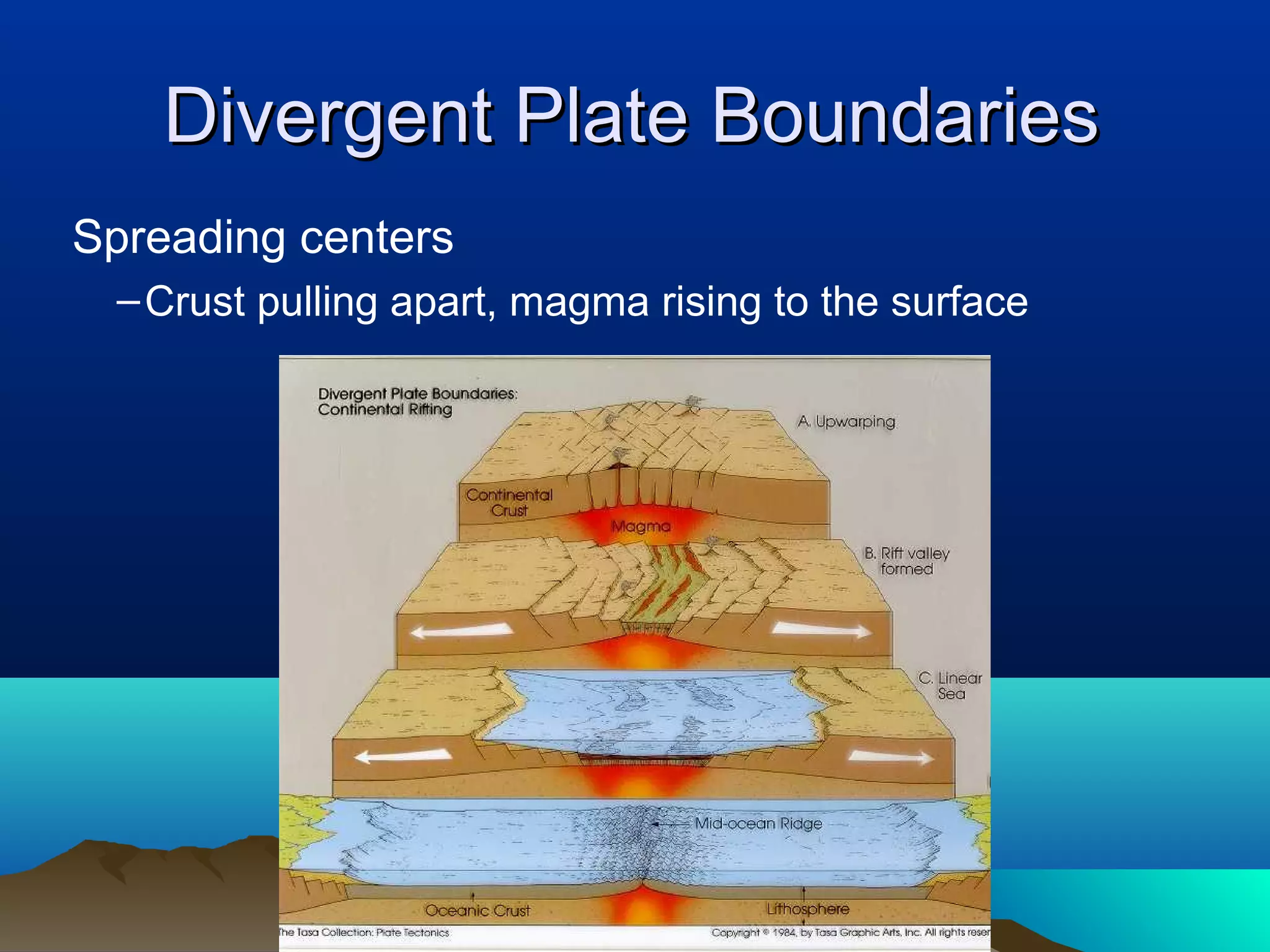
Divergent Plate BoundariesDivergent Plate Boundaries
Spreading centers
–Crust pulling apart, magma rising to the surface
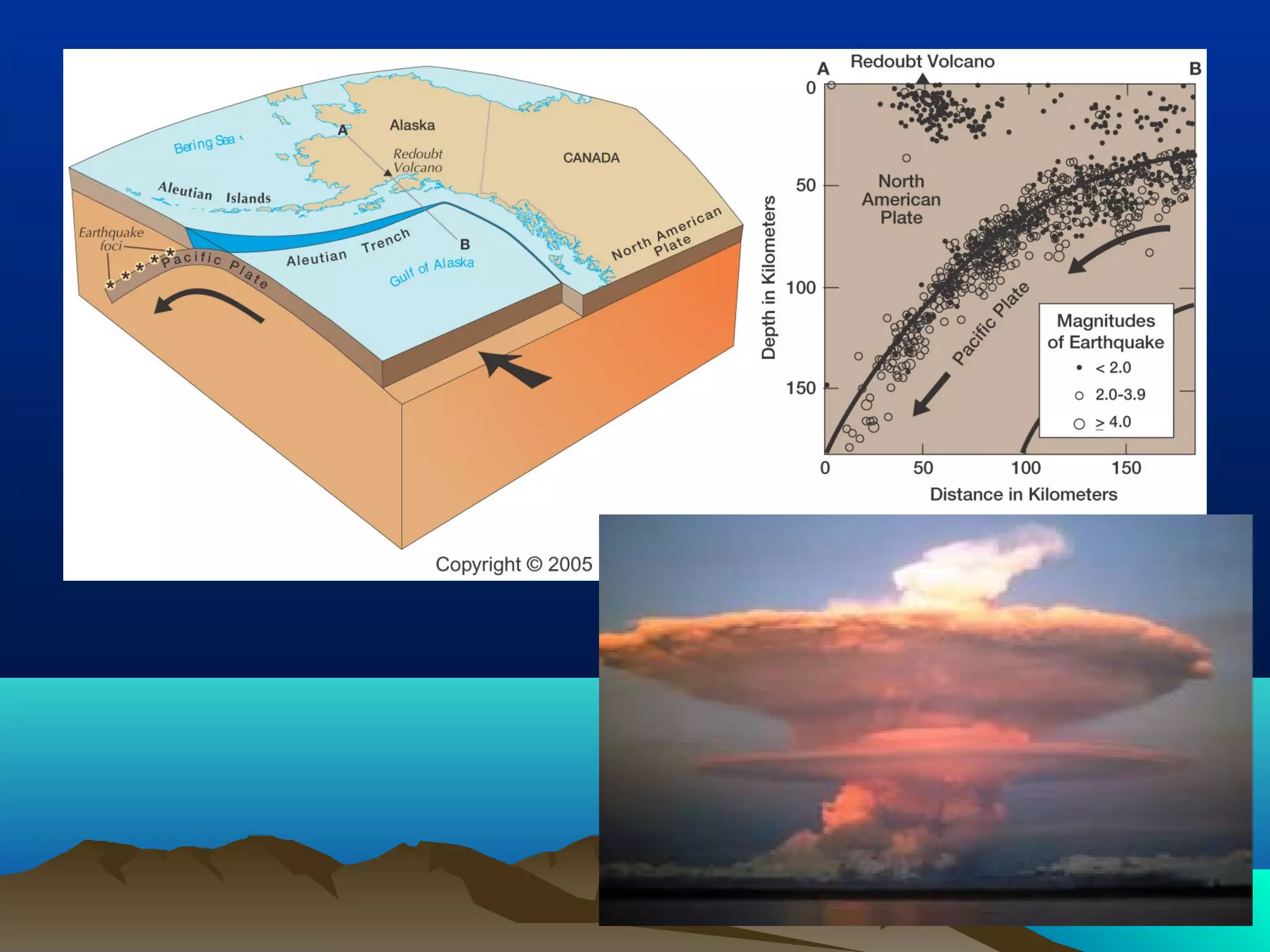
Convergent Plate BoundariesConvergent Plate Boundaries
Subduction zones
–Crust being forced together
–Lightest material rises (mountain-building) while the
heaviest stuff sinks (pushed back into the mantle)
–Remelting (mostly from friction) creates volcanoes
–Intense, deep-focus earthquakes
2323
2424
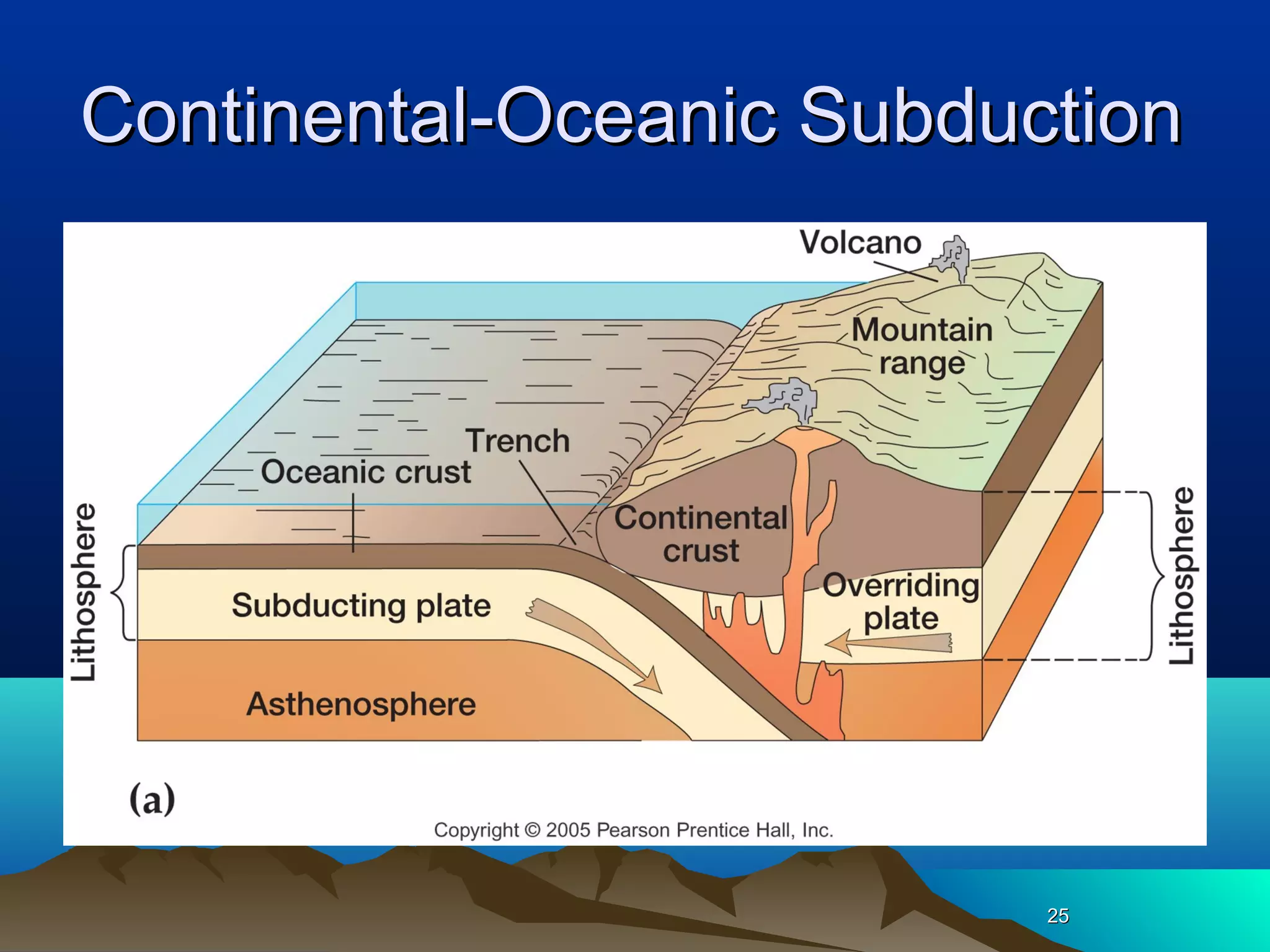
Three Types of Subduction ZonesThree Types of Subduction Zones
1. Continental crust meets oceanic crust
Oceanic crust sinks
Big trench offshore
Volcanoes on the continental margin
Big earthquakes (potential for tsunamis)
2525
Continental-Oceanic SubductionContinental-Oceanic Subduction
2626
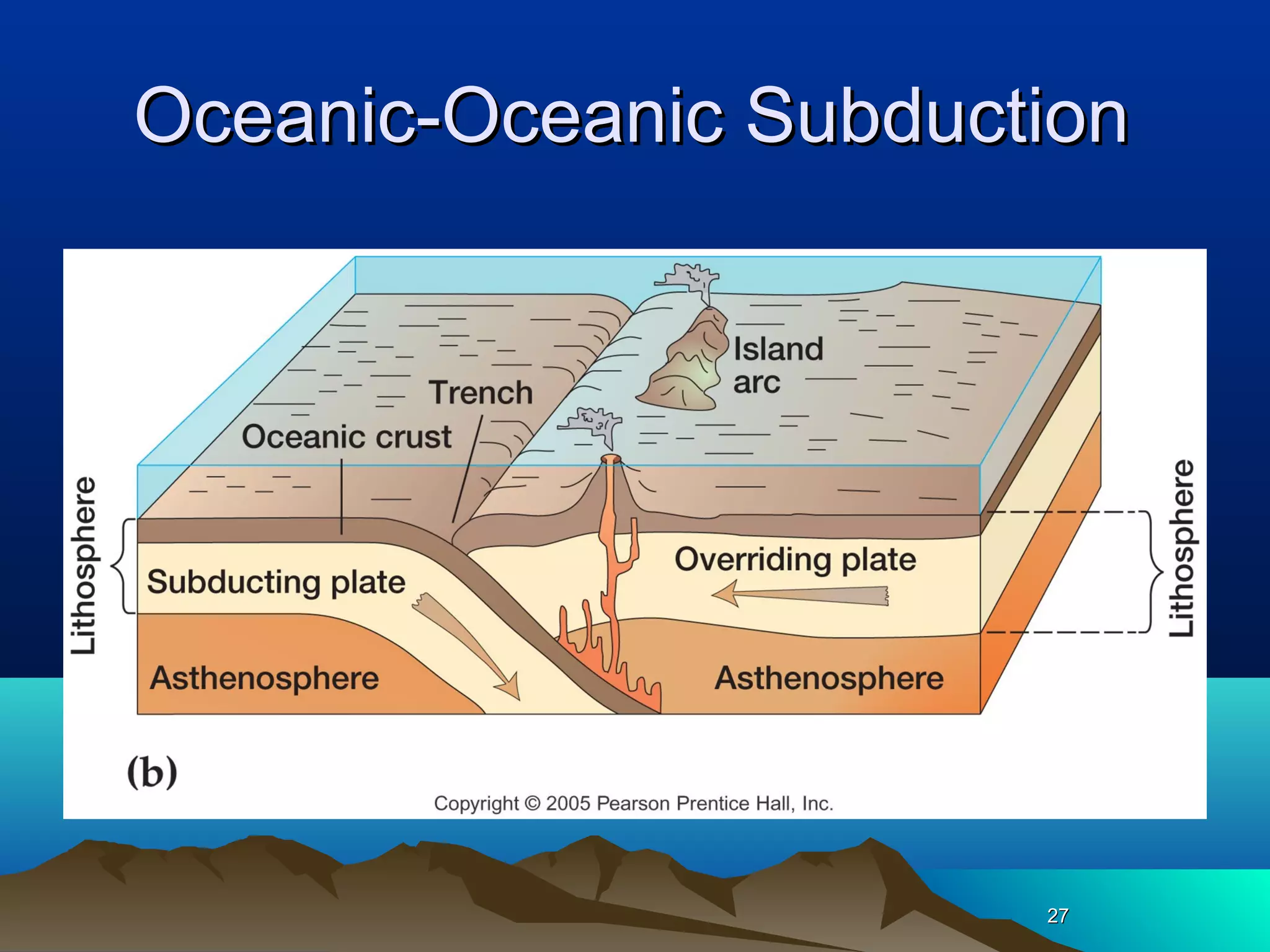
Three Types of Subduction ZonesThree Types of Subduction Zones
2. Oceanic crust meets oceanic crust
The older and colder crust will probably sink
Big earthquakes and volcanic islands (“island arcs”)
Deep ocean trench
Potential for tsunamis
2727
Oceanic-Oceanic SubductionOceanic-Oceanic Subduction
2828
Three Types of Subduction ZonesThree Types of Subduction Zones
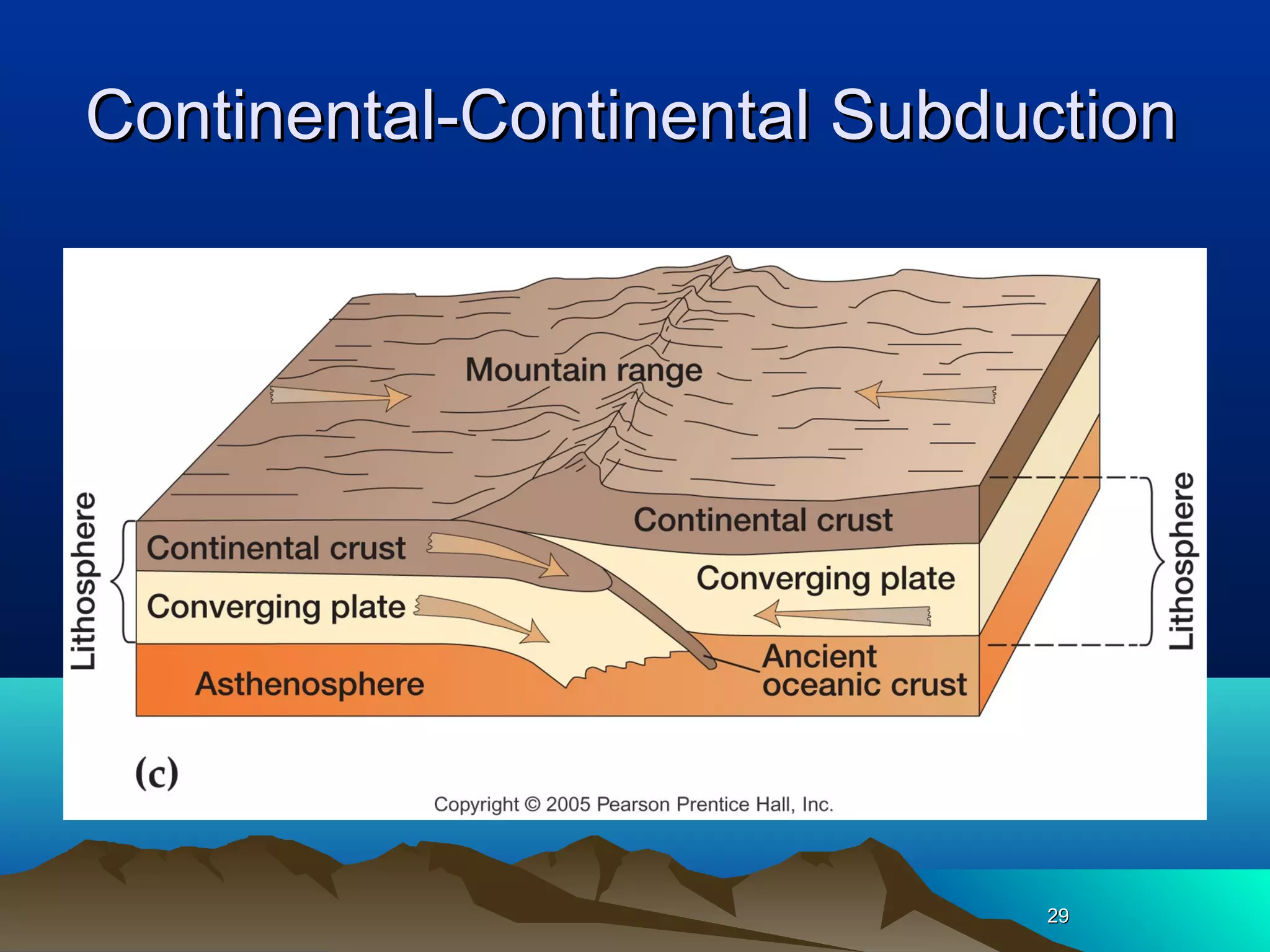
3. Continental crust meets continental crust
Too light to subduct
Mountain-building
Big earthquakes
Little if any volcanism (mostly intrusive)
2929
Continental-Continental SubductionContinental-Continental Subduction
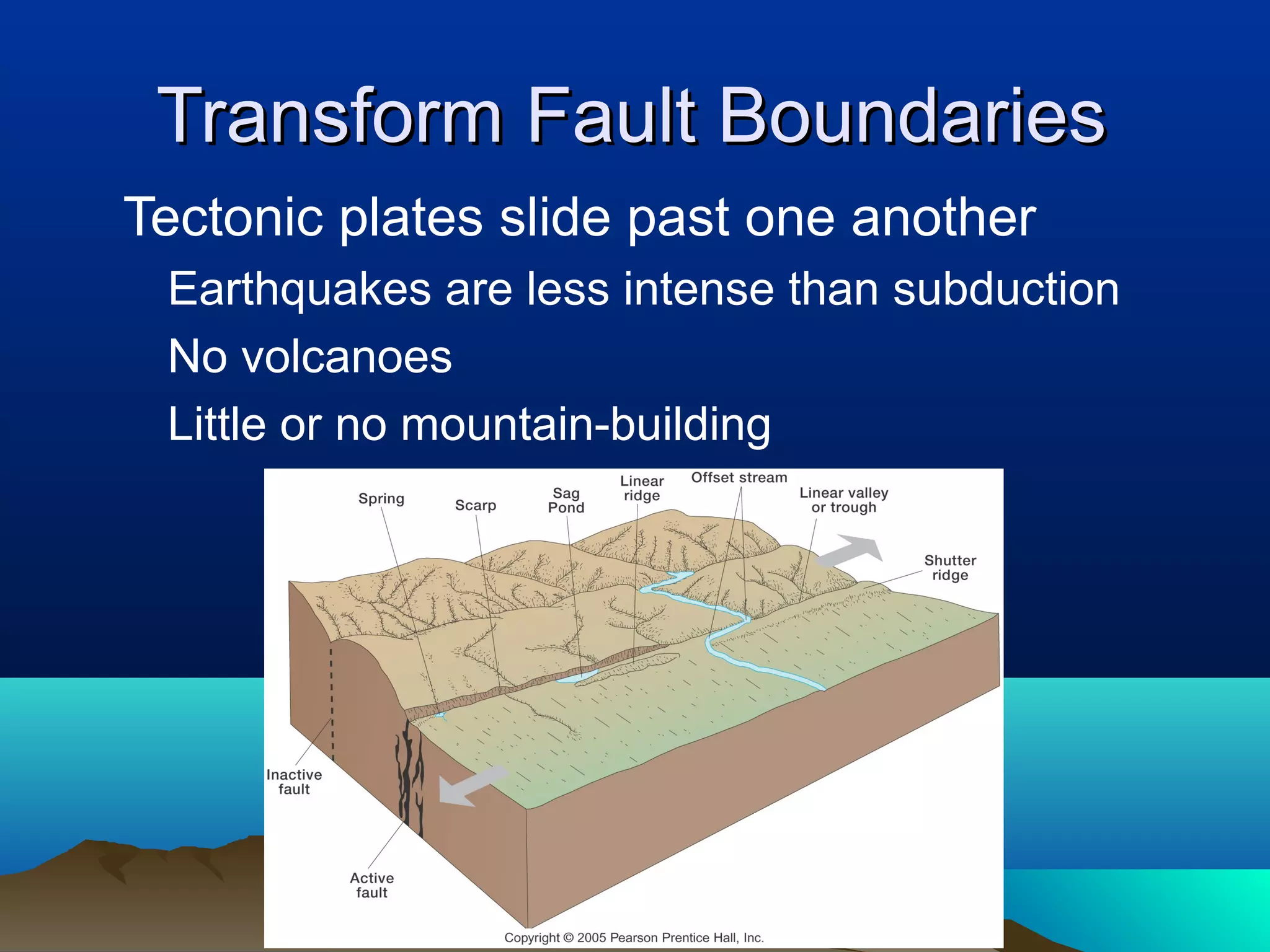
Transform Fault BoundariesTransform Fault Boundaries
Tectonic plates slide past one another
Earthquakes are less intense than subduction
No volcanoes
Little or no mountain-building
3434
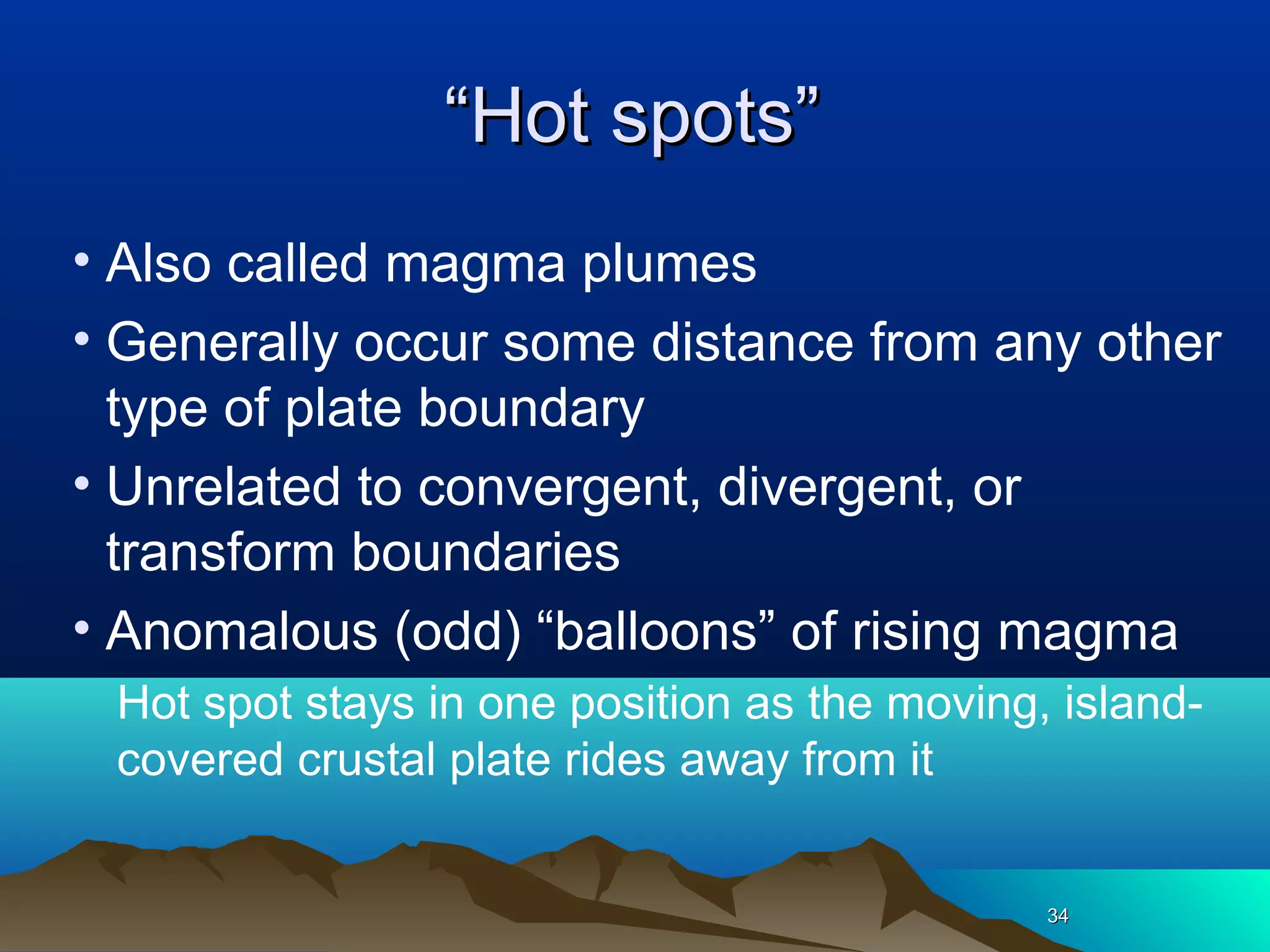
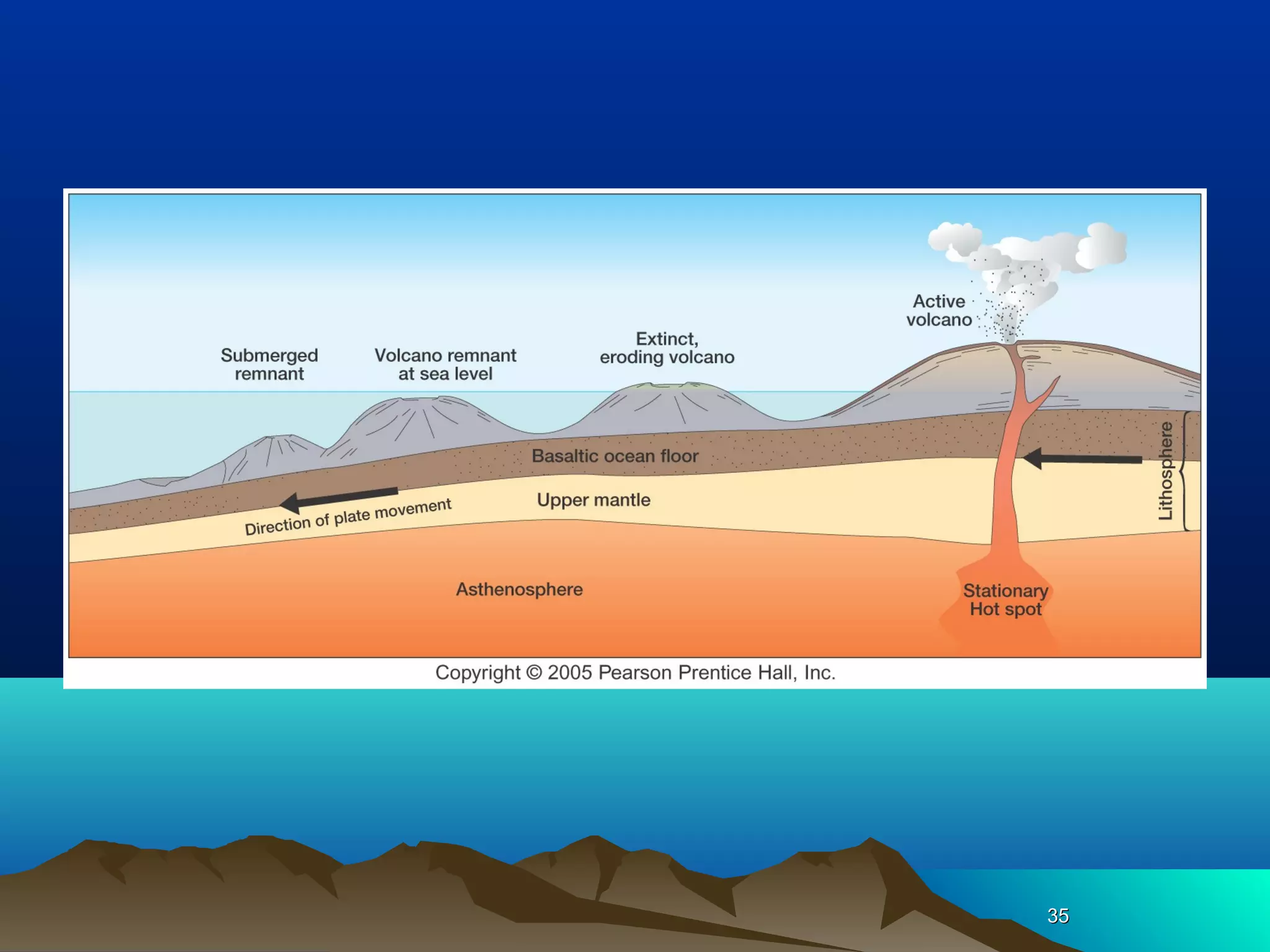
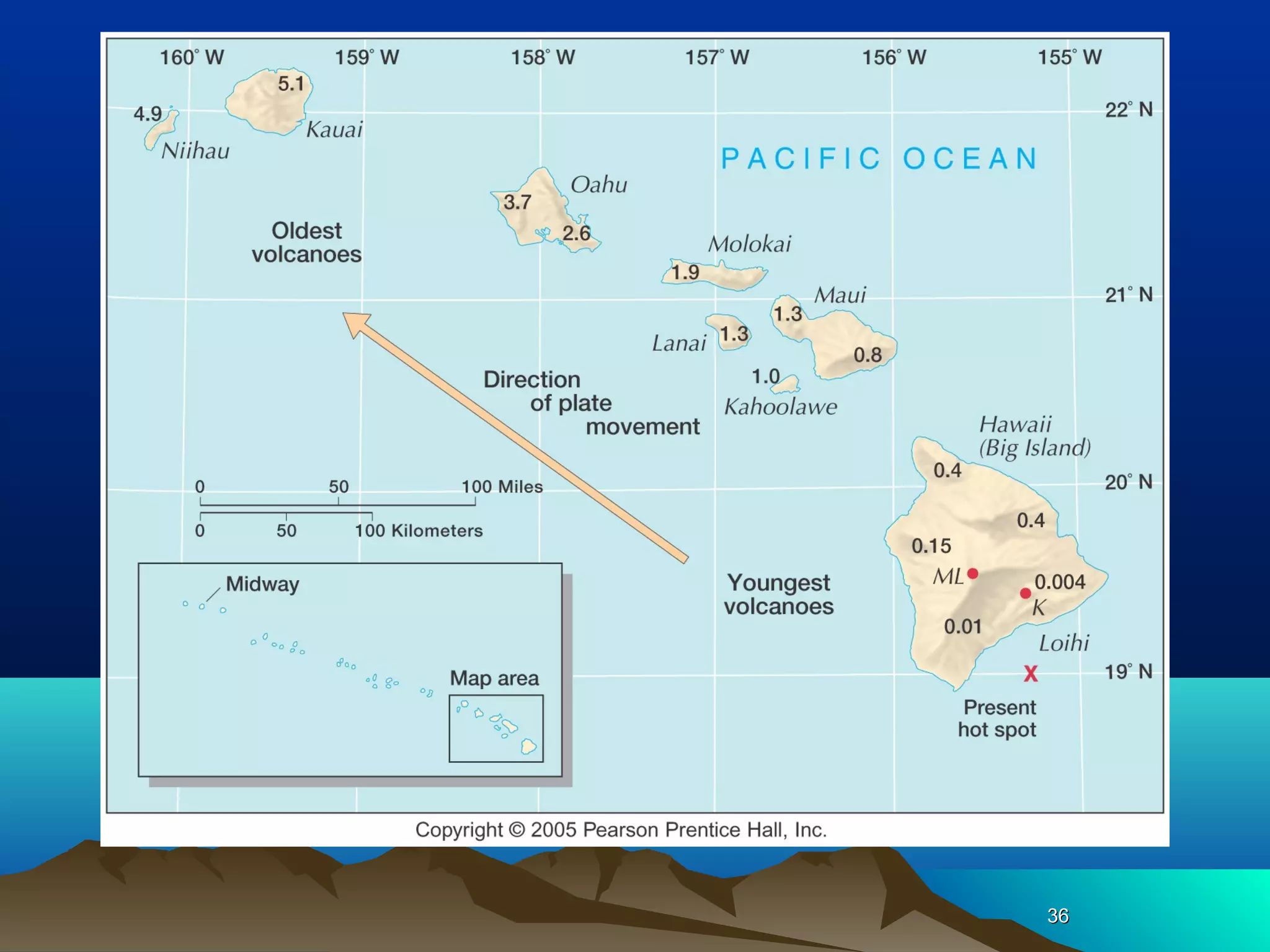
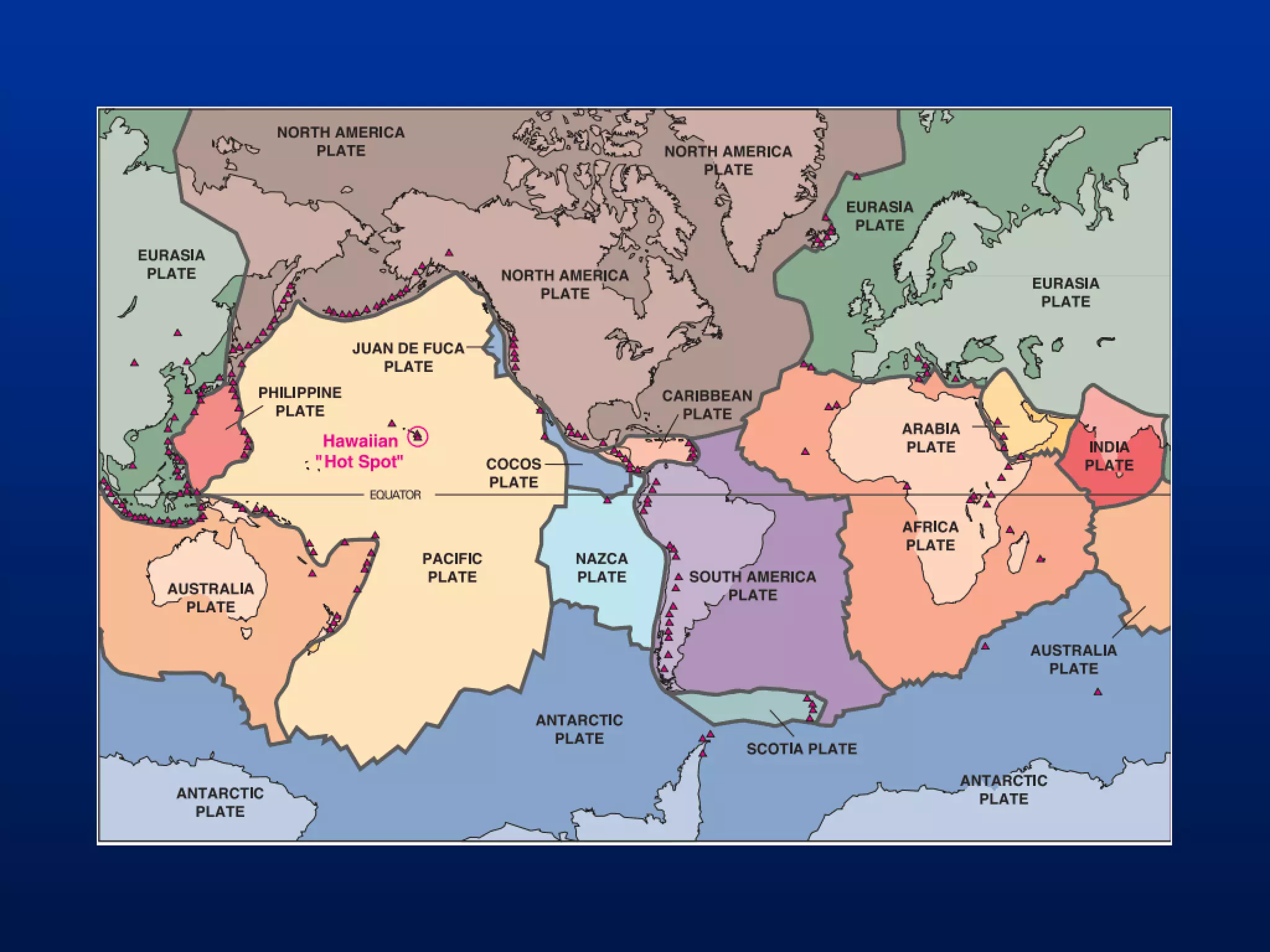
““Hot spots”Hot spots”
• Also called magma plumes
• Generally occur some distance from any other
type of plate boundary
• Unrelated to convergent, divergent, or
transform boundaries
• Anomalous (odd) “balloons” of rising magma
Hot spot stays in one position as the moving, island-
covered crustal plate rides away from it
3535
3636
3737
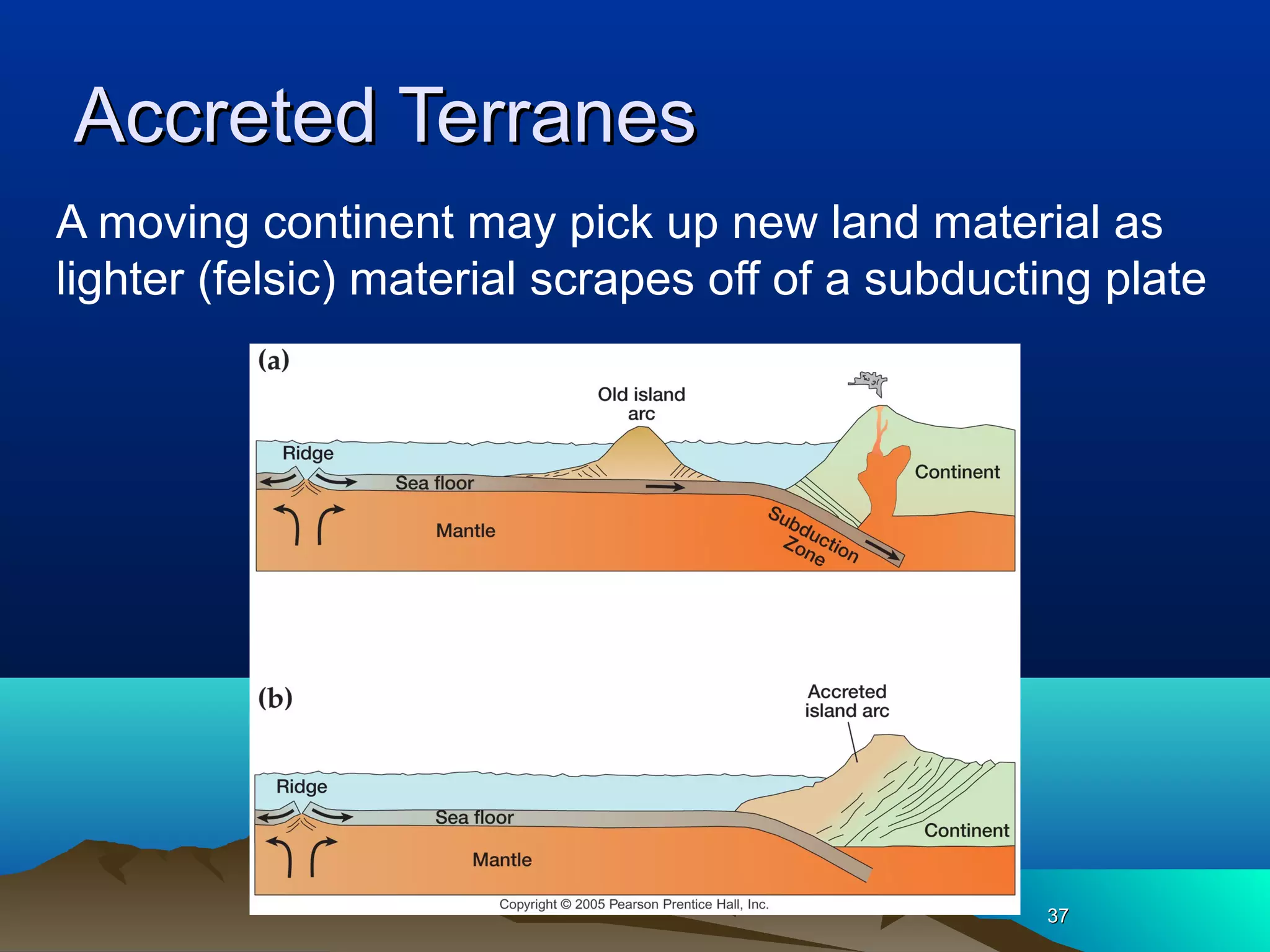
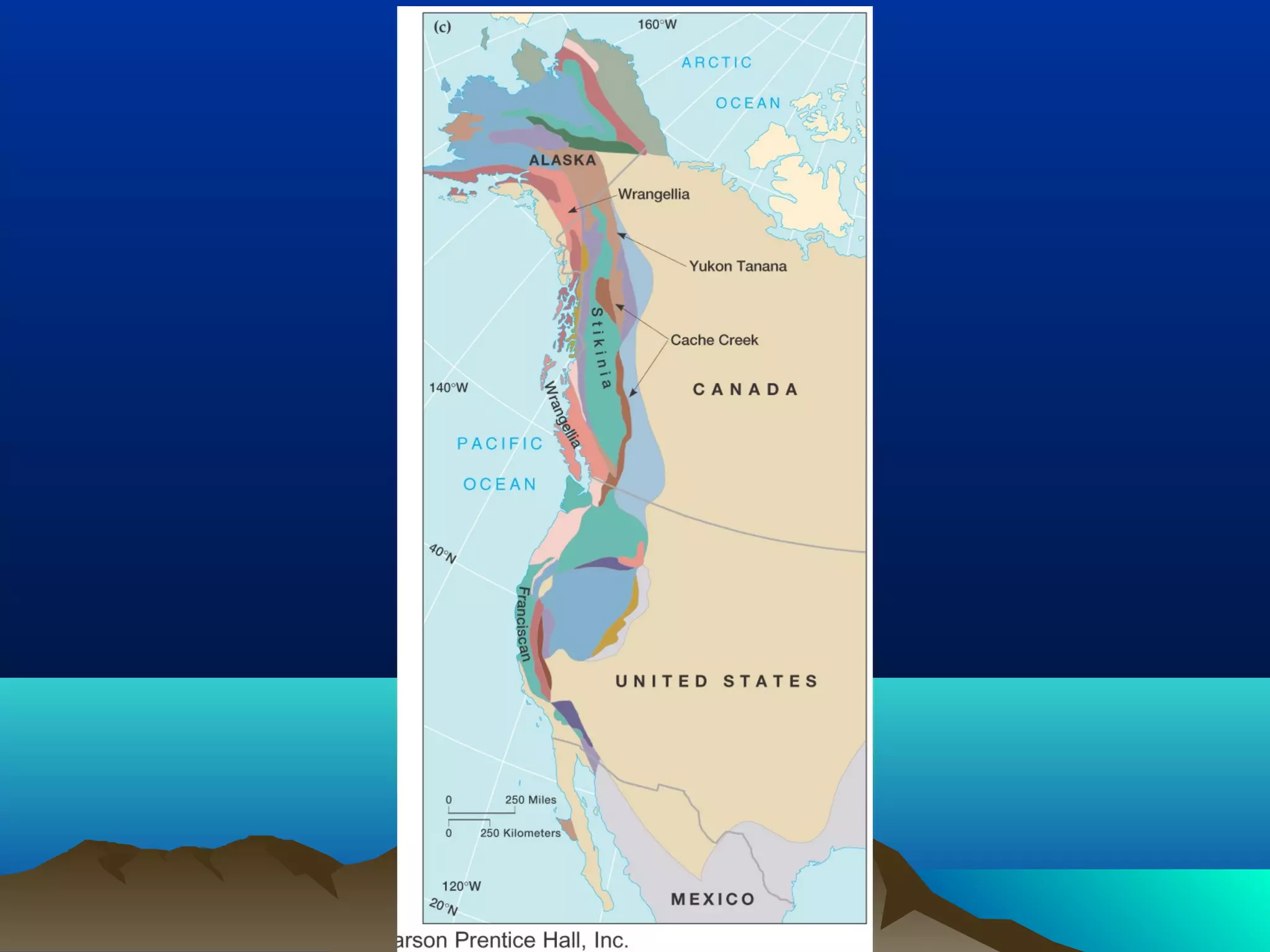
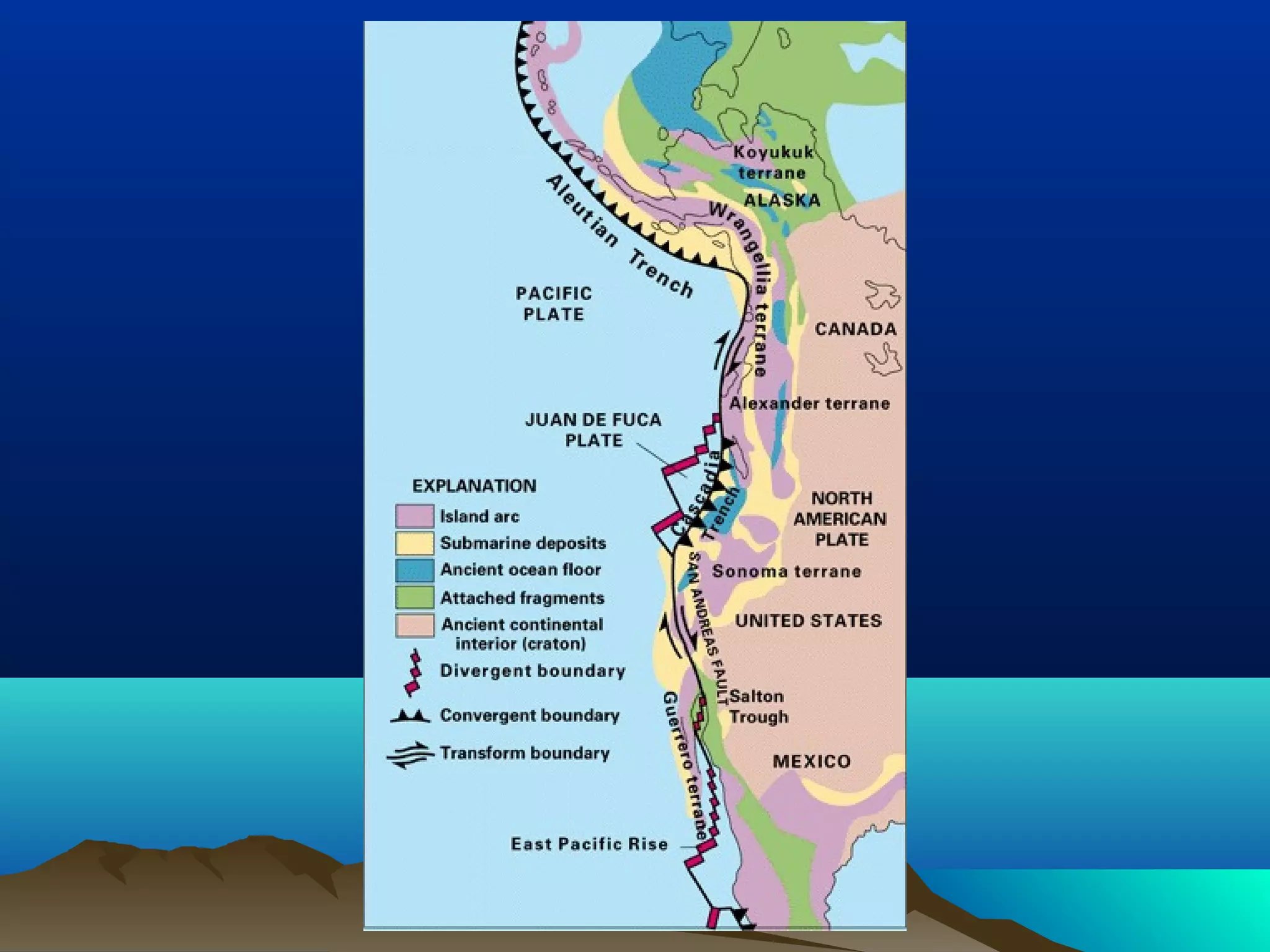
Accreted TerranesAccreted Terranes
A moving continent may pick up new land material as
lighter (felsic) material scrapes off of a subducting plate
4040
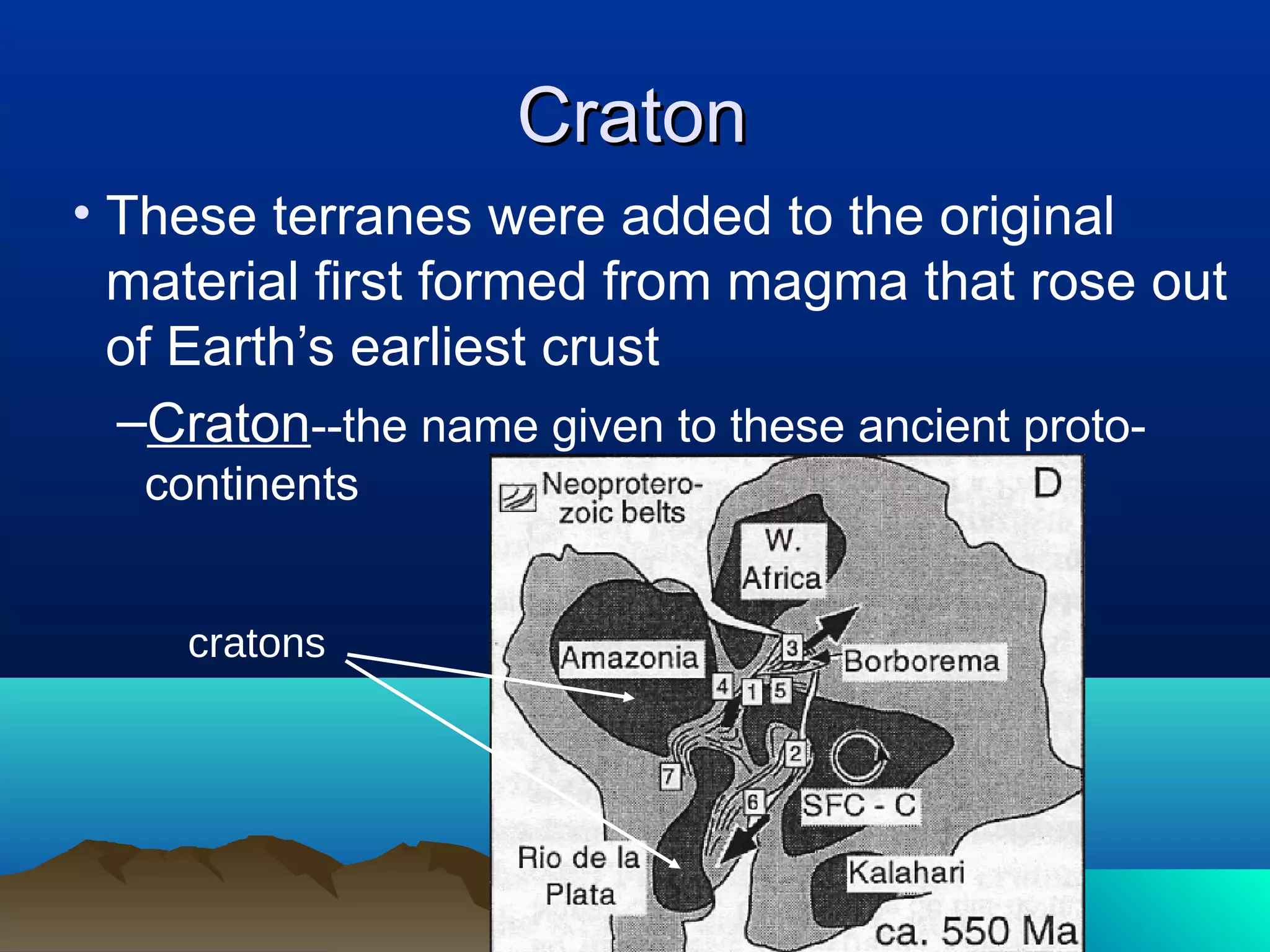
CratonCraton
• These terranes were added to the original
material first formed from magma that rose out
of Earth’s earliest crust
–Craton--the name given to these ancient proto-
continents
4040
cratons
4141
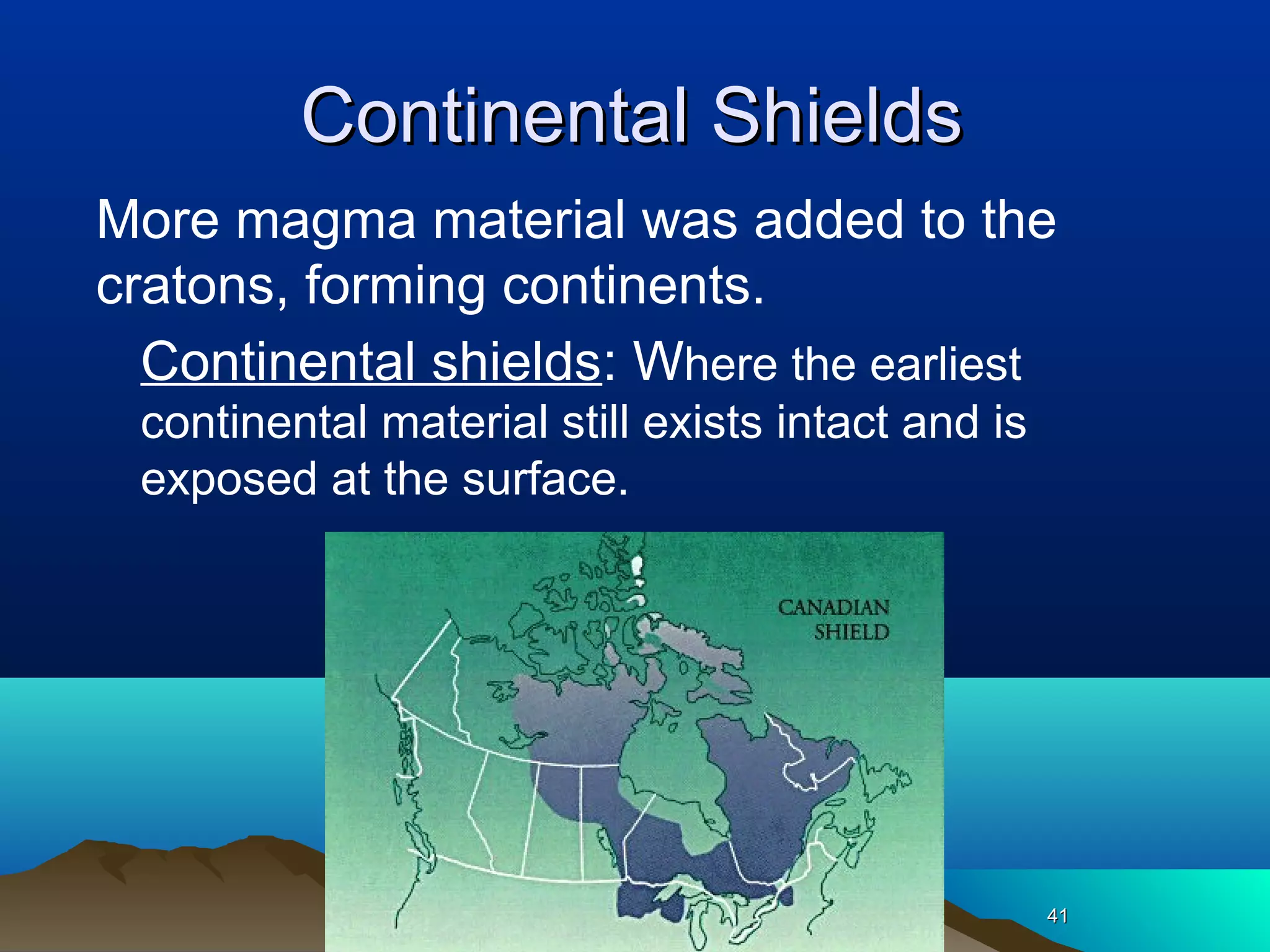
Continental ShieldsContinental Shields
More magma material was added to the
cratons, forming continents.
Continental shields: Where the earliest
continental material still exists intact and is
exposed at the surface.
4141
4242
TopographyTopography
• Right from the very beginning, the crust was
affected by stresses and strains that caused
crustal deformations
• Over time, the crust has continued to be
folded, faulted, broken, eroded and further
built upon, creating the topography, the ups
and downs of land relief, that we see today
Physical Geography Lecture 12 - Plate Tectonics 111616

Physical Geography Lecture 12 - Plate Tectonics 111616

  • 1.
  • 2.
    Rigid Earth TheoryRigidEarth Theory It was once believed that Earth’s crust was hard and brittle and could not bend Plasticity We now know that Earth’s crust can bend (like a tough plastic) before breaking
  • 3.
    33 IsostacyIsostacy • Maintaining equilibriumin the crust • Addition or removal of crustal material causes a sinking or rebounding of crust –A glacier growing or remelting, crust eroding off the surface, sediment deposits, water bodies on land, esp. those created by dams, etc.
  • 5.
    Alfred Wegener andAlfredWegener and His Continental Drift TheoryHis Continental Drift Theory German meteorologist, 1920s--Pangaea (Gk. “whole land”) “The present continents were originally connected as one enormous landmass that has broken up and drifted apart over the last few 100 million years. The drifting continues….” What evidence led him to this theory?
  • 6.
  • 7.
  • 8.
  • 10.
    1010 Wegener’s Lines ofEvidenceWegener’s Lines of Evidence Similar geology (rocks and rock structures)… …petrology (rock chemistry), …matching glacial features (U-shaped valleys, glacial deposits, etc.) on continents separated by oceans, …continent shapes that seem to fit together, …patterns in the locations of volcanoes, …paleontology (fossilized plants and animals)... Ex.: S. America/Africa, Madagascar/India, Australia/Antarctica
  • 11.
    1111 ……but no onebought it.but no one bought it. What do you mean, “The continents are floating???” So why don’t we see the crust ripping apart right now? And hey, what’s the power source driving these movements of all the land masses, anyway??? The crust is too rigid! What a knucklehead.
  • 12.
    Then along cameOceanographerThen along came Oceanographer Harry Hess in the 1960s…Harry Hess in the 1960s…
  • 15.
    The evidence continuedto mount…The evidence continued to mount… • Military seafloor mapping: Seafloor geology—structure,Military seafloor mapping: Seafloor geology—structure, chemistry, and agechemistry, and age – Oceanic crust: only 100 m.y.oOceanic crust: only 100 m.y.o – Continental crust: 4.1 b.y.o.Continental crust: 4.1 b.y.o. • Core samplingCore sampling • Seafloor sedimentSeafloor sediment • Rigid Earth folks retired—paradigm shift to plasticityRigid Earth folks retired—paradigm shift to plasticity • Geologists, geophysicists, seismologists,Geologists, geophysicists, seismologists, oceanographers, physicists, and paleontologists alloceanographers, physicists, and paleontologists all agree the theory fits the evidence gathered within theiragree the theory fits the evidence gathered within their respective fieldsrespective fields • Convection currents as mechanism/power sourceConvection currents as mechanism/power source
  • 16.
    1616 Convection CurrentsConvection Currents Slow-moving convectioncurrents within the mantle transfer heat from the outer core to the upper mantle Finally, there was a mechanism and a process for moving all those pieces of crust!
  • 17.
  • 18.
    The Theory ofPlate TectonicsThe Theory of Plate Tectonics Tectonic (crustal) plates Pulling apart (diverging) = Spreading centers Slamming together, sinking (converging) = Subduction zones Sliding laterally (sideways) = Transform fault boundaries
  • 19.
  • 21.
    Divergent Plate BoundariesDivergentPlate Boundaries Spreading centers –Crust pulling apart, magma rising to the surface
  • 22.
    Convergent Plate BoundariesConvergentPlate Boundaries Subduction zones –Crust being forced together –Lightest material rises (mountain-building) while the heaviest stuff sinks (pushed back into the mantle) –Remelting (mostly from friction) creates volcanoes –Intense, deep-focus earthquakes
  • 23.
  • 24.
    2424 Three Types ofSubduction ZonesThree Types of Subduction Zones 1. Continental crust meets oceanic crust Oceanic crust sinks Big trench offshore Volcanoes on the continental margin Big earthquakes (potential for tsunamis)
  • 25.
  • 26.
    2626 Three Types ofSubduction ZonesThree Types of Subduction Zones 2. Oceanic crust meets oceanic crust The older and colder crust will probably sink Big earthquakes and volcanic islands (“island arcs”) Deep ocean trench Potential for tsunamis
  • 27.
  • 28.
    2828 Three Types ofSubduction ZonesThree Types of Subduction Zones 3. Continental crust meets continental crust Too light to subduct Mountain-building Big earthquakes Little if any volcanism (mostly intrusive)
  • 29.
  • 30.
    Transform Fault BoundariesTransformFault Boundaries Tectonic plates slide past one another Earthquakes are less intense than subduction No volcanoes Little or no mountain-building
  • 34.
    3434 ““Hot spots”Hot spots” •Also called magma plumes • Generally occur some distance from any other type of plate boundary • Unrelated to convergent, divergent, or transform boundaries • Anomalous (odd) “balloons” of rising magma Hot spot stays in one position as the moving, island- covered crustal plate rides away from it
  • 35.
  • 36.
  • 37.
    3737 Accreted TerranesAccreted Terranes Amoving continent may pick up new land material as lighter (felsic) material scrapes off of a subducting plate
  • 40.
    4040 CratonCraton • These terraneswere added to the original material first formed from magma that rose out of Earth’s earliest crust –Craton--the name given to these ancient proto- continents 4040 cratons
  • 41.
    4141 Continental ShieldsContinental Shields Moremagma material was added to the cratons, forming continents. Continental shields: Where the earliest continental material still exists intact and is exposed at the surface. 4141
  • 42.
    4242 TopographyTopography • Right fromthe very beginning, the crust was affected by stresses and strains that caused crustal deformations • Over time, the crust has continued to be folded, faulted, broken, eroded and further built upon, creating the topography, the ups and downs of land relief, that we see today