z
PETROLOGY
The branch of Geology
dealing with various aspects
of rocks such as formation of
rocks, chemical and
mineralogical classification
occurrence of rocks, their
rocks
z
INTRODUCTION
 In geology, rock or stone is a
naturally occurring solid
aggregate of one or more
minerals or mineraloids .
 A rock is an aggregate of
minerals. It may be up of one
z
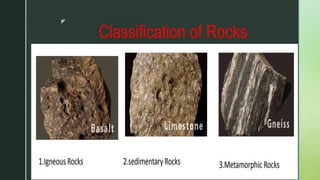
Classification of Rocks
z
z
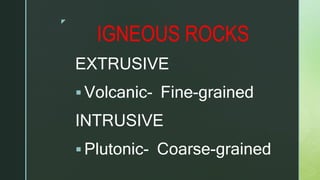
IGNEOUS ROCKS
EXTRUSIVE
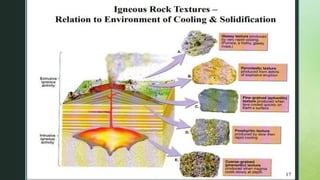
 Volcanic- Fine-grained
INTRUSIVE
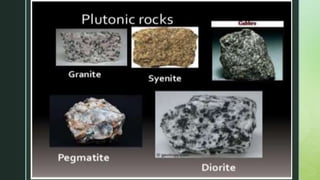
 Plutonic- Coarse-grained
z
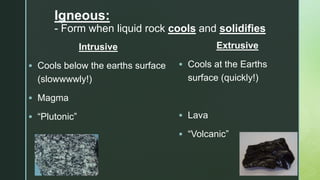
Igneous:
- Form when liquid rock cools and solidifies
Intrusive
 Cools below the earths surface
(slowwwwly!)
 Magma
 “Plutonic”
Extrusive
 Cools at the Earths
surface (quickly!)
 Lava
 “Volcanic”
z
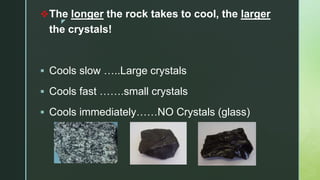
The longer the rock takes to cool, the larger
the crystals!
 Cools slow …..Large crystals
 Cools fast …….small crystals
 Cools immediately……NO Crystals (glass)
z
Igneous rocks
1. The rocks that have formed from an originally hot
molten material through the process of cooling and
crystallization are called as igneous rocks .
2. Magma-The hot molten material occurring
naturally below the surface of the earth is called
magma . It is called lava when erupted through
volcanoes. Igneous Rocks are formed both from
magma and lava
z
a) Volcanic Rocks-These are the igneous rocks formed
on the surface of the earth by cooling and
crystallization of lava erupted from volcanos. The
grain size of the crystals formed in these rocks are
very fine and microscopic.
b) Plutonic rocks-These are igneous rocks formed at
considerable depths generally between 7-10km below
the surface of the earth
c) Hypabyssal rocks-These igneous rocks are formed at
intermediate depths , generally up to 2 kms below the
surface of the earth.
z
z
z
z
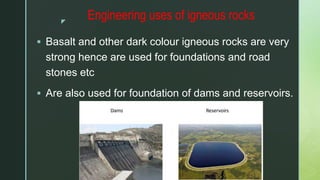
Engineering uses of igneous rocks
 Basalt and other dark colour igneous rocks are very
strong hence are used for foundations and road
stones etc
 Are also used for foundation of dams and reservoirs.
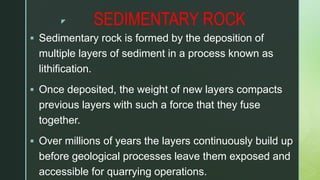
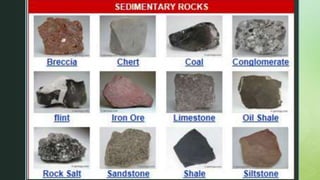
z SEDIMENTARY ROCK
 Sedimentary rock is formed by the deposition of
multiple layers of sediment in a process known as
lithification.
 Once deposited, the weight of new layers compacts
previous layers with such a force that they fuse
together.
 Over millions of years the layers continuously build up
before geological processes leave them exposed and
accessible for quarrying operations.
z
z
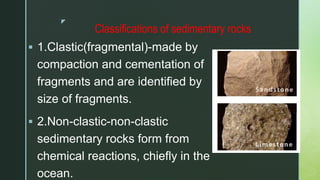
Classifications of sedimentary rocks
 1.Clastic(fragmental)-made by
compaction and cementation of
fragments and are identified by
size of fragments.
 2.Non-clastic-non-clastic
sedimentary rocks form from
chemical reactions, chiefly in the
ocean.
z
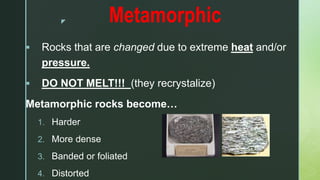
z Metamorphic
 Rocks that are changed due to extreme heat and/or
pressure.
 DO NOT MELT!!! (they recrystalize)
Metamorphic rocks become…
1. Harder
2. More dense
3. Banded or foliated
4. Distorted
z
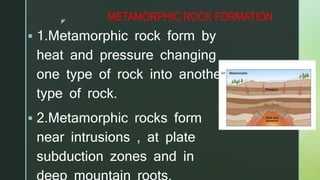
METAMORPHIC ROCK FORMATION
 1.Metamorphic rock form by
heat and pressure changing
one type of rock into another
type of rock.
 2.Metamorphic rocks form
near intrusions , at plate
subduction zones and in
z
z
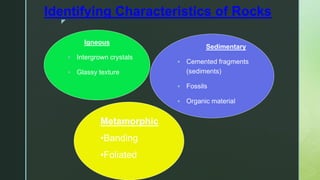
Identifying Characteristics of Rocks
Igneous
 Intergrown crystals
 Glassy texture
Sedimentary
 Cemented fragments
(sediments)
 Fossils
 Organic material
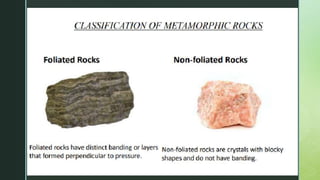
Metamorphic
•Banding
•Foliated
z
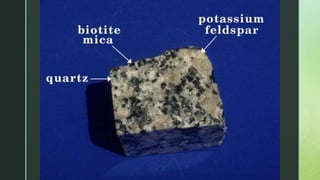
 Minerals are the
ingredients of
rocks.
Or
 Rocks are made
up of minerals.
z
z
Minerals
 Defn: naturally occurring,
inorganic elements or
compounds with specific physical
and chemical properties.
zMineral Properties
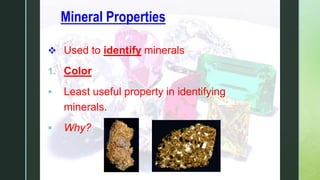
 Used to identify minerals
1. Color
 Least useful property in identifying
minerals.
 Why?
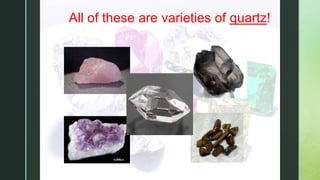
z All of these are varieties of quartz!
z
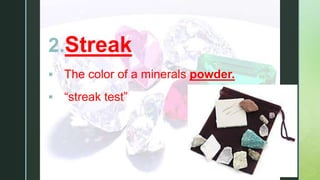
2.Streak
 The color of a minerals powder.
 “streak test”
z
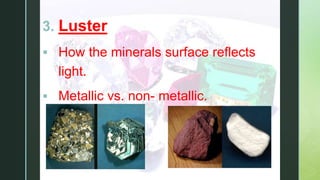
3. Luster
 How the minerals surface reflects
light.
 Metallic vs. non- metallic.
z
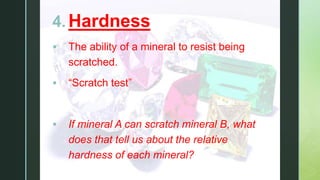
4. Hardness
 The ability of a mineral to resist being
scratched.
 “Scratch test”
 If mineral A can scratch mineral B, what
does that tell us about the relative
hardness of each mineral?
z
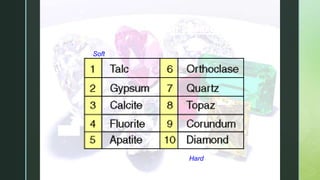
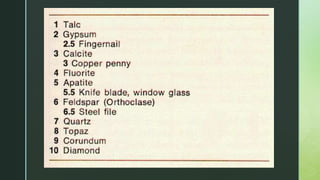
Moh’s Hardness Scale
Soft
Hard
z
z
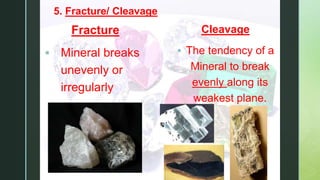
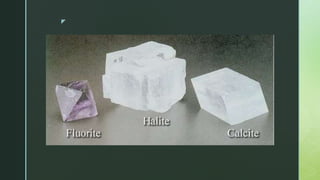
5. Fracture/ Cleavage
Fracture
 Mineral breaks
unevenly or
irregularly
Cleavage
 The tendency of a
Mineral to break
evenly along its
weakest plane.
z
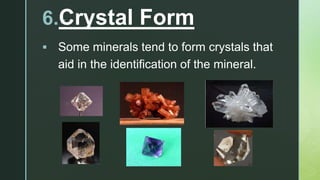
z6.Crystal Form
 Some minerals tend to form crystals that
aid in the identification of the mineral.
z
7.Specific Gravity
 The ratio of the density of the mineral to
the density of water (1 g/cm3)
 If a mineral has a specific gravity of 5 that
means it is 5 times as dense as water.
z
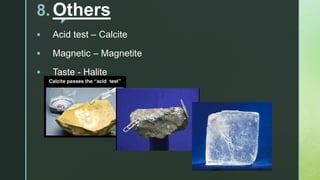
8. Others
 Acid test – Calcite
 Magnetic – Magnetite
 Taste - Halite
z
A minerals
properties are due to
the internal
arrangement of its
atoms.
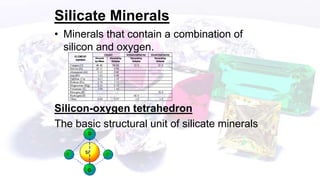
Silicate Minerals
• Minerals that contain a combination of
silicon and oxygen.
Silicon-oxygen tetrahedron
The basic structural unit of silicate minerals
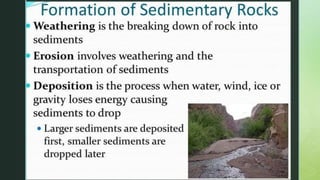
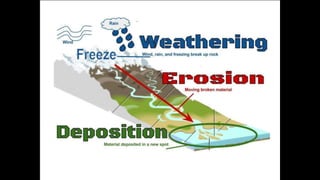
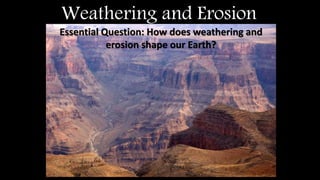
Weathering and Erosion
Essential Question: How does weathering and
erosion shape our Earth?
What is Weathering?
What are the two forms of weathering?
Define each.
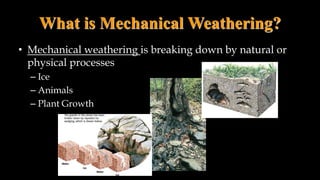
What is Mechanical Weathering?
• Mechanical weathering is breaking down by natural or
physical processes
– Ice
– Animals
– Plant Growth
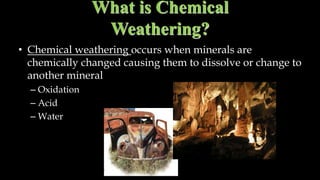
What is Chemical
Weathering?
• Chemical weathering occurs when minerals are
chemically changed causing them to dissolve or change to
another mineral
– Oxidation
– Acid
– Water
DISCUSS with your table:
• What is the connection between weathering and
erosion??
• Why did we learn weathering first??
• How does this affect the Earth? Us?
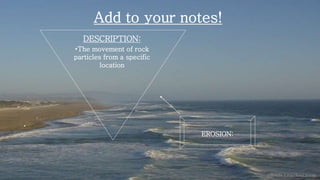
EROSION:
DESCRIPTION:
•The movement of rock
particles from a specific
location
Add to your notes!
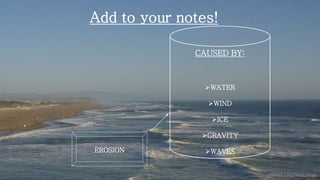
EROSION
CAUSED BY:
WATER
WIND
ICE
GRAVITY
WAVES
Add to your notes!
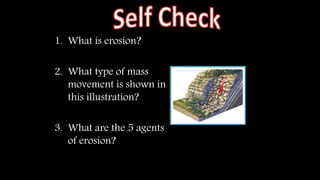
1. What is erosion?
2. What type of mass
movement is shown in
this illustration?
3. What are the 5 agents
of erosion?
Environmental science

Environmental science

  • 1.
    z PETROLOGY The branch ofGeology dealing with various aspects of rocks such as formation of rocks, chemical and mineralogical classification occurrence of rocks, their rocks
  • 2.
    z INTRODUCTION  In geology,rock or stone is a naturally occurring solid aggregate of one or more minerals or mineraloids .  A rock is an aggregate of minerals. It may be up of one
  • 3.
  • 4.
  • 5.
    z IGNEOUS ROCKS EXTRUSIVE  Volcanic-Fine-grained INTRUSIVE  Plutonic- Coarse-grained
  • 6.
    z Igneous: - Form whenliquid rock cools and solidifies Intrusive  Cools below the earths surface (slowwwwly!)  Magma  “Plutonic” Extrusive  Cools at the Earths surface (quickly!)  Lava  “Volcanic”
  • 7.
    z The longer therock takes to cool, the larger the crystals!  Cools slow …..Large crystals  Cools fast …….small crystals  Cools immediately……NO Crystals (glass)
  • 8.
    z Igneous rocks 1. Therocks that have formed from an originally hot molten material through the process of cooling and crystallization are called as igneous rocks . 2. Magma-The hot molten material occurring naturally below the surface of the earth is called magma . It is called lava when erupted through volcanoes. Igneous Rocks are formed both from magma and lava
  • 9.
    z a) Volcanic Rocks-Theseare the igneous rocks formed on the surface of the earth by cooling and crystallization of lava erupted from volcanos. The grain size of the crystals formed in these rocks are very fine and microscopic. b) Plutonic rocks-These are igneous rocks formed at considerable depths generally between 7-10km below the surface of the earth c) Hypabyssal rocks-These igneous rocks are formed at intermediate depths , generally up to 2 kms below the surface of the earth.
  • 10.
  • 11.
  • 12.
  • 13.
    z Engineering uses ofigneous rocks  Basalt and other dark colour igneous rocks are very strong hence are used for foundations and road stones etc  Are also used for foundation of dams and reservoirs.
  • 14.
    z SEDIMENTARY ROCK Sedimentary rock is formed by the deposition of multiple layers of sediment in a process known as lithification.  Once deposited, the weight of new layers compacts previous layers with such a force that they fuse together.  Over millions of years the layers continuously build up before geological processes leave them exposed and accessible for quarrying operations.
  • 15.
  • 16.
    z Classifications of sedimentaryrocks  1.Clastic(fragmental)-made by compaction and cementation of fragments and are identified by size of fragments.  2.Non-clastic-non-clastic sedimentary rocks form from chemical reactions, chiefly in the ocean.
  • 17.
  • 18.
    z Metamorphic  Rocksthat are changed due to extreme heat and/or pressure.  DO NOT MELT!!! (they recrystalize) Metamorphic rocks become… 1. Harder 2. More dense 3. Banded or foliated 4. Distorted
  • 19.
    z METAMORPHIC ROCK FORMATION 1.Metamorphic rock form by heat and pressure changing one type of rock into another type of rock.  2.Metamorphic rocks form near intrusions , at plate subduction zones and in
  • 20.
  • 21.
    z Identifying Characteristics ofRocks Igneous  Intergrown crystals  Glassy texture Sedimentary  Cemented fragments (sediments)  Fossils  Organic material Metamorphic •Banding •Foliated
  • 22.
    z  Minerals arethe ingredients of rocks. Or  Rocks are made up of minerals.
  • 23.
  • 24.
    z Minerals  Defn: naturallyoccurring, inorganic elements or compounds with specific physical and chemical properties.
  • 25.
    zMineral Properties  Usedto identify minerals 1. Color  Least useful property in identifying minerals.  Why?
  • 26.
    z All ofthese are varieties of quartz!
  • 27.
    z 2.Streak  The colorof a minerals powder.  “streak test”
  • 28.
    z 3. Luster  Howthe minerals surface reflects light.  Metallic vs. non- metallic.
  • 29.
    z 4. Hardness  Theability of a mineral to resist being scratched.  “Scratch test”  If mineral A can scratch mineral B, what does that tell us about the relative hardness of each mineral?
  • 30.
  • 31.
  • 32.
    z 5. Fracture/ Cleavage Fracture Mineral breaks unevenly or irregularly Cleavage  The tendency of a Mineral to break evenly along its weakest plane.
  • 33.
  • 34.
    z6.Crystal Form  Someminerals tend to form crystals that aid in the identification of the mineral.
  • 35.
    z 7.Specific Gravity  Theratio of the density of the mineral to the density of water (1 g/cm3)  If a mineral has a specific gravity of 5 that means it is 5 times as dense as water.
  • 36.
    z 8. Others  Acidtest – Calcite  Magnetic – Magnetite  Taste - Halite
  • 37.
    z A minerals properties aredue to the internal arrangement of its atoms.
  • 38.
    Silicate Minerals • Mineralsthat contain a combination of silicon and oxygen. Silicon-oxygen tetrahedron The basic structural unit of silicate minerals
  • 39.
    Weathering and Erosion EssentialQuestion: How does weathering and erosion shape our Earth?
  • 40.
    What is Weathering? Whatare the two forms of weathering? Define each.
  • 41.
    What is MechanicalWeathering? • Mechanical weathering is breaking down by natural or physical processes – Ice – Animals – Plant Growth
  • 42.
    What is Chemical Weathering? •Chemical weathering occurs when minerals are chemically changed causing them to dissolve or change to another mineral – Oxidation – Acid – Water
  • 43.
    DISCUSS with yourtable: • What is the connection between weathering and erosion?? • Why did we learn weathering first?? • How does this affect the Earth? Us?
  • 44.
    EROSION: DESCRIPTION: •The movement ofrock particles from a specific location Add to your notes!
  • 45.
  • 46.
    1. What iserosion? 2. What type of mass movement is shown in this illustration? 3. What are the 5 agents of erosion?