Earth Science
Quarter 1
Minerals and
Objectives
At the end of the lesson, the learners will be able to:
1.identify common rock-forming minerals using their physical
and chemical properties
2.classify minerals based on chemical affinity
3.identify and describe the three basic types of rocks
4.describe the transformation of rocks from one rock type to
another
1. Which of the following mineral formula represents a silicate?
A. FeS2 B. KAlSi3O8 C. Fe2O3 D. CaSO4•2H2O
2. What property is shown by a feldspar as it breaks into pieces with
jagged edges?
B. cleavage B. crystal form C. fracture D. hardness
3. How do you classify the gold nuggets found in the soil or sand in
rivers?
C. halide B. silicate C. carbonate D. native element
4. Which specific property of crushed halite makes it perfectly suited
for flavoring food?
A. fracture B. luster C. odor D. taste
5. Which of the following are characteristics of a mineral?
I It has a definite crystal structure.
II It is made of chemical substance/s.
III It is composed of one or more minerals.
IV It has no organic material present within it.
A. I, II, & III only C. I, II, & IV only
B. I, III & IV only D. I, II, III & IV
6. What is the hardest mineral?
C. corundum B. diamond C. quartz D. topaz
7. What property of mineral is shown as sulfur crystal looks yellow in
powder form?
A. color B. luster C. streak D. crystal habit
8. What property of mineral is exhibited by its tendency to break along
smooth planes parallel to zones of weak bonding as shown in the diagram
below?
A. cleavage C. conchoidal B. fracture D. tenacity
9. Which of the following statements describes luster? How __________.
A. hard a mineral is C. malleable a mineral is
B. mineral reflects light D. a mineral conducts electricity
10. What is the difference between a foliated and a non-foliated rock?
Foliated rocks have a texture in which the mineral grains are
arranged in_____________, which is absent in a non- foliated rock.
A. bands B. holes C. matrix D. rounded fragments
11. What rock-forming process occurs when hot magma comes near
and heats up rock?
B. deposition C. regional metamorphism.
C. contact metamorphism. D. biochemical sedimentation.
12. What type of rocks are formed from sediments over a long time?
A. igneous B. metamorphic C. meteorite D. sedimentary
13. How would the metamorphic rock look like when the mineral crystals in
it are aligned with each other due to pressure?
A. foliated B. frothy C. glassy D. non-foliated
14. A student obtains a cup of quartz sand from a beach. Saltwater solution is
poured into the sand and allowed to evaporate. The mineral residue from
the saltwater solution cements the sand grains together. What kind of
rock undergoes similar process as the sand grains are glued together?
B. molten B. igneous C. metamorphic D. sedimentary
15. Why are fossils not found in igneous and metamorphic rocks? Fossils are
found in igneous and metamorphic rocks because remnants of plants
and animals are __________________ when subjected to extreme heat and
pressure.
A. compacted B. destroyed C. imprinted D. preserved
Lesson 1 – Rock-forming Minerals
Rocks are made up of minerals which are glued together by
natural processes to form into solid lumps. There are over
4,000 different minerals which have been identified by
scientists but only a few forms into rocks. Both rocks and
minerals are valuable to humans because of their ecological
and economic uses. In this lesson, the focus is learning
about the nature of rock-forming minerals.
Instructions:
1.Study the picture below.
2.Answer the questions that follow on a piece of paper.
Questions:
1.What materials are in the picture above?
2.In what sphere of the Earth can these materials be found?
What’s In
Questions:
1.How is a mineral described in the
poem?
2.What are its characteristics?
Optional Activity: If internet
connection is available watch a video
clip about the Criteria that qualify a
Substance as Mineral.
https://www.youtube.com/watch?v=fnH
gMLJq7VI
A mineral is described by the author in the poem as a wondrous
thing because of its unique characteristics that includes ordered structure
and beauty. But what exactly are minerals as defined by most geologists?
Most geologists define mineral as a substance that must meet five
requirements as follows:
"Naturally occurring" means that people did not make it. Steel is not a
mineral because it is an alloy produced by people.
"Inorganic" means that the substance is not made by an organism.
Wood and pearls are made by organisms and thus, they are not minerals.
What Is It
"Solid" means that it is not a liquid or a
gas at standard temperature and pressure.
Water is not a mineral because it is a liquid.
"Definite chemical composition" means
that all occurrences of that mineral have a
chemical composition that varies within a
specific limited range. For example: the
mineral halite (known as "rock salt" when it
is mined) has a chemical composition of
NaCl. It is made up of an equal number of
atoms of sodium and chlorine.
"Ordered internal structure" means that
the atoms in a mineral are arranged in a
systematic and repeating pattern. The
structure of the mineral halite is shown in
(Figure 1.1). Halite is composed of an equal
ratio of sodium and chlorine atoms
arranged in a cubic pattern.
Figure 1.1 Arrangement of Sodium and
Chloride Ions in Halite https://tinyurl.com/3fe6hmad
There are almost 5000 known mineral species. Yet, a vast majority of
rocks are formed from combinations of a few common minerals as shown
in figure 1.2, referred to as “rock-forming minerals”.
Figure 1.2. The Most Abundant Minerals
in Earth’s Crust
Source: https://tinyurl.com/2zstevaa
Figure 1.3. Common Rock-forming Minerals
Source: https://tinyurl.com/thh5s48b
To be considered a common rock-forming mineral, a mineral must: A)
be one of the most abundant minerals in Earth’s crust; B) be one of the
original minerals present at the time of a crustal rock’s formation; and C)
be an important mineral in determining a rock’s classification. Minerals
that easily meet these criteria are feldspars, quartz, amphiboles, micas,
olivine, garnet, calcite, pyroxenes as shown in Figure 1.3.
Physical property of Minerals
Each of the minerals has a unique set of physical properties. The
properties are related to the chemical composition and bonding of the
minerals which include color, streak, hardness, luster, cleavage, fracture,
magnetism, and many more. These physical properties are useful for
identifying minerals. However, they are much more important in
determining the potential industrial uses of the mineral. Let us consider a
few examples.
1. Color and Streak
Most minerals have a distinctive color that can be used for
identification. In opaque minerals, the color tends to be more
consistent. So, learning the colors associated with these minerals
can be very helpful in identification. Translucent to transparent
minerals have a much more varied degree of color due to the
presence of trace minerals. For example, ruby and sapphire are
differently colored types of the mineral corundum (Al
2
O
3
). The red
color of
ruby is due to the presence of the element chromium.
There are also lots of minerals that share the same color while
some minerals can exhibit a range of colors. The mineral quartz
for example, can be pink (rose quartz), purple (amethyst), orange
(citrine), white (colorless quartz) etc.
The different colors and varieties of quartz is the result of impurities within the
crystal structure. The color of some minerals can also be modified by
weathering. Therefore, color alone is not reliable as a single identifying
characteristic. Streak, on the other hand is
the color of a mineral in powdered form.
Streak is the color of the mineral in powdered
form when rubbed against a streak plate or
unglazed porcelain file (Figure 1.4). Note that
the color of a mineral could be different from
the streak. For example, pyrite (FeS
2) exhibits golden
color.
Hence, the other term of pyrite is Fool’s Gold
which has a black or dark gray streak. Streak
is a better diagnostic property as compared to
color since it is inherent to almost every
mineral. Impurities within the minerals may
give them different color. Thus, color maybe
unreliable for identification. Figure 1.4: Color vs streak of a
hematite (FeO
3
).
Source: https://tinyurl.com/43nruc97
2. Luster
Luster is the amount (quantity) and appearance (quality) of
light reflected from the surface of a mineral. It provides an
assessment of how much the mineral surface “sparkles”.
Minerals are primarily divided into the two categories of
metallic and nonmetallic luster (Table 1). Minerals possessing
metallic luster are opaque and very reflective, possessing a high
absorptive index. This type of luster indicates the presence of
metallic bonding within the crystal lattice of the material.
Submetallic minerals have similar luster to metal but are duller
and less reflective. Those which vary in appearance and non-
lustrous possess non-metallic luster.
Table 1. Types hand is of luster
METALLIC NON-METALLIC
having the
Look of a
polished
metal;
Examples:
copper, gold,
and silver,
galena, pyrite,
Dull or Earthy - reflect light very poorly
and do not shine
Ex. kaolinite
Sub-metallic Resinous - resembling that of a resin Ex.sulfur
having the
Look of a
metal that
is dulled
by
weathering
or
corrosion
Example:
hematite
Pearly - having the iridescent look of
mother-of-pearl
Ex.talc
Greasy - looks as if it is covered with
oil/grease
Ex.gypsum
Silky – having the look of silk, fine
parallel fibers of mineral
Ex. asbestos
Vitreous – similar to that of glass Ex.Quartz
Adamantine - sparkling reflection Ex. diamond
3. Hardness
Hardness is a measure of how resistant a mineral
from being scratched. This physical property is
controlled by the chemical composition and structure of
the mineral. Hardness is commonly measured on the
Mohs scale (Figure 1.5). This is defined by ten
minerals, where each mineral can scratch those with a
lower scale number. Diamond (hardness 10) can
scratch everything below it on the Mohs scale, but
cannot itself be scratched, whereas quartz (hardness
5) can scratch calcite (hardness 3) but not corundum
(hardness 9).
The hardness scale is designed by German
geologist/mineralogist Friedrich Mohs in 1812 (Mohs
Scale of Hardness). The test compares the resistance
of a mineral relative to the 10 reference minerals with
known hardness. It is simply determining the hardness
of a mineral by scratching them with common objects
of known hardness (e.g., copper coin -3.0-3.5).
Figure 1.5. Mohs Hardness Scale
Source: https://tinyurl.com/aw85wyf9
4.
Cleavage
Cleavage is the property of some
minerals to break along parallel
repetitive planes of weakness to form
smooth, flat surfaces (Figure 1.7). These
planes of weakness are inherent in the
bonding of atoms that makes up the
mineral. These planes of weakness are
parallel to the atomic planes and appear
to be repeating within the mineral. When
minerals break evenly in more than one
direction, cleavage is described by the
number of cleavage directions and the
angle(s) between planes (e.g., cleavage in
2 directions at 90 degrees to each other).
The illustration in Figure 1.7 shows
the effect when an external force is
applied on calcite that produces cleavage.
Note how the crystal breaks into smaller
pieces and still manifest the same
rhombic shape. Where the crystal breaks
(the flat surfaces) are called cleavage
planes. For the calcite crystal, there are
three cleavage planes at 120 and 60
degrees. Whereas some minerals have
excellent cleavage in one, two, three, or
more directions, whereas others exhibit
fair or poor cleavage, and still others
have no cleavage at all .
Cleavage differs from fracture in
terms of breaking properties.
Cleavage occurs when mineral breaks
along a flat surface. While fracture
happens if mineral breaks with lots of
jagged edges (Figure 1.8).
5. Crystal Form or Habit
Crystal Form or Habit is the external shape
of a crystal or groups of crystals that is
displayed and observed as these crystals grow
in open spaces (Table 1.1). The form reflects
the supposedly internal structure (of atoms
and ions) of the crystal (mineral). It is the
natural shape of the mineral before the
development of any cleavage or fracture.
It is important to clearly differentiate a
crystal habit from cleavage. Although both
are dictated by crystal structure, crystal habit
forms as the mineral is growing. Therefore, it
relies on how the individual atoms in the
crystal come together. Cleavage on the other
hand is the weak plane that developed after
the crystal is formed. Cleavage in different
directions is presented. 23
The crystal form also defines the relative growth of the crystal in 3
dimension which are its length, width, and height. Examples of
crystal form or habit are prismatic, tabular, bladed, platy, reniform
and equant. A mineral that does not have a crystal structure is
described as amorphous.
6. Specific Gravity
Specific gravity is the ratio of the weight of a mineral to the weight
of an equal volume of water. A bucket of silver (SG 10) would weigh
10 times more than a bucket of water (SG 1). It is a measure to
express the density (mass per unit volume) of a mineral. The
specific gravity of a mineral is numerically equal to density.
Table 1.3. Other Properties of Minerals
Propertie
s
Description Examples
Magnetism allows a mineral to attract or
repel
other magnetic materials
A.Diamagnetic minerals –not attracted by
a magnet
B.Paramagnetic minerals – Attracted
by a magnet
Examples:
magnetite (Fe3O
4
) –strongly
magnetic
ilmenite (FeTiO
3
) -weakly magnetic
Taste a characteristic shown among
water-soluble minerals. Some
minerals are toxic. So, tasting
minerals is discouraged.
A)acid or sour taste of sulfuric acid
- indicates the presence of sulfur
B)alkaline taste of potash
C)astringent or puckering - alum
D)bitter taste - epsom or bitter salts
E)cooling - saltpeter (NaNO
3
),
F)metallic decomposed FeS
2
-brassy
taste
G)saline or salty - table salt (NaCl)
Table 1.3. Other Properties of Minerals
Propertie
s
Description Examples
double
refraction
a special optical property of certain
minerals where a light ray enters the
crystal and splits up into two separate
rays.
effervescence property of some minerals that
effervesce or bubble when dilute
hydrochloric acid is applied to the
surface
Chemical reaction of calcium carbonate
with dilute hydrochloric acid produces
bubbles because carbon dioxide gas if
released.
fluorescence the ability of a substance to produce
light when activated by invisible
ultraviolet light (UV), X-
rays and/or electron beams
gypsum
phosphorescen
ce
ability of a mineral to continue
emitting light after external light
source is taken away
fluorite
Table 1.3. Other Properties of Minerals
Properties Description Examples
thermoluminescence property of some minerals to glow
when they are heated
calcite
triboluminescence property of some minerals to glow
when they are crushed, struck,
scratched, or even rubbed in some
cases
calcite and fluorite
7. Fracture
Fracture occurs when a mineral is broken or crushed. The breaking
happens in a direction which does not serve as a plane of perfect or distinct
cleavage. In other words, fracture takes place along a plane possessing
difficult or indistinct cleavage. Thus, the mineral splits into any possible
direction. Examples of fracture are conchoidal, fibrous, hackly, and uneven
or irregular among others (Table 1.2).
Table 1.2. Types of Fracture in Minerals
Types of
Fracture
Conchoidal Fibrous and
Splintery
Hackly Uneven of
Irregular
Descriptio
n
breaks along
smooth
curved
surfaces
similar to the
way wood
breaks
jagged
fractures
with sharp
edges
rough
irregular
surfaces
Examples
Chemical Properties of Minerals
Minerals can be pure elements or compounds. Their chemical properties mainly reflect
the kind of atoms or molecules present in each. The properties depend on the way the
atoms or molecules are bound in the mineral's crystal structure. And minerals are
identified by how they chemically react to certain substances.
There are 7 types of minerals based on chemical composition. This includes
silicates, oxides, sulfides, sulfates, carbonates, halides, and native elements as
presented in Table 1.4.
Table 1.4. Classification of Minerals based on Composition
Types of
Minerals
Radicals Descriptions Examples
Silicates SiO
42-
composed primarily of silicon-
oxygen tetrahedrons (the major rock-
forming minerals)
quartz (SiO
2
)
talc (Mg
3
Si
4
O
10
(OH)
2
Oxides
O2-
, O3-
consist of metal cations bonded
to oxygen anions
magnetite (Fe
3
, O
4
)
hematite (Fe
2
O
3
)
Sulfides
S2-
consist of metal cation bonded
to sulfide (S2-
)
galena (PbS)
pyrite (FeS
2
)
Sulfates SO
42-
consist of a metal ion bonded to
the SO
42- anion group
gypsum (CaSO
4
.2H
2
O)
barite (BaSO
4
)
Halides Halogens (Cl-,
F-,
Br, I-
, At-
)
composed of a halogen ion
such as chlorine or fluorine
halite (NaCl)
fluorite (CaF
2
)
characterized by the presence
29
Notice that the most abundant minerals, the silicates, are formed by the most
plentiful elements in Earth’s crust. Hence, they are the rock-forming minerals among
the numerous minerals ever discovered. Table 1.5 shows that seven out of eight
rock-forming minerals are silicates.
Table 1.5. Common rock-forming minerals and their chemical composition.
Rock-forming
Minerals
Chemical
Group
Examples Chemical Formula
Amphibole silicate hornblende (Ca, Na)
2
(Mg, Fe, Al)
5
(Al, Si)
8
O
22
(OH)
2
Calcite carbonate Calcium
carbonate
CaCO
3
Feldspar silicate potassium
feldspar
KAlSi
3
O
8
Garnet silicate almandine Fe
3
Al
2
Si
3
O
12
Mica silicate muscovite KAl
2
(Si
3
Al) O
10
(OH)
2
Olivine silicate olivine (Fe, Mg)
2
SiO
4
What’s More
Activity
1.1
Minerals
Procedur
e:
1.Fill in the blanks with the
missing ideas in the concept map
to generalize your learning about
minerals.
2.Write your answers on a
separate sheet of paper.
What I Can Do
Activity 1.2 Minerals Found at Home
Materials: table salt, iron nail without rust, graphite (pencil), piece of paper,
hand lens (optional/only if available), light source, 3 plastic cups (each is
half- filled with potable water), spoon
Procedure:
1.Copy the table on a sheet of paper.
2.Observe the properties of each sample mineral. Record your observations
in the table.
a.Give the chemical composition of each mineral.
b.Place the minerals under a source of light. NOTE: Rub the iron nail with
sandpaper/scrub pad/sand to remove the rust before testing its
properties.
c. Describe the color.
d. Test the streak by rubbing the mineral against a piece of clean
stone. Take note of the color left on the stone after rubbing.
e. Observe the minerals with the naked eye (or you may use a hand
lens). Describe whether it is crystalline (clear and transparent
like crystal) or not crystalline.
f. Pound each mineral with a hammer in a safe and clean area where
you will not destroy anything valuable. Feel the pounded
mineral in your hand.
g. Put the pounded mineral in a plastic cup half-filled with potable
water. Stir the mixture using a spoon and observe. The mineral
is soluble if it dissolves or mixes thoroughly in water. It is
not soluble if it does dissolve in water. NOTE: Taste only the
ones with star which is soluble. Dip the teaspoon into
the solution and taste it. Describe the taste.
Properties Name of Minerals
Halite Iron Nail Graphite (Pencil)
a. chemical Composition
b. luster
c. color
d. streak
e. crystal form or habit
f. mineral cleavage and texture
g. solubility
h. taste
3. Fill in the table to identify the properties and uses of each sample minerals.
Table B. Properties and Uses of Common Household Minerals
Sample Minerals Properties Uses
halite or table salt to season food or dishes
iron nail
graphite (pencil) brittle, soft and easily leaves marks
A. Physical Properties of Common Household Minerals
Lesson 2 – Rocks and the Rock
Cycle
Rocks are found in the lithosphere. Lithosphere is the rigid, rocky,
outermost part of Earth that is composed of the crust and the uppermost part
of the mantle. The word lithosphere is derived from the Greek word lithos
which means “stone”. We see stones and rocks on mountains, valleys, bodies
of water and in the ground. In this lesson, you will learn more about these
amazing materials called rocks.
What’s In
Instruction: Guess what is described below and write it on a sheet of paper.
I am inorganic.
I am a solid substance with crystalline structure.
I have a definite chemical composition.
What am I? ______
What’s New
Instructions:
1.You may sing the song following the tune of Queen’s song “We Will
Rock You.”
2.Take note of the lyrics to be able to answer the questions that follow.
3.Write the answers on a separate sheet of paper.
Questions:
1.What are the types of
rocks mentioned in
the song?
2.What are the
processes involved in
the formation of each
type of rock?
WE WILL ROCK YOU! (Rock Cycle Song) OPTIONAL:
May watch video: https://www.youtube.com/watch?v=r68iEwYdbh4
37
Figure 2.1. Levels of organization that make up the Earth’s crust.
http://www.soest.hawaii.edu/coasts/lecture/gg101/powerpoints/Minerals_Igneous.pdf
What is It
The song describes the three types of rocks and the processes responsible for their
formation. But what exactly is a rock? First, let us understand the level of organizations where
rocks become part of. Atoms of elements combine chemically to form into compound. Example,
elements silicon (Si) and oxygen gas (O
2) react to become silicon dioxide (SiO
2). The compound (SiO
2) is
a mineral called quartz which
further clump together with other minerals to form into a rock. And
in the previous lessons, we learned that rocks made up the lithospheric plates of the planet
Earth (Figure 2.1).
Rocks are made of minerals. They can be a mixture of different kinds of
minerals, a mixture of many grains of the same kind of mineral, or a mixture of
different grains of rocks. When you split a rock into very small pieces, the pieces
are different from each other. For example (Figure 2.2), when you break granite
apart, you get small pieces of quartz (clear), feldspar (pink or white), and mica
(black). When you split a mineral into pieces, you still have pieces of the same
mineral. If you break a big chunk of quartz into smaller pieces, you still have pieces
of quartz.
Figure 2.2. Four types of minerals that aggregate into a piece of granite rock.
Geologists define a rock as a natural substance composed of solid crystals of
different minerals that have been fused together into a solid lump. The minerals
may or may not have been formed at the same time. What matters is that natural
processes glued them all together.
Generally, rocks are classified based on the mode of formation and that some of
these physical and chemical properties are inherent on how the rocks are formed.
The three common classes of rocks are igneous, sedimentary, and metamorphic. The
details about the major classes of rocks are presented in the succeeding discussions.
Igneous Rocks
Igneous rocks are formed from the cooling and solidification of magma or lava.
Magma is called lava once it is expelled out of the Earth’s surface through a central
vent of a volcano or as fissure eruption. The word “igneous” is derived from Latin
igneus, which means “fiery” or “on fire.” Igneous rocks form at much higher
temperatures compared to other types of rocks. There are three ways in which
igneous rocks can form:
1. Below the surface, from
slowly cooling magma – This results in the
formation of crystals that are visible to the naked
eye without the aid of a magnifying lens (Figure
2.3). These types of igneous rocks are called
intrusive or plutonic since they cool underneath
the surface as plutons. Examples of these rocks
include granite, diorite, and syenite. Notice the
different colored portions. Each color
represents a different mineral in the rock.
Figure 2.3. Granite showing visible mineral crystals.
Figure 2.4. Fine-grained basalt rock
2. On the surface, from rapidly cooling lava –
This results in the formation of very small crystals
that may not be visible without the use of a
magnifying lens (Figure 4). Igneous rocks like
these are called extrusive or volcanic since they
are usually extruded during volcanic eruptions.
Examples of these rocks are basalt, andesite, and
rhyolite.
3. On the surface, from the consolidation of particle erupted by explosive volcanic
activity – When volcanoes erupt violently, the lava exiting the volcanoes are ripped
apart into smaller pieces by rapidly expanding gases in the lava, just like the
bubbles in a bottle of soft drinks shaken vigorously. Depending on how much gas is
present, the particles may solidify in different sizes (Figure5). When these particles
come together on the surface via lithification, they form pyroclastic igneous rocks.
Examples of this type of rock are ignimbrite (locally known as adobe), tuff, and
volcanic breccia. The formation of pyroclastic rocks is a hybrid of igneous and
sedimentary processes. Pyroclastic rocks are relevant in the Philippine setting
because it is a common eruptive product.
Figure 2.5. Pyroclastic igneous rocks.
Igneous rocks form when molten rock material (magma or lava) cools
and crystallizes. They can look different based on their cooling
conditions because the rate of cooling is an important factor that control
crystal size of minerals present in them. Slow cooling forms large
interlocking crystals. Fast cooling does not promote the formation of
large crystals.
Igneous rocks can have many different compositions, depending on the
magma they cool from. For example, two rocks from identical magma can
become either rhyolite or granite, depending on whether they cool
quickly or slowly.
Classification of Igneous Rocks
The two main categories of igneous rocks are intrusive and extrusive.
These can be crystalline when they form from slowly cooled magma or
lava, or pyroclastic, when they are made of consolidated eruption
products like volcanic ash. Intrusive rocks known as plutonic
rocks are formed beneath the ground, while extrusive rocks also
called as volcanic rocks are developed on the surface of the Earth.
Volcanic rocks break down into two more categories: (a) lava
flows and (b) tephra (pyroclastic material).
1. Intrusive rocks
Igneous rocks are called intrusive or plutonic when they cool and
solidify beneath the surface. Because they form within the Earth,
cooling occurs slowly. Such slow cooling allows time for large
crystals to form, therefore, intrusive, or plutonic igneous rocks
have relatively large mineral crystals that are easy to see. This
surface
is known as a phaneritic (phaner means visible) texture. Perhaps the
best-known phaneritic rock is granite. It is the most common intrusive
igneous rock.
Some igneous rocks can have a huge variety of crystal shapes and sizes.
They show pegmatitic textures in which the crystals are very observable.
Examples are pegmatite, diorite and gabbro shown in figure 2.6 that
show large crystals.
Figure 2.6. Rocks with pegmatitic textures.
2. Extrusive rocks
Extrusive rocks are also called volcanic igneous
rocks. They are formed from magmas that erupt as
lava onto the earth’s surface cool and solidify
rapidly. Rapid cooling results in an aphanitic (a
means not, phaner means visible) igneous texture,
in which few or none of the individual minerals
are big enough to see with the naked eye (Figure
2.7).
Some lava flows, however, are not purely fine-
grained. If some mineral crystals start growing
while the magma is still underground and cooling
slowly, those crystals grow to a large enough size
to be easily seen, and the magma then erupts as a
lava flow, the resulting texture will consist of
coarse-grained crystals embedded in a fine-
grained matrix. This texture is called porphyritic
texture (Figure 2.7).
2. The rock samples shown in Figure 2.8 shows other textures. If
lava has bubbles of gas escaping from it as it solidifies, it will end up
with “frozen bubble holes” in it. These “frozen bubble holes” are
called vesicles, and the texture of a rock containing them is said to
be vesicular.
When there are many bubbles escaping from lava that it ends up
containing more bubble holes than solid rock, the resulting texture
is said to be frothy. Pumice is the name of a type of volcanic rock
with a frothy texture.
As lava cools extremely quickly, and has very little water dissolved
in it, it may freeze into glass, with no minerals (glass as defined here
is not a mineral, because it does not have a crystal lattice). Such a
rock is said to have a glassy texture.
47
Now let us briefly consider textures of tephra or pyroclastic rocks. Like
lava flow rocks, these are also extrusive igneous rocks. However, instead of
originating from lava that flowed on the earth’s surface, tephra is volcanic
material that was hurled through the air during a volcanic eruption.
Figure 2.8. Other textures of extrusive rocks
A pyroclastic (pyro means igneous, clastic means fragment) rock
made of fine- grained volcanic ash may be said to have a fine-
grained, fragmental texture. Volcanic ash consists mainly of fine
shards of volcanic glass. It may be white, gray, pink, brown, beige, or
black in color, and it may have some other fine crystals and rock
debris mixed in. Rocks made of volcanic ash are called tuff.
A pyroclastic rock with many big chunks of material in it that were
caught up in the explosive eruption is said to have a coarse-grained,
fragmental texture. However, a better word that will avoid confusion
is to say it has a brecciated texture, and the rock is usually called a
volcanic breccia.
Igneous rocks are also classified according
to silica content and relative amounts of K,
Na, Fe, Mg and Ca. They can be classified as
felsic, intermediate, mafic, and ultramafic,
practically based on presence of light and
dark colored minerals. Felsic rocks tend to
be light in color (white, pink, tan, light
brown, light gray) because their composition
is higher in silica (SiO
2) and low in iron (Fe) and
magnesium (Mg). On the other hand, mafic
rocks tend to be dark in color (black, very
dark brown, very dark gray, dark green)
mixed with black since their composition is
higher in iron and magnesium and lower in
silica. Intermediate compositions contain
silica, iron, and magnesium in amounts that
are intermediate to felsic and mafic
compositions while ultramafic rocks have
very low silica content and are rich in
minerals (Figure 2.9).
Figure 2.9. Types of Igneous rocks based on
composition.
However, there are some rocks that do not follow the color index. Obsidian is a
volcanic glass which erupts as a lava flow. Most obsidian is felsic in composition
but will typically have a very dark color. Dunite has ultramafic composition but is
greenish in color because it is composed almost entirely of green mineral, olivine
(Table 2.1)
Table 2.1. Identification of Igneous Rocks based on Texture and Composition
TEXTURE COMPOSITION
felsic intermediate mafic ultramafic
pegmatitic granite pegmatitic diorite gabbro pegmatite
pegmatitic granite gabbro dunite
aphanitic rhyolite andesite basalt
porphyritic rhyolite andesite basalt
glassy obsidian basaltic glass
vesicular pumice scoria
pyroclastic volcanic stuff
OPTIONAL: Video on Igneous Rocks
2. Sedimentary rocks
Sedimentary rocks are formed by the accumulation of sediments.
Sediments are solid fragments of organic or inorganic materials
from weathered and eroded pre-existing rocks and living matters.
The term sediment is derived from the Latin sedentarius, which
means “sitting,” as these sediments will eventually be deposited
and remain until they are transformed into sedimentary rocks.
Sediments that undergo the processes to become sedimentary
rocks are of different types. These are the following:
a.Grains - greater than sand- sized minerals and/or rock
fragments.
b.Matrix - fine-grained (clay to silt sized) minerals.
c. Cement - minerals precipitated from solution that binds the
grains and matrix together.
Accumulation of sediments occur in low-lying areas like lakes,
oceans, and deserts. Fragments are then compressed back into
rock by the weight of overlying materials. Examples include
sandstone which is formed from sand, mudstone from mud, and
limestone from seashells, diatoms, or bonelike minerals
precipitating out of calcium-rich water.
Sedimentary rocks are formed on or near the Earth’s surface
where temperature and pressure are low, in contrast with igneous
and metamorphic rocks that formed below the Earth’s surface.
The most important geological processes that lead to the creation
of sedimentary rocks are weathering, erosion, dissolution,
precipitation, deposition, and lithification (compaction and
cementation).
Common sedimentary features are fossil assemblages and stratification.
Fossil assemblages are remains and traces of plants and animals that are
preserved in rocks (Figure 2.10). While stratification or layering is the
result of a change in grain size and composition. Stratification which is
greater than1cm is called bedding while lamination is less than 1cm. Each
layer represents a distinct period of deposition (Figure 2.11).
Figure 2.10. Fossil fish assemblage. Figure 2.11. Series of sedimentary strata at Kapurpurawan
Burgos, Ilocos Norte, courtesy of riderako.com
Classification of Sedimentary Rocks
1. Clastic sedimentary rocks
Sedimentary rocks are clastic when they
form from the concentration of sediments that
have been deposited, buried, and compacted
over a long period of time such as quartz,
felspar, and clay. These fragments may come
from pre-existing rocks or minerals which are
called clasts. Clastic indicates that particles
have been broken and transported.
Sedimentary clastic texture may further be
refined whether the shapes of the individual
grains are angular or rounded. Clasts may also
be described based on their sizes and is
divided into three types: clay or silt, sand, and
gravel. Figure 2.12 on the right shows the clast
size or rock name relationship. Figure 2.12. Transformation of sediments into
sedimentary rocks.
Rocks that are formed from mechanical weathering debris include breccia,
conglomerate, sandstone, siltstone, and shale (Figure 2.13). They have been formed from
sediments of different sizes such gravel, sand, silty mud, and clayey mud. Examples of
clastic sedimentary rocks like (a)conglomerate rock has relatively large and rounded clasts
as compared to the angular clasts of the (b) breccia (Figure 16). The sandstone has visible
grains and prominent layering while the (d) claystone may have several embedded fossils.
Non-clastic sedimentary rocks like (e)limestone are a precipitate and (f) coquina is a
bioclastic.
25
Figure 2.13. Clastic sedimentary rocks
Clastic rocks with volcanic origin (e.g., pyroclastics) and may have
undergone some stages in the sedimentary processes could be
classified as sedimentary rock (e.g., volcanoclastic rocks).
2. Crystalline or chemical sedimentary rocks
Sedimentary rocks are crystalline or chemical when minerals or
mineraloids are precipitated directly from water or are concentrated
by organic matter or life. Rocks that are exposed to water and oxygen
can slowly experience chemical changes such as oxidation or rusting
and hydrolysis through time. These processes break down rocks into
their chemical components, particularly into ions that can be carried
by running water in solution. Once the solution is saturated, the
precipitation of minerals like calcite and halite can occur, leading into
the formation of chemical sedimentary rocks. The
25
components of these rocks have not been transported prior to
deposition and clasts are not present. These rocks are classified by the
chemistry of the minerals. Examples of these types of rocks include
limestone, dolostone, and rock salt.
There are three common groups within chemical sedimentary rocks:
carbonates, evaporites and chert (Figure 2.14).
Carbonate rocks are made of the minerals, called calcite and
dolomite. When a rock contains calcite, it is one of the types of
limestone. This type of stone is usually formed by organisms that live
in water, or biota, like clams or corals. This water life creates their
exoskeletons by taking the chemicals needed from the water. Their
skeletal remains become part of the rocks. Algae and zooplankton also
become part of these rocks. 25
Geologists test for limestone by way of its reaction to dilute
hydrochloric acid. Bubbles are formed when the acid reacts with
limestone. When limestone contains large pieces of fossils, they
are called fossiliferous limes. If the shell fragments are even larger
the rock is a coquina. Otherwise, the rock is called limestone or
micrite.
Limestone made of very small exoskeletons of algae are chalk.
This can be differentiated from micrite by its texture. Chalk has a
gritty texture. Other limestones are made of spheres of calcite, or
ooliths, and are called oolitic limestone.
A dolostone is a rock that is made up of dolomite. These stones
begin as limestone, but they go through a change. Dolostones lose
the limestone texture when they go through recrystallization. This
makes them appears to be micrites or fossiliferous limestone.
Chemical sedimentary rocks that are created by precipitation are
called evaporites. Evaporites formed from the evaporation of
water leaving the dissolved minerals to crystallize. These stones
are dominated by dolostone, gypsum, and halite or rock salt.
When water becomes supersaturated with these minerals
evaporite rocks form. Precipitates are rocks that developed when
minerals from a mineral supersaturated water start to crystallize
at the bottom of the solution.
When minerals are formed under the Earth’s surface, the
temperature and pressure produced the mineral quartz. Chert is
what is called a cryptocrystalline type of quartz. Its mineral
structure is different than quartz. When chert is formed, it is
created by biochemical processes where silica is taken up from the
water by diatoms to use in their exoskeleton.
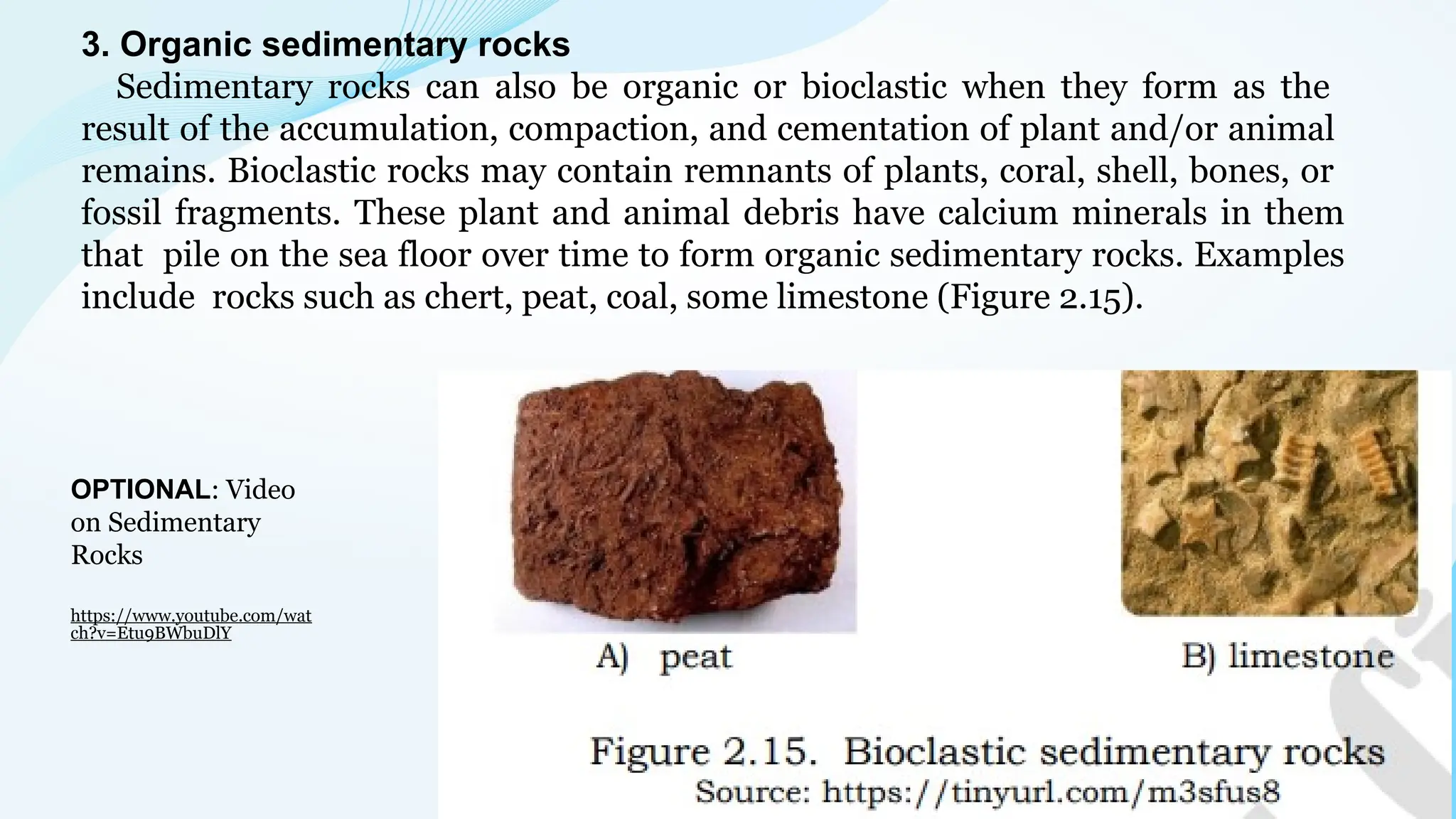
3. Organic sedimentary rocks
Sedimentary rocks can also be organic or bioclastic when they form as the
result of the accumulation, compaction, and cementation of plant and/or animal
remains. Bioclastic rocks may contain remnants of plants, coral, shell, bones, or
fossil fragments. These plant and animal debris have calcium minerals in them
that pile on the sea floor over time to form organic sedimentary rocks. Examples
include rocks such as chert, peat, coal, some limestone (Figure 2.15).
OPTIONAL: Video
on Sedimentary
Rocks
https://www.youtube.com/wat
ch?v=Etu9BWbuDlY
Metamorphic Rocks
Metamorphic rocks are made when existing rocks are subjected to high
temperatures and high pressures for long periods of time. Metamorphism
(meta means change, morph means form) happens when molten rock
intrudes other rocks and bakes the contact zone where the molten rock
touches the preexisting rock. This is contact metamorphism in which
heat and reactive fluids are the main factors in the transformation of rocks.
Metamorphism also occurs at convergent boundaries where tectonic plates
are colliding. During this process of mountain building, rocks are
subjected to pressure which is the main factor in its transformation. This is
called regional metamorphism.
All metamorphic rocks are derived by the action of heat and/or pressure
on pre-existing igneous, sedimentary, or metamorphic rocks. The pre-
existing rock is called either the parent rock or the protolith. Heat and
pressure do not melt the parent rocks, but instead transforms
27
them into denser, more compact rocks. Exposure to extreme
conditions have also altered the rocks’ mineralogy, texture, and
chemical composition. New minerals are created either by
rearrangement of mineral components or by reactions with fluids
that enter the rocks. Pressure or temperature can even change
previously metamorphosed rocks into new types. Metamorphic
rocks are often squished, smeared out, and folded.
The kind of metamorphic rock depends on the type of original
rock. For example, sandstone is turned to quartzite, shale is turned
to slate, and limestone is turned to marble. Other kinds of
metamorphic rock are named for the kinds of minerals present, the
size of the grains and other textures. For example, mica schist has
very thin layers of mica, and garnet gneiss (pronounced like nice)
has garnet 27
crystals in thick layers of quartz and feldspar. The amount of
time, amount of pressure, and highness of temperature
determine what types of metamorphic rocks are made.
Metamorphic rocks are classified according to their texture.
Texture refers to the size, shape, and boundary relationships of
the minerals, particles, and other substances that make up a
rock. There are two major textural groups in metamorphic
rocks: Foliated and Non-Foliated.
Foliated or Banded Metamorphic Rocks
Metamorphic rocks may be foliated when the dominant agent
of metamorphism is pressure. In this texture, the mineral
28
crystals in the rock are aligned with each other. This alignment
may be displayed as parallel planes along which the rock splits,
by overlapping sheets of platy minerals such as micas, by the
parallel alignment of elongate minerals such as amphiboles, or
by alternating layers of light and dark minerals.
Differential stress has a major influence on the appearance of a
metamorphic rock. This can flatten pre-existing grains in the
rock, as shown in the diagram below (Figure 2.16).
Metamorphic minerals that grow under differential stress will have a
preferred orientation if the minerals have atomic structures that tend to
make them form either flat or elongate crystals. This will be especially
apparent for micas or other sheet silicates that grow during
metamorphism, such as biotite, muscovite, chlorite, talc, or serpentine.
If any of these flat minerals are growing under normal
28
Figure 2.16. Grains in rocks before stress and under stress
stress, they will grow with their sheets oriented perpendicular to the
direction of maximum compression. As shown in Figure 2.17, platy
minerals align themselves parallel to the axis of pressure, resulting in a
layered appearance or foliation. This results in a rock that can be easily
broken along the parallel mineral sheets. Such a rock is said to be
foliated, or to have foliation.
28
Figure 2.17. Change in orientation of minerals due to stress
Minerals differ in foliation based on their composition (Table
2.2). Slaty foliation results if the minerals are microscopic and
the rock appears foliated to the naked eye. This kind of foliation,
however, will manifest itself physically in the rock’s tendency to
separate along parallel planes. If the minerals are barely visible to
the naked eye, their alignment results in an obvious but not very
well-defined foliation called phyllitic. When the bands are visible
to the naked eye and have more distinct layering, the texture is
schistose. But if the minerals are visible and elongated, the rock
exhibits a coarsely banded appearance due to the alignment of
minerals. This type of texture is gneissic.
Table 2.2. Simple metamorphic rock identification based on texture,
foliation, composition, and parent rock.
Non-Foliated Metamorphic Rocks
Non-foliated metamorphic rocks result when the dominant agent
is heat. Heat induces recrystallization of the existing minerals. In
this texture the mineral crystals in the rock have grown in many
directions and do not show alignment. As a result, non- foliated
rocks commonly appear massive and structureless, with only a few
lines of impurities through the rock.
Crystalline metamorphic rocks are usually composed only of one
type of mineral. For example, when a limestone composed of
calcite that precipitated out of solution gets in contact with an
intrusive magma body will metamorphose into marble. But when
conglomerate rocks which is composed of rock and mineral
fragments undergo contact metamorphism, the smaller components may
recrystallize, producing a meta-conglomerate rock that physically
resembles the parent material but is denser and shows evidence of
deformation.
The appearance of a foliated metamorphic rock can easily be
distinguished from a non-foliated one through its bands that clearly show
that the minerals are arranged parallel to the axis of pressure. Non-
foliated metamorphic rock does not show any bands since its
metamorphism is due to heat that allowed mineral crystals to grow in
many directions (Figure 2.18).
Figure 2.18. Difference in
appearance of foliated
and non-foliated rocks.
Figure 2.19. Rocks subjected to
increasing pressure & temperature
attained increased metamorphic grade
Source: https://tinyurl.com/5xnwy6pv
OPTIONAL: Video on Metamorphic Rocks
https://www.youtube.com/watch?v=1oQ1J0w3x0o&t=6s
Non-foliated rocks like marble also form through regional
metamorphism, where pressure is not intense, far from the main geologic
event.
Both foliated and non-foliated metamorphic rocks have undergone the
process of transformation due to increasing metamorphic grade and
increasing pressure as shown in Figure 2.19.
What I Can Do
Instructions:
1.Perform the activity on Rock
Type Identification Chart.
2. Fill in the blanks to
complete the tables and
write your answers on a
sheet of paper.
A). Sedimentary Rocks
32
ROCK
TEXTURE
(Clastic, Crystalline,
Bioclastic)
GRAIN SIZE
(Gravel, Sand,
Silt, Clay)
ROCK
NAME
OTHER
CHARACT-
ERISTICS
ENVIRONMENT
1. clastic sandstone beach, river, or
sand dunes
2. gravel round rock
fragments
river deposit
3. clastic shale low energy basin
4. varied halite dried up salty
water
5. bioclastic Do you see
plant material?
swamp
B). Igneous Rocks
ROCK
COLOR
(Dark with
green,
Dark,
Intermediate,
Light)
TEXTURE
(Glassy,
Fine,
Coarse,
Very
Coarse,
Vesicular)
ROCK
NAME
INTRUSIVE
or
EXTRUSIVE
ENVIRONMENT
(Mantle, Ocean,
Intermediate,
Continental)
6. dark extrusive ocean
7. dark to
greenish
black
gabbro mantle
8. medium-
coarse
diorite intermediate
9. intermediate fine extrusive intermediate
10. light medium-
coarse
continental
11. fine rhyolite extrusive continental
C). Metamorphic
Rocks
35
The texture and composition of igneous rocks are determined by their degree of
metamorphism.
Depending on the influence of heat/pressure, metamorphic rocks may form as:
1.New mineral compositions, some typical of igneous rocks and some unique to
metamorphic rocks.
2.New textures unique to metamorphic rocks.
ROC
K
TEXTURE
(Foliated or
Non-
foliated)
COMPOSITI
ON
(minerals)
ROCK
NAME
PROTOLI
TH
(parent
rock)
ENVIRONMENT
Contact (heat) or
regional,
(heat+pressure)
12. non-
foliated
Does it
fizz?
extrusive
(volcanic)
ocean
13. Does it
fizz?
mantle
14. intermediate
15.
banded
(compositi
onal
layering)
Quartz,
garnet,
pyroxene,
amphibole
extrusive intermediate

3_Q1-Earth-Science_Rocks_Minerals_Igneous rocks_metamorphic rocks_Sendimentary rocks

  • 1.
  • 2.
    Objectives At the endof the lesson, the learners will be able to: 1.identify common rock-forming minerals using their physical and chemical properties 2.classify minerals based on chemical affinity 3.identify and describe the three basic types of rocks 4.describe the transformation of rocks from one rock type to another
  • 3.
    1. Which ofthe following mineral formula represents a silicate? A. FeS2 B. KAlSi3O8 C. Fe2O3 D. CaSO4•2H2O 2. What property is shown by a feldspar as it breaks into pieces with jagged edges? B. cleavage B. crystal form C. fracture D. hardness 3. How do you classify the gold nuggets found in the soil or sand in rivers? C. halide B. silicate C. carbonate D. native element 4. Which specific property of crushed halite makes it perfectly suited for flavoring food? A. fracture B. luster C. odor D. taste
  • 4.
    5. Which ofthe following are characteristics of a mineral? I It has a definite crystal structure. II It is made of chemical substance/s. III It is composed of one or more minerals. IV It has no organic material present within it. A. I, II, & III only C. I, II, & IV only B. I, III & IV only D. I, II, III & IV 6. What is the hardest mineral? C. corundum B. diamond C. quartz D. topaz 7. What property of mineral is shown as sulfur crystal looks yellow in powder form? A. color B. luster C. streak D. crystal habit
  • 5.
    8. What propertyof mineral is exhibited by its tendency to break along smooth planes parallel to zones of weak bonding as shown in the diagram below? A. cleavage C. conchoidal B. fracture D. tenacity 9. Which of the following statements describes luster? How __________. A. hard a mineral is C. malleable a mineral is B. mineral reflects light D. a mineral conducts electricity
  • 6.
    10. What isthe difference between a foliated and a non-foliated rock? Foliated rocks have a texture in which the mineral grains are arranged in_____________, which is absent in a non- foliated rock. A. bands B. holes C. matrix D. rounded fragments 11. What rock-forming process occurs when hot magma comes near and heats up rock? B. deposition C. regional metamorphism. C. contact metamorphism. D. biochemical sedimentation. 12. What type of rocks are formed from sediments over a long time? A. igneous B. metamorphic C. meteorite D. sedimentary
  • 7.
    13. How wouldthe metamorphic rock look like when the mineral crystals in it are aligned with each other due to pressure? A. foliated B. frothy C. glassy D. non-foliated 14. A student obtains a cup of quartz sand from a beach. Saltwater solution is poured into the sand and allowed to evaporate. The mineral residue from the saltwater solution cements the sand grains together. What kind of rock undergoes similar process as the sand grains are glued together? B. molten B. igneous C. metamorphic D. sedimentary 15. Why are fossils not found in igneous and metamorphic rocks? Fossils are found in igneous and metamorphic rocks because remnants of plants and animals are __________________ when subjected to extreme heat and pressure. A. compacted B. destroyed C. imprinted D. preserved
  • 8.
    Lesson 1 –Rock-forming Minerals Rocks are made up of minerals which are glued together by natural processes to form into solid lumps. There are over 4,000 different minerals which have been identified by scientists but only a few forms into rocks. Both rocks and minerals are valuable to humans because of their ecological and economic uses. In this lesson, the focus is learning about the nature of rock-forming minerals.
  • 9.
    Instructions: 1.Study the picturebelow. 2.Answer the questions that follow on a piece of paper. Questions: 1.What materials are in the picture above? 2.In what sphere of the Earth can these materials be found? What’s In
  • 10.
    Questions: 1.How is amineral described in the poem? 2.What are its characteristics? Optional Activity: If internet connection is available watch a video clip about the Criteria that qualify a Substance as Mineral. https://www.youtube.com/watch?v=fnH gMLJq7VI
  • 11.
    A mineral isdescribed by the author in the poem as a wondrous thing because of its unique characteristics that includes ordered structure and beauty. But what exactly are minerals as defined by most geologists? Most geologists define mineral as a substance that must meet five requirements as follows: "Naturally occurring" means that people did not make it. Steel is not a mineral because it is an alloy produced by people. "Inorganic" means that the substance is not made by an organism. Wood and pearls are made by organisms and thus, they are not minerals. What Is It
  • 12.
    "Solid" means thatit is not a liquid or a gas at standard temperature and pressure. Water is not a mineral because it is a liquid. "Definite chemical composition" means that all occurrences of that mineral have a chemical composition that varies within a specific limited range. For example: the mineral halite (known as "rock salt" when it is mined) has a chemical composition of NaCl. It is made up of an equal number of atoms of sodium and chlorine. "Ordered internal structure" means that the atoms in a mineral are arranged in a systematic and repeating pattern. The structure of the mineral halite is shown in (Figure 1.1). Halite is composed of an equal ratio of sodium and chlorine atoms arranged in a cubic pattern. Figure 1.1 Arrangement of Sodium and Chloride Ions in Halite https://tinyurl.com/3fe6hmad
  • 13.
    There are almost5000 known mineral species. Yet, a vast majority of rocks are formed from combinations of a few common minerals as shown in figure 1.2, referred to as “rock-forming minerals”. Figure 1.2. The Most Abundant Minerals in Earth’s Crust Source: https://tinyurl.com/2zstevaa
  • 14.
    Figure 1.3. CommonRock-forming Minerals Source: https://tinyurl.com/thh5s48b
  • 15.
    To be considereda common rock-forming mineral, a mineral must: A) be one of the most abundant minerals in Earth’s crust; B) be one of the original minerals present at the time of a crustal rock’s formation; and C) be an important mineral in determining a rock’s classification. Minerals that easily meet these criteria are feldspars, quartz, amphiboles, micas, olivine, garnet, calcite, pyroxenes as shown in Figure 1.3. Physical property of Minerals Each of the minerals has a unique set of physical properties. The properties are related to the chemical composition and bonding of the minerals which include color, streak, hardness, luster, cleavage, fracture, magnetism, and many more. These physical properties are useful for identifying minerals. However, they are much more important in determining the potential industrial uses of the mineral. Let us consider a few examples.
  • 16.
    1. Color andStreak Most minerals have a distinctive color that can be used for identification. In opaque minerals, the color tends to be more consistent. So, learning the colors associated with these minerals can be very helpful in identification. Translucent to transparent minerals have a much more varied degree of color due to the presence of trace minerals. For example, ruby and sapphire are differently colored types of the mineral corundum (Al 2 O 3 ). The red color of ruby is due to the presence of the element chromium. There are also lots of minerals that share the same color while some minerals can exhibit a range of colors. The mineral quartz for example, can be pink (rose quartz), purple (amethyst), orange (citrine), white (colorless quartz) etc.
  • 17.
    The different colorsand varieties of quartz is the result of impurities within the crystal structure. The color of some minerals can also be modified by weathering. Therefore, color alone is not reliable as a single identifying characteristic. Streak, on the other hand is the color of a mineral in powdered form. Streak is the color of the mineral in powdered form when rubbed against a streak plate or unglazed porcelain file (Figure 1.4). Note that the color of a mineral could be different from the streak. For example, pyrite (FeS 2) exhibits golden color. Hence, the other term of pyrite is Fool’s Gold which has a black or dark gray streak. Streak is a better diagnostic property as compared to color since it is inherent to almost every mineral. Impurities within the minerals may give them different color. Thus, color maybe unreliable for identification. Figure 1.4: Color vs streak of a hematite (FeO 3 ). Source: https://tinyurl.com/43nruc97
  • 18.
    2. Luster Luster isthe amount (quantity) and appearance (quality) of light reflected from the surface of a mineral. It provides an assessment of how much the mineral surface “sparkles”. Minerals are primarily divided into the two categories of metallic and nonmetallic luster (Table 1). Minerals possessing metallic luster are opaque and very reflective, possessing a high absorptive index. This type of luster indicates the presence of metallic bonding within the crystal lattice of the material. Submetallic minerals have similar luster to metal but are duller and less reflective. Those which vary in appearance and non- lustrous possess non-metallic luster.
  • 19.
    Table 1. Typeshand is of luster METALLIC NON-METALLIC having the Look of a polished metal; Examples: copper, gold, and silver, galena, pyrite, Dull or Earthy - reflect light very poorly and do not shine Ex. kaolinite Sub-metallic Resinous - resembling that of a resin Ex.sulfur having the Look of a metal that is dulled by weathering or corrosion Example: hematite Pearly - having the iridescent look of mother-of-pearl Ex.talc Greasy - looks as if it is covered with oil/grease Ex.gypsum Silky – having the look of silk, fine parallel fibers of mineral Ex. asbestos Vitreous – similar to that of glass Ex.Quartz Adamantine - sparkling reflection Ex. diamond
  • 20.
    3. Hardness Hardness isa measure of how resistant a mineral from being scratched. This physical property is controlled by the chemical composition and structure of the mineral. Hardness is commonly measured on the Mohs scale (Figure 1.5). This is defined by ten minerals, where each mineral can scratch those with a lower scale number. Diamond (hardness 10) can scratch everything below it on the Mohs scale, but cannot itself be scratched, whereas quartz (hardness 5) can scratch calcite (hardness 3) but not corundum (hardness 9). The hardness scale is designed by German geologist/mineralogist Friedrich Mohs in 1812 (Mohs Scale of Hardness). The test compares the resistance of a mineral relative to the 10 reference minerals with known hardness. It is simply determining the hardness of a mineral by scratching them with common objects of known hardness (e.g., copper coin -3.0-3.5). Figure 1.5. Mohs Hardness Scale Source: https://tinyurl.com/aw85wyf9
  • 21.
    4. Cleavage Cleavage is theproperty of some minerals to break along parallel repetitive planes of weakness to form smooth, flat surfaces (Figure 1.7). These planes of weakness are inherent in the bonding of atoms that makes up the mineral. These planes of weakness are parallel to the atomic planes and appear to be repeating within the mineral. When minerals break evenly in more than one direction, cleavage is described by the number of cleavage directions and the angle(s) between planes (e.g., cleavage in 2 directions at 90 degrees to each other).
  • 22.
    The illustration inFigure 1.7 shows the effect when an external force is applied on calcite that produces cleavage. Note how the crystal breaks into smaller pieces and still manifest the same rhombic shape. Where the crystal breaks (the flat surfaces) are called cleavage planes. For the calcite crystal, there are three cleavage planes at 120 and 60 degrees. Whereas some minerals have excellent cleavage in one, two, three, or more directions, whereas others exhibit fair or poor cleavage, and still others have no cleavage at all . Cleavage differs from fracture in terms of breaking properties. Cleavage occurs when mineral breaks along a flat surface. While fracture happens if mineral breaks with lots of jagged edges (Figure 1.8).
  • 23.
    5. Crystal Formor Habit Crystal Form or Habit is the external shape of a crystal or groups of crystals that is displayed and observed as these crystals grow in open spaces (Table 1.1). The form reflects the supposedly internal structure (of atoms and ions) of the crystal (mineral). It is the natural shape of the mineral before the development of any cleavage or fracture. It is important to clearly differentiate a crystal habit from cleavage. Although both are dictated by crystal structure, crystal habit forms as the mineral is growing. Therefore, it relies on how the individual atoms in the crystal come together. Cleavage on the other hand is the weak plane that developed after the crystal is formed. Cleavage in different directions is presented. 23
  • 24.
    The crystal formalso defines the relative growth of the crystal in 3 dimension which are its length, width, and height. Examples of crystal form or habit are prismatic, tabular, bladed, platy, reniform and equant. A mineral that does not have a crystal structure is described as amorphous. 6. Specific Gravity Specific gravity is the ratio of the weight of a mineral to the weight of an equal volume of water. A bucket of silver (SG 10) would weigh 10 times more than a bucket of water (SG 1). It is a measure to express the density (mass per unit volume) of a mineral. The specific gravity of a mineral is numerically equal to density.
  • 25.
    Table 1.3. OtherProperties of Minerals Propertie s Description Examples Magnetism allows a mineral to attract or repel other magnetic materials A.Diamagnetic minerals –not attracted by a magnet B.Paramagnetic minerals – Attracted by a magnet Examples: magnetite (Fe3O 4 ) –strongly magnetic ilmenite (FeTiO 3 ) -weakly magnetic Taste a characteristic shown among water-soluble minerals. Some minerals are toxic. So, tasting minerals is discouraged. A)acid or sour taste of sulfuric acid - indicates the presence of sulfur B)alkaline taste of potash C)astringent or puckering - alum D)bitter taste - epsom or bitter salts E)cooling - saltpeter (NaNO 3 ), F)metallic decomposed FeS 2 -brassy taste G)saline or salty - table salt (NaCl)
  • 26.
    Table 1.3. OtherProperties of Minerals Propertie s Description Examples double refraction a special optical property of certain minerals where a light ray enters the crystal and splits up into two separate rays. effervescence property of some minerals that effervesce or bubble when dilute hydrochloric acid is applied to the surface Chemical reaction of calcium carbonate with dilute hydrochloric acid produces bubbles because carbon dioxide gas if released. fluorescence the ability of a substance to produce light when activated by invisible ultraviolet light (UV), X- rays and/or electron beams gypsum phosphorescen ce ability of a mineral to continue emitting light after external light source is taken away fluorite
  • 27.
    Table 1.3. OtherProperties of Minerals Properties Description Examples thermoluminescence property of some minerals to glow when they are heated calcite triboluminescence property of some minerals to glow when they are crushed, struck, scratched, or even rubbed in some cases calcite and fluorite 7. Fracture Fracture occurs when a mineral is broken or crushed. The breaking happens in a direction which does not serve as a plane of perfect or distinct cleavage. In other words, fracture takes place along a plane possessing difficult or indistinct cleavage. Thus, the mineral splits into any possible direction. Examples of fracture are conchoidal, fibrous, hackly, and uneven or irregular among others (Table 1.2).
  • 28.
    Table 1.2. Typesof Fracture in Minerals Types of Fracture Conchoidal Fibrous and Splintery Hackly Uneven of Irregular Descriptio n breaks along smooth curved surfaces similar to the way wood breaks jagged fractures with sharp edges rough irregular surfaces Examples Chemical Properties of Minerals Minerals can be pure elements or compounds. Their chemical properties mainly reflect the kind of atoms or molecules present in each. The properties depend on the way the atoms or molecules are bound in the mineral's crystal structure. And minerals are identified by how they chemically react to certain substances.
  • 29.
    There are 7types of minerals based on chemical composition. This includes silicates, oxides, sulfides, sulfates, carbonates, halides, and native elements as presented in Table 1.4. Table 1.4. Classification of Minerals based on Composition Types of Minerals Radicals Descriptions Examples Silicates SiO 42- composed primarily of silicon- oxygen tetrahedrons (the major rock- forming minerals) quartz (SiO 2 ) talc (Mg 3 Si 4 O 10 (OH) 2 Oxides O2- , O3- consist of metal cations bonded to oxygen anions magnetite (Fe 3 , O 4 ) hematite (Fe 2 O 3 ) Sulfides S2- consist of metal cation bonded to sulfide (S2- ) galena (PbS) pyrite (FeS 2 ) Sulfates SO 42- consist of a metal ion bonded to the SO 42- anion group gypsum (CaSO 4 .2H 2 O) barite (BaSO 4 ) Halides Halogens (Cl-, F-, Br, I- , At- ) composed of a halogen ion such as chlorine or fluorine halite (NaCl) fluorite (CaF 2 ) characterized by the presence 29
  • 30.
    Notice that themost abundant minerals, the silicates, are formed by the most plentiful elements in Earth’s crust. Hence, they are the rock-forming minerals among the numerous minerals ever discovered. Table 1.5 shows that seven out of eight rock-forming minerals are silicates. Table 1.5. Common rock-forming minerals and their chemical composition. Rock-forming Minerals Chemical Group Examples Chemical Formula Amphibole silicate hornblende (Ca, Na) 2 (Mg, Fe, Al) 5 (Al, Si) 8 O 22 (OH) 2 Calcite carbonate Calcium carbonate CaCO 3 Feldspar silicate potassium feldspar KAlSi 3 O 8 Garnet silicate almandine Fe 3 Al 2 Si 3 O 12 Mica silicate muscovite KAl 2 (Si 3 Al) O 10 (OH) 2 Olivine silicate olivine (Fe, Mg) 2 SiO 4
  • 31.
    What’s More Activity 1.1 Minerals Procedur e: 1.Fill inthe blanks with the missing ideas in the concept map to generalize your learning about minerals. 2.Write your answers on a separate sheet of paper.
  • 32.
    What I CanDo Activity 1.2 Minerals Found at Home Materials: table salt, iron nail without rust, graphite (pencil), piece of paper, hand lens (optional/only if available), light source, 3 plastic cups (each is half- filled with potable water), spoon Procedure: 1.Copy the table on a sheet of paper. 2.Observe the properties of each sample mineral. Record your observations in the table. a.Give the chemical composition of each mineral. b.Place the minerals under a source of light. NOTE: Rub the iron nail with sandpaper/scrub pad/sand to remove the rust before testing its properties.
  • 33.
    c. Describe thecolor. d. Test the streak by rubbing the mineral against a piece of clean stone. Take note of the color left on the stone after rubbing. e. Observe the minerals with the naked eye (or you may use a hand lens). Describe whether it is crystalline (clear and transparent like crystal) or not crystalline. f. Pound each mineral with a hammer in a safe and clean area where you will not destroy anything valuable. Feel the pounded mineral in your hand. g. Put the pounded mineral in a plastic cup half-filled with potable water. Stir the mixture using a spoon and observe. The mineral is soluble if it dissolves or mixes thoroughly in water. It is not soluble if it does dissolve in water. NOTE: Taste only the ones with star which is soluble. Dip the teaspoon into the solution and taste it. Describe the taste.
  • 34.
    Properties Name ofMinerals Halite Iron Nail Graphite (Pencil) a. chemical Composition b. luster c. color d. streak e. crystal form or habit f. mineral cleavage and texture g. solubility h. taste 3. Fill in the table to identify the properties and uses of each sample minerals. Table B. Properties and Uses of Common Household Minerals Sample Minerals Properties Uses halite or table salt to season food or dishes iron nail graphite (pencil) brittle, soft and easily leaves marks A. Physical Properties of Common Household Minerals
  • 35.
    Lesson 2 –Rocks and the Rock Cycle Rocks are found in the lithosphere. Lithosphere is the rigid, rocky, outermost part of Earth that is composed of the crust and the uppermost part of the mantle. The word lithosphere is derived from the Greek word lithos which means “stone”. We see stones and rocks on mountains, valleys, bodies of water and in the ground. In this lesson, you will learn more about these amazing materials called rocks. What’s In Instruction: Guess what is described below and write it on a sheet of paper. I am inorganic. I am a solid substance with crystalline structure. I have a definite chemical composition. What am I? ______
  • 36.
    What’s New Instructions: 1.You maysing the song following the tune of Queen’s song “We Will Rock You.” 2.Take note of the lyrics to be able to answer the questions that follow. 3.Write the answers on a separate sheet of paper.
  • 37.
    Questions: 1.What are thetypes of rocks mentioned in the song? 2.What are the processes involved in the formation of each type of rock? WE WILL ROCK YOU! (Rock Cycle Song) OPTIONAL: May watch video: https://www.youtube.com/watch?v=r68iEwYdbh4 37
  • 38.
    Figure 2.1. Levelsof organization that make up the Earth’s crust. http://www.soest.hawaii.edu/coasts/lecture/gg101/powerpoints/Minerals_Igneous.pdf What is It The song describes the three types of rocks and the processes responsible for their formation. But what exactly is a rock? First, let us understand the level of organizations where rocks become part of. Atoms of elements combine chemically to form into compound. Example, elements silicon (Si) and oxygen gas (O 2) react to become silicon dioxide (SiO 2). The compound (SiO 2) is a mineral called quartz which further clump together with other minerals to form into a rock. And in the previous lessons, we learned that rocks made up the lithospheric plates of the planet Earth (Figure 2.1).
  • 39.
    Rocks are madeof minerals. They can be a mixture of different kinds of minerals, a mixture of many grains of the same kind of mineral, or a mixture of different grains of rocks. When you split a rock into very small pieces, the pieces are different from each other. For example (Figure 2.2), when you break granite apart, you get small pieces of quartz (clear), feldspar (pink or white), and mica (black). When you split a mineral into pieces, you still have pieces of the same mineral. If you break a big chunk of quartz into smaller pieces, you still have pieces of quartz. Figure 2.2. Four types of minerals that aggregate into a piece of granite rock.
  • 40.
    Geologists define arock as a natural substance composed of solid crystals of different minerals that have been fused together into a solid lump. The minerals may or may not have been formed at the same time. What matters is that natural processes glued them all together. Generally, rocks are classified based on the mode of formation and that some of these physical and chemical properties are inherent on how the rocks are formed. The three common classes of rocks are igneous, sedimentary, and metamorphic. The details about the major classes of rocks are presented in the succeeding discussions. Igneous Rocks Igneous rocks are formed from the cooling and solidification of magma or lava. Magma is called lava once it is expelled out of the Earth’s surface through a central vent of a volcano or as fissure eruption. The word “igneous” is derived from Latin igneus, which means “fiery” or “on fire.” Igneous rocks form at much higher temperatures compared to other types of rocks. There are three ways in which igneous rocks can form:
  • 41.
    1. Below thesurface, from slowly cooling magma – This results in the formation of crystals that are visible to the naked eye without the aid of a magnifying lens (Figure 2.3). These types of igneous rocks are called intrusive or plutonic since they cool underneath the surface as plutons. Examples of these rocks include granite, diorite, and syenite. Notice the different colored portions. Each color represents a different mineral in the rock. Figure 2.3. Granite showing visible mineral crystals. Figure 2.4. Fine-grained basalt rock 2. On the surface, from rapidly cooling lava – This results in the formation of very small crystals that may not be visible without the use of a magnifying lens (Figure 4). Igneous rocks like these are called extrusive or volcanic since they are usually extruded during volcanic eruptions. Examples of these rocks are basalt, andesite, and rhyolite.
  • 42.
    3. On thesurface, from the consolidation of particle erupted by explosive volcanic activity – When volcanoes erupt violently, the lava exiting the volcanoes are ripped apart into smaller pieces by rapidly expanding gases in the lava, just like the bubbles in a bottle of soft drinks shaken vigorously. Depending on how much gas is present, the particles may solidify in different sizes (Figure5). When these particles come together on the surface via lithification, they form pyroclastic igneous rocks. Examples of this type of rock are ignimbrite (locally known as adobe), tuff, and volcanic breccia. The formation of pyroclastic rocks is a hybrid of igneous and sedimentary processes. Pyroclastic rocks are relevant in the Philippine setting because it is a common eruptive product. Figure 2.5. Pyroclastic igneous rocks.
  • 43.
    Igneous rocks formwhen molten rock material (magma or lava) cools and crystallizes. They can look different based on their cooling conditions because the rate of cooling is an important factor that control crystal size of minerals present in them. Slow cooling forms large interlocking crystals. Fast cooling does not promote the formation of large crystals. Igneous rocks can have many different compositions, depending on the magma they cool from. For example, two rocks from identical magma can become either rhyolite or granite, depending on whether they cool quickly or slowly. Classification of Igneous Rocks The two main categories of igneous rocks are intrusive and extrusive. These can be crystalline when they form from slowly cooled magma or lava, or pyroclastic, when they are made of consolidated eruption
  • 44.
    products like volcanicash. Intrusive rocks known as plutonic rocks are formed beneath the ground, while extrusive rocks also called as volcanic rocks are developed on the surface of the Earth. Volcanic rocks break down into two more categories: (a) lava flows and (b) tephra (pyroclastic material). 1. Intrusive rocks Igneous rocks are called intrusive or plutonic when they cool and solidify beneath the surface. Because they form within the Earth, cooling occurs slowly. Such slow cooling allows time for large crystals to form, therefore, intrusive, or plutonic igneous rocks have relatively large mineral crystals that are easy to see. This surface
  • 45.
    is known asa phaneritic (phaner means visible) texture. Perhaps the best-known phaneritic rock is granite. It is the most common intrusive igneous rock. Some igneous rocks can have a huge variety of crystal shapes and sizes. They show pegmatitic textures in which the crystals are very observable. Examples are pegmatite, diorite and gabbro shown in figure 2.6 that show large crystals. Figure 2.6. Rocks with pegmatitic textures.
  • 46.
    2. Extrusive rocks Extrusiverocks are also called volcanic igneous rocks. They are formed from magmas that erupt as lava onto the earth’s surface cool and solidify rapidly. Rapid cooling results in an aphanitic (a means not, phaner means visible) igneous texture, in which few or none of the individual minerals are big enough to see with the naked eye (Figure 2.7). Some lava flows, however, are not purely fine- grained. If some mineral crystals start growing while the magma is still underground and cooling slowly, those crystals grow to a large enough size to be easily seen, and the magma then erupts as a lava flow, the resulting texture will consist of coarse-grained crystals embedded in a fine- grained matrix. This texture is called porphyritic texture (Figure 2.7).
  • 47.
    2. The rocksamples shown in Figure 2.8 shows other textures. If lava has bubbles of gas escaping from it as it solidifies, it will end up with “frozen bubble holes” in it. These “frozen bubble holes” are called vesicles, and the texture of a rock containing them is said to be vesicular. When there are many bubbles escaping from lava that it ends up containing more bubble holes than solid rock, the resulting texture is said to be frothy. Pumice is the name of a type of volcanic rock with a frothy texture. As lava cools extremely quickly, and has very little water dissolved in it, it may freeze into glass, with no minerals (glass as defined here is not a mineral, because it does not have a crystal lattice). Such a rock is said to have a glassy texture. 47
  • 48.
    Now let usbriefly consider textures of tephra or pyroclastic rocks. Like lava flow rocks, these are also extrusive igneous rocks. However, instead of originating from lava that flowed on the earth’s surface, tephra is volcanic material that was hurled through the air during a volcanic eruption. Figure 2.8. Other textures of extrusive rocks
  • 49.
    A pyroclastic (pyromeans igneous, clastic means fragment) rock made of fine- grained volcanic ash may be said to have a fine- grained, fragmental texture. Volcanic ash consists mainly of fine shards of volcanic glass. It may be white, gray, pink, brown, beige, or black in color, and it may have some other fine crystals and rock debris mixed in. Rocks made of volcanic ash are called tuff. A pyroclastic rock with many big chunks of material in it that were caught up in the explosive eruption is said to have a coarse-grained, fragmental texture. However, a better word that will avoid confusion is to say it has a brecciated texture, and the rock is usually called a volcanic breccia.
  • 50.
    Igneous rocks arealso classified according to silica content and relative amounts of K, Na, Fe, Mg and Ca. They can be classified as felsic, intermediate, mafic, and ultramafic, practically based on presence of light and dark colored minerals. Felsic rocks tend to be light in color (white, pink, tan, light brown, light gray) because their composition is higher in silica (SiO 2) and low in iron (Fe) and magnesium (Mg). On the other hand, mafic rocks tend to be dark in color (black, very dark brown, very dark gray, dark green) mixed with black since their composition is higher in iron and magnesium and lower in silica. Intermediate compositions contain silica, iron, and magnesium in amounts that are intermediate to felsic and mafic compositions while ultramafic rocks have very low silica content and are rich in minerals (Figure 2.9). Figure 2.9. Types of Igneous rocks based on composition.
  • 51.
    However, there aresome rocks that do not follow the color index. Obsidian is a volcanic glass which erupts as a lava flow. Most obsidian is felsic in composition but will typically have a very dark color. Dunite has ultramafic composition but is greenish in color because it is composed almost entirely of green mineral, olivine (Table 2.1) Table 2.1. Identification of Igneous Rocks based on Texture and Composition TEXTURE COMPOSITION felsic intermediate mafic ultramafic pegmatitic granite pegmatitic diorite gabbro pegmatite pegmatitic granite gabbro dunite aphanitic rhyolite andesite basalt porphyritic rhyolite andesite basalt glassy obsidian basaltic glass vesicular pumice scoria pyroclastic volcanic stuff OPTIONAL: Video on Igneous Rocks
  • 52.
    2. Sedimentary rocks Sedimentaryrocks are formed by the accumulation of sediments. Sediments are solid fragments of organic or inorganic materials from weathered and eroded pre-existing rocks and living matters. The term sediment is derived from the Latin sedentarius, which means “sitting,” as these sediments will eventually be deposited and remain until they are transformed into sedimentary rocks. Sediments that undergo the processes to become sedimentary rocks are of different types. These are the following: a.Grains - greater than sand- sized minerals and/or rock fragments. b.Matrix - fine-grained (clay to silt sized) minerals.
  • 53.
    c. Cement -minerals precipitated from solution that binds the grains and matrix together. Accumulation of sediments occur in low-lying areas like lakes, oceans, and deserts. Fragments are then compressed back into rock by the weight of overlying materials. Examples include sandstone which is formed from sand, mudstone from mud, and limestone from seashells, diatoms, or bonelike minerals precipitating out of calcium-rich water. Sedimentary rocks are formed on or near the Earth’s surface where temperature and pressure are low, in contrast with igneous and metamorphic rocks that formed below the Earth’s surface. The most important geological processes that lead to the creation of sedimentary rocks are weathering, erosion, dissolution, precipitation, deposition, and lithification (compaction and cementation).
  • 54.
    Common sedimentary featuresare fossil assemblages and stratification. Fossil assemblages are remains and traces of plants and animals that are preserved in rocks (Figure 2.10). While stratification or layering is the result of a change in grain size and composition. Stratification which is greater than1cm is called bedding while lamination is less than 1cm. Each layer represents a distinct period of deposition (Figure 2.11). Figure 2.10. Fossil fish assemblage. Figure 2.11. Series of sedimentary strata at Kapurpurawan Burgos, Ilocos Norte, courtesy of riderako.com
  • 55.
    Classification of SedimentaryRocks 1. Clastic sedimentary rocks Sedimentary rocks are clastic when they form from the concentration of sediments that have been deposited, buried, and compacted over a long period of time such as quartz, felspar, and clay. These fragments may come from pre-existing rocks or minerals which are called clasts. Clastic indicates that particles have been broken and transported. Sedimentary clastic texture may further be refined whether the shapes of the individual grains are angular or rounded. Clasts may also be described based on their sizes and is divided into three types: clay or silt, sand, and gravel. Figure 2.12 on the right shows the clast size or rock name relationship. Figure 2.12. Transformation of sediments into sedimentary rocks.
  • 56.
    Rocks that areformed from mechanical weathering debris include breccia, conglomerate, sandstone, siltstone, and shale (Figure 2.13). They have been formed from sediments of different sizes such gravel, sand, silty mud, and clayey mud. Examples of clastic sedimentary rocks like (a)conglomerate rock has relatively large and rounded clasts as compared to the angular clasts of the (b) breccia (Figure 16). The sandstone has visible grains and prominent layering while the (d) claystone may have several embedded fossils. Non-clastic sedimentary rocks like (e)limestone are a precipitate and (f) coquina is a bioclastic. 25 Figure 2.13. Clastic sedimentary rocks
  • 57.
    Clastic rocks withvolcanic origin (e.g., pyroclastics) and may have undergone some stages in the sedimentary processes could be classified as sedimentary rock (e.g., volcanoclastic rocks). 2. Crystalline or chemical sedimentary rocks Sedimentary rocks are crystalline or chemical when minerals or mineraloids are precipitated directly from water or are concentrated by organic matter or life. Rocks that are exposed to water and oxygen can slowly experience chemical changes such as oxidation or rusting and hydrolysis through time. These processes break down rocks into their chemical components, particularly into ions that can be carried by running water in solution. Once the solution is saturated, the precipitation of minerals like calcite and halite can occur, leading into the formation of chemical sedimentary rocks. The 25
  • 58.
    components of theserocks have not been transported prior to deposition and clasts are not present. These rocks are classified by the chemistry of the minerals. Examples of these types of rocks include limestone, dolostone, and rock salt. There are three common groups within chemical sedimentary rocks: carbonates, evaporites and chert (Figure 2.14). Carbonate rocks are made of the minerals, called calcite and dolomite. When a rock contains calcite, it is one of the types of limestone. This type of stone is usually formed by organisms that live in water, or biota, like clams or corals. This water life creates their exoskeletons by taking the chemicals needed from the water. Their skeletal remains become part of the rocks. Algae and zooplankton also become part of these rocks. 25
  • 59.
    Geologists test forlimestone by way of its reaction to dilute hydrochloric acid. Bubbles are formed when the acid reacts with limestone. When limestone contains large pieces of fossils, they are called fossiliferous limes. If the shell fragments are even larger the rock is a coquina. Otherwise, the rock is called limestone or micrite.
  • 60.
    Limestone made ofvery small exoskeletons of algae are chalk. This can be differentiated from micrite by its texture. Chalk has a gritty texture. Other limestones are made of spheres of calcite, or ooliths, and are called oolitic limestone. A dolostone is a rock that is made up of dolomite. These stones begin as limestone, but they go through a change. Dolostones lose the limestone texture when they go through recrystallization. This makes them appears to be micrites or fossiliferous limestone. Chemical sedimentary rocks that are created by precipitation are called evaporites. Evaporites formed from the evaporation of water leaving the dissolved minerals to crystallize. These stones are dominated by dolostone, gypsum, and halite or rock salt.
  • 61.
    When water becomessupersaturated with these minerals evaporite rocks form. Precipitates are rocks that developed when minerals from a mineral supersaturated water start to crystallize at the bottom of the solution. When minerals are formed under the Earth’s surface, the temperature and pressure produced the mineral quartz. Chert is what is called a cryptocrystalline type of quartz. Its mineral structure is different than quartz. When chert is formed, it is created by biochemical processes where silica is taken up from the water by diatoms to use in their exoskeleton.
  • 62.
    3. Organic sedimentaryrocks Sedimentary rocks can also be organic or bioclastic when they form as the result of the accumulation, compaction, and cementation of plant and/or animal remains. Bioclastic rocks may contain remnants of plants, coral, shell, bones, or fossil fragments. These plant and animal debris have calcium minerals in them that pile on the sea floor over time to form organic sedimentary rocks. Examples include rocks such as chert, peat, coal, some limestone (Figure 2.15). OPTIONAL: Video on Sedimentary Rocks https://www.youtube.com/wat ch?v=Etu9BWbuDlY
  • 63.
    Metamorphic Rocks Metamorphic rocksare made when existing rocks are subjected to high temperatures and high pressures for long periods of time. Metamorphism (meta means change, morph means form) happens when molten rock intrudes other rocks and bakes the contact zone where the molten rock touches the preexisting rock. This is contact metamorphism in which heat and reactive fluids are the main factors in the transformation of rocks. Metamorphism also occurs at convergent boundaries where tectonic plates are colliding. During this process of mountain building, rocks are subjected to pressure which is the main factor in its transformation. This is called regional metamorphism. All metamorphic rocks are derived by the action of heat and/or pressure on pre-existing igneous, sedimentary, or metamorphic rocks. The pre- existing rock is called either the parent rock or the protolith. Heat and pressure do not melt the parent rocks, but instead transforms 27
  • 64.
    them into denser,more compact rocks. Exposure to extreme conditions have also altered the rocks’ mineralogy, texture, and chemical composition. New minerals are created either by rearrangement of mineral components or by reactions with fluids that enter the rocks. Pressure or temperature can even change previously metamorphosed rocks into new types. Metamorphic rocks are often squished, smeared out, and folded. The kind of metamorphic rock depends on the type of original rock. For example, sandstone is turned to quartzite, shale is turned to slate, and limestone is turned to marble. Other kinds of metamorphic rock are named for the kinds of minerals present, the size of the grains and other textures. For example, mica schist has very thin layers of mica, and garnet gneiss (pronounced like nice) has garnet 27
  • 65.
    crystals in thicklayers of quartz and feldspar. The amount of time, amount of pressure, and highness of temperature determine what types of metamorphic rocks are made. Metamorphic rocks are classified according to their texture. Texture refers to the size, shape, and boundary relationships of the minerals, particles, and other substances that make up a rock. There are two major textural groups in metamorphic rocks: Foliated and Non-Foliated. Foliated or Banded Metamorphic Rocks Metamorphic rocks may be foliated when the dominant agent of metamorphism is pressure. In this texture, the mineral 28
  • 66.
    crystals in therock are aligned with each other. This alignment may be displayed as parallel planes along which the rock splits, by overlapping sheets of platy minerals such as micas, by the parallel alignment of elongate minerals such as amphiboles, or by alternating layers of light and dark minerals. Differential stress has a major influence on the appearance of a metamorphic rock. This can flatten pre-existing grains in the rock, as shown in the diagram below (Figure 2.16).
  • 67.
    Metamorphic minerals thatgrow under differential stress will have a preferred orientation if the minerals have atomic structures that tend to make them form either flat or elongate crystals. This will be especially apparent for micas or other sheet silicates that grow during metamorphism, such as biotite, muscovite, chlorite, talc, or serpentine. If any of these flat minerals are growing under normal 28 Figure 2.16. Grains in rocks before stress and under stress
  • 68.
    stress, they willgrow with their sheets oriented perpendicular to the direction of maximum compression. As shown in Figure 2.17, platy minerals align themselves parallel to the axis of pressure, resulting in a layered appearance or foliation. This results in a rock that can be easily broken along the parallel mineral sheets. Such a rock is said to be foliated, or to have foliation. 28 Figure 2.17. Change in orientation of minerals due to stress
  • 69.
    Minerals differ infoliation based on their composition (Table 2.2). Slaty foliation results if the minerals are microscopic and the rock appears foliated to the naked eye. This kind of foliation, however, will manifest itself physically in the rock’s tendency to separate along parallel planes. If the minerals are barely visible to the naked eye, their alignment results in an obvious but not very well-defined foliation called phyllitic. When the bands are visible to the naked eye and have more distinct layering, the texture is schistose. But if the minerals are visible and elongated, the rock exhibits a coarsely banded appearance due to the alignment of minerals. This type of texture is gneissic.
  • 70.
    Table 2.2. Simplemetamorphic rock identification based on texture, foliation, composition, and parent rock.
  • 71.
    Non-Foliated Metamorphic Rocks Non-foliatedmetamorphic rocks result when the dominant agent is heat. Heat induces recrystallization of the existing minerals. In this texture the mineral crystals in the rock have grown in many directions and do not show alignment. As a result, non- foliated rocks commonly appear massive and structureless, with only a few lines of impurities through the rock. Crystalline metamorphic rocks are usually composed only of one type of mineral. For example, when a limestone composed of calcite that precipitated out of solution gets in contact with an intrusive magma body will metamorphose into marble. But when conglomerate rocks which is composed of rock and mineral
  • 72.
    fragments undergo contactmetamorphism, the smaller components may recrystallize, producing a meta-conglomerate rock that physically resembles the parent material but is denser and shows evidence of deformation. The appearance of a foliated metamorphic rock can easily be distinguished from a non-foliated one through its bands that clearly show that the minerals are arranged parallel to the axis of pressure. Non- foliated metamorphic rock does not show any bands since its metamorphism is due to heat that allowed mineral crystals to grow in many directions (Figure 2.18). Figure 2.18. Difference in appearance of foliated and non-foliated rocks.
  • 73.
    Figure 2.19. Rockssubjected to increasing pressure & temperature attained increased metamorphic grade Source: https://tinyurl.com/5xnwy6pv OPTIONAL: Video on Metamorphic Rocks https://www.youtube.com/watch?v=1oQ1J0w3x0o&t=6s Non-foliated rocks like marble also form through regional metamorphism, where pressure is not intense, far from the main geologic event. Both foliated and non-foliated metamorphic rocks have undergone the process of transformation due to increasing metamorphic grade and increasing pressure as shown in Figure 2.19.
  • 74.
    What I CanDo Instructions: 1.Perform the activity on Rock Type Identification Chart. 2. Fill in the blanks to complete the tables and write your answers on a sheet of paper. A). Sedimentary Rocks 32
  • 76.
    ROCK TEXTURE (Clastic, Crystalline, Bioclastic) GRAIN SIZE (Gravel,Sand, Silt, Clay) ROCK NAME OTHER CHARACT- ERISTICS ENVIRONMENT 1. clastic sandstone beach, river, or sand dunes 2. gravel round rock fragments river deposit 3. clastic shale low energy basin 4. varied halite dried up salty water 5. bioclastic Do you see plant material? swamp B). Igneous Rocks
  • 79.
    ROCK COLOR (Dark with green, Dark, Intermediate, Light) TEXTURE (Glassy, Fine, Coarse, Very Coarse, Vesicular) ROCK NAME INTRUSIVE or EXTRUSIVE ENVIRONMENT (Mantle, Ocean, Intermediate, Continental) 6.dark extrusive ocean 7. dark to greenish black gabbro mantle 8. medium- coarse diorite intermediate 9. intermediate fine extrusive intermediate 10. light medium- coarse continental 11. fine rhyolite extrusive continental
  • 80.
  • 81.
    The texture andcomposition of igneous rocks are determined by their degree of metamorphism. Depending on the influence of heat/pressure, metamorphic rocks may form as: 1.New mineral compositions, some typical of igneous rocks and some unique to metamorphic rocks. 2.New textures unique to metamorphic rocks.
  • 82.
    ROC K TEXTURE (Foliated or Non- foliated) COMPOSITI ON (minerals) ROCK NAME PROTOLI TH (parent rock) ENVIRONMENT Contact (heat)or regional, (heat+pressure) 12. non- foliated Does it fizz? extrusive (volcanic) ocean 13. Does it fizz? mantle 14. intermediate 15. banded (compositi onal layering) Quartz, garnet, pyroxene, amphibole extrusive intermediate