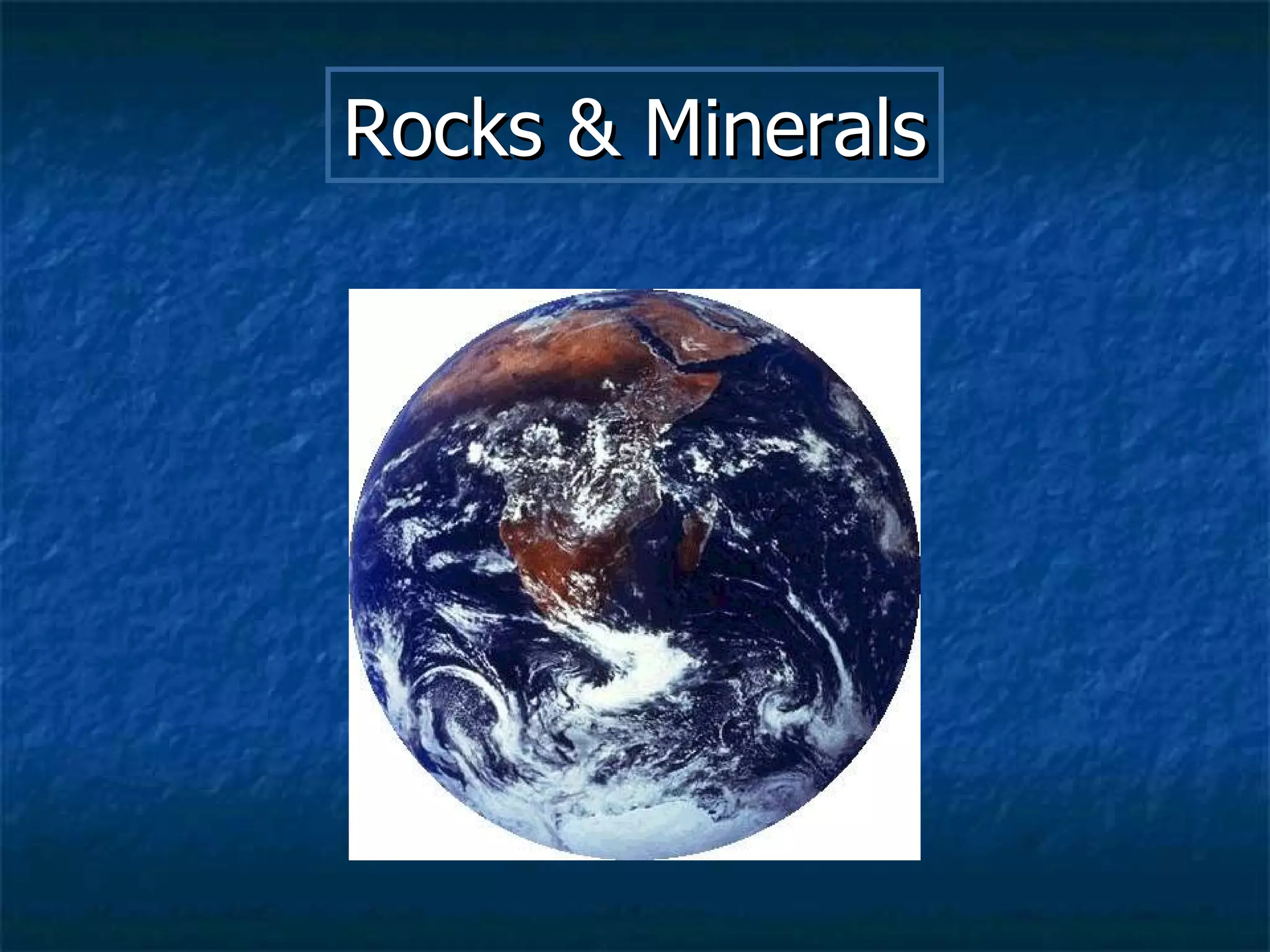
Rocks & Minerals
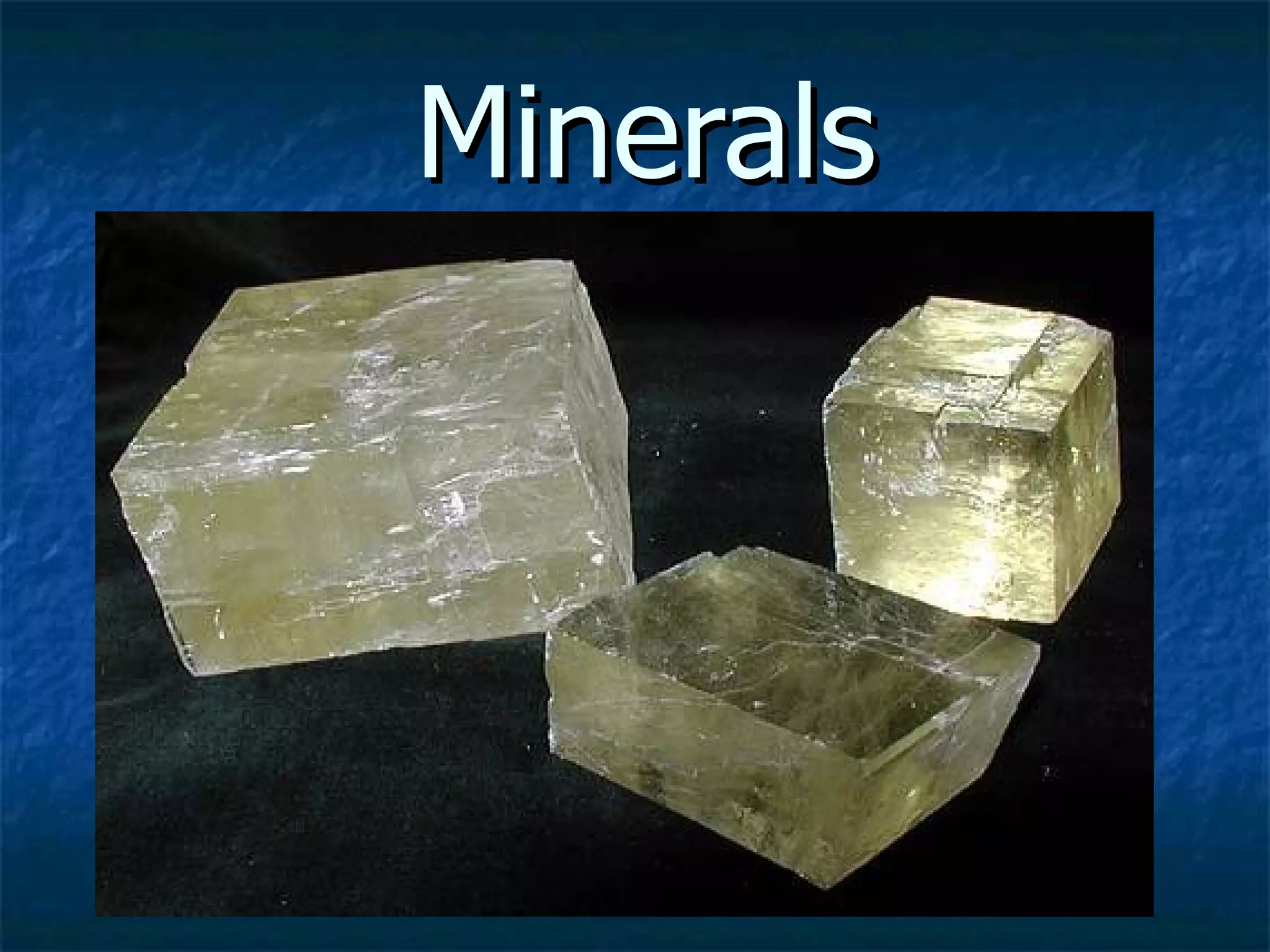
Minerals
What is a Mineral? Naturally Occurring Inorganic Solid Definite Chemical Formula Definite Crystal Structure
Naturally Occurring Formed by natural processes not in the laboratory - Is an Ice Cube a mineral? - Is the ice on the windshield of a car a mineral?
Inorganic Formed by inorganic processes; not living Does not contain chains of carbon atoms
Solid Not gas or liquid -H 2 O as ice in a glacier is a mineral, but  water is not
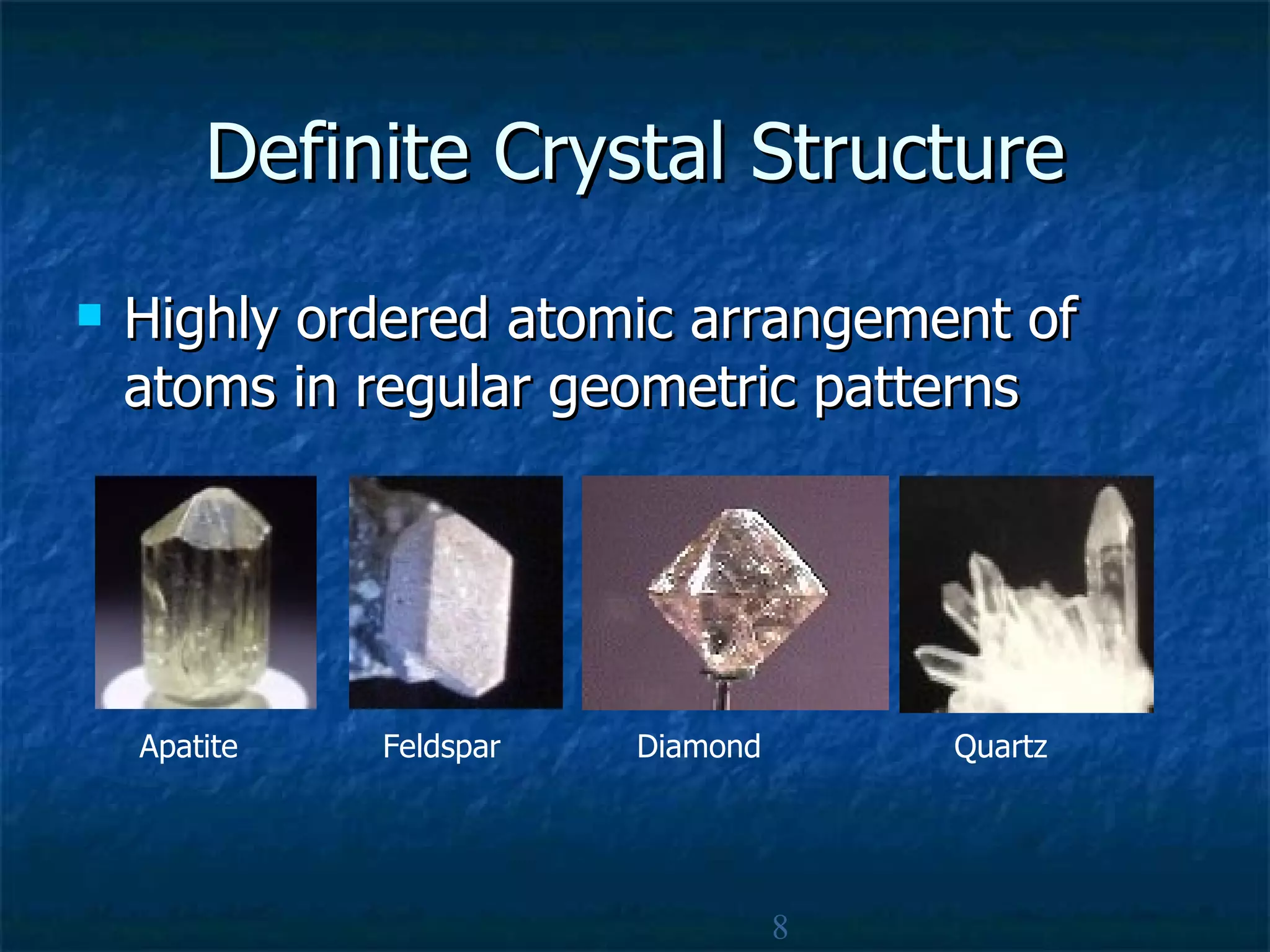
Definite Crystal Structure Highly ordered atomic arrangement of atoms in regular geometric patterns  8 Apatite Feldspar Diamond Quartz
Definite Chemical Formula Minerals are expressed by a specific chemical formula -Gold (Au) -Calcite  (CaCO 3 )   -Quartz  (SiO 2 ) -Pyrite  (FeS 2 )
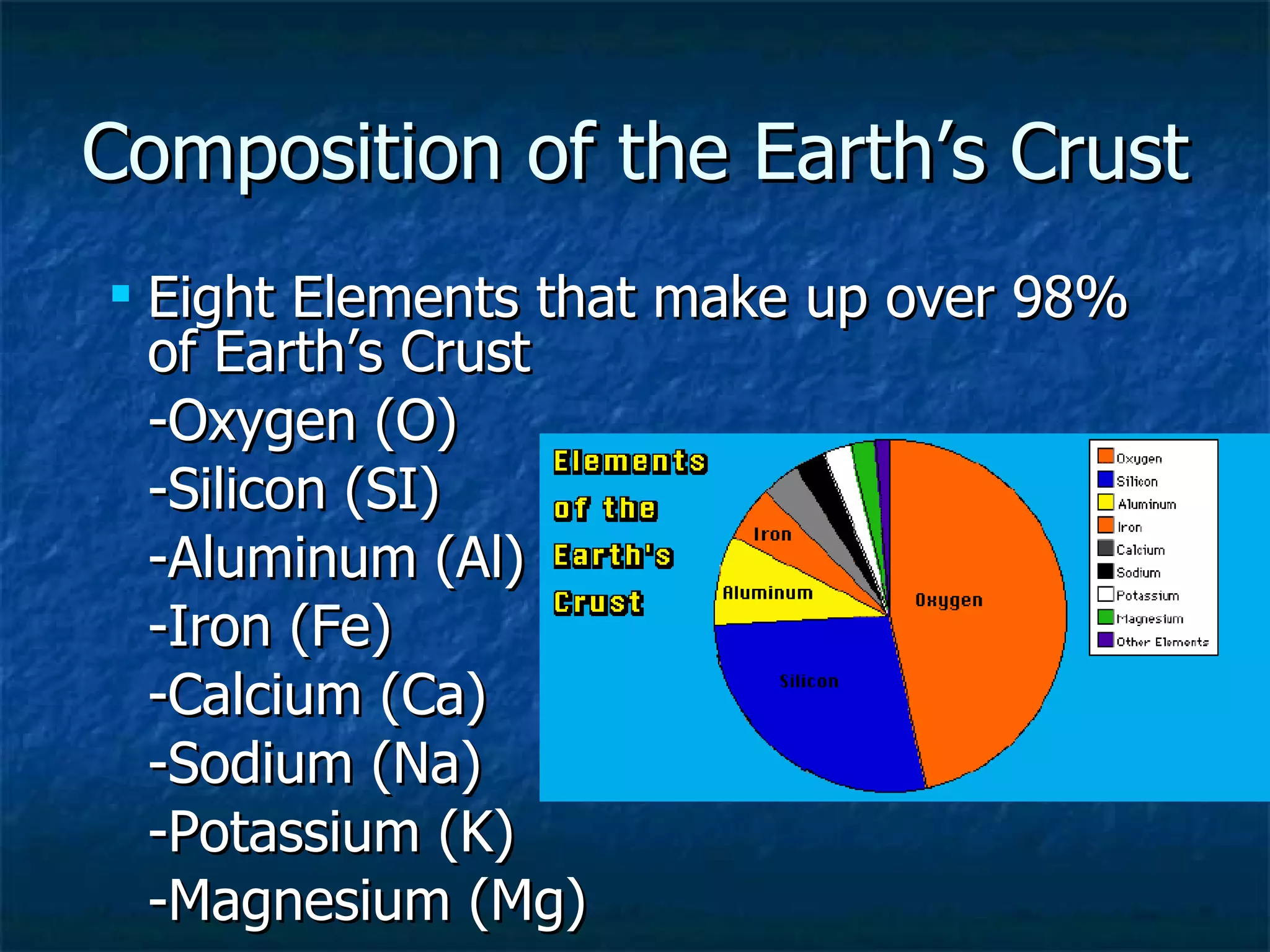
Composition of the Earth’s Crust Eight Elements that make up over 98% of Earth’s Crust -Oxygen (O) -Silicon (SI) -Aluminum (Al) -Iron (Fe) -Calcium (Ca) -Sodium (Na) -Potassium (K) -Magnesium (Mg)
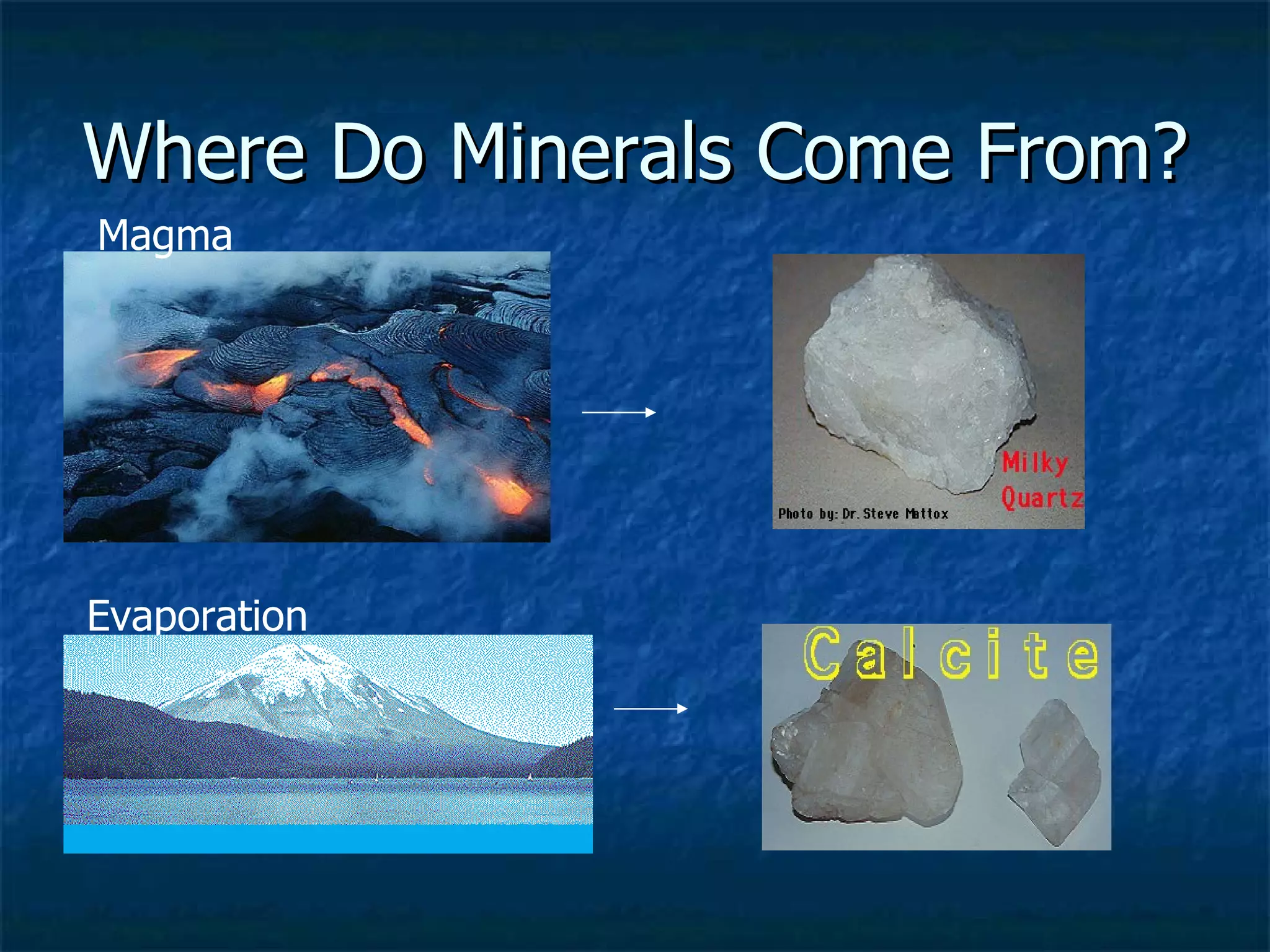
Where Do Minerals Come From? Magma Evaporation
How Are Minerals Identified? Color Luster Hardness Streak Density Crystal Shape Cleavage and Fracture Special Properties
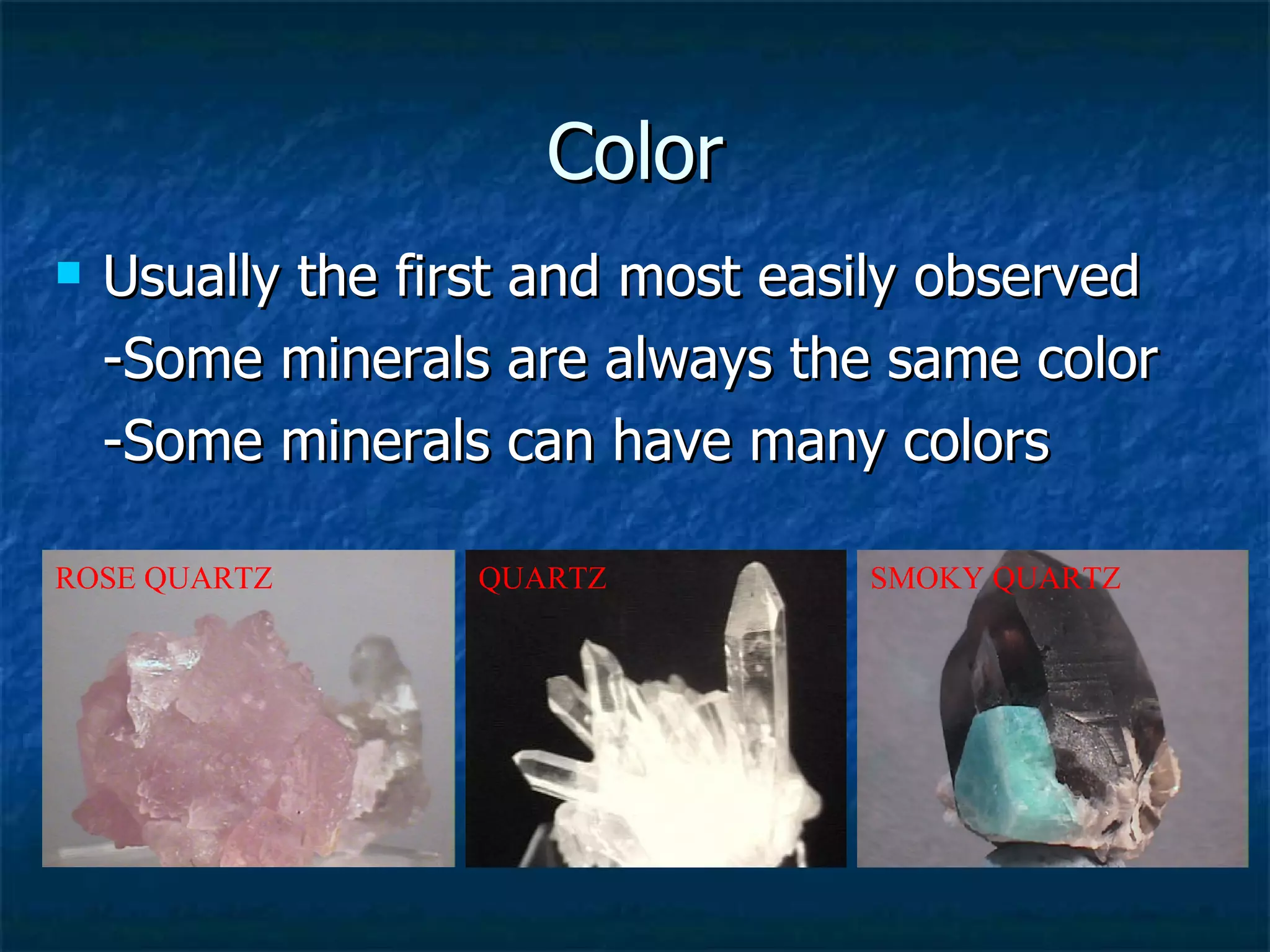
Color Usually the first and most easily observed -Some minerals are always the same color -Some minerals can have many colors QUARTZ ROSE QUARTZ SMOKY QUARTZ
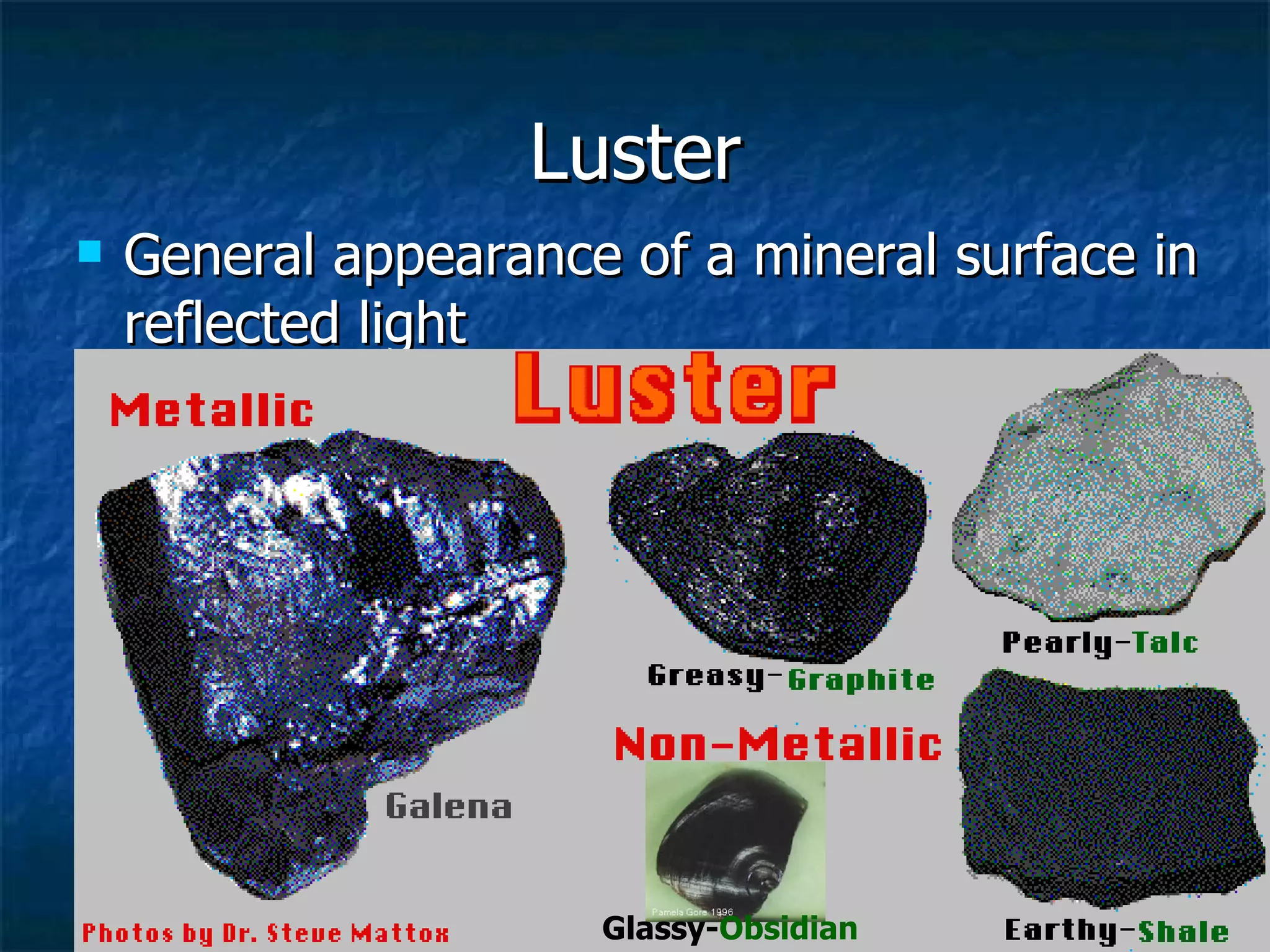
Luster General appearance of a mineral surface in reflected light Glassy- Obsidian
Hardness Resistance to scratching by different items;  “scratchability” Mohs Hardness Scale >2 fingernail  3  penny  ~5 Steel of a pocket knife  5.5 Window Glass 6.6 Steel of a file  7  quartz crystal
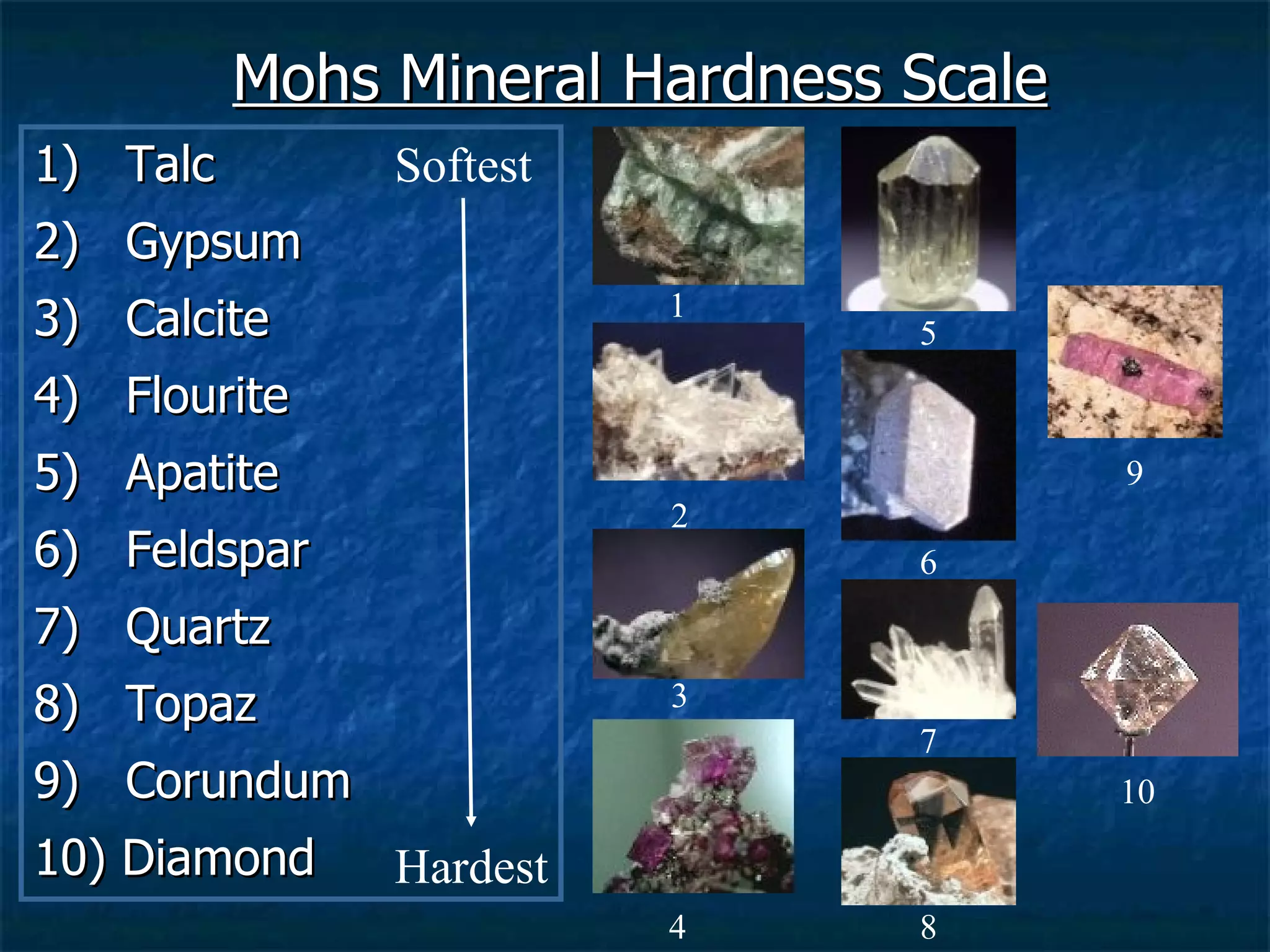
Mohs Mineral Hardness Scale 1)  Talc  2)  Gypsum  3)  Calcite  4)  Flourite  5)  Apatite  6)  Feldspar  7)  Quartz  8)  Topaz  9)  Corundum  10) Diamond Softest Hardest 1 2 3 4 5 6 7 8 9 10
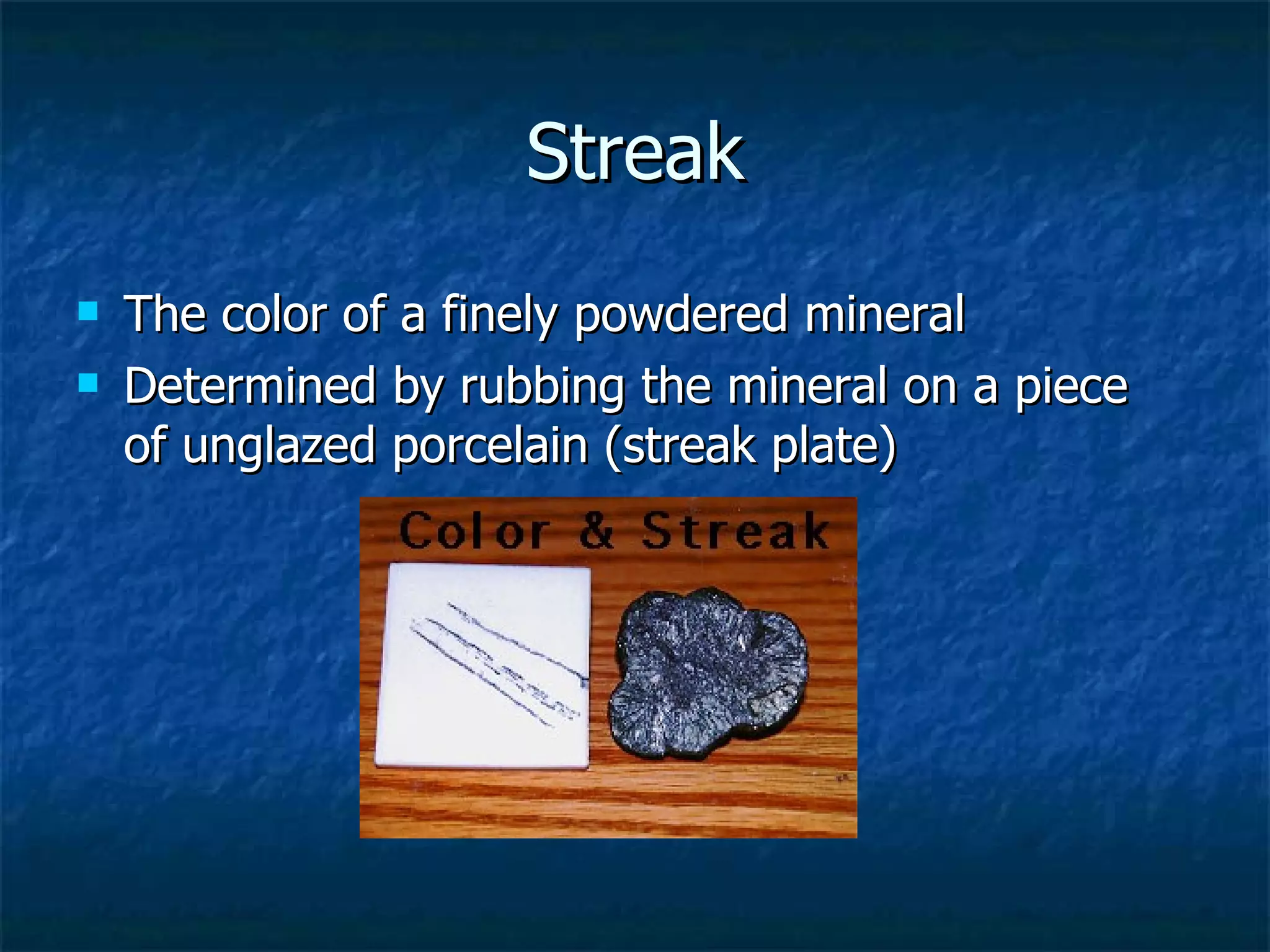
Streak The color of a finely powdered mineral  Determined by rubbing the mineral on a piece of unglazed porcelain (streak plate)
Density The amount of matter in a given space (Mass/Volume)
Crystal Shape Minerals have a characteristic crystal shape resulting from the atomic packing of the atoms when the mineral is forming
Cleavage and Fracture Cleavage  is the tendency  of a mineral to split or crack along parallel or flat planes Fracture  occurs when a mineral breaks at random lines instead of at consistent cleavage planes. Obsidian No Cleavage 1 Direction of Cleavage Conchoidal Fracture BIOTITE QUARTZ
Special Properties Magnetism (Magnetite) Glowing under ultraviolet light (Fluorite) Salty taste (Halite) Smell (Sulfur) Reaction to HCl (Calcite) Magnetite
Economic Importance of Minerals Minerals are in many things we see and use everyday such as; bricks, glass, cement, plaster, iron, gold
Every American Requires 40,000 Pounds of New Minerals per Year at this level of consumption the average newborn infant will need a lifetime supply of: -795 lbs of lead (car batteries, electric components) -757 lbs of zinc (to make brass, rubber, paints) -1500lbs of copper (electrical motors, wirings -3593 lbs aluminum (soda cans, aircraft) -32,700 lbs of iron (kitchen utensils, automobiles,  buildings) -28,213 lbs of salt (cooking, detergents) -1,238,101 lbs of stone, sand, gravel, cement (roads, homes, etc.)
Rocks
Rocks Made of two or more different minerals that have been:  cemented together squeezed and heated together  melted and cooled together.
Types of Rocks Igneous Sedimentary Metamorphic
Igneous Rocks Most igneous rocks are produced deep underground by the cooling and hardening of magma
Sedimentary Rocks Formed from the breaking apart of other rocks (igneous, metamorphic, or sedimentary rocks) and the cementation, compaction and recrystallization of these broken pieces of rock
Fact about the Mississippi River Did You Know? The Mississippi River carries an average of 436,000 tons of sediment each day It moves an average of 159,000,000 tons of sediment a year
Metamorphic Rocks Formed from heat and pressure changing the original or parent rock into a completely new rock. The parent rock can be either sedimentary, igneous, or even another metamorphic rock.
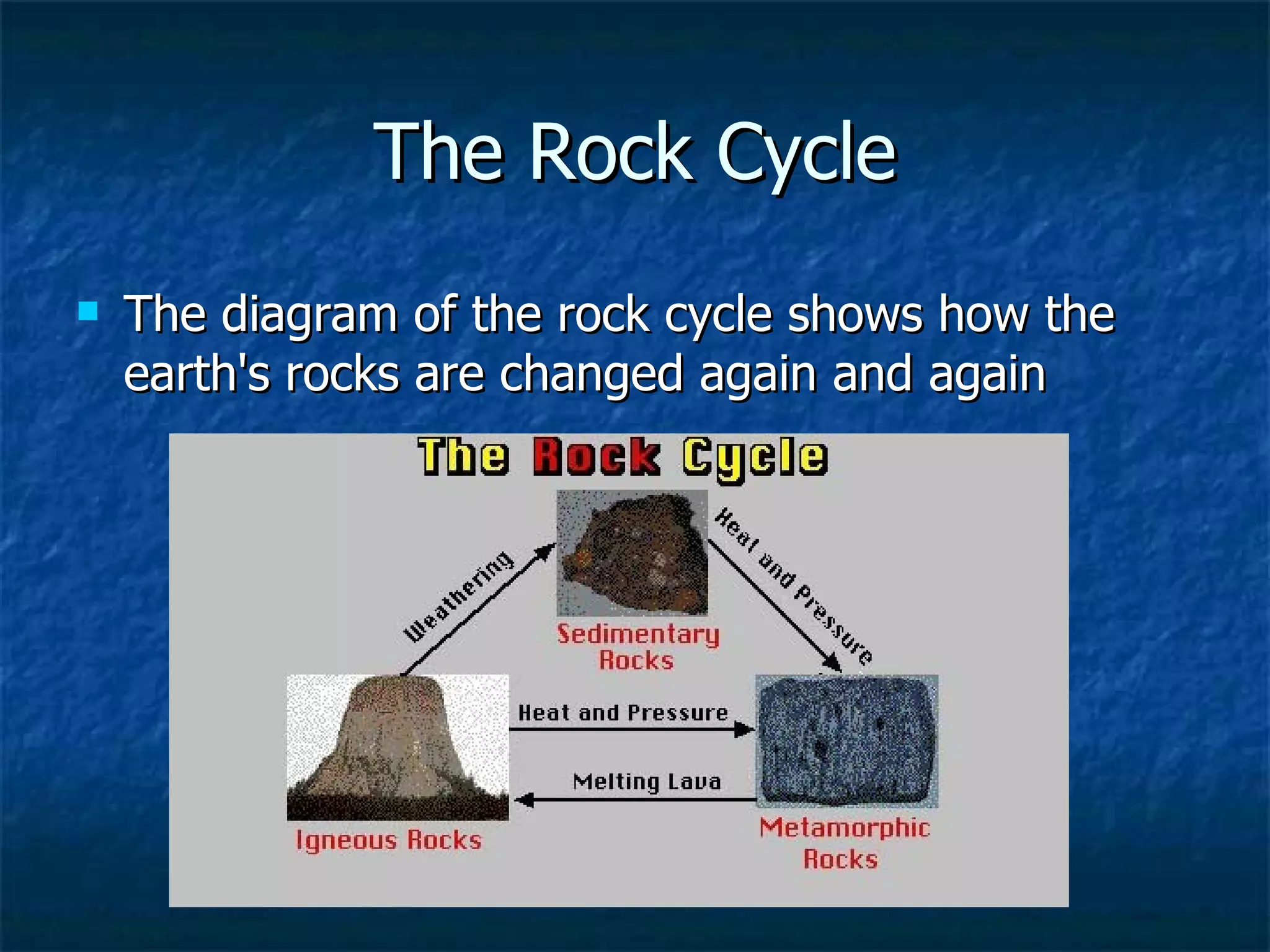
The Rock Cycle The diagram of the rock cycle shows how the earth's rocks are changed again and again
Classification of Igneous Rocks Composition -refers to the minerals that make up the rock Texture -shape, size, arrangement and distribution of minerals that make up the rock
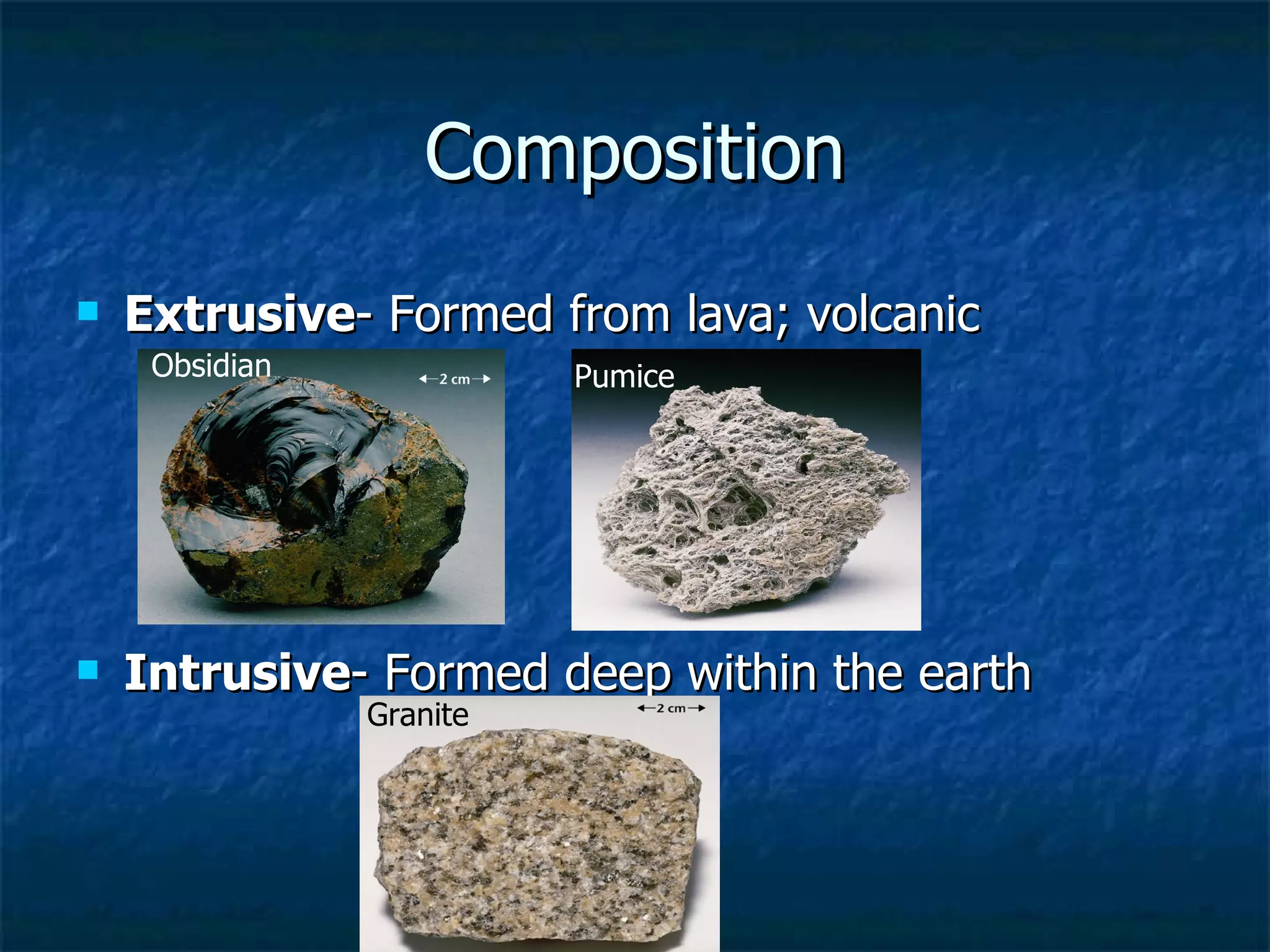
Composition Extrusive - Formed from lava; volcanic Intrusive - Formed deep within the earth Obsidian Pumice Granite
Textures Glassy Fine-grained Coarse-grained Porphyritic Obsidian Granite Granite Basalt
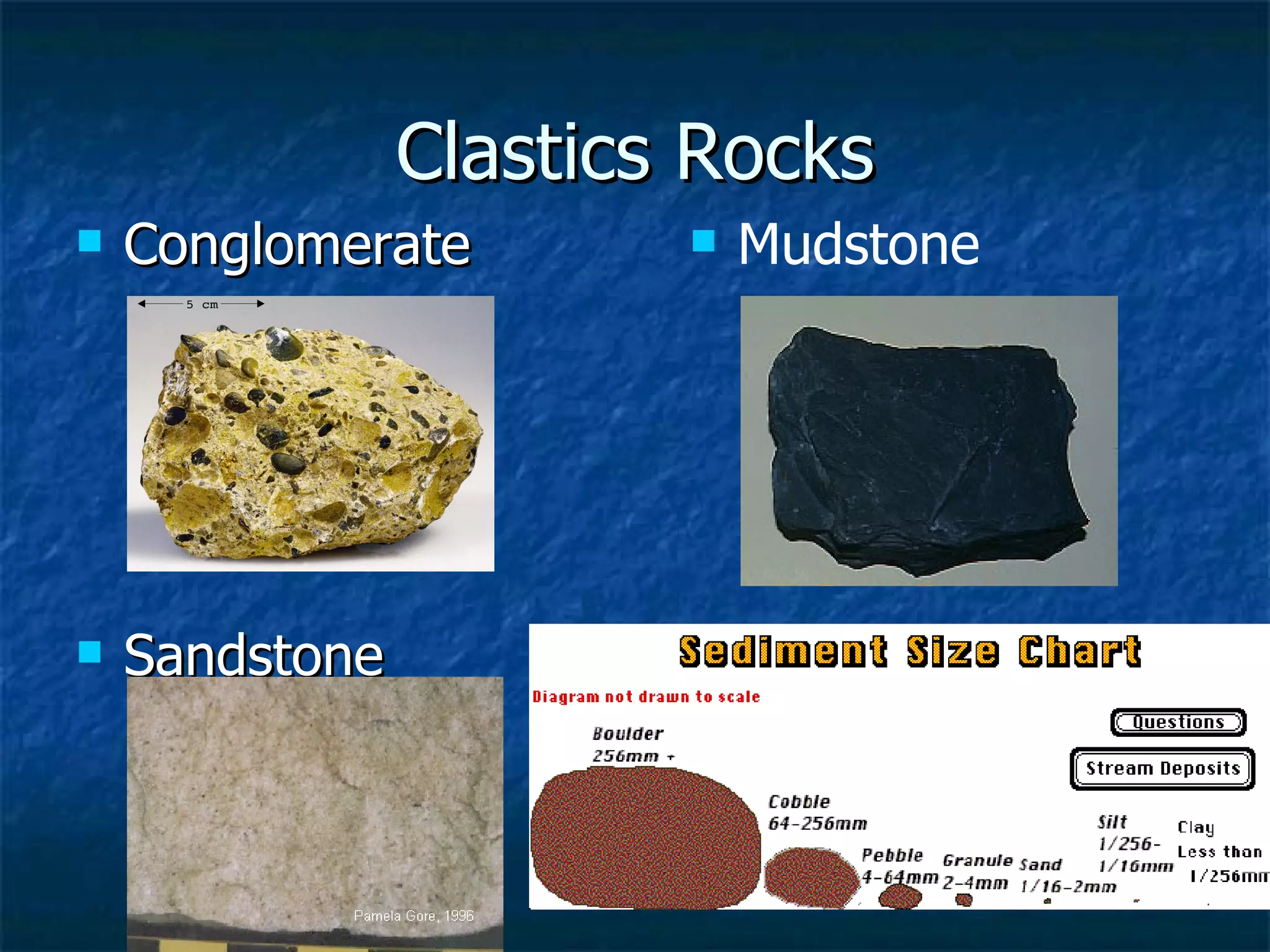
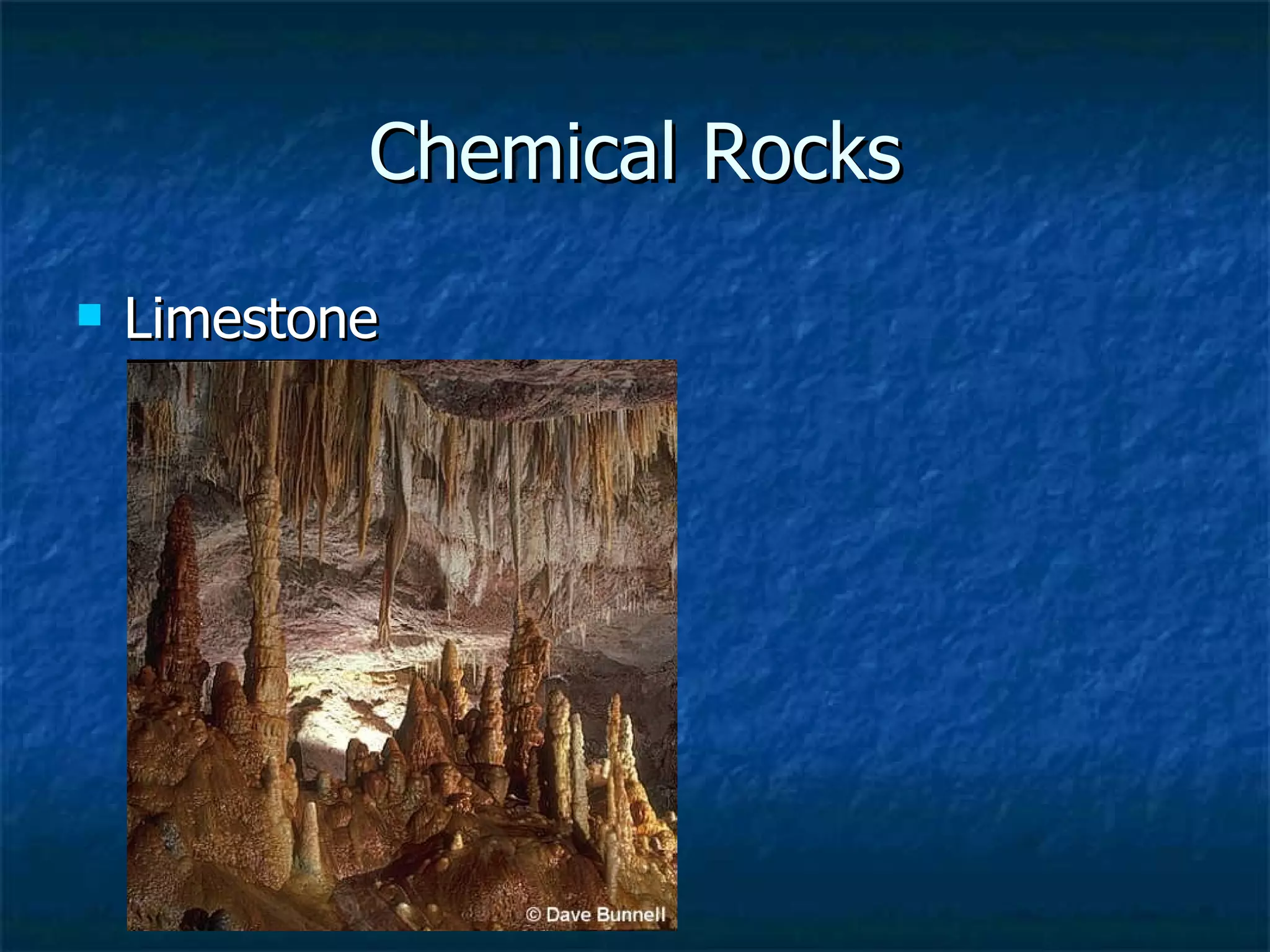
Classification of Sedimentary Rocks Clastic Rocks-  Made of the fragments of previously existing rocks Organic Rocks-  Come from organisms Chemical Rocks-  Formed by inorganic processes such as evaporation
Clastics Rocks Conglomerate Sandstone Mudstone
Organic Rocks Limestone Coquina Fossiliferous Limestone
Chemical Rocks Limestone
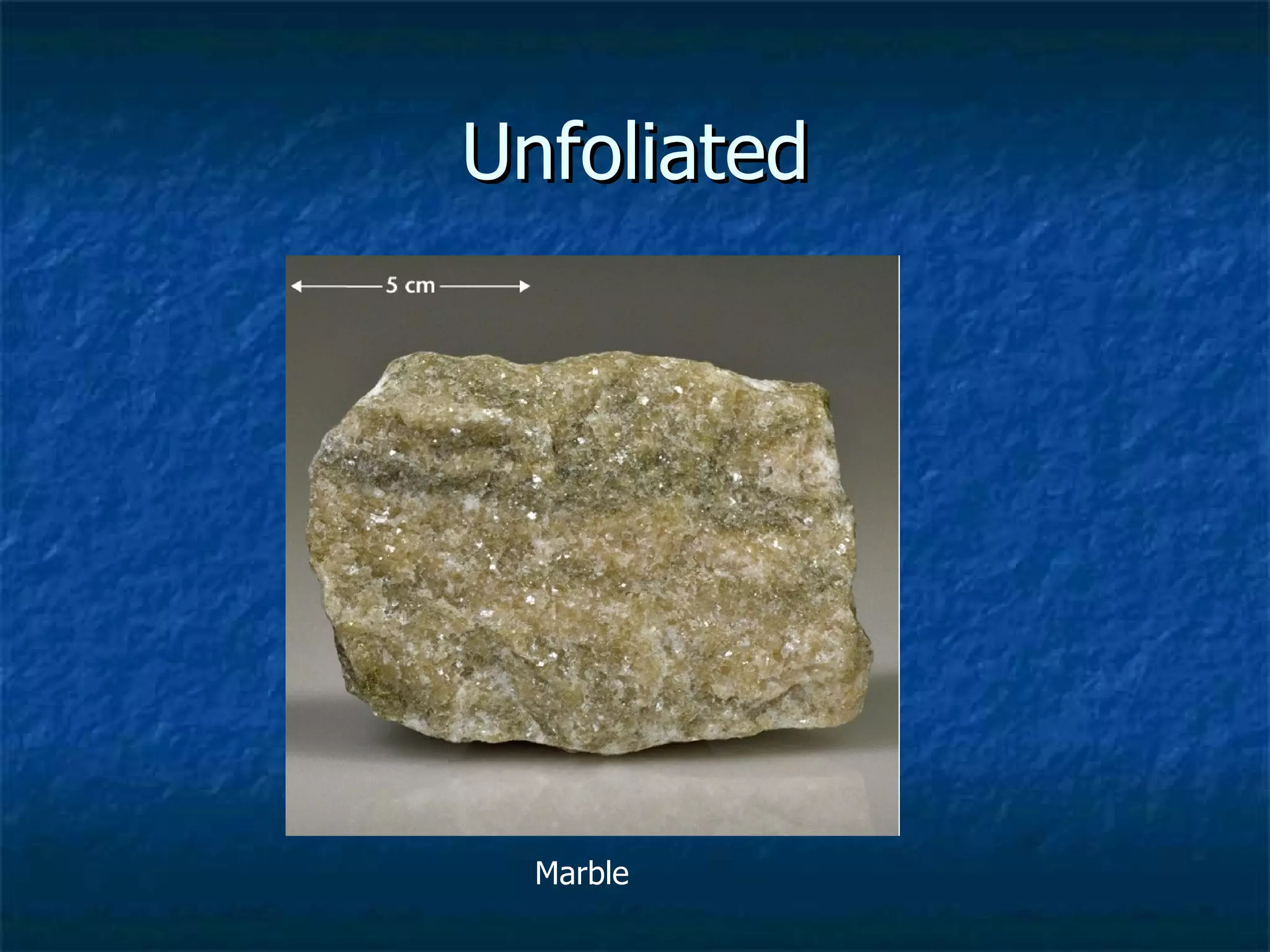
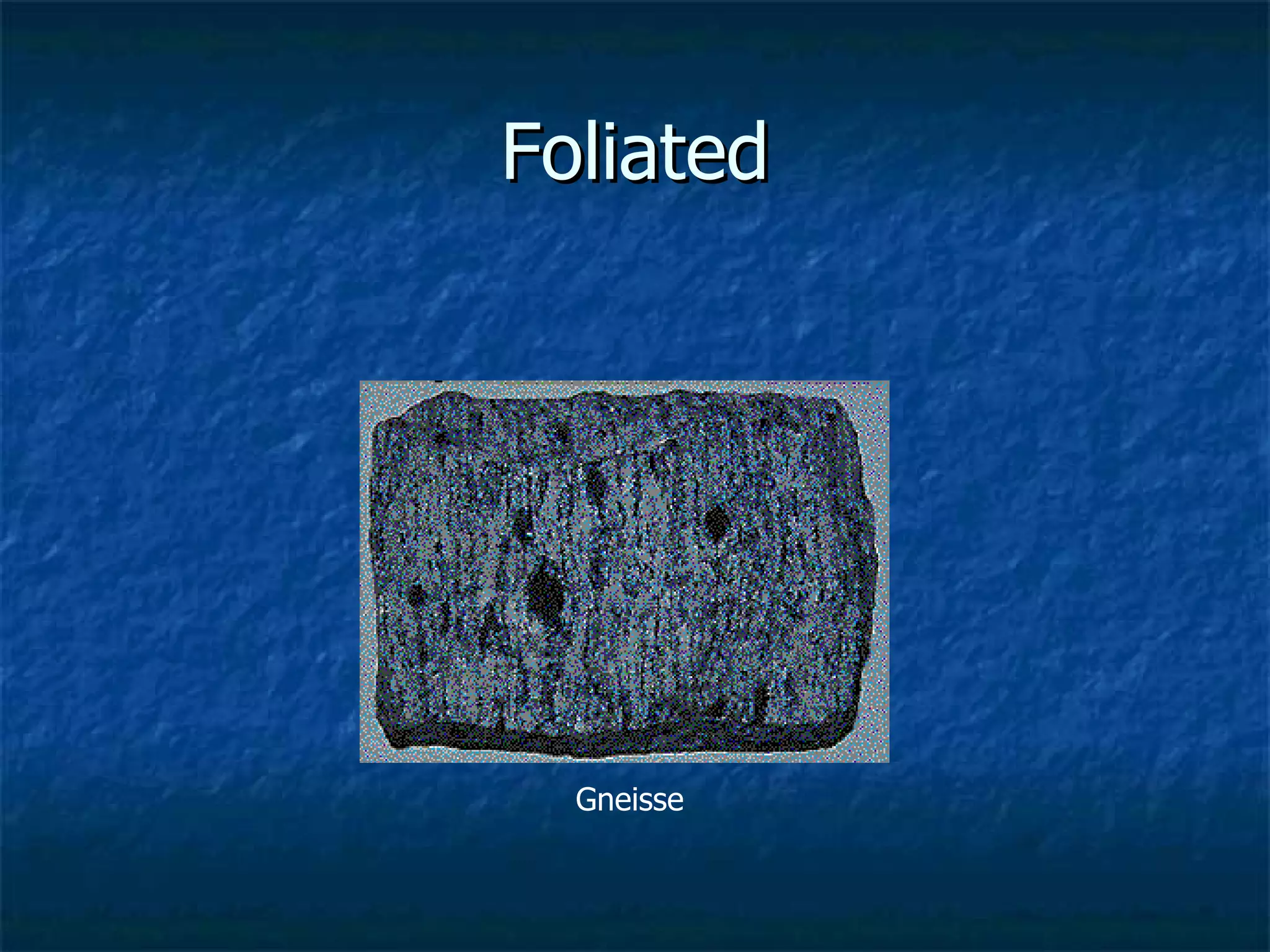
Metamorphic Rocks Foliated-   Parallel alignment of flattened mineral grains and pebbles Unfoliated- Rocks that are not banded and do not break into layers
Foliated Gneisse
Unfoliated Marble
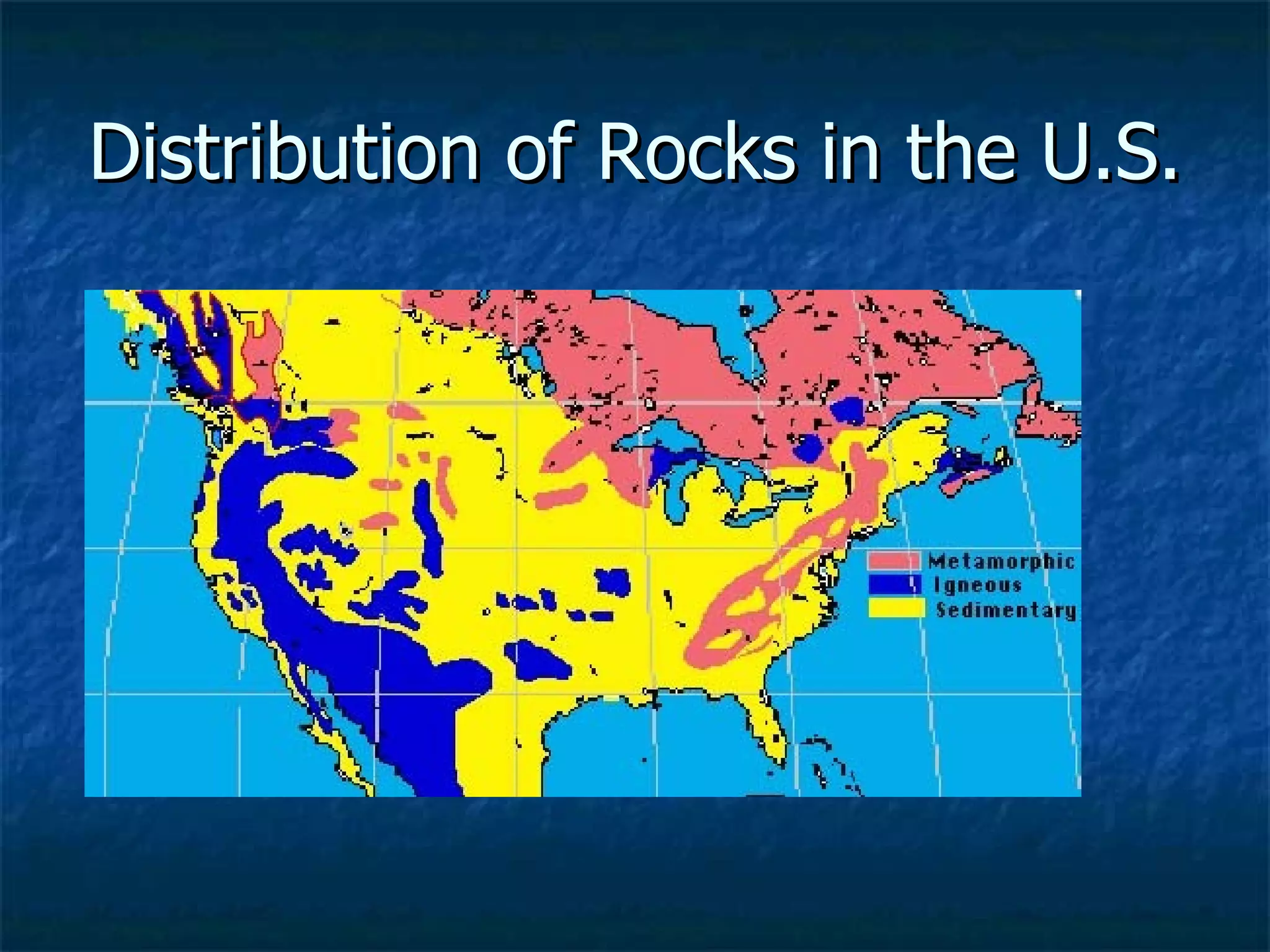
Distribution of Rocks in the U.S.

Mineral And Rocks

  • 1.
  • 2.
  • 3.
    What is aMineral? Naturally Occurring Inorganic Solid Definite Chemical Formula Definite Crystal Structure
  • 4.
    Naturally Occurring Formedby natural processes not in the laboratory - Is an Ice Cube a mineral? - Is the ice on the windshield of a car a mineral?
  • 5.
    Inorganic Formed byinorganic processes; not living Does not contain chains of carbon atoms
  • 6.
    Solid Not gasor liquid -H 2 O as ice in a glacier is a mineral, but water is not
  • 7.
    Definite Crystal StructureHighly ordered atomic arrangement of atoms in regular geometric patterns 8 Apatite Feldspar Diamond Quartz
  • 8.
    Definite Chemical FormulaMinerals are expressed by a specific chemical formula -Gold (Au) -Calcite (CaCO 3 ) -Quartz (SiO 2 ) -Pyrite (FeS 2 )
  • 9.
    Composition of theEarth’s Crust Eight Elements that make up over 98% of Earth’s Crust -Oxygen (O) -Silicon (SI) -Aluminum (Al) -Iron (Fe) -Calcium (Ca) -Sodium (Na) -Potassium (K) -Magnesium (Mg)
  • 10.
    Where Do MineralsCome From? Magma Evaporation
  • 11.
    How Are MineralsIdentified? Color Luster Hardness Streak Density Crystal Shape Cleavage and Fracture Special Properties
  • 12.
    Color Usually thefirst and most easily observed -Some minerals are always the same color -Some minerals can have many colors QUARTZ ROSE QUARTZ SMOKY QUARTZ
  • 13.
    Luster General appearanceof a mineral surface in reflected light Glassy- Obsidian
  • 14.
    Hardness Resistance toscratching by different items; “scratchability” Mohs Hardness Scale >2 fingernail 3 penny ~5 Steel of a pocket knife 5.5 Window Glass 6.6 Steel of a file 7 quartz crystal
  • 15.
    Mohs Mineral HardnessScale 1) Talc 2) Gypsum 3) Calcite 4) Flourite 5) Apatite 6) Feldspar 7) Quartz 8) Topaz 9) Corundum 10) Diamond Softest Hardest 1 2 3 4 5 6 7 8 9 10
  • 16.
    Streak The colorof a finely powdered mineral Determined by rubbing the mineral on a piece of unglazed porcelain (streak plate)
  • 17.
    Density The amountof matter in a given space (Mass/Volume)
  • 18.
    Crystal Shape Mineralshave a characteristic crystal shape resulting from the atomic packing of the atoms when the mineral is forming
  • 19.
    Cleavage and FractureCleavage is the tendency of a mineral to split or crack along parallel or flat planes Fracture occurs when a mineral breaks at random lines instead of at consistent cleavage planes. Obsidian No Cleavage 1 Direction of Cleavage Conchoidal Fracture BIOTITE QUARTZ
  • 20.
    Special Properties Magnetism(Magnetite) Glowing under ultraviolet light (Fluorite) Salty taste (Halite) Smell (Sulfur) Reaction to HCl (Calcite) Magnetite
  • 21.
    Economic Importance ofMinerals Minerals are in many things we see and use everyday such as; bricks, glass, cement, plaster, iron, gold
  • 22.
    Every American Requires40,000 Pounds of New Minerals per Year at this level of consumption the average newborn infant will need a lifetime supply of: -795 lbs of lead (car batteries, electric components) -757 lbs of zinc (to make brass, rubber, paints) -1500lbs of copper (electrical motors, wirings -3593 lbs aluminum (soda cans, aircraft) -32,700 lbs of iron (kitchen utensils, automobiles, buildings) -28,213 lbs of salt (cooking, detergents) -1,238,101 lbs of stone, sand, gravel, cement (roads, homes, etc.)
  • 23.
  • 24.
    Rocks Made oftwo or more different minerals that have been: cemented together squeezed and heated together melted and cooled together.
  • 25.
    Types of RocksIgneous Sedimentary Metamorphic
  • 26.
    Igneous Rocks Mostigneous rocks are produced deep underground by the cooling and hardening of magma
  • 27.
    Sedimentary Rocks Formedfrom the breaking apart of other rocks (igneous, metamorphic, or sedimentary rocks) and the cementation, compaction and recrystallization of these broken pieces of rock
  • 28.
    Fact about theMississippi River Did You Know? The Mississippi River carries an average of 436,000 tons of sediment each day It moves an average of 159,000,000 tons of sediment a year
  • 29.
    Metamorphic Rocks Formedfrom heat and pressure changing the original or parent rock into a completely new rock. The parent rock can be either sedimentary, igneous, or even another metamorphic rock.
  • 30.
    The Rock CycleThe diagram of the rock cycle shows how the earth's rocks are changed again and again
  • 31.
    Classification of IgneousRocks Composition -refers to the minerals that make up the rock Texture -shape, size, arrangement and distribution of minerals that make up the rock
  • 32.
    Composition Extrusive -Formed from lava; volcanic Intrusive - Formed deep within the earth Obsidian Pumice Granite
  • 33.
    Textures Glassy Fine-grainedCoarse-grained Porphyritic Obsidian Granite Granite Basalt
  • 34.
    Classification of SedimentaryRocks Clastic Rocks- Made of the fragments of previously existing rocks Organic Rocks- Come from organisms Chemical Rocks- Formed by inorganic processes such as evaporation
  • 35.
    Clastics Rocks ConglomerateSandstone Mudstone
  • 36.
    Organic Rocks LimestoneCoquina Fossiliferous Limestone
  • 37.
  • 38.
    Metamorphic Rocks Foliated- Parallel alignment of flattened mineral grains and pebbles Unfoliated- Rocks that are not banded and do not break into layers
  • 39.
  • 40.
  • 41.