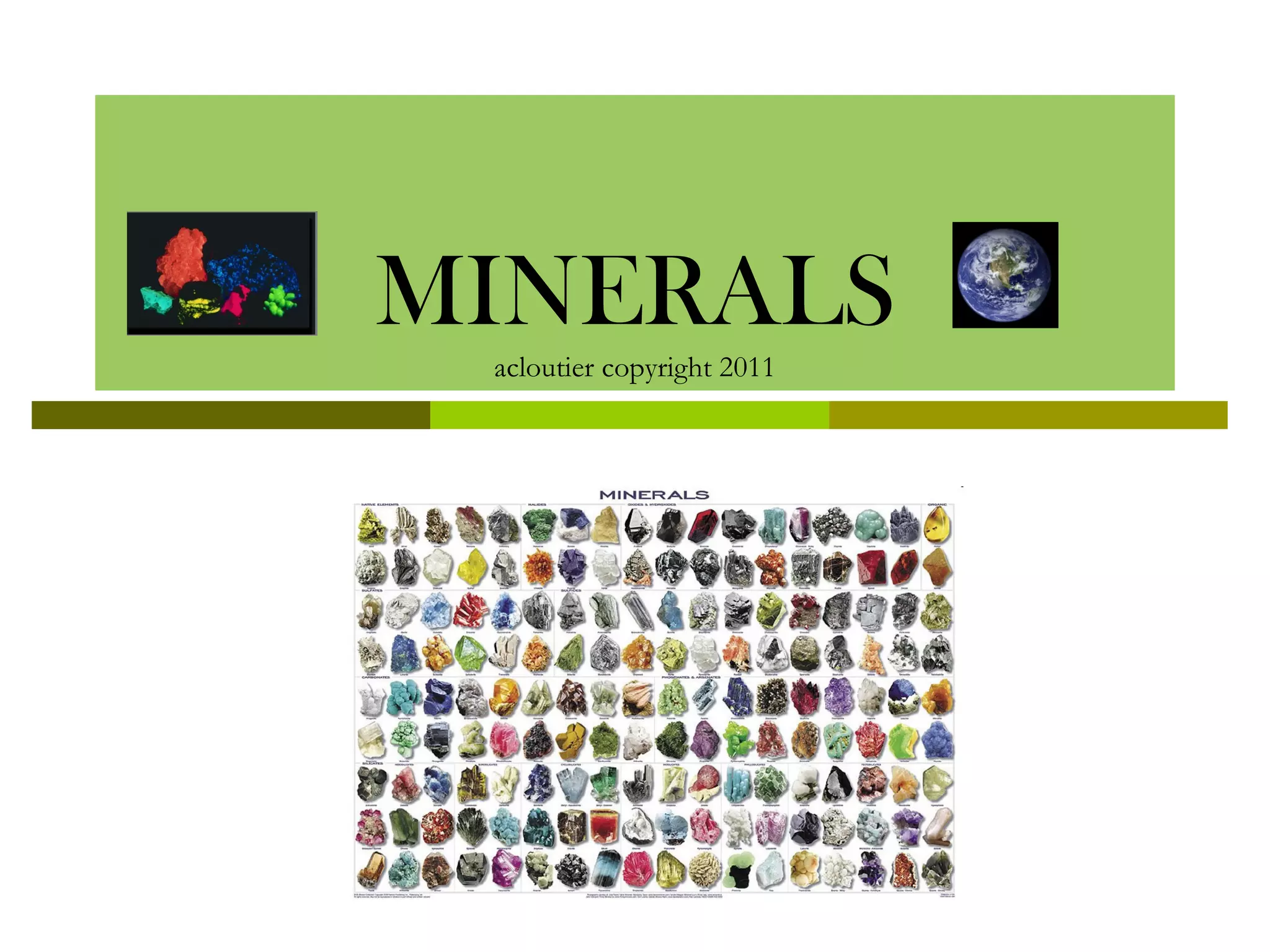
MINERALS acloutier copyright 2011 acloutier copyright 2011
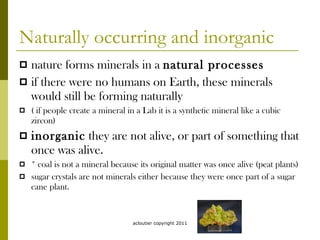
Essential questions : What is a mineral ? How are minerals formed ? naturally occurring inorganic  (never alive, or part of a living organism) solid with a specific chemical composition a definite crystalline structure acloutier copyright 2011
Naturally occurring and inorganic nature forms minerals in a  natural processes   if there were no humans on Earth, these minerals would still be forming naturally ( if people create a mineral in a Lab it is a synthetic mineral like a cubic zircon) inorganic  they are not alive, or part of something that once was alive. * coal is not a mineral because its original matter was once alive (peat plants) sugar crystals are not minerals either because they were once part of a sugar cane plant. acloutier copyright 2011
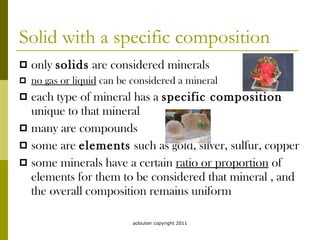
Solid with a specific composition only  solids  are considered minerals no gas or liquid  can be considered a mineral each type of mineral has a  specific composition  unique to that mineral many are compounds some are  elements  such as gold, silver, sulfur, copper some minerals have a certain  ratio or proportion  of elements for them to be considered that mineral , and the overall composition remains uniform acloutier copyright 2011
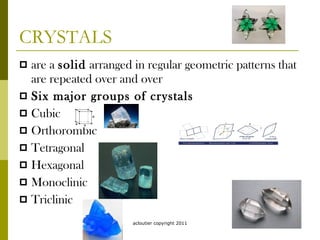
CRYSTALS are a  solid  arranged in regular geometric patterns that are repeated over and over Six major groups of crystals Cubic Orthorombic Tetragonal Hexagonal Monoclinic Triclinic acloutier copyright 2011
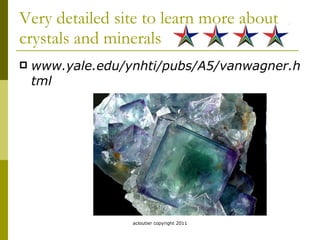
Very detailed site to learn more about crystals and minerals  www.yale.edu/ynhti/pubs/A5/vanwagner.html   acloutier copyright 2011
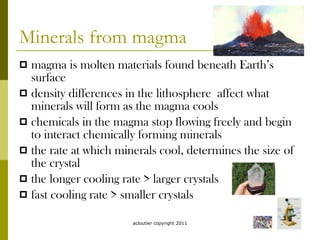
Minerals from magma magma is molten materials found beneath Earth’s surface density differences in the lithosphere  affect what minerals will form as the magma cools chemicals in the magma stop flowing freely and begin to interact chemically forming minerals the rate at which minerals cool, determines the size of the crystal the longer cooling rate > larger crystals fast cooling rate > smaller crystals acloutier copyright 2011
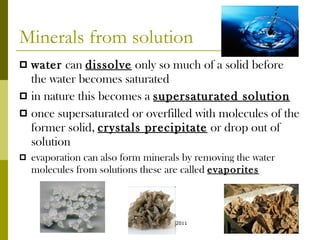
Minerals from solution water  can  dissolve  only so much of a solid before the water becomes saturated in nature this becomes a  supersaturated solution once supersaturated or overfilled with molecules of the former solid,  crystals precipitate  or drop out of solution evaporation can also form minerals by removing the water molecules from solutions these are called  evaporites acloutier copyright 2011
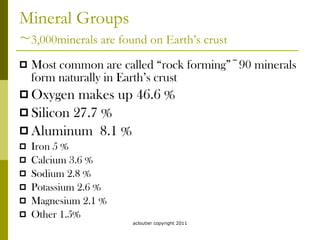
Mineral Groups ~ 3,000minerals are found on Earth’s crust Most common are called “rock forming”~90 minerals form naturally in Earth’s crust Oxygen makes up 46.6 % Silicon 27.7 % Aluminum  8.1 % Iron 5 % Calcium 3.6 % Sodium 2.8 % Potassium 2.6 % Magnesium 2.1 % Other 1.5% acloutier copyright 2011
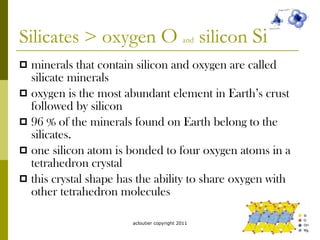
Silicates > oxygen  O   and  silicon  Si minerals that contain silicon and oxygen are called silicate minerals oxygen is the most abundant element in Earth’s crust followed by silicon 96 % of the minerals found on Earth belong to the silicates. one silicon atom is bonded to four oxygen atoms in a tetrahedron crystal this crystal shape has the ability to share oxygen with other tetrahedron molecules acloutier copyright 2011
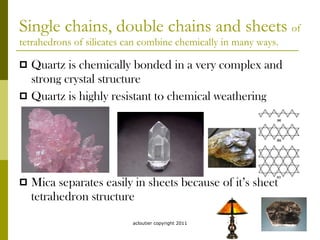
Single chains, double chains and sheets  of tetrahedrons of silicates can combine chemically in many ways. Quartz is chemically bonded in a very complex and strong crystal structure Quartz is highly resistant to chemical weathering Mica separates easily in sheets because of it’s sheet tetrahedron structure acloutier copyright 2011
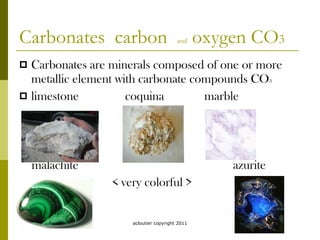
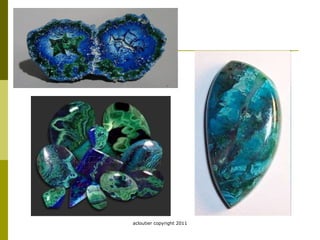
Carbonates  carbon  and  oxygen CO 3 Carbonates are minerals composed of one or more metallic element with carbonate compounds CO 3 limestone  coquina  marble malachite  azurite  < very colorful > acloutier copyright 2011
acloutier copyright 2011
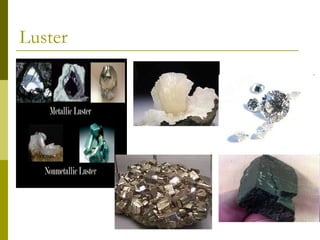
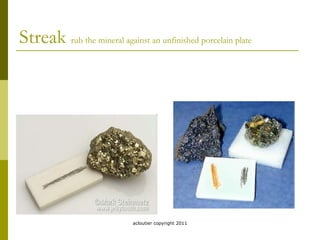
Identifying Minerals >the field method Geologist depend on simple test to identify minerals: Color > most notable but can’t be certain Luster > how the mineral reflects light  (dull, pearly, metallic, waxy, silky) Texture > how does it feel to touch?  (smooth, rough, greasy, soapy, glassy) Streak > when the mineral is rubbed against a white or black porcelain tile a powder streak is left in it. This is the true color of the mineral  ( sometimes the power streak does not match what we see) One test does not identify a mineral * acloutier copyright 2011
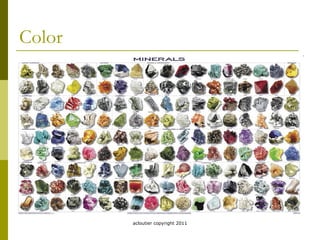
Color acloutier copyright 2011
Luster acloutier copyright 2011
Streak  rub the mineral against an unfinished porcelain plate acloutier copyright 2011
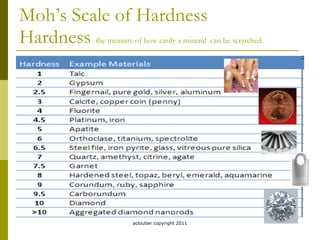
Moh’s Scale of Hardness Hardness  the measure of how easily a mineral  can be scratched acloutier copyright 2011
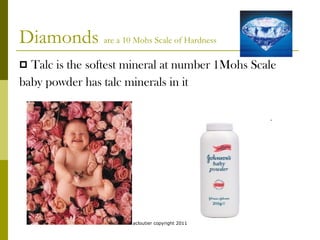
Diamonds  are a 10 Mohs Scale of Hardness  Talc is the softest mineral at number 1Mohs Scale baby powder has talc minerals in it acloutier copyright 2011
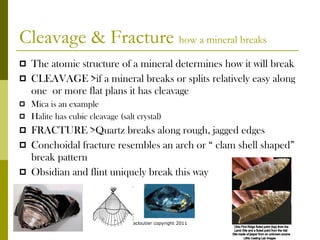
Cleavage & Fracture  how a mineral breaks The atomic structure of a mineral determines how it will break CLEAVAGE >if a mineral breaks or splits relatively easy along one  or more flat plans it has cleavage Mica is an example Halite has cubic cleavage (salt crystal) FRACTURE >Quartz breaks along rough, jagged edges Conchoidal fracture resembles an arch or “ clam shell shaped” break pattern Obsidian and flint uniquely break this way acloutier copyright 2011
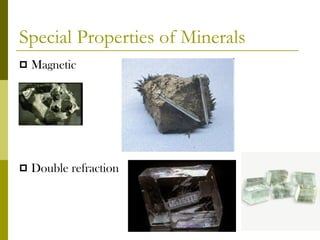
Special Properties of Minerals Magnetic Double refraction acloutier copyright 2011
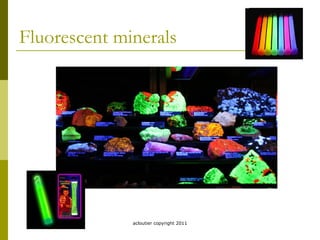
Fluorescent minerals acloutier copyright 2011
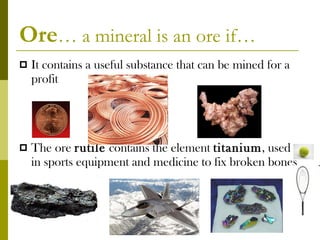
Ore … a mineral is an ore if… It contains a useful substance that can be mined for a profit The ore  rutile  contains the element  titanium , used in sports equipment and medicine to fix broken bones acloutier copyright 2011
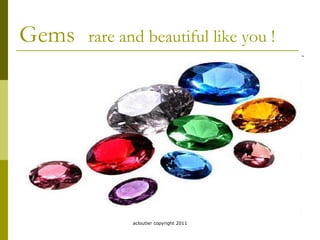
Gems   rare and beautiful like you ! acloutier copyright 2011
the end acloutier copyright 2011

Identifying Minerals Earth & Space science acloutier 2011

  • 1.
    MINERALS acloutier copyright2011 acloutier copyright 2011
  • 2.
    Essential questions :What is a mineral ? How are minerals formed ? naturally occurring inorganic (never alive, or part of a living organism) solid with a specific chemical composition a definite crystalline structure acloutier copyright 2011
  • 3.
    Naturally occurring andinorganic nature forms minerals in a natural processes if there were no humans on Earth, these minerals would still be forming naturally ( if people create a mineral in a Lab it is a synthetic mineral like a cubic zircon) inorganic they are not alive, or part of something that once was alive. * coal is not a mineral because its original matter was once alive (peat plants) sugar crystals are not minerals either because they were once part of a sugar cane plant. acloutier copyright 2011
  • 4.
    Solid with aspecific composition only solids are considered minerals no gas or liquid can be considered a mineral each type of mineral has a specific composition unique to that mineral many are compounds some are elements such as gold, silver, sulfur, copper some minerals have a certain ratio or proportion of elements for them to be considered that mineral , and the overall composition remains uniform acloutier copyright 2011
  • 5.
    CRYSTALS are a solid arranged in regular geometric patterns that are repeated over and over Six major groups of crystals Cubic Orthorombic Tetragonal Hexagonal Monoclinic Triclinic acloutier copyright 2011
  • 6.
    Very detailed siteto learn more about crystals and minerals www.yale.edu/ynhti/pubs/A5/vanwagner.html acloutier copyright 2011
  • 7.
    Minerals from magmamagma is molten materials found beneath Earth’s surface density differences in the lithosphere affect what minerals will form as the magma cools chemicals in the magma stop flowing freely and begin to interact chemically forming minerals the rate at which minerals cool, determines the size of the crystal the longer cooling rate > larger crystals fast cooling rate > smaller crystals acloutier copyright 2011
  • 8.
    Minerals from solutionwater can dissolve only so much of a solid before the water becomes saturated in nature this becomes a supersaturated solution once supersaturated or overfilled with molecules of the former solid, crystals precipitate or drop out of solution evaporation can also form minerals by removing the water molecules from solutions these are called evaporites acloutier copyright 2011
  • 9.
    Mineral Groups ~3,000minerals are found on Earth’s crust Most common are called “rock forming”~90 minerals form naturally in Earth’s crust Oxygen makes up 46.6 % Silicon 27.7 % Aluminum 8.1 % Iron 5 % Calcium 3.6 % Sodium 2.8 % Potassium 2.6 % Magnesium 2.1 % Other 1.5% acloutier copyright 2011
  • 10.
    Silicates > oxygen O and silicon Si minerals that contain silicon and oxygen are called silicate minerals oxygen is the most abundant element in Earth’s crust followed by silicon 96 % of the minerals found on Earth belong to the silicates. one silicon atom is bonded to four oxygen atoms in a tetrahedron crystal this crystal shape has the ability to share oxygen with other tetrahedron molecules acloutier copyright 2011
  • 11.
    Single chains, doublechains and sheets of tetrahedrons of silicates can combine chemically in many ways. Quartz is chemically bonded in a very complex and strong crystal structure Quartz is highly resistant to chemical weathering Mica separates easily in sheets because of it’s sheet tetrahedron structure acloutier copyright 2011
  • 12.
    Carbonates carbon and oxygen CO 3 Carbonates are minerals composed of one or more metallic element with carbonate compounds CO 3 limestone coquina marble malachite azurite < very colorful > acloutier copyright 2011
  • 13.
  • 14.
    Identifying Minerals >thefield method Geologist depend on simple test to identify minerals: Color > most notable but can’t be certain Luster > how the mineral reflects light (dull, pearly, metallic, waxy, silky) Texture > how does it feel to touch? (smooth, rough, greasy, soapy, glassy) Streak > when the mineral is rubbed against a white or black porcelain tile a powder streak is left in it. This is the true color of the mineral ( sometimes the power streak does not match what we see) One test does not identify a mineral * acloutier copyright 2011
  • 15.
  • 16.
  • 17.
    Streak rubthe mineral against an unfinished porcelain plate acloutier copyright 2011
  • 18.
    Moh’s Scale ofHardness Hardness the measure of how easily a mineral can be scratched acloutier copyright 2011
  • 19.
    Diamonds area 10 Mohs Scale of Hardness Talc is the softest mineral at number 1Mohs Scale baby powder has talc minerals in it acloutier copyright 2011
  • 20.
    Cleavage & Fracture how a mineral breaks The atomic structure of a mineral determines how it will break CLEAVAGE >if a mineral breaks or splits relatively easy along one or more flat plans it has cleavage Mica is an example Halite has cubic cleavage (salt crystal) FRACTURE >Quartz breaks along rough, jagged edges Conchoidal fracture resembles an arch or “ clam shell shaped” break pattern Obsidian and flint uniquely break this way acloutier copyright 2011
  • 21.
    Special Properties ofMinerals Magnetic Double refraction acloutier copyright 2011
  • 22.
  • 23.
    Ore … amineral is an ore if… It contains a useful substance that can be mined for a profit The ore rutile contains the element titanium , used in sports equipment and medicine to fix broken bones acloutier copyright 2011
  • 24.
    Gems rare and beautiful like you ! acloutier copyright 2011
  • 25.
    the end acloutiercopyright 2011