Section 2 Matter and Its Properties
     Chapter 1


Preview

•   Lesson Starter
•   Objectives
•   Matter
•   Basic Building Blocks of Matter
•   Properties and Changes in Matter
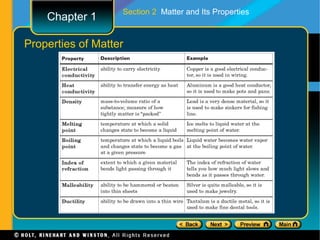
•   Properties of Matter
•   Physical Properties and Physical Changes
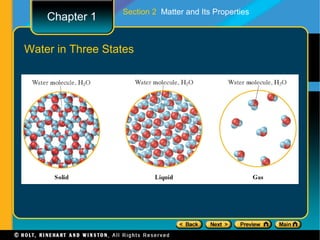
•   Water in Three States
•   Chemical Properties and Chemical Changes
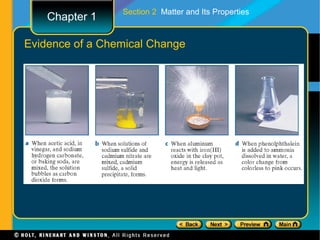
•   Evidence of a Chemical Change
Section 2 Matter and Its Properties
   Chapter 1

Lesson Starter

• Mass of deflated balloon _______________

• Mass of inflated balloon ________________

• The matter in the balloon must have a mass.
Section 2 Matter and Its Properties
   Chapter 1

Objectives, continued

• Explain how the law of conservation of energy
  applies to changes of matter.

• Distinguish between a mixture and a pure
  substance.
Section 2 Matter and Its Properties
   Chapter 1

Matter

• Volume is the amount of three dimensional space
  an object occupies.

• Mass is a measure of the amount of matter.

• Matter is anything that has mass and takes up
  space.
Section 2 Matter and Its Properties
   Chapter 1

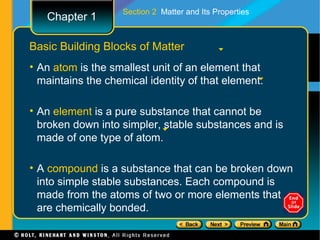
Basic Building Blocks of Matter
• An atom is the smallest unit of an element that
  maintains the chemical identity of that element.

• An element is a pure substance that cannot be
  broken down into simpler, stable substances and is
  made of one type of atom.

• A compound is a substance that can be broken down
  into simple stable substances. Each compound is
  made from the atoms of two or more elements that
  are chemically bonded.
Section 2 Matter and Its Properties
   Chapter 1

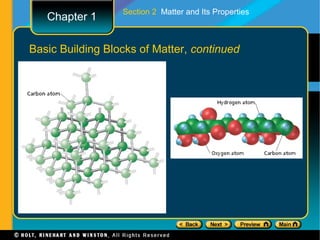
Basic Building Blocks of Matter, continued
Section 2 Matter and Its Properties
   Chapter 1

Properties and Changes in Matter

• Extensive properties depend on the amount of
  matter that is present.

  • volume
  • mass
  • the amount of energy in a substance.
Section 2 Matter and Its Properties
   Chapter 1

Properties and Changes in Matter

• Intensive properties do not depend on the amount of
  matter present.

  • melting point
  • boiling point
  • density
  • ability to conduct electricity
  • ability to transfer energy as heat
Section 2 Matter and Its Properties
    Chapter 1

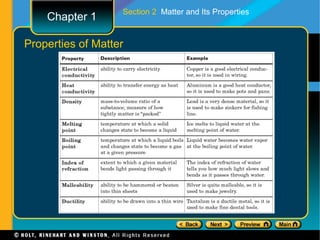
Properties of Matter
Section 2 Matter and Its Properties
    Chapter 1

Properties of Matter
Section 2 Matter and Its Properties
   Chapter 1

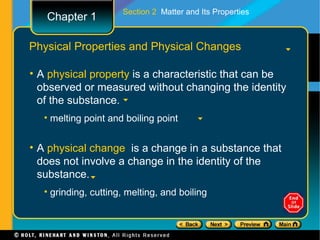
Physical Properties and Physical Changes

• A physical property is a characteristic that can be
  observed or measured without changing the identity
  of the substance.
  • melting point and boiling point


• A physical change is a change in a substance that
  does not involve a change in the identity of the
  substance.
  • grinding, cutting, melting, and boiling
Section 2 Matter and Its Properties
   Chapter 1

Physical Properties and Physical Changes, continued


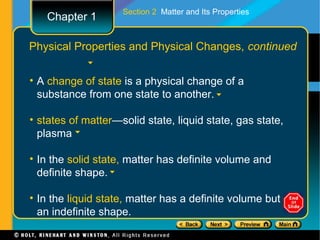
• A change of state is a physical change of a
  substance from one state to another.

• states of matter—solid state, liquid state, gas state,
  plasma

• In the solid state, matter has definite volume and
  definite shape.

• In the liquid state, matter has a definite volume but
  an indefinite shape.
Section 2 Matter and Its Properties
   Chapter 1

Physical Properties and Physical Changes, continued


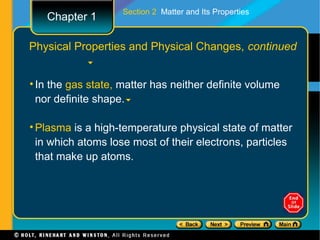
• In the gas state, matter has neither definite volume
  nor definite shape.

• Plasma is a high-temperature physical state of matter
  in which atoms lose most of their electrons, particles
  that make up atoms.
Section 2 Matter and Its Properties
    Chapter 1

Water in Three States
Section 2 Matter and Its Properties
   Chapter 1

Chemical Properties and Chemical Changes

• A chemical property relates to a substance’s ability
  to undergo changes that transform it into different
  substances

• A change in which one or more substances are
  converted into different substances is called a
  chemical change or chemical reaction.
Section 2 Matter and Its Properties
   Chapter 1

Chemical Properties and Chemical Changes, continued


 • The reactants are the substances that react in a
   chemical change.

 • The products are the substances that are formed by
   the chemical change.
      reactants                          product

 Carbon plus oxygen yields (or forms) carbon dioxide.
 carbon    + oxygen                    carbon dioxide
Section 2 Matter and Its Properties
    Chapter 1

Evidence of a Chemical Change
Section 2 Matter and Its Properties
    Chapter 1

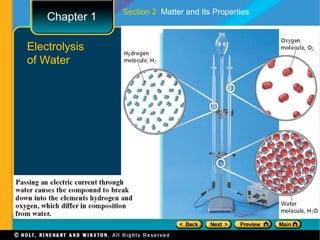
Electrolysis
of Water
Section 2 Matter and Its Properties
    Chapter 1

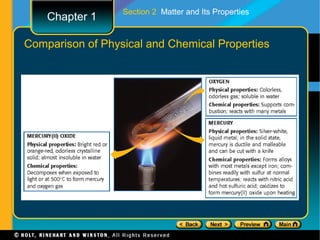
Comparison of Physical and Chemical Properties
Section 2 Matter and Its Properties
   Chapter 1

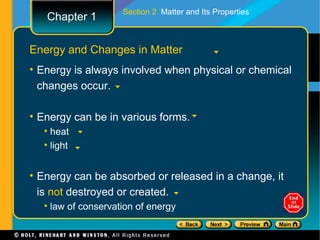
Energy and Changes in Matter
• Energy is always involved when physical or chemical
  changes occur.

• Energy can be in various forms.
  • heat
  • light


• Energy can be absorbed or released in a change, it
  is not destroyed or created.
  • law of conservation of energy
Section 2 Matter and Its Properties
   Chapter 1

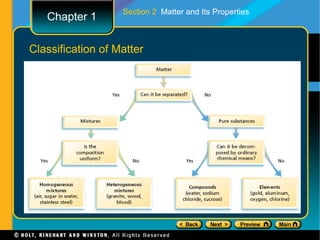
Classification of Matter
Section 2 Matter and Its Properties
    Chapter 1

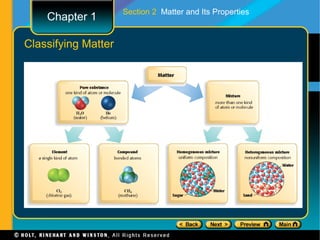
Classifying Matter
Section 2 Matter and Its Properties
   Chapter 1

Classification of Matter

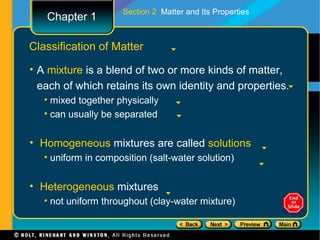
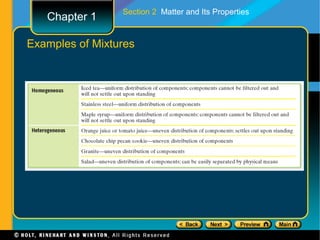
• A mixture is a blend of two or more kinds of matter,
  each of which retains its own identity and properties.
   • mixed together physically
   • can usually be separated


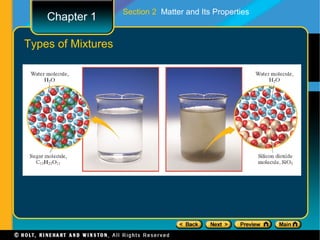
• Homogeneous mixtures are called solutions
   • uniform in composition (salt-water solution)


• Heterogeneous mixtures
   • not uniform throughout (clay-water mixture)
Section 2 Matter and Its Properties
    Chapter 1

Types of Mixtures
Section 2 Matter and Its Properties
    Chapter 1

Pure Substances
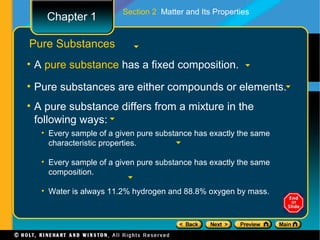
• A pure substance has a fixed composition.

• Pure substances are either compounds or elements.
• A pure substance differs from a mixture in the
  following ways:
   • Every sample of a given pure substance has exactly the same
     characteristic properties.

   • Every sample of a given pure substance has exactly the same
     composition.

   • Water is always 11.2% hydrogen and 88.8% oxygen by mass.
Section 2 Matter and Its Properties
   Chapter 1

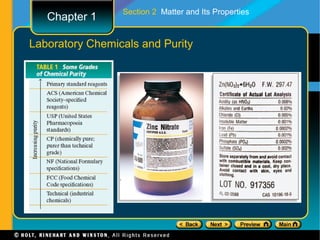
Laboratory Chemicals and Purity
Section 2 Matter and Its Properties
   Chapter 1

Examples of Mixtures

Chemistry Chapter 1 Lesson 2 Powerpoint 2

  • 1.
    Section 2 Matterand Its Properties Chapter 1 Preview • Lesson Starter • Objectives • Matter • Basic Building Blocks of Matter • Properties and Changes in Matter • Properties of Matter • Physical Properties and Physical Changes • Water in Three States • Chemical Properties and Chemical Changes • Evidence of a Chemical Change
  • 2.
    Section 2 Matterand Its Properties Chapter 1 Lesson Starter • Mass of deflated balloon _______________ • Mass of inflated balloon ________________ • The matter in the balloon must have a mass.
  • 3.
    Section 2 Matterand Its Properties Chapter 1 Objectives, continued • Explain how the law of conservation of energy applies to changes of matter. • Distinguish between a mixture and a pure substance.
  • 4.
    Section 2 Matterand Its Properties Chapter 1 Matter • Volume is the amount of three dimensional space an object occupies. • Mass is a measure of the amount of matter. • Matter is anything that has mass and takes up space.
  • 5.
    Section 2 Matterand Its Properties Chapter 1 Basic Building Blocks of Matter • An atom is the smallest unit of an element that maintains the chemical identity of that element. • An element is a pure substance that cannot be broken down into simpler, stable substances and is made of one type of atom. • A compound is a substance that can be broken down into simple stable substances. Each compound is made from the atoms of two or more elements that are chemically bonded.
  • 6.
    Section 2 Matterand Its Properties Chapter 1 Basic Building Blocks of Matter, continued
  • 7.
    Section 2 Matterand Its Properties Chapter 1 Properties and Changes in Matter • Extensive properties depend on the amount of matter that is present. • volume • mass • the amount of energy in a substance.
  • 8.
    Section 2 Matterand Its Properties Chapter 1 Properties and Changes in Matter • Intensive properties do not depend on the amount of matter present. • melting point • boiling point • density • ability to conduct electricity • ability to transfer energy as heat
  • 9.
    Section 2 Matterand Its Properties Chapter 1 Properties of Matter
  • 10.
    Section 2 Matterand Its Properties Chapter 1 Properties of Matter
  • 11.
    Section 2 Matterand Its Properties Chapter 1 Physical Properties and Physical Changes • A physical property is a characteristic that can be observed or measured without changing the identity of the substance. • melting point and boiling point • A physical change is a change in a substance that does not involve a change in the identity of the substance. • grinding, cutting, melting, and boiling
  • 12.
    Section 2 Matterand Its Properties Chapter 1 Physical Properties and Physical Changes, continued • A change of state is a physical change of a substance from one state to another. • states of matter—solid state, liquid state, gas state, plasma • In the solid state, matter has definite volume and definite shape. • In the liquid state, matter has a definite volume but an indefinite shape.
  • 13.
    Section 2 Matterand Its Properties Chapter 1 Physical Properties and Physical Changes, continued • In the gas state, matter has neither definite volume nor definite shape. • Plasma is a high-temperature physical state of matter in which atoms lose most of their electrons, particles that make up atoms.
  • 14.
    Section 2 Matterand Its Properties Chapter 1 Water in Three States
  • 15.
    Section 2 Matterand Its Properties Chapter 1 Chemical Properties and Chemical Changes • A chemical property relates to a substance’s ability to undergo changes that transform it into different substances • A change in which one or more substances are converted into different substances is called a chemical change or chemical reaction.
  • 16.
    Section 2 Matterand Its Properties Chapter 1 Chemical Properties and Chemical Changes, continued • The reactants are the substances that react in a chemical change. • The products are the substances that are formed by the chemical change. reactants product Carbon plus oxygen yields (or forms) carbon dioxide. carbon + oxygen carbon dioxide
  • 17.
    Section 2 Matterand Its Properties Chapter 1 Evidence of a Chemical Change
  • 18.
    Section 2 Matterand Its Properties Chapter 1 Electrolysis of Water
  • 19.
    Section 2 Matterand Its Properties Chapter 1 Comparison of Physical and Chemical Properties
  • 20.
    Section 2 Matterand Its Properties Chapter 1 Energy and Changes in Matter • Energy is always involved when physical or chemical changes occur. • Energy can be in various forms. • heat • light • Energy can be absorbed or released in a change, it is not destroyed or created. • law of conservation of energy
  • 21.
    Section 2 Matterand Its Properties Chapter 1 Classification of Matter
  • 22.
    Section 2 Matterand Its Properties Chapter 1 Classifying Matter
  • 23.
    Section 2 Matterand Its Properties Chapter 1 Classification of Matter • A mixture is a blend of two or more kinds of matter, each of which retains its own identity and properties. • mixed together physically • can usually be separated • Homogeneous mixtures are called solutions • uniform in composition (salt-water solution) • Heterogeneous mixtures • not uniform throughout (clay-water mixture)
  • 24.
    Section 2 Matterand Its Properties Chapter 1 Types of Mixtures
  • 25.
    Section 2 Matterand Its Properties Chapter 1 Pure Substances • A pure substance has a fixed composition. • Pure substances are either compounds or elements. • A pure substance differs from a mixture in the following ways: • Every sample of a given pure substance has exactly the same characteristic properties. • Every sample of a given pure substance has exactly the same composition. • Water is always 11.2% hydrogen and 88.8% oxygen by mass.
  • 26.
    Section 2 Matterand Its Properties Chapter 1 Laboratory Chemicals and Purity
  • 27.
    Section 2 Matterand Its Properties Chapter 1 Examples of Mixtures