Preview

    Section 1 Work

    Section 2 Energy

    Section 3 Conservation of Energy

    Section 4 Power


Mr. Thompson's Physics Class
What do you think?
  
      List five examples of things you have done in the last year that
      you would consider work.
  
      Based on these examples, how do you define work?


Mr. Thompson's Physics Class

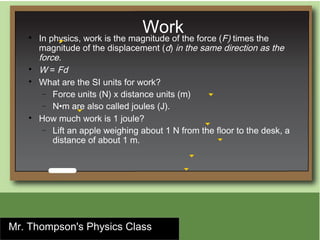
                                 Workthe force (F) times the
       In physics, work is the magnitude of
       magnitude of the displacement (d) in the same direction as the
       force.
   
       W = Fd
   
       What are the SI units for work?
        − Force units (N) x distance units (m)
        − N•m are also called joules (J).
   
       How much work is 1 joule?
        − Lift an apple weighing about 1 N from the floor to the desk, a
           distance of about 1 m.


Mr. Thompson's Physics Class

                                 Workthe force (F) times the
       In physics, work is the magnitude of
       magnitude of the displacement (d) in the same direction as the
       force.
   
       W = Fd
   
       What are the SI units for work?
        − Force units (N) x distance units (m)
        − N•m are also called joules (J).
   
       How much work is 1 joule?
        − Lift an apple weighing about 1 N from the floor to the desk, a
           distance of about 1 m.


Mr. Thompson's Physics Class
Work and Energy                                                                        Section 1


   Work
                                                  • Pushing this car is work because F
                                                    and d are in the same direction.
                                                  • Why aren’t the following tasks
                                                    considered work?
                                                     – A student holds a heavy chair at arm’s
                                                       length for several minutes.
                                                     – A student carries a bucket of water along
                                                       a horizontal path while walking at a
                                                       constant velocity.


Mr. Thompson's Physics Class
 © Houghton Mifflin Harcourt Publishing Company
Work and Energy                                             Section 1
                                                  Work
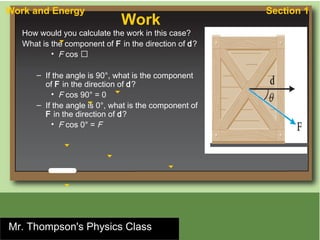
    How would you calculate the work in this case?
    What is the component of F in the direction of d?
            • F cos 

           – If the angle is 90°, what is the component
             of F in the direction of d?
               • F cos 90° = 0
           – If the angle is 0°, what is the component of
             F in the direction of d?
               • F cos 0° = F


Mr. Thompson's Physics Class
 © Houghton Mifflin Harcourt Publishing Company
Work


Mr. Thompson's Physics Class
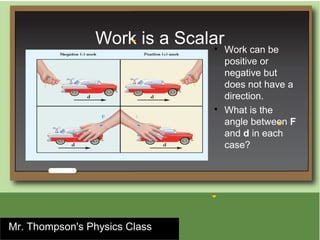
Work is a ScalarWork can be
                                 


                                     positive or
                                     negative but
                                     does not have a
                                     direction.
                                 
                                     What is the
                                     angle between F
                                     and d in each
                                     case?


Mr. Thompson's Physics Class
Classroom Practice Problem
  
      A 20.0 kg suitcase is raised 3.0 m above a
      platform. How much work is done on the
      suitcase?
  
      Answer: 5.9 x 10² J or 590 J


Mr. Thompson's Physics Class
Now what do you think?
  
      Based on the physics definition, list
      five examples of things you have
      done in the last year that you would
      consider work.


Mr. Thompson's Physics Class

Physics Work and Energy

  • 1.
    Preview Section 1 Work Section 2 Energy Section 3 Conservation of Energy Section 4 Power Mr. Thompson's Physics Class
  • 2.
    What do youthink?  List five examples of things you have done in the last year that you would consider work.  Based on these examples, how do you define work? Mr. Thompson's Physics Class
  • 3.
    Workthe force (F) times the In physics, work is the magnitude of magnitude of the displacement (d) in the same direction as the force.  W = Fd  What are the SI units for work? − Force units (N) x distance units (m) − N•m are also called joules (J).  How much work is 1 joule? − Lift an apple weighing about 1 N from the floor to the desk, a distance of about 1 m. Mr. Thompson's Physics Class
  • 4.
    Workthe force (F) times the In physics, work is the magnitude of magnitude of the displacement (d) in the same direction as the force.  W = Fd  What are the SI units for work? − Force units (N) x distance units (m) − N•m are also called joules (J).  How much work is 1 joule? − Lift an apple weighing about 1 N from the floor to the desk, a distance of about 1 m. Mr. Thompson's Physics Class
  • 5.
    Work and Energy Section 1 Work • Pushing this car is work because F and d are in the same direction. • Why aren’t the following tasks considered work? – A student holds a heavy chair at arm’s length for several minutes. – A student carries a bucket of water along a horizontal path while walking at a constant velocity. Mr. Thompson's Physics Class © Houghton Mifflin Harcourt Publishing Company
  • 6.
    Work and Energy Section 1 Work How would you calculate the work in this case? What is the component of F in the direction of d? • F cos  – If the angle is 90°, what is the component of F in the direction of d? • F cos 90° = 0 – If the angle is 0°, what is the component of F in the direction of d? • F cos 0° = F Mr. Thompson's Physics Class © Houghton Mifflin Harcourt Publishing Company
  • 7.
  • 8.
    Work is aScalarWork can be  positive or negative but does not have a direction.  What is the angle between F and d in each case? Mr. Thompson's Physics Class
  • 9.
    Classroom Practice Problem  A 20.0 kg suitcase is raised 3.0 m above a platform. How much work is done on the suitcase?  Answer: 5.9 x 10² J or 590 J Mr. Thompson's Physics Class
  • 10.
    Now what doyou think?  Based on the physics definition, list five examples of things you have done in the last year that you would consider work. Mr. Thompson's Physics Class

Editor's Notes

  • #3 When asking students to express their ideas, you might try one of the following methods. (1) You could ask them to write their answers in their notebook and then discuss them. (2) You could ask them to first write their ideas and then share them with a small group of 3 or 4 students. At that time you can have each group present their consensus idea. This can be facilitated with the use of whiteboards for the groups. The most important aspect of eliciting student’s ideas is the acceptance of all ideas as valid. Do not correct or judge them. You might want to ask questions to help clarify their answers. You do not want to discourage students from thinking about these questions and just waiting for the correct answer from the teacher. Thank them for sharing their ideas. Misconceptions are common and can be dealt with if they are first expressed in writing and orally. Likely answers are: homework, babysitting, jobs, studying physics, and so on. After listening and discussing, let the students know that in physics, the definition of work is much more precise and many things that they consider work will not fit that definition. In physics, work produces a change in energy. Work is defined in terms of force and displacement on the next slide.
  • #4 Units are sometimes confusing. It would be a good idea to show students that 1 J = 1 N•m = 1 kg•m 2 /s 2 at this time. Give them a chance to figure it out for themselves from the definition of a newton ( F = ma ). This is important because they will later learn that kinetic energy and potential energy are measured in joules as well, and the equations lead to kg•m 2 /s 2 . Students need to understand the fundamental SI units behind all of the derived units such as newtons, joules, watts and so on.
  • #5 Units are sometimes confusing. It would be a good idea to show students that 1 J = 1 N•m = 1 kg•m 2 /s 2 at this time. Give them a chance to figure it out for themselves from the definition of a newton ( F = ma ). This is important because they will later learn that kinetic energy and potential energy are measured in joules as well, and the equations lead to kg•m 2 /s 2 . Students need to understand the fundamental SI units behind all of the derived units such as newtons, joules, watts and so on.
  • #6 In the first case, no work is done because the object does not move ( d = 0). In the second case, no work is done because the distance moved is not in the direction of the force (the force is vertically upward while the distance is horizontal). There is no component of the force in the horizontal direction.
  • #7 Discussion of the component of F along the direction of d should lead to the equation on the next slide.
  • #8 Students should already have deduced this equation from the last slide.
  • #9 Show students that the two diagrams on the left show force and distance in opposite directions, while those on the right show force and distance in the same direction. Ask the angle between the force and distance in the top left diagram. It looks like it is roughly 135°. Point out to them that the cos(135°) is a negative number. The angle on the top right is about 45° (cos is +). The angle on the bottom left is about 225° (cos is -). The angle on the bottom right is about 315° (cos is +). For the bottom pictures, it will be harder for students to determine the angle unless they draw the force and distance starting at a common point.
  • #10 Students may use the mass instead of the weight (20.0 kg x 9.81 m/s 2 ). This is a good time to remind them that mass and weight are different although related quantities.
  • #11 Students should now select answers that show a force moving an object in the direction of the force.